
Japan Cold Chain Market (2026-2031)

The Japan Cold Chain Market was valued at $10817.5 Million in 2026 and projected to reach to $17415.2 Million by 2031, representing a compound annual growth rate of 10.0%. Japan's cold chain market is positioned for sustained expansion through 2031, supported by the nation's commitment to food safety excellence and technological advancement in logistics.


| Market Size in | USD 26.32 MN |
| Market Forecast in | |
| CAGR | |
| Forecast Period | |
| Units Considered | Value (USD MN) |
Japan Cold Chain Market Trends and Insights
- Japan's cold chain sector is driven by stringent food safety regulations, rising consumer demand for fresh and frozen products, and the nation's advanced logistics infrastructure.
- Japan's aging population and increasing e-commerce penetration are accelerating adoption of temperature-controlled distribution networks across the food and beverage sector. The cold chain market in Japan is characterized by high technological adoption and investment in automation.
- Japan's pharmaceutical and perishable goods sectors are major contributors to cold chain demand, with particular emphasis on maintaining product integrity during storage and transport.
- Japan's position as a developed economy with sophisticated supply chain networks positions it as a key market within the Asia Pacific region, with sustained growth expected through 2031..
Key Market Statistics
- CAGR (2026-2031) 10.0% CAGR
- Market Size, 2026 ~USD 10817.5 Million
- Forecast, 2031 ~USD 17415.2 Million
- Country Japan
Japan Cold Chain Market Overview
Market Valuation Growth :
Japan's cold chain market is valued at USD 10,817.5 million in 2026 and is projected to reach USD 17,415.2 million by 2031, representing a robust 10% CAGR over the forecast period.
Regulatory Compliance Driver :
Stringent Japanese food safety regulations and compliance standards are compelling businesses to invest in advanced cold chain infrastructure, ensuring product quality and consumer protection across the supply chain.
E-commerce & Logistics Expansion :
Japan's increasing e-commerce penetration and advanced logistics infrastructure are accelerating cold chain adoption, with retailers and food distributors modernizing their temperature-controlled distribution networks.
Demographic & Consumer Trends :
Japan's aging population and rising consumer demand for fresh, frozen, and premium food products are driving sustained investment in cold storage facilities and last-mile delivery solutions.
Japan Cold Chain Market Dynamics
- The market benefits from Japan's mature retail infrastructure, high consumer expectations for product freshness, and regulatory frameworks that mandate temperature-controlled handling.
- E-commerce growth and the rise of online grocery shopping are accelerating cold chain modernization across urban and rural regions. The forecast period will see increased investment in automated cold storage facilities, IoT-enabled temperature monitoring, and last-mile delivery innovations.
- Japan's aging demographic will continue driving demand for convenient, fresh food delivery services.
- Strategic partnerships between logistics providers, retailers, and food manufacturers will enhance supply chain efficiency, positioning Japan as a benchmark for cold chain excellence in Asia-Pacific..
Market Ecosystem
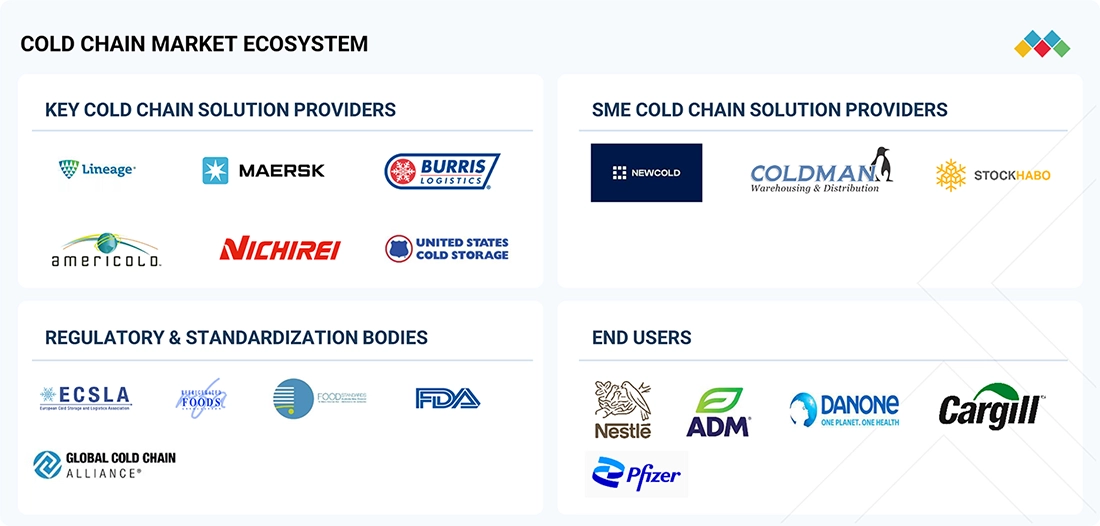
COLD CHAIN MARKET GROWTH & FUTURE TRENDS (2024–2029): COMMERCIAL USE CASES ACROSS INDUSTRIES
| COMPANY | USE CASE DESCRIPTION | BENEFITS |
|---|---|---|
 |
Provides automated cold storage, temperature-controlled warehousing, and integrated food supply chain logistics solutions. | Enhances inventory efficiency, reduces food spoilage, improves supply chain visibility, and supports large-scale cold storage operations. |
 |
Offers refrigerated warehousing, transportation management, and cold chain distribution services for food and pharmaceutical products. | Maintains product quality and safety, ensures regulatory compliance, and enables efficient handling of temperature-sensitive goods. |
 |
Provides end-to-end refrigerated container shipping and integrated cold chain logistics solutions globally. | Supports reliable international transportation of perishables, improves supply chain connectivity, and reduces transit-related product losses. |
 |
Operates temperature-controlled warehouses and frozen food logistics networks across domestic and international markets. | Enables efficient frozen food distribution, improves storage optimization, and supports stable cold chain operations. |
Logos and trademarks shown above are the property of their respective owners. Their use here is for informational and illustrative purposes only.
Related Ecosystem
Fandb Logistics Cold Chain And Packaging
- Rigid Packaging
- Acrylics
- Active Packaging
- Dairy Products
- Gravure Process
- Amcor plc
- Essentra plc
- Basf se
- AZELIS HOLDINGS SA
- Sonoco Products Company
Key Takeaways
- Japan's cold chain market will grow from USD 10,817.5 million in 2026 to USD 17,415.2 million in 2031, representing a 10.0% CAGR.
- Japan's stringent food safety regulations and advanced logistics infrastructure drive cold chain adoption across food and pharmaceutical sectors.
- Japan's e-commerce expansion and aging population are accelerating demand for temperature-controlled distribution networks.
- Japan's technological sophistication and automation investments position it as a leading cold chain market within Asia Pacific.
Cold Chain Market Report Scope
| Report Metric | Details |
|---|---|
| Base Year | 2026 |
| Fastest Growing Segment | PHARMACEUTICALS (Application) |
| Forecast Period | 2026–2031 |
| Growth Rate | CAGR of 10.5% from 2026 to 2031 |
| Largest Segment | FOOD & BEVERAGES (Application) |
| Market Size Base Year (Billions) | ~USD 276.18 (2026) |
| Revenue Forecast (Billions) | ~USD 455 (2031) |
| Segments Covered | Type, Vehicle Type, Application, Application Type, Temperature Type, Refrigerated Transportation, Mode Of Transport, Food & Beverage |
Japan Cold Chain Market Report Segmentation
8 segment dimensions are covered across the global market.
By Type
- Cold Chain Storage & Infrastructure
- Other Types
- Refrigerated Air Transportation
- Refrigerated Rail Transportation
- Refrigerated Road Transportation
- Refrigerated Sea Transportation
- Refrigerated Transportation
By Vehicle Type
- Hcvs
- Lcvs
- Mhcvs
By Application
- Food & Beverages
- Other Applications
- Pharmaceuticals
By Application Type
- Bakery & Confectionery
- Dairy & Frozen Desserts
- Fish, Meat, & Seafood
- Fruits & Vegetables
By Temperature Type
- Chilled
- Deep Frozen
- Frozen
By Refrigerated Transportation
- Refrigerated Air Transportation
- Refrigerated Rail Transportation
- Refrigerated Road Transportation
- Refrigerated Sea Transportation
By Mode Of Transport
- Hcvs
- Lcvs
- Mhcvs
By Food & Beverage
- Bakery & Confectionery
- Dairy & Frozen Desserts
- Fish, Meat, & Seafood
- Fruits & Vegetables
JAPAN: COLD CHAIN MARKET, BY APPLICATION, 2026–2031
| Segment | 2026 | 2027 | 2028 | 2029 | 2030 | 2031 | CAGR (%) |
|---|---|---|---|---|---|---|---|
| FOOD & BEVERAGES | 9109.9 | 9999.8 | 10983.2 | 12085.3 | 13279.8 | 14636.6 | 9.9 |
| OTHER APPLICATIONS | 504 | 549.8 | 600 | 656 | 716.2 | 784.2 | 9.2 |
| PHARMACEUTICALS | 1203.6 | 1329.4 | 1469.2 | 1626.7 | 1798.4 | 1994.3 | 10.6 |
| TOTAL | 10817.5 | 11879 | 13052.5 | 14367.9 | 15794.5 | 17415.2 | 10 |
Target Audience
- Food & Beverage Manufacturers : Manufacturers need Japan-specific cold chain data to optimize distribution networks, ensure regulatory compliance, and meet rising consumer demand for fresh and frozen products in this mature market.
- Logistics & Supply Chain Providers : Logistics companies require detailed market insights to identify expansion opportunities, invest in temperature-controlled infrastructure, and compete effectively in Japan's advanced cold chain ecosystem.
- Retail & E-commerce Operators : Retailers and online grocers need market intelligence to develop cold chain capabilities, enhance last-mile delivery, and capitalize on Japan's growing demand for convenient fresh food delivery services.
- Technology & Equipment Vendors : Providers of cold storage systems, IoT monitoring solutions, and refrigeration equipment need Japan market data to identify customer segments, forecast demand, and tailor product offerings to local requirements.
- Investment & Strategy Consultants : Investors and consultants require comprehensive Japan cold chain analysis to evaluate market entry strategies, assess growth potential, and guide clients through regulatory landscapes and competitive dynamics.
Key Companies in the Japan Cold Chain Market
| Company | HQ | Ownership | Strongest segments |
|---|---|---|---|
| UNILEVER PLC | United Kingdom | Public Company | Beauty & Wellbeing,Personal Care,Home Care, |
| MAREL | Japan | Private Company | Cockpit modules and interior electronics,Climate control systems and compressors,Heat exchangers and cooling modules, |
| AZELIS HOLDINGS SA | Belgium | Private Company | Life Sciences (food, nutrition, pharma, personal and home care),Industrial Specialties (coatings, plastics, lubricants, advanced materials),Other and cross-portfolio services, |
| AMERICOLD LOGISTICS, INC. | United States | Private Company | Public refrigerated warehousing,Plant-attached and dedicated storage,Port facilities and import/export logistics, |
| LINEAGE, INC. | United States | Public Investment Firm | Temperature-controlled warehousing (storage and handling),End-to-end logistics and transportation,Value-added services and technology-enabled solutions, |
| NICHIREI CORPORATION | Japan | Public Company | Processed and Frozen Foods (incl. retort, canned, ice),Logistics (temperature-controlled storage, transport, 3PL),Marine, Meat and Poultry Products, |
| A.P. MOLLER - MAERSK | Denmark | Public Company | Ocean transport (container and specialized ocean services),Logistics & Services (air, inland, warehousing, e-commerce, lead logistics),Terminals and depots, |
| C.H. ROBINSON | United States | Public Company | Truckload Brokerage,Less-than-Truckload and Intermodal,Global Forwarding (Ocean, Air, NVOCC), |
| KUEHNE+NAGEL | Switzerland | Public Company | Sea Logistics,Air Logistics,Road Logistics, |
UNILEVER PLC
Unilever PLC is a United Kingdom-based public company founded in 1860 with 93,732 employees. The company operates as a multinational consumer goods corporation.
MAREL
Marel is a Japan-based private company founded in 1938 with 21,987 employees.
AZELIS HOLDINGS SA
Azelis Holdings SA is a Belgium-based private company founded in 2001 with 1,325 employees.
AMERICOLD LOGISTICS, INC.
Americold Logistics, Inc. is a United States-based private company founded in 1903 with 10,288 employees.
LINEAGE, INC.
Lineage, Inc. is a United States-based public investment firm founded in 2015 with 24,000 employees.
NICHIREI CORPORATION
Nichirei Corporation is a Japan-based public company founded in 1942 with 17,763 employees.
A.P. MOLLER - MAERSK
A.P. Moller - Maersk is a Denmark-based public company founded in 1904 with 100,000 employees.
C.H. ROBINSON
C.H. Robinson is a United States-based public company founded in 1905 with 11,705 employees.
KUEHNE+NAGEL
Kuehne+Nagel is a Switzerland-based public company founded in 1890 with 82,400 employees.
Reasons to Buy this Report
- Market Size & Growth Projections : Access precise valuation data for Japan's cold chain market (USD 10.8B in 2026 to USD 17.4B in 2031) to benchmark investments, identify growth opportunities, and forecast revenue potential in this high-growth segment.
- Regulatory & Compliance Insights : Understand Japan's stringent food safety regulations and compliance requirements that drive cold chain investments, enabling businesses to align operations with local standards and capture regulatory-driven demand.
- E-commerce & Distribution Trends : Gain intelligence on Japan's e-commerce penetration and its impact on cold chain logistics, helping retailers and distributors optimize last-mile delivery strategies and capitalize on online food sales growth.
- Competitive Landscape Analysis : Identify key players, market consolidation trends, and competitive positioning within Japan's cold chain sector to inform partnership strategies, M&A decisions, and market entry planning.
- Technology & Infrastructure Opportunities : Discover investment opportunities in IoT-enabled monitoring, automated cold storage facilities, and logistics innovations tailored to Japan's advanced infrastructure and consumer expectations.
Frequently asked questions
What is the projected size of Japan's cold chain market by 2031?
Japan's cold chain market is projected to reach USD 17,415.2 million by 2031, growing from USD 10,817.5 million in 2026 at a 10.0% CAGR.
What are the primary drivers of cold chain growth in Japan?
Japan's cold chain growth is driven by stringent food safety regulations, rising consumer demand for fresh products, advanced logistics infrastructure, e-commerce expansion, and pharmaceutical sector requirements.
How does Japan's cold chain market compare to other Asia Pacific countries?
Japan's cold chain market is one of the most developed in Asia Pacific, characterized by high technological adoption, sophisticated supply chain networks, and strong regulatory frameworks that exceed regional averages.
Which sectors contribute most to Japan's cold chain demand?
Japan's food and beverage sector, pharmaceutical industry, and e-commerce logistics are the primary contributors to cold chain demand, with emphasis on product integrity and safety compliance.
What role does automation play in Japan's cold chain market?
Automation and advanced technology are critical components of Japan's cold chain infrastructure, enabling efficient temperature control, real-time monitoring, and reduced operational costs across distribution networks.
RESEARCH METHODOLOGY
The study employed two primary approaches to estimate the current size of the cold chain market. Exhaustive secondary research was conducted to gather information on the market, peer markets, and parent markets. The next step was to validate these findings, assumptions, and sizing with industry experts across the value chain through primary research. Both top-down and bottom-up approaches were employed to estimate the complete market size. After that, market breakdown and data triangulation were used to estimate the market size of segments and subsegments.
Secondary Research
This research study involved the extensive use of secondary sources—directories and databases such as Web of Science, Scopus, PubMed, GenBank, EMBL-EBI, and GBIF—to identify and collect information useful for a technical, market-oriented, and commercial study of the market.
In the secondary research process, various sources such as annual reports, press releases & investor presentations of companies, white papers, food journals, certified publications, articles from recognized authors, directories, and databases were referred to identify and collect information.
Secondary research was mainly used to obtain key information about the industry’s supply chain, the total pool of key players, and market classification and segmentation as per the industry trends to the bottom-most level, regional markets, and key developments from both market- and technology-oriented perspectives.
Primary Research
Extensive primary research was conducted after obtaining information regarding the cold chain market scenario through secondary research. Several primary interviews were conducted with market experts from both the demand and supply sides across major countries of North America, Europe, Asia Pacific, South America, and RoW. Primary data was collected through questionnaires, emails, and telephonic interviews. The primary sources from the supply side included various industry experts, such as Chief X Officers (CXOs), Vice Presidents (VPs), Directors from business development, marketing, research, and development teams, and key opinion leaders. Primary interviews were conducted to gather insights such as market statistics, data on revenue collected from the products and services, market breakdowns, market size estimations, market forecasting, and data triangulation. Primary research also helped in understanding the various trends related to cold chain type, technology, application, temperature type, offering and region. Stakeholders from the demand side, such as dairy & frozen desserts, meat & seafood, fruits & vegetables, and bakery & confectionery products, pharmaceutical, chemical, art, flower & plants, electronics, and other temperature sensitive products manufacturers who avail the cold chain services were interviewed to understand the buyer’s perspective on the suppliers, services, and their current usage of cold chain and the outlook of their business which will affect the overall market.
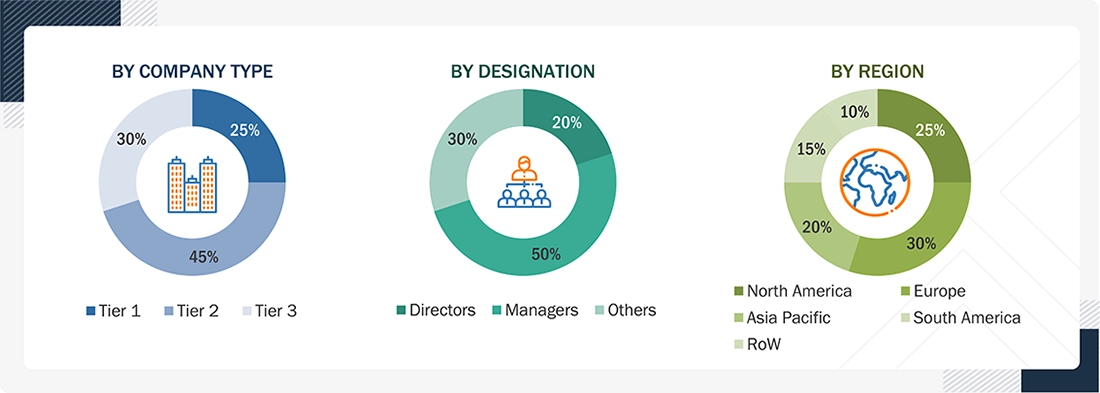
Note: The three tiers of the companies are defined based on their total revenues in 2021 or 2022, as per the availability of financial data: Tier 1: Revenue > USD 1 billion; Tier 2: USD 100 million ≤ Revenue ≤ USD 1 billion; Tier 3: Revenue < USD 100 million.
To know about the assumptions considered for the study, download the pdf brochure
Market Size Estimation
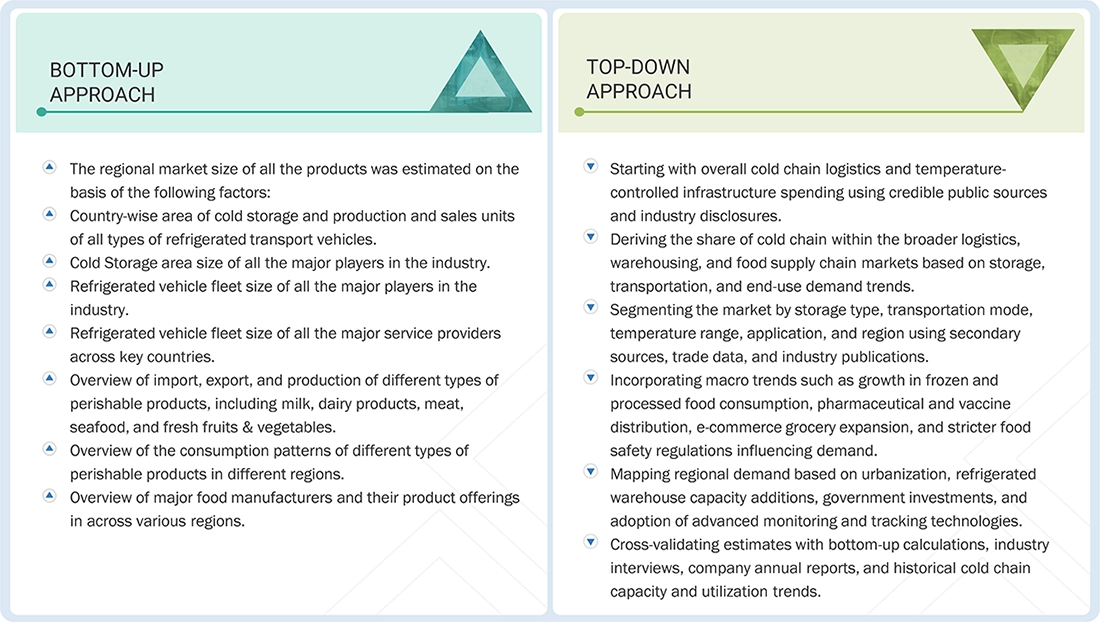
Both the top-down and bottom-up approaches were used to estimate and validate the total size of the cold chain market. These approaches were also used extensively to determine the size of various subsegments in the market. The research methodology used to estimate the market size includes the following details:
The research methodology used to estimate the market size also includes the following details:
- The key players in the industry and the overall markets were identified through extensive secondary research.
- All shares, splits, and breakdowns were determined using secondary sources and verified through primary sources.
- All possible parameters that affect the market covered in this research study were accounted for, viewed in extensive detail, verified through primary research, and analyzed to obtain final quantitative and qualitative data.
- The research included the study of reports, reviews, and newsletters of top market players, along with extensive interviews for opinions from leaders, such as CEOs, directors, and marketing executives.
Cold Chain Market : Top-Down and Bottom-Up Approach
Data Triangulation
After arriving at the overall market size from the estimation process explained above, the total market was split into several segments and subsegments. The data triangulation and market breakdown procedures were employed, wherever applicable, to estimate the overall Environmental DNA market and arrive at the exact statistics for all segments and subsegments. The data was triangulated by studying various factors and trends from the demand and supply sides. The market size was also validated using both the top-down and bottom-up approaches.
Market Definition
Cold chain refers to the transportation of temperature-sensitive products along a supply chain through thermal and refrigerated packaging methods and logistical planning to protect the integrity of these shipments. It is an unbroken/uninterrupted series of refrigerated or chilled production, storage, and distribution activities, along with associated equipment and logistics, which maintain the desired temperature range
Key Stakeholders
- Cold chain service providers
- Refrigerated transport service providers
- Refrigerated warehouse and transport equipment providers
- Refrigerated transport vehicle manufacturers
- Logistics service providers
-
Associations and government agencies:
- International Refrigerated Transport Association (IRTA)
- Global Food Cold Chain Council (GFCCC)
- Global Cold Chain Alliance
- Refrigerated Foods Association (RFA)
- The Refrigerated Warehouse & Transport Association of Australia Ltd (RWTA)
- Southern African Refrigerated Distribution Association (SARDA)
- International Association for Cold Storage Construction (IACSC)
- International Association of Refrigerated Warehouses (IARW)
- World Food Logistics Organization (WFLO)
- European Cold Storage and Logistics Association (ECSLA)
- Cool Chain Association (CCA)
- American Association of Meat Processors (AAMP)
- Frozen Potato Products Institute (FPPI)
- Cold logistics players (shipping lines, transporters, and container companies)
- Supply chain solution providers
- Manufacturers and traders of dairy & frozen desserts, meat & seafood, fruits & vegetables, and bakery & confectionery products
- Manufacturers of agricultural products
- Manufacturers of pharmaceutical products
- Manufacturers of temperature-sensitive flowers & plants
- Manufacturers of temperature-sensitive chemicals, arts, electronics
Report Objectives
- To determine, define, and project the size of the cold chain market based on technology, type, offering, application, temperature type, and region over a five-year period, ranging from 2026 to 2031
- To identify the attractive opportunities in the market by determining the largest and fastest-growing segments across regions
- To provide detailed information about the key factors influencing the growth of the market (drivers, restraints, opportunities, and challenges)
- To analyze the micro markets with respect to individual growth trends, prospects, and their contribution to the total market
- To strategically profile key market players and comprehensively analyze their core competencies in each segment
- To track and analyze competitive developments, such as alliances, joint ventures, new product developments, mergers, and acquisitions, in the cold chain market
Available customizations:
With the given market data, MarketsandMarkets offers customizations according to company-specific scientific needs.
The following customization options are available for the report:
Product Analysis
- Products Matrix, which gives a detailed comparison of the service portfolio of each company.
Geographic Analysis
- Further breakdown of the Rest of European market for cold chain into Ireland, Poland, Sweden, Switzerland and other EU & non-EU countries.
- Further breakdown of the Rest of Asia Pacific market for cold chain into South Korea, Indonesia,, the Philippines, and Vietnam.
- Further breakdown of the Rest of South American market for cold chain into Colombia, Peru, Chile, and Venezuela.
- Further breakdown of the Rest of the World into the Middle East (Saudi Arabia, UAE, and the Rest of Middle East) and Africa (South Africa, Nigeria, and the Rest of Africa).
Company Information
- Detailed analyses and profiling of additional market players (up to five)
Get the Full Cold Chain Market Report
Full forecast, segment splits, and company analysis for all Cold Chain Market.
- US Cold Chain Market
- Canada Cold Chain Market
- Mexico Cold Chain Market
- Germany Cold Chain Market
- France Cold Chain Market
- UK Cold Chain Market
- Italy Cold Chain Market
- Spain Cold Chain Market
- Netherlands Cold Chain Market
- China Cold Chain Market
- India Cold Chain Market
- Brazil Cold Chain Market
- Rest Of Europe Cold Chain Market
Need a Tailored Report?
Customize this report to your needs
Get 10% FREE Customization
Customize This Report
