
US CAM Software Market (2024-2029)

The US CAM Software Market was valued at $1058.7 Million in 2024 and projected to reach to $1429 Million by 2029, representing a compound annual growth rate of 5.1%. The US CAM Software Market is positioned for steady growth through 2029, driven by ongoing digital transformation in manufacturing and increased investment in automation technologies.


| Market Size in | USD 26.32 MN |
| Market Forecast in | |
| CAGR | |
| Forecast Period | |
| Units Considered | Value (USD MN) |
US CAM Software Market Trends and Insights
- The US market reflects steady expansion driven by increased adoption of computer-aided manufacturing solutions across aerospace, automotive, and industrial sectors.
- In 2024, the US represents a significant portion of North American CAM software demand, with manufacturers investing in digital transformation and precision engineering capabilities. By 2029, the US CAM Software Market is expected to experience sustained growth as enterprises prioritize automation, reduce production costs, and enhance design-to-manufacturing workflows.
- The US market benefits from a mature technology infrastructure, skilled workforce, and strong demand from mid-market and enterprise manufacturers.
- Growth in the US is supported by integration of AI-driven features, cloud-based deployment models, and increased focus on supply chain optimization within the manufacturing sector..
Key Market Statistics
- CAGR (2024-2029) 5.1% CAGR
- Market Size, 2024 ~USD 1058.7 Million
- Forecast, 2029 ~USD 1429 Million
- Country US
US CAM Software Market Overview
Market Valuation :
The US CAM Software Market is valued at $1,058.7 million in 2024, with projected growth to $1,429.0 million by 2029, demonstrating strong market maturity and expansion potential in North America.
Growth Trajectory :
The US market is experiencing a CAGR of 5.1% through 2029, reflecting steady adoption of computer-aided manufacturing solutions across key industrial verticals including aerospace, automotive, and advanced manufacturing sectors.
Sector Drivers :
Aerospace, automotive, and industrial manufacturing sectors are primary growth catalysts in the US, driven by increased demand for precision engineering, digital transformation initiatives, and competitive manufacturing requirements.
Market Position :
The US represents a significant portion of the global CAM software market, with established infrastructure, high technology adoption rates, and mature manufacturing ecosystems supporting continued market expansion.
US CAM Software Market Dynamics
- Key sectors including aerospace and automotive are accelerating adoption of advanced CAM solutions to enhance productivity, reduce production costs, and maintain competitive advantage in global markets.
- The 5.1% CAGR reflects a mature market with consistent demand from established manufacturers seeking to modernize legacy systems and optimize production workflows. Looking ahead, the US market will benefit from growing emphasis on Industry 4.0 initiatives, integration of AI and machine learning capabilities into CAM platforms, and increased focus on sustainable manufacturing practices.
- Small and medium-sized enterprises are expected to drive incremental growth as CAM solutions become more accessible and affordable, while large manufacturers continue to invest in advanced features and cloud-based deployment options..
Market Ecosystem
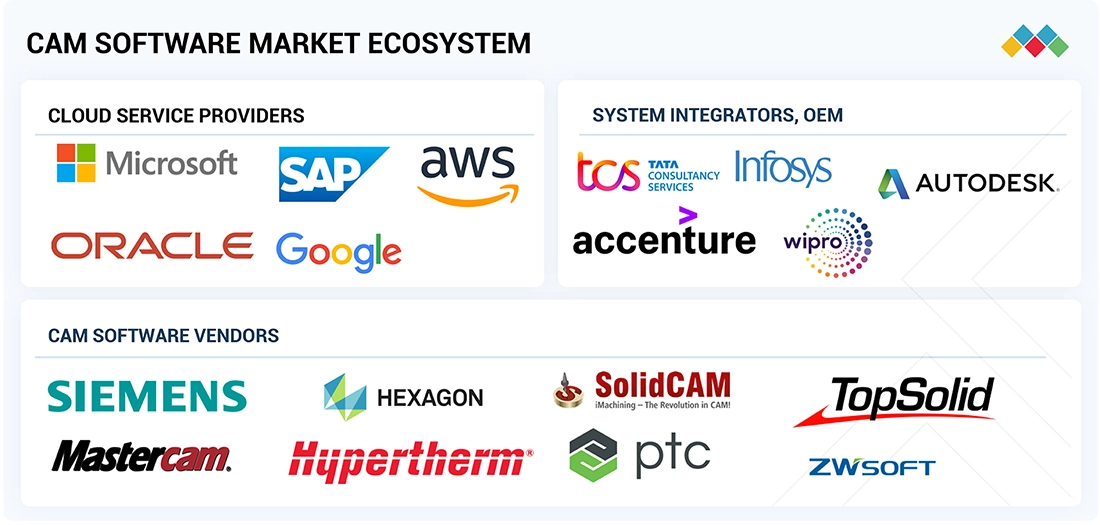
Computer Aided Manufacturing Market: COMMERCIAL USE CASES ACROSS INDUSTRIES
| COMPANY | USE CASE DESCRIPTION | BENEFITS |
|---|---|---|
 |
Western Saw developed the WSX-1 using SolidWorks and CAMWorks to enable precise, safe, and efficient corner cuts, while streamlining design and prototyping to cut development time. | Achieve high-precision cuts while preserving structural integrity Reduce manual handling, improving worker safety Cut development timelines significantly (e.g., prototype in 6 months) Deliver cost-effective alternatives to specialized tools Improve installation speed and operational throughput |
 |
Edwards implemented the 3DEXPERIENCE platform to centralize data, streamline product development, and improve collaboration, enabling secure sharing and customized vacuum pump solutions for the life sciences industry. | Centralize engineering data and streamline cross-functional collaboration Accelerate design iterations and enable virtual testing Improve project visibility and resource planning Reduce delays and enhance team communication Support sustainable innovation in high-performance components |
 |
Decathlon utilized Autodesk’s generative design technology to develop a lighter, more sustainable diving fin, reducing material usage and environmental impact while ensuring superior performance and durability. | Reduced material usage and carbon footprint by 50% Created lighter, recyclable products with high durability Maintained performance standards while enhancing user comfort Used single-material recycled plastic for easier end-of-life processing |
 |
Brasseler, a leading German medical technology company, implemented PTC’s Creo NC to enhance the design and manufacturing of precision dental tools through advanced 3D modeling, automation, and integrated workflows. | Cut design time from hours to minutes Improved machine utilization and shop floor productivity Accelerated product launch cycles Increased design precision and manufacturing quality |
Logos and trademarks shown above are the property of their respective owners. Their use here is for informational and illustrative purposes only.
Related Ecosystem
Software And Services
- Natural Language Processing (NLP)
- Machine Learning
- Supply Chain Management
- Predictive Analytics
- Image Sensors
- International Business Machines Corporation
- MICROSOFT CORPORATION
- Oracle Corporation
- SAP SE
- Amazon.com, Inc.
Key Takeaways
- The US CAM Software Market is valued at $1,058.7 million in 2024 and will reach $1,429.0 million by 2029 at a 5.1% CAGR.
- The US market is driven by digital transformation initiatives and automation investments across aerospace, automotive, and industrial manufacturing sectors.
- Cloud-based CAM solutions and AI-integrated tools are accelerating adoption rates in the US market.
- The US benefits from mature infrastructure and skilled workforce, positioning it as a stable growth market within North America.
CAM Software Market Report Scope
| Report Metric | Details |
|---|---|
| Base Year | 2024 |
| Fastest Growing Segment | TRAINING, SUPPORT, AND MAINTENANCE (Service) |
| Forecast Period | 2024-2029 |
| Growth Rate | CAGR of 9% from 2024 to 2029 |
| Largest Segment | SOFTWARE (Component) |
| Market Size Base Year (Billions) | ~USD 3.39 (2024) |
| Revenue Forecast (Billions) | ~USD 5.69 (2029) |
| Segments Covered | Offering, Software, Service, Application, Product Design & Prototyping, Machining & Production, Capability, Deployment Mode, Organization Size, Vertical, Component, Service Type, Software Type |
US CAM Software Market Report Segmentation
13 segment dimensions are covered across the global market.
By Offering
- Professional Services
- Services
- Software
By Software
- Cad-Embedded Cam
- Cad-Embedded Cam Software
- Independent Cam
- Independent Cam Software
By Service
- Consulting
- Implementation & Integration
- Training, Support & Maintenance
- Training, Support, And Maintenance
By Application
- Automotive & Vehicle Simulation
- Engineering, Research, Modeling, And Simulated Testing
- Gamification, Vr, Ar, And Immersive Experience
- Healthcare & Medical Device Simulation
- Machining & Production
- Manufacturing & Process Optimization
- Other Applications
- Product & Prototyping
- Product Design & Prototyping
- Quality Control & Inspection
- Supply Chain, Logistics Management, And Transportation
- Urban Planning
By Product Design & Prototyping
- 3D Printing/Additive Manufacturing
- Simulation
- Tool & Die Manufacturing
By Machining & Production
- Cnc Machining
- Sheet Metal Fabrication
By Capability
- 2D
- 3D
- Multi-Axis
By Deployment Mode
- Cloud
- On-Premises
By Organization Size
- Large Enterprises
- Medium Enterprises
- Smes
By Vertical
- Aerospace
- Aerospace & Defense
- Aerospace And Defense
- Automotive
- Automotive And Transportation
- Chemical
- Chemicals
- Construction
- Electrical & Electronics
- Electronics & Semiconductors
- Energy & Power
- Energy And Utilities
- Food & Beverages
- Gaming
- Healthcare & Pharmaceuticals
- Healthcare And Life Sciences
- Heavy Machinery
- Industrial Machinery And Heavy Equipment
- Medical Devices & Pharmaceuticals
- Metal & Mining
- Oil & Gas
- Oil, Gas, And Mining
- Other Verticals
- Others*
- Pulp & Paper
- Retail And Consumer Goods
- Semiconductor & Electronics
- Semiconductor And Electronics
- Shipbuilding & Marine Engineering
By Component
- Services
- Software
By Service Type
- Managed Services
- Professional Services
By Software Type
- Cad Simulation Software
- Cfd
- Electromagnetic Simulation Software
- Electronic Simulation Software
- Fea
- Gaming, Ar, Vr, And Training Simulation Software
- Healthcare & Epidemiological Simulation Software
- Manufacturing Simulation Software
- Other Software Types
- Physics & Multiphysics Simulation Software
- Process Simulation Software
Target Audience
- CAM Software Vendors : Vendors need detailed US market insights to develop localized strategies, identify growth opportunities in aerospace and automotive sectors, and benchmark performance against regional competitors and market trends.
- Manufacturing Companies : US manufacturers require market intelligence to evaluate CAM software solutions, understand adoption trends within their industry, and make informed technology investment decisions to enhance operational efficiency.
- Investment & Private Equity Firms : Investors need comprehensive US market data to identify acquisition targets, assess growth potential in the CAM software sector, and evaluate investment returns based on market size and CAGR projections.
- Technology Consultants : Consultants advising manufacturing clients require detailed US market analysis to recommend appropriate CAM solutions, understand sector-specific requirements, and guide digital transformation initiatives aligned with market trends.
- Industry Analysts & Researchers : Analysts need granular US market data to produce accurate reports, track market evolution, identify emerging opportunities, and provide stakeholders with credible insights on the CAM software sector's trajectory.
Reasons to Buy this Report
- Market Size & Growth Data : Access precise valuation metrics for the US CAM Software Market with detailed historical data from 2024 and forecasts through 2029, enabling accurate business planning and investment decisions specific to the North American market.
- Sector-Specific Insights : Gain deep understanding of CAM adoption patterns across US aerospace, automotive, and industrial manufacturing sectors, identifying high-growth opportunities and sector-specific demand drivers for targeted market entry strategies.
- Competitive Landscape Analysis : Understand the competitive dynamics within the US CAM software market, including key players, market share distribution, and differentiation strategies essential for positioning products and services effectively.
- Technology Adoption Trends : Identify emerging technology trends specific to the US market, including cloud-based CAM solutions, AI integration, and Industry 4.0 adoption rates, helping stakeholders align product development with market demands.
- Strategic Investment Guidance : Make informed investment and expansion decisions based on comprehensive US market analysis, growth projections, and regional economic factors affecting the CAM software sector through 2029.
Frequently asked questions
What is the current size of the US CAM Software Market in 2024?
The US CAM Software Market is valued at $1,058.7 million in 2024, representing a significant segment of the North American manufacturing technology landscape.
What is the projected size of the US CAM Software Market by 2029?
The US CAM Software Market is projected to reach $1,429.0 million by 2029, reflecting a 5.1% compound annual growth rate over the forecast period.
What is driving growth in the US CAM Software Market?
Growth in the US market is driven by digital transformation initiatives, automation investments, cloud-based deployment adoption, and AI-integrated manufacturing solutions across key industries.
Which industries are the primary adopters of CAM software in the US?
The US aerospace, automotive, and industrial manufacturing sectors are the primary adopters of CAM software, leveraging these tools for precision engineering and production optimization.
How does the US CAM Software Market compare to global trends?
The US market grows at 5.1% CAGR, reflecting a more moderate pace than the global market's 9% CAGR, indicating a mature but stable market with consistent enterprise investment.
RESEARCH METHODOLOGY
The study comprised four main activities to estimate the computer-aided manufacturing market size. We conducted significant secondary research to gather data on the market, the competing market, and the parent market. The following stage involved conducting primary research to confirm these conclusions and hypotheses and sizing with industry experts throughout the value chain. The overall market size was evaluated using a blend of top-down and bottom-up approach methodologies. After that, we estimated the market sizes of the various computer-aided manufacturing market segments using the market breakup and data triangulation techniques.
Secondary Research
The market size of companies offering CAM tools was arrived at based on secondary data available through paid and unpaid sources, as well as by analyzing the product portfolios of major companies in the ecosystem and rating the companies based on their product capabilities and business strategies.
In the secondary research process, various sources were referred to identify and collect information for the study. The secondary sources included annual reports, press releases, investor presentations of companies, product data sheets, white papers, journals, certified publications, articles from recognized authors, government websites, directories, and databases.
Secondary research was mainly used to obtain essential information about the industry's supply chain, the total pool of key players, market classification and segmentation according to industry trends to the bottom-most level, regional markets, and key developments from both market- and technology-oriented perspectives, all of which were further validated by primary sources.
Primary Research
In the primary research process, various sources from the supply and demand sides were interviewed to obtain qualitative and quantitative information for this report. The primary sources from the supply side included industry experts, such as chief executive officers (CEOs), vice presidents (VPs), marketing directors, technology and innovation directors, and related key executives from various companies and organizations operating in the CAM market.
Primary interviews were conducted to gather insights, such as market statistics, the latest trends disrupting the market, new use cases implemented, data on revenue collected from products and services, market breakups, market size estimations, market forecasts, and data triangulation. Primary research also helped me understand various technologies-related trends, segmentation types, industry trends, and regions. Demand-side stakeholders, such as Chief Information Officers (CIOs), Chief Technology Officers (CTOs), Chief Security Officers (CSOs), the installation teams of governments/end users using Modular Data Centers, and digital initiatives project teams, were interviewed to understand the buyer's perspective on suppliers, products, service providers, and their current use of services, which would affect the overall CAM market.
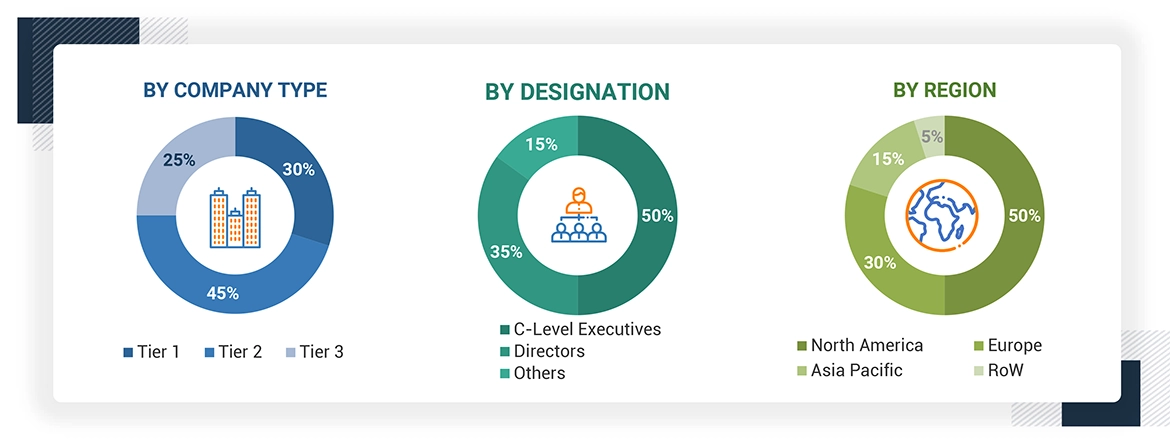
Note 1: Tier 1 companies have revenues greater than USD 10 billion; tier 2 companies' revenues range
between USD 1 and 10 billion; and tier 3 companies' revenues range between USD 500 million and 1 billion
Note 2: Others include sales, marketing, and product managers.
Source: Secondary Literature, Interviews with Experts, and MarketsandMarkets Analysis
To know about the assumptions considered for the study, download the pdf brochure
Market Size Estimation
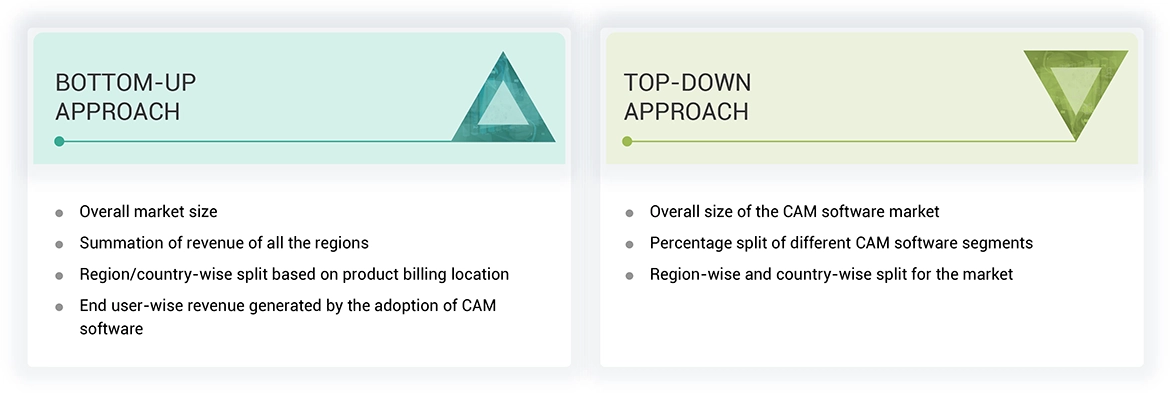
The computer-aided manufacturing and related submarkets were estimated and forecasted using top-down and bottom-up methodologies. We used the bottom-up method to determine the market's overall size, using the revenues and product offerings of the major market players. This research ascertained and validated the precise value of the total parent market size through data triangulation techniques and primary interview validation. Next, using percentage splits of the market segments, we utilized the overall market size in the top-down approach to estimate the size of other individual markets.
The research methodology used to estimate the market size included the following:
- We used primary and secondary research to determine the revenue contributions of the major market participants in each country after secondary research helped identify them.
- Throughout the process, we obtained critical insights by conducting in-depth interviews with industry professionals, including directors, CEOs, VPs, and marketing executives, and by reading the annual and financial reports of the top firms in the market.
- We used primary sources to verify all percentage splits and breakups, which we calculated using secondary sources.
CAM Software Market : Top-Down and Bottom-Up Approach
Data Triangulation
Once the overall market size was determined, we divided the market into segments and subsegments using the previously described market size estimation procedures. When required, market breakdown and data triangulation procedures were employed to complete the market engineering process and specify the exact figures for every market segment and subsegment. The data was triangulated by examining several variables and patterns from government entities' supply and demand sides.
Market Definition
Considering the views of various sources and associations, MarketsandMarkets defines Computer-aided manufacturing as "computer software used to automate the generation of machine tool instructions for manufacturing parts. CAM software typically produces precise, detailed instructions—commonly G-code—that direct computer numerical control (CNC) machines, such as lathes, mills, and routers, to produce highly accurate and efficient components. CAM supports end-to-end product designing & prototyping, machining & production, and quality control & inspection."
Stakeholders
- Cloud Service Providers (CSPs)
- CAM Software Vendors
- Machine Tool and CNC Equipment Manufacturers
- System Integrators and Resellers
- Technology Partners
- Government Agencies & Regulatory Bodies
- Manufacturing Companies
Report Objectives
- To define, describe, and forecast the Computer-aided manufacturing (CAM) market based on offering, application, organization size, capability, deployment mode, vertical, and region
- To forecast the market size of the five major regional segments: North America, Europe, Asia Pacific, Middle East & Africa, and Latin America
- To strategically analyze the market subsegments concerning individual growth trends, prospects, and contributions to the total market
- To provide detailed information related to the significant factors influencing the growth of the market (drivers, restraints, opportunities, and challenges)
- To strategically analyze macro and micro markets for growth trends, prospects, and their contribution to the overall market
- To analyze industry trends, patents and innovations, and pricing data related to the market
- To analyze the opportunities in the market for stakeholders and provide details of the competitive landscape for major players.
- To profile key players in the market and comprehensively analyze their market share/ranking and core competencies.
- To track and analyze competitive developments, such as mergers & acquisitions, product developments, and partnerships & collaborations in the market.
Available Customizations
MarketsandMarkets provides customizations based on the company's unique requirements using market data. The following customization options are available for the report:
Product Analysis
- The product matrix provides a detailed comparison of each company's portfolio.
Geographic Analysis as per Feasibility
- Further breakup of the computer-aided manufacturing market
Company Information
- Detailed analysis and profiling of five additional market players
Get the Full CAM Software Market Report
Full forecast, segment splits, and company analysis for all CAM Software Market.
- Canada CAM Software Market
- UK CAM Software Market
- Germany CAM Software Market
- France CAM Software Market
- Italy CAM Software Market
- China CAM Software Market
- Japan CAM Software Market
- India CAM Software Market
- South Africa CAM Software Market
- Brazil CAM Software Market
- Mexico CAM Software Market
- Rest Of Europe CAM Software Market
- Rest Of Asia Pacific CAM Software Market
- Rest Of Latin America CAM Software Market
- GCC Countries CAM Software Market
- Ksa CAM Software Market
- Rest Of GCC Countries CAM Software Market
- UAE CAM Software Market
Need a Tailored Report?
Customize this report to your needs
Get 10% FREE Customization
Customize This Report
