
India Computer Vision in Healthcare Market (2025-2030)

The India Computer Vision in Healthcare Market was valued at $121.8 Million in 2025 and projected to reach to $385 Million by 2030, representing a compound annual growth rate of CAGR 25.9%. India's computer vision in healthcare market is poised for exceptional growth, driven by the country's digital health infrastructure expansion and increasing adoption of AI-powered diagnostic solutions.


| Market Size in | USD 26.32 MN |
| Market Forecast in | |
| CAGR | |
| Forecast Period | |
| Units Considered | Value (USD MN) |
India Computer Vision in Healthcare Market Trends and Insights
- This growth trajectory reflects India's increasing adoption of AI-driven diagnostic tools, medical imaging analysis, and automated clinical workflows across hospitals and diagnostic centers.
- India's healthcare sector is leveraging computer vision technology to address physician shortages, improve diagnostic accuracy, and enhance patient outcomes in both urban and emerging markets. The 25.9% compound annual growth rate (CAGR) positions India as a high-growth market within the Asia Pacific region.
- India's competitive advantage stems from its large patient population, cost-effective implementation models, and growing investments in healthcare infrastructure and digital health initiatives.
- Between 2025 and 2030, India is expected to see significant deployment of computer vision solutions in pathology, radiology, ophthalmology, and surgical applications, driven by government healthcare digitalization programs and private sector innovation..
Key Market Statistics
- CAGR (2025-2030) CAGR 25.9%
- Market Size, 2025 ~USD 121.8 Million
- Forecast, 2030 ~USD 385 Million
- Country India
India Computer Vision in Healthcare Market Overview
Market Valuation Growth :
India's computer vision in healthcare market is valued at $121.8 million in 2025, with a robust CAGR of 25.9%, significantly outpacing the global average of 24.3%, demonstrating India's accelerated digital health transformation.
Diagnostic Innovation Adoption :
Indian hospitals and diagnostic centers are rapidly implementing AI-driven diagnostic tools and medical imaging analysis solutions, leveraging computer vision to enhance accuracy, reduce turnaround times, and improve patient outcomes across urban and emerging healthcare facilities.
Automation in Clinical Workflows :
Automated clinical workflows powered by computer vision technology are streamlining operations across Indian healthcare institutions, reducing manual errors, optimizing resource allocation, and enabling healthcare providers to handle increasing patient volumes efficiently.
Projected Market Expansion :
The market is forecasted to reach $385.0 million by 2030, representing a 216% growth over five years, driven by increasing healthcare digitalization, government initiatives supporting AI adoption, and rising demand for advanced diagnostic capabilities in India's expanding healthcare sector.
India Computer Vision in Healthcare Market Dynamics
- The 25.9% CAGR reflects strong momentum as Indian healthcare providers invest in computer vision technologies to address diagnostic challenges, improve clinical efficiency, and enhance patient care quality across metropolitan and tier-2 cities. Government initiatives promoting healthcare digitalization, coupled with rising healthcare expenditure and a growing pool of tech-savvy medical professionals, are accelerating market penetration.
- The convergence of affordable computing solutions, cloud-based platforms, and increasing awareness of AI benefits positions India as a high-growth market.
- By 2030, computer vision will become integral to India's healthcare ecosystem, supporting preventive care, early disease detection, and personalized treatment approaches across diverse healthcare settings..
Market Ecosystem
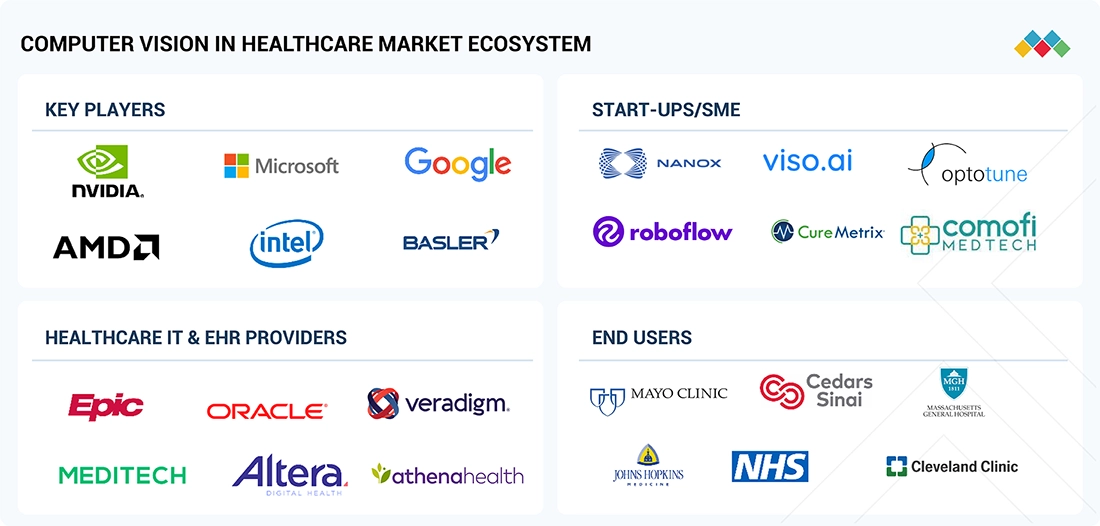
Computer Vision in Healthcare Market: COMMERCIAL USE CASES ACROSS INDUSTRIES
| COMPANY | USE CASE DESCRIPTION | BENEFITS |
|---|---|---|
 |
Intel processors accelerate AI-driven medical imaging and diagnostic workflows in healthcare applications. | Enhances imaging accuracy, reduces processing time, boosts AI performance up to 4×, and supports faster, precise clinical decision-making. |
 |
Microsoft Azure AI Vision enables cloud-based medical imaging analysis for enhanced healthcare workflows. | Improves diagnostic accuracy, accelerates image processing, streamlines clinical workflows, and supports better patient care outcomes efficiently. |
 |
NVIDIA Clara, BioNeMo, and GPUs provide AI-driven medical imaging analysis, pathology interpretation, and generative drug discovery model deployment. | Enhances diagnostic accuracy, accelerates imaging workflows, enables personalized treatment, reduces drug development timelines, and efficiently deploys AI models for healthcare and biopharma research. |
 |
Google Cloud Vision API and Document AI extract and analyze medical images and healthcare documents efficiently. | Enhances diagnostic accuracy, automates data processing, streamlines clinical workflows, ensures data compliance, and improves overall patient care quality. |
 |
AMD FPGAs and adaptive SoCs enable high-performance medical imaging, diagnostics, and surgical machine vision. | Improves image processing speed, enhances diagnostic accuracy, supports real-time surgical guidance, and enables advanced healthcare automation efficiently. |
Logos and trademarks shown above are the property of their respective owners. Their use here is for informational and illustrative purposes only.
Related Ecosystem
Healthcare It
- Computed Tomography (CT)
- Machine Learning
- Magnetic Resonance Imaging (MRI)
- Natural Language Processing (NLP)
- Predictive Analytics
- CERNER CORPORATION
- PHILIPS HEALTHCARE
- Oracle Corporation
- GE HealthCare Technologies Inc.
- Siemens healthineers
Key Takeaways
- India's computer vision healthcare market is valued at $121.8M in 2025 and will grow to $385.0M by 2030, representing a 25.9% CAGR.
- India's large patient population and physician shortage create strong demand for AI-powered diagnostic and imaging solutions.
- Government digital health initiatives and private sector innovation are accelerating computer vision adoption across India's healthcare ecosystem.
- India is positioned as a high-growth market in Asia Pacific, with applications expanding across radiology, pathology, ophthalmology, and surgical domains.
Computer Vision in Healthcare Market Report Scope
| Report Metric | Details |
|---|---|
| Base Year | 2025 |
| Fastest Growing Segment | SERVICES (Product & Service) |
| Forecast Period | 2025–2030 |
| Growth Rate | CAGR of 24.3% from 2025 to 2030 |
| Largest Segment | HEALTHCARE PROVIDERS (End User) |
| Market Size Base Year (Billions) | ~USD 4.85 (2025) |
| Revenue Forecast (Billions) | ~USD 14.39 (2030) |
| Segments Covered | Product & Service, Type, Application, End User |
India Computer Vision in Healthcare Market Report Segmentation
4 segment dimensions are covered across the global market.
By Product & Service
- Hardware
- Services
- Software
By Type
- Asics
- Cloud-Based Solutions
- Cpus
- Fpgas
- Gpus
- Inventory Management
- Memory Devices
- Networks
- On-Premise Solutions
- Patient Activity Monitoring/Fall Prevention
- Patient/Provider Tracking
- Pc-Based Computer Vision Systems
- Processors
- Scheduling Optimization
- Smart Camera-Based Computer Vision Systems
- Vpus
By Application
- Hospital Management
- Medical Imaging & Diagnostics
- Other Applications
- Surgeries
By End User
- Diagnostic Centers
- Healthcare Providers
- Other End Users
INDIA: COMPUTER VISION IN HEALTHCARE MARKET, BY END USER, 2023–2030
| Segment | 2023 | 2024 | 2025 | 2026 | 2027 | 2028 | 2030 | CAGR (%) |
|---|---|---|---|---|---|---|---|---|
| DIAGNOSTIC CENTERS | 21.9 | 27 | 33.4 | 41.3 | 51.1 | 63.4 | 98 | 24.1 |
| HEALTHCARE PROVIDERS | 102.3 | 128.6 | 162 | 204.2 | 257.9 | 326.2 | 517.3 | 26.1 |
| OTHER END USERS | 9.9 | 11.7 | 13.8 | 16.3 | 19.3 | 22.8 | 32.2 | 18.5 |
| TOTAL | 134.2 | 167.4 | 209.1 | 261.8 | 328.3 | 412.4 | 647.5 | 25.4 |
Target Audience
- Healthcare Technology Investors : Investment firms and venture capitalists seeking high-growth opportunities in India's digital health sector need detailed market sizing, growth projections, and investment landscape analysis to identify promising computer vision healthcare startups and expansion opportunities.
- Medical Device & Software Companies : Established and emerging healthcare technology providers require India-specific market data to evaluate market entry feasibility, competitive positioning, pricing strategies, and customer acquisition approaches for computer vision diagnostic solutions.
- Hospital & Diagnostic Center Operators : Healthcare facility administrators and procurement teams need market insights to understand technology trends, vendor options, ROI potential, and implementation best practices for integrating computer vision solutions into their diagnostic and clinical operations.
- Government & Healthcare Policy Bodies : Indian healthcare regulators, government agencies, and policy makers require market intelligence to inform digital health initiatives, technology adoption roadmaps, and regulatory frameworks supporting computer vision integration in the healthcare sector.
- Consulting & Strategy Firms : Management consultants and strategy advisors serving healthcare clients need comprehensive India market data to develop client recommendations, competitive strategies, and market entry plans for computer vision healthcare solutions and services.
Key Companies in the India Computer Vision in Healthcare Market
| Company | HQ | Ownership | Strongest segments |
|---|---|---|---|
| CYIENT | India | Public Company | Software,Services,Processors, |
| NVIDIA CORPORATION | United States | Public Company | Processors,Software,Memory Devices, |
| INTEL CORPORATION | United States | Public Company | Processors,Software,Memory Devices, |
| MICROSOFT | United States | Public Company | Software,Services,Processors, |
| ADVANCED MICRO DEVICES, INC. | United States | Public Company | Processors,Software,Memory Devices, |
| United States | Public Company | Software (AI platforms, analytics, imaging and hospital management workloads),Services (cloud consumption, implementation, support, and managed AI ops),Processors (AI infrastructure, TPUs, GPUs consumed via Google Cloud), | |
| BASLER AG | United States | Public Company | Processors,Software,Memory Devices, |
| ICAD, INC. | France | Public Investment Firm | Processors,Software,Memory Devices, |
| THERMO FISHER SCIENTIFIC INC. | United States | Public Company | Processors,Software,Memory Devices, |
| SENSETIME | China | Public Company | Software (SenseCare, SenseFoundry modules),Services (AI data center, integration, support),Smart Cameras and Embedded Hardware, |
| KEYENCE CORPORATION | Japan | Public Company | Processors,Software,Memory Devices, |
CYIENT
CYIENT is an Indian public company founded in 1991 that employs 12,049 people. The company operates as a technology and engineering services provider serving global markets.
NVIDIA CORPORATION
NVIDIA Corporation is a United States-based public company founded in 1993 with 42,000 employees. The company designs and manufactures graphics processing units and system-on-chip units.
INTEL CORPORATION
Intel Corporation is a United States-based public company founded in 1968 with 85,100 employees. The company is a leading manufacturer of semiconductor processors and computing technologies.
MICROSOFT
Microsoft is a United States-based public company founded in 1975 with 228,000 employees. The company develops, manufactures, and sells computer software, hardware, and cloud computing services.
ADVANCED MICRO DEVICES, INC.
Advanced Micro Devices, Inc. is a United States-based public company founded in 1969 with 31,000 employees. The company designs and manufactures semiconductor processors and graphics processing units.
Google is a United States-based public company founded in 1998 with 194,668 employees. The company operates as a technology conglomerate providing search, advertising, cloud computing, and software services.
BASLER AG
Basler AG is a United States-based public company founded in 1988 with 836 employees. The company manufactures and distributes industrial cameras and imaging solutions.
ICAD, INC.
ICAD, Inc. is a France-based public investment firm founded in 1954 with 981 employees. The company operates in the technology and investment sectors.
THERMO FISHER SCIENTIFIC INC.
Thermo Fisher Scientific Inc. is a United States-based public company founded in 1956 with 125,000 employees. The company provides laboratory equipment, reagents, and analytical instruments for scientific research and diagnostics.
SENSETIME
SenseTime is a China-based public company founded in 2014 with 2,472 employees. The company specializes in artificial intelligence and computer vision technologies.
KEYENCE CORPORATION
Keyence Corporation is a Japan-based public company founded in 1972 with 12,784 employees. The company manufactures and sells automation sensors, measurement systems, and related equipment.
Reasons to Buy this Report
- Market Size & Growth Validation : Obtain precise valuation data for India's computer vision healthcare market ($121.8M in 2025) with verified CAGR of 25.9%, enabling accurate financial forecasting, investment planning, and competitive benchmarking specific to the Indian market landscape.
- India-Specific Growth Drivers : Understand localized factors accelerating adoption including government digital health initiatives, hospital modernization trends, diagnostic center expansion, and India's unique healthcare infrastructure challenges that differentiate this market from global trends.
- Strategic Market Entry Planning : Develop targeted go-to-market strategies for India with insights into regional adoption patterns, key healthcare segments, technology preferences, and competitive dynamics specific to Indian hospitals, diagnostic centers, and healthcare providers.
- Investment & Partnership Opportunities : Identify high-potential investment targets and partnership opportunities within India's rapidly expanding computer vision healthcare ecosystem, including emerging startups, established healthcare providers, and technology integrators driving market growth.
- Competitive Intelligence for India : Gain comprehensive competitive insights specific to India's market, including key players, technology adoption rates, pricing strategies, and market positioning to inform product development, pricing decisions, and competitive differentiation strategies.
Frequently asked questions
What is the current size of India's computer vision in healthcare market?
India's computer vision in healthcare market is valued at $121.8 million in 2025 and is projected to reach $385.0 million by 2030.
What is the growth rate of computer vision in India's healthcare sector?
India's computer vision healthcare market is growing at a compound annual growth rate (CAGR) of 25.9% from 2025 to 2030.
Which healthcare applications are driving computer vision adoption in India?
India is seeing significant adoption of computer vision in radiology, pathology, ophthalmology, surgical applications, and diagnostic imaging analysis.
What factors are accelerating computer vision adoption in India's healthcare market?
India's large patient population, physician shortages, government digital health initiatives, cost-effective implementation models, and private sector innovation are key growth drivers.
How does India's computer vision market compare to other Asia Pacific countries?
India is positioned as a high-growth market within Asia Pacific, with a 25.9% CAGR driven by unique advantages including population scale, healthcare infrastructure investments, and competitive pricing models.
RESEARCH METHODOLOGY
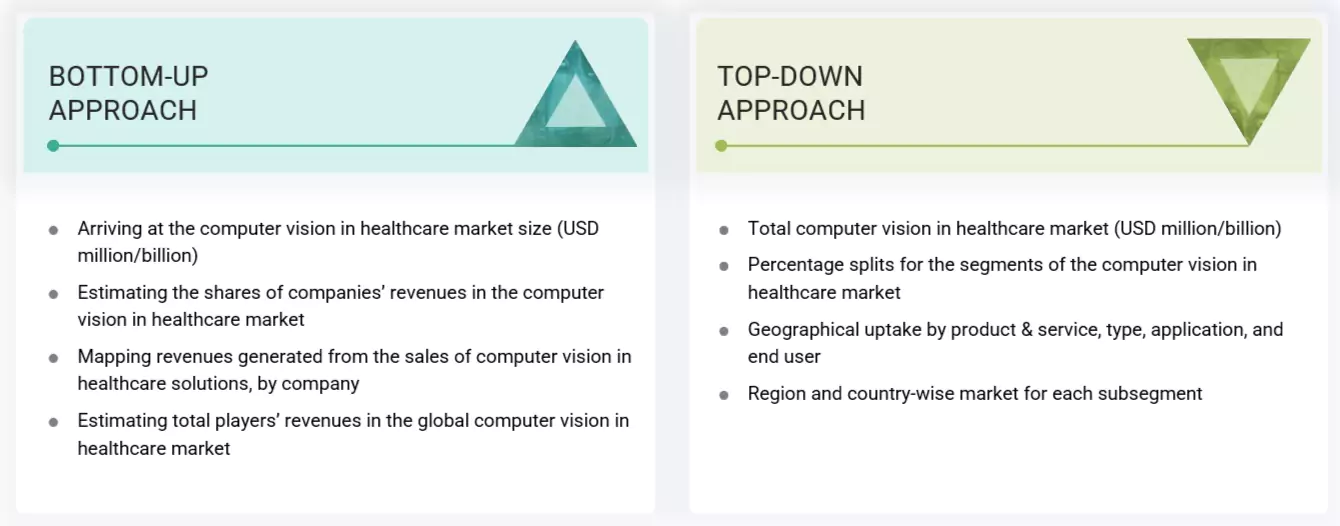
The study involved several key activities to estimate the current size of the computer vision in healthcare market. Extensive secondary research was conducted to gather information on this market. The next step was to validate the findings, assumptions, and size estimates by consulting industry experts throughout the value chain through primary research. We employed various methods, including top-down and bottom-up approaches, to estimate the overall market size. Following this, market segmentation and data triangulation techniques were utilized to determine the size of specific segments and subsegments within the computer vision in healthcare market.
Secondary Research
This research study involved the wide use of secondary sources, directories, and databases such as Dun & Bradstreet, Bloomberg Business, and Factiva; whitepapers, annual reports, and companies’ house documents; investor presentations; and the SEC filings of companies. The market for companies providing computer vision in healthcare solutions is assessed using secondary data from paid and free sources. This involves analyzing the product portfolios of major players in the industry and evaluating these companies based on their performance and quality. Various resources were utilized in the secondary research process to gather information for this study. The sources include annual reports, press releases, investor presentations, white papers, academic journals, certified publications, articles by recognized authors, directories, and databases.
The secondary research process involved referring to various secondary sources to identify and collect information related to the study. These sources included annual reports, press releases, investor presentations of computer vision in healthcare vendors, forums, certified publications, and whitepapers. The secondary research was used to obtain critical information on the industry’s value chain, the total pool of key players, market classification, and segmentation from the market and technology-oriented perspectives.
Primary Research
In the primary research process, various sources from both the supply and demand sides were interviewed to obtain qualitative and quantitative information for this report. Primary sources are mainly industry experts from the core and related industries and preferred suppliers, manufacturers, distributors, technology developers, researchers, and organizations related to all segments of this industry’s value chain. In-depth interviews were conducted with various primary respondents, including key industry participants, subject-matter experts (SMEs), C-level executives of key market players, and industry consultants, among other experts, to obtain and verify the critical qualitative and quantitative information as well as assess prospects.
Primary research was conducted to identify segmentation types, industry trends, key players, and key market dynamics such as drivers, restraints, opportunities, challenges, industry trends, and strategies adopted by key players.
After completing the market engineering process, which includes calculations for market statistics, market breakdown, size estimations, forecasting, and data triangulation, extensive primary research was conducted. This research aimed to gather information and verify the critical numbers obtained during the market analysis. Additionally, primary research was conducted to identify different types of market segmentation, analyze industry trends, evaluate the competitive landscape of computer vision in healthcare solutions offered by various players, and understand key market dynamics such as drivers, restraints, opportunities, challenges, industry trends, and strategies employed by key market participants.
In the complete market engineering process, the top-down and bottom-up approaches and several data triangulation methods were extensively used to perform the market estimation and market forecasting for the overall market segments and subsegments listed in this report. Extensive qualitative and quantitative analysis was performed on the complete market engineering process to list the key information/insights throughout the report.
Breakdown of Primary Respondents
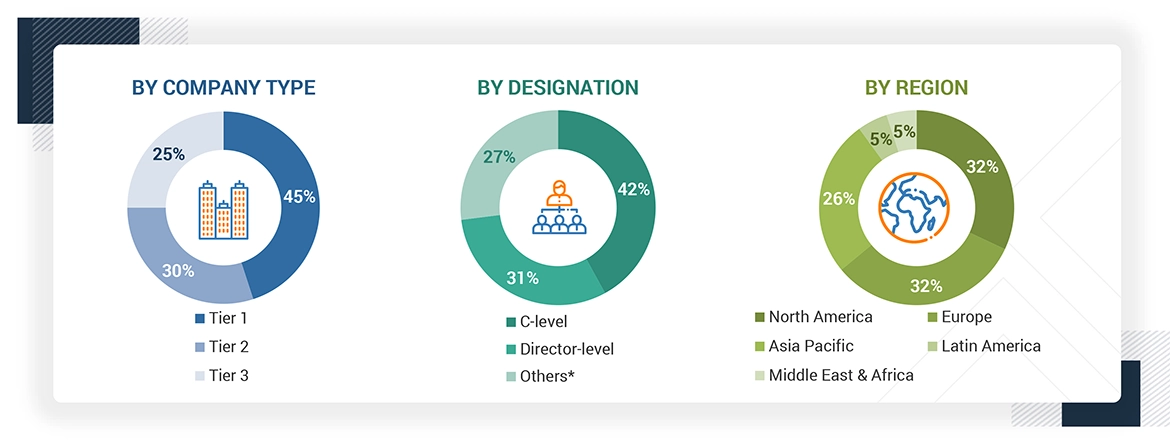
Note 1: Other designations include sales managers, marketing managers, and product managers.
Note 2: Tiers are defined based on a company’s total revenue, as of 2024: Tier 1 = >USD 1 billion, Tier 2 = USD 500 million to USD 1 billion, and Tier 3 = < USD 500 million
To know about the assumptions considered for the study, download the pdf brochure
Market Size Estimation
The market size estimates and forecasts provided in this study are derived through a mix of the bottom-up approach (revenue share analysis of leading players) and top-down approach (assessment of utilization/adoption/penetration trends, by product & service, type, application, end user, and region).
Data Triangulation
After arriving at the overall market size, using the market size estimation processes, the market was split into several segments and subsegments. To complete the overall market engineering process and arrive at the exact statistics of each market segment and subsegment, the data triangulation and market breakdown procedures were employed, wherever applicable. The data was triangulated by studying various factors and trends from both the demand and supply sides in the computer vision in healthcare market.
Market Definition
Computer vision is concerned with capturing, processing, and analyzing real-world images and video to allow machines to extract meaningful, contextual information from a single image or sequence of images. Computer vision in healthcare is used in medical image diagnosis, intraoperative imaging, and clinical trials.
Stakeholders
- CV Software and Service Providers
- Healthcare Providers
- AI Solution Providers
- AI Platform Providers
- Business Providers
- Professional Service/Solution Providers
- Research Organizations
- Technology Standard Organizations, Forums, Alliances, and Associations
- Technology Investors
- Venture Capitalists
Report Objectives
- To define, describe, and forecast the global computer vision in healthcare market by product & service, type, application, end user, and region
- To provide detailed information regarding the major factors influencing the growth of the market (such as drivers, restraints, opportunities, and challenges)
- To analyze micromarkets with respect to individual growth trends, prospects, and contributions to the overall computer vision in healthcare market
- To assess the computer vision in healthcare market with regard to Porter’s Five Forces, regulatory landscape, value chain, ecosystem map, patent analysis, and buying criteria
- To analyze opportunities in the market for stakeholders and provide details of the competitive landscape for market leaders
- To forecast the size of the computer vision in healthcare market with respect to five main regions, namely, North America, Europe, the Asia Pacific, Latin America, and the Middle East & Africa
- To profile the key players in the computer vision in healthcare market and comprehensively analyze their core competencies and market shares
- To track and analyze competitive developments such as agreements, partnerships, acquisitions, expansions, product launches & enhancements, and R&D activities in the computer vision in healthcare market
Get the Full Computer Vision in Healthcare Market Report
Full forecast, segment splits, and company analysis for all Computer Vision in Healthcare Market.
- US Computer Vision in Healthcare Market
- Canada Computer Vision in Healthcare Market
- Germany Computer Vision in Healthcare Market
- UK Computer Vision in Healthcare Market
- France Computer Vision in Healthcare Market
- Italy Computer Vision in Healthcare Market
- China Computer Vision in Healthcare Market
- Japan Computer Vision in Healthcare Market
- Brazil Computer Vision in Healthcare Market
- Mexico Computer Vision in Healthcare Market
- Rest Of Europe Computer Vision in Healthcare Market
- Rest Of Asia Pacific Computer Vision in Healthcare Market
Need a Tailored Report?
Customize this report to your needs
Get 10% FREE Customization
Customize This Report
