
Europe Core Materials Market (2026-2031)

The Europe Core Materials Market was valued at $736.7 Million in 2026 and projected to reach to $1333.6 Million by 2031, representing a compound annual growth rate of 12.6%. Europe's core materials market is poised for sustained expansion through 2031, driven by accelerating demand from aerospace, automotive, and renewable energy sectors.


| Market Size in | USD 26.32 MN |
| Market Forecast in | |
| CAGR | |
| Forecast Period | |
| Units Considered | Value (USD MN) |
Europe Core Materials Market Trends and Insights
- This growth trajectory reflects Europe's strong demand across aerospace, automotive, and renewable energy sectors, where lightweight composite solutions are increasingly critical.
- Europe maintains a mature manufacturing base and stringent sustainability standards that drive innovation in core material technologies. The European market's 12.6% compound annual growth rate underscores the region's commitment to advanced materials development and circular economy principles.
- Europe's regulatory environment and investment in green technologies position the region as a leader in high-performance core materials adoption.
- Between 2026 and 2031, Europe is expected to capture significant market share through continued R&D initiatives and strategic partnerships across the value chain..
Key Market Statistics
- CAGR (2026-2031) 12.6% CAGR
- Market Size, 2026 ~USD 736.7 Million
- Forecast, 2031 ~USD 1333.6 Million
- Geography Europe
Europe Core Materials Market Overview
Market Valuation & Growth :
Europe's core materials market is valued at $736.7 million in 2026 and is projected to reach $1,333.6 million by 2031, representing a robust 12.6% CAGR. This growth trajectory demonstrates strong investor confidence in the region's composite materials sector.
Aerospace & Automotive Dominance :
Europe's mature manufacturing base drives significant demand for lightweight composite solutions in aerospace and automotive industries. These sectors leverage core materials for weight reduction, fuel efficiency, and performance enhancement, positioning Europe as a global innovation hub.
Renewable Energy Integration :
The European renewable energy sector, particularly wind power, is a major growth driver for core materials. Composite cores are essential in wind turbine blade manufacturing, aligning with Europe's aggressive sustainability and decarbonization targets.
Sustainability & Regulatory Leadership :
Europe's stringent environmental regulations and commitment to circular economy principles are shaping core materials innovation. Manufacturers are increasingly adopting sustainable production methods and recyclable composite solutions to meet EU compliance standards.
Europe Core Materials Market Dynamics
- The region's commitment to lightweight materials for fuel efficiency and emissions reduction creates a favorable regulatory environment for composite adoption.
- Germany, France, and the UK lead market growth, supported by advanced manufacturing capabilities and significant R&D investments. The market outlook remains positive as European OEMs prioritize sustainability and performance.
- Increasing investments in wind energy infrastructure and electric vehicle production will further propel core materials demand.
- Strategic partnerships between material suppliers and end-users, combined with technological advancements in bio-based and recyclable composites, position Europe for continued market leadership and innovation through the forecast period..
Market Ecosystem
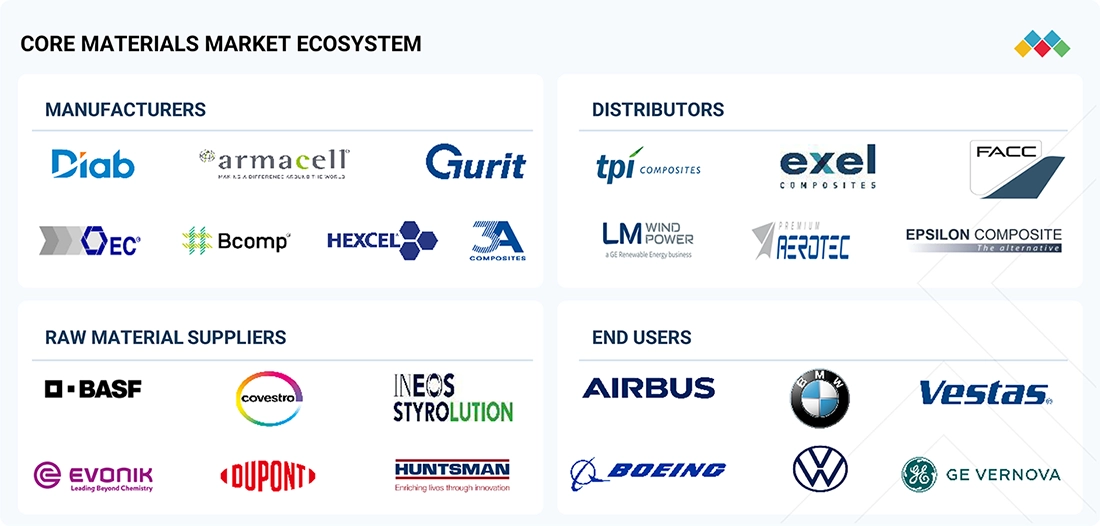
CORE MATERIALS MARKET: COMMERCIAL USE CASES ACROSS INDUSTRIES
| COMPANY | USE CASE DESCRIPTION | BENEFITS |
|---|---|---|
 |
Utilizes PET foam, PVC foam, and balsa core materials in wind turbine blades to create lightweight sandwich composite structures with high stiffness and fatigue resistance. | Enables longer blade lengths, improved energy generation efficiency, reduced blade weight, and enhanced durability for onshore and offshore wind turbines. |
 |
Incorporates Nomex honeycomb and foam core materials in aircraft fuselage panels, flooring systems, nacelles, control surfaces, and interior structures | Reduces aircraft weight, improves fuel efficiency, enhances structural integrity, and lowers maintenance costs while maintaining safety standards |
 |
Uses honeycomb and foam core materials in wings, empennage structures, cabin interiors, radomes, and secondary aircraft components | Improves fuel savings, corrosion resistance, passenger comfort, and overall aircraft performance while supporting sustainability objectives |
 |
Integrates honeycomb and foam core composites in vehicle body panels, roof structures, battery enclosures, and lightweight automotive components | Improves fuel savings, corrosion resistance, passenger comfort, and overall aircraft performance while supporting sustainability objectives |
 |
Employs PVC foam, SAN foam, and balsa core materials in hulls, decks, and superstructures of luxury marine vessels | Provides high stiffness-to-weight ratios, improved buoyancy, corrosion resistance, and fuel efficiency while maintaining structural durability in harsh marine environments |
Logos and trademarks shown above are the property of their respective owners. Their use here is for informational and illustrative purposes only.
Related Ecosystem
Key Takeaways
- Europe's core materials market will nearly double from $736.7M (2026) to $1,333.6M (2031), driven by aerospace and automotive demand.
- Europe's 12.6% CAGR reflects strong regulatory support for lightweight, sustainable composite materials across the region.
- Europe's mature manufacturing infrastructure and R&D investment position the region as a global innovation hub for core materials.
- Europe's renewable energy sector expansion is a key growth catalyst for advanced core material applications through 2031.
Core Materials Market Report Scope
| Report Metric | Details |
|---|---|
| Base Year | 2026 |
| Fastest Growing Segment | HONEYCOMB (Type) |
| Forecast Period | 2026–2031 |
| Growth Rate | CAGR of 12.8% from 2026 to 2031 |
| Largest Segment | FOAM (Type) |
| Market Size Base Year (Billions) | ~USD 2.45 (2026) |
| Revenue Forecast (Billions) | ~USD 4.47 (2031) |
| Segments Covered | Type, Foam Type |
Europe Core Materials Market Report Segmentation
2 segment dimensions are covered across the global market.
By Type
- Balsa
- Foam
- Honeycomb
By Foam Type
- Pei
- Pet
- Pmi
- Pvc
- San
Target Audience
- Composite Material Manufacturers : Understand European market demand, regional growth rates, and sector-specific applications to optimize production capacity, R&D investments, and geographic expansion strategies across key European markets.
- Aerospace & Defense OEMs : Access insights on core materials availability, supplier landscape, and regulatory compliance requirements essential for sourcing decisions and supply chain optimization in European aerospace manufacturing.
- Automotive Suppliers & OEMs : Identify lightweight composite opportunities aligned with European emission standards and EV production growth. Understand material specifications, cost structures, and supplier capabilities across the region.
- Renewable Energy Developers : Evaluate core materials market dynamics for wind turbine blade manufacturing in Europe. Access data on material performance, sustainability certifications, and supplier capabilities supporting Europe's renewable energy expansion.
- Investment & Strategy Consultants : Provide clients with comprehensive European market analysis, growth forecasts, and competitive positioning data to support M&A strategies, market entry decisions, and portfolio optimization in the core materials sector.
Key Companies in the Europe Core Materials Market
| Company | HQ | Ownership | Strongest segments |
|---|---|---|---|
| BASF SE | Germany | Public Company | Chemicals (petrochemicals and intermediates),Materials (isocyanates, polyamides, inorganic basics, specialties),Industrial Solutions (dispersions, resins, additives, catalysts), |
| GURIT HOLDINGS AG | Switzerland | Public Company | Wind Materials,Manufacturing Solutions (Tooling & Automation),Marine and Industrial, |
| HEXCEL CORPORATION | United States | Public Company | Composite Materials,Engineered Products, |
| EVONIK INDUSTRIES AG | Germany | Public Company | Advanced Technologies,Custom Solutions,Infrastructure, |
| TORAY INDUSTRIES, INC. | Japan | Public Company | Fibers and textiles (filament, staple, non-wovens, apparel),Performance chemicals (resins, films, fine chemicals, electronic materials),Carbon fiber composite materials and molded products, |
| CHANGZHOU TIANSHENG NEW MATERIALS CO., LTD. | China | Public Company | Structural foam materials (wind, rail, shipbuilding, energy-saving buildings),Soft foaming materials,High-purification protective film, |
BASF SE
BASF SE is a German multinational chemical company founded in 1865, employing 106,428 people and operating as a public company.
GURIT HOLDINGS AG
Gurit Holdings AG is a Swiss composite materials and engineering company founded in 1835, with 1,925 employees and publicly traded.
HEXCEL CORPORATION
Hexcel Corporation is a U.S.-based advanced composites manufacturer founded in 1946, employing 5,563 people and operating as a public company.
EVONIK INDUSTRIES AG
Evonik Industries AG is a German specialty chemicals company founded in 1847, employing 30,643 people and operating as a public company.
TORAY INDUSTRIES, INC.
Toray Industries, Inc. is a Japanese advanced materials and chemicals company founded in 1926, with 46,294 employees and publicly traded.
CHANGZHOU TIANSHENG NEW MATERIALS CO., LTD.
Changzhou Tiansheng New Materials Co., Ltd is a Chinese materials company founded in 1998, employing 567 people and operating as a public company.
Countries within Europe - compare and drill down
| Country | 2025 size (native) |
|---|---|
| Germany | USD 307 Million |
| France | USD 228.2 Million |
| UK | USD 181.5 Million |
| Italy | USD 154.6 Million |
| Spain | USD 155.5 Million |
| Turkey | USD 91.5 Million |
Country market size visualization
Reasons to Buy this Report
- Regional Market Segmentation : Gain detailed insights into Europe's core materials market with country-level breakdowns for Germany, France, UK, Italy, Spain, and Turkey. Understand regional variations in demand drivers and competitive landscapes specific to each European market.
- Sector-Specific Growth Drivers : Identify high-growth opportunities across aerospace, automotive, wind energy, and marine industries in Europe. Access data on how regulatory frameworks and sustainability mandates are reshaping material specifications and procurement strategies.
- Competitive Intelligence : Benchmark your position against European market leaders and emerging players. Understand market consolidation trends, technology partnerships, and strategic investments shaping the competitive landscape across the region.
- Regulatory & Sustainability Insights : Navigate Europe's complex regulatory environment with comprehensive analysis of EU directives, circular economy requirements, and sustainability certifications impacting core materials procurement and manufacturing practices.
- Forecast-Driven Strategy : Leverage 5-year market projections (2026-2031) to inform capital allocation, capacity planning, and market entry strategies. Make data-driven decisions with confidence using Europe-specific CAGR and growth trajectory analysis.
Frequently asked questions
What is the projected size of Europe's core materials market in 2031?
Europe's core materials market is forecast to reach $1,333.6 million by 2031, up from $736.7 million in 2026.
What is Europe's core materials market CAGR?
Europe's core materials market is expected to grow at a compound annual growth rate of 12.6% between 2026 and 2031.
Which industries drive Europe's core materials demand?
Europe's core materials demand is primarily driven by aerospace, automotive, wind energy, and marine industries seeking lightweight composite solutions.
Why is Europe a leader in core materials innovation?
Europe leads in core materials innovation due to stringent environmental regulations, substantial R&D investment, and a mature manufacturing ecosystem focused on sustainability.
How does Europe's market compare to global core materials growth?
Europe's 12.6% CAGR is slightly below the global 12.8% CAGR, reflecting the region's mature market status while maintaining strong absolute growth.
RESEARCH METHODOLOGY
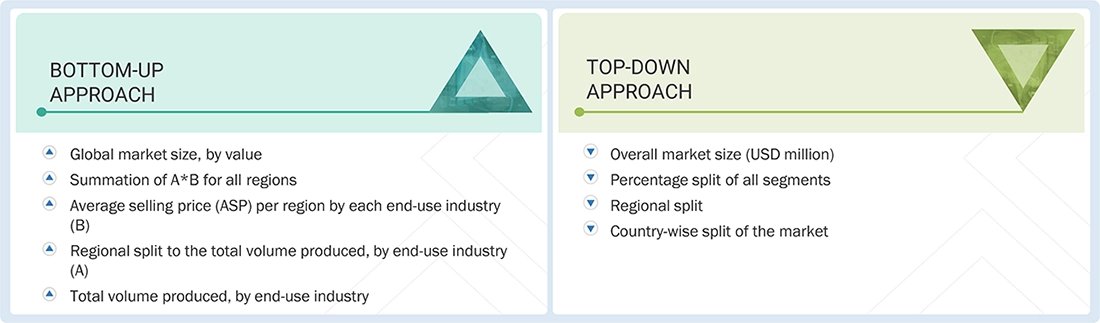
The study involves two major activities to estimate the current market size of core materials. Exhaustive secondary research was conducted to gather information on the market, the peer market, and the parent market. The next step was to validate these findings, assumptions, and sizing with industry experts across the value chain through primary research. Both top-down and bottom-up approaches were employed to estimate the complete market size. After that, market breakdown and data triangulation were used to estimate the market size of segments and subsegments.
Secondary Research
Secondary sources used in this research study include financial statements of companies that offer core materials and information from various trade, business, and professional associations. Secondary research has been used to obtain critical information about the industry’s value chain, the total pool of key players, market classification, and segmentation according to industry trends to the bottom-most level and regional markets. The secondary data were collected and analyzed to determine the overall size of the core materials market, which was validated by primary respondents.
Primary Research
Extensive primary research was conducted after obtaining information regarding the core materials market scenario through secondary research. Several primary interviews were conducted with market experts from both the demand and supply sides across major countries of North America, Europe, Asia Pacific, and the Rest of the World (ROW). Primary data was collected through questionnaires, emails, and telephonic interviews. The primary sources from the supply side included various industry experts, such as chief experience officers (CXOs), vice presidents (VPs), business development/marketing directors, product development/innovation teams, related key executives from the core materials industry, system integrators, component providers, distributors, and key opinion leaders. Primary interviews were conducted to gather insights, such as market statistics, data on revenue collected from the products and services, market breakdowns, market size estimations, market forecasting, and data triangulation. Primary research also helped in understanding the various trends related to type, end-use industry, and region. Stakeholders from the demand side, such as CIOs, CTOs, CSOs, and installation teams of the customers/end users who are seeking core materials services, were interviewed to understand the buyer’s perspective on the suppliers, products, component providers, and their current usage of core materials and future outlook of their business, which will affect the overall market.
Breakup of Primary Research:
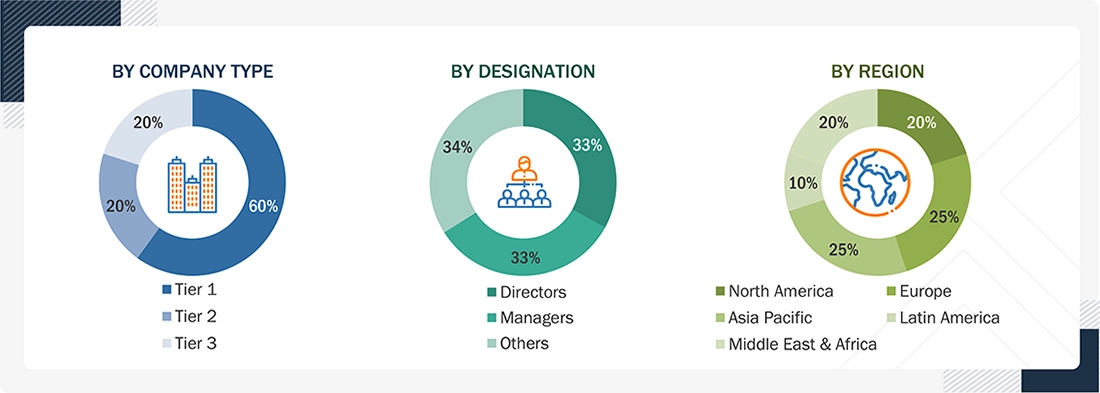
To know about the assumptions considered for the study, download the pdf brochure
Market Size Estimation
The research methodology used to estimate the size of the core materials market is as follows. The market size was undertaken from the demand side. The market was upsized based on the demand for core materials in different applications at the regional level. Such procurements provide information on the demand aspects of the core materials industry for each end-use industry. For each end-use industry, all possible segments of the core materials market were integrated and mapped.
Core Materials Market : Top-Down and Bottom-Up Approach
Data Triangulation
After arriving at the overall size from the market size estimation process explained above, the total market was split into several segments and subsegments. The data triangulation and market breakdown procedures explained below were implemented, wherever applicable, to complete the overall market engineering process and arrive at the exact statistics for various market segments and subsegments. The data was triangulated by studying various factors and trends from the demand and supply sides. Along with this, the market size was validated using both the top-down and bottom-up approaches.
Market Definition
The term "core materials" refers to a wide range of materials used as essential components of composite structures across various sectors. These substances serve as the inner core of sandwich composite structures, providing crucial characteristics such as insulation, rigidity, and strength while maintaining a thin profile. Core materials, commonly classified as foam, balsa wood, and honeycomb structures, are widely used across a range of industries, including construction, wind energy, aerospace, marine, automotive, and industrial manufacturing. The market for core materials is continually evolving due to advances in materials science and the growing emphasis on lightweight, sustainable solutions. This is because a variety of end-use sectors are seeing a growing need for high-performance and affordable alternatives.
Key Stakeholders
- Core Materials Manufacturers
- Core Materials Distributors and Suppliers
- Universities, Governments, and Research Organizations
- Associations and Industrial Bodies
- R&D Institutes
- Environmental Support Agencies
- Investment Banks and Private Equity Firms
- Research and Consulting Firms
Report Objectives
- To define, describe, and forecast the core materials market size in terms of volume and value
- To provide detailed information regarding the key factors, such as drivers, restraints, opportunities, and challenges influencing market growth
- To analyze and project the global core materials market by type, end-use industry, and region
- To forecast the market size concerning four main regions (along with country-level data), namely, North America, Europe, Asia Pacific, and Rest of World (RoW), and analyze the significant region-specific trends
- To strategically analyze micromarkets with respect to individual growth trends, prospects, and contributions of the submarkets to the overall market
- To analyze the market opportunities and the competitive landscape for stakeholders and market leaders
- To assess recent market developments and competitive strategies, such as agreements, contracts, acquisitions, and product developments/product launches, to draw the competitive landscape
- To strategically profile the key market players and comprehensively analyze their core competencies
Available customizations:
MarketsandMarkets offers the following customizations for this market report:
- Additional country-level analysis of the core materials market
Product Analysis
- Product matrix, which provides a detailed comparison of the product portfolio of each company’s market
Get the Full Core Materials Market Report
Full forecast, segment splits, and company analysis for all Core Materials Market.
- US Core Materials Market
- Canada Core Materials Market
- Germany Core Materials Market
- France Core Materials Market
- UK Core Materials Market
- Italy Core Materials Market
- Spain Core Materials Market
- Turkey Core Materials Market
- China Core Materials Market
- Japan Core Materials Market
- India Core Materials Market
- Australia Core Materials Market
- Brazil Core Materials Market
- Mexico Core Materials Market
Need a Tailored Report?
Customize this report to your needs
Get 10% FREE Customization
Customize This Report
