
Germany Critical Infrastructure Protection Market (2025-2030)

The Germany Critical Infrastructure Protection Market was valued at $6854 Million in 2025 and projected to reach to $8679.3 Million by 2030, representing a compound annual growth rate of 4.8%. Germany's Critical Infrastructure Protection Market is positioned for steady growth driven by increasing cyber threats, regulatory compliance requirements, and the nation's strategic focus on industrial security.


| Market Size in | USD 26.32 MN |
| Market Forecast in | |
| CAGR | |
| Forecast Period | |
| Units Considered | Value (USD MN) |
Germany Critical Infrastructure Protection Market Trends and Insights
- Germany's strategic position as Europe's largest economy and industrial hub drives significant investment in safeguarding critical infrastructure across energy, transportation, water, and telecommunications sectors.
- The country's regulatory framework, including the IT Security Act and NIS Directive implementation, mandates robust protection measures for essential services. Germany's market growth is fueled by increasing cyber threats targeting industrial facilities, the expansion of Industry 4.0 initiatives, and heightened government spending on national security infrastructure.
- Organizations across Germany are prioritizing advanced threat detection, resilience planning, and compliance with stringent European standards.
- The forecast period through 2030 reflects sustained demand as Germany strengthens its digital sovereignty and critical infrastructure resilience amid evolving geopolitical risks and technological advancement..
Key Market Statistics
- CAGR (2025-2030) 4.8% CAGR
- Market Size, 2025 ~USD 6854 Million
- Forecast, 2030 ~USD 8679.3 Million
- Country Germany
Germany Critical Infrastructure Protection Market Overview
Market Size & Growth :
Germany's Critical Infrastructure Protection Market is valued at USD 6,854.0 million in 2025, with a projected CAGR of 4.8% through 2030, reaching USD 8,679.3 million. This growth trajectory reflects Germany's commitment to strengthening its critical infrastructure resilience.
Industrial Leadership :
As Europe's largest economy, Germany's manufacturing, energy, and transportation sectors drive substantial demand for advanced cybersecurity and physical protection solutions across critical infrastructure assets.
Regulatory & Compliance Drivers :
Germany's stringent NIS2 Directive implementation, KRITIS regulations, and EU cybersecurity mandates create a robust compliance framework that accelerates investment in critical infrastructure protection technologies and services.
Multi-Sector Investment :
Significant protection investments span Germany's energy grids, transportation networks, water utilities, telecommunications infrastructure, and financial systems, creating diverse market opportunities across multiple vertical segments.
Germany Critical Infrastructure Protection Market Dynamics
- The country's role as Europe's economic powerhouse necessitates robust protection of interconnected critical systems spanning energy, transportation, water, and telecommunications sectors.
- Government initiatives and private sector investments in digital resilience are expected to sustain market expansion through 2030. The market will be shaped by evolving threat landscapes, Industry 4.0 digitalization, and cross-border infrastructure dependencies within the EU.
- German enterprises are increasingly adopting integrated protection solutions combining cybersecurity, physical security, and operational technology safeguards.
- Strategic partnerships between technology providers and critical infrastructure operators will drive innovation and market penetration across the forecast period..
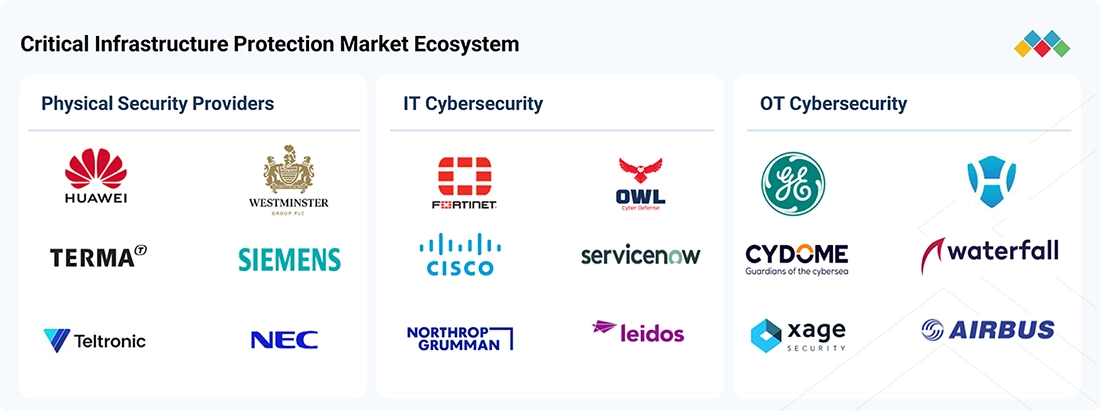
Market Ecosystem
CRITICAL INFRASTRUCTURE PROTECTION MARKET: COMMERCIAL USE CASES ACROSS INDUSTRIES
| COMPANY | USE CASE DESCRIPTION | BENEFITS |
|---|---|---|
 |
CPFL Energia deployed Cisco Cyber Vision across its distributed substations to identify OT assets, vulnerabilities, and anomalies, while Cisco Secure Firewall protected communications across the grid. | Detected 20+ malware instances, improved OT visibility, reduced attack surface, and strengthened grid resilience/compliance. |
 |
Dubai Electricity & Water Authority (DEWA) deployed Nozomi Networks across 180+ transmission sites and 2 control centers for OT asset visibility, threat detection, and centralized monitoring. | Enhanced threat detection and response, real-time OT-CSOC intelligence, and improved compliance across critical electricity and water infrastructure. |
 |
West Burton Energy deployed Tenable OT Security across its UK power-generation environment for OT asset visibility, vulnerability management, and threat detection. | 98% reduction in threat detection alerts, 87% efficiency improvement, and 200+ hours/year saved in asset management. |
 |
Motor Oil partnered with Honeywell to secure its 50-year-old refinery, implementing OT cybersecurity, network segmentation, security controls, and managed security services. | Improved refinery security and safety, enabled faster remote updates, and reduced operational delays. |
 |
Hydrovolt deployed Claroty xDome and Secure Access to discover OT assets and control remote access across its battery recycling production environment. | Achieved asset visibility in ~1 month vs. 6–12 months with passive-only discovery, removed insecure remote access tools, and centralized supplier/employee access. |
Logos and trademarks shown above are the property of their respective owners. Their use here is for informational and illustrative purposes only.
Related Ecosystem
Cyber Security
- Cloud Security
- Biometric Systems
- Multi-Factor Authentication
- Security Analytics
- Data Loss Prevention (DLP)
- International Business Machines Corporation
- Cisco Systems, Inc.
- MITSUI BUSSAN SECURE DIRECTIONS INC
- MICROSOFT CORPORATION
- Allot Ltd.
Network Security
- Cloud Security
- Critical Communication Network
- Surveillance System
- Video Surveillance Systems
- Biometric Security and Authentication System
- Cisco Systems, Inc.
- International Business Machines Corporation
- MICROSOFT CORPORATION
- Fortinet, Inc.
- PALO ALTO NETWORKS, INC
Key Takeaways
- Germany's Critical Infrastructure Protection Market is valued at USD 6,854.0 million in 2025 and expected to reach USD 8,679.3 million by 2030 at a 4.8% CAGR.
- Germany's regulatory environment, including the IT Security Act and NIS Directive, mandates comprehensive protection strategies for critical sectors.
- Industry 4.0 adoption and cyber threat escalation are primary growth drivers for critical infrastructure protection investments across Germany.
- Germany's position as Europe's industrial leader creates sustained demand for advanced threat detection, resilience planning, and compliance solutions.
Critical Infrastructure Protection Market Report Scope
| Report Metric | Details |
|---|---|
| Base Year | 2025 |
| Fastest Growing Segment | AI-ENABLED SMART VIDEO ANALYTICS (Surveillance & Monitoring Systems) |
| Forecast Period | 2025–2030 |
| Growth Rate | CAGR of 5.1% from 2025 to 2030 |
| Largest Segment | PROFESSIONAL SERVICES (Services) |
| Market Size Base Year (Billions) | ~USD 153.72 (2025) |
| Revenue Forecast (Billions) | ~USD 197.13 (2030) |
| Segments Covered | Offering, Physical Security Offering, System, Perimeter Protection, Surveillance & Monitoring Systems, Access Control Systems, Screening & Scanning Systems, Emergency Communication Systems, Services, Professional Services, It Cybersecurity Solutions, Solutions, Network & Endpoint Protection, Threat Detection & Response Platforms, Patch Management, Data Backup & Recovery, Ot Cybersecurity Solution, Solution, Ot & Ics Security Platforms, Iot & Iiot Security Solutions, Ot Threat Detection & Monitoring, Digital Twin Platforms |
Germany Critical Infrastructure Protection Market Report Segmentation
22 segment dimensions are covered across the global market.
By Offering
- It Cybersecurity Solutions
- Ot Cybersecurity Solutions
- Physical Security Offerings
By Physical Security Offering
- Services
- Systems
By System
- Access Control Systems
- Emergency Communication Systems
- Perimeter Protection
- Screening & Scanning Systems
- Surveillance & Monitoring Systems
By Perimeter Protection
- Intrusion Detection Systems
- Physical Barriers
By Surveillance & Monitoring Systems
- AI-Enabled Smart Video Analytics
- Cctv Systems
- Counter-Drone Detection & Neutralization Systems
- Drone Surveillance Platforms
- Thermal And Multi-Sensor Surveillance Units
- Video Management Software
By Access Control Systems
- Biometric Identity Verification Systems
- Mobile Device–Based Access Control
- Smart Card Access Solutions
- Visitor Management System
By Screening & Scanning Systems
- Explosive & Hazardous Material Detection Systems
- Metal Detection Equipment
- X-Ray Scanning Solutions
By Emergency Communication Systems
- Audible & Visual Alert Systems
- Public Address & Mass Notification Platforms
By Services
- Managed Services
- Professional Services
By Professional Services
- Design, Consulting, & Implementation Services
- Risk & Threat Management
- Risk Assessment & Compliance Consulting
- Support & Maintenance
- Training & Education
By It Cybersecurity Solutions
- Services
- Solutions
By Solutions
- Cloud & Application Security
- Compliance & Policy Management
- Data Backup & Recovery
- Encryption & Data Protection
- Identity & Access Management Solutions
- Network & Endpoint Protection
- Patch Management
- Threat Detection & Response Platform
By Network & Endpoint Protection
- Antivirus/Antimalware Solutions
- Epp & Xdr Platforms
- Firewalls & Nac
- Vpn & Ztna
By Threat Detection & Response Platforms
- Log Management & Siem
- Soar
By Patch Management
- Automated Patch Deployment Tools
- Vulnerability Assessment & Remediation
By Data Backup & Recovery
- Backup Automation & Orchestration Tools
- Disaster Recovery-As-A-Service (Draas)
By Ot Cybersecurity Solution
- Services
- Solutions
By Solution
- Asset Identification & Visibility
- Digital Twin Platform
- IoT & Iiot Security Solutions
- Ot & Ics Security Platform
- Ot Threat Detection & Monitoring
By Ot & Ics Security Platforms
- Firewall Solutions
- Industrial Control System Security Solutions
- Scada Network Security Systems
By Iot & Iiot Security Solutions
- Anomaly Detection
- Network Segmentation
- Secure Device Authentication & Management
By Ot Threat Detection & Monitoring
- Behavioral Anomaly Detection
- Siem Solutions
By Digital Twin Platforms
- Predictive Analysis
- Security Scenario Simulation & Response Planning
GERMANY: CRITICAL INFRASTRUCTURE PROTECTION MARKET, BY VERTICAL, 2025–2030
| Segment | 2025 | 2026 | 2027 | 2028 | 2029 | 2030 | CAGR (%) |
|---|---|---|---|---|---|---|---|
| CHEMICALS & MANUFACTURING | 536.6 | 556.8 | 578 | 600.6 | 624.1 | 647 | 3.8 |
| COMMERCIAL SECTOR | 1216.1 | 1256.8 | 1298.7 | 1358.3 | 1410.3 | 1459.2 | 3.7 |
| DEFENSE | 442.6 | 473.8 | 507.6 | 544.2 | 583.5 | 623.4 | 7.1 |
| ENERGY & POWER | 972.2 | 1027.4 | 1086.2 | 1149.3 | 1215.9 | 1283.8 | 5.7 |
| FINANCIAL INSTITUTIONS | 364.6 | 390 | 418.6 | 442.2 | 471.4 | 502.5 | 6.6 |
| GOVERNMENT | 706 | 751 | 799.2 | 851.3 | 906.7 | 963.2 | 6.4 |
| IT & TELECOM | 307.9 | 328.3 | 350.3 | 374.1 | 399.5 | 425.3 | 6.7 |
| OIL & GAS | 726.5 | 765.5 | 807 | 851.5 | 898.3 | 945.9 | 5.4 |
| OTHER VERTICALS | 722 | 745.4 | 769.2 | 764.8 | 777.3 | 792.9 | 1.9 |
| TRANSPORT & LOGISTICS | 859.7 | 886.7 | 914 | 963.2 | 1001.3 | 1036.1 | 3.8 |
| TOTAL | 6854 | 7181.6 | 7528.7 | 7899.5 | 8288.3 | 8679.3 | 4.8 |
Target Audience
- Government & Regulatory Bodies : German federal and state agencies responsible for critical infrastructure oversight need market data to inform policy development, funding allocation, and national security strategy aligned with KRITIS and NIS2 requirements.
- Critical Infrastructure Operators : Energy utilities, transportation authorities, water management companies, and telecommunications providers require market insights to benchmark security investments, identify emerging threats, and evaluate protection solution providers.
- Cybersecurity & Technology Vendors : Solution providers and system integrators targeting Germany's critical infrastructure sector need market sizing, growth forecasts, and competitive intelligence to develop go-to-market strategies and product roadmaps.
- Investment & Consulting Firms : Private equity, venture capital, and management consulting firms evaluating opportunities in German critical infrastructure protection require detailed market analysis, growth drivers, and investment landscape assessments.
- Enterprise Risk & Security Leaders : Chief Information Security Officers and infrastructure protection managers in German organizations need market data to justify security budgets, evaluate vendor solutions, and align protection strategies with industry trends.
Reasons to Buy this Report
- Germany-Specific Market Sizing : Access precise market valuation data for Germany's critical infrastructure protection sector with detailed 2025-2030 forecasts, enabling accurate budget allocation and investment planning for German market entry or expansion.
- Regulatory Compliance Roadmap : Understand Germany's unique regulatory landscape including KRITIS requirements, NIS2 Directive implementation timelines, and sector-specific compliance mandates that directly impact purchasing decisions and technology adoption.
- Competitive Landscape Intelligence : Identify key market players, solution providers, and competitive dynamics specific to Germany's critical infrastructure protection ecosystem, including local partnerships and market consolidation trends.
- Sector-Specific Opportunity Analysis : Gain insights into protection investments across Germany's energy, transportation, water, telecommunications, and financial infrastructure sectors with segment-level growth projections and investment priorities.
- Strategic Decision Support : Leverage Germany-focused market intelligence to inform go-to-market strategies, partnership development, product positioning, and resource allocation decisions for the German critical infrastructure protection market.
Frequently asked questions
What is the current market size of Critical Infrastructure Protection in Germany?
Germany's Critical Infrastructure Protection Market is valued at USD 6,854.0 million in 2025.
What is the projected market size for Critical Infrastructure Protection in Germany by 2030?
Germany's Critical Infrastructure Protection Market is projected to reach USD 8,679.3 million by 2030.
What is the CAGR for Germany's Critical Infrastructure Protection Market?
Germany's Critical Infrastructure Protection Market is expected to grow at a compound annual growth rate (CAGR) of 4.8% from 2025 to 2030.
Which sectors drive critical infrastructure protection demand in Germany?
Key sectors in Germany include energy, transportation, water, telecommunications, and industrial manufacturing, all subject to stringent regulatory protection requirements.
What regulatory frameworks govern critical infrastructure protection in Germany?
Germany's IT Security Act and the implementation of the NIS Directive establish mandatory protection standards for essential services and critical infrastructure operators.
RESEARCH METHODOLOGY
Secondary research was conducted to collect information useful for this technical, market-oriented, and commercial study of the CIP market. The next step involved validating these findings, assumptions, and sizing with industry experts across the value chain using primary research. Different approaches, including top-down and bottom-up methods, were employed to estimate the total market size. After that, the market breakup and data triangulation procedures were used to estimate the market size of the segments and subsegments of the CIP market.
Secondary Research
During the secondary research process, various secondary sources were consulted to identify and collect information relevant to the study. Secondary sources included annual reports, press releases, investor presentations from CIP vendors, forums, certified publications, and whitepapers. The secondary research was mainly used to obtain key information about the industry’s supply chain, the total pool of key players, market classification and segmentation according to industry trends to the bottom-most level, regional markets, and key developments from both market- and technology-oriented perspectives, all of which were further validated by primary sources.
Primary Research
In the primary research process, various primary sources from both the supply and demand sides were interviewed to obtain qualitative and quantitative information for this report. Primary sources from the supply side included industry experts such as chief executive officers (CEOs), vice presidents (VPs), marketing directors, technology and innovation directors, and other key executives from companies and organizations operating in the CIP market.
In the market engineering process, top-down and bottom-up approaches were extensively used, along with several data triangulation methods, to perform market estimation and forecasting for the overall market segments and subsegments listed in this report. Extensive qualitative and quantitative analysis was performed throughout the market engineering process to identify key information/insights for the report.
After the complete market engineering process (including calculations for market statistics, market breakups, market size estimations, market forecasts, and data triangulation), extensive primary research was conducted to gather information and verify & validate the critical numbers arrived at. Primary research was also conducted to identify segmentation types, industry trends, the competitive landscape of CIP market players, and key market dynamics such as drivers, restraints, opportunities, challenges, and key strategies.
The following is the breakdown of the primary study:
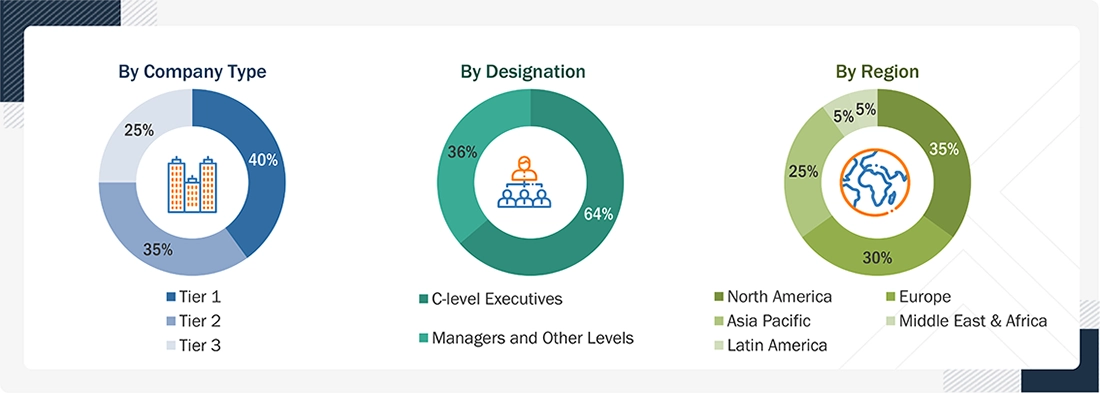
Note: Tier 1 companies receive revenues higher than USD 10 billion; Tier 2 companies' revenues range between USD 1 and 10 billion; and Tier 3 companies' revenues range between USD 500 million and USD 1 billion. Other designations include sales, marketing, and product managers.
To know about the assumptions considered for the study, download the pdf brochure
Market Size Estimation
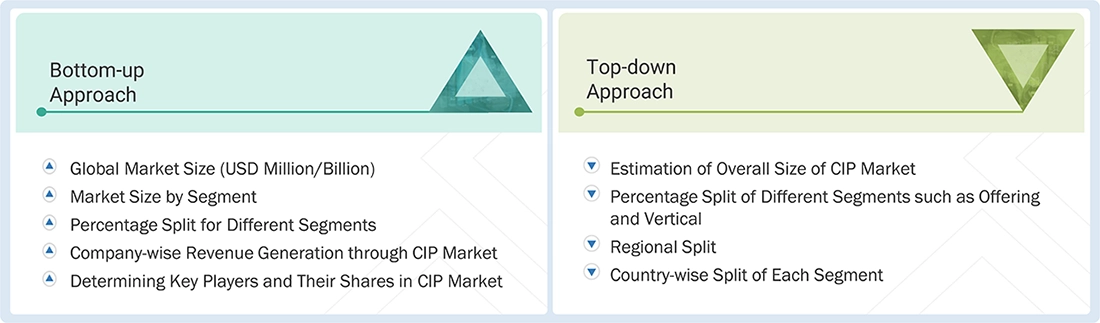
Top-down and bottom-up approaches were employed to estimate and validate the size of the CIP market, as well as the size of various dependent sub-segments within the overall CIP market. The research methodology used to estimate the market size includes the following details: critical players in the market were identified through secondary research, and their market shares in the respective regions were determined through primary and secondary research. This procedure involved reviewing the annual and financial reports of the top market players and conducting extensive interviews with key industry leaders, including CEOs, VPs, directors, and marketing executives, to gather valuable insights.
All percentage splits and breakdowns were determined using secondary sources and verified through primary sources. All parameters that affect the market covered in this research study were accounted for, examined in detail, verified through primary research, and analyzed to produce the final quantitative and qualitative data. This data was consolidated and added to detailed inputs and analysis from MarketsandMarkets.
Critical Infrastructure Protection Market : Top-Down and Bottom-Up Approach
Data Triangulation
The market was split into several segments and subsegments after arriving at the overall market size using the market size estimation processes explained above. Wherever applicable, data triangulation and market breakup procedures were used to complete the overall market engineering process and arrive at the exact statistics for each market segment and subsegment. The data was triangulated by studying various factors and trends from both the demand and supply sides.
Key Stakeholders
- Chief technology and data officers
- Government bodies and public safety agencies
- Project managers
- Developers
- Business analysts
- Quality assurance (QA)/Test engineers
- CIP specialists
- CIP solution and service providers
- Consulting firms
- Third-party vendors
- Investors and venture capitalists
- System integrators (SIs)
Report Objectives
- To define, describe, and forecast the CIP market based on offering, vertical, and region
- To provide detailed information on major factors, such as drivers, opportunities, restraints, and challenges, influencing market growth
- To forecast the size of the market segments across five main regions: North America, Europe, Asia Pacific, Middle East & Africa, and Latin America
- To analyze subsegments of the market with respect to individual growth trends, prospects, and contributions to the overall market
- To profile the key players of the market and comprehensively analyze their market shares and core competencies
- To map the competitive intelligence based on company profiles, key player strategies, and game-changing developments, such as product enhancements/launches, collaborations, and acquisitions
- To track and analyze competitive developments, such as product enhancements/launches, acquisitions, partnerships, and collaborations, in the global CIP market
Available customizations:
With the given market data, MarketsandMarkets offers customizations based on company-specific needs. The following customization options are available for the report:
Geogrphic Analysis
- Further breakup of the Asia Pacific market into countries contributing to the remaining regional market size.
- Further breakup of the North American market into countries contributing to the remaining regional market size.
- Further breakup of the Latin American market into countries contributing to the remaining regional market size.
- Further breakup of the Middle East & African market into countries contributing to the remaining regional market size.
- Further breakup of the European market into countries contributing to the remaining regional market size.
Company Information
- Detailed analysis and profiling of additional market players (up to 5)
Get the Full Critical Infrastructure Protection Market Report
Full forecast, segment splits, and company analysis for all Critical Infrastructure Protection Market.
- US Critical Infrastructure Protection Market
- Canada Critical Infrastructure Protection Market
- UK Critical Infrastructure Protection Market
- France Critical Infrastructure Protection Market
- Italy Critical Infrastructure Protection Market
- China Critical Infrastructure Protection Market
- Japan Critical Infrastructure Protection Market
- India Critical Infrastructure Protection Market
- UAE Critical Infrastructure Protection Market
- South Africa Critical Infrastructure Protection Market
- Brazil Critical Infrastructure Protection Market
- Mexico Critical Infrastructure Protection Market
Need a Tailored Report?
Customize this report to your needs
Get 10% FREE Customization
Customize This Report
