
Japan Data Center Solutions Market (2026-2031)

The Japan Data Center Solutions Market was valued at $50155.7 Million in 2026 and projected to reach to $126588.1 Million by 2031, representing a compound annual growth rate of CAGR 20.3%. Japan's data center solutions market is positioned for exceptional growth through 2031, driven by widespread cloud migration, artificial intelligence deployment, and enterprise digital transformation initiatives.


| Market Size in | USD 26.32 MN |
| Market Forecast in | |
| CAGR | |
| Forecast Period | |
| Units Considered | Value (USD MN) |
Japan Data Center Solutions Market Trends and Insights
- This represents a compound annual growth rate of 20.3%, reflecting Japan's strategic position as a leading technology hub in Asia Pacific.
- Japan's market growth is driven by increasing cloud adoption, digital transformation initiatives, and rising demand for edge computing infrastructure across enterprise and hyperscale segments. The forecast period through 2031 demonstrates Japan's commitment to modernizing its digital infrastructure and supporting next-generation technologies.
- Japan's data center solutions sector benefits from strong government support for digital innovation, substantial investments in AI and IoT capabilities, and the nation's focus on building resilient, secure data infrastructure.
- Japan's market dynamics are shaped by both domestic demand from financial services, manufacturing, and telecommunications sectors, as well as regional demand from multinational corporations establishing Asia Pacific operations. Japan's competitive landscape features a mix of global technology leaders and domestic providers, all competing to capture market share in this high-growth segment.
- Japan's strategic geographic location, advanced technological capabilities, and regulatory framework position the country as a critical node in Asia Pacific's data center ecosystem through 2031..
Key Market Statistics
- CAGR (2026-2031) CAGR 20.3%
- Market Size, 2026 ~USD 50155.7 Million
- Forecast, 2031 ~USD 126588.1 Million
- Country Japan
Japan Data Center Solutions Market Overview
Explosive Growth Trajectory :
Japan's data center solutions market is projected to grow from $50,155.7 million in 2026 to $126,588.1 million by 2031, representing a robust 20.3% CAGR, outpacing the global average of 20.1%.
Asia Pacific Technology Leadership :
Japan maintains its strategic position as a leading technology hub in Asia Pacific, driving regional demand for advanced data center infrastructure and cloud-based solutions across enterprise and government sectors.
Digital Transformation Catalyst :
Accelerating digital transformation initiatives across Japanese enterprises, coupled with increased cloud adoption and AI integration, are fueling unprecedented demand for scalable, secure data center solutions.
Government & Enterprise Investment :
Strong government support for digital infrastructure modernization and substantial corporate investments in edge computing and hybrid cloud architectures are propelling market expansion across Japan.
Japan Data Center Solutions Market Dynamics
- The nation's advanced technological infrastructure and commitment to digital innovation create a compelling environment for data center expansion.
- Major Japanese corporations and government agencies are increasingly investing in next-generation data center capabilities to support emerging technologies and ensure competitive advantage in the global digital economy. The market will be shaped by growing demand for edge computing, enhanced cybersecurity solutions, and sustainable data center operations.
- Japan's focus on energy efficiency and green technology adoption will drive innovation in cooling systems and renewable energy integration.
- Strategic partnerships between local providers and global technology leaders will accelerate market penetration, while regulatory frameworks supporting data sovereignty and privacy will create additional opportunities for specialized data center solutions tailored to Japanese market requirements..
Market Ecosystem
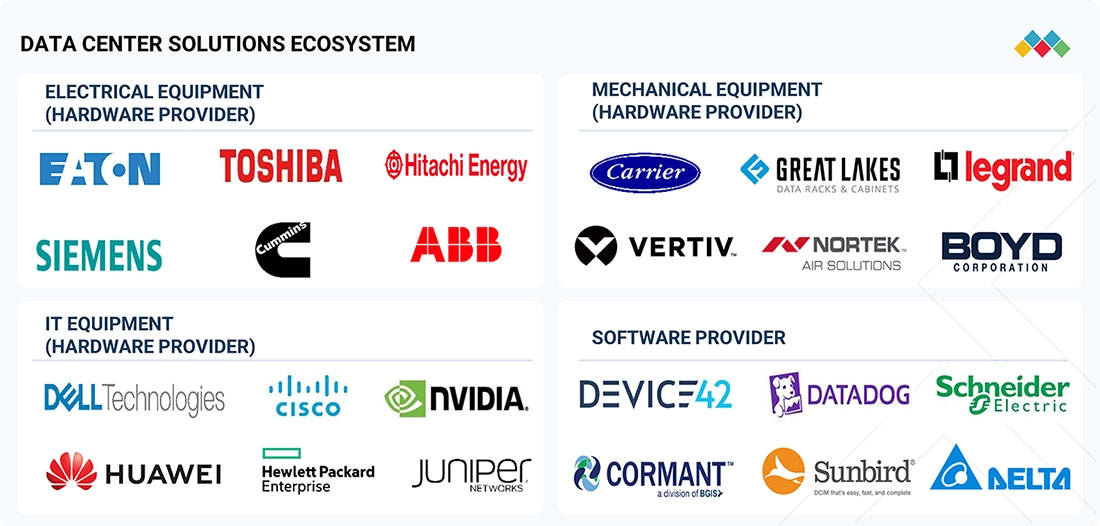
DATA CENTER SOLUTIONS MARKET: COMMERCIAL USE CASES ACROSS INDUSTRIES
| COMPANY | USE CASE DESCRIPTION | BENEFITS |
|---|---|---|
 |
The University of Winchester deployed Eaton’s Intelligent Power Management (IPM) software integrated with VMware vCenter, UPS systems, and lithium-ion battery technology to strengthen power management and improve visibility across its data center infrastructure. | Improved uptime through predictive monitoring | Reduced battery-related failures | Enhanced operational reliability | Better preparedness for future capacity requirements |
 |
Oxygen DC implemented Vertiv’s AFC cooling systems, power management solutions, CRV cooling units, and monitoring technologies to develop scalable colocation facilities powered by renewable energy. | Supported AI and HPC workloads | Improved energy efficiency | Enabled phased infrastructure expansion | Enhanced cooling and power reliability |
 |
Deutsche Bahn AG deployed Stulz cooling systems and intelligent environmental controls across battery storage and substation facilities to improve thermal management and operational efficiency. | Delivered cooling redundancy | Energy-efficient operation | Improved infrastructure monitoring | Reliable performance for critical power environments |
 |
ED Netze GmbH implemented Schneider Electric’s medium-voltage switchgear with integrated sensors and digital monitoring capabilities to modernize grid and power distribution infrastructure. | Improved grid reliability | Enabled predictive maintenance | Supported sustainability objectives | Enhanced long-term operational efficiency |
 |
Scott Data Center installed Caterpillar diesel generator systems, paralleling switchgear, and resilient backup power infrastructure to support mission-critical data center operations. | Achieved high availability | Seamless power transition during outages | Improved operational resilience | Reliable backup power for critical workloads |
Logos and trademarks shown above are the property of their respective owners. Their use here is for informational and illustrative purposes only.
Related Ecosystem
Cloud Computing
- Software as A Service (SaaS)
- Natural Language Processing (NLP)
- Platform as A Service (PaaS)
- Machine Learning
- Supply Chain Management
- International Business Machines Corporation
- MICROSOFT CORPORATION
- Oracle Corporation
- Amazon.com, Inc.
Data Centre And Networking
- Software-Defined Networking (SDN)
- Mid-Sized Data Centers
- Small Data Centers
- Remote Monitoring
- Smart Healthcare
- Cisco Systems, Inc.
- HUAWEI TECHNOLOGIES CO LTD
- Hewlett Packard Enterprise Company
- MITSUBISHI ELECTRIC INFORMATION SYSTEMS CORPORATION
- MITSUBISHI ELECTRIC INFORMATION NETWORK CORPORATION
Electrical System And Components
- Natural Language Processing (NLP)
- Sensors
- Machine Learning
- Temperature Sensors
- Actuators
- ABB India Limited
- Siemens ag
- SCHNEIDER ELECTRIC SE
- Eaton Corporation plc
- Lenovo
Key Takeaways
- Japan's data center solutions market will grow from $50.2B (2026) to $126.6B (2031) at a 20.3% CAGR, outpacing global growth rates.
- Japan's market expansion is fueled by cloud migration, AI infrastructure investments, and enterprise digital transformation across key sectors.
- Japan's strategic position in Asia Pacific makes it a critical hub for multinational corporations and regional data center operations.
- Japan's regulatory environment and technological capabilities attract both domestic and international data center solution providers through 2031.
Data Center Solutions Market Report Scope
| Report Metric | Details |
|---|---|
| Base Year | 2026 |
| Fastest Growing Segment | ECONOMIZER SYSTEMS (Other Mechanical & Cooling Infrastructure) |
| Forecast Period | 2026-2031 |
| Growth Rate | CAGR of 20.1% from 2026 to 2031 |
| Largest Segment | INFRASTRUCTURE (Component) |
| Market Size Base Year (Billions) | ~USD 534.9 (2026) |
| Revenue Forecast (Billions) | ~USD 1336.55 (2031) |
| Segments Covered | Component, Infrastructure, Data Center It & Networking Infrastructure, Server Type, Storage Type, Data Center Power Infrastructure, Critical Power, Power Backup, Power Distribution, Other Mechanical & Cooling Infrastructure, Data Center Physical Infrastructure, Rack Type, Cabling, Software, Workload Type, Tier Type, Data Center Size, Data Center Type, Data Center Mechanical & Cooling Infrastructure |
Japan Data Center Solutions Market Report Segmentation
19 segment dimensions are covered across the global market.
By Component
- Coolant Distribution Units (Cdus)
- Data Center Fan Coil Units (Fcus)
- Heat Exchangers
- Infrastructure
- Others (Cold Plates, Tanks, Compressors, Etc.)
- Power Management Controllers
- Processors
- Software
By Infrastructure
- Data Center It & Networking Infrastructure
- Data Center Mechanical & Cooling Infrastructure
- Data Center Mechanical Cooling Infrastructure
- Data Center Physical Infrastructure
- Data Center Power Infrastructure
By Data Center It & Networking Infrastructure
- Chips
- Networking
- Server
- Servers
- Storage
By Server Type
- Blade Servers
- Gpu Servers
- Others (Twin Servers)
- Rackmount Servers
- Tower Servers
By Storage Type
- AI & Hpc Networking Hardware
- Das (Direct-Attached Storage)
- Nas (Network-Attached Storage)
- Network Interface & Offload Hardware
- Routers
- San (Storage Area Network)
- Switches
By Data Center Power Infrastructure
- Backup Power Generation System
- Critical Power
- Power Distribution
- Switchgear
By Critical Power
- Battery Backup Units (Bbus)
- Bess
- Flywheel Energy Storage System
- Ups
By Power Backup
- Fuel Cells
- Gas Turbines
- Generators
By Power Distribution
- Busbar/Busway Systems
- Pdu
- Power Switching
- Rpps (Remote Power Panel)
- Switchboards
- Transformers
By Other Mechanical & Cooling Infrastructure
- Containment Systems
- Economizer Systems
- Heat Pumps
- Insulation Material
By Data Center Physical Infrastructure
- Cabling
- Racks
By Rack Type
- Enclosed Racks
- Open-Frame Racks
By Cabling
- Cable
- Power Connectors
By Software
- Analytics & Aiops Software
- Building/Facility Management Software
- Compliance & Security Software
- Dcim Software
- Virtualization & Orchestration Software
By Workload Type
- General Purpose It
- Hpc & AI
By Tier Type
- Tier 1
- Tier 2
- Tier 3
- Tier 4
By Data Center Size
- Large Data Centers
- Medium Data Centers
- Small Data Centers
By Data Center Type
- Colocation Data Centers
- Edge Data Centers
- Enterprises Data Centers
- Hyperscale Data Centers
By Data Center Mechanical & Cooling Infrastructure
- Air Cooling
- Liquid Cooling
- Other Mechanical & Cooling
Target Audience
- Japanese Enterprise IT Leaders : CIOs and IT directors managing digital transformation initiatives need market intelligence to evaluate data center investments, cloud migration strategies, and infrastructure modernization roadmaps aligned with Japan's market evolution.
- Data Center & Cloud Providers : Infrastructure providers and cloud service operators require detailed market analysis to identify growth opportunities, assess competitive positioning, and develop Japan-specific service offerings and expansion strategies.
- Government & Public Sector Agencies : Japanese government bodies and public institutions planning digital infrastructure investments need market data to inform procurement decisions, infrastructure modernization programs, and technology adoption policies.
- Technology Investors & PE Firms : Investment professionals evaluating opportunities in Japan's ICT sector require comprehensive market sizing, growth forecasts, and competitive landscape analysis to identify high-potential investment targets and exit opportunities.
- System Integrators & Solution Providers : Japanese and international systems integrators need market insights to develop tailored data center solutions, identify partnership opportunities, and align service portfolios with evolving customer requirements in Japan's growing market.
Reasons to Buy this Report
- Market-Specific Growth Intelligence : Gain detailed insights into Japan's unique market dynamics, including localized drivers of the 20.3% CAGR and competitive landscape specific to Japanese enterprises and government agencies.
- Investment Decision Support : Access comprehensive forecasts and market sizing data ($50.2B to $126.6B) to inform capital allocation decisions, M&A strategies, and expansion planning within Japan's high-growth data center sector.
- Competitive Positioning Analysis : Understand Japan-specific competitive dynamics, key market players, and differentiation opportunities to develop targeted go-to-market strategies and enhance market share in this strategic Asia Pacific hub.
- Regulatory & Compliance Framework : Navigate Japan's unique regulatory environment, data sovereignty requirements, and compliance standards that shape data center operations and create specialized market opportunities for compliant solutions.
- Technology Trend Alignment : Identify Japan-specific technology adoption patterns, including cloud migration priorities, edge computing demand, and AI infrastructure requirements to align product development and service offerings.
Frequently asked questions
What is the projected size of Japan's data center solutions market by 2031?
Japan's data center solutions market is projected to reach $126,588.1 million by 2031, growing from $50,155.7 million in 2026.
What is the CAGR for Japan's data center solutions market?
Japan's data center solutions market is expected to grow at a compound annual growth rate of 20.3% between 2026 and 2031.
What are the primary drivers of growth in Japan's data center market?
Japan's market growth is driven by cloud adoption acceleration, digital transformation initiatives, AI infrastructure demand, edge computing expansion, and enterprise modernization across financial services, manufacturing, and telecommunications sectors.
Why is Japan important for Asia Pacific data center solutions?
Japan serves as a critical regional hub due to its advanced technological infrastructure, strong regulatory framework, geographic location, and appeal to multinational corporations establishing Asia Pacific operations.
Who are the key players in Japan's data center solutions market?
Japan's market includes global technology leaders and domestic providers competing across infrastructure, cloud services, edge computing, and managed data center solutions segments.
RESEARCH METHODOLOGY
This research study on the data center solutions market relied on extensive secondary sources, including directories, IEEE Communication-Efficient: Algorithms and Systems, the International Journal of Innovation and Technology Management, and paid databases. Primary sources were mainly industry experts from the core and related industries, preferred data center solution providers, third-party service providers, consulting service providers, end users, and other commercial enterprises. In-depth interviews were conducted with primary respondents, including key industry participants and subject matter experts, to obtain and verify critical qualitative and quantitative information and assess the market’s prospects.
Secondary Research
In the secondary research process, various sources were referred to identify and collect information for this study. Secondary sources included annual reports, press releases, and investor presentations of companies; white papers, journals, and certified publications; and articles from recognized authors, directories, and databases. The data was also collected from other secondary sources, such as journals, government websites, blogs, and vendors’ websites. Additionally, the data center solutions spending of various countries was extracted from the respective sources.
Primary Research
In the primary research process, various primary sources from the supply and demand sides were interviewed to obtain qualitative and quantitative information on the market. The primary sources from the supply side included industry experts, such as Chief Experience Officers (CXOs), Vice Presidents (VPs), and directors specializing in business development, marketing, and data center solutions. It also included key executives from data center solution vendors, system integrators (SIs), professional service providers, industry associations, and other key opinion leaders.
Breakdown of primary profiles:
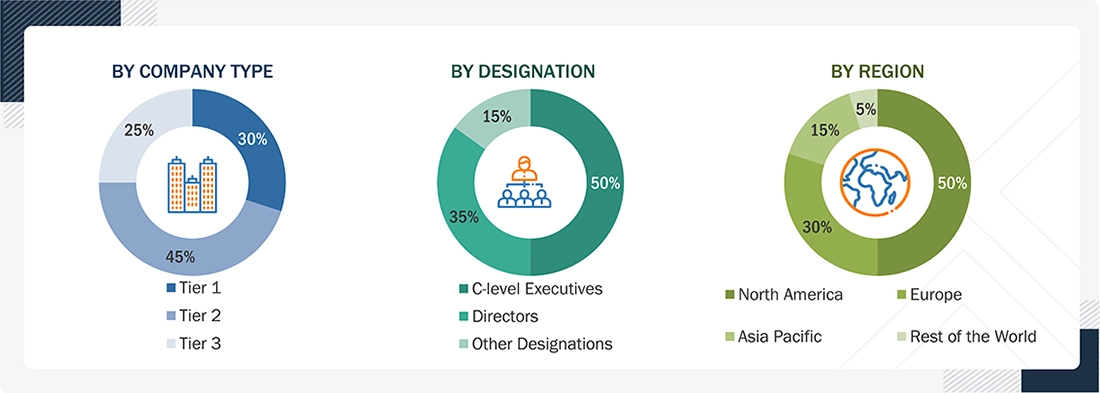
Note: Tier 1 companies’ revenues are more than USD 10 billion; tier 2 companies’ revenues range between USD 1 and 10 billion; and tier 3 companies’ revenues range between USD 500 million and USD 1 billion. Other designations include sales managers, marketing managers, and product managers.
Source: Industry Experts
To know about the assumptions considered for the study, download the pdf brochure
Market Size Estimation
Multiple approaches were adopted to estimate and forecast the data center solutions market. The first approach involved estimating the market size based on companies’ revenue generated through the sale of data center solutions.
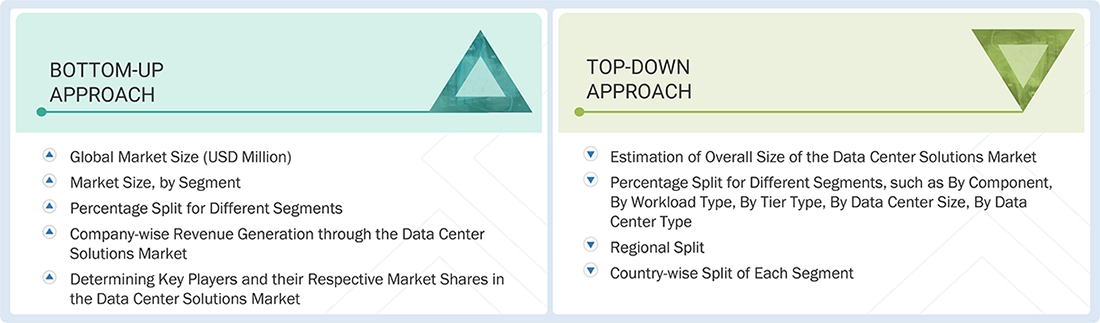
Market Size Estimation Methodology: Top-down Approach
The top-down approach produced an exhaustive list of vendors offering products in the data center solutions market. The revenue contribution of the market vendors was estimated through annual reports, press releases, funding, investor presentations, paid databases, and primary interviews. Each vendor’s offerings were evaluated based on platform, degree of customization, type, application, end user, and region. The markets were triangulated through primary and secondary research. The primary procedure involved extensive interviews with industry leaders, including CIOs, CEOs, VPs, directors, and marketing executives, to gather key insights. The market numbers were further triangulated with the existing MarketsandMarkets’ data repository for validation.
Market Size Estimation Methodology: Bottom-up Approach
In the bottom-up approach, the adoption rate of data center solutions among different verticals in key countries, concerning their regions contributing the most to the market share, was identified. For cross-validation, the adoption of data center solutions among enterprises, along with different use cases for their regions, was identified and extrapolated. Use cases identified in different areas were given weightage for the market size calculation.
Based on the market numbers, the regional split was determined by primary and secondary sources. The procedure included an analysis of the data center solutions market’s regional penetration. Based on secondary research, the regional spending on Information and Communications Technology (ICT), socioeconomic analysis of each country, strategic vendor analysis of major data center solution providers, and organic and inorganic business development activities of regional and global players were estimated.
Data Center Solutions Market : Top-Down and Bottom-Up Approach
Data Triangulation
After determining the overall market size using the market size estimation processes as explained above, the market was split into several segments and subsegments. Data triangulation and market breakdown procedures were employed, wherever applicable, to complete the overall market engineering process and arrive at the exact statistics of each market segment and subsegment. The overall market size was then used in the top-down procedure to estimate the size of other individual markets via percentage splits of the market segmentation.
Market Definition
The data center solutions market refers to the collection of technologies, hardware, software, and services that enable the design, construction, operation, and optimization of data centers for secure, reliable, and scalable digital operations. This market includes systems for IT infrastructure (servers, storage, networking), power and cooling, racks, cabling, and monitoring, supporting workloads from enterprise IT to artificial intelligence and cloud computing. Data center solutions ensure uptime, energy efficiency, compliance, and high-performance processing, allowing organizations to meet growing digital, regulatory, and sustainability demands while underpinning transformation across industries and global cloud and digital platforms.
Key Stakeholders
- IT service providers
- Support infrastructure equipment providers
- Component providers
- Software providers
- System integrators
- Network service providers
- Consulting service providers
- Professional service providers
- Distributors and resellers
- Cloud providers
- Colocation providers
- Enterprises
- Government and standardization bodies
- Telecom operators
- Healthcare organizations
Report Objectives
- To define, describe, and forecast the data center solutions market based on Component (Infrastructure (Data Center Power Infrastructure, Data Center Mechanical & Cooling Infrastructure, Data Center IT & Networking Infrastructure, Data Center Physical Infrastructure), Software (DCIM Software, Building/Facility Management Software, Virtualization & Orchestration Software, Compliance & Security Software, Analytics & AIOps Software)), Workload Type (HPC & AI, General Purpose IT), Tier Type (Tier 1, Tier 2, Tier 3, Tier 4), Data Center Size (Small Data Centers, Medium-Sized Data Centers, Large Data Centers), Data Center Type (Hyperscale Data Center, Colocation Data Center, Enterprise Data Center), and Region (North America, Europe, Asia Pacific, Middle East & Africa, and Latin America)
- To forecast the market size of five major regional segments: North America, Europe, Asia Pacific, the Middle East & Africa, and Latin America
- To strategically analyze the market subsegments with respect to individual growth trends, prospects, and contributions to the total market
- To provide detailed information related to the major factors influencing the growth of the market (drivers, restraints, opportunities, and challenges)
- To strategically analyze macro and micro markets with respect to growth trends, prospects, and their contributions to the overall market
- To analyze industry trends, patents and innovations, and pricing data related to the market
- To analyze the opportunities in the market for stakeholders and provide details of the competitive landscape for major players
- To analyze the impact of AI/generative AI on the market
- To profile key players in the market and comprehensively analyze their market share/ranking and core competencies
- To track and analyze competitive developments such as mergers & acquisitions, product launches, and partnerships & collaborations in the market
Available customizations:
With the given market data, MarketsandMarkets offers customizations as per the company’s specific needs. The following customization options are available for the report:
Product Analysis
- The product matrix provides a detailed comparison of the product portfolio of each company.
Regional Analysis
- Further breakup of the North American data center solutions market
- Further breakup of the European data center solutions market
- Further breakup of the Asia Pacific data center solutions market
- Further breakup of the Middle East & Africa data center solutions market
- Further breakup of the Latin American data center solutions market
Company Information
- Detailed analysis and profiling of additional market players (up to five)
Get the Full Data Center Solutions Market Report
Full forecast, segment splits, and company analysis for all Data Center Solutions Market.
- India Data Center Solutions Market
- South Africa Data Center Solutions Market
- Brazil Data Center Solutions Market
- Mexico Data Center Solutions Market
- Rest Of Europe Data Center Solutions Market
- Spain Data Center Solutions Market
- Canada Data Center Solutions Market
- US Data Center Solutions Market
- UK Data Center Solutions Market
- Germany Data Center Solutions Market
- France Data Center Solutions Market
- Italy Data Center Solutions Market
- China Data Center Solutions Market
Need a Tailored Report?
Customize this report to your needs
Get 10% FREE Customization
Customize This Report
