
India Data Center Infrastructure Management Market (2024-2029)

The India Data Center Infrastructure Management Market was valued at $120.5 Million in 2024 and projected to reach to $248.7 Million by 2029, representing a compound annual growth rate of 15.6%. India's Data Center Infrastructure Management market is poised for exceptional growth as enterprises increasingly prioritize operational efficiency and cost optimization in their data center operations.


| Market Size in | USD 26.32 MN |
| Market Forecast in | |
| CAGR | |
| Forecast Period | |
| Units Considered | Value (USD MN) |
India Data Center Infrastructure Management Market Trends and Insights
- This represents a compound annual growth rate of 15.6%, significantly outpacing global averages, driven by India's rapid digital transformation and increasing cloud adoption.
- India's expanding IT infrastructure, coupled with rising demand for efficient data center operations, positions the country as a critical growth hub in the Asia Pacific region. The market in India is fueled by the proliferation of data centers supporting cloud services, e-commerce, and digital payments across the nation.
- India's growing emphasis on data sovereignty and localized infrastructure has accelerated investments in DCIM solutions.
- Between 2024 and 2029, India is expected to witness substantial adoption of advanced monitoring, automation, and energy management technologies within data centers, reflecting the country's commitment to operational efficiency and sustainability..
Key Market Statistics
- CAGR (2024-2029) 15.6% CAGR
- Market Size, 2024 ~USD 120.5 Million
- Forecast, 2029 ~USD 248.7 Million
- Country India
India Data Center Infrastructure Management Market Overview
Exceptional Growth Trajectory :
India's DCIM market is growing at 15.6% CAGR, significantly outpacing the global average of 10.6%, reflecting the country's accelerated digital transformation and enterprise modernization initiatives.
Rapid Market Expansion :
The market is projected to more than double from USD 120.5 million in 2024 to USD 248.7 million by 2029, driven by increasing cloud adoption and data center proliferation across Indian enterprises.
Cloud Infrastructure Boom :
India's expanding IT infrastructure and rising cloud migration initiatives are creating substantial demand for sophisticated data center management solutions among enterprises and service providers.
Digital Economy Catalyst :
Government initiatives like Digital India and Make in India, combined with growing FDI in technology sectors, are accelerating the need for robust DCIM solutions across the country.
India Data Center Infrastructure Management Market Dynamics
- The surge in cloud adoption, coupled with India's emergence as a global IT hub, is driving substantial investments in DCIM technologies.
- Organizations are recognizing the critical need for real-time monitoring, energy management, and capacity planning solutions to support their expanding digital infrastructure. The forecast period through 2029 will witness accelerated adoption of AI-powered DCIM platforms and integrated management solutions across Indian data centers.
- Rising energy costs, regulatory compliance requirements, and the need for sustainable operations will further propel market growth.
- Both domestic enterprises and multinational corporations establishing operations in India will contribute significantly to this expansion, making India one of the fastest-growing DCIM markets globally..
Market Ecosystem
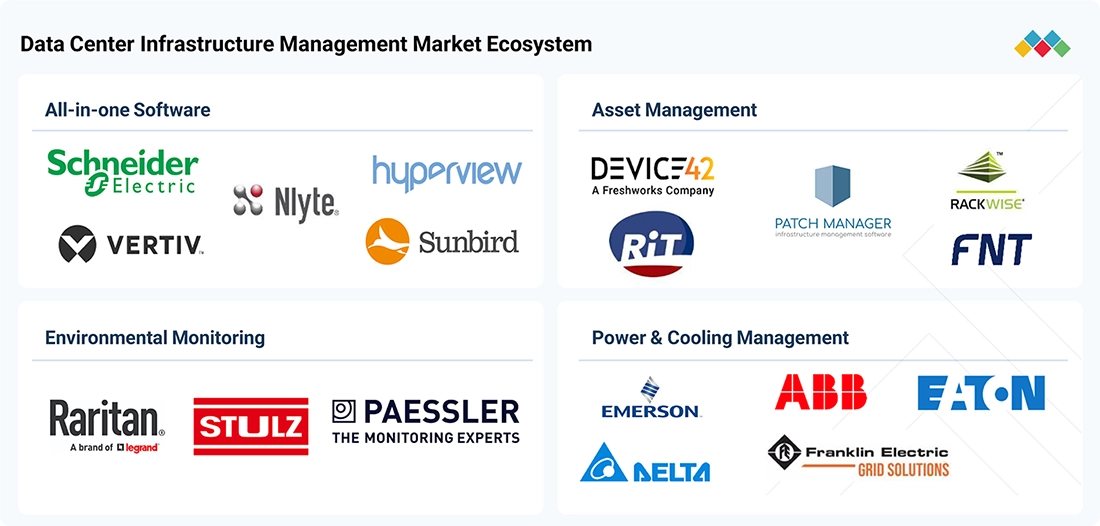
DATA CENTER INFRASTRUCTURE MANAGEMENT MARKET: COMMERCIAL USE CASES ACROSS INDUSTRIES
| COMPANY | USE CASE DESCRIPTION | BENEFITS |
|---|---|---|
 |
Leading Edge Data Centres (LEDC), aiming to bridge the “digital divide” in regional Australia, partnered with Schneider Electric to deploy a network of prefabricated Tier-III edge data centers. LEDC uses EcoStruxure IT and other Schneider Electric infrastructure to monitor and manage its geographically dispersed sites in real time. | LEDC significantly enhanced service reliability and uptime for regional customers by leveraging remote monitoring and proactive analytics. The company also reduced deployment complexity and costs by using Schneider’s prefabricated data center modules, enabling faster and more scalable network roll-out. |
 |
Computacenter, a leading UK-based IT infrastructure services provider, used Nlyte’s DCIM suite to centralize visibility across its data centers (including newly acquired ones) and to model, predict, and optimize capacity. | Computacenter achieved more accurate, usage-based billing and improved SLA alignment through real-time power and capacity visibility. Audit time was reduced from three weeks to under one week, improving data accuracy and compliance. The company also boosted operational efficiency by enabling proactive maintenance and optimizing space, power, and cooling across its facilities. |
 |
Vodafone deployed Sunbird’s DCIM solution to gain real-time insight into its global data centers, leveraging environmental sensors at different rack heights and unified dashboards. With this platform, Vodafone consolidated its asset inventory, capacity management, and power monitoring across all sites. | Using temperature data from the racks, Vodafone identified overcooling and safely raised set-points, resulting in significant energy savings. Vodafone also improved operational agility by having a centralized, real-time view of rack capacity and device relationships, enabling faster deployment decisions. |
 |
FNT Software helped DataVita, a rapidly growing colocation and cloud provider, to document and manage its data center infrastructure using the FNT Command DCIM platform. The system captures all physical, logical, and network assets including cabling, power, cooling, and IT devices in a unified, dynamically updating repository. | DataVita gained full visibility into its infrastructure, significantly improving capacity planning and resource utilization across its two buildings. The platform’s multi-tenancy features ensured data separation and compliance, reducing risk and supporting GDPR requirements. Meanwhile, integrated workflows and real-time asset tracking helped streamline operations, lower operating costs, and accelerate decision-making. |
Logos and trademarks shown above are the property of their respective owners. Their use here is for informational and illustrative purposes only.
Related Ecosystem
Data Centre And Networking
- Software-Defined Networking (SDN)
- Mid-Sized Data Centers
- Small Data Centers
- Remote Monitoring
- Smart Healthcare
- Cisco Systems, Inc.
- HUAWEI TECHNOLOGIES CO LTD
- Hewlett Packard Enterprise Company
- MITSUBISHI ELECTRIC INFORMATION NETWORK CORPORATION
- MITSUBISHI ELECTRIC INFORMATION SYSTEMS CORPORATION
Cloud Computing
- Software as A Service (SaaS)
- Natural Language Processing (NLP)
- Platform as A Service (PaaS)
- Machine Learning
- Supply Chain Management
- International Business Machines Corporation
- MICROSOFT CORPORATION
- Oracle Corporation
- Amazon.com, Inc.
Digitalization And Iot
- Sensors
- Remote Monitoring
- Supply Chain Management
- Passenger Information System (PIS)
- Platform as A Service (PaaS)
- International Business Machines Corporation
- Cisco Systems, Inc.
- MICROSOFT CORPORATION
- Oracle Corporation
- HUAWEI TECHNOLOGIES CO LTD
Key Takeaways
- India's DCIM market is projected to more than double from USD 120.5M (2024) to USD 248.7M (2029), growing at 15.6% CAGR.
- India's rapid digital transformation and cloud adoption are primary drivers accelerating DCIM solution deployment across the country.
- Data sovereignty regulations and localized infrastructure requirements in India are spurring investments in advanced data center management technologies.
- India's focus on energy efficiency and sustainability is driving adoption of DCIM automation and monitoring solutions through 2029.
Data Center Infrastructure Management Market Report Scope
| Report Metric | Details |
|---|---|
| Base Year | 2024 |
| Fastest Growing Segment | PERFORMANCE OPTIMIZATION (Functionality) |
| Forecast Period | 2024-2029 |
| Growth Rate | CAGR of 10.6% from 2024 to 2029 |
| Largest Segment | BFSI (Vertical) |
| Market Size Base Year (Billions) | ~USD 3.03 (2024) |
| Revenue Forecast (Billions) | ~USD 5.01 (2029) |
| Segments Covered | Offering, Dcim Software, Service, Functionality, Deployment Mode, Tier Type, Data Center Size, End User, Vertical, Service Type |
India Data Center Infrastructure Management Market Report Segmentation
10 segment dimensions are covered across the global market.
By Offering
- Dcim Software
- Hardware
- Services
- Software
By Dcim Software
- Monitoring
- Operations & Management
By Service
- Design & Consulting
- Integration & Deployment
- Support & Maintenance
By Functionality
- Asset Management
- Configuration
- Operational Monitoring
- Other Functionalities
- Performance Optimization
- Reporting & Dashboards
By Deployment Mode
- Cloud
- On-Premises
By Tier Type
- Tier 1
- Tier 2
- Tier 3
- Tier 4
By Data Center Size
- Large Data Centers
- Mid-Sized Data Centers
- Small Data Centers
By End User
- Cloud Service Providers
- Enterprises
- Telecom Service Providers
By Vertical
- Bfsi
- Energy & Utilities
- Government & Defense
- Government & Public Sector
- Healthcare
- Healthcare & Life Sciences
- It & Telecom
- Manufacturing
- Other Verticals
- Retail
- Transportation
By Service Type
- Automation Services
- Consolidation Services
- Infrastructure Management Services
- Optimization Services
Target Audience
- DCIM Solution Providers : Vendors need India-specific market data to develop localized products, establish competitive pricing strategies, and identify high-potential customer segments within India's rapidly expanding data center ecosystem.
- Enterprise IT Decision-Makers : CIOs and infrastructure managers require market insights to justify DCIM investments, benchmark against industry standards, and align technology decisions with India's digital transformation roadmap.
- Data Center Operators : Facility managers and operators need comprehensive market analysis to optimize operations, reduce energy costs, and implement best-in-class management practices aligned with India's growing compliance requirements.
- Investment & Consulting Firms : Private equity, venture capital, and management consultants require India market data to identify investment opportunities, assess portfolio company positioning, and guide strategic recommendations in the DCIM sector.
- Government & Policy Bodies : Regulatory agencies and government bodies need market intelligence to develop infrastructure policies, incentivize data center investments, and support India's digital economy growth objectives.
Reasons to Buy this Report
- Market Size & Growth Validation : Obtain precise market valuation data for India (USD 120.5M in 2024) with verified 15.6% CAGR projections through 2029, enabling accurate business planning and investment decisions specific to the Indian market.
- Competitive Positioning Intelligence : Understand India's market dynamics relative to global trends (10.6% global CAGR) to identify competitive advantages and market gaps for DCIM solution providers targeting Indian enterprises.
- Strategic Investment Guidance : Leverage India-specific market insights to guide capital allocation, product development priorities, and go-to-market strategies for maximizing ROI in this high-growth emerging market.
- Customer Segmentation Clarity : Access detailed understanding of India's diverse buyer landscape—from domestic enterprises to multinational corporations—to tailor solutions and marketing approaches for maximum market penetration.
- Risk Mitigation & Forecasting : Utilize comprehensive India market data to anticipate regulatory changes, infrastructure trends, and adoption patterns, enabling proactive strategy adjustments and reduced market entry risks.
Frequently asked questions
What is the current size of India's Data Center Infrastructure Management Market?
India's Data Center Infrastructure Management Market was valued at USD 120.5 million in 2024 and is expected to grow to USD 248.7 million by 2029.
What is the projected growth rate for India's DCIM market?
India's DCIM market is projected to grow at a compound annual growth rate (CAGR) of 15.6% from 2024 to 2029.
What are the main drivers of growth in India's DCIM market?
Key drivers include India's digital transformation, increasing cloud adoption, data sovereignty requirements, and the need for energy-efficient data center operations.
How does India's DCIM market growth compare to global trends?
India's 15.6% CAGR significantly exceeds the global DCIM market CAGR of 10.6%, reflecting India's accelerated digital infrastructure development.
Which sectors are driving DCIM adoption in India?
Cloud services, e-commerce, digital payments, and IT infrastructure sectors are primary drivers of DCIM solution adoption across India.
RESEARCH METHODOLOGY
The study involved four major activities to estimate the data center infrastructure management market. We conducted secondary research to gather information on the market, competitors, and the parent market. The next stage was to validate these findings and assumptions and size them with industry professionals across the value chain through primary research. Top-down and bottom-up methodologies were used to determine the total market size. We used market breakup and data triangulation techniques to estimate the market size of the data center infrastructure management market segments.
Secondary Research
Multiple sources were used to collect data for this research project during the secondary research phase. These included annual reports, press releases, investor presentations, white papers, journals, publications, and articles from reputable sources, as well as directories and databases. Information was also collected from additional secondary sources such as academic journals, official government sites, blogs, and vendor websites.
Primary Research
Primary sources included industry experts from the core and associated industries, preferred software suppliers, hardware manufacturers, distributors, service providers, technology developers, alliances, and organizations representing all parts of the industry's value chain. In-depth interviews were conducted with primary respondents, including major industry participants, subject-matter experts, C-level executives at key market companies, and industry consultants, to collect and verify critical qualitative and quantitative data and to analyze the market's potential.
Primary interviews were conducted to gain insights such as market statistics, current disruptive industry trends, new use cases, revenue data from products and services, market breakdowns, size projections, predictions, and data triangulation. This research also helped to understand various technology trends, segmentation types, industry movements, and geographic factors. Demand-side stakeholders—including Chief Information Officers (CIOs), Chief Technology Officers (CTOs), Chief Security Officers (CSOs), installation teams of governments and end users utilizing data center infrastructure management solutions and services, as well as digital initiatives project teams—were interviewed to understand the buyer's perspective on suppliers, products, service providers, and current service usage, which influence the overall data center infrastructure management market.
Breakup of Primary Profiles:
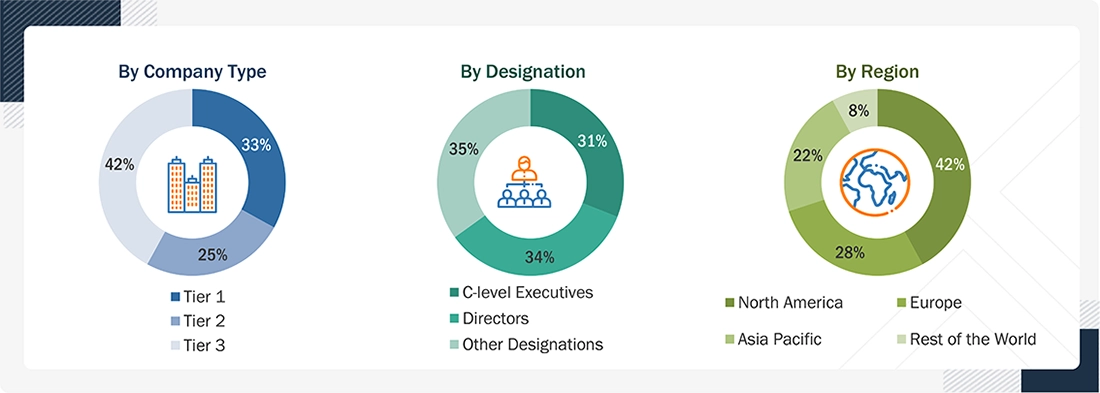
*Others include sales managers, marketing managers, and product managers
Note: Tier 1 – recorded overall annual revenues of more than USD 10 billion; Tier 2 company – USD 1–10 billion; and Tier 3 company – USD 500 million – 1 billion of the overall revenues
To know about the assumptions considered for the study, download the pdf brochure
Market Size Estimation
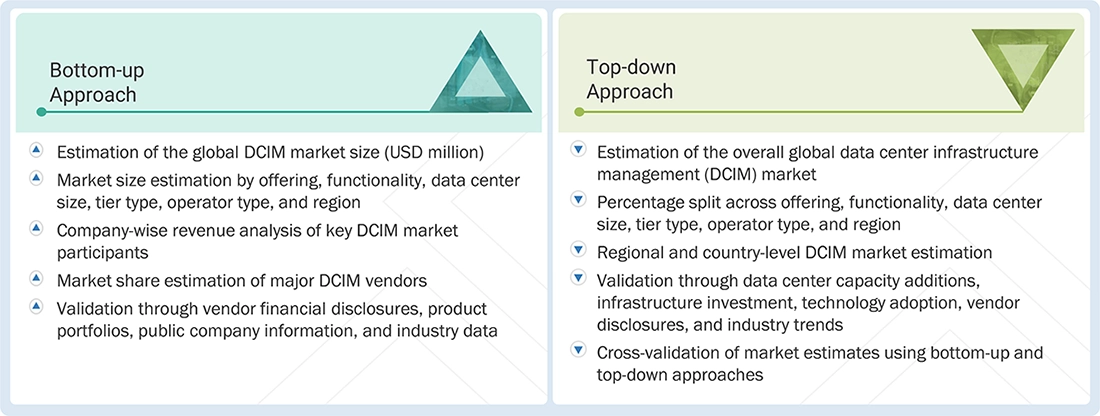
The data center infrastructure management market and related submarkets were estimated and forecasted using top-down and bottom-up methodologies. A bottom-up approach was employed to determine the overall market size by analyzing the revenues and offerings of significant market players. Data triangulation and validation through primary interviews were utilized to establish and confirm the precise value of the parent market. The overall market size was used in the top-down process to estimate the size of other specific markets through percentage splits of market segments.
Top-down and bottom-up approaches were used to estimate and validate the data center infrastructure management market and its dependent subsegments.
The research methodology used to estimate the market size included the following details:
- Key players in the market were identified through secondary research. Their revenue contributions in the respective countries were then determined using primary and secondary research..
- This procedure included studying top market players’ annual and financial reports and extensive interviews for key insights from industry leaders, such as Chief Executive Officers (CEOs), VPs, directors, and marketing executives.
- All percentage splits and breakups were determined using secondary sources and verified through primary sources.
Using top-down and bottom-up methodologies, the data center infrastructure management market and related submarkets were estimated and forecasted. a bottom-up approach was used to calculate the overall market size by analyzing the revenues and offerings of significant market players. data triangulation methods and validation through primary interviews were employed to determine and confirm the precise worth of the entire parent market. the overall market size in the top-down process was used to estimate the size of other specific markets using percentage splits of market segments.
Data Center Infrastructure Management Market : Top-Down and Bottom-Up Approach
Data Triangulation
After determining the overall market size, the market was segmented and subsegmented using the previously described market size estimation techniques. Where applicable, data triangulation and market breakdown methods were used to complete the market engineering process and determine the exact numbers for each market segment and subsegment. The data was triangulated by evaluating multiple elements and trends on the demand and supply sides of the data center infrastructure management (DCIM) market.
Market Definition
Based on input from various sources and associations, data center infrastructure management (DCIM) is defined as “a suite of tools and platforms that a data center can use to control and monitor the IT, facility, and environmental settings across all departments. Flexible integration with IT and facility management enables DCIM systems to provide real-time operating information necessary for more efficient resource utilization, energy conservation, and operational enhancements in a data center.”
Key Stakeholders
- Cloud Service Providers (CSPs)
- Original Equipment Manufacturers (OEMs)
- Data Center Equipment Suppliers
- Colocation Providers
- Technology Services Providers
- Data Center Managed Service Providers
- Government Organizations
- Networking Companies
- Consultants/Consultancies/Advisory Firms
- Support and Maintenance Service Providers
- Telecom Service Providers
- Information Technology (IT) Infrastructure Providers
- System Integrators (SIs)
- Regional Associations
- Independent Software Vendors
- Value-added Resellers and Distributors
Report Objectives
- To define, describe, and forecast the data center infrastructure management (DCIM) market based on offering, functionality, deployment mode, tier type, data center size, end user, and region
- To forecast the market size of the five major regional segments: North America, Europe, Asia Pacific, Middle East & Africa, and Latin America
- To strategically analyze the market subsegments concerning individual growth trends, prospects, and contributions to the total market
- To provide detailed information related to the significant factors influencing the growth of the market (drivers, restraints, opportunities, and challenges)
- To strategically analyze macro and micromarkets concerning growth trends, prospects, and their contribution to the overall market
- To analyze industry trends, patents and innovations, and pricing data related to the market
- To analyze the opportunities in the market for stakeholders and provide details of the competitive landscape for major players
- To profile key players in the market and comprehensively analyze their market share/ranking and core competencies
- To track and analyze competitive developments, such as mergers & acquisitions, product developments, and partnerships & collaborations in the market
Available customizations:
With the given market data, MarketsandMarkets offers customizations per the company's specific needs. The following customization options are available for the report:
Product Analysis
- The product matrix provides a detailed comparison of each company's product portfolio.
Geographic Analysis
- Further breakup of the Asia Pacific market into countries contributing 75% to the regional market size
- Further breakup of the North American market into countries contributing 75% to the regional market size
- Further breakup of the Latin American market into countries contributing 75% to the regional market size
- Further breakup of the Middle Eastern & African market into countries contributing 75% to the regional market size
- Further breakup of the European market into countries contributing 75% to the regional market size
Company Information
-
Detailed analysis and profiling of additional market players (up to 5)
Get the Full Data Center Infrastructure Management Market Report
Full forecast, segment splits, and company analysis for all Data Center Infrastructure Management Market.
- Canada Data Center Infrastructure Management Market
- US Data Center Infrastructure Management Market
- UK Data Center Infrastructure Management Market
- Germany Data Center Infrastructure Management Market
- France Data Center Infrastructure Management Market
- Italy Data Center Infrastructure Management Market
- China Data Center Infrastructure Management Market
- Japan Data Center Infrastructure Management Market
- South Africa Data Center Infrastructure Management Market
- Brazil Data Center Infrastructure Management Market
- Mexico Data Center Infrastructure Management Market
- Rest Of Europe Data Center Infrastructure Management Market
- Rest Of Asia Pacific Data Center Infrastructure Management Market
- Rest Of Latin America Data Center Infrastructure Management Market
- GCC Data Center Infrastructure Management Market
- Rest Of GCC Data Center Infrastructure Management Market
- Saudi Arabia Data Center Infrastructure Management Market
- UAE Data Center Infrastructure Management Market
Need a Tailored Report?
Customize this report to your needs
Get 10% FREE Customization
Customize This Report
