
Japan Data Center Interconnect Market (2025-2030)

The Japan Data Center Interconnect Market was valued at $1166.5 Million in 2025 and projected to reach to $2247.7 Million by 2030, representing a compound annual growth rate of 14.0%. Japan's Data Center Interconnect Market is positioned for sustained expansion through 2030, driven by accelerating cloud adoption among Japanese enterprises and the proliferation of AI-driven applications.


| Market Size in | USD 26.32 MN |
| Market Forecast in | |
| CAGR | |
| Forecast Period | |
| Units Considered | Value (USD MN) |
Japan Data Center Interconnect Market Trends and Insights
- Japan is witnessing accelerating demand for high-speed interconnect solutions driven by cloud infrastructure expansion, AI workload proliferation, and enterprise digital transformation initiatives.
- The 14.0% compound annual growth rate reflects Japan's strategic positioning as a regional technology hub and increasing investments in data center capacity to support regional connectivity demands. Japan's market dynamics are shaped by rising adoption of optical interconnect technologies and growing interconnection between hyperscale data centers across the country.
- Japan's regulatory environment and emphasis on data sovereignty are driving localized data center deployments, which in turn fuel demand for advanced interconnect solutions.
- By 2030, Japan is expected to solidify its role as a critical node in Asia-Pacific data center infrastructure, with interconnect solutions becoming essential to supporting cross-border data flows and regional cloud services..
Key Market Statistics
- CAGR (2025-2030) 14.0% CAGR
- Market Size, 2025 ~USD 1166.5 Million
- Forecast, 2030 ~USD 2247.7 Million
- Country Japan
Japan Data Center Interconnect Market Overview
Market Valuation Growth :
Japan's Data Center Interconnect Market is valued at USD 1,166.5 million in 2025, with projections reaching USD 2,247.7 million by 2030, representing a robust 14% CAGR—outpacing the global average of 11%.
Cloud Infrastructure Expansion :
Japanese enterprises are rapidly adopting cloud-based solutions, driving demand for high-speed interconnect technologies to support seamless data center connectivity and multi-cloud strategies across the region.
AI and Machine Learning Adoption :
Japan's growing AI workload proliferation across financial services, manufacturing, and healthcare sectors is accelerating the need for low-latency, high-bandwidth data center interconnect solutions.
Digital Transformation Initiatives :
Enterprise digital transformation across Japan's major industries is fueling investments in advanced interconnect infrastructure to support real-time data processing and improved operational efficiency.
Japan Data Center Interconnect Market Dynamics
- The region's strong technology infrastructure and digital transformation momentum create favorable conditions for interconnect solution providers.
- Government initiatives supporting digital infrastructure and the rise of edge computing deployments further strengthen market dynamics.
- With a 14% CAGR significantly exceeding global growth rates, Japan represents a high-priority market for vendors seeking to capitalize on Asia-Pacific opportunities.
- Strategic partnerships with local data center operators and cloud providers will be critical for market penetration and sustained competitive advantage in this rapidly evolving landscape..
Market Ecosystem
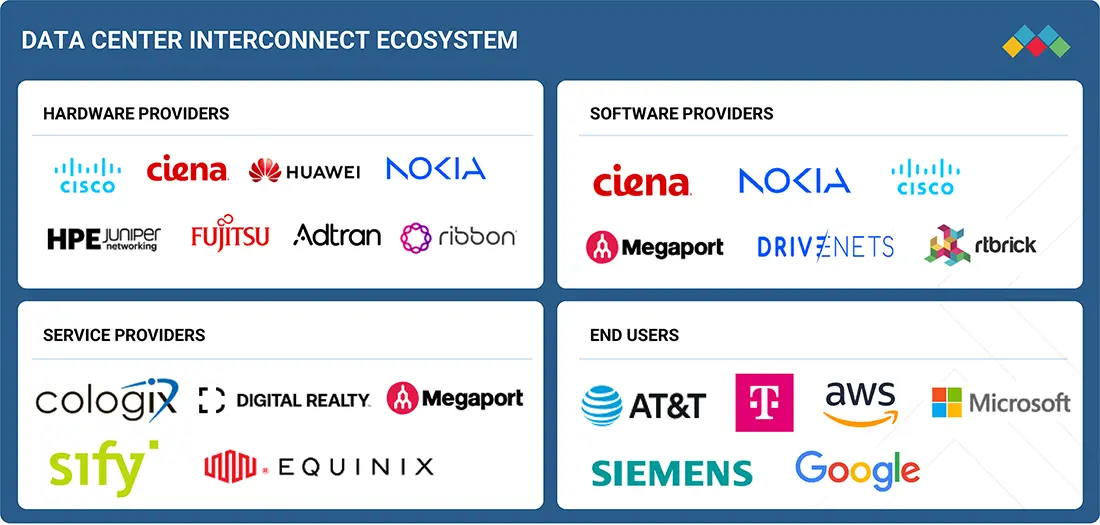
Data Center Interconnect Market TRENDS: COMMERCIAL USE CASES ACROSS INDUSTRIES
| COMPANY | USE CASE DESCRIPTION | BENEFITS |
|---|---|---|
 |
Deployed a global SD-WAN solution combining Cisco’s SD-WAN Cloud Interconnect (SDCI) with Megaport’s Virtual Edge (MVE) to build a dual underlay model for resilient, flexible, and secure multicloud connectivity across three continents | Improved network performance with low-latency and high-resiliency connectivity | Reduced packet loss and jitter | Enhanced security | Eliminated MPLS costs | Delivered agility for multicloud access |
 |
Implemented Extreme Switching, Fabric Connect, and ExtremeCloud IQ Site Engine to modernize the city’s IT infrastructure with centralized management, automation, and analytics for citizen-centric digital services | Smarter and more responsive city network | Real-time insights for decision-making | Reduced IT workload | Improved citizen engagement |Scalable foundation for future smart city initiatives |
 |
Built a cloud data center network with Huawei CloudFabric, leveraging spine-leaf architecture, EVPN, VXLAN, and CE8800/6800/6870 switches to achieve intent-driven networking (IDN) for high-capacity, scalable, and reliable traffic handling | Enhanced network scalability and high availability | Efficient traffic surge management | Smooth evolution toward IDN | Improved performance for VOD, gaming, and online advertising services |
 |
Connected two physically distant data centers in Marseille with a super-fast DCI solution, enabling seamless integration into a single virtualized campus with access to subsea cables and connectivity providers | Created a virtualized data center campus | Ensured high-speed interconnection | Expanded operational scale | Enhanced customer access to global connectivity ecosystems |
 |
Deployed modular optical DCI solution (1830 PSI-M) with programmable PSE-3 coherent DSP modules to scale interconnection capacity across three Madrid metro data centers with redundancy and 400G support | Increased interconnection capacity by 10x | Improved reliability with redundant optical links | Ensured pay-as-you-grow scalability | Supported future bandwidth and peering demands |
Logos and trademarks shown above are the property of their respective owners. Their use here is for informational and illustrative purposes only.
Related Ecosystem
Electronics System And Components
- Sensors
- Temperature Sensors
- Pressure Sensors
- Actuators
- Image Sensors
- Lenovo
- Samsung
- Texas Instruments Incorporated
- HONEYWELL INTERNATIONAL INC.
- Teledyne Technologies Incorporated
Key Takeaways
- Japan's Data Center Interconnect Market is projected to nearly double from USD 1,166.5 million in 2025 to USD 2,247.7 million by 2030, representing a 14.0% CAGR.
- Japan's market growth is driven by hyperscale data center expansion, AI infrastructure deployment, and increasing demand for low-latency interconnect solutions.
- Japan's emphasis on data residency and regulatory compliance is accelerating localized interconnect infrastructure investments across major metropolitan regions.
- Japan's position as a regional technology leader positions the country to capture significant share of Asia-Pacific data center interconnect demand through 2030.
Data Center Interconnect Market Report Scope
| Report Metric | Details |
|---|---|
| Base Year | 2025 |
| Fastest Growing Segment | UTILITY & POWER (Enterprises) |
| Forecast Period | 2025-2030 |
| Growth Rate | CAGR of 11% from 2025 to 2030 |
| Largest Segment | PRODUCTS (Type) |
| Market Size Base Year (Billions) | ~USD 15.36 (2025) |
| Revenue Forecast (Billions) | ~USD 25.89 (2030) |
| Segments Covered | Type, Products, Services, Professional Services, Application, End User, Enterprises, Product |
Japan Data Center Interconnect Market Report Segmentation
8 segment dimensions are covered across the global market.
By Type
- Products
- Services
- Software
By Products
- Optical Dci
- Packet Switching Network
By Services
- Managed Services
- Professional Services
By Professional Services
- Consulting And Integration
- Training, Support, And Maintenance
By Application
- Real-Time Disaster Recovery And Business Continuity
- Shared Data And Resources/Server High-Availability Clusters (Geoclustering)
- Workload (Vm) And Data (Storage) Mobility
By End User
- Carrier Neutral Providers (Cnps)/Internet Content Providers (Icps)
- Carrier-Neutral Providers (Cnps)/Internet Content Providers (Icps)
- Communication Service Providers (Csps)
- Enterprises
- Governments
By Enterprises
- Banking & Finance
- Healthcare
- Media & Entertainment
- Retail & E-Commerce
- Utility & Power
By Product
- Optical Dci
- Packet-Switching Network
Target Audience
- Data Center Operators : Japanese data center providers need detailed market insights to plan infrastructure investments, optimize interconnect capacity, and identify partnership opportunities with equipment vendors and service providers.
- Telecommunications & Network Providers : Telecom companies operating in Japan require market intelligence to develop DCI service offerings, assess competitive positioning, and allocate capital toward high-growth interconnect segments.
- Cloud Service Providers : Japanese and international cloud providers need region-specific data to evaluate market entry strategies, forecast demand for interconnect services, and plan infrastructure expansion across Japan.
- Technology Equipment Vendors : DCI hardware and software vendors require Japan market analysis to refine product strategies, identify key customer segments, and develop localized sales and marketing approaches for the region.
- Enterprise IT Decision Makers : Japanese enterprise CIOs and infrastructure leaders need market insights to benchmark interconnect investments, evaluate vendor solutions, and align technology strategies with industry growth trends.
Reasons to Buy this Report
- Japan-Specific Market Sizing : Access precise valuation data for Japan's DCI market with verified 2025 baseline (USD 1,166.5M) and 2030 forecasts, enabling accurate budgeting and ROI projections for Japan-focused expansion strategies.
- Competitive Landscape Intelligence : Understand Japan's unique competitive dynamics, local vendor positioning, and market consolidation trends specific to the region, differentiating your go-to-market strategy from global competitors.
- Growth Driver Analysis : Identify Japan-specific growth catalysts including cloud adoption rates, AI investment trends, and enterprise digital transformation priorities that directly influence interconnect demand and purchasing decisions.
- Regional Investment Opportunities : Pinpoint high-potential customer segments and geographic hotspots within Japan where DCI adoption is accelerating, optimizing sales resource allocation and partnership development efforts.
- Strategic Planning & Forecasting : Leverage Japan's 14% CAGR outlook to inform 5-year business plans, product roadmaps, and market entry timelines with confidence in region-specific growth trajectories and market maturity indicators.
Frequently asked questions
What is the current size of Japan's Data Center Interconnect Market?
Japan's Data Center Interconnect Market is valued at USD 1,166.5 million in 2025 and is expected to grow to USD 2,247.7 million by 2030.
What is the projected growth rate for Japan's Data Center Interconnect Market?
Japan's Data Center Interconnect Market is projected to grow at a compound annual growth rate (CAGR) of 14.0% from 2025 to 2030.
What are the primary drivers of growth in Japan's Data Center Interconnect Market?
Key growth drivers in Japan include hyperscale data center expansion, AI and machine learning infrastructure deployment, cloud service adoption, and regulatory requirements for data residency.
Which technologies are most in demand in Japan's Data Center Interconnect Market?
Japan's market is increasingly focused on optical interconnect solutions, high-speed Ethernet technologies, and software-defined networking (SDN) solutions that enable efficient data center connectivity.
How does Japan's market compare to the broader Asia-Pacific region?
Japan's 14.0% CAGR outpaces the global average of 11%, reflecting Japan's advanced infrastructure maturity, strong technology sector, and strategic importance as a regional data hub.
RESEARCH METHODOLOGY
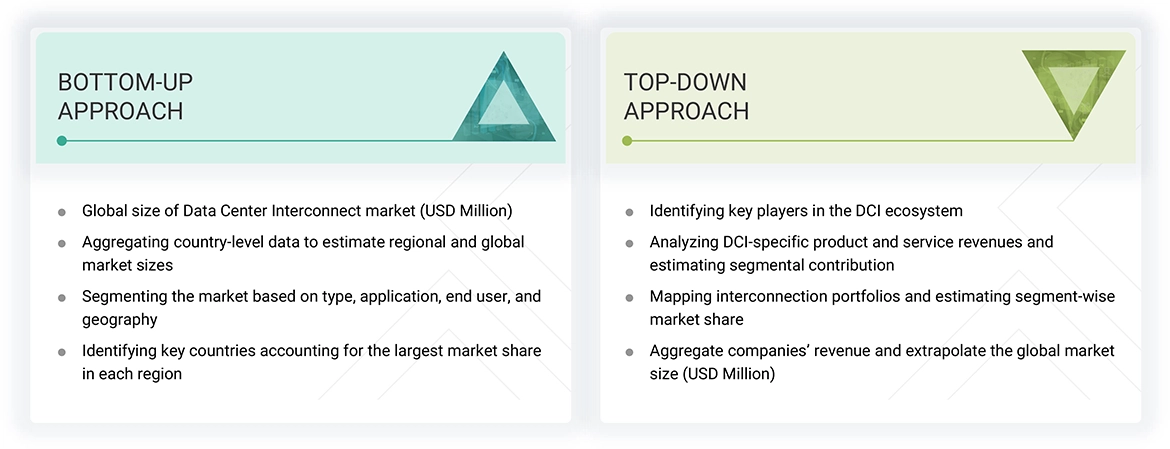
The study involved four main activities to estimate the current size of the data center interconnect market. Comprehensive secondary research gathered information on the market, peer markets, and parent markets. The next step was to validate these findings, assumptions, and sizing with industry experts across the value chain through primary research. Both top-down and bottom-up approaches were used to estimate the overall market size. Subsequently, market segmentation and data triangulation techniques were employed to estimate the sizes of segments and subsegments.
Secondary Research
The secondary research process involved consulting various secondary sources to gather essential information for this study. These sources include annual reports, press releases, investor presentations from companies, white papers, journals and certified publications, and articles from recognized authors, websites, directories, and databases. This research was conducted to obtain critical details about the industry’s supply chain, the market’s value chain, the total pool of key players, market segmentation based on industry trends (down to the most detailed level), regional markets, and significant developments from both market and technology perspectives. The secondary data collected was analyzed to estimate the overall market size, which was further validated through primary research.
Primary Research
Extensive primary research was conducted after understanding the current state of the data center interconnect market through secondary research. Several primary interviews were carried out with experts from both demand and supply sides across four major regions: North America, Europe, Asia Pacific, and RoW. This primary data was gathered through questionnaires, emails, and telephone interviews.
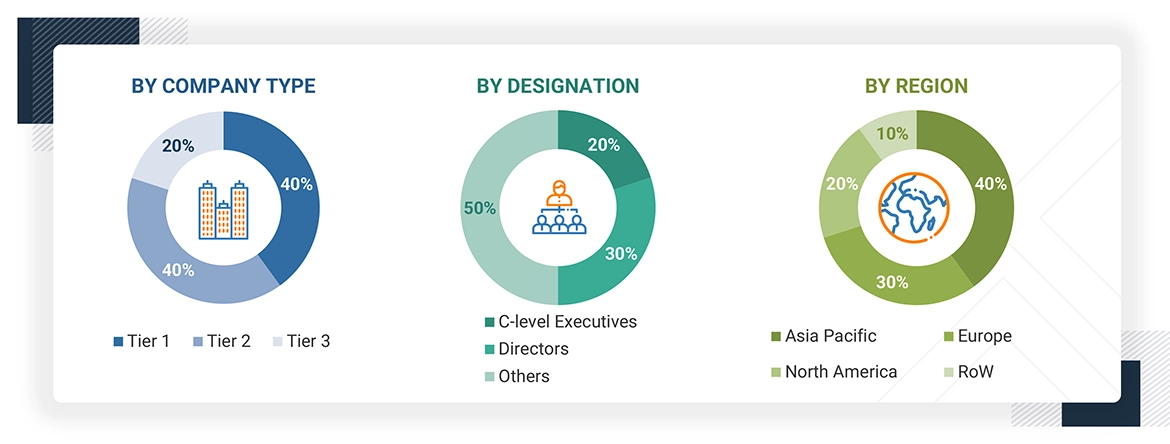
Note: Other designations include technology heads, media analysts, sales managers, marketing managers, and product managers.
The three tiers of the companies are based on their total revenues as of 2024 ? Tier 1: >USD 1 billion, Tier 2: USD 500 million–1 billion, and Tier 3: USD 500 million.
To know about the assumptions considered for the study, download the pdf brochure
Market Size Estimation
In the full market engineering process, top-down and bottom-up methods and various data triangulation techniques were used to estimate and forecast the overall market segments and subsegments listed in this report. Key market players were identified through secondary research, and their market shares in respective regions were determined via primary and secondary research. This process included analyzing annual and financial reports of leading companies and conducting extensive interviews with industry experts — including CEOs, VPs, directors, and marketing executives — to gather key insights (both quantitative and qualitative).
All percentage shares, splits, and breakdowns were derived from secondary sources and confirmed through primary sources. Every factor influencing the markets studied was carefully examined, verified, and analyzed through primary research to produce accurate final quantitative and qualitative data. This information was consolidated and enhanced with detailed inputs and analysis from MarketsandMarkets before being presented in this report.
Data Center Interconnect Market : Top-Down and Bottom-Up Approach
Data Triangulation
After arriving at the overall market size, the market was split into several segments and subsegments using the market size estimation processes explained above. Data triangulation and market breakdown procedures were employed to complete the entire market engineering process and determine the exact statistics of each market segment and subsegment. The data was triangulated by studying various factors and trends from the demand and supply sides in the data center interconnect market.
Market Definition
Data center interconnect (DCI) refers to the technology and infrastructure used to connect two or more data centers over short, medium, or long distances. It enables the smooth transfer of data, workloads, and applications between geographically separated data center facilities. DCI solutions are designed to offer high-speed, low-latency, and highly secure connectivity to support functions such as disaster recovery, workload mobility, data replication, and business continuity. DCI plays a vital role in modern cloud computing, enterprise IT strategies, and multi-location data center architecture by facilitating efficient resource sharing and scalability across multiple sites.
Key Stakeholders
- Companies in the DCI market
- Investment community interested in the DCI market
- Research institutes and organizations
- Government and financial institutions
- Innovative SMEs
- Consultants/ consultancies/ advisory firms
- End users, such as communication service providers (CSPs), carrier-neutral providers (CNPs), internet content providers (ICPs), governments, enterprises, and healthcare organizations
Report Objectives
- To define, describe, and estimate the data center interconnect (DCI) market based on type, application, and end-user
- To forecast the market size with respect to four main regions: North America, Europe, APAC, and the Rest of the World (RoW), in terms of value
- To strategically analyze the micromarkets with respect to individual growth trends, prospects, and contribution to the overall market
- To map competitive intelligence based on company profiles, key player strategies, and key developments
- To identify drivers, restraints, opportunities, and challenges impacting the growth of the market and submarkets
- To provide value chain analysis, ecosystem analysis, case study analysis, patent analysis, trade analysis, technology analysis, pricing analysis, key conferences and events, key stakeholders and buying criteria, Porter’s Five Forces analysis, regulations, impact of AI, and impact of US tariffs pertaining to the market
- To analyze opportunities in the market for stakeholders by identifying high-growth segments of the data center interconnect ecosystem
- To strategically profile the key players in the market and comprehensively analyze their market share and core competencies in each segment
- To benchmark the market players using the proprietary company evaluation matrix framework, which analyzes them on various parameters within the broad categories of market ranking/share and product portfolio
- To analyze competitive developments such as collaboration, partnerships, mergers and acquisitions, product launches and developments, and research & development (R&D) in the data center interconnect market
- To analyze the impact of the macroeconomic outlook for each region
Available customizations:
With the given market data, MarketsandMarkets offers customizations according to the specific requirements of companies. The following customization options are available for the report:
Regional Analysis:
- Further country-wise breakdown and application-specific market data
- Company Information: Detailed analysis and profiling of the DCI market, including additional market players (up to five)
Get the Full Data Center Interconnect Market Report
Full forecast, segment splits, and company analysis for all Data Center Interconnect Market.
- China Data Center Interconnect Market
- India Data Center Interconnect Market
- South Korea Data Center Interconnect Market
- Rest Of Asia Pacific Data Center Interconnect Market
- US Data Center Interconnect Market
- Canada Data Center Interconnect Market
- Rest Of North America Data Center Interconnect Market
- Germany Data Center Interconnect Market
- UK Data Center Interconnect Market
- France Data Center Interconnect Market
- Rest Of Europe Data Center Interconnect Market
Need a Tailored Report?
Customize this report to your needs
Get 10% FREE Customization
Customize This Report
