
Latin America DDoS Protection & Mitigation Security Market (2025-2030)

The Latin America DDoS Protection & Mitigation Security Market was valued at $273.6 Million in 2025 and projected to reach to $518 Million by 2030, representing a compound annual growth rate of 13.6%. Latin America's DDoS Protection & Mitigation Security Market is positioned for substantial growth, expanding from USD 273.6 million in 2025 to USD 518.0 million by 2030.


| Market Size in | USD 26.32 MN |
| Market Forecast in | |
| CAGR | |
| Forecast Period | |
| Units Considered | Value (USD MN) |
Latin America DDoS Protection & Mitigation Security Market Trends and Insights
- Latin America's digital transformation and increasing cyber threats are driving demand for advanced DDoS mitigation solutions across financial services, e-commerce, and government sectors.
- The region's growing internet penetration and cloud adoption are accelerating investment in security infrastructure. Latin America's DDoS protection market is expanding at a compound annual growth rate of 13.6%, outpacing global trends as organizations prioritize network resilience.
- Between 2025 and 2030, Latin America will see heightened adoption of managed DDoS services and hybrid protection models.
- Regulatory compliance requirements and rising awareness of cyber risks are compelling enterprises across Latin America to deploy comprehensive mitigation strategies, positioning the region as a high-growth market within the global security landscape..
Key Market Statistics
- CAGR (2025-2030) 13.6% CAGR
- Market Size, 2025 ~USD 273.6 Million
- Forecast, 2030 ~USD 518 Million
- Geography Latin America
Latin America DDoS Protection & Mitigation Security Market Overview
Rapid Regional Growth :
Latin America's DDoS Protection & Mitigation Security Market is expanding at 13.6% CAGR, outpacing the global rate of 12.3%, driven by accelerating digital transformation and regulatory compliance requirements across the region.
Financial Services Leadership :
Banks and fintech companies in Latin America are prioritizing DDoS mitigation solutions to protect against sophisticated cyber attacks targeting payment systems and customer data, representing the largest end-user segment.
E-commerce & Retail Expansion :
Growing online retail penetration across Latin America is creating urgent demand for DDoS protection as merchants face increasing threats during peak shopping seasons and cross-border transactions.
Government & Critical Infrastructure Focus :
Latin American governments are investing in cybersecurity infrastructure and mandating DDoS protection for critical services, creating new opportunities for solution providers in the public sector.
Latin America DDoS Protection & Mitigation Security Market Dynamics
- This trajectory reflects the region's increasing vulnerability to cyber threats, coupled with mandatory compliance frameworks and digital economy expansion.
- Financial institutions, e-commerce platforms, and government agencies are prioritizing robust DDoS mitigation strategies to safeguard operations and customer trust. The market's 13.6% CAGR demonstrates strong regional momentum as organizations recognize the business-critical nature of DDoS protection.
- Investment in cloud-based and hybrid DDoS solutions is accelerating, particularly among mid-market enterprises seeking cost-effective, scalable defenses.
- Latin America's growing internet penetration and digital payment adoption will continue driving demand for advanced mitigation technologies through 2030..
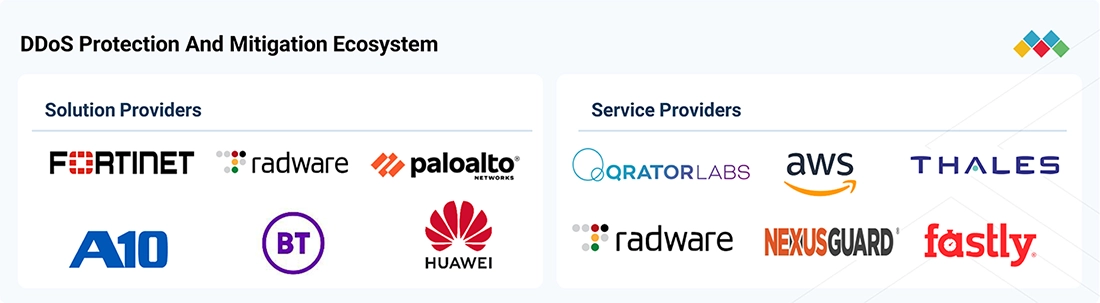
Market Ecosystem
DDOS PROTECTION AND MITIGATION MARKET: COMMERCIAL USE CASES ACROSS INDUSTRIES
| COMPANY | USE CASE DESCRIPTION | BENEFITS |
|---|---|---|
 |
CCP Games deployed Cloudflare Magic Transit and Spectrum to protect its EVE Online gaming infrastructure against persistent DDoS attacks targeting its game servers and IP addresses. The combination provided protection at Layers 3 and 4 across its TCP and IP-based gaming infrastructure, while Cloudflare adapted mitigation controls to CCP Games’ unusual network architecture during an active attack. | Blocked persistent DDoS attacks at Layers 3 and 4 | Protected game infrastructure and player experience | Improved mitigation flexibility for complex network architecture | Reduced need to develop and maintain equivalent protection in-house |
 |
A major US financial institution deployed Akamai Prolexic to protect its digital infrastructure against large-scale DDoS attacks. In September 2023, Prolexic detected and mitigated a multi-vector attack involving ACK, PUSH, RESET, and SYN floods that peaked at 633.7 Gbps and 55.1 Mpps. The attack lasted less than two minutes and was proactively mitigated without affecting the organization’s operations. | Prevented service disruption | Mitigated 633.7 Gbps attack traffic | Protected critical financial infrastructure | Maintained service availability during a high-volume multi-vector attack |
 |
Liberty Life Group implemented Radware’s DDoS protection to strengthen the security and availability of its financial-services infrastructure. Radware's team enabled traffic inspection based on security policies to identify and control malicious traffic, helping the organization reduce unnecessary traffic reaching its network infrastructure while maintaining service availability. | 40% reduction in traffic reaching routers | Improved network cleanliness and traffic visibility | Strengthened protection against DDoS attacks | Improved service availability and user experience |
Logos and trademarks shown above are the property of their respective owners. Their use here is for informational and illustrative purposes only.
Related Ecosystem
Application Security
- Cloud Security
- Security Analytics
- Network Testing
- Web Application Security
- Biometric Security and Authentication System
- International Business Machines Corporation
- MICROSOFT CORPORATION
- Cisco Systems, Inc.
- PALO ALTO NETWORKS, INC
- Fortinet, Inc.
Cyber Security
- Cloud Security
- Biometric Systems
- Data Loss Prevention (DLP)
- Multi-Factor Authentication
- Security Analytics
- International Business Machines Corporation
- Cisco Systems, Inc.
- MITSUI BUSSAN SECURE DIRECTIONS INC
- MICROSOFT CORPORATION
- Allot Ltd.
Endpoint Security
- Cloud Security
- Security Analytics
- Multi-Factor Authentication
- Biometric Security and Authentication System
- Critical Communication Network
- International Business Machines Corporation
- MICROSOFT CORPORATION
- Cisco Systems, Inc.
- PALO ALTO NETWORKS, INC
- Fortinet, Inc.
Key Takeaways
- Latin America's DDoS protection market will nearly double from USD 273.6M (2025) to USD 518.0M (2030), driven by 13.6% CAGR growth.
- Latin America is experiencing accelerated cloud migration and digital transformation, increasing vulnerability to DDoS attacks and security investment.
- Regulatory compliance mandates and financial sector cyber threats are primary growth catalysts for DDoS solutions adoption across Latin America.
- Latin America's managed DDoS services and hybrid protection models are gaining traction as enterprises prioritize cost-effective, scalable security.
DDoS Protection & Mitigation Security Market Report Scope
| Report Metric | Details |
|---|---|
| Base Year | 2025 |
| Fastest Growing Segment | SUPPORT AND MAINTENANCE (Service) |
| Forecast Period | 2025–2030 |
| Growth Rate | CAGR of 12.3% from 2025 to 2030 |
| Largest Segment | LARGE ENTERPRISES (Organization Size) |
| Market Size Base Year (Billions) | ~USD 5.82 (2025) |
| Revenue Forecast (Billions) | ~USD 10.39 (2030) |
| Segments Covered | Offering, Type, Solution Type, Application Area, Deployment Mode, Organization Size, Vertical, Hardware Solution, Service, Professional Service |
Latin America DDoS Protection & Mitigation Security Market Report Segmentation
10 segment dimensions are covered across the global market.
By Offering
- Hardware Solutions
- Services
- Software Solutions
By Type
- Consulting And Advisory
- Design And Implementation
- Managed Services
- Professional Services
- Support And Maintenance
- Training And Education
By Solution Type
- Botnet Detection & Management
- Network Traffic Analyzers
- Other Solution Types
- Threat Mitigation System
- Threat Mitigation Systems
By Application Area
- Application Security
- Cloud Security
- Database Security
- Endpoint Security
- Network Security
By Deployment Mode
- Cloud
- On-Premises
By Organization Size
- Large Enterprises
- Smes
By Vertical
- Bfsi
- Education
- Energy & Utilities
- Energy And Utilities
- Government & Defense
- Healthcare
- It & Ites
- Manufacturing
- Other Verticals
- Retail
- Telecom
By Hardware Solution
- Firewalls
- Intrusion Detection & Prevention Systems
- Load Balancers
- Other Hardware Solutions
By Service
- Managed Services
- Professional Services
By Professional Service
- Consulting And Advisory
- Design And Implementation
- Support And Maintenance
- Training And Education
Target Audience
- Cybersecurity Solution Providers : DDoS protection vendors and managed security service providers need Latin America market intelligence to develop region-specific offerings, pricing strategies, and go-to-market approaches for financial and e-commerce sectors.
- Financial Services Institutions : Banks, payment processors, and fintech companies require detailed market insights to benchmark their DDoS protection investments, understand competitive threats, and ensure regulatory compliance across Latin America.
- E-commerce & Retail Enterprises : Online retailers and marketplace operators need market data to justify DDoS mitigation investments, assess solution providers, and protect revenue during peak trading periods in Latin America.
- Government & Public Sector Agencies : Latin American government bodies and critical infrastructure operators need market intelligence to develop cybersecurity strategies, procurement decisions, and national DDoS resilience frameworks.
- Investment & Consulting Firms : Private equity, venture capital, and management consultants require comprehensive market analysis to identify investment opportunities, assess portfolio companies, and advise clients on Latin America's cybersecurity landscape.
Key Companies in the Latin America DDoS Protection & Mitigation Security Market
| Company | HQ | Ownership | Strongest segments |
|---|---|---|---|
| DELL INC | United States | Public Company | Client Solutions Group (notebooks, desktops, workstations, peripherals),Infrastructure Solutions Group (servers, storage, networking),Financing, consumption models, and other services, |
| CASA SYSTEMS | United States | Private Company | Converged cable access platforms (CCAP/vCCAP),Fixed-line broadband & virtual BNG/multiservice routers,Wireless core (vEPC/5G core) and small cells, |
| MOBILE TELEPHONE NETWORKS | South Africa | Private Company | Prepaid voice and bundles,Mobile data and broadband,Postpaid and high-value hybrid plans, |
| TELENET GROUP | Belgium | Private Company | Fixed broadband and pay TV (residential),Mobile services (retail and wholesale),B2B connectivity and ICT (voice, data, cloud, security), |
| KUDELSKI GROUP | Switzerland | Public Company | Core Digital Security (conditional access, middleware, watermarking, IP licensing),Cybersecurity (advisory, resale, managed security services),Internet of Things (IoT security and related services), |
| NETSCOUT | United States | Public Company | nGeniusONE and service assurance platforms (including ISNG, vSTREAM, Infinistream, test access points),Arbor DDoS and Omnis Cyber Intelligence,Omnis Insights and observability/analytics solutions, |
| AKAMAI TECHNOLOGIES | United States | Public Company | Security solutions (web, API, bot & abuse, account protection),Delivery solutions (web & mobile performance, media delivery, DNS),Cloud computing (compute, storage, cloud-native, networking, App Platform), |
| RADWARE | Israel | Public Company | Cloud WAF, WAAP, and Application Protection Services,Cloud and Hybrid DDoS Protection,Application Delivery and Traffic Management (Alteon, LinkProof NG, SSL Inspection), |
| CLOUDFLARE | United States | Public Company | Application & Network Security (WAF, DDoS, Zero Trust, SWG, CASB, email security),Application Performance & Network Services (CDN, DNS, load balancing, Magic WAN/Transit/Firewall),Developer Platform & Storage (Workers, R2, KV, Durable Objects, AI/Workers AI), |
| FORTINET | United States | Public Company | Secure Networking & Firewalls (FortiGate, SD-WAN, WLAN, secure connectivity),Security Services & Threat Intelligence (FortiGuard, FortiCare, FortiGuard Labs),Cloud, SASE & Cloud-Native Security (FortiSASE, cloud firewalls, CNAPP, CASB), |
| BT | United Kingdom | Public Company | Consumer fixed (broadband, landline, entertainment),Mobile (consumer and business),Enterprise & public sector connectivity and networking, |
DELL INC
Dell Inc. is a United States-based public company founded in 1984 with approximately 97,000 employees, operating as a major technology hardware and services provider.
CASA SYSTEMS
Casa Systems is a United States-based private company founded in 2003 with 1,043 employees, providing software and hardware solutions for media and network operators.
MOBILE TELEPHONE NETWORKS
Mobile Telephone Networks is a South Africa-based private company with 10 employees operating in the telecommunications sector.
TELENET GROUP
Telenet Group is a Belgium-based private company founded in 1994 with 3,467 employees, operating as a media and telecommunications provider.
KUDELSKI GROUP
Kudelski Group is a Switzerland-based public company founded in 1951 with 110 employees, specializing in digital security and content protection solutions.
NETSCOUT
Netscout is a United States-based public company founded in 1984 with 2,063 employees, providing network performance software and cybersecurity solutions.
AKAMAI TECHNOLOGIES
Akamai Technologies is a United States-based public company founded in 1998 with 11,000 employees, operating as a leading content delivery network and cloud services provider.
RADWARE
Radware is an Israel-based public company founded in 1996 with 1,228 employees, specializing in cybersecurity and application delivery solutions.
CLOUDFLARE
Cloudflare is a United States-based public company founded in 2009 with 5,483 employees, providing web performance, security, and reliability services.
FORTINET
Fortinet is a United States-based public company founded in 2000 with 15,311 employees, specializing in network security and cybersecurity solutions.
BT
BT is a United Kingdom-based public company founded in 1846 with 77,200 employees, operating as a major telecommunications and network services provider.
Countries within Latin America - compare and drill down
| Country | 2025 size (native) |
|---|---|
| Brazil | USD 192.2 Million |
| Mexico | USD 194.9 Million |
Country market size visualization
Reasons to Buy this Report
- Regional Market Sizing & Forecasts : Obtain precise market valuations for Latin America (USD 273.6M in 2025, USD 518.0M in 2030) with country-level breakdowns for Brazil and Mexico, enabling targeted investment and expansion strategies.
- Sector-Specific Insights : Understand demand drivers across financial services, e-commerce, and government sectors in Latin America, identifying high-growth verticals and customer pain points unique to the region.
- Competitive Landscape Analysis : Benchmark your DDoS protection offerings against regional competitors and global players entering Latin America, with insights on market positioning and differentiation opportunities.
- Growth Opportunity Identification : Leverage the 13.6% CAGR growth trajectory to identify emerging opportunities in underserved markets, new customer segments, and technology adoption trends across Latin America.
- Strategic Decision Support : Make informed decisions on market entry, partnerships, product development, and resource allocation with comprehensive data on Latin America's DDoS protection market dynamics and future outlook.
Frequently asked questions
What is the current size of the DDoS protection market in Latin America?
The DDoS Protection & Mitigation Security Market in Latin America is valued at USD 273.6 million in 2025 and is expected to grow significantly through 2030.
What is the projected growth rate for DDoS protection in Latin America?
Latin America's DDoS protection market is projected to grow at a compound annual growth rate (CAGR) of 13.6% from 2025 to 2030.
What will be the market size of DDoS protection in Latin America by 2030?
The DDoS Protection & Mitigation Security Market in Latin America is forecast to reach USD 518.0 million by 2030.
Which industries in Latin America are driving DDoS protection demand?
Financial services, e-commerce, government, and telecommunications sectors in Latin America are primary drivers of DDoS protection adoption due to regulatory requirements and cyber threat exposure.
Why is Latin America's DDoS market growing faster than the global average?
Latin America's 13.6% CAGR exceeds the global 12.3% rate due to rapid digital transformation, cloud adoption, increasing cyber threats, and strengthening regulatory compliance frameworks across the region.
RESEARCH METHODOLOGY
Secondary research was conducted to collect information useful for this technical, market-oriented, and commercial study of the DDoS protection and mitigation market. The next step involved validating these findings, assumptions, and sizing with industry experts across the value chain using primary research. Different approaches, including top-down and bottom-up methods, were employed to estimate the total market size. After that, the market breakup and data triangulation procedures were used to estimate the market size of the segments and subsegments of the market.
Secondary Research
During the secondary research process, various secondary sources were consulted to identify and collect information relevant to the study. The secondary sources included annual reports, press releases, investor presentations of vendors, forums, certified publications, and whitepapers in the DDoS protection and mitigation market. The secondary research was mainly used to obtain key information about the industry’s supply chain, the total pool of key players, market classification and segmentation according to industry trends to the bottom-most level, regional markets, and key developments from both market- and technology-oriented perspectives, all of which were further validated by primary sources.
Primary Research
In the primary research process, various primary sources from the supply and demand sides were interviewed to obtain qualitative and quantitative information for this report. The primary sources from the supply side included industry experts such as chief executive officers (CEOs), vice presidents (VPs), marketing directors, technology and innovation directors, and other key executives from major companies and organizations operating in the DDoS protection and mitigation market.
In the market engineering process, top-down and bottom-up approaches were extensively used, along with several data triangulation methods, to estimate and forecast the overall market segments and subsegments listed in this report. Extensive qualitative and quantitative analyses were performed on the complete market engineering process to present key information/insights throughout the report.
After the complete market engineering process (including calculations for market statistics, market breakups, market size estimates, market forecasts, and data triangulation), extensive primary research was conducted to gather information and verify & validate the derived critical numbers. The primary research was also conducted to identify the segmentation types, industry trends, competitive landscape of market players, and key market dynamics, such as drivers, restraints, opportunities, challenges, and key strategies.
Breakdown of Primary Interviews
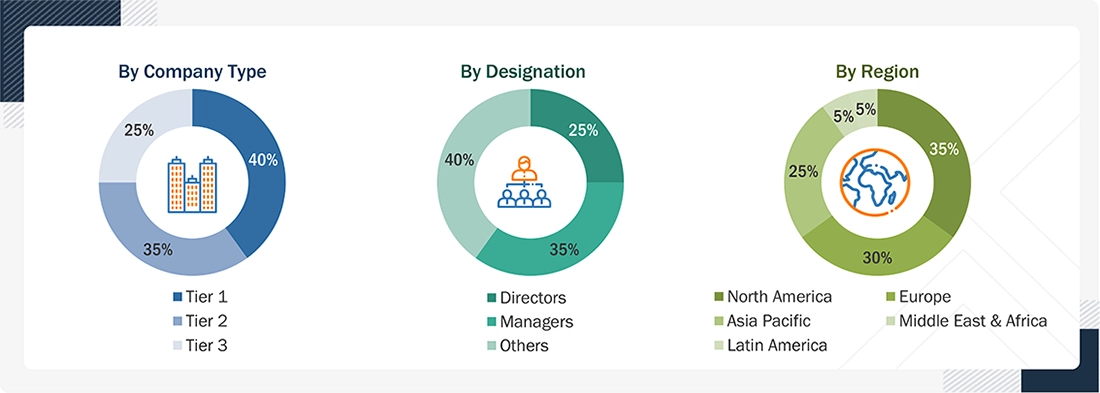
Note: Tier 1 companies receive revenues higher than USD 10 billion; Tier 2 companies' revenues range between USD 1 and 10 billion; and Tier 3 companies' revenues range between USD 500 million and USD 1 billion.
Other designations include sales, marketing, and product managers.
To know about the assumptions considered for the study, download the pdf brochure
Market Size Estimation
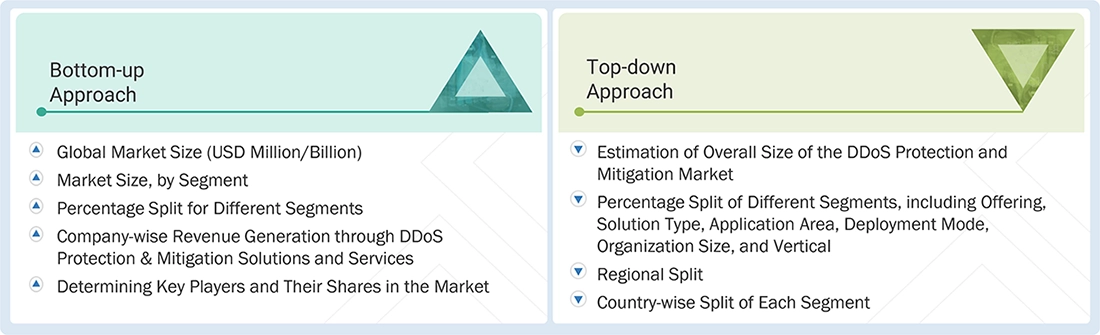
Top-down and bottom-up approaches were employed to estimate and validate the size of the DDoS protection and mitigation market and of various dependent subsegments within it. The research methodology used to estimate the market size includes the following: critical players in the market were identified through secondary research, and their market shares in the respective regions were determined through primary and secondary research. This procedure involved analyzing the annual and financial reports of the top market players and conducting extensive interviews with key industry leaders, including CEOs, VPs, directors, and marketing executives, to gather valuable insights.
All percentage splits and breakdowns were determined using secondary sources and verified through primary sources. All parameters that affect the market covered in this study were accounted for, examined in detail, verified through primary research, and analyzed to obtain final quantitative and qualitative data. This data was consolidated with detailed inputs and analysis from MarketsandMarkets.
DDoS Protection and Mitigation Market : Top-Down and Bottom-Up Approach
Data Triangulation
The DDoS protection and mitigation market was divided into several segments and subsegments after determining the overall market size using the market size estimation processes explained above. Data triangulation and market breakup procedures were employed, where applicable, to complete the overall market engineering process and arrive at the exact statistics for each market segment and subsegment. The data was triangulated by studying various factors and trends from the demand and supply sides.
Market Definition
Distributed denial of service (DDoS) protection and mitigation security refers to measures designed to defend against and minimize the impact of DDoS attacks, where multiple compromised systems flood a target with traffic, rendering it unavailable. These solutions monitor network traffic to detect abnormal spikes, filter malicious requests, and reroute or block traffic before it overwhelms the target infrastructure. Key techniques include traffic scrubbing, rate limiting, bot filtering, and real-time traffic analysis. DDoS mitigation services often employ hardware, software, and services to ensure seamless business operations and maintain online resources' availability, performance, and integrity.
Key Stakeholders
- Hardware Vendors
- Software Vendors
- Service Providers
- Defense Organizations
- Government Agencies
- Independent Software Vendors (ISVs)
- Consulting Firms
- System Integrators
- Value-added Resellers (VARs)
- Information Technology (IT) Security Agencies
- Managed Security Service Providers (MSSPs)
- Internet Service Providers (ISPs)
Report Objectives
- To describe and forecast the DDoS protection and mitigation market, by offering, solution type, application area, deployment mode, organization size, and vertical, in terms of value
- To forecast the market size of five major regions: North America, Europe, Asia Pacific, the Middle East & Africa, and Latin America, in terms of value
- To analyze the subsegments of the market concerning individual growth trends, prospects, and contributions to the overall market
- To provide detailed information related to the primary factors (drivers, restraints, opportunities, and challenges) influencing the market growth
- To analyze opportunities in the market for stakeholders by identifying high-growth segments of the market
- To profile the key players and comprehensively analyze their market size and core competencies
- To analyze competitive developments, such as product launches, mergers and acquisitions, partnerships, agreements, and collaborations in the global market
Available customizations:
With the given market data, MarketsandMarkets offers customizations based on company-specific needs. The following customization options are available for the report:
Geographic Analysis
- Further breakdown of the Asia Pacific market, by country, contributes to the regional market size.
- Further breakdown of the North American market, by country, contributes to the regional market size.
- Further breakdown of the Latin American market, by country, contributes to the regional market size.
- Further breakdown of the Middle Eastern & African market by country contributes to the regional market size.
- Further breakdown of the European market by country contributes to the regional market size.
Company Information
- Detailed analysis and profiling of additional market players (up to 5)
Get the Full DDoS Protection & Mitigation Security Market Report
Full forecast, segment splits, and company analysis for all DDoS Protection & Mitigation Security Market.
- Canada DDoS Protection & Mitigation Security Market
- US DDoS Protection & Mitigation Security Market
- UK DDoS Protection & Mitigation Security Market
- Germany DDoS Protection & Mitigation Security Market
- China DDoS Protection & Mitigation Security Market
- Japan DDoS Protection & Mitigation Security Market
- India DDoS Protection & Mitigation Security Market
- Brazil DDoS Protection & Mitigation Security Market
- Mexico DDoS Protection & Mitigation Security Market
- Rest Of Europe DDoS Protection & Mitigation Security Market
- Rest Of Asia Pacific DDoS Protection & Mitigation Security Market
Need a Tailored Report?
Customize this report to your needs
Get 10% FREE Customization
Customize This Report
