
Australia Dental 3D Printing Market (2025-2030)

The Australia Dental 3D Printing Market was valued at $26.5 Million in 2025 and projected to reach to $69.5 Million by 2030, representing a compound annual growth rate of 21.3%. Australia's dental 3D printing market is positioned for sustained growth through 2030, driven by increasing digitalization of dental practices and growing patient demand for customized solutions.


| Market Size in | USD 26.32 MN |
| Market Forecast in | |
| CAGR | |
| Forecast Period | |
| Units Considered | Value (USD MN) |
Australia Dental 3D Printing Market Trends and Insights
- This growth trajectory reflects Australia's strong adoption of advanced digital dentistry technologies and increasing investment in dental infrastructure across the country.
- Australia's market is driven by rising demand for customized dental solutions, including crowns, bridges, aligners, and surgical guides, as dental practitioners increasingly recognize the efficiency and precision benefits of 3D printing technologies. The Australian dental 3D printing sector is supported by a mature healthcare system, high patient awareness, and favorable reimbursement policies that encourage technology adoption.
- Australia's growing dental tourism and cosmetic dentistry segments further accelerate market penetration.
- Between 2025 and 2030, Australia is expected to see significant investment in dental laboratories and clinical practices upgrading to 3D printing capabilities, positioning the country as a regional leader in digital dental innovation within the Asia Pacific region..
Key Market Statistics
- CAGR (2025-2030) 21.3% CAGR
- Market Size, 2025 ~USD 26.5 Million
- Forecast, 2030 ~USD 69.5 Million
- Country Australia
Australia Dental 3D Printing Market Overview
Market Valuation Growth :
Australia's dental 3D printing market is valued at $26.5 million in 2025, with projections reaching $69.5 million by 2030, representing a robust 21.3% CAGR over the forecast period.
Digital Dentistry Adoption :
Australian dental practices are rapidly embracing advanced digital technologies, with 3D printing becoming integral to modern dental workflows for crowns, bridges, aligners, and surgical guides.
Infrastructure Investment :
Significant investment in dental infrastructure across major Australian cities is driving adoption of 3D printing technologies among both private practices and public dental institutions.
Customization Demand :
Rising patient expectations for personalized dental solutions and improved treatment outcomes are fueling demand for customized 3D-printed dental prosthetics and appliances throughout Australia.
Australia Dental 3D Printing Market Dynamics
- The market benefits from Australia's advanced healthcare infrastructure, high disposable incomes, and early adoption of innovative dental technologies.
- Regulatory support and professional endorsements from Australian dental associations are accelerating market penetration across metropolitan and regional areas. Key growth drivers include expanding dental tourism, rising cosmetic dentistry procedures, and integration of 3D printing with digital treatment planning software.
- Investment in dental education and training programs is creating a skilled workforce capable of leveraging 3D printing technologies.
- As material science advances and printer costs decline, accessibility will improve for smaller practices, further broadening market opportunities across Australia's diverse dental sector..
Market Ecosystem
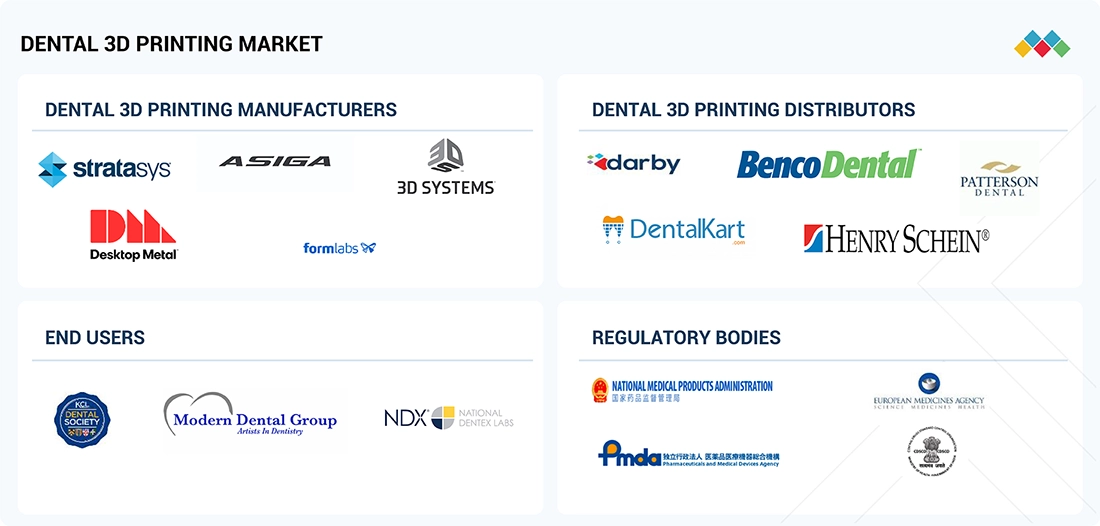
Dental 3D Printing Market: COMMERCIAL USE CASES ACROSS INDUSTRIES
| COMPANY | USE CASE DESCRIPTION | BENEFITS |
|---|---|---|
 |
Advanced DENTAL 3D PRINTING solutions for orthodontic and restorative applications | High-accuracy aligner manufacturing, seamless digital workflow integration, enhanced patient customization |
 |
Comprehensive DENTAL and MEDICAL 3D PRINTING platforms for prosthodontics, surgical guides, and anatomical modeling | Multi-material printing, biocompatible resins, precision modeling for clinical and educational use |
 |
Chairside DENTAL 3D PRINTING systems for restorative, implant, and orthodontic applications | Compact, cost-efficient desktop printing, resin versatility, and fast turnaround for dental labs and clinics |
 |
Industrial-grade DENTAL 3D PRINTING for large-scale production of dental models and custom appliances | High-speed printing, robust mechanical properties, broad material compatibility, and scalable workflows |
 |
Advanced DENTAL and MEDICAL 3D PRINTING for prosthetics, implants, and anatomical models | Precision additive manufacturing, bio-compatible materials, and optimized design-to-print solutions |
Logos and trademarks shown above are the property of their respective owners. Their use here is for informational and illustrative purposes only.
Related Ecosystem
Dental Devices
- Dental Implants
- Dental Bone Grafts
- Dental Crowns
- Dental Prosthetics
- Zirconium Implants
- DENTSPLY SIRONA Inc.
- Henry Schein, Inc.
- KAVO KERR GROUP
- PLANMECA GROUP
- Patterson Companies, Inc.
Medical Devices
- Polymerase Chain Reaction (PCR)
- Magnetic Resonance Imaging (MRI)
- Disposable Autoinjectors
- Pulse Oximeters
- Blood Pressure Monitors
- Medtronic plc
- Abbott Laboratories
- Stryker Corporation
- Becton, Dickinson and Company
- JOHNSON & JOHNSON
Key Takeaways
- Australia's dental 3D printing market is valued at $26.5 million in 2025 and is forecast to grow to $69.5 million by 2030, representing a 21.3% CAGR.
- Australia's mature healthcare infrastructure and high digital adoption rates position the country as a leader in dental 3D printing technology implementation across Asia Pacific.
- Customized dental solutions and cosmetic dentistry demand are primary growth drivers in Australia's market expansion through 2030.
- Australia's favorable reimbursement environment and strong patient awareness support accelerated adoption of 3D printing in dental laboratories and clinical practices.
Dental 3D Printing Market Report Scope
| Report Metric | Details |
|---|---|
| Base Year | 2025 |
| Fastest Growing Segment | MODELS FOR CLEAR ALIGNERS (Application) |
| Forecast Period | 2025–2030 |
| Growth Rate | CAGR of 20.5% from 2025 to 2030 |
| Largest Segment | DENTAL LABORATORIES (End User) |
| Market Size Base Year (Billions) | ~USD 3.96 (2025) |
| Revenue Forecast (Billions) | ~USD 10.06 (2030) |
| Segments Covered | Product & Service, Type, Technology, Application, End User |
Australia Dental 3D Printing Market Report Segmentation
5 segment dimensions are covered across the global market.
By Product & Service
- Equipment
- Materials
- Services
By Type
- Ceramics
- Dental 3D Printers
- Dental 3D Scanners
- Digital Light Processing
- Liquid Crystal Display
- Metals
- Other Materials
- Photopolymers
- Resins
- Stereolithography
By Technology
- Fused Deposition Modeling
- Fused Deposition Modelling
- Other Technologies
- Others Technologies
- Polyjet Printing
- Selective Laser Sintering
- Vat Photopolymerization
By Application
- Complete Dentures (Base + Teeth)
- Crowns & Bridges (Final)
- Crowns & Bridges (Temporary)
- Dental Models (Removables + Crowns & Bridges)
- Models For Clear Aligners
- Other Applications
- Partial Dentures
- Removable Partial Frameworks
- Surgical Guides
By End User
- Dental Academic & Research Institutes
- Dental Hospitals & Clinics
- Dental Laboratories
AUSTRALIA: DENTAL 3D PRINTING MARKET, BY END USER, 2023–2030
| Segment | 2023 | 2024 | 2025 | 2026 | 2027 | 2028 | 2029 | 2030 | CAGR (%) |
|---|---|---|---|---|---|---|---|---|---|
| DENTAL ACADEMIC & RESEARCH INSTITUTES | 1.5 | 1.7 | 2 | 2.4 | 2.8 | 3.4 | 4.1 | 5 | 20 |
| DENTAL HOSPITALS & CLINICS | 5.7 | 6.7 | 8.1 | 9.8 | 12 | 14.9 | 18.7 | 23.6 | 23.9 |
| DENTAL LABORATORIES | 22.2 | 25.7 | 30.1 | 35.6 | 42.5 | 51.5 | 63 | 77.7 | 20.9 |
| TOTAL | 29.4 | 34.1 | 40.2 | 47.7 | 57.3 | 69.8 | 85.8 | 106.3 | 21.5 |
Target Audience
- Dental Equipment Manufacturers : Manufacturers need Australia-specific market data to assess market potential, develop localized product strategies, and identify distribution partnerships for 3D printing systems and materials.
- Dental Practice Owners : Practice owners require market insights to evaluate investment ROI for 3D printing technology, understand competitive advantages, and benchmark adoption rates against peers in Australia.
- Healthcare Investors & PE Firms : Investors need detailed market analysis to evaluate investment opportunities in Australian dental technology companies, assess growth potential, and identify acquisition targets in the 3D printing space.
- Dental Material Suppliers : Material suppliers need market segmentation data to understand demand for specific resins, polymers, and biocompatible materials used in Australian dental 3D printing applications.
- Healthcare Consultants & Advisors : Consultants require comprehensive market intelligence to advise clients on digital transformation strategies, technology adoption roadmaps, and competitive positioning in Australia's dental sector.
Key Companies in the Australia Dental 3D Printing Market
| Company | HQ | Ownership | Strongest segments |
|---|---|---|---|
| STRATASYS | United States | Public Company | FDM printers and consumables,PolyJet, Digital Anatomy and medical solutions,SLA (Neo, Somos) and P3/Origin platforms, |
| ALIGN TECHNOLOGY, INC. | United States | Public Company | Invisalign comprehensive (adult and teen) and First,Invisalign lite/moderate/Go and express portfolios,Retention, Vivera, whitening, palatal expander, and accessories, |
| 3D SYSTEMS, INC. | United States | Public Company | Healthcare Solutions (medical, dental, bioprinting, biocompatible materials),Industrial Solutions (polymer and metal printers, materials, services),Software and Platforms (3D Sprint, 3DXpert, Oqton, design tools), |
| PRODWAYS GROUP | France | Public Company | Photopolymerization 3D printers and related hardware,Materials (resins and powders),Service bureaus (prototyping and serial production), |
| NIKON SLM SOLUTIONS AG | Germany | Private Company | Machine Business – metal SLM systems and peripherals,After-Sales Business – service, spare parts, consumables,Software, metal powder, QA products, consulting, |
| SHINING 3D | China | Private Company | 3D scanners (desktop, handheld, metrology, dental, CAD, photogrammetry, 3D cameras),3D printers (desktop, SLA, SLS, SLM) and laser engraving,Network cloud platform, design and distribution services, |
| EOS GMBH | Australia | Public Company | Remote weapon, fire control, and lethality systems (incl. UGV and marine),Counter-drone and force protection solutions,High energy laser weapon systems, |
STRATASYS
STRATASYS is a United States-based public company with 1757 employees.
ALIGN TECHNOLOGY, INC.
ALIGN TECHNOLOGY, INC. is a United States-based public company founded in 1997 with 20,275 employees.
3D SYSTEMS, INC.
3D SYSTEMS, INC. is a United States-based public company founded in 1986 with 1,418 employees.
PRODWAYS GROUP
PRODWAYS GROUP is a French public company founded in 2013 with 393 employees.
NIKON SLM SOLUTIONS AG
NIKON SLM SOLUTIONS AG is a German private company with 537 employees.
SHINING 3D
SHINING 3D is a Chinese private company founded in 2004 with 680 employees.
EOS GMBH
EOS GMBH is an Australia-based public company founded in 1983 with 436 employees.
Reasons to Buy this Report
- Market Size & Growth Validation : Obtain precise valuation data for Australia's dental 3D printing market with verified CAGR of 21.3%, enabling accurate financial forecasting and investment decision-making specific to the Australian region.
- Competitive Landscape Intelligence : Understand market dynamics, key players, and competitive positioning within Australia's dental 3D printing sector to identify partnership opportunities and market entry strategies.
- Regional Adoption Insights : Access detailed analysis of technology adoption rates across Australian dental practices, identifying geographic hotspots and underserved markets for targeted business expansion.
- Regulatory & Compliance Framework : Gain comprehensive understanding of Australian regulatory requirements, TGA approvals, and compliance standards specific to dental 3D printing devices and materials.
- Strategic Growth Opportunities : Identify emerging segments, customer pain points, and unmet needs within Australia's dental market to develop targeted product offerings and service solutions.
Frequently asked questions
What is the current size of Australia's dental 3D printing market?
Australia's dental 3D printing market was valued at $26.5 million in 2025 and is expected to grow significantly through the forecast period.
What is the projected market size for Australia's dental 3D printing sector by 2030?
Australia's dental 3D printing market is projected to reach $69.5 million by 2030, representing substantial growth from 2025 levels.
What is the CAGR for Australia's dental 3D printing market?
Australia's dental 3D printing market is expected to grow at a compound annual growth rate of 21.3% between 2025 and 2030.
What are the main drivers of growth in Australia's dental 3D printing market?
Key growth drivers in Australia include rising demand for customized dental solutions, increasing adoption of digital dentistry technologies, favorable reimbursement policies, and expansion of cosmetic dentistry services.
How does Australia's dental 3D printing market compare to other Asia Pacific countries?
Australia's mature healthcare system, high digital adoption rates, and strong patient awareness position it as a regional leader in dental 3D printing technology implementation within Asia Pacific.
RESEARCH METHODOLOGY
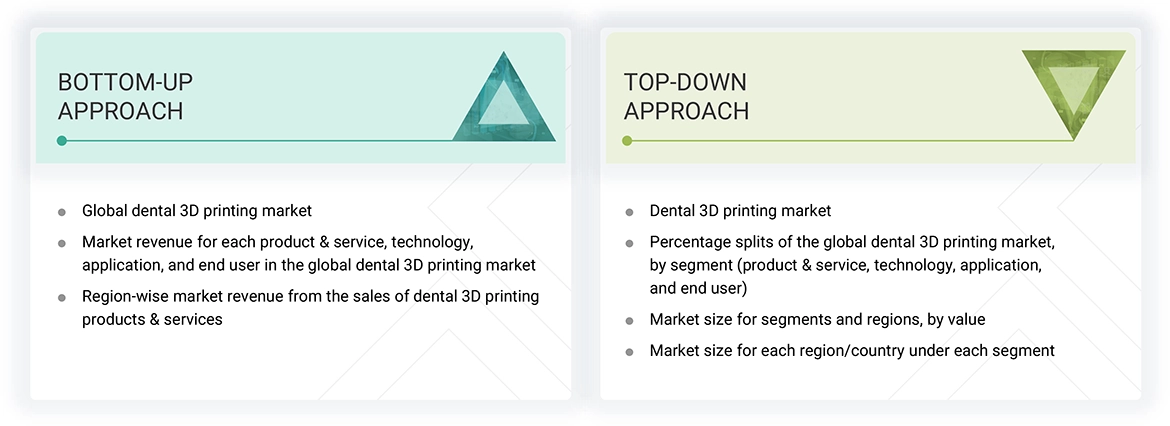
The study comprised four key activities aimed at estimating the current size of the dental 3D printing market. First, extensive secondary research was conducted to gather information on the market, including related and parent markets. The next step involved validating these findings, assumptions, and market size estimates through primary research with industry experts across the value chain. We employed both top-down and bottom-up approaches to arrive at a comprehensive estimate of the overall market size. Finally, we utilized market breakdown and data triangulation techniques to determine the sizes of segments and subsegments within the market.
Secondary Research
The secondary research process involved extensive use of various secondary sources, including directories, databases like Bloomberg Business, Factiva, and D&B Hoovers, as well as white papers, annual reports, company house documents, investor presentations, and SEC filings. This research was conducted to gather information valuable for a comprehensive, technical, market-oriented, and commercial study of the dental 3D printing market. It also helped obtain critical insights about key players in the industry, market classification, and segmentation based on current industry trends, down to the finest details. Additionally, a database of leading industry players was created through this secondary research.
Primary Research
In the primary research process, we interviewed various sources from both the supply and demand sides to gather qualitative and quantitative information for this report. On the supply side, we interviewed industry experts, including CEOs, vice presidents, marketing & sales directors, technology & innovation directors, and other key executives from prominent companies and organizations involved in the dental 3D printing market. For the demand side, we engaged with industry experts, purchase and sales managers, doctors, and personnel from research organizations. This primary research was essential to validate market segmentation, identify key players in the industry, and gather insights on important industry trends and market dynamics.
A breakdown of the primary respondents for the dental 3D printing market is provided below:
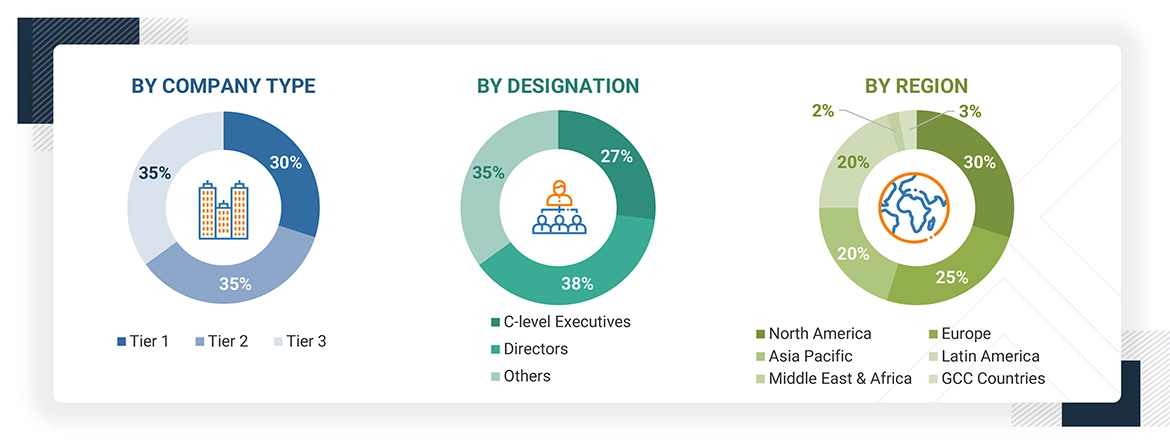
Note 1: C-level executives include CEOs, COOs, CTOs, and VPs.
Note 2: Others include sales, marketing, and product managers.
Note 3: Companies are classified into tiers based on their total revenue. As of 2024: Tier 1=>USD 1 billion, Tier 2 = USD 500 million to USD 1 billion, and Tier 3 = < USD 500 million.
To know about the assumptions considered for the study, download the pdf brochure
Market Size Estimation
The research methodology used to estimate the size of the dental 3D printing market includes the following details.
The market sizing was undertaken from the global side.
Country-level Analysis: The size of the dental 3D printing market was obtained from the annual presentations of leading players and secondary data available in the public domain. The share of products and services in the overall dental 3D printing market was obtained from secondary data and validated by primary participants to arrive at the total dental 3D printing market. Primary participants further validated the numbers.
Geographic Market Assessment (By Region & Country): The geographic assessment was done using the following approaches:
Approach 1: Geographic revenue contributions/splits of leading players in the market (wherever available) and respective growth trends
Approach 2: Geographic adoption trends for individual product segments by end users and growth prospects for each of the segments (assumptions and indicative estimates validated from primary interviews)
At each point, the assumptions and approaches were validated by industry experts who were contacted during primary research. Considering the limitations of data available from secondary research, revenue estimates for individual companies (for the overall dental 3D printing market and geographic market assessment) were ascertained based on a detailed analysis of their respective product offerings, geographic reach/strength (direct or through distributors or suppliers), and the shares of the leading players in a particular region or country.
Data Triangulation
After arriving at the overall size from the market size estimation process explained above, the total market was split into several segments and subsegments. The data triangulation and market breakdown procedures explained below were implemented, wherever applicable, to complete the overall market engineering process and arrive at the exact statistics for various market segments and subsegments. The data was triangulated by studying various factors and trends from the demand and supply sides. The market size was also validated using both the top-down and bottom-up approaches.
Market Definition
Dental 3D printing is a groundbreaking technology that uses additive manufacturing techniques to produce customized dental restorations, prosthetics, and appliances directly from digital models. This innovation allows dental practices to bypass traditional molds and lengthy lab work. Instead, intricate crowns, bridges, and even surgical guides can be printed on-demand right within the dental office itself.
Stakeholders
- Senior Management
- Finance Department
- Procurement Department
- Dental Hospitals & Clinics
- Dental Laboratories
- Dental Academic & Research Institutes
- Trade Associations and Industry Bodies
- Regulatory Bodies and Government Agencies
- Business Research and Consulting Service Providers
- Market Research and Consulting Firms
- Venture Capitalists and Investors
Report Objectives
- To define, describe, segment, analyze, and forecast the global dental 3D printing market by product & service, technology, application, end user, and region
- To provide detailed information about the factors influencing the market growth (drivers, restraints, opportunities, and challenges)
- To analyze micromarkets concerning individual growth trends, prospects, and contributions to the overall market
- To analyze market opportunities for stakeholders and provide details of the competitive landscape for key players
- To forecast the size of the dental 3D printing market in North America, Europe, the Asia Pacific, Latin America, the Middle East & Africa, and GCC countries
- To profile the key players in the dental 3D printing market and comprehensively analyze their core competencies
- To track and analyze competitive developments such as agreements, collaborations, and partnerships; expansions; acquisitions; and product launches & approvals in the dental 3D printing market
Get the Full Dental 3D Printing Market Report
Full forecast, segment splits, and company analysis for all Dental 3D Printing Market.
- Canada Dental 3D Printing Market
- US Dental 3D Printing Market
- Germany Dental 3D Printing Market
- UK Dental 3D Printing Market
- France Dental 3D Printing Market
- Italy Dental 3D Printing Market
- Spain Dental 3D Printing Market
- Netherlands Dental 3D Printing Market
- China Dental 3D Printing Market
- Japan Dental 3D Printing Market
- India Dental 3D Printing Market
- South Korea Dental 3D Printing Market
- Brazil Dental 3D Printing Market
- Mexico Dental 3D Printing Market
- Argentina Dental 3D Printing Market
Need a Tailored Report?
Customize this report to your needs
Get 10% FREE Customization
Customize This Report
