
Germany Dental Implants and Prosthetics Market (2026-2031)

The Germany Dental Implants and Prosthetics Market was valued at $1186.9 Million in 2026 and projected to reach to $1594.6 Million by 2031, representing a compound annual growth rate of 6.1%. Germany's dental implants and prosthetics market is poised for sustained growth through 2031, supported by an aging population with increased demand for restorative dental solutions and rising disposable incomes.


| Market Size in | USD 26.32 MN |
| Market Forecast in | |
| CAGR | |
| Forecast Period | |
| Units Considered | Value (USD MN) |
Germany Dental Implants and Prosthetics Market Trends and Insights
- Germany maintains a strong position within the European dental healthcare sector, driven by advanced clinical infrastructure, high patient awareness, and robust reimbursement frameworks that support both implant adoption and prosthetic innovation.
- The German market benefits from a mature healthcare system and a population with elevated expectations for dental aesthetics and functionality, positioning Germany as a key growth hub for premium dental solutions across the forecast period..
Key Market Statistics
- CAGR (2026-2031) 6.1% CAGR
- Market Size, 2026 ~USD 1186.9 Million
- Forecast, 2031 ~USD 1594.6 Million
- Country Germany
Germany Dental Implants and Prosthetics Market Overview
Market Valuation Growth :
Germany's dental implants and prosthetics market is valued at USD 1,186.9 million in 2026 and is projected to reach USD 1,594.6 million by 2031, representing significant expansion in the European dental healthcare sector.
Strong CAGR Performance :
The German market is expanding at a CAGR of 6.1% from 2026 to 2031, demonstrating steady growth driven by increasing demand for advanced dental solutions and rising patient awareness of oral health.
Advanced Clinical Infrastructure :
Germany benefits from world-class dental healthcare facilities, highly trained dental professionals, and cutting-edge technology adoption, positioning it as a leader in implant and prosthetic innovations within Europe.
Robust Reimbursement Framework :
Germany's comprehensive health insurance system and favorable reimbursement policies for dental implants and prosthetics support market growth and increase patient accessibility to premium dental treatments.
Germany Dental Implants and Prosthetics Market Dynamics
- The country's emphasis on preventive and cosmetic dentistry, combined with strong regulatory standards and professional expertise, creates a favorable environment for market expansion.
- Patient preference for long-term, durable dental solutions continues to drive implant adoption over traditional alternatives. The German market will benefit from ongoing technological advancements, including digital implantology and CAD/CAM prosthetics, alongside growing medical tourism and international patient referrals.
- Strategic investments by dental manufacturers and increasing collaboration between clinics and research institutions will further accelerate market development, positioning Germany as a premium destination for advanced dental implant and prosthetic solutions in Europe..
Market Ecosystem
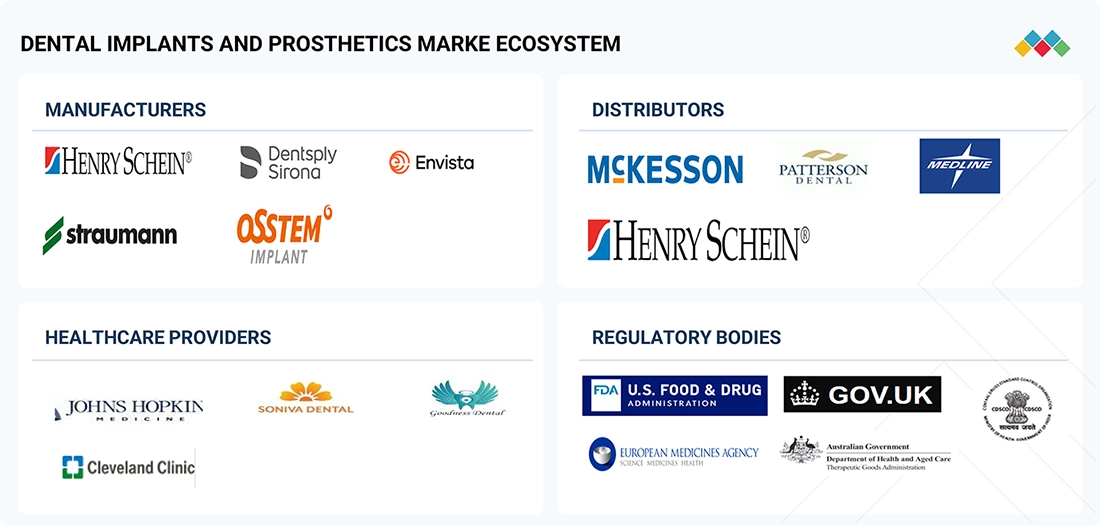
DENTAL IMPLANTS AND PROSTHETICS MARKET: COMMERCIAL USE CASES ACROSS INDUSTRIES
| COMPANY | USE CASE DESCRIPTION | BENEFITS |
|---|---|---|
 |
BLX and TLX dental implants are designed for immediate placement and loading in a wide range of bone types and clinical situations. | High primary stability, faster treatment protocols, reduced healing time, predictable long-term osseointegration, and suitability for complex cases. |
 |
The N1 implant system is engineered for minimally invasive placement with a trioval conical connection for prosthetic flexibility. | Minimizes surgical trauma, enhances patient comfort, ensures strong implant–abutment seal, reduces complications, and enables aesthetic, long-lasting restorations. |
 |
Ceramco3 is a porcelain system used for fabricating metal-ceramic crowns and bridges with natural aesthetics. | Delivers life-like aesthetics, high strength, long-lasting wear resistance, biocompatibility, and shade-matching versatility. |
 |
The Camlog implant system offers a tube-in-tube connection design that supports precise prosthetic positioning and stability. | Simple surgical workflow, reliable mechanical stability, high prosthetic flexibility, strong clinical success rates, and predictable outcomes. |
 |
The TS system features tapered body implants with sand-blasted, acid-etched surfaces for reliable osseointegration. | Strong initial stability, wide clinical applicability, faster bone healing, reduced risk of implant failure, and cost-effective solution for patients and providers. |
Logos and trademarks shown above are the property of their respective owners. Their use here is for informational and illustrative purposes only.
Related Ecosystem
Key Takeaways
- Germany's dental implants and prosthetics market will expand from USD 1,186.9M (2026) to USD 1,594.6M (2031) at a 6.1% CAGR.
- Germany's advanced healthcare infrastructure and high patient purchasing power drive premium implant and prosthetic adoption.
- Germany's favorable reimbursement policies and aging demographic support sustained market growth through 2031.
- Germany's competitive dental technology sector attracts both domestic and international manufacturers, enhancing market innovation.
Dental Implants and Prosthetics Market Report Scope
| Report Metric | Details |
|---|---|
| Base Year | 2026 |
| Fastest Growing Segment | VALUE IMPLANTS (Price) |
| Forecast Period | 2026–2031 |
| Growth Rate | CAGR of 6.7% from 2026 to 2031 |
| Largest Segment | DENTAL IMPLANTS (Product) |
| Market Size Base Year (Billions) | ~USD 12.78 (2026) |
| Revenue Forecast (Billions) | ~USD 17.67 (2031) |
| Segments Covered | Product, Material, Procedure, Connector, Design, Type, Price, End User |
Germany Dental Implants and Prosthetics Market Report Segmentation
8 segment dimensions are covered across the global market.
By Product
- Bridges
- Crowns
- Dental Implants
- Dental Prosthetics
- Dentures
- Inlays & Onlays
- Veneers
By Material
- Titanium Implants
- Zirconium Implants
By Procedure
- Single-Stage Procedures
- Two-Stage Procedures
By Connector
- External Hexagonal Connectors
- Internal Hexagonal Connectors
- Internal Octagonal Connectors
By Design
- Parallel-Walled Dental Implants
- Parallel-Walled Implants
- Tapered Dental Implants
- Tapered Implants
By Type
- 3-Unit Bridges
- 4-Unit Bridges
- Cantilever Bridges
- Complete Dentures
- Crowns
- Dental Bridges
- Dentures
- Inlays & Onlays
- Maryland Bridges
- Partial Dentures
- Plate-Form Dental Implants
- Root-Form Dental Implants
- Veneers
By Price
- Discounted Implants
- Premium Implants
- Value Implants
By End User
- Dental Hospitals & Clinics
- Dental Labs
- Other End Users
GERMANY: DENTAL IMPLANTS AND PROSTHETICS MARKET, BY END USER, 2024–2031
| Segment | 2024 | 2025 | 2026 | 2027 | 2028 | 2029 | 2030 | 2031 | CAGR (%) |
|---|---|---|---|---|---|---|---|---|---|
| DENTAL HOSPITALS & CLINICS | 536.7 | 559.1 | 586.9 | 616.5 | 648.5 | 683.2 | 720.7 | 761.3 | 5.3 |
| DENTAL LABS | 481.5 | 509.6 | 543.2 | 579.5 | 619.1 | 662.3 | 709.5 | 761.1 | 7 |
| OTHER END USERS | 52.4 | 54.4 | 56.8 | 59.4 | 62.3 | 65.3 | 68.6 | 72.1 | 4.9 |
| TOTAL | 1070.6 | 1123.1 | 1186.9 | 1255.4 | 1329.9 | 1410.7 | 1498.7 | 1594.6 | 6.1 |
Target Audience
- Dental Device Manufacturers : Manufacturers of implants, prosthetics, and related devices need Germany-specific market data to assess market potential, identify growth opportunities, and develop localized product strategies for this premium European market.
- Dental Practice Operators : Clinic owners and dental practice managers require market insights to understand demand trends, competitive positioning, reimbursement dynamics, and investment opportunities in Germany's growing implant and prosthetic segment.
- Healthcare Investors & PE Firms : Investment professionals evaluating opportunities in German dental healthcare need detailed market sizing, growth projections, and competitive analysis to make informed investment decisions in this sector.
- Dental Service Providers & Distributors : Distributors and service providers need Germany-specific market data to optimize inventory, identify high-growth segments, understand customer needs, and develop effective sales and marketing strategies.
- Healthcare Consultants & Analysts : Consulting firms and research analysts require comprehensive Germany market data to support client advisory work, competitive benchmarking, and strategic recommendations in the dental healthcare sector.
Key Companies in the Germany Dental Implants and Prosthetics Market
| Company | HQ | Ownership | Strongest segments |
|---|---|---|---|
| NOBEL BIOCARE | Switzerland | Private Company | Dental Implants (NobelActive, Brånemark System, NobelReplace, TiUnite),Individualized Prosthetics & CAD/CAM (NobelProcera, abutments),Biomaterials (creos soft tissue and bone regeneration), |
| BODYCOTE PLC | United Kingdom | Public Company | Specialist Technologies (HIP, Powdermet, advanced surface technologies, metal joining),Precision Heat Treatment (conventional heat treatment services), |
| ENVISTA | United States | Public Company | Equipment & Consumables,Implants and Prosthetics (Nobel Biocare, Alpha-Bio Tec, Implant Direct, Nobel Procera),Orthodontics and Clear Aligners (Ormco, Spark, Damon, Insignia, AOA), |
| DENTSPLY SIRONA | United States | Public Company | Connected Technology Solutions (imaging, CEREC, digital equipment),Essential Dental Solutions (endodontic, restorative, preventive consumables),Orthodontic and Implant Solutions (SureSmile, implants, digital dentures), |
| HENRY SCHEIN, INC. | United States | Public Company | Global Distribution and Value-Added Services,Global Specialty Products,Global Technology, |
| OSSTEM IMPLANT CO., LTD. | South Korea | Private Company | Dental implant systems (fixtures and prosthetics),Dental equipment and supplies,Software and integrated digital solutions, |
| SOLVENTUM | United States | Public Company | Medsurg,Dental Solutions,Health Information Systems, |
| ZIMVIE INC. | United States | Private Company | Dental implant systems,Biomaterials and bone grafts,Digital dentistry and CAD/CAM workflows, |
| DIO IMPLANT CO., LTD. | South Korea | Public Company | Conventional dental implants (UFII, FTN, protem),UV active implant systems,Digital dental implant solutions (software, guided surgery, CAD/CAM), |
NOBEL BIOCARE
NOBEL BIOCARE is a Swiss private company founded in 1981 with 2,552 employees, operating as a major player in the dental implant and restorative solutions industry.
BODYCOTE PLC
BODYCOTE PLC is a UK-based public company founded in 1923 with 3,921 employees, specializing in thermal processing and materials testing services.
ENVISTA
ENVISTA is a US-based public company founded in 2018 with 12,000 employees, serving the dental and specialty healthcare markets.
DENTSPLY SIRONA
DENTSPLY SIRONA is a US-based public company founded in 1877 with 14,000 employees, a global leader in dental products and technologies.
HENRY SCHEIN, INC.
HENRY SCHEIN, INC. is a US-based public company founded in 1932 with 25,000 employees, serving as a major distributor of dental, medical, and veterinary supplies.
OSSTEM IMPLANT CO., LTD.
OSSTEM IMPLANT CO., LTD. is a South Korean private company founded in 1997 with 2,817 employees, specializing in dental implant manufacturing and distribution.
SOLVENTUM
SOLVENTUM is a US-based public company founded in 2023 with 20,584 employees, operating across healthcare, safety, and industrial sectors.
ZIMVIE INC.
ZIMVIE INC. is a US-based private company founded in 2021 with 1,770 employees, focused on dental and specialty healthcare solutions.
DIO IMPLANT CO., LTD.
DIO IMPLANT CO., LTD. is a South Korean public company founded in 1988 with 462 employees, specializing in dental implant manufacturing.
Reasons to Buy this Report
- Market-Specific Sizing & Forecasts : Access precise valuation data for Germany's dental implants and prosthetics market with detailed projections through 2031, enabling accurate business planning and investment decisions tailored to the German market landscape.
- Competitive Intelligence for Germany : Understand the competitive dynamics, key players, and market positioning strategies specific to Germany's dental healthcare sector, allowing you to identify opportunities and benchmark against local and international competitors.
- Reimbursement & Regulatory Insights : Gain comprehensive understanding of Germany's unique reimbursement frameworks, insurance policies, and regulatory requirements that directly impact market accessibility, pricing strategies, and product adoption rates.
- Growth Driver Analysis : Identify and analyze the specific factors driving Germany's 6.1% CAGR, including demographic trends, technological adoption, patient preferences, and healthcare infrastructure developments unique to the German market.
- Strategic Market Entry Planning : Leverage Germany-specific market intelligence to develop targeted go-to-market strategies, partnership opportunities, and localization approaches for dental implant and prosthetic products and services.
Frequently asked questions
What is the current size of Germany's dental implants and prosthetics market?
Germany's dental implants and prosthetics market is valued at USD 1,186.9 million in 2026.
What is the projected market size for Germany by 2031?
Germany's dental implants and prosthetics market is forecast to reach USD 1,594.6 million by 2031.
What is the CAGR for Germany's dental implants and prosthetics market?
Germany's dental implants and prosthetics market is expected to grow at a CAGR of 6.1% from 2026 to 2031.
What factors drive growth in Germany's dental implants market?
Growth in Germany is driven by advanced healthcare infrastructure, high patient awareness, favorable reimbursement policies, and an aging population seeking restorative dental solutions.
How does Germany's market compare to other European markets?
Germany maintains a leading position in Europe due to its mature healthcare system, strong purchasing power, and established dental technology manufacturing base.
RESEARCH METHODOLOGY
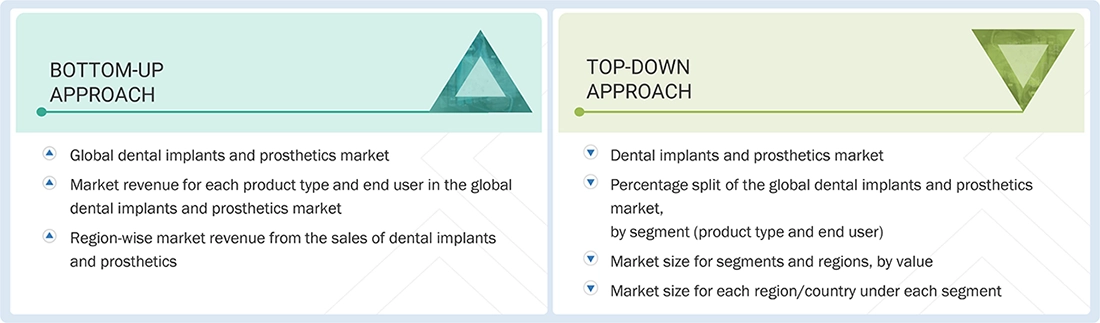
The study involved four major activities in estimating the current size of the dental implants and prosthetics market. Exhaustive secondary research was done to collect information on the market, peer market, and parent market. The next step was to validate these findings, assumptions, and sizing estimates with industry experts across the value chain through primary research. Both top-down and bottom-up approaches were employed to estimate the complete market size. After that, market breakdown and data triangulation were used to estimate the market size of segments and subsegments.
Secondary Research
In the secondary research process, various secondary sources such as annual reports, press releases & investor presentations of companies, white papers, certified publications, articles by recognized authors, gold-standard & silver-standard websites, regulatory bodies, and databases (such as D&B Hoovers, Bloomberg Business, and Factiva) were referred to in order to identify and collect information for this study on the dental implants and prosthetics market. It was also used to obtain important information on the top players, market classification, segmentation by industry trends to the bottom-most level, and key developments in the market. A database of the key industry leaders was also prepared using secondary research.
Primary Research
Extensive primary research was conducted after secondary research on the dental implants and prosthetics market. Several primary interviews were conducted with market experts from both the demand and supply sides across major countries of North America, Europe, Asia Pacific, Latin America, the Middle East & Africa, and the GCC countries. Primary data was collected through questionnaires, emails, and telephonic interviews. The primary sources on the supply side included various industry experts, such as chief executive officers (CEOs), vice presidents (VPs), and directors from business development, marketing, and product development/innovation teams. Additionally, key dental implants and prosthetics manufacturers, distributors, and influential opinion leaders were also consulted.
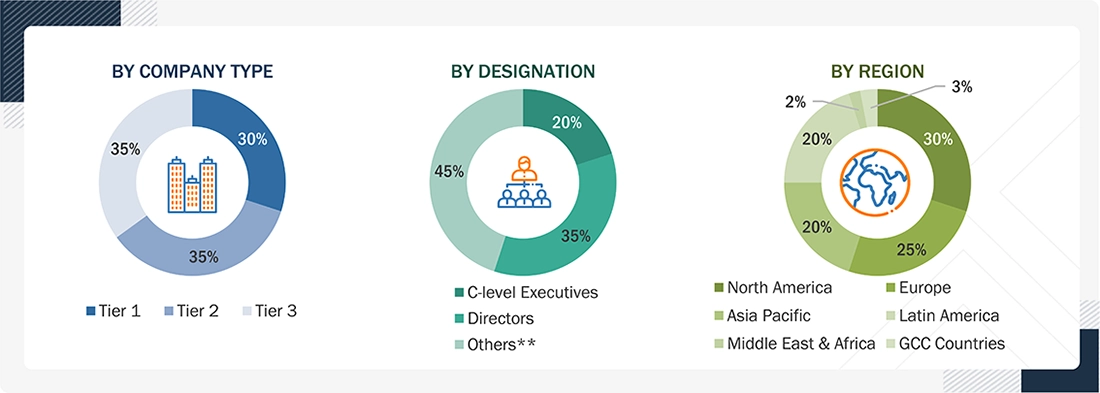
A breakdown of the primary respondents for the dental implants and prosthetics market is provided below:
**Others include sales, marketing, and product managers.
Note 1: C-level executives include CEOs, COOs, CTOs, and VPs.
Note 2: Companies are classified into tiers based on their total revenue. As of 2025: Tier 1 = >USD 1 billion, Tier 2 = USD 500 million to USD 1 billion, Tier 3 = USD 500 million.
To know about the assumptions considered for the study, download the pdf brochure
Market Size Estimation
The research methodology used to estimate the size of the dental implants and prosthetics market includes the following details.
The market sizing was undertaken globally.
Country-level Analysis: The size of the dental implants and prosthetics market was obtained from the annual presentations of leading players and secondary data available in the public domain. The share of products and services in the overall dental implants and prosthetics market was obtained from secondary data and validated by primary participants to arrive at the total dental implants and prosthetics market. Primary participants further validated the numbers.
Geographic market assessment (by region & country): The geographic assessment was done using the following approaches:
Approach 1: Geographic revenue contributions/splits of leading players in the market (wherever available) and respective growth trends
Approach 2: Geographic adoption trends for individual product segments by end users and growth prospects for each of the segments (assumptions and indicative estimates validated from primary interviews)
At each point, the assumptions and approaches were validated through industry experts contacted during primary research. Considering the limitations of data available from secondary research, revenue estimates for individual companies (for the overall dental implants and prosthetics market and geographic market assessment) were ascertained based on a detailed analysis of their respective product offerings, geographic reach/strength (direct or through distributors or suppliers), and the shares of the leading players in a particular region or country.
Dental Implants and Prosthetics Market : Top-Down and Bottom-Up Approach
Data Triangulation
After determining the overall size from the market-size estimation process described above, the total market was split into several segments and subsegments. The data triangulation and market breakdown procedures explained below were implemented, as applicable, to complete the overall market engineering process and obtain exact statistics for various market segments and subsegments. The data was triangulated by examining various factors and trends on both the demand and supply sides. Additionally, the market size was validated using both top-down and bottom-up approaches.
Market Definition
Dental implants, also known as endosseous implants, are surgical devices designed to serve as artificial tooth roots. They integrate with the bone of the skull or jaw to support prosthetics such as bridges, dentures, facial prostheses, or crowns, functioning as a stable anchor for orthodontic needs. For individuals with missing teeth, dental implants are considered the best alternative, as they provide a strong foundation for tooth replacement.
Key Stakeholders
- Dental Implant Manufacturers
- Dental Prosthetic Manufacturers
- Raw Material Suppliers for Dental Implants
- Suppliers and Distributors of Dental Implant and Prosthetic Products
- Healthcare Service Providers
- Teaching Hospitals and Academic Medical Centers
- Health Insurance Players
- Government Bodies/Municipal Corporations
- Regulatory Bodies
- Medical Research Institutes
- Business Research and Consulting Service Providers
- Venture Capitalists
- Market Research and Consulting Firms
Report Objectives
- To describe, analyze, and forecast the dental implants and prosthetics market by product, end user, and region
- To describe and forecast the dental implants and prosthetics market for key regions: North America, Europe, the Asia Pacific, Latin America, the Middle East & Africa, and GCC Countries
- To provide detailed information regarding the drivers, restraints, opportunities, and challenges influencing the growth of the dental implants and prosthetics market
- To strategically analyze the ecosystem, regulations, patenting trend, value chain, Porter’s Five Forces, and prices pertaining to the market under study
- To strategically analyze micromarkets with respect to individual growth trends, prospects, and contributions to the overall market
- To analyze market opportunities for stakeholders and provide details of the competitive landscape for market players
- To profile the key players and comprehensively analyze their market shares and core competencies in the dental implants and prosthetics market
- To analyze competitive developments such as partnerships, collaborations, acquisitions, product launches, expansions, and R&D activities in the dental implants and prosthetics market
- To benchmark players within the market using the proprietary Company Evaluation Matrix framework, which analyzes market players on various parameters within the broad categories of business and product strategy
Available customizations:
Based on the given market data, MarketsandMarkets offers customizations tailored to your company’s specific needs. The following customization options are available for the report::
Company Information
- Detailed analysis and profiling of additional market players (up to 5)
Geographic Analysis
- Further breakdown of the Rest of Europe dental implants and prosthetics market into the Netherlands, Austria, Belgium, and others
- Further breakdown of the Rest of Asia Pacific dental implants and prosthetics market into Singapore, Malaysia, and others
Get the Full Dental Implants and Prosthetics Market Report
Full forecast, segment splits, and company analysis for all Dental Implants and Prosthetics Market.
- US Dental Implants and Prosthetics Market
- Japan Dental Implants and Prosthetics Market
- China Dental Implants and Prosthetics Market
- India Dental Implants and Prosthetics Market
- Australia Dental Implants and Prosthetics Market
- Brazil Dental Implants and Prosthetics Market
- Argentina Dental Implants and Prosthetics Market
- Italy Dental Implants and Prosthetics Market
- Spain Dental Implants and Prosthetics Market
- France Dental Implants and Prosthetics Market
- UK Dental Implants and Prosthetics Market
- Switzerland Dental Implants and Prosthetics Market
- Canada Dental Implants and Prosthetics Market
- South Korea Dental Implants and Prosthetics Market
- Mexico Dental Implants and Prosthetics Market
- GCC Countries Dental Implants and Prosthetics Market
- Rest Of Europe Dental Implants and Prosthetics Market
- Rest Of Asia Pacific Dental Implants and Prosthetics Market
- Rest Of Latin America Dental Implants and Prosthetics Market
Need a Tailored Report?
Customize this report to your needs
Get 10% FREE Customization
Customize This Report
