
US Digital Pathology Market (2026-2031)

The US Digital Pathology Market was valued at $562.9 Million in 2026 and projected to reach to $980.4 Million by 2031, representing a compound annual growth rate of 11.7%. The US digital pathology market is positioned for sustained expansion through 2031, supported by increasing healthcare IT investments, regulatory approvals for digital diagnostic tools, and growing acceptance among pathologists and laboratory administrators.


| Market Size in | USD 26.32 MN |
| Market Forecast in | |
| CAGR | |
| Forecast Period | |
| Units Considered | Value (USD MN) |
US Digital Pathology Market Trends and Insights
- This 11.7% compound annual growth rate reflects the US healthcare system's accelerating adoption of digital pathology solutions, driven by increasing demand for remote diagnostics, workflow automation, and AI-integrated analysis tools.
- The US market benefits from advanced healthcare infrastructure, significant R&D investments, and regulatory support for digital health innovations. In the US, digital pathology adoption is reshaping laboratory operations across hospitals, diagnostic centers, and research institutions.
- The US market's growth trajectory is supported by rising pathologist shortages, the need for faster turnaround times, and integration with electronic health records.
- By 2031, the US is expected to solidify its position as a leading market for digital pathology technologies, with widespread implementation across major healthcare networks and academic medical centers..
Key Market Statistics
- CAGR (2026-2031) 11.7% CAGR
- Market Size, 2026 ~USD 562.9 Million
- Forecast, 2031 ~USD 980.4 Million
- Country US
US Digital Pathology Market Overview
Market Valuation Growth :
The US digital pathology market is valued at $562.9 million in 2026 and is projected to reach $980.4 million by 2031, representing a robust 11.7% CAGR driven by healthcare modernization initiatives.
Remote Diagnostics Adoption :
US healthcare providers are increasingly adopting remote diagnostic capabilities, enabling pathologists to access and analyze slides from multiple locations, improving turnaround times and reducing geographic barriers to specialist care.
AI-Integrated Solutions :
The US market is witnessing significant integration of artificial intelligence and machine learning tools in digital pathology platforms, enhancing diagnostic accuracy, reducing manual workload, and supporting clinical decision-making processes.
Workflow Automation Benefits :
US laboratories are leveraging digital pathology for comprehensive workflow automation, including specimen tracking, image analysis, and report generation, leading to improved operational efficiency and reduced diagnostic errors.
US Digital Pathology Market Dynamics
- The shift toward value-based care models and the need for cost-effective diagnostic solutions are accelerating adoption across hospital systems, reference laboratories, and academic medical centers.
- Technological advancements in whole slide imaging, cloud-based platforms, and AI-powered analytics are further driving market penetration.
- Additionally, the post-pandemic emphasis on remote healthcare delivery and interoperability standards continues to strengthen the business case for digital pathology investments across US healthcare institutions..
Market Ecosystem

DIGITAL PATHOLOGY MARKET: COMMERCIAL USE CASES ACROSS INDUSTRIES
| COMPANY | USE CASE DESCRIPTION | BENEFITS |
|---|---|---|
 |
Digital pathology workflow solutions including slide digitization, pathology image management, and AI-assisted analysis for clinical diagnostics and life sciences research. | Faster case review, improved workflow efficiency, reduced manual workload, and enhanced diagnostic consistency. |
 |
Integrated digital pathology and companion diagnostics platform supporting biomarker testing, oncology research, and precision medicine applications. | Improved biomarker assessment, faster treatment decisions, enhanced diagnostic accuracy, and support for personalized medicine. |
 |
Whole-slide imaging, digital pathology management, and remote pathology solutions for hospitals, laboratories, and healthcare networks. | Reduced turnaround times, increased pathologist productivity, remote collaboration, and optimized laboratory operations. |
 |
Enterprise digital pathology platform enabling storage, sharing, viewing, and management of pathology images across multiple sites. | Centralized image access, improved collaboration, secure data management, and streamlined pathology workflows. |
 |
High-resolution whole-slide scanners and digital imaging systems for pathology laboratories, academic institutions, and pharmaceutical research. | Superior image quality, faster slide digitization, support for remote diagnostics, and increased laboratory throughput. |
Logos and trademarks shown above are the property of their respective owners. Their use here is for informational and illustrative purposes only.
Related Ecosystem
Healthcare Analytics
Healthcare It
Key Takeaways
- The US digital pathology market will grow from $562.9M (2026) to $980.4M (2031) at an 11.7% CAGR.
- US healthcare providers are increasingly adopting digital pathology to address pathologist shortages and improve diagnostic efficiency.
- AI integration and remote consultation capabilities are key growth drivers in the US market.
- The US regulatory environment and advanced healthcare infrastructure position it as a leader in digital pathology adoption.
Digital Pathology Market Report Scope
| Report Metric | Details |
|---|---|
| Base Year | 2026 |
| Fastest Growing Segment | PHARMACEUTICAL & BIOTECHNOLOGY COMPANIES (End User) |
| Forecast Period | 2026–2031 |
| Growth Rate | CAGR of 12.5% from 2026 to 2031 |
| Largest Segment | ONCOLOGY (Therapeutic Area) |
| Market Size Base Year (Billions) | ~USD 1.59 (2026) |
| Revenue Forecast (Billions) | ~USD 2.86 (2031) |
| Segments Covered | Product, Type, Technology, Application, Therapeutic Area, End User |
US Digital Pathology Market Report Segmentation
6 segment dimensions are covered across the global market.
By Product
- Hardware
- Software
- Storage Systems
By Type
- AI & Computational Pathology Software
- Biomarker Discovery & Validation
- Brightfield Scanners
- Cloud Storage
- Drug Discovery & Efficacy Studies
- Enterprise Digital Pathology Solutions/Platforms
- Fluorescence Scanners
- Human Pathology
- Hybrid Storage
- Image Analysis Software
- Image Management Software
- On-Premise Storage
- Other Pre-Clinical Research
- Other Scanners
- Peripherals & Accessories
- Toxicology & Safety Assessment
- Veterinary Pathology
- Whole Slide Imaging Scanners
- Workstations & Viewing Systems
By Technology
- AI-Enabled Digital Pathology
- Conventional Digital Pathology
By Application
- Academic & Translational Research
- Clinical Diagnostics
- Clinical Trials
- Education & Training
- Other Applications
- Pre-Clinical Research
- Telepathology
By Therapeutic Area
- Gastrointestinal Disease
- Hematology
- Infectious Disease
- Neurology
- Oncology
- Other Therapeutic Areas
By End User
- Academic & Research Institutes
- Contract Research Organizations
- Diagnostic & Reference Laboratories
- Hospitals & Health Systems
- Other End Users
- Pharmaceutical & Biotechnology Companies
- Veterinary Laboratories
US: DIGITAL PATHOLOGY MARKET, BY END USER, 2024–2031
| Segment | 2024 | 2025 | 2026 | 2027 | 2028 | 2029 | 2030 | 2031 | CAGR (%) |
|---|---|---|---|---|---|---|---|---|---|
| ACADEMIC & RESEARCH INSTITUTES | 41.6 | 45.8 | 50.4 | 55.6 | 61.5 | 68.2 | 75.8 | 84.3 | 10.8 |
| CONTRACT RESEARCH ORGANIZATIONS | 49.4 | 54.8 | 60.9 | 67.8 | 75.7 | 84.7 | 94.9 | 106.6 | 11.8 |
| DIAGNOSTIC & REFERENCE LABORATORIES | 107.9 | 120.2 | 134.2 | 150 | 168.1 | 188.8 | 212.5 | 239.6 | 12.3 |
| HOSPITALS & HEALTH SYSTEMS | 155.9 | 172.1 | 190.4 | 211 | 234.4 | 260.8 | 290.9 | 325.1 | 11.3 |
| OTHER END USERS | 11 | 11.9 | 12.9 | 13.9 | 15 | 16.1 | 17.3 | 18.6 | 7.6 |
| PHARMACEUTICAL & BIOTECHNOLOGY COMPANIES | 73.6 | 82.7 | 93 | 104.8 | 118.4 | 134 | 152 | 172.8 | 13.2 |
| VETERINARY LABORATORIES | 17.8 | 19.4 | 21.1 | 23.1 | 25.2 | 27.6 | 30.4 | 33.4 | 9.6 |
| TOTAL | 457.3 | 506.8 | 562.9 | 626.3 | 698.4 | 780.3 | 873.7 | 980.4 | 11.7 |
Target Audience
- Digital Pathology Solution Vendors : Vendors need US market data to benchmark performance, identify growth opportunities, refine product roadmaps, and develop targeted sales strategies for hospital systems and laboratory networks across America.
- Healthcare IT Investment Firms : Investment firms require detailed US market analysis to evaluate portfolio companies, identify acquisition targets, assess market timing, and understand growth potential in the digital pathology sector.
- Hospital & Laboratory Administrators : Decision-makers need market insights to justify digital pathology investments, understand peer adoption rates, evaluate vendor options, and plan technology infrastructure upgrades for their institutions.
- Medical Device & Diagnostics Companies : Companies entering or expanding in US digital pathology need market sizing, growth forecasts, and competitive intelligence to develop business cases and allocate R&D resources effectively.
- Healthcare Consultants & Analysts : Consultants advising healthcare organizations require authoritative US market data, trend analysis, and forecasts to provide credible recommendations on digital pathology adoption and technology investments.
Key Companies in the US Digital Pathology Market
| Company | HQ | Ownership | Strongest segments |
|---|---|---|---|
| NIKON CORPORATION | Japan | Public Company | Imaging Business (digital cameras and cinema cameras),Precision Equipment Business (FPD exposure equipment),Healthcare Business (life science solutions), |
| PIXCELLDATA | Israel | Private Company | Core data/analytics platform subscriptions,Professional services & implementation,Value-added modules & advanced analytics, |
| SUNQUEST INFORMATION SYSTEMS | United States | Private Company | Core LIS (Sunquest Laboratory, Multi-Lab Networking, Collect),Pathology and Anatomic Pathology (PowerPath, CoPathPlus),Blood Bank and Transfusion Management, |
| CERNER CORPORATION | United States | Private Company | Cerner Millennium and core clinical/financial applications,HealtheIntent population health and data platform,CareAware and device connectivity solutions, |
| ZENSAR TECHNOLOGIES LTD | India | Public Company | Digital and Application Services,Cloud Infrastructure and Security,Experience, Brand, and Creative Services, |
| DANAHER CORPORATION | United States | Public Company | Biotechnology (bioprocessing, single-use, cell culture, filtration),Life Sciences (genomics, mass spec, imaging, lab automation),Diagnostics (clinical instruments, consumables, software), |
| KONINKLIJKE PHILIPS N.V. | Netherlands | Public Company | Diagnosis & Treatment (Imaging and Image-Guided Therapy),Connected Care (Monitoring, Enterprise Informatics, Sleep & Respiratory Care),Personal Health, |
| SECTRA AB | Sweden | Public Company | Imaging IT Solutions,Secure Communications,Business Innovation (orthopedics, education, precision diagnostics), |
| HAMAMATSU PHOTONICS K.K. | Japan | Public Company | Electron Tube (incl. photomultiplier tubes and radiation/x-ray sensors),Opto-Semiconductor (photodiodes, APDs, SPADs, MPPC, UV/IR sensors),Imaging and Measurement Instruments (cameras, spectrometers, x-ray systems, software), |
| QUANTERIX CORPORATION | United States | Public Company | HD-X instrument and related assays/consumables,SR-X instrument and related assays/consumables,SP-X planar array platform and multiplex assays, |
| FUJIFILM HOLDINGS CORPORATION | Japan | Public Company | Healthcare (medical systems, CDMO, pharma, regenerative, cosmetics),Business Innovation (office, document solutions, graphic communications),Electronics (display, semiconductor materials, storage, industrial equipment), |
| HOLOGIC, INC. | United States | Private Company | Diagnostics (Aptima, Panther, ThinPrep, Rapid Fetal Fibronectin),Breast Health (3D mammography, biopsy, localization, treatment support),GYN Surgical (MyoSure, NovaSure, Fluent, Acessa, CoolSeal), |
| AIFORIA | Finland | Public Company | Clinical AI suite (viewer + cancer diagnostics),Aiforia Create (AI model development platform),Services, customization, and other software, |
NIKON CORPORATION
Nikon Corporation is a Japanese public company founded in 1917 with 19,928 employees, known for manufacturing imaging and optical products.
PIXCELLDATA
Pixcelldata is a private company founded in 2010 and based in Israel.
SUNQUEST INFORMATION SYSTEMS
Sunquest Information Systems is a private company founded in 1979 and based in the United States.
CERNER CORPORATION
Cerner Corporation is a private company founded in 1979 in the United States with 25,150 employees, specializing in healthcare information technology.
ZENSAR TECHNOLOGIES LTD
Zensar Technologies Ltd is an Indian public company founded in 1963 with 10,066 employees, providing IT services and solutions.
DANAHER CORPORATION
Danaher Corporation is a public company founded in 1969 in the United States with 59,000 employees, operating as a diversified conglomerate.
KONINKLIJKE PHILIPS N.V.
Koninklijke Philips N.V. is a Dutch public company founded in 1891 with 64,317 employees, operating as a global diversified technology corporation.
SECTRA AB
Sectra AB is a Swedish public company founded in 1957 with 1,365 employees, specializing in medical imaging and cybersecurity solutions.
HAMAMATSU PHOTONICS K.K.
Hamamatsu Photonics K.K. is a Japanese public company founded in 1953 with 6,601 employees, manufacturing photonic products and systems.
QUANTERIX CORPORATION
Quanterix Corporation is a public company founded in 2007 in the United States with 450 employees, specializing in biotech instrumentation.
FUJIFILM HOLDINGS CORPORATION
Fujifilm Holdings Corporation is a Japanese public company founded in 1934 with 73,526 employees, operating across imaging, healthcare, and materials sectors.
HOLOGIC, INC.
Hologic, Inc. is a private company founded in 1985 in the United States with 7,070 employees, specializing in medical diagnostics and imaging.
AIFORIA
Aiforia is a Finnish public company founded in 2013 with 76 employees, specializing in artificial intelligence solutions.
Reasons to Buy this Report
- Market Size & Growth Validation : Obtain precise US market valuation data ($562.9M in 2026) and verified growth projections through 2031, enabling accurate financial forecasting and investment decision-making for digital pathology solutions and services.
- Competitive Landscape Intelligence : Understand the US-specific competitive dynamics, key market players, and differentiation strategies to identify partnership opportunities, market gaps, and positioning strategies for your digital pathology offerings.
- Adoption Trend Analysis : Access detailed insights into US healthcare provider adoption patterns, including hospital systems, reference labs, and academic centers, to refine go-to-market strategies and identify high-potential customer segments.
- Technology & Regulatory Insights : Gain comprehensive understanding of US regulatory requirements, FDA approval pathways, reimbursement trends, and technology standards driving digital pathology adoption in the American healthcare ecosystem.
- Strategic Planning & Forecasting : Leverage country-specific market data and 5-year forecasts to develop informed business strategies, allocate resources effectively, and anticipate market shifts in the US digital pathology sector.
Frequently asked questions
What is the current size of the US digital pathology market?
The US digital pathology market is valued at $562.9 million in 2026 and is projected to reach $980.4 million by 2031.
What is the growth rate of the US digital pathology market?
The US digital pathology market is growing at a compound annual growth rate (CAGR) of 11.7% from 2026 to 2031.
What are the main drivers of growth in the US digital pathology market?
Key drivers include pathologist shortages, demand for faster diagnostics, AI-integrated analysis tools, remote consultation capabilities, and integration with electronic health records.
Which healthcare institutions in the US are adopting digital pathology?
Adoption is widespread across US hospitals, diagnostic centers, academic medical centers, and research institutions seeking to improve operational efficiency.
How does the US market compare to global digital pathology trends?
The US market's 11.7% CAGR slightly exceeds the global average of 12.5%, reflecting strong domestic adoption driven by advanced infrastructure and regulatory support.
RESEARCH METHODOLOGY
This research study involved the extensive use of both primary and secondary sources. It involved the analysis of various factors affecting the industry to identify the segmentation types, industry trends, key players, the competitive landscape of market players, and key market dynamics such as drivers, opportunities, challenges, restraints, and key player strategies.
Secondary Research
This research study extensively utilized secondary sources, including directories, databases such as Dun & Bradstreet, Bloomberg Businessweek, and Factiva, as well as white papers, annual reports, and companies' house documents. The secondary research aimed to gather and analyze information for a comprehensive and commercially focused study of the digital pathology market, encompassing technical aspects and market dynamics. It also facilitated the identification of key players, market classification, industry trends, geographical markets, and significant market-related developments. Additionally, a database of prominent industry leaders was compiled through secondary research.
Primary Research
In the primary research process, various supply-side and demand-side sources were interviewed to obtain qualitative and quantitative information for this report. Primary sources from the supply side included industry experts such as CEOs, vice presidents, marketing and sales directors, technology & innovation directors, engineers, and related key executives from various companies and organizations operating in the digital pathology market. Primary sources from the demand side included personnel from pharmaceutical & biotechnology companies, hospitals, diagnostic laboratories, and academic & research institutes.
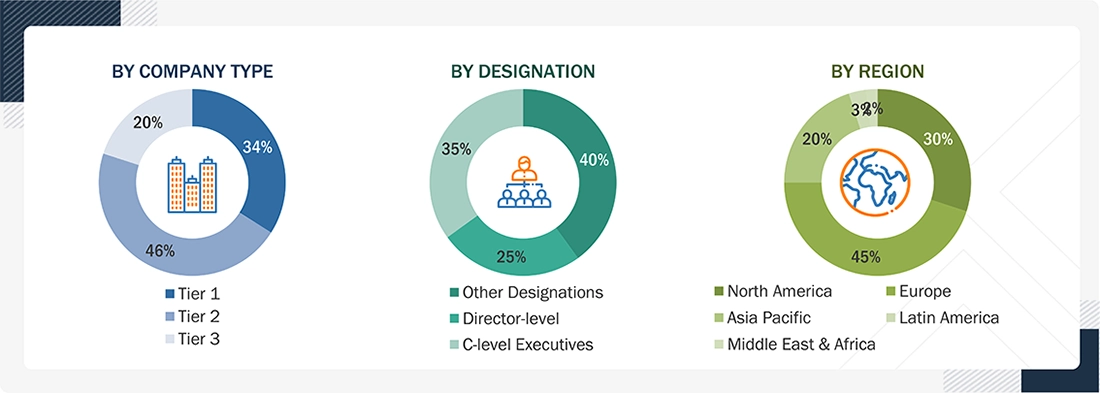
*Others include sales managers, marketing managers, and product managers.
Note: Tiers are defined based on a company’s total revenue as of 2025: Tier 1 = > USD 1 billion, Tier 2 = USD 500 million to USD 1 billion, and Tier 3 = < USD 500 million.
To know about the assumptions considered for the study, download the pdf brochure
Market Size Estimation
The total size of the digital pathology market was determined through data triangulation using the two approaches described below. After completing each approach, a weighted average was calculated based on the level of assumptions used in each approach.
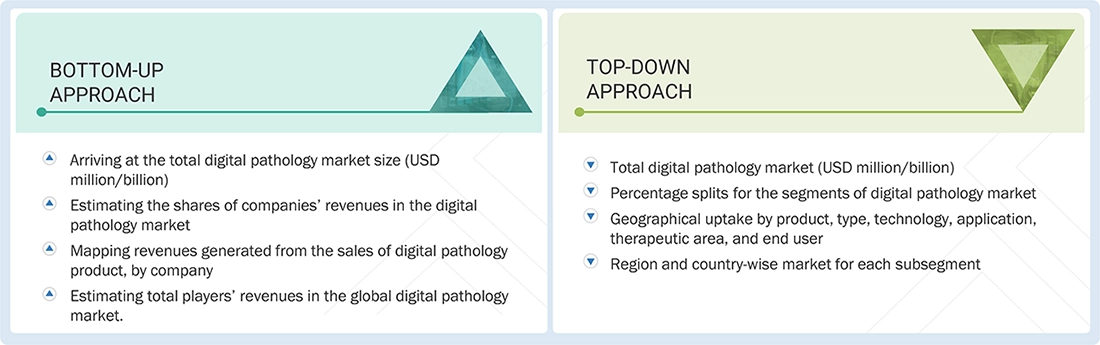
Data Triangulation
The size of the digital pathology market was estimated through segmental extrapolation using the bottom-up approach. The methodology used is as follows: -
- Revenues for individual companies were gathered from public sources and databases.
- Shares of leading players in the digital pathology market were gathered from secondary sources to the extent available. In certain cases, shares of digital pathology businesses have been determined through a detailed analysis of various parameters, including product portfolios, market positioning, selling prices, and geographic reach & strength.
- Individual shares or revenue estimates were validated through interviews with experts.
- The total revenue in the digital pathology market was determined by extrapolating the market share data of major companies.
Market Definition
Digital pathology is an image-based information environment for managing and interpreting information generated from digitized glass slides. The process involves converting glass slides to digital pathology slides using digital pathology scanning solutions. A digital image is then generated, enabling high-resolution slide viewing.
Key Stakeholders
- Healthcare Institutions/Providers (Hospitals, Medical Groups, Physician Practices, Diagnostic Centers, Ambulatory Centers, and Outpatient Clinics)
- Digital Pathology Organizations
- Senior Management
- Finance/Procurement Department
- R&D Department
- Healthcare Data Aggregators
- Venture Capitalists
- Government Agencies
- Healthcare Startups, Consultants, and Regulators
- Academic Medical Institutes
Report Objectives
- To define, describe, and forecast the digital pathology market based on product, type, technology, application, therapeutic area, end user, and region
- To provide detailed information regarding the major factors influencing the market growth (such as drivers, restraints, opportunities, and challenges)
- To analyze the micromarkets1 with respect to individual growth trends, prospects, and contributions to the overall digital pathology market
- To analyze the opportunities for stakeholders and provide details of the competitive landscape for market leaders
- To forecast the size of the market segments with respect to five main regions, namely, North America, Europe, the Asia Pacific, Latin America, the Middle East & Africa.
- To profile the key players and analyze their market shares and core competencies2
- To track and analyze competitive developments such as product launches & approvals, partnerships, agreements, and collaborations in the overall digital pathology market
- To benchmark players within the market using the proprietary "Competitive Leadership Mapping" framework, which analyzes market players on various parameters within the broad categories of business and product strategy
Available customizations:
With the given market data, MarketsandMarkets offers customizations as per your company’s specific needs. The following customization options are available for the report:
Company Information
- Detailed analysis and profiling of additional market players (up to 5)
Geographic Analysis
- Further breakdown of the Rest of Asia Pacific digital pathology market into Taiwan, New Zealand, Thailand, Singapore, Malaysia, and other countries
- Further breakdown of the Rest of Europe digital pathology market into Russia, Austria, Finland, Turkey, Norway, Poland, Portugal, Romania, Denmark, and other countries
Get the Full Digital Pathology Market Report
Full forecast, segment splits, and company analysis for all Digital Pathology Market.
- Canada Digital Pathology Market
- Germany Digital Pathology Market
- UK Digital Pathology Market
- France Digital Pathology Market
- Italy Digital Pathology Market
- Spain Digital Pathology Market
- Sweden Digital Pathology Market
- China Digital Pathology Market
- Japan Digital Pathology Market
- India Digital Pathology Market
- Australia Digital Pathology Market
- South Korea Digital Pathology Market
- Brazil Digital Pathology Market
- Mexico Digital Pathology Market
- Saudi Arabia Digital Pathology Market
- UAE Digital Pathology Market
- South Africa Digital Pathology Market
- Rest Of Europe Digital Pathology Market
Need a Tailored Report?
Customize this report to your needs
Get 10% FREE Customization
Customize This Report
