
Mexico Digital Railway Market (2026-2031)

The Mexico Digital Railway Market was valued at $1.01 Million in 2026 and projected to reach to $1.93 Million by 2031, representing a compound annual growth rate of 13.8%. Mexico's digital railway market is positioned for exceptional growth over the next five years, driven by government initiatives to modernize aging rail infrastructure and increase digital adoption across the transportation sector.


| Market Size in | USD 26.32 MN |
| Market Forecast in | |
| CAGR | |
| Forecast Period | |
| Units Considered | Value (USD MN) |
Mexico Digital Railway Market Trends and Insights
- This acceleration in Mexico reflects increasing investments in railway modernization and digital infrastructure across the country's transportation networks.
- Mexico's market expansion outpaces the global average, driven by government initiatives to enhance operational efficiency and passenger safety in rail systems. The digital railway sector in Mexico encompasses advanced signaling systems, real-time monitoring platforms, and integrated ticketing solutions that modernize legacy rail infrastructure.
- Between 2026 and 2031, Mexico is expected to see significant adoption of IoT-enabled asset management and predictive maintenance technologies.
- Mexico's strategic position in North America and growing freight rail demand position the country as a key growth market for digital railway solutions in Latin America..
Key Market Statistics
- CAGR (2026-2031) 13.8% CAGR
- Market Size, 2026 ~USD 1.01 Million
- Forecast, 2031 ~USD 1.93 Million
- Country Mexico
Mexico Digital Railway Market Overview
Rapid Market Expansion :
Mexico's digital railway market is projected to nearly double from $1.01 billion in 2026 to $1.93 billion by 2031, driven by substantial government and private sector investments in railway modernization and digital infrastructure upgrades across the country's transportation networks.
Outpacing Global Growth :
With a CAGR of 13.8%, Mexico's digital railway market significantly outperforms the global average of 8.5%, reflecting the country's strategic focus on modernizing its rail infrastructure and adopting advanced digital technologies for operational efficiency.
Infrastructure Modernization :
Mexico is prioritizing the digitalization of its railway systems to enhance connectivity, safety, and operational efficiency. This includes investments in IoT sensors, real-time monitoring systems, and integrated digital platforms across major rail corridors.
Strategic Transportation Hub :
As a critical logistics and transportation hub in North America, Mexico's railway digitalization efforts are essential for supporting cross-border trade, improving freight management, and enhancing passenger services across the nation's expanding rail network.
Mexico Digital Railway Market Dynamics
- The country's strategic location as a North American trade corridor creates significant demand for advanced railway technologies that improve efficiency, safety, and connectivity.
- Investment in smart rail systems, predictive maintenance solutions, and integrated digital platforms will accelerate market expansion. The forecast period will witness increased participation from both domestic and international technology providers seeking to capitalize on Mexico's modernization agenda.
- Public-private partnerships and government funding mechanisms will support infrastructure upgrades, while growing e-commerce and logistics demands will necessitate more efficient railway operations.
- This convergence of factors positions Mexico as one of the fastest-growing digital railway markets in the region..
Market Ecosystem
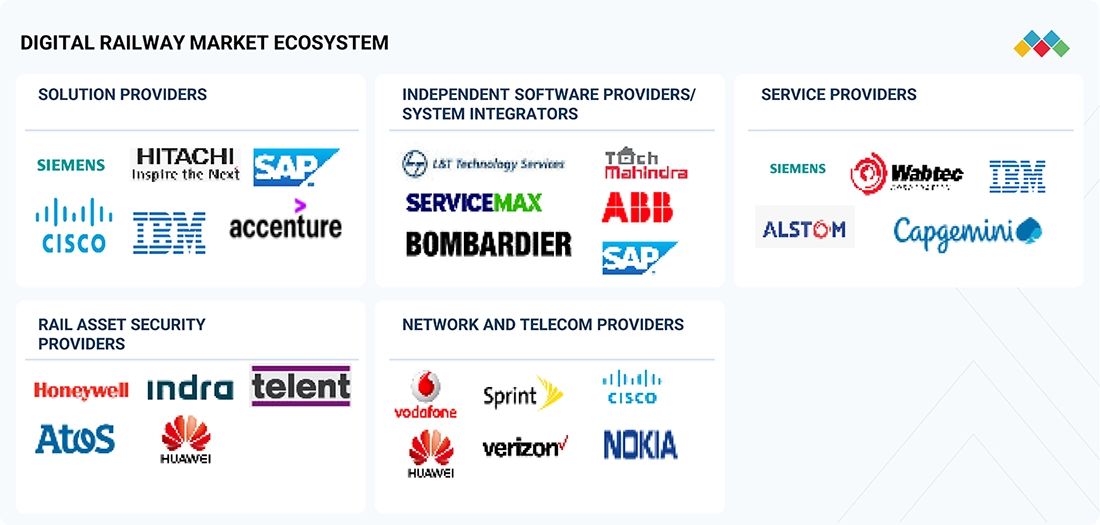
DIGITAL RAILWAY MARKET: COMMERCIAL USE CASES ACROSS INDUSTRIES
| COMPANY | USE CASE DESCRIPTION | BENEFITS |
|---|---|---|
 |
Rail operators use Siemens Mobility's Railigent X application suite and IoT connectivity tools to keep track of and take care of their physical assets. The platform uses sensors and digital twin technology to keep an eye on the state of rolling stock and rail infrastructure in real time, predicting when parts will break before they do. | Maximized system availability | Condition-based predictive maintenance | Lower overall lifecycle costs |
 |
Rail networks have used Huawei's Smart Railway Solutions to make communication and infrastructure security more digital. The system uses AI, smart cameras, and vibration-sensing optical fibers to keep an eye on the railway's perimeter all the time for intruders, damage to the tracks, and environmental dangers. | Enhanced physical security | 50% increase in inspection efficiency | Highly reliable operational communication |
 |
Rail operators have started using Alstom's HealthHub platform and TrainScanner solution to improve their old maintenance processes. This system uses 3D cameras, lasers, and AI-based analytics to automatically check the technical condition of trains (like wheels and brake pads) as they pass by, turning raw data into useful health indexes. | Extended component life | Up to 25% savings on lifecycle costs | Improved train reliability and availability |
Logos and trademarks shown above are the property of their respective owners. Their use here is for informational and illustrative purposes only.
Related Ecosystem
Digitalization And Iot
- Sensors
- Remote Monitoring
- Supply Chain Management
- Passenger Information System (PIS)
- Platform as A Service (PaaS)
- International Business Machines Corporation
- Cisco Systems, Inc.
- MICROSOFT CORPORATION
- Oracle Corporation
- HUAWEI TECHNOLOGIES CO LTD
Key Takeaways
- Mexico's digital railway market will nearly double from $1.01B (2026) to $1.93B (2031) at a 13.8% CAGR, significantly outpacing global growth rates.
- Government modernization initiatives in Mexico are driving adoption of advanced signaling, IoT monitoring, and predictive maintenance technologies across rail networks.
- Mexico's strategic geographic position and growing freight rail demand create substantial opportunities for digital railway solution providers through 2031.
- Real-time monitoring platforms and integrated ticketing systems represent key growth segments within Mexico's expanding digital railway infrastructure market.
Digital Railway Market Report Scope
| Report Metric | Details |
|---|---|
| Base Year | 2026 |
| Fastest Growing Segment | MANAGED SERVICES (Service) |
| Forecast Period | 2026–2031 |
| Growth Rate | CAGR of 8.5% from 2026 to 2031 |
| Largest Segment | RAIL OPERATIONS MANAGEMENT (Application) |
| Market Size Base Year (Billions) | ~USD 90.77 (2026) |
| Revenue Forecast (Billions) | ~USD 136.49 (2031) |
| Segments Covered | Solution, Service, Type, Application, Offering, Professional Service |
Mexico Digital Railway Market Report Segmentation
6 segment dimensions are covered across the global market.
By Solution
- Analytics
- Network Management
- Other Solutions
- Predictive Maintenance
- Remote Monitoring
- Route Optimization & Scheduling
- Security
By Service
- Managed Services
- Professional Services
By Type
- Consulting
- Freight Management
- Rail Automation Management
- Rail Control
- Rail Traffic Management
- Signaling Solution
- Smart Ticketing
- Support & Maintenance
- System Integration & Deployment
- Workforce Management
By Application
- Asset Management
- Other Applications
- Pis
- Rail Operations Management
By Offering
- Services
- Solutions
By Professional Service
- Consulting
- Support & Maintenance
- System Integration & Deployment
MEXICO: DIGITAL RAILWAY MARKET, BY APPLICATION, 2026–2031
| Segment | 2026 | 2027 | 2028 | 2029 | 2030 | 2031 | CAGR (%) |
|---|---|---|---|---|---|---|---|
| ASSET MANAGEMENT | 0.27 | 0.31 | 0.35 | 0.39 | 0.44 | 0.5 | 13.3 |
| OTHER APPLICATIONS | 0.1 | 0.12 | 0.14 | 0.16 | 0.18 | 0.21 | 16.1 |
| PIS | 0.18 | 0.21 | 0.25 | 0.29 | 0.34 | 0.39 | 17.2 |
| RAIL OPERATIONS MANAGEMENT | 0.47 | 0.54 | 0.61 | 0.68 | 0.76 | 0.83 | 12.1 |
| TOTAL | 1.01 | 1.17 | 1.34 | 1.53 | 1.72 | 1.93 | 13.8 |
Target Audience
- Railway Operators & Authorities : Mexican railway companies and government transportation agencies need this data to benchmark their digital transformation initiatives, identify technology gaps, and plan capital investments in modernization projects aligned with market trends.
- Technology & Solution Providers : Software vendors, IoT platform developers, and digital infrastructure companies require Mexico-specific market intelligence to assess market potential, identify customer segments, and develop localized solutions for the growing digital railway sector.
- Investment & Private Equity Firms : Investors evaluating opportunities in Mexico's transportation and infrastructure sectors need comprehensive market data to assess growth potential, competitive dynamics, and risk factors for digital railway investments and acquisitions.
- Logistics & Freight Companies : Mexican and international logistics providers utilizing rail networks require market insights to understand digital transformation trends, evaluate technology partnerships, and optimize their supply chain operations through advanced railway solutions.
- Government & Policy Makers : Mexican government agencies and transportation planners need market research to inform infrastructure investment decisions, policy development, and strategic planning for the country's digital railway modernization agenda.
Key Companies in the Mexico Digital Railway Market
| Company | HQ | Ownership | Strongest segments |
|---|---|---|---|
| KNORR-BREMSE AG | Germany | Public Company | Rail Vehicle Systems (braking, entrance, HVAC, sanitary, coupling, digital, signaling, aftermarket),Commercial Vehicle Systems (pneumatic braking, steering, vehicle dynamics, ADAS, energy supply, engine/transmission control),Other services (leasing, holding, logistics, media and IT services), |
| SIEMENS | Germany | Public Company | Digital Industries (automation, industrial software, PLM, simulation),Smart Infrastructure (building tech, grid, electrification),Mobility (rail systems, automation, services), |
| CISCO | United States | Public Company | Data center and campus switching/routing,Security (network security, SASE, identity, threat detection/response),Collaboration (Webex, devices, contact center, CPaaS), |
| HITACHI | Japan | Public Company | Digital Systems & Services,Green Energy & Mobility,Connective Industries, |
| WABTEC | United States | Public Company | Freight locomotives and propulsion (diesel-electric, LNG, engines, motors),Freight components and systems (trucks, braking, compressors, HVAC, turbochargers),Transit equipment and components (braking, doors, HVAC, pantographs, converters), |
| ALSTOM | France | Public Company | Rolling stock (metros, regional, high-speed, locomotives, people movers),Signaling (urban, mainline, freight and mining),Turnkey systems (APM, monorail, tram, metro, main line systems), |
| IBM | United States | Public Company | Software (Hybrid Cloud and AI Platforms),Consulting (Strategy, Technology, and Operations),Infrastructure (Servers, Storage, Lifecycle Services), |
| ABB | Switzerland | Public Company | Electrification,Motion,Automation, |
| FUJITSU | Japan | Public Company | Service Solutions (consulting, cloud, system integration, managed and BPO services),Hardware Solutions (computer platforms, network equipment, infrastructure),Ubiquitous Solutions (end-user, edge, and embedded offerings), |
| DXC | United States | Public Company | Global Infrastructure Services,Consulting & Engineering Services,Insurance Software & Services, |
| HONEYWELL | United States | Public Company | Industrial Automation,Building Automation,Energy and Sustainability Solutions (UOP and related), |
| INDRA | Spain | Public Company | Defense (radars, C2, air and naval systems, UAS, simulators),Air Traffic Management (ATM and ATC services),Mobility (ticketing, tolling, rail signaling, transport systems), |
| NOKIA | Finland | Public Company | Network Infrastructure (IP, Optical, Fixed Networks),Mobile Networks (RAN, Microwave, Services),Cloud and Network Services, |
| ATKINS REALIS | Canada | Public Company | Consultancy, Strategy, Advisory, and Design,Project and Program Management / Project Delivery,Nuclear Lifecycle Services, |
| TOSHIBA | Japan | Private Company | Energy Systems & Solutions,Infrastructure Systems & Solutions,Building Solutions, |
KNORR-BREMSE AG
Knorr-Bremse AG is a German public company founded in 1905 that specializes in braking systems and safety technology for rail and commercial vehicles. With 26,629 employees, the company is a leading global supplier of brake components and control systems for the transportation industry.
SIEMENS
Siemens is a German multinational public company founded in 1847 that operates across electrification, automation, and digitalization sectors. With 310,312 employees worldwide, it is one of the largest engineering and technology conglomerates globally.
CISCO
Cisco is a United States public company founded in 1984 that designs, manufactures, and sells networking equipment and software solutions. With 86,200 employees, the company is a leader in internet infrastructure and cybersecurity technologies.
HITACHI
Hitachi is a Japanese multinational public company founded in 1910 with 287,901 employees operating across diverse sectors including industrial systems, power generation, and information technology. The company is one of Japan's largest conglomerates.
WABTEC
Wabtec is a United States public company founded in 1869 with 31,000 employees that provides equipment, systems, and services for the rail and transit industries. The company specializes in locomotive components, braking systems, and digital solutions.
ALSTOM
Alstom is a French public company founded in 1928 with 87,832 employees that designs and manufactures rail transport equipment and services. The company is a global leader in sustainable mobility solutions for trains and trams.
IBM
IBM is a United States public company founded in 1911 with 264,300 employees that provides information technology services, software, and hardware solutions. The company serves clients across enterprise computing, cloud services, and artificial intelligence.
ABB
ABB is a Swiss multinational public company founded in 1883 with 112,700 employees specializing in robotics, power, and automation technologies. The company serves industrial, utility, and infrastructure customers worldwide.
FUJITSU
Fujitsu is a Japanese public company founded in 1935 with 99,203 employees providing information technology services, systems integration, and digital solutions. The company serves enterprise clients across multiple industries globally.
DXC
DXC is a United States public company founded in 1959 with 115,000 employees that provides information technology services, consulting, and managed services. The company supports enterprise clients in digital transformation and infrastructure management.
HONEYWELL
Honeywell is a United States public company founded in 1885 with 101,000 employees that manufactures automation, control systems, and aerospace technologies. The company serves industrial, commercial, and aerospace markets worldwide.
INDRA
Indra is a Spanish public company founded in 1921 with 62,689 employees specializing in information technology, defense, and transportation systems. The company provides solutions for critical infrastructure and digital transformation.
NOKIA
Nokia is a Finnish public company founded in 1865 with 78,005 employees that develops telecommunications infrastructure, 5G networks, and software solutions. The company is a leading provider of mobile network technology and services.
ATKINS REALIS
Atkins Realis is a Canadian public company founded in 1911 with 40,246 employees providing professional services in engineering, design, and project management. The company serves infrastructure, energy, and industrial sectors.
TOSHIBA
Toshiba is a Japanese private company founded in 1875 with 106,648 employees operating across electronics, energy, and infrastructure sectors. The company manufactures semiconductors, power systems, and industrial equipment globally.
Reasons to Buy this Report
- Market Size & Growth Validation : Obtain precise market valuation data for Mexico's digital railway sector with detailed CAGR analysis (13.8%) and five-year forecasts, enabling accurate business planning and investment decisions specific to this high-growth market.
- Competitive Intelligence : Identify key players, technology providers, and solution vendors operating in Mexico's digital railway ecosystem. Understand market positioning, partnerships, and competitive strategies to inform go-to-market approaches and partnership opportunities.
- Investment Opportunity Assessment : Evaluate the attractiveness of Mexico's digital railway market for capital allocation, M&A activities, and strategic partnerships. Leverage market sizing and growth projections to justify investment decisions and secure stakeholder buy-in.
- Regulatory & Policy Insights : Understand Mexico-specific regulatory frameworks, government initiatives, and policy drivers supporting railway digitalization. Identify compliance requirements and incentive programs that impact market entry and expansion strategies.
- Customer & Demand Analysis : Gain insights into Mexico's railway operators, logistics companies, and government agencies driving digital adoption. Understand their pain points, technology requirements, and procurement timelines to tailor solutions and sales strategies effectively.
Frequently asked questions
What is the projected size of Mexico's digital railway market by 2031?
Mexico's digital railway market is projected to reach $1.93 billion by 2031, growing from $1.01 billion in 2026 at a CAGR of 13.8%.
What is driving growth in Mexico's digital railway sector?
Growth in Mexico is driven by government modernization initiatives, increased freight rail demand, and adoption of IoT-enabled asset management and predictive maintenance technologies.
How does Mexico's digital railway market growth compare to global trends?
Mexico's 13.8% CAGR significantly exceeds the global average of 8.5%, positioning Mexico as a high-growth market within the digital railway industry.
What technologies are being adopted in Mexico's digital railway market?
Mexico is adopting advanced signaling systems, real-time monitoring platforms, integrated ticketing solutions, IoT-enabled asset management, and predictive maintenance technologies.
Why is Mexico strategically important for digital railway solutions?
Mexico's position in North America, growing freight rail demand, and legacy infrastructure modernization needs make it a key market for digital railway solution providers.
RESEARCH METHODOLOGY
The research study involved four major activities in estimating the digital railway market size. Extensive secondary research has been done to collect important information about the market and peer markets. The next step has been to validate these findings and assumptions and size them with the help of primary research with industry experts across the value chain. Both top-down and bottom-up approaches have been used to estimate the market size. Post which, the market breakdown and data triangulation have been adopted to estimate the market sizes of segments and sub-segments.
Secondary Research
The market size of companies offering digital railway solutions and services was arrived at based on secondary data available through paid and unpaid sources. It was also arrived at by analyzing the product portfolios of major companies and rating the companies based on their performance and quality.
In the secondary research process, various sources were referred to for identifying and collecting information for this study. Secondary sources included annual reports, press releases, and investor presentations of companies; white papers, journals, and certified publications; and articles from recognized authors, directories, and databases. The data was also collected from other secondary sources, such as Data Science Journal, Institute of Electrical and Electronics Engineers (IEEE) Journals and magazines, and Journal/forums for ML, AI India magazine, Customer Experience magazine, and other magazines. The railway investment spending of various countries was extracted from respective sources. Secondary research was used to obtain key information related to the industry’s value chain and supply chain to identify key players based on solutions, services, market classification, and segmentation according to offerings of major players, industry trends related to solutions, services, applications, and regions, and key developments from both market- and technology-oriented perspectives.
Primary Research
In the primary research process, various sources from the supply and demand sides were interviewed to obtain qualitative and quantitative information for the report. The primary sources from the supply side included CEOs, CTOs, COOs, VPs, MDs, technology and innovation directors, and related key executives from various companies and organizations operating in the digital railway market.
Primary interviews were conducted to gather insights, such as market statistics, data on revenue collected from software and services, market breakups, market size estimations, market forecasts, and data triangulation. Stakeholders from the demand side, such as CIOs, CFOs, CSOs, and the installation team of end users who use digital railway, were interviewed to understand buyers’ perspectives on suppliers, products, service providers, and their current usage of digital railway solutions and services, which is expected to affect the overall digital railway market growth.
BREAKDOWN OF PRIMARIES
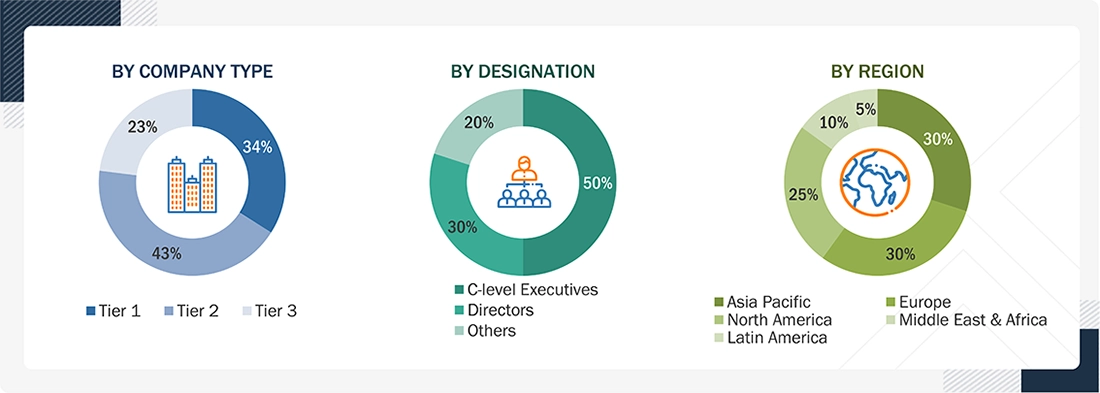
Note 1: Tier 1 companies have revenues of more than USD 10 billion; tier 2 companies’ revenue ranges from USD 1 billion to USD 10 billion; and tier 3 companies’ revenue ranges from USD 500 million to USD 1 billion
To know about the assumptions considered for the study, download the pdf brochure
Market Size Estimation
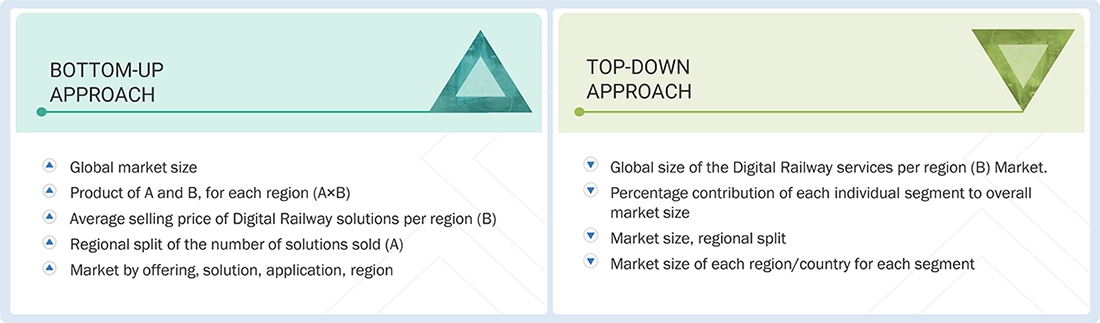
In the market engineering process, the top-down and bottom-up approaches were used along with multiple data triangulation methods to estimate and validate the size of the digital railway market, as well as other dependent submarkets. The research methodology used to estimate the market sizes includes the following:
- Focusing on top-line investments and spending in the ecosystems.
- Tracking the recent and upcoming developments, including investments, R&D activities, product launches, collaborations, mergers and acquisitions, and partnerships, as well as forecasting the market size based on these developments and other critical parameters.
- Conducting multiple discussions with key opinion leaders to learn about the diverse types of authentications and brand protection offerings used, and the applications for which they are used, to analyze the breakdown of the scope of work carried out by major companies.
- Segmenting the market based on applications, wherein the applications are to be used, and deriving the size of the global application market.
- Segmenting the overall market into various market segments.
- Validating the estimates at every level through discussions with key opinion leaders, such as CXOs, directors, and operations managers, as well as domain experts at MarketsandMarkets.
Digital Railway Market : Top-Down and Bottom-Up Approach
Data Triangulation
After arriving at the overall market size from the above estimation process, the digital railway market has been split into several segments and sub-segments. To complete the overall market engineering process and arrive at the exact statistics for all segments and sub-segments, data triangulation and market breakdown procedures have been used, wherever applicable. The data has been triangulated by studying various factors and trends from both the demand and supply sides. The digital railway market size has been validated using top-down and bottom-up approaches.
Market Definition
Digital railway is the integration and deployment of technologies, such as IoT, AI, analytics, cloud, and cybersecurity, to improve the safety, performance, and reliability, enabling smarter utilization of the railway infrastructure. Digital railway harness technologies to improve rail operations, ticketing, passenger experience, workforce management, and asset management.
Key Stakeholders
- Digital railway vendors
- Network and System Integrators
- Cloud Service Providers
- Digital Railway Infrastructure Providers
- Digital Railway Support Service Providers
- Digital Railway Companies
- National Railway Governing Authorities/Regulators/Bodies
- Independent Software Vendors
- Value-added Resellers and Distributors
- Consultancy Firms and Advisory Firms
- Regulatory Agencies
- Governments
Report Objectives
- To define, describe, and forecast the digital railway market by solution, service, application, and region
- To provide detailed information related to major factors (drivers, restraints, opportunities, and industry-specific challenges) influencing the market growth
- To analyze opportunities in the market and provide details of the competitive landscape for stakeholders and market leaders
- To forecast the market size of segments for five main regions: North America, Europe, Asia Pacific, the Middle East & Africa, and Latin America
- To profile the key market players and provide a comparative analysis based on their business overviews, regional presence, product offerings, business strategies, and key financials, and illustrate the competitive landscape of the market
- To track and analyze competitive developments, such as product launches, deals, other developments, and R&D activities in the market
Available customizations:
With the given market data, MarketsandMarkets offers customizations per the company’s specific needs. The following customization options are available for the report:
Regional Analysis
- Further breakup of the Asia Pacific market into countries contributing 75% to the regional market size
- Further breakup of the North American market into countries contributing 75% to the regional market size
- Further breakup of the Latin American market into countries contributing 75% to the regional market size
- Further breakup of the Middle East & African market into countries contributing 75% to the regional market size
- Further breakup of the European market into countries contributing 75% to the regional market size
Company Information
- Detailed analysis and profiling of additional market players (up to five)
Get the Full Digital Railway Market Report
Full forecast, segment splits, and company analysis for all Digital Railway Market.
- Canada Digital Railway Market
- US Digital Railway Market
- UK Digital Railway Market
- Germany Digital Railway Market
- France Digital Railway Market
- China Digital Railway Market
- India Digital Railway Market
- Japan Digital Railway Market
- UAE Digital Railway Market
- Nigeria Digital Railway Market
- South Africa Digital Railway Market
- Brazil Digital Railway Market
- Rest Of Europe Digital Railway Market
- Rest Of Asia Pacific Digital Railway Market
Need a Tailored Report?
Customize this report to your needs
Get 10% FREE Customization
Customize This Report
