



Smart Railways Market Size, Share, Growth & Latest Trends
Report Code
TC 1417
Published in
May, 2025, By MarketsandMarkets™
Smart Railways Market by Offering (Solutions (Rail Asset Management & Maintenance, Operation & Control, Communication & Networking, Security & Safety, and Rail Analytics) and Services (Professional and Managed)) Region - Global Forecast to 2030

USD 54.31 BN
MARKET SIZE, 2030

CAGR 8.3%
(2025-2030)

309
REPORT PAGES

284
MARKET TABLES
OVERVIEW
Source: Secondary Research, Interviews with Experts, MarketsandMarkets Analysis
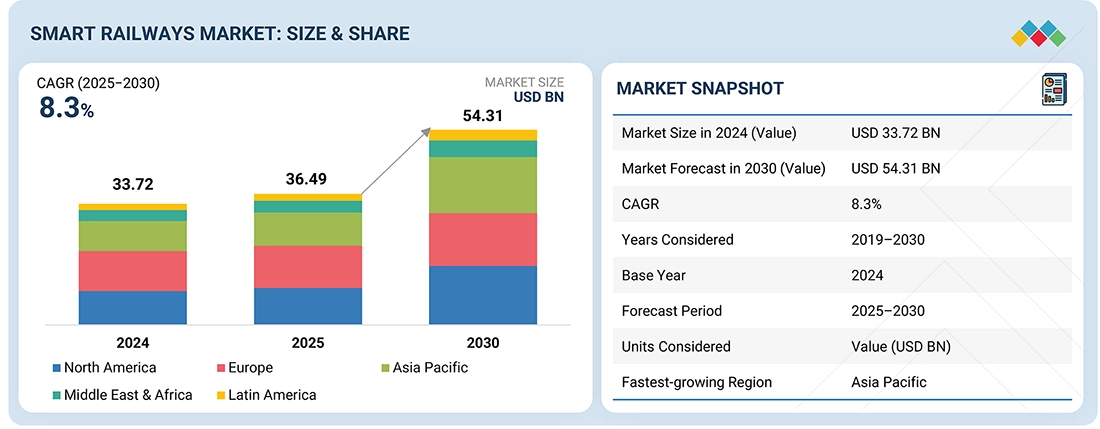
The smart railways market is projected to grow from USD 36.49 billion in 2025 to USD 54.31 billion by 2030 at a CAGR of 8.3% during the forecast period. The market’s growth is primarily driven by the global emphasis on sustainable and efficient transportation. This shift is supported by government funding for new digital systems and the integration of IoT, AI, and big data to enhance operations
Market Size and Forecast:
- 2024 Market Size: USD 33.72 Billion
- 2025 Projected Market Size: USD 36.49 Billion
- 2030 Forecasted Market Size: USD 54.31 Billion
- Growth Rate (2025-2030): CAGR of 8.3%
- Data available from 2025 to 2030
Key Market Trends and Insights
- Fastest Growing region: Asia Pacific
-
Growth Drivers: rail digitalization, urbanization, smart ticketing demand, safety automation.
- Latest Trends: AI, IoT, 5G, predictive maintenance, and smart mobility upgrades.
- Emerging Opportunities: in AI analytics, IoT infrastructure, cybersecurity, and mobility-as-a-service
- AI Impact: AI is transforming the Smart Railways Market through predictive maintenance, real-time traffic management, automated safety, and passenger analytics.
- Leading Companies: Alstom (France), Cisco (US), Wabtec (US), ABB (Switzerland), IBM (US), Hitachi (Japan), Huawei (China)
KEY TAKEAWAYS
-
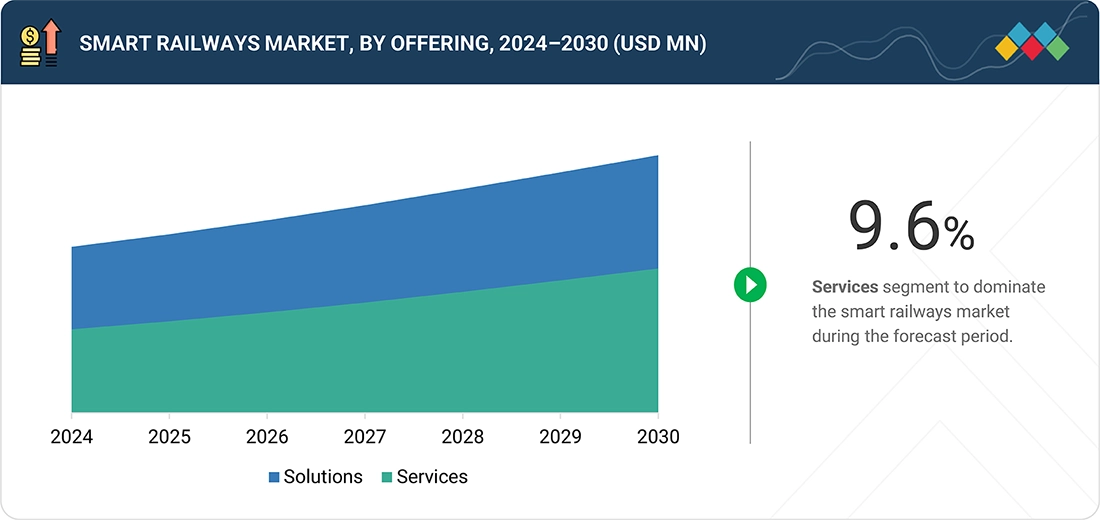
BY OFFERINGThe growing demand for outsourcing the maintenance of smart railway solutions is anticipated to drive the demand for managed services
-
BY REGIONThe growth of the market in Asia Pacific can be attributed to the rapid growth of new technologies, government initiatives to boost digital infrastructure, and the need for efficient railway infrastructure
-
COMPETITIVE LANDSCAPEMajor market players have adopted both organic and inorganic strategies, including partnerships and investments. For instance, Alstom (France), Cisco (US), Wabtec (US) and, ABB (Switzerland) have entered into a number of agreements and partnerships to cater to the growing demand for smart railways across innovative applications.
The increasing focus on passenger-centric services is driving transport operators to deploy smart ticketing solutions such as mobile-based ticketing apps, contactless payment systems, and facial recognition-based access. These systems simplify boarding, minimize queues, and generally improve the commuter experience. Smart Ticketing also fits perfectly well in multimodal transport platforms, allowing for unified payment for buses, trains, metros, and shared mobility services
TRENDS & DISRUPTIONS IMPACTING CUSTOMERS' CUSTOMERS
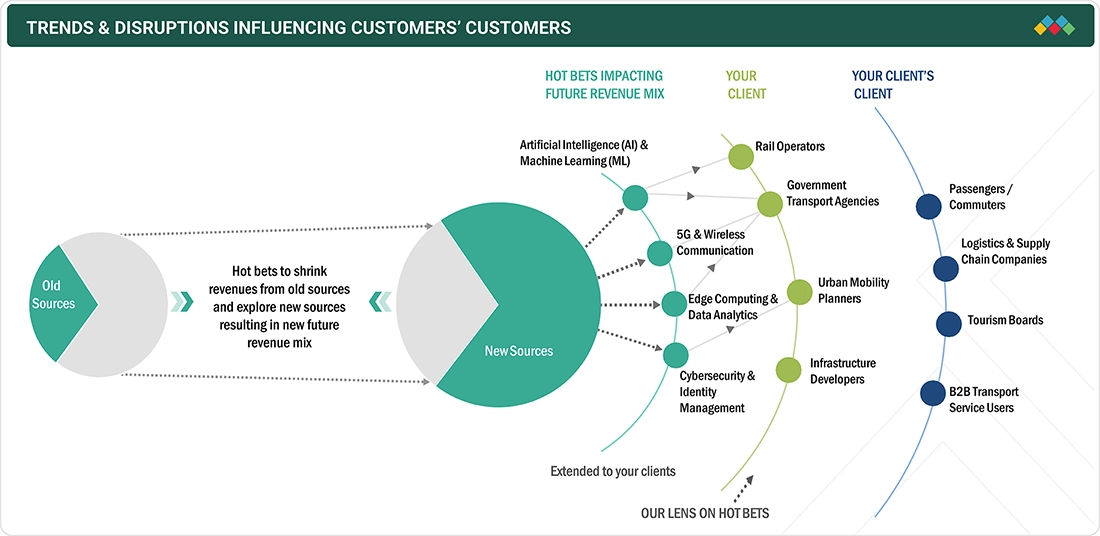
The impact on consumers' business emerges from customer trends or disruptions. Hotbets are predictive maintenance with digital twins, FRMCS/5G, Edge Computing, AI-driven operations and autonomous train control are shifting rail from asset-centric to data- and service-driven models. Disruptions include real-time connectivity needs, OT Security-IT convergence and new safety/security models. End users gain via higher punctuality, lower lifecycle costs, improved safety and better passenger experience.
Source: Secondary Research, Interviews with Experts, MarketsandMarkets Analysis
MARKET DYNAMICS

Drivers
Impact
Level
Level
-
Rapid urbanization, resulting in increased need for efficient railway system

-
Government initiatives ad increased number of public-private partnership projects in rail industry


RESTRAINTS
Impact
Level
Level
-
Substantial upfront investment


OPPORTUNITIES
Impact
Level
Level
-
Rising demand for cloud-based services

-
Increased globalization and need for advanced transportation infrastructure


CHALLENGES
Impact
Level
Level
-
Data security and privacy issues related to IoT devices

-
Disruption in logistics and supply chain of IoT devices

Source: Secondary Research, Interviews with Experts, MarketsandMarkets Analysis
Driver: Rapid urbanization, resulting in increased need for efficient railway system
According to UN statistics, the world's population is expected to cross the 10 billion mark by 2050. Close to half of this population is expected to reside in Sub-Saharan Africa, Latin America, and Asia Pacific, where population growth is expected to be more than threefold. In these regions, railways are a well-suited means of mass transport for passengers and freight. The combination of prospective economic growth and a rise in population will encourage more than half of the world's population, which is approximately 66%, to live in cities and towns by 2050. Most of this growth is expected to occur in Africa and Asia. These two regions are projected to reach 56% and 64% urbanization by 2050, respectively. However, they would still be less urbanized than other regions of the world. On the other hand, in mature countries, private transportation, such as cars, will be discouraged to encourage public transport, such as metros and tramways. This shift is expected to be driven by economic factors and the active promotion of environmentally friendly and sustainable forms of mass transport. Urban planners and inhabitants will seek an efficient and comfortable urban transport system with seamless interchanges
Restraint: Substantial upfront investment
The high initial cost of the deployment of smart railway technologies is a major hindrance to market growth. Funding these projects can be a significant barrier to the adoption of state-of-the-art solutions by governments and private companies struggling with the existing budgetary limitations of the railway infrastructure. The adoption of smart railway systems requires a massive capital outlay in installing field-level equipment, upgrading or replacing old infrastructure, building robust communication systems, and achieving smooth integration between new and old systems within railway premises. For example, the implementation of new signaling systems, such as ERTMS (European Rail Traffic Management System) or CBTC (Communication-Based Train Control), requires huge investments in hardware, software, and engineering. Besides, railway authorities are concerned about the long-term costs of operating and maintaining advanced technologies, including software updates, system monitoring, and specialized personnel training, which create financial barriers to widespread adoption
Opportunity: Rising demand for cloud-based services
The demand for cloud-based services, analytics, and internet technologies is increasing due to their efficient IT management and reliable security environment. The big data cloud model is the biggest opportunity for rail transportation to embrace the changing structure of data and maximize its use. It offers the potential for a vast shift for all rail management companies, enabling them to enhance both rail infrastructure and operations. With the rapid increase in big data applications, the level of complexity is also expected to increase due to the increasing data, emerging technologies, and the growing need to optimize cost-efficiency. These factors would influence the growth of new analytics platforms and data storage
Challenge: Data security and privacy issues related to IoT devices
The smart railways market has significant growth potential; however, maintaining data security and privacy is a key challenge faced by players operating in this market. Smart devices and sensors continuously generate a huge amount of data; this is expected to help rail operators handle data and gain insights related to the market position of their competitors. A majority of IoT-enabled devices are connected to various connectivity networks, such as mobile connectivity, public Wi-Fi, and office Wide Area Networks (WAN). Public networks may not be as protected as they are required to be at an enterprise level. Therefore, in a large-scale deployment, privacy and security are two closely related issues for IoT devices. The business data collected in the cloud and IoT-enabled devices can be vulnerable to cyber threats and breaches
Smart Railways Market: COMMERCIAL USE CASES ACROSS INDUSTRIES
| COMPANY | USE CASE DESCRIPTION | BENEFITS |
|---|---|---|
 |
HealthHub predictive-maintenance and fleet monitoring for rolling stock and infrastructure (continuous condition monitoring and AI analytics). | Reduced downtime, lower maintenance costs, higher asset availability. |
 |
Private 5G and digital services for rail operations — telemetry, predictive maintenance and readiness for FRMCS/mission-critical apps. | Deterministic connectivity, faster troubleshooting, improved operational efficiency |
 |
HMAX digital asset management / condition-based maintenance (example: Copenhagen Metro deployment) using sensors and analytics. | Shift to condition-based maintenance, fewer interventions, longer component life. |
 |
5G rail corridors and mission-critical 4G/5G deployments for train-to-ground communications, passenger broadband and real-time IoT | High-capacity comms, support for FRMCS, resilient passenger/operational services. |
 |
FRMCS-ready train-to-ground solutions and onboard connectivity (real-time CCTV, PTT/voice, passenger information systems) | Future-proof wireless standard support, safer operations, better passenger experience |
Logos and trademarks shown above are the property of their respective owners. Their use here is for informational and illustrative purposes only.
MARKET ECOSYSTEM
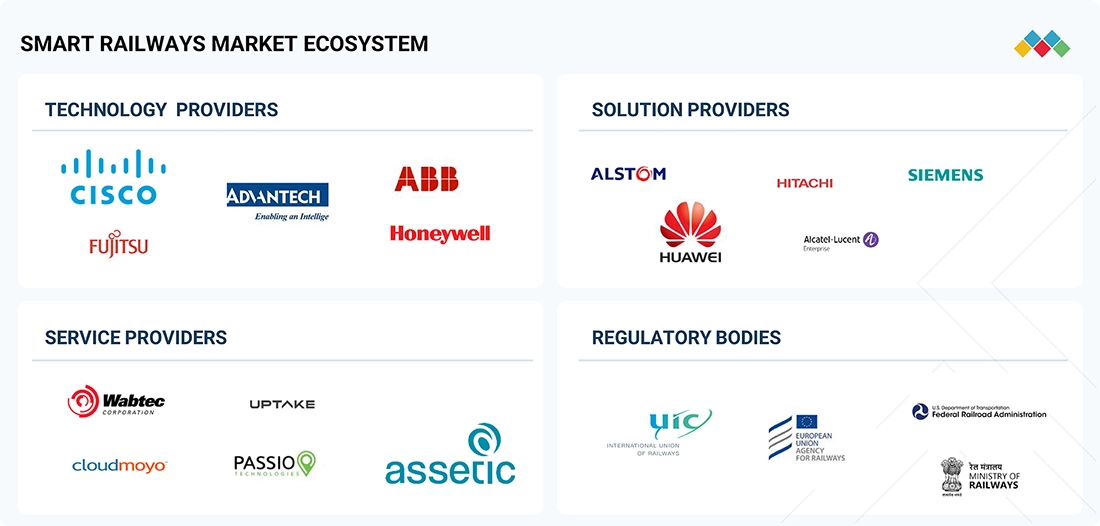
Prominent players in this market include well-established, financially stable smart railways providers of platforms and services, as well as regulatory bodies. These companies have been operating in the market for several years and possess a diversified product portfolio and state-of-the-art technologies. Alstom (France), Cisco (US), Wabtec (US), ABB (Switzerland), IBM (US), Hitachi (Japan), Huawei (China), Indra Sistemas (Spain), Siemens (Germany), Honeywell (US), Thales (France), Advantech (Taiwan), Fujitsu (Japan), Toshiba (Japan), and Alcatel-Lucent Enterprise (France) are some of the key players operating in this ecosystem
Logos and trademarks shown above are the property of their respective owners. Their use here is for informational and illustrative purposes only.
MARKET SEGMENTS
Source: Secondary Research, Interviews with Experts, MarketsandMarkets Analysis
In-building Wireless Market, By Offering
Rail analytics systems are closely integrated with all vital railway solutions to manage the overall operations of railways through a single control panel. The major activities included in rail analytics systems are railway revenue management, demand analysis and planning, transit analysis, pricing analysis, and workforce management. With the rapid increase in passenger traffic, the level of complexity will increase due to an increase in the amount of data, emerging technologies, and the constant need to optimize costs. These factors would influence the growth of new analytical platforms and data storage. Though rail analytics systems' potential is still confined to early adopters in railway transportation, they would be highly scalable and agile to deploy and integrate. The emergence of predictive analytics is expected to create new opportunities for rail analytics solutions in the smart railways market. These analytics mainly focus on estimating the resource requirements and probable congestion patterns in route planning
REGION
Europe to be largest region in global smart railways market during forecast period
Europe’s focus on upgrading its railway infrastructure is driving tremendous growth in the smart railways market. One of the major drivers is the necessity for enhanced safety via the application of advanced technology signaling systems, such as installing automatic train protection and intelligent surveillance technologies. Countries from Western Europe, such as the UK, France, and Germany, have well-established railway infrastructure, and several regional railway operators are using some of the advanced smart railway solutions. European countries have been investing heavily in the modernization and upgrade of their rail infrastructure. Social and trade agreements among the European Union (EU) countries have promoted large-scale, cross-border trade and passenger traffic in Europe. High growth is expected in the region, especially in communication technology, as the European Telecommunications Standards Institute (ETSI) has formed a separate committee to focus on Machine-to-Machine (M2M) communication privacy standardization and high trading standards. The dynamics of the rail industry in Europe are changing rapidly with new freight and passenger management systems. Several European countries are expected to adapt to the new smart railway solutions to boost the efficiency of the existing infrastructure

Smart Railways Market: COMPANY EVALUATION MATRIX
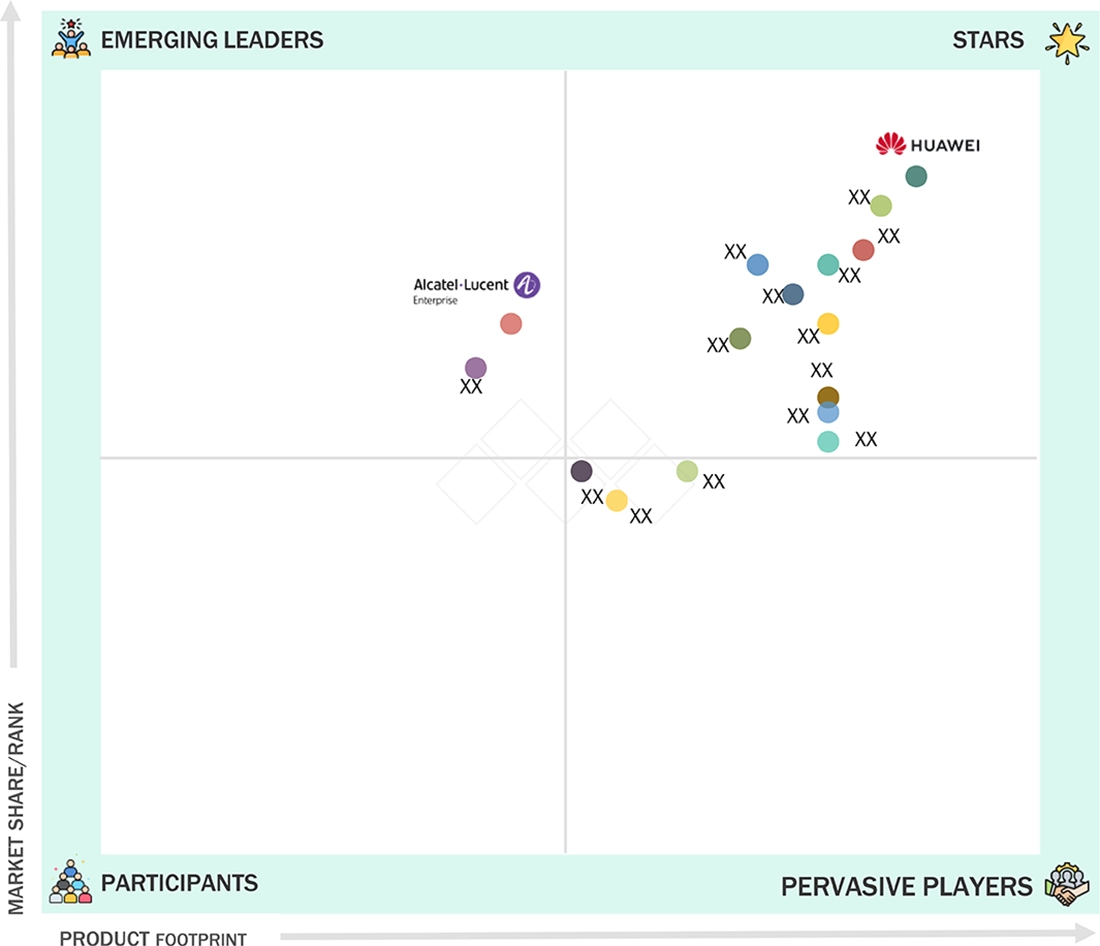
In the In-building wireless market matrix, Huawei (Star) leads with a strong market share and extensive product footprint, driven by its offering customized solutions as per customers' requirements and adopting growth strategies to achieve advanced technology consistently. Alcatel-Lucent Enterprise (Emerging Leader) is gaining visibility with its innovative solutions to cater to future smart railway demands. While Huawei dominates through scale and a diverse portfolio, Alcatel-Lucent Enterprise shows significant potential to move toward the leaders’ quadrant as demand for smart railways continues to rise.
Source: Secondary Research, Interviews with Experts, MarketsandMarkets Analysis
KEY MARKET PLAYERS
MARKET SCOPE
| REPORT METRIC | DETAILS |
|---|---|
| Market Size in 2024 (Value) | USD 33.72 Billion |
| Market Forecast in 2030 (Value) | USD 54.31 Billion |
| Growth Rate | CAGR of 8.3% from 2025-2030 |
| Years Considered | 2019-2030 |
| Base Year | 2024 |
| Forecast Period | 2025-2030 |
| Units Considered | Value (USD Million/Billion) |
| Report Coverage | Revenue forecast, company ranking, competitive landscape, growth factors, and trends |
| Segments Covered | By Offering: Solutions (Passenger Information System, Freight Management System, Security and Safety Solutions, Rail Communication ad Networking System, Smart Ticketing System, Rail Analytics System, Rail Asset Mangement and Maintenance Solutions, Rail Operation and Control Solutions), Services (Professional Services, Managed Services) |
| Regions Covered | North America, Europe, Asia Pacific, Middle East & Africa, Latin America |
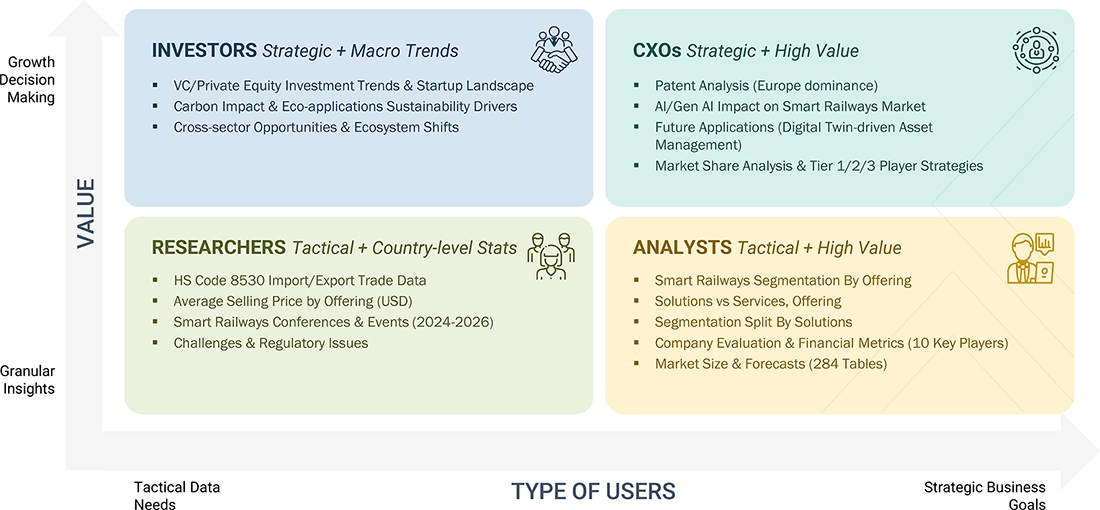
WHAT IS IN IT FOR YOU: Smart Railways Market REPORT CONTENT GUIDE
DELIVERED CUSTOMIZATIONS
We have successfully delivered the following deep-dive customizations:
| CLIENT REQUEST | CUSTOMIZATION DELIVERED | VALUE ADDS |
|---|---|---|
| Leading Solution Provider (US) | Product Analysis: Product Matrix, which gives a detailed comparison of the product portfolio of each company | Enhanced understanding of competitive positioning and product offerings |
| Leading Service Provider (EU) | Company Information: Detailed analysis and profiling of additional market players (up to 5) | Deeper insights into market dynamics and potential strategic partnerships |
RECENT DEVELOPMENTS
- March 2025 : ABB partnered with Stadler US to supply traction converters and Pro Series Traction Batteries for Metra’s battery-powered and Caltrans’ hydrogen-powered trainsets, advancing sustainable rail transport in the US. The components will be assembled at ABB’s Virginia facility to support local manufacturing and emission reduction goals
- January 2025 : Hitachi Rail agreed to acquire Omnicom from Balfour Beatty to enhance its new HMAX digital asset management platform. Omnicom’s AI-powered rail monitoring technology will support real-time infrastructure insights, boosting predictive maintenance and operational efficiency across global rail networks
- November 2024 : Alstom and Kazakhstan Railways (KTZ) signed a partnership agreement to advance rail transport along the Middle Corridor, focusing on innovation, digitalization, and local production. Alstom will invest over USD 56.8 million in service depots and infrastructure, creating 700 jobs and strengthening Kazakhstan’s role as a regional logistics hub
- September 2024 : At InnoTrans 2024, Siemens Mobility unveiled Signaling X, a cloud-based platform integrating mainline and mass transit signaling systems to boost operational efficiency and flexibility. It also introduced new Railigent X features, including fully automated and mobile inspections, aimed at enhancing rail service, optimizing infrastructure use, and supporting digitalization for sustainable transport
- September 2024 : Schaeffler signed a strategic partnership agreement with Alstom to advance reliable and sustainable rail transport solutions. The partnership focuses on long-term collaboration, innovation, and remanufacturing to support circular economy goals and enhance rail system efficiency
Table of Contents
 Exclusive indicates content/data unique to MarketsandMarkets and not available with any competitors.
TITLE
PAGE NO
1
INTRODUCTION
30
2
RESEARCH METHODOLOGY
35
3
EXECUTIVE SUMMARY
46
4
PREMIUM INSIGHTS
52
5
MARKET OVERVIEW
Smart railways evolve with IoT, AI, and public-private partnerships driving efficiency and innovation.
54
5.1
INTRODUCTION
5.2
MARKET DYNAMICS
5.2.1
DRIVERS
5.2.1.1
RISE IN NEED FOR EFFICIENCY IN RAIL OPERATIONS
5.2.1.2
RAPID URBANIZATION RESULTS IN INCREASED NEED FOR EFFICIENT RAILWAY SYSTEMS
5.2.1.3
GOVERNMENT INITIATIVES AND INCREASED NUMBER OF PUBLIC-PRIVATE PARTNERSHIP PROJECTS IN RAIL INDUSTRY
5.2.1.4
ADOPTION OF IOT AND OTHER AUTOMATION TECHNOLOGIES FOR PROCESS OPTIMIZATION
5.2.1.5
TECHNOLOGICAL ADVANCEMENTS TARGETED TOWARD ENHANCEMENT OF CUSTOMER EXPERIENCE
5.2.2
RESTRAINTS
5.2.2.1
HIGH INITIAL COST OF DEPLOYMENT
5.2.3
OPPORTUNITIES
5.2.3.1
INCREASED GLOBALIZATION AND NEED FOR ADVANCED TRANSPORTATION INFRASTRUCTURE
5.2.3.2
RISE IN DEMAND FOR CLOUD-BASED SERVICES
5.2.4
CHALLENGES
5.2.4.1
INTEGRATION OF ADVANCED AND COMPLEX SYSTEMS WITH LEGACY INFRASTRUCTURE
5.2.4.2
DISRUPTION IN LOGISTICS AND SUPPLY CHAIN OF IOT DEVICES
5.2.4.3
DATA SECURITY AND PRIVACY ISSUES RELATED TO IOT DEVICES
5.3
BRIEF HISTORY OF SMART RAILWAYS
5.3.1
1980S–1990S: FOUNDATION LAYING
5.3.2
2000S: RISE OF INTELLIGENT INFRASTRUCTURE
5.3.3
2010S: DIGITAL TRANSFORMATION AND CONNECTIVITY
5.3.4
2020S–PRESENT: AI-DRIVEN AND AUTONOMOUS RAILWAYS
5.4
ECOSYSTEM ANALYSIS
5.5
CASE STUDY ANALYSIS
5.5.1
CASE STUDY 1: LUXEMBOURG RAILWAYS EQUIPPED 34 NEW CORADIA TRAINS WITH ALSTOM’S AUTOMATIC TRAIN OPERATION SYSTEM
5.5.2
CASE STUDY 2: VTG RAIL EUROPE COLLABORATED WITH SIEMENS TO INNOVATE RAIL FREIGHT TRANSPORT
5.5.3
CASE STUDY 3: UPTAKE AUTOMATED MAINTENANCE WORK ORDER OF A NORTH AMERICAN FREIGHT RAILWAY COMPANY
5.5.4
CASE STUDY 4: THALES PROVIDED TRAIN-TO-GROUND BROADBAND DATA COMMUNICATION SOLUTION TO BRESCIA METRO
5.5.5
CASE STUDY 5: COMBOIOS DE PORTUGAL IMPLEMENTED SOLUTIONS BY FUJITSU TO INNOVATE ITS TICKETING INFRASTRUCTURE
5.5.6
CASE STUDY 6: SIEMENS PROVIDED MAINTENANCE SERVICES TO GOVIA THAMESLINK RAILWAY
5.5.7
CASE STUDY 7: ASSETIC HELPED SYDNEY TRAINS VISUALIZE RAIL ASSETS FOR OPTIMIZED ASSET MANAGEMENT
5.6
SUPPLY CHAIN ANALYSIS
5.7
TARIFF AND REGULATORY LANDSCAPE
5.7.1
TARIFF DATA (HSN: 853010) - ELECTRICAL SIGNALING, SAFETY, OR TRAFFIC CONTROL EQUIPMENT FOR RAILWAYS AND TRAMWAYS
5.8
REGULATORY LANDSCAPE
5.8.1
REGULATORY BODIES, GOVERNMENT AGENCIES, AND OTHER ORGANIZATIONS
5.8.2
KEY REGULATIONS, BY REGION
5.8.2.1
NORTH AMERICA
5.8.2.2
EUROPE
5.8.2.3
ASIA PACIFIC
5.8.2.4
REST OF THE WORLD
5.8.3
REGULATORY BODIES, GOVERNMENT AGENCIES, AND OTHER ORGANIZATIONS
5.8.4
ISO
5.8.4.1
ISO/IEC JTC 1
5.8.4.2
ISO/IEC 27001
5.8.4.3
ISO/IEC 19770-1
5.8.4.4
ISO/IEC JTC 1/SWG 5
5.8.4.5
ISO/IEC JTC 1/SC 31
5.8.4.6
ISO/IEC JTC 1/SC 27
5.8.4.7
ISO/IEC JTC 1/WG 7 SENSORS
5.8.5
GDPR
5.8.6
FMCSA
5.8.7
FHWA
5.8.8
MARAD
5.8.9
FAA
5.8.10
FRA
5.8.11
IEEE-SA
5.8.12
CEN/ISO
5.8.13
CEN/CENELEC
5.8.14
ETSI
5.8.15
ITU-T
5.9
PRICING ANALYSIS
5.9.1
AVERAGE SELLING PRICE OF KEY PLAYERS, BY OFFERING
5.9.1.1
INDICATIVE PRICING ANALYSIS OF KEY PLAYERS, BY SOLUTION
5.10
TECHNOLOGY ANALYSIS
5.10.1
KEY TECHNOLOGIES
5.10.1.1
INTERNET OF THINGS (IOT)
5.10.1.2
BIG DATA ANALYTICS AND CLOUD COMPUTING
5.10.1.3
ARTIFICIAL INTELLIGENCE (AI) AND MACHINE LEARNING (ML)
5.10.1.4
ADVANCED SIGNALING SYSTEMS
5.10.1.5
COMMUNICATION-BASED TRAIN CONTROL (CBTC)
5.10.2
ADJACENT TECHNOLOGIES
5.10.2.1
AUGMENTED REALITY (AR) AND VIRTUAL REALITY (VR)
5.10.2.2
BLOCKCHAIN
5.10.2.3
DRONES
5.10.3
COMPLEMENTARY TECHNOLOGIES
5.10.3.1
EDGE COMPUTING
5.10.3.2
DIGITAL TWIN
5.10.3.3
CYBERSECURITY
5.10.3.4
5G AND WIRELESS COMMUNICATION NETWORKS
5.11
PATENT ANALYSIS
5.12
KEY CONFERENCES AND EVENTS, 2025–2026
5.13
PORTER’S FIVE FORCES MODEL
5.13.1
THREAT OF NEW ENTRANTS
5.13.2
THREAT OF SUBSTITUTES
5.13.3
BARGAINING POWER OF BUYERS
5.13.4
BARGAINING POWER OF SUPPLIERS
5.13.5
INTENSITY OF COMPETITIVE RIVALRY
5.14
TRADE ANALYSIS
5.14.1
EXPORT SCENARIO OF PARTS SUITABLE FOR ELECTRICAL SIGNALING, SAFETY, OR TRAFFIC CONTROL EQUIPMENT FOR RAILWAYS, TRAMWAYS, AND ROADS
5.14.2
IMPORT SCENARIO OF ELECTRICAL SIGNALING, SAFETY, OR TRAFFIC CONTROL EQUIPMENT FOR RAILWAYS, TRAMWAYS, AND ROADS
5.15
TRENDS AND DISRUPTIONS IMPACTING CUSTOMER BUSINESS
5.16
KEY STAKEHOLDERS AND BUYING CRITERIA
5.16.1
KEY STAKEHOLDERS IN BUYING PROCESS
5.16.2
BUYING CRITERIA
5.17
BEST PRACTICES IN SMART RAILWAYS MARKET
5.18
TECHNOLOGY ROADMAP FOR SMART RAILWAYS MARKET
5.18.1
SHORT-TERM ROADMAP (2023–2025)
5.18.2
MID-TERM ROADMAP (2026–2028)
5.18.3
LONG-TERM ROADMAP (2029–2030)
5.19
INVESTMENT AND FUNDING SCENARIO
5.20
BUSINESS MODELS OF SMART RAILWAYS
5.20.1
CURRENT BUSINESS MODELS
5.20.2
EMERGING BUSINESS MODELS
5.21
IMPACT OF AI/GENERATIVE AI ON SMART RAILWAYS MARKET
5.21.1
USE CASES OF GENERATIVE AI IN SMART RAILWAYS
6
IMPACT OF 2025 US TARIFF – SMART RAILWAYS MARKET
US tariffs set to reshape global smart railways market dynamics and pricing strategies.
90
6.1
INTRODUCTION
6.2
KEY TARIFF RATES
6.3
PRICE IMPACT ANALYSIS
6.4
IMPACT ON COUNTRY/REGION
6.4.1
US
6.4.2
EUROPE
6.4.3
ASIA PACIFIC
6.5
IMPACT ON SMART RAILWAYS MARKET SEGMENTS
7
SMART RAILWAYS MARKET, BY OFFERING
Market Size & Growth Rate Forecast Analysis to 2030 in USD Million | 80 Data Tables
96
7.1
INTRODUCTION
7.2
SOLUTIONS
7.2.1
SOLUTIONS: SMART RAILWAYS MARKET DRIVERS
7.2.2
PASSENGER INFORMATION SYSTEM
7.2.2.1
RISING DEMAND FOR REAL-TIME PASSENGER INFORMATION SYSTEMS
7.2.2.2
MULTIMEDIA INFORMATION AND ENTERTAINMENT
7.2.2.3
NETWORK CONNECTIVITY
7.2.3
FREIGHT MANAGEMENT SYSTEM
7.2.3.1
RAPID DIGITALIZATION AND ADOPTION OF ADVANCED TECHNOLOGIES
7.2.3.2
FREIGHT OPERATION MANAGEMENT
7.2.3.3
FREIGHT TRACKING
7.2.4
SECURITY AND SAFETY SOLUTIONS
7.2.4.1
USE OF AI AND IOT IN RAILWAY SECURITY
7.2.4.2
VIDEO SURVEILLANCE AND ANALYTICS
7.2.4.3
INTRUSION DETECTION
7.2.4.4
ACCESS CONTROL
7.2.4.5
FIRE ALARM AND VOICE EVACUATION
7.2.4.6
OTHER SECURITY AND SAFETY SOLUTIONS
7.2.5
RAIL COMMUNICATION AND NETWORKING SYSTEM
7.2.5.1
EMERGING REQUIREMENTS FOR IT AND NETWORKING IN RAILWAYS
7.2.5.2
GROUND-TO-TRAIN COMMUNICATION
7.2.5.3
TRAIN-TO-TRAIN COMMUNICATION
7.2.6
SMART TICKETING SYSTEM
7.2.6.1
NEED FOR CONVENIENCE
7.2.7
RAIL ANALYTICS SYSTEM
7.2.7.1
RAPID ADOPTION OF AI-POWERED SOLUTIONS IN VARIOUS COUNTRIES ACROSS GLOBE
7.2.8
RAIL ASSET MANAGEMENT AND MAINTENANCE SOLUTIONS
7.2.8.1
INCREASED USE OF SENSORS IN RAIL ASSET MAINTENANCE
7.2.8.2
ASSET PLANNING AND SCHEDULING
7.2.8.3
WORKFORCE MANAGEMENT AND OPTIMIZATION
7.2.8.4
CONDITION-BASED MONITORING
7.2.8.5
PREDICTIVE MAINTENANCE
7.2.8.6
OTHER RAILWAY ASSET MANAGEMENT AND MAINTENANCE SOLUTIONS
7.2.9
RAIL OPERATION AND CONTROL SOLUTIONS
7.2.9.1
NEED TO COMPETE WITH OTHER MODES OF TRANSPORTATION
7.3
SERVICES
7.3.1
SERVICES: SMART RAILWAYS MARKET DRIVERS
7.3.2
PROFESSIONAL SERVICES
7.3.2.1
FAST DIGITALIZATION IN RAILWAY INDUSTRY AND GROWING NEED FOR PERSONNEL TRAINING
7.3.2.2
CONSULTING
7.3.2.3
SYSTEM INTEGRATION AND DEPLOYMENT
7.3.2.4
TRAINING, SUPPORT, AND MAINTENANCE
7.3.3
MANAGED SERVICES
7.3.3.1
INCREASED REQUIREMENT FOR COMPETENT PERSONNEL FOR TECHNICAL ASSISTANCE
8
SMART RAILWAYS MARKET, BY REGION
Comprehensive coverage of 9 Regions with country-level deep-dive of 17 Countries | 124 Data Tables.
139
8.1
INTRODUCTION
8.2
NORTH AMERICA
8.2.1
NORTH AMERICA: PESTLE ANALYSIS
8.2.2
NORTH AMERICA: MARKET DRIVERS
8.2.3
NORTH AMERICA: MACROECONOMIC OUTLOOK
8.2.4
US
8.2.4.1
GOVERNMENT INITIATIVES TO DRIVE MARKET IN US
8.2.5
CANADA
8.2.5.1
INCREASE IN NUMBER OF PASSENGERS AND HIGHER FREIGHT TRAFFIC TO DRIVE MARKET IN CANADA
8.3
EUROPE
8.3.1
EUROPE: MARKET DRIVERS
8.3.2
EUROPE: MACROECONOMIC OUTLOOK
8.3.3
UK
8.3.3.1
NEED TO IMPROVE EFFICIENCY OF EXISTING RAILWAY INFRASTRUCTURE TO BOOST MARKET
8.3.4
GERMANY
8.3.4.1
SIGNIFICANT ADOPTION OF IOT TECHNOLOGIES AND ANALYTICS IN RAILWAY SECTOR TO PROPEL MARKET
8.3.5
FRANCE
8.3.5.1
HIGH INVESTMENT BY RAILWAY OPERATORS TO DRIVE MARKET
8.3.6
ITALY
8.3.6.1
ADVANCEMENT IN RAILWAY MOBILITY THROUGH SMART AND INTEGRATED SOLUTIONS TO DRIVE MARKET
8.3.7
SPAIN
8.3.7.1
MODERNIZATION OF RAILWAY INFRASTRUCTURE WITH CUTTING-EDGE TECHNOLOGY AND STRATEGIC INVESTMENT TO DRIVE MARKET
8.3.8
NORDIC COUNTRIES
8.3.8.1
FOCUS ON SUSTAINABLE INNOVATION AND AUTONOMOUS RAIL OPERATIONS TO DRIVE MARKET
8.3.9
REST OF EUROPE
8.4
ASIA PACIFIC
8.4.1
ASIA PACIFIC: MARKET DRIVERS
8.4.2
ASIA PACIFIC: MACROECONOMIC OUTLOOK
8.4.3
CHINA
8.4.3.1
HIGH GOVERNMENT INVESTMENTS IN RAILWAY INFRASTRUCTURE AND RAPID GROWTH IN RAILWAYS TO DRIVE MARKET
8.4.4
INDIA
8.4.4.1
INVESTMENTS IN SMART CITY PROJECTS BY GOVERNMENT TO SPUR MARKET GROWTH
8.4.5
JAPAN
8.4.5.1
RISE IN ADOPTION OF RAILWAY TECHNOLOGIES TO BOOST MARKET
8.4.6
AUSTRALIA & NEW ZEALAND (ANZ)
8.4.6.1
RISING INFRASTRUCTURE INVESTMENTS TO DRIVE MARKET
8.4.7
SOUTHEAST ASIA
8.4.7.1
INCREASING INVESTMENT IN RAIL INFRASTRUCTURE MODERNIZATION TO DRIVE MARKET
8.4.8
REST OF ASIA PACIFIC
8.5
MIDDLE EAST & AFRICA
8.5.1
MIDDLE EAST & AFRICA: MARKET DRIVERS
8.5.2
MIDDLE EAST & AFRICA: MACROECONOMIC OUTLOOK
8.5.3
MIDDLE EAST
8.5.3.1
UAE
8.5.3.2
KSA
8.5.3.3
TURKEY
8.5.3.4
REST OF MIDDLE EAST
8.5.4
AFRICA
8.5.4.1
NIGERIA
8.5.4.2
SOUTH AFRICA
8.5.4.3
REST OF AFRICA
8.6
LATIN AMERICA
8.6.1
LATIN AMERICA: MARKET DRIVERS
8.6.2
LATIN AMERICA: MACROECONOMIC OUTLOOK
8.6.3
BRAZIL
8.6.3.1
SIGNIFICANT SCOPE FOR DEVELOPMENT OF ADVANCED RAILWAY INFRASTRUCTURE TO BOOST MARKET GROWTH
8.6.4
MEXICO
8.6.4.1
INCREASED DEMAND FOR IMPROVED TRANSPORTATION INFRASTRUCTURE TO FUEL MARKET GROWTH
8.6.5
REST OF LATIN AMERICA
9
COMPETITIVE LANDSCAPE
Discover top strategies and market shifts shaping competitive dynamics in the smart railways sector.
195
9.1
INTRODUCTION
9.2
KEY PLAYER STRATEGIES/RIGHT TO WIN, 2022–2025
9.3
MARKET SHARE ANALYSIS, 2024
9.4
REVENUE ANALYSIS OF LEADING PLAYERS, 2020–2024
9.5
BRAND/PRODUCT COMPARISON
9.6
COMPANY VALUATION AND FINANCIAL METRICS
9.7
COMPANY EVALUATION MATRIX: KEY PLAYERS, 2024
9.7.1
STARS
9.7.2
EMERGING LEADERS
9.7.3
PERVASIVE PLAYERS
9.7.4
PARTICIPANTS
9.7.5
COMPANY FOOTPRINT: KEY PLAYERS, 2024
9.7.5.1
COMPANY FOOTPRINT
9.7.5.2
REGION FOOTPRINT
9.7.5.3
OFFERING FOOTPRINT
9.8
COMPANY EVALUATION MATRIX: SME/STARTUPS, 2024
9.8.1
PROGRESSIVE COMPANIES
9.8.2
RESPONSIVE COMPANIES
9.8.3
DYNAMIC COMPANIES
9.8.4
STARTING BLOCKS
9.8.5
COMPETITIVE BENCHMARKING: STARTUPS/SMES, 2024
9.8.5.1
DETAILED LIST OF KEY STARTUPS/SMES
9.8.5.2
COMPETITIVE BENCHMARKING OF KEY STARTUPS/SMES
9.9
COMPETITIVE SCENARIO
9.9.1
PRODUCT LAUNCHES
9.9.2
DEALS
9.9.3
OTHER DEVELOPMENTS
10
COMPANY PROFILES
In-depth Company Profiles of Leading Market Players with detailed Business Overview, Product and Service Portfolio, Recent Developments, and Unique Analyst Perspective (MnM View)
223
10.1
MAJOR PLAYERS
10.1.1
ALSTOM
10.1.1.1
BUSINESS OVERVIEW
10.1.1.2
PRODUCTS/SOLUTIONS/SERVICES OFFERED
10.1.1.3
RECENT DEVELOPMENTS
10.1.1.4
MNM VIEW
10.1.2
CISCO
10.1.3
HITACHI
10.1.4
WABTEC
10.1.5
SIEMENS
10.1.6
IBM
10.1.7
HUAWEI
10.1.8
INDRA SISTEMAS
10.1.9
HONEYWELL
10.1.10
ABB
10.1.11
ADVANTECH
10.1.12
FUJITSU
10.1.13
TOSHIBA
10.1.14
MOXA
10.1.15
TELEVIC
10.1.16
ALCATEL-LUCENT ENTERPRISE
10.1.17
CONDUENT
10.2
STARTUPS/SMES
10.2.1
EKE-ELECTRONICS
10.2.2
AITEK S.P.A.
10.2.3
UPTAKE
10.2.4
EUROTECH
10.2.5
TEGO
10.2.6
KONUX
10.2.7
ASSETIC
10.2.8
MACHINES WITH VISION
10.2.9
DELPHISONIC
10.2.10
PASSIO TECHNOLOGIES
10.2.11
CLOUDMOYO
10.2.12
CHEMITO
10.2.13
RAILTEL
11
ADJACENT/RELATED MARKETS
290
11.1
LIMITATIONS
11.2
RAILWAY MANAGEMENT SYSTEM MARKET – GLOBAL FORECAST TO 2025
11.2.1
MARKET DEFINITION
11.2.2
MARKET OVERVIEW
11.2.3
RAILWAY MANAGEMENT SYSTEM MARKET, BY OFFERING
11.2.4
RAILWAY MANAGEMENT SYSTEM MARKET, BY SERVICE
11.2.5
RAILWAY MANAGEMENT SYSTEM MARKET, BY REGION
11.3
RAILWAY PLATFORM SECURITY MARKET – GLOBAL FORECAST TO 2024
11.3.1
MARKET DEFINITION
11.3.2
MARKET OVERVIEW
11.3.3
RAILWAY PLATFORM SECURITY MARKET, BY COMPONENT
11.3.4
RAILWAY PLATFORM SECURITY MARKET, BY SOLUTION
11.3.5
RAILWAY PLATFORM SECURITY MARKET, BY SERVICE
11.3.6
RAILWAY PLATFORM SECURITY MARKET, BY PROFESSIONAL SERVICE
11.3.7
RAILWAY PLATFORM SECURITY MARKET, BY APPLICATION
11.3.8
RAILWAY PLATFORM SECURITY MARKET, BY REGION
11.4
DIGITAL RAILWAY MARKET – GLOBAL FORECAST TO 2024
11.4.1
MARKET DEFINITION
11.4.2
MARKET OVERVIEW
11.4.3
DIGITAL RAILWAY MARKET, BY SOLUTION
11.4.4
DIGITAL RAILWAY MARKET, BY SERVICE
11.4.5
DIGITAL RAILWAY MARKET, BY PROFESSIONAL SERVICE
11.4.6
DIGITAL RAILWAY MARKET, BY APPLICATION
11.4.7
DIGITAL RAILWAY MARKET, BY REGION
12
APPENDIX
301
12.1
DISCUSSION GUIDE
12.2
KNOWLEDGESTORE: MARKETSANDMARKETS’ SUBSCRIPTION PORTAL
12.3
CUSTOMIZATION OPTIONS
12.4
RELATED REPORTS
12.5
AUTHOR DETAILS
LIST OF TABLES
TABLE 1
USD EXCHANGE RATES, 2020–2024
TABLE 2
RISK ASSESSMENT
TABLE 3
SMART RAILWAYS MARKET ECOSYSTEM
TABLE 4
TARIFF RELATED TO AERIALS AND AERIAL REFLECTORS OF ALL KINDS (HSN: 853010), 2024
TABLE 5
NORTH AMERICA: REGULATORY BODIES, GOVERNMENT AGENCIES, AND OTHER ORGANIZATIONS
TABLE 6
EUROPE: REGULATORY BODIES, GOVERNMENT AGENCIES, AND OTHER ORGANIZATIONS
TABLE 7
ASIA PACIFIC: REGULATORY BODIES, GOVERNMENT AGENCIES, AND OTHER ORGANIZATIONS
TABLE 8
REST OF THE WORLD: REGULATORY BODIES, GOVERNMENT AGENCIES, AND OTHER ORGANIZATIONS
TABLE 9
AVERAGE SELLING PRICE OF KEY PLAYERS, BY OFFERING
TABLE 10
INDICATIVE PRICING ANALYSIS OF KEY PLAYERS, BY SOLUTION
TABLE 11
SMART RAILWAYS MARKET: LIST OF TOP PATENTS, 2024
TABLE 12
SMART RAILWAYS MARKET: LIST OF KEY CONFERENCES AND EVENTS
TABLE 13
IMPACT OF EACH FORCE ON SMART RAILWAYS MARKET
TABLE 14
INFLUENCE OF STAKEHOLDERS ON BUYING PROCESS FOR TOP THREE SOLUTIONS
TABLE 15
KEY BUYING CRITERIA FOR TOP THREE SOLUTIONS
TABLE 16
US ADJUSTED RECIPROCAL TARIFF RATES
TABLE 17
EXPECTED CHANGE IN PRICES AND LIKELY IMPACT ON END-USE MARKET DUE TO TARIFF IMPACT
TABLE 18
SMART RAILWAYS MARKET SIZE, BY OFFERING, 2019–2024 (USD MILLION)
TABLE 19
SMART RAILWAYS MARKET SIZE, BY OFFERING, 2025–2030 (USD MILLION)
TABLE 20
SOLUTIONS: SMART RAILWAYS MARKET SIZE, BY TYPE, 2019–2024 (USD MILLION)
TABLE 21
SOLUTIONS: SMART RAILWAYS MARKET SIZE, BY TYPE, 2025–2030 (USD MILLION)
TABLE 22
SOLUTIONS: SMART RAILWAYS MARKET SIZE, BY REGION, 2019–2024 (USD MILLION)
TABLE 23
SOLUTIONS: SMART RAILWAYS MARKET SIZE, BY REGION, 2025–2030 (USD MILLION)
TABLE 24
PASSENGER INFORMATION SYSTEM: SMART RAILWAYS MARKET SIZE, BY TYPE, 2019–2024 (USD MILLION)
TABLE 25
PASSENGER INFORMATION SYSTEM: SMART RAILWAYS MARKET SIZE, BY TYPE, 2025–2030 (USD MILLION)
TABLE 26
PASSENGER INFORMATION SYSTEM: SMART RAILWAYS MARKET SIZE, BY REGION, 2019–2024 (USD MILLION)
TABLE 27
PASSENGER INFORMATION SYSTEM: SMART RAILWAYS MARKET SIZE, BY REGION, 2025–2030 (USD MILLION)
TABLE 28
MULTIMEDIA INFORMATION AND ENTERTAINMENT: SMART RAILWAYS MARKET SIZE, BY REGION, 2019–2024 (USD MILLION)
TABLE 29
MULTIMEDIA INFORMATION AND ENTERTAINMENT: SMART RAILWAYS MARKET SIZE, BY REGION, 2025–2030 (USD MILLION)
TABLE 30
NETWORK CONNECTIVITY: SMART RAILWAYS MARKET SIZE, BY REGION, 2019–2024 (USD MILLION)
TABLE 31
NETWORK CONNECTIVITY: SMART RAILWAYS MARKET SIZE, BY REGION, 2025–2030 (USD MILLION)
TABLE 32
FREIGHT MANAGEMENT SYSTEM: SMART RAILWAYS MARKET SIZE, BY TYPE, 2019–2024 (USD MILLION)
TABLE 33
FREIGHT MANAGEMENT SYSTEM: SMART RAILWAYS MARKET SIZE, BY TYPE, 2025–2030 (USD MILLION)
TABLE 34
FREIGHT MANAGEMENT SYSTEM: SMART RAILWAYS MARKET SIZE, BY REGION, 2019–2024 (USD MILLION)
TABLE 35
FREIGHT MANAGEMENT SYSTEM: SMART RAILWAYS MARKET SIZE, BY REGION, 2025–2030 (USD MILLION)
TABLE 36
FREIGHT OPERATION MANAGEMENT: SMART RAILWAYS MARKET SIZE, BY REGION, 2019–2024 (USD MILLION)
TABLE 37
FREIGHT OPERATION MANAGEMENT: SMART RAILWAYS MARKET SIZE, BY REGION, 2025–2030 (USD MILLION)
TABLE 38
FREIGHT TRACKING: SMART RAILWAYS MARKET SIZE, BY REGION, 2019–2024 (USD MILLION)
TABLE 39
FREIGHT TRACKING: SMART RAILWAYS MARKET SIZE, BY REGION, 2025–2030 (USD MILLION)
TABLE 40
SECURITY AND SAFETY SOLUTIONS: SMART RAILWAYS MARKET SIZE, BY TYPE, 2019–2024 (USD MILLION)
TABLE 41
SECURITY AND SAFETY SOLUTIONS: SMART RAILWAYS MARKET SIZE, BY TYPE, 2025–2030 (USD MILLION)
TABLE 42
SECURITY AND SAFETY SOLUTIONS: SMART RAILWAYS MARKET SIZE, BY REGION, 2019–2024 (USD MILLION)
TABLE 43
SECURITY AND SAFETY SOLUTIONS: SMART RAILWAYS MARKET SIZE, BY REGION, 2025–2030 (USD MILLION)
TABLE 44
VIDEO SURVEILLANCE AND ANALYTICS: SMART RAILWAYS MARKET SIZE, BY REGION, 2019–2024 (USD MILLION)
TABLE 45
VIDEO SURVEILLANCE AND ANALYTICS: SMART RAILWAYS MARKET SIZE, BY REGION, 2025–2030 (USD MILLION)
TABLE 46
INTRUSION DETECTION: SMART RAILWAYS MARKET SIZE, BY REGION, 2019–2024 (USD MILLION)
TABLE 47
INTRUSION DETECTION: SMART RAILWAYS MARKET SIZE, BY REGION, 2025–2030 (USD MILLION)
TABLE 48
ACCESS CONTROL: SMART RAILWAYS MARKET SIZE, BY REGION, 2019–2024 (USD MILLION)
TABLE 49
ACCESS CONTROL: SMART RAILWAYS MARKET SIZE, BY REGION, 2025–2030 (USD MILLION)
TABLE 50
FIRE ALARM AND VOICE EVACUATION: SMART RAILWAYS MARKET SIZE, BY REGION, 2019–2024 (USD MILLION)
TABLE 51
FIRE ALARM AND VOICE EVACUATION: SMART RAILWAYS MARKET SIZE, BY REGION, 2025–2030 (USD MILLION)
TABLE 52
OTHER SECURITY AND SAFETY SOLUTIONS: SMART RAILWAYS MARKET SIZE, BY REGION, 2019–2024 (USD MILLION)
TABLE 53
OTHER SECURITY AND SAFETY SOLUTIONS: SMART RAILWAYS MARKET SIZE, BY REGION, 2025–2030 (USD MILLION)
TABLE 54
RAIL COMMUNICATION AND NETWORKING SYSTEM: SMART RAILWAYS MARKET SIZE, BY TYPE, 2019–2024 (USD MILLION)
TABLE 55
RAIL COMMUNICATION AND NETWORKING SYSTEM: SMART RAILWAYS MARKET SIZE, BY TYPE, 2025–2030 (USD MILLION)
TABLE 56
RAIL COMMUNICATION AND NETWORKING SYSTEM: SMART RAILWAYS MARKET SIZE, BY REGION, 2019–2024 (USD MILLION)
TABLE 57
RAIL COMMUNICATION AND NETWORKING SYSTEM: SMART RAILWAYS MARKET SIZE, BY REGION, 2025–2030 (USD MILLION)
TABLE 58
GROUND-TO-TRAIN COMMUNICATION: SMART RAILWAYS MARKET SIZE, BY REGION, 2019–2024 (USD MILLION)
TABLE 59
GROUND-TO-TRAIN COMMUNICATION: SMART RAILWAYS MARKET SIZE, BY REGION, 2025–2030 (USD MILLION)
TABLE 60
TRAIN-TO-TRAIN COMMUNICATION: SMART RAILWAYS MARKET SIZE, BY REGION, 2019–2024 (USD MILLION)
TABLE 61
TRAIN-TO-TRAIN COMMUNICATION: SMART RAILWAYS MARKET SIZE, BY REGION, 2025–2030 (USD MILLION)
TABLE 62
SMART TICKETING SYSTEM: SMART RAILWAYS MARKET SIZE, BY REGION, 2019–2024 (USD MILLION)
TABLE 63
SMART TICKETING SYSTEM: SMART RAILWAYS MARKET SIZE, BY REGION, 2025–2030 (USD MILLION)
TABLE 64
RAIL ANALYTICS SYSTEM: SMART RAILWAYS MARKET SIZE, BY REGION, 2019–2024 (USD MILLION)
TABLE 65
RAIL ANALYTICS SYSTEM: SMART RAILWAYS MARKET SIZE, BY REGION, 2025–2030 (USD MILLION)
TABLE 66
RAIL ASSET MANAGEMENT AND MAINTENANCE SOLUTIONS: SMART RAILWAYS MARKET SIZE, BY TYPE, 2019–2024 (USD MILLION)
TABLE 67
RAIL ASSET MANAGEMENT AND MAINTENANCE SOLUTIONS: SMART RAILWAYS MARKET SIZE, BY TYPE, 2025–2030 (USD MILLION)
TABLE 68
RAIL ASSET MANAGEMENT AND MAINTENANCE SOLUTIONS: SMART RAILWAYS MARKET SIZE, BY REGION, 2019–2024 (USD MILLION)
TABLE 69
RAIL ASSET MANAGEMENT AND MAINTENANCE SOLUTIONS: SMART RAILWAYS MARKET SIZE, BY REGION, 2025–2030 (USD MILLION)
TABLE 70
ASSET PLANNING AND SCHEDULING: SMART RAILWAYS MARKET SIZE, BY REGION, 2019–2024 (USD MILLION)
TABLE 71
ASSET PLANNING AND SCHEDULING: SMART RAILWAYS MARKET SIZE, BY REGION, 2025–2030 (USD MILLION)
TABLE 72
WORKFORCE MANAGEMENT AND OPTIMIZATION: SMART RAILWAYS MARKET SIZE, BY REGION, 2019–2024 (USD MILLION)
TABLE 73
WORKFORCE MANAGEMENT AND OPTIMIZATION: SMART RAILWAYS MARKET SIZE, BY REGION, 2025–2030 (USD MILLION)
TABLE 74
CONDITION-BASED MONITORING: SMART RAILWAYS MARKET SIZE, BY REGION, 2019–2024 (USD MILLION)
TABLE 75
CONDITION-BASED MONITORING: SMART RAILWAYS MARKET SIZE, BY REGION, 2025–2030 (USD MILLION)
TABLE 76
PREDICTIVE MAINTENANCE: SMART RAILWAYS MARKET SIZE, BY REGION, 2019–2024 (USD MILLION)
TABLE 77
PREDICTIVE MAINTENANCE: SMART RAILWAYS MARKET SIZE, BY REGION, 2025–2030 (USD MILLION)
TABLE 78
OTHER RAIL ASSET MANAGEMENT AND MAINTENANCE SOLUTIONS: SMART RAILWAYS MARKET SIZE, BY REGION, 2019–2024 (USD MILLION)
TABLE 79
OTHER RAIL ASSET MANAGEMENT AND MAINTENANCE SOLUTIONS: SMART RAILWAYS MARKET SIZE, BY REGION, 2025–2030 (USD MILLION)
TABLE 80
RAIL OPERATION AND CONTROL SOLUTIONS: SMART RAILWAYS MARKET SIZE, BY REGION, 2019–2024 (USD MILLION)
TABLE 81
RAIL OPERATION AND CONTROL SOLUTIONS: SMART RAILWAYS MARKET SIZE, BY REGION, 2025–2030 (USD MILLION)
TABLE 82
SERVICES: SMART RAILWAYS MARKET SIZE, BY TYPE, 2019–2024 (USD MILLION)
TABLE 83
SERVICES: SMART RAILWAYS MARKET SIZE, BY TYPE, 2025–2030 (USD MILLION)
TABLE 84
SERVICES: SMART RAILWAYS MARKET SIZE, BY REGION, 2019–2024 (USD MILLION)
TABLE 85
SERVICES: SMART RAILWAYS MARKET SIZE, BY REGION, 2025–2030 (USD MILLION)
TABLE 86
PROFESSIONAL SERVICES: SMART RAILWAYS MARKET SIZE, BY TYPE, 2019–2024 (USD MILLION)
TABLE 87
PROFESSIONAL SERVICES: SMART RAILWAYS MARKET SIZE, BY TYPE, 2025–2030 (USD MILLION)
TABLE 88
PROFESSIONAL SERVICES: SMART RAILWAYS MARKET SIZE, BY REGION, 2019–2024 (USD MILLION)
TABLE 89
PROFESSIONAL SERVICES: SMART RAILWAYS MARKET SIZE, BY REGION, 2025–2030 (USD MILLION)
TABLE 90
CONSULTING: SMART RAILWAYS MARKET SIZE, BY REGION, 2019–2024 (USD MILLION)
TABLE 91
CONSULTING: SMART RAILWAYS MARKET SIZE, BY REGION, 2025–2030 (USD MILLION)
TABLE 92
SYSTEM INTEGRATION AND DEPLOYMENT: SMART RAILWAYS MARKET SIZE, BY REGION, 2019–2024 (USD MILLION)
TABLE 93
SYSTEM INTEGRATION AND DEPLOYMENT: SMART RAILWAYS MARKET SIZE, BY REGION, 2025–2030 (USD MILLION)
TABLE 94
TRAINING, SUPPORT, AND MAINTENANCE: SMART RAILWAYS MARKET SIZE, BY REGION, 2019–2024 (USD MILLION)
TABLE 95
TRAINING, SUPPORT, AND MAINTENANCE: SMART RAILWAYS MARKET SIZE, BY REGION, 2025–2030 (USD MILLION)
TABLE 96
MANAGED SERVICES: SMART RAILWAYS MARKET SIZE, BY REGION, 2019–2024 (USD MILLION)
TABLE 97
MANAGED SERVICES: SMART RAILWAYS MARKET SIZE, BY REGION, 2025–2030 (USD MILLION)
TABLE 98
SMART RAILWAYS MARKET SIZE, BY REGION, 2019–2024 (USD MILLION)
TABLE 99
SMART RAILWAYS MARKET SIZE, BY REGION, 2025–2030 (USD MILLION)
TABLE 100
NORTH AMERICA: SMART RAILWAYS MARKET SIZE, BY OFFERING, 2019–2024 (USD MILLION)
TABLE 101
NORTH AMERICA: SMART RAILWAYS MARKET SIZE, BY OFFERING, 2025–2030 (USD MILLION)
TABLE 102
NORTH AMERICA: SMART RAILWAYS MARKET SIZE, BY SOLUTIONS, 2019–2024 (USD MILLION)
TABLE 103
NORTH AMERICA: SMART RAILWAYS MARKET SIZE, BY SOLUTIONS, 2025–2030 (USD MILLION)
TABLE 104
NORTH AMERICA: SMART RAILWAYS MARKET SIZE, BY PASSENGER INFORMATION SYSTEM, 2019–2024 (USD MILLION)
TABLE 105
NORTH AMERICA: SMART RAILWAYS MARKET SIZE, BY PASSENGER INFORMATION SYSTEM, 2025–2030 (USD MILLION)
TABLE 106
NORTH AMERICA: SMART RAILWAYS MARKET SIZE, BY FREIGHT MANAGEMENT SYSTEM, 2019–2024 (USD MILLION)
TABLE 107
NORTH AMERICA: SMART RAILWAYS MARKET SIZE, BY FREIGHT MANAGEMENT SYSTEM, 2025–2030 (USD MILLION)
TABLE 108
NORTH AMERICA: SMART RAILWAYS MARKET SIZE, BY SECURITY AND SAFETY SOLUTIONS, 2019–2024 (USD MILLION)
TABLE 109
NORTH AMERICA: SMART RAILWAYS MARKET SIZE, BY SECURITY AND SAFETY SOLUTIONS, 2025–2030 (USD MILLION)
TABLE 110
NORTH AMERICA: SMART RAILWAYS MARKET SIZE, BY RAIL COMMUNICATION AND NETWORKING SYSTEM, 2019–2024 (USD MILLION)
TABLE 111
NORTH AMERICA: SMART RAILWAYS MARKET SIZE, BY RAIL COMMUNICATION AND NETWORKING SYSTEM, 2025–2030 (USD MILLION)
TABLE 112
NORTH AMERICA: SMART RAILWAYS MARKET SIZE, BY RAIL ASSET MANAGEMENT AND MAINTENANCE SOLUTIONS, 2019–2024 (USD MILLION)
TABLE 113
NORTH AMERICA: SMART RAILWAYS MARKET SIZE, BY RAIL ASSET MANAGEMENT AND MAINTENANCE SOLUTIONS, 2025–2030 (USD MILLION)
TABLE 114
NORTH AMERICA: SMART RAILWAYS MARKET SIZE, BY SERVICES, 2019–2024 (USD MILLION)
TABLE 115
NORTH AMERICA: SMART RAILWAYS MARKET SIZE, BY SERVICES, 2025–2030 (USD MILLION)
TABLE 116
NORTH AMERICA: SMART RAILWAYS MARKET SIZE, BY PROFESSIONAL SERVICES, 2019–2024 (USD MILLION)
TABLE 117
NORTH AMERICA: SMART RAILWAYS MARKET SIZE, BY PROFESSIONAL SERVICES, 2025–2030 (USD MILLION)
TABLE 118
NORTH AMERICA: SMART RAILWAYS MARKET SIZE, BY COUNTRY, 2019–2024 (USD MILLION)
TABLE 119
NORTH AMERICA: SMART RAILWAYS MARKET SIZE, BY COUNTRY, 2025–2030 (USD MILLION)
TABLE 120
US: SMART RAILWAYS MARKET SIZE, BY OFFERING, 2019–2024 (USD MILLION)
TABLE 121
US: SMART RAILWAYS MARKET SIZE, BY OFFERING, 2025–2030 (USD MILLION)
TABLE 122
US: SMART RAILWAYS MARKET SIZE, BY SOLUTIONS, 2019–2024 (USD MILLION)
TABLE 123
US: SMART RAILWAYS MARKET SIZE, BY SOLUTIONS, 2025–2030 (USD MILLION)
TABLE 124
US: SMART RAILWAYS MARKET SIZE, BY PASSENGER INFORMATION SYSTEM, 2019–2024 (USD MILLION)
TABLE 125
US: SMART RAILWAYS MARKET SIZE, BY PASSENGER INFORMATION SYSTEM, 2025–2030 (USD MILLION)
TABLE 126
US: SMART RAILWAYS MARKET SIZE, BY FREIGHT MANAGEMENT SYSTEM, 2019–2024 (USD MILLION)
TABLE 127
US: SMART RAILWAYS MARKET SIZE, BY FREIGHT MANAGEMENT SYSTEM, 2025–2030 (USD MILLION)
TABLE 128
US: SMART RAILWAYS MARKET SIZE, BY SECURITY AND SAFETY SOLUTIONS, 2019–2024 (USD MILLION)
TABLE 129
US: SMART RAILWAYS MARKET SIZE, BY SECURITY AND SAFETY SOLUTIONS, 2025–2030 (USD MILLION)
TABLE 130
US: SMART RAILWAYS MARKET SIZE, BY RAIL COMMUNICATION AND NETWORKING SYSTEM, 2019–2024 (USD MILLION)
TABLE 131
US: SMART RAILWAYS MARKET SIZE, BY RAIL COMMUNICATION AND NETWORKING SYSTEM, 2025–2030 (USD MILLION)
TABLE 132
US: SMART RAILWAYS MARKET SIZE, BY RAIL ASSET MANAGEMENT AND MAINTENANCE SOLUTIONS, 2019–2024 (USD MILLION)
TABLE 133
US: SMART RAILWAYS MARKET SIZE, BY RAIL ASSET MANAGEMENT AND MAINTENANCE SOLUTIONS, 2025–2030 (USD MILLION)
TABLE 134
US: SMART RAILWAYS MARKET SIZE, BY SERVICES, 2019–2024 (USD MILLION)
TABLE 135
US: SMART RAILWAYS MARKET SIZE, BY SERVICES, 2025–2030 (USD MILLION)
TABLE 136
US: SMART RAILWAYS MARKET SIZE, BY PROFESSIONAL SERVICES, 2019–2024 (USD MILLION)
TABLE 137
US: SMART RAILWAYS MARKET SIZE, BY PROFESSIONAL SERVICES, 2025–2030 (USD MILLION)
TABLE 138
EUROPE: SMART RAILWAYS MARKET SIZE, BY OFFERING, 2019–2024 (USD MILLION)
TABLE 139
EUROPE: SMART RAILWAYS MARKET SIZE, BY OFFERING, 2025–2030 (USD MILLION)
TABLE 140
EUROPE: SMART RAILWAYS MARKET SIZE, BY SOLUTIONS, 2019–2024 (USD MILLION)
TABLE 141
EUROPE: SMART RAILWAYS MARKET SIZE, BY SOLUTIONS, 2025–2030 (USD MILLION)
TABLE 142
EUROPE: SMART RAILWAYS MARKET SIZE, BY PASSENGER INFORMATION SYSTEM, 2019–2024 (USD MILLION)
TABLE 143
EUROPE: SMART RAILWAYS MARKET SIZE, BY PASSENGER INFORMATION SYSTEM, 2025–2030 (USD MILLION)
TABLE 144
EUROPE: SMART RAILWAYS MARKET SIZE, BY FREIGHT MANAGEMENT SYSTEM, 2019–2024 (USD MILLION)
TABLE 145
EUROPE: SMART RAILWAYS MARKET SIZE, BY FREIGHT MANAGEMENT SYSTEM, 2025–2030 (USD MILLION)
TABLE 146
EUROPE: SMART RAILWAYS MARKET SIZE, BY SECURITY AND SAFETY SOLUTIONS, 2019–2024 (USD MILLION)
TABLE 147
EUROPE: SMART RAILWAYS MARKET SIZE, BY SECURITY AND SAFETY SOLUTIONS, 2025–2030 (USD MILLION)
TABLE 148
EUROPE: SMART RAILWAYS MARKET SIZE, BY RAIL COMMUNICATION AND NETWORKING SYSTEM, 2019–2024 (USD MILLION)
TABLE 149
EUROPE: SMART RAILWAYS MARKET SIZE, BY RAIL COMMUNICATION AND NETWORKING SYSTEM, 2025–2030 (USD MILLION)
TABLE 150
EUROPE: SMART RAILWAYS MARKET SIZE, BY RAIL ASSET MANAGEMENT AND MAINTENANCE SOLUTIONS, 2019–2024 (USD MILLION)
TABLE 151
EUROPE: SMART RAILWAYS MARKET SIZE, BY RAIL ASSET MANAGEMENT AND MAINTENANCE SOLUTIONS, 2025–2030 (USD MILLION)
TABLE 152
EUROPE: SMART RAILWAYS MARKET SIZE, BY SERVICES, 2019–2024 (USD MILLION)
TABLE 153
EUROPE: SMART RAILWAYS MARKET SIZE, BY SERVICES, 2025–2030 (USD MILLION)
TABLE 154
EUROPE: SMART RAILWAYS MARKET SIZE, BY PROFESSIONAL SERVICES, 2019–2024 (USD MILLION)
TABLE 155
EUROPE: SMART RAILWAYS MARKET SIZE, BY PROFESSIONAL SERVICES, 2025–2030 (USD MILLION)
TABLE 156
EUROPE: SMART RAILWAYS MARKET SIZE, BY COUNTRY, 2019–2024 (USD MILLION)
TABLE 157
EUROPE: SMART RAILWAYS MARKET SIZE, BY COUNTRY, 2025–2030 (USD MILLION)
TABLE 158
ASIA PACIFIC: SMART RAILWAYS MARKET SIZE, BY OFFERING, 2019–2024 (USD MILLION)
TABLE 159
ASIA PACIFIC: SMART RAILWAYS MARKET SIZE, BY OFFERING, 2025–2030 (USD MILLION)
TABLE 160
ASIA PACIFIC: SMART RAILWAYS MARKET SIZE, BY SOLUTIONS, 2019–2024 (USD MILLION)
TABLE 161
ASIA PACIFIC: SMART RAILWAYS MARKET SIZE, BY SOLUTIONS, 2025–2030 (USD MILLION)
TABLE 162
ASIA PACIFIC: SMART RAILWAYS MARKET SIZE, BY PASSENGER INFORMATION SYSTEM, 2019–2024 (USD MILLION)
TABLE 163
ASIA PACIFIC: SMART RAILWAYS MARKET SIZE, BY PASSENGER INFORMATION SYSTEM, 2025–2030 (USD MILLION)
TABLE 164
ASIA PACIFIC: SMART RAILWAYS MARKET SIZE, BY FREIGHT MANAGEMENT SYSTEM, 2019–2024 (USD MILLION)
TABLE 165
ASIA PACIFIC: SMART RAILWAYS MARKET SIZE, BY FREIGHT MANAGEMENT SYSTEM, 2025–2030 (USD MILLION)
TABLE 166
ASIA PACIFIC: SMART RAILWAYS MARKET SIZE, BY SECURITY AND SAFETY SOLUTIONS, 2019–2024 (USD MILLION)
TABLE 167
ASIA PACIFIC: SMART RAILWAYS MARKET SIZE, BY SECURITY AND SAFETY SOLUTIONS, 2025–2030 (USD MILLION)
TABLE 168
ASIA PACIFIC: SMART RAILWAYS MARKET SIZE, BY RAIL COMMUNICATION AND NETWORKING SYSTEM, 2019–2024 (USD MILLION)
TABLE 169
ASIA PACIFIC: SMART RAILWAYS MARKET SIZE, BY RAIL COMMUNICATION AND NETWORKING SYSTEM, 2025–2030 (USD MILLION)
TABLE 170
ASIA PACIFIC: SMART RAILWAYS MARKET SIZE, BY RAIL ASSET MANAGEMENT AND MAINTENANCE SOLUTIONS, 2019–2024 (USD MILLION)
TABLE 171
ASIA PACIFIC: SMART RAILWAYS MARKET SIZE, BY RAIL ASSET MANAGEMENT AND MAINTENANCE SOLUTIONS, 2025–2030 (USD MILLION)
TABLE 172
ASIA PACIFIC: SMART RAILWAYS MARKET SIZE, BY SERVICES, 2019–2024 (USD MILLION)
TABLE 173
ASIA PACIFIC: SMART RAILWAYS MARKET SIZE, BY SERVICES, 2025–2030 (USD MILLION)
TABLE 174
ASIA PACIFIC: SMART RAILWAYS MARKET SIZE, BY PROFESSIONAL SERVICES, 2019–2024 (USD MILLION)
TABLE 175
ASIA PACIFIC: SMART RAILWAYS MARKET SIZE, BY PROFESSIONAL SERVICES, 2025–2030 (USD MILLION)
TABLE 176
ASIA PACIFIC: SMART RAILWAYS MARKET SIZE, BY COUNTRY, 2019–2024 (USD MILLION)
TABLE 177
ASIA PACIFIC: SMART RAILWAYS MARKET SIZE, BY COUNTRY, 2025–2030 (USD MILLION)
TABLE 178
MIDDLE EAST AND AFRICA: SMART RAILWAYS MARKET SIZE, BY OFFERING, 2019–2024 (USD MILLION)
TABLE 179
MIDDLE EAST AND AFRICA: SMART RAILWAYS MARKET SIZE, BY OFFERING, 2025–2030 (USD MILLION)
TABLE 180
MIDDLE EAST AND AFRICA: SMART RAILWAYS MARKET SIZE, BY SOLUTIONS, 2019–2024 (USD MILLION)
TABLE 181
MIDDLE EAST AND AFRICA: SMART RAILWAYS MARKET SIZE, BY SOLUTIONS, 2025–2030 (USD MILLION)
TABLE 182
MIDDLE EAST AND AFRICA: SMART RAILWAYS MARKET SIZE, BY PASSENGER INFORMATION SYSTEM, 2019–2024 (USD MILLION)
TABLE 183
MIDDLE EAST AND AFRICA: SMART RAILWAYS MARKET SIZE, BY PASSENGER INFORMATION SYSTEM, 2025–2030 (USD MILLION)
TABLE 184
MIDDLE EAST AND AFRICA: SMART RAILWAYS MARKET SIZE, BY FREIGHT MANAGEMENT SYSTEM, 2019–2024 (USD MILLION)
TABLE 185
MIDDLE EAST AND AFRICA: SMART RAILWAYS MARKET SIZE, BY FREIGHT MANAGEMENT SYSTEM, 2025–2030 (USD MILLION)
TABLE 186
MIDDLE EAST AND AFRICA: SMART RAILWAYS MARKET SIZE, BY SECURITY AND SAFETY SOLUTIONS, 2019–2024 (USD MILLION)
TABLE 187
MIDDLE EAST AND AFRICA: SMART RAILWAYS MARKET SIZE, BY SECURITY AND SAFETY SOLUTIONS, 2025–2030 (USD MILLION)
TABLE 188
MIDDLE EAST AND AFRICA: SMART RAILWAYS MARKET SIZE, BY RAIL COMMUNICATION AND NETWORKING SYSTEM, 2019–2024 (USD MILLION)
TABLE 189
MIDDLE EAST AND AFRICA: SMART RAILWAYS MARKET SIZE, BY RAIL COMMUNICATION AND NETWORKING SYSTEM, 2025–2030 (USD MILLION)
TABLE 190
MIDDLE EAST AND AFRICA: SMART RAILWAYS MARKET SIZE, BY RAIL ASSET MANAGEMENT AND MAINTENANCE SOLUTIONS, 2019–2024 (USD MILLION)
TABLE 191
MIDDLE EAST AND AFRICA: SMART RAILWAYS MARKET SIZE, BY RAIL ASSET MANAGEMENT AND MAINTENANCE SOLUTIONS, 2025–2030 (USD MILLION)
TABLE 192
MIDDLE EAST AND AFRICA: SMART RAILWAYS MARKET SIZE, BY SERVICES, 2019–2024 (USD MILLION)
TABLE 193
MIDDLE EAST AND AFRICA: SMART RAILWAYS MARKET SIZE, BY SERVICES, 2025–2030 (USD MILLION)
TABLE 194
MIDDLE EAST AND AFRICA: SMART RAILWAYS MARKET SIZE, BY PROFESSIONAL SERVICES, 2019–2024 (USD MILLION)
TABLE 195
MIDDLE EAST AND AFRICA: SMART RAILWAYS MARKET SIZE, BY PROFESSIONAL SERVICES, 2025–2030 (USD MILLION)
TABLE 196
MIDDLE EAST AND AFRICA: SMART RAILWAYS MARKET SIZE, BY REGION, 2019–2024 (USD MILLION)
TABLE 197
MIDDLE EAST AND AFRICA: SMART RAILWAYS MARKET SIZE, BY REGION, 2025–2030 (USD MILLION)
TABLE 198
MIDDLE EAST: SMART RAILWAYS MARKET SIZE, BY COUNTRY, 2019–2024 (USD MILLION)
TABLE 199
MIDDLE EAST: SMART RAILWAYS MARKET SIZE, BY COUNTRY, 2025–2030 (USD MILLION)
TABLE 200
AFRICA: SMART RAILWAYS MARKET SIZE, BY COUNTRY, 2019–2024 (USD MILLION)
TABLE 201
AFRICA: SMART RAILWAYS MARKET SIZE, BY COUNTRY, 2025–2030 (USD MILLION)
TABLE 202
LATIN AMERICA: SMART RAILWAYS MARKET SIZE, BY OFFERING, 2019–2024 (USD MILLION)
TABLE 203
LATIN AMERICA: SMART RAILWAYS MARKET SIZE, BY OFFERING, 2025–2030 (USD MILLION)
TABLE 204
LATIN AMERICA: SMART RAILWAYS MARKET SIZE, BY SOLUTIONS, 2019–2024 (USD MILLION)
TABLE 205
LATIN AMERICA: SMART RAILWAYS MARKET SIZE, BY SOLUTIONS, 2025–2030 (USD MILLION)
TABLE 206
LATIN AMERICA: SMART RAILWAYS MARKET SIZE, BY PASSENGER INFORMATION SYSTEM, 2019–2024 (USD MILLION)
TABLE 207
LATIN AMERICA: SMART RAILWAYS MARKET SIZE, BY PASSENGER INFORMATION SYSTEM, 2025–2030 (USD MILLION)
TABLE 208
LATIN AMERICA: SMART RAILWAYS MARKET SIZE, BY FREIGHT MANAGEMENT SYSTEM, 2019–2024 (USD MILLION)
TABLE 209
LATIN AMERICA: SMART RAILWAYS MARKET SIZE, BY FREIGHT MANAGEMENT SYSTEM, 2025–2030 (USD MILLION)
TABLE 210
LATIN AMERICA: SMART RAILWAYS MARKET SIZE, BY SECURITY AND SAFETY SOLUTIONS, 2019–2024 (USD MILLION)
TABLE 211
LATIN AMERICA: SMART RAILWAYS MARKET SIZE, BY SECURITY AND SAFETY SOLUTIONS, 2025–2030 (USD MILLION)
TABLE 212
LATIN AMERICA: SMART RAILWAYS MARKET SIZE, BY RAIL COMMUNICATION AND NETWORKING SYSTEM, 2019–2024 (USD MILLION)
TABLE 213
LATIN AMERICA: SMART RAILWAYS MARKET SIZE, BY RAIL COMMUNICATION AND NETWORKING SYSTEM, 2025–2030 (USD MILLION)
TABLE 214
LATIN AMERICA: SMART RAILWAYS MARKET SIZE, BY RAIL ASSET MANAGEMENT AND MAINTENANCE SOLUTIONS, 2019–2024 (USD MILLION)
TABLE 215
LATIN AMERICA: SMART RAILWAYS MARKET SIZE, BY RAIL ASSET MANAGEMENT AND MAINTENANCE SOLUTIONS, 2025–2030 (USD MILLION)
TABLE 216
LATIN AMERICA: SMART RAILWAYS MARKET SIZE, BY SERVICES, 2019–2024 (USD MILLION)
TABLE 217
LATIN AMERICA: SMART RAILWAYS MARKET SIZE, BY SERVICES, 2025–2030 (USD MILLION)
TABLE 218
LATIN AMERICA: SMART RAILWAYS MARKET SIZE, BY PROFESSIONAL SERVICES, 2019–2024 (USD MILLION)
TABLE 219
LATIN AMERICA: SMART RAILWAYS MARKET SIZE, BY PROFESSIONAL SERVICES, 2025–2030 (USD MILLION)
TABLE 220
LATIN AMERICA: SMART RAILWAYS MARKET SIZE, BY COUNTRY, 2019–2024 (USD MILLION)
TABLE 221
LATIN AMERICA: SMART RAILWAYS MARKET SIZE, BY COUNTRY, 2025–2030 (USD MILLION)
TABLE 222
OVERVIEW OF STRATEGIES DEPLOYED BY KEY MARKET PLAYERS, 2022–2025
TABLE 223
SMART RAILWAYS MARKET: DEGREE OF COMPETITION
TABLE 224
SMART RAILWAYS MARKET: REGION FOOTPRINT
TABLE 225
SMART RAILWAYS MARKET: OFFERING FOOTPRINT
TABLE 226
SMART RAILWAYS MARKET: LIST OF KEY STARTUPS/SMES
TABLE 227
SMART RAILWAYS MARKET: COMPETITIVE BENCHMARKING OF KEY STARTUPS/SMES
TABLE 228
SMART RAILWAYS MARKET: PRODUCT LAUNCHES, JANUARY 2019–MAY 2025
TABLE 229
SMART RAILWAYS MARKET: DEALS, JANUARY 2019–MAY 2025
TABLE 230
SMART RAILWAYS MARKET: OTHER DEVELOPMENTS, JANUARY 2019–MAY 2025
TABLE 231
ALSTOM: COMPANY OVERVIEW
TABLE 232
ALSTOM: PRODUCTS/SOLUTIONS/SERVICES OFFERED
TABLE 233
ALSTOM: DEALS
TABLE 234
ALSTOM: OTHER DEVELOPMENTS
TABLE 235
CISCO: COMPANY OVERVIEW
TABLE 236
CISCO: PRODUCTS/SOLUTIONS/SERVICES OFFERED
TABLE 237
CISCO: DEALS
TABLE 238
HITACHI: COMPANY OVERVIEW
TABLE 239
HITACHI: PRODUCTS/SOLUTIONS/SERVICES OFFERED
TABLE 240
HITACHI: PRODUCT LAUNCHES
TABLE 241
HITACHI: DEALS
TABLE 242
HITACHI: OTHER DEVELOPMENTS
TABLE 243
WABTEC: COMPANY OVERVIEW
TABLE 244
WABTEC: PRODUCTS/SOLUTIONS/SERVICES OFFERED
TABLE 245
WABTEC: PRODUCT LAUNCHES
TABLE 246
WABTEC: DEALS
TABLE 247
SIEMENS: COMPANY OVERVIEW
TABLE 248
SIEMENS: PRODUCTS/SOLUTIONS/SERVICES OFFERED
TABLE 249
WABTEC: PRODUCT LAUNCHES
TABLE 250
SIEMENS: DEALS
TABLE 251
SIEMENS: OTHER DEVELOPMENTS
TABLE 252
IBM: COMPANY OVERVIEW
TABLE 253
IBM: PRODUCTS/SOLUTIONS/SERVICES OFFERED
TABLE 254
IBM: DEALS
TABLE 255
HUAWEI: COMPANY OVERVIEW
TABLE 256
HUAWEI: PRODUCTS/SOLUTIONS/SERVICES OFFERED
TABLE 257
HUAWEI: PRODUCT LAUNCHES
TABLE 258
HUAWEI: DEALS
TABLE 259
INDRA SISTEMAS: COMPANY OVERVIEW
TABLE 260
INDRA SISTEMAS: PRODUCTS/SOLUTIONS/SERVICES OFFERED
TABLE 261
INDRA SISTEMAS: DEALS
TABLE 262
HONEYWELL: COMPANY OVERVIEW
TABLE 263
HONEYWELL: PRODUCTS/SOLUTIONS/SERVICES OFFERED
TABLE 264
HONEYWELL: DEALS
TABLE 265
ABB: COMPANY OVERVIEW
TABLE 266
ABB: PRODUCTS/SOLUTIONS/SERVICES OFFERED
TABLE 267
ABB: DEALS
TABLE 268
RAILWAY MANAGEMENT SYSTEM MARKET SIZE, BY OFFERING, 2016–2019 (USD MILLION)
TABLE 269
RAILWAY MANAGEMENT SYSTEM MARKET SIZE, BY OFFERING, 2019–2025 (USD MILLION)
TABLE 270
RAILWAY MANAGEMENT SYSTEM MARKET SIZE, BY SERVICE, 2016–2019 (USD MILLION)
TABLE 271
RAILWAY MANAGEMENT SYSTEM MARKET SIZE, BY SERVICE, 2019–2025 (USD MILLION)
TABLE 272
RAILWAY MANAGEMENT SYSTEM MARKET SIZE, BY REGION, 2016–2019 (USD MILLION)
TABLE 273
RAILWAY MANAGEMENT SYSTEM MARKET SIZE, BY REGION, 2019–2025 (USD MILLION)
TABLE 274
RAILWAY PLATFORM SECURITY MARKET SIZE, BY COMPONENT, 2017–2024 (USD MILLION)
TABLE 275
SOLUTIONS: RAILWAY PLATFORM SECURITY MARKET SIZE, BY TYPE, 2017–2024 (USD MILLION)
TABLE 276
SERVICES: RAILWAY PLATFORM SECURITY MARKET SIZE, BY TYPE, 2017–2024 (USD MILLION)
TABLE 277
PROFESSIONAL SERVICES: RAILWAY PLATFORM SECURITY MARKET SIZE, BY TYPE, 2017–2024 (USD MILLION)
TABLE 278
RAILWAY PLATFORM SECURITY MARKET SIZE, BY APPLICATION, 2017–2024 (USD MILLION)
TABLE 279
RAILWAY PLATFORM SECURITY MARKET SIZE, BY REGION, 2017–2024 (USD MILLION)
TABLE 280
DIGITAL RAILWAY MARKET SIZE, BY SOLUTION, 2017–2024 (USD BILLION)
TABLE 281
DIGITAL RAILWAY MARKET SIZE, BY SERVICE, 2017–2024 (USD BILLION)
TABLE 282
PROFESSIONAL SERVICES: DIGITAL RAILWAY MARKET SIZE, BY TYPE, 2017–2024 (USD BILLION)
TABLE 283
DIGITAL RAILWAY MARKET SIZE, BY APPLICATION, 2017–2024 (USD BILLION)
TABLE 284
DIGITAL RAILWAY MARKET SIZE, BY REGION, 2017–2024 (USD BILLION)
LIST OF FIGURES
FIGURE 1
SMART RAILWAYS MARKET: RESEARCH DESIGN
FIGURE 2
SMART RAILWAYS MARKET: TOP-DOWN AND BOTTOM-UP APPROACHES
FIGURE 3
MARKET SIZE ESTIMATION METHODOLOGY–APPROACH 1 (SUPPLY SIDE): REVENUE OF VENDORS IN SMART RAILWAYS MARKET
FIGURE 4
MARKET SIZE ESTIMATION METHODOLOGY–APPROACH 2 (DEMAND SIDE): SMART RAILWAYS MARKET
FIGURE 5
MARKET SIZE ESTIMATION METHODOLOGY: DEMAND-SIDE ANALYSIS
FIGURE 6
MARKET SIZE ESTIMATION USING BOTTOM-UP APPROACH
FIGURE 7
DATA TRIANGULATION
FIGURE 8
RAILWAY MANAGEMENT SYSTEM EVOLUTION
FIGURE 9
SMART RAILWAYS MARKET SIZE, 2023–2030
FIGURE 10
LARGEST SEGMENTS IN SMART RAILWAYS MARKET, 2025
FIGURE 11
SMART RAILWAYS MARKET ANALYSIS
FIGURE 12
NEED FOR EFFICIENCY IN RAIL OPERATIONS TO DRIVE MARKET DURING FORECAST PERIOD
FIGURE 13
SOLUTIONS SEGMENT AND UK TO HOLD LARGEST MARKET SHARES IN EUROPE DURING FORECAST PERIOD
FIGURE 14
SOLUTIONS SEGMENT AND CHINA TO HOLD LARGEST MARKET SHARES IN ASIA PACIFIC DURING FORECAST PERIOD
FIGURE 15
DRIVERS, RESTRAINTS, OPPORTUNITIES, AND CHALLENGES: SMART RAILWAYS MARKET
FIGURE 16
BRIEF HISTORY OF SMART RAILWAYS
FIGURE 17
SMART RAILWAYS MARKET: ECOSYSTEM
FIGURE 18
SMART RAILWAYS MARKET: SUPPLY CHAIN ANALYSIS
FIGURE 19
AVERAGE SELLING PRICE OF KEY PLAYERS, BY OFFERING
FIGURE 20
SMART RAILWAYS MARKET: PATENTS APPLIED AND GRANTED, 2015–2024
FIGURE 21
PORTER’S FIVE FORCES ANALYSIS
FIGURE 22
EXPORTS OF PARTS SUITABLE FOR ELECTRICAL SIGNALING, SAFETY, OR TRAFFIC CONTROL EQUIPMENT FOR RAILWAYS, TRAMWAYS, AND ROADS, BY COUNTRY, 2017–2024 (USD MILLION)
FIGURE 23
IMPORTS OF PARTS SUITABLE FOR ELECTRICAL SIGNALING, SAFETY, OR TRAFFIC CONTROL EQUIPMENT FOR RAILWAYS, TRAMWAYS, AND ROADS, BY COUNTRY, 2017–2024 (USD MILLION)
FIGURE 24
TRENDS AND DISRUPTIONS IMPACTING CUSTOMER BUSINESS
FIGURE 25
INFLUENCE OF STAKEHOLDERS ON BUYING PROCESS FOR TOP THREE SOLUTIONS
FIGURE 26
KEY BUYING CRITERIA FOR TOP THREE SOLUTIONS
FIGURE 27
INVESTMENT IN LEADING GLOBAL SMART RAILWAYS, BY NUMBER OF INVESTORS AND FUNDING (USD MILLION)
FIGURE 28
USE CASES OF GENERATIVE AI IN SMART RAILWAYS
FIGURE 29
SERVICES SEGMENT TO GROW AT HIGHER CAGR DURING FORECAST PERIOD
FIGURE 30
RAIL ANALYTICS SYSTEM SEGMENT TO GROW AT HIGHEST CAGR DURING FORECAST PERIOD
FIGURE 31
MULTIMEDIA INFORMATION AND ENTERTAINMENT SEGMENT TO GROW AT HIGHER CAGR DURING FORECAST PERIOD
FIGURE 32
FREIGHT TRACKING SEGMENT TO GROW AT HIGHER CAGR FROM 2025 TO 2030
FIGURE 33
VIDEO SURVEILLANCE AND ANALYTICS SEGMENT TO GROW AT HIGHEST CAGR DURING FORECAST PERIOD
FIGURE 34
TRAIN-TO-TRAIN COMMUNICATION SEGMENT TO GROW AT HIGHER CAGR FROM 2025 TO 2030
FIGURE 35
PREDICTIVE MAINTENANCE SEGMENT TO GROW AT HIGHEST CAGR FROM 2025 TO 2030
FIGURE 36
MANAGED SERVICES TO GROW AT HIGHER CAGR FROM 2022 TO 2027
FIGURE 37
TRAINING, SUPPORT, AND MAINTENANCE SEGMENT TO GROW AT HIGHEST CAGR DURING FORECAST PERIOD
FIGURE 38
EUROPE TO BE LARGEST MARKET DURING FORECAST PERIOD
FIGURE 39
EUROPE: MARKET SNAPSHOT
FIGURE 40
ASIA PACIFIC: MARKET SNAPSHOT
FIGURE 41
SHARES OF LEADING COMPANIES IN SMART RAILWAYS MARKET, 2024
FIGURE 42
REVENUE ANALYSIS OF TOP 5 PLAYERS, 2020–2024
FIGURE 43
SMART RAILWAYS MARKET: BRAND/PRODUCT COMPARISON
FIGURE 44
COMPANY VALUATION: 2025
FIGURE 45
FINANCIAL METRICS OF KEY VENDORS: 2025
FIGURE 46
SMART RAILWAYS MARKET: COMPANY EVALUATION MATRIX (KEY PLAYERS), 2024
FIGURE 47
SMART RAILWAYS MARKET: COMPANY FOOTPRINT
FIGURE 48
SMART RAILWAYS MARKET: COMPANY EVALUATION MATRIX (STARTUPS/SMES), 2024
FIGURE 49
ALSTOM: COMPANY SNAPSHOT
FIGURE 50
CISCO: COMPANY SNAPSHOT
FIGURE 51
HITACHI: COMPANY SNAPSHOT
FIGURE 52
WABTEC: COMPANY SNAPSHOT
FIGURE 53
SIEMENS: COMPANY SNAPSHOT
FIGURE 54
IBM: COMPANY SNAPSHOT
FIGURE 55
HUAWEI: COMPANY SNAPSHOT
FIGURE 56
INDRA SISTEMAS: COMPANY SNAPSHOT
FIGURE 57
HONEYWELL: COMPANY SNAPSHOT
FIGURE 58
ABB: COMPANY SNAPSHOT
Methodology
This research study involved the extensive use of secondary sources, directories, and databases, such as Dun & Bradstreet (D&B) Hoovers and Bloomberg BusinessWeek, to identify and collect information useful for a technical, market-oriented, and commercial study of the smart railways market. The primary sources were mainly industry experts from the core and related industries and preferred suppliers, manufacturers, distributors, service providers, technology developers, alliances, and organizations related to all segments of the value chain of this market. In-depth interviews were conducted with various primary respondents, including key industry participants, subject matter experts, C-level executives of key market players, and industry consultants, to obtain and verify critical qualitative and quantitative information.
Secondary Research
The market size of companies offering smart railways worldwide was arrived at based on secondary data available through paid and unpaid sources. It was also arrived at by analyzing the product portfolio of major companies and rating them based on their performance and quality.
In the secondary research process, various secondary sources were referred to to identify and collect information for the study. The secondary sources included annual reports, press releases, and investor presentations of companies; white papers, journals, and certified publications; and articles from recognized authors, directories, and databases. The data was also collected from the OECD, International Railway Journal, Railway Gazette International, and the US DoT. The spending by various countries in the railway sector was extracted from their respective transportation associations, such as Société Nationale Des Chemins De Fer Français (SNCF), Taiwan Railways Administration (TRA), Passenger Rail Agency of South Africa (PRASA), European Rail Freight Association, and the European Union (EU) Agency for Railways.
Secondary research was mainly used to obtain key information about the industry’s value chain and supply chain and to identify key players through various solutions and services, market classification and segmentation according to offerings of major players, industry trends related to technologies, applications, and regions, and key developments from both market-oriented and technology-oriented perspectives.
Primary Research
In the primary research process, various primary sources from the supply and demand sides were interviewed to obtain qualitative and quantitative information on the market. The primary sources from the supply side included various industry experts, including chief experience officers (CXOs); vice presidents (VPs); directors from business development, marketing, and product development/innovation teams; related key executives from smart railways solution vendors, professional service providers, and industry associations; and key opinion leaders.
Primary interviews were conducted to gather insights, such as market statistics, revenue data collected from solutions and services, market breakups, market size estimations, market forecasts, and data triangulation. Primary research also helped in understanding various trends related to technologies, applications, deployments, and regions. Stakeholders from the demand side, such as chief information officers (CIOs), chief technology officers (CTOs), chief strategy officers (CSOs), and end users using smart railways solutions, were interviewed to understand the buyer’s perspective on suppliers, products, service providers, and their current usage of smart railways solutions, which would impact the overall smart railways market.
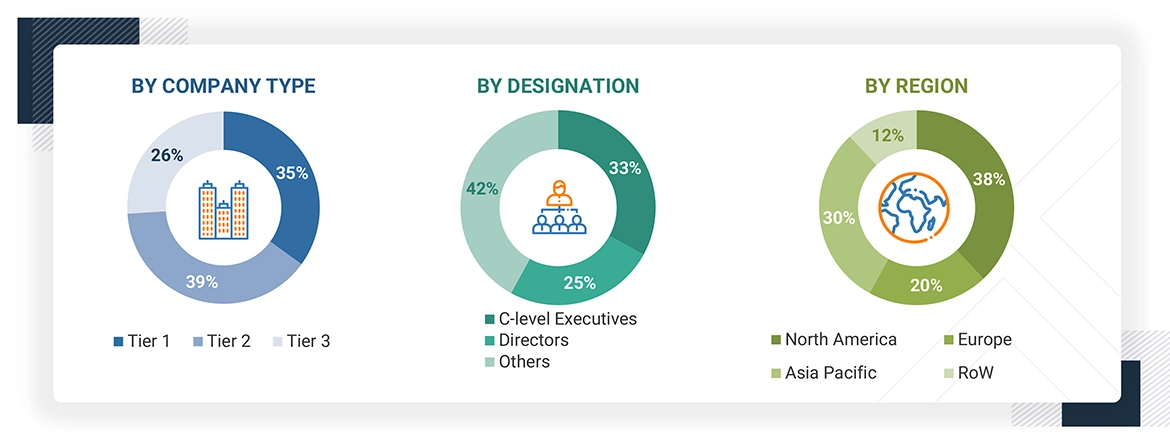
Note: Tier 1 companies’ revenue is more than USD 1 billion; Tier 2 companies’ revenue ranges between USD
500 million and 1 billion; and Tier 3 companies’ revenue ranges between USD 100 million and 500 million. Other designations include sales
managers, marketing managers, and product managers.
To know about the assumptions considered for the study, download the pdf brochure
Market Size Estimation
Multiple approaches were adopted to estimate and forecast the size of the smart railways market. The first approach involves estimating market size by summing up the revenue generated by companies through the sale of smart railway offerings.
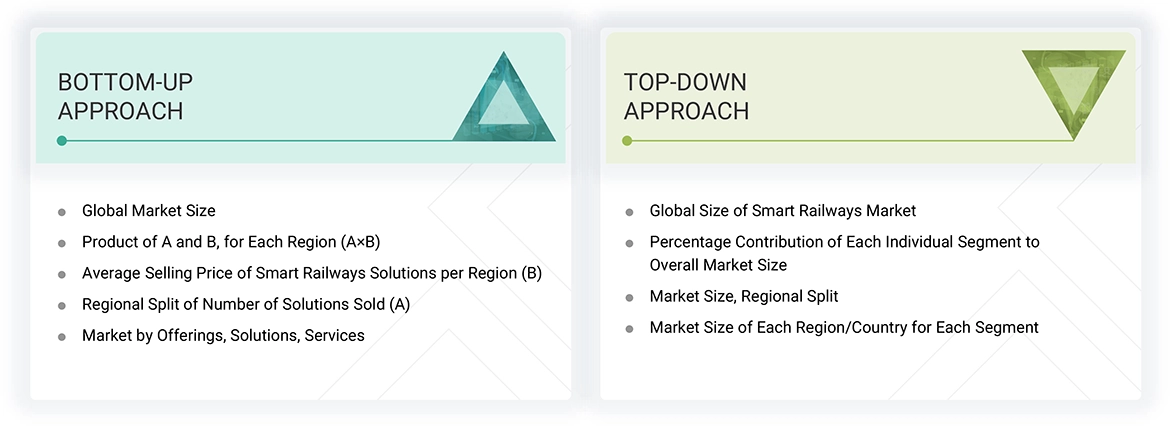
Top-down and bottom-up approaches were used to estimate and validate the total size of the smart railways market. These methods were also extensively used to estimate the size of various market segments. The research methodology used to evaluate the market size is listed below.
- Key players in the market were identified through extensive secondary research.
- In terms of value, the industry’s supply chain and market size were determined through primary and secondary research processes.
- All percentage shares, splits, and breakups were determined using secondary sources and verified through primary sources.
Smart Railways Market : Top-Down and Bottom-Up Approach
Data Triangulation
After determining the overall market size, the smart railways market was divided into several segments and subsegments. A data triangulation procedure was used to complete the overall market engineering process and arrive at the exact statistics for all segments and subsegments, wherever applicable. The data was triangulated by studying various factors and trends from the demand and supply sides. Along with data triangulation and market breakdown, the market size was validated by the top-down and bottom-up approaches.
Market Definition
Smart railways involve the integration of advanced solutions and services that utilize Information and Communication Technology (ICT) in railway operations. This integration can transform key aspects of rail transportation, making them more focused on customer needs. By sharing data, information, and insights with supply chain partners, smart railways enhance the efficiency and effectiveness of railway services. The smart railways market is composed of various systems, associated solutions (software and applications), and services. Smart railways include passenger information systems (PIS), freight management systems, security and safety solutions, rail communication and networking systems, smart ticketing systems, rail analytics systems, rail asset management and maintenance solutions, and rail operation and control solutions. These solutions and systems optimize the performance, costs, and risks for the entire smart rail infrastructure.
Stakeholders
- Smart Railway Vendors
- Network and System Integrators (SIs)
- Cloud Service Providers
- Railway Infrastructure Providers
- Railway Support Service Providers
- National Railway Governing Authorities/Regulators/Bodies
- Railway Operators and Agencies
- Value-added Resellers (VARs) and Distributors
Report Objectives
- To determine and forecast the smart railways market by offering (solutions and services) and region
- To forecast the size of the market segments for North America, Europe, Asia Pacific, Latin America, and the Middle East & Africa
- To provide detailed information about the major factors (drivers, restraints, opportunities, and challenges) influencing the market’s growth
- To analyze each submarket concerning individual growth trends, prospects, and contributions to the overall market
- To analyze the opportunities in the market for stakeholders by identifying high-growth segments of the market
- To profile the key market players; provide a comparative analysis based on business overviews, regional presence, product offerings, business strategies, and key financials; and illustrate the market’s competitive landscape
- To track and analyze competitive developments in the market, such as mergers and acquisitions, product developments, partnerships, collaborations, and research and development (R&D) activities
Available Customizations
With the given market data, MarketsandMarkets offers customizations to meet the company’s specific needs. The following customization options are available for the report:
Geographic Analysis as per Feasibility
- Analysis for additional countries (up to five)
Company Information
- Detailed analysis and profiling of additional market players (up to 5)
Key Questions Addressed by the Report
What is the definition of the smart railways market?
Smart railways involve the integration of advanced solutions and services powered by Information and Communication Technology (ICT) into railway operations. This approach can transform key aspects of rail transportation, making them more customer-centric by facilitating the sharing of data, information, and insights with supply chain partners. The smart railways market is composed of various systems, associated solutions (software and applications), and services. Smart railways include passenger information systems (PIS), freight management systems, security and safety solutions, rail communication and networking systems, smart ticketing systems, rail analytics systems, rail asset management and maintenance solutions, and rail operation and control solutions. These solutions and systems optimize the performance, costs, and risks for the entire smart rail infrastructure.
What is the market size of the smart railways market?
The smart railways market is projected to grow from USD 36.49 billion in 2025 to USD 54.31 billion by 2030 at a CAGR of 8.3% from 2025 to 2030.
What are the major drivers of the smart railways market?
The major drivers of the smart railways market include the increasing need for efficiency in rail operations, high demographic growth, hyper-urbanization, rising demand for efficient railway systems, increase in government initiatives and public-private partnerships, the adoption of IoT and other automation technologies for enhanced optimization, and technological advancements targeted toward the enhancement of customer experience.
Who are the key players operating in the smart railways market?
The key players profiled in the smart railways market include Alstom (France), Cisco (US), Wabtec (US), ABB (Switzerland), IBM (US), Hitachi (Japan), Huawei (China), Indra Sistemas (Spain), Siemens (Germany), Honeywell (US), Thales (France), Advantech (Taiwan), Fujitsu (Japan), Toshiba (Japan), Alcatel-Lucent Enterprise (France), Moxa (Taiwan), EKE-Electronics (Finland), Televic (Belgium), Uptake (US), Eurotech (Italy), Tego (US), KONUX (Germany), Aitek S.p.A (Italy), Assetic (Australia), Machines With Vision (UK), Delphisonic (US), Passio Technologies (US), CloudMoyo (US), Conduent (US), RailTel (India), and Chemito (India).
What are the key technological trends prevailing in the smart railways market?
The smart railways market is witnessing key trends like IoT for real-time data, AI for automation and optimization, and 5G for enhanced connectivity, all of which aim to improve efficiency, safety, and passenger experience.
Fact checked
Personalize This Research
- Triangulate with your Own Data
- Get Data as per your Format and Definition
- Gain a Deeper Dive on a Specific Application, Geography, Customer or Competitor
- Any level of Personalization
Let Us Help You
- What are the Known and Unknown Adjacencies Impacting the Smart Railways Market
- What will your New Revenue Sources be?
- Who will be your Top Customer; what will make them switch?
- Defend your Market Share or Win Competitors
- Get a Scorecard for Target Partners

Custom Market Research Services
We Will Customise The Research For You, In Case The Report Listed Above Does Not Meet With Your Requirements
Get 10% Free CustomisationTESTIMONIALS
Growth opportunities and latent adjacency in Smart Railways Market






Prabhu
Aug, 2016
Gather insights into Vendor Evaluations, Project Management Unit, Program Management, Bid Management, Project Monitoring & Auditing..