
China Digital Rights Management Market (2025-2030)

The China Digital Rights Management Market was valued at $570.4 Million in 2025 and projected to reach to $924.7 Million by 2030, representing a compound annual growth rate of 10.1%. China's Digital Rights Management market is poised for sustained growth through 2030, supported by the government's commitment to IP protection and the expansion of digital content platforms.


| Market Size in | USD 26.32 MN |
| Market Forecast in | |
| CAGR | |
| Forecast Period | |
| Units Considered | Value (USD MN) |
China Digital Rights Management Market Trends and Insights
- This expansion reflects China's increasing focus on intellectual property protection, stringent regulatory frameworks, and the rapid digitalization of content distribution across entertainment, software, and publishing sectors.
- China's market growth is driven by rising demand from streaming platforms, e-commerce operators, and software vendors seeking to safeguard digital assets against unauthorized access and piracy. The 10.1% compound annual growth rate (CAGR) through 2030 underscores China's strategic emphasis on cybersecurity and content protection infrastructure.
- China's government policies promoting digital innovation and IP enforcement have accelerated DRM adoption across industries.
- Major technology companies and content creators in China are investing heavily in advanced encryption, watermarking, and licensing technologies to protect revenue streams and comply with evolving regulations. China's DRM market landscape is characterized by both domestic innovation and international technology integration, positioning the country as a critical hub for digital content security solutions in the Asia Pacific region..
Key Market Statistics
- CAGR (2025-2030) 10.1% CAGR
- Market Size, 2025 ~USD 570.4 Million
- Forecast, 2030 ~USD 924.7 Million
- Country China
China Digital Rights Management Market Overview
Rapid Market Expansion :
China's DRM market is growing at 10.1% CAGR, reaching USD 570.4 million in 2025 and projected to hit USD 924.7 million by 2030, driven by aggressive IP protection policies and digital content proliferation.
Regulatory Compliance Pressure :
Stringent Chinese government regulations on intellectual property and content protection are compelling enterprises across entertainment, software, and publishing to adopt robust DRM solutions.
Content Distribution Digitalization :
Rapid digitalization of China's entertainment and publishing sectors, including streaming platforms and e-books, is creating substantial demand for advanced DRM technologies to protect proprietary content.
IP Protection Priority :
China's strategic focus on becoming an innovation leader has elevated intellectual property protection to a national priority, accelerating DRM adoption across domestic and international-facing businesses.
China Digital Rights Management Market Dynamics
- The market benefits from increasing enforcement of copyright laws and the proliferation of streaming services, e-commerce platforms, and software distribution channels requiring sophisticated DRM infrastructure.
- Enterprise investments in content security will remain strong as companies compete in the digital economy. The competitive landscape will intensify as both domestic Chinese tech firms and international DRM providers vie for market share.
- Integration of DRM with emerging technologies like blockchain and AI-powered content protection will define next-generation solutions.
- Government incentives for domestic innovation and the mandatory adoption of DRM in regulated sectors will further accelerate market penetration across entertainment, software, and publishing industries..
Market Ecosystem
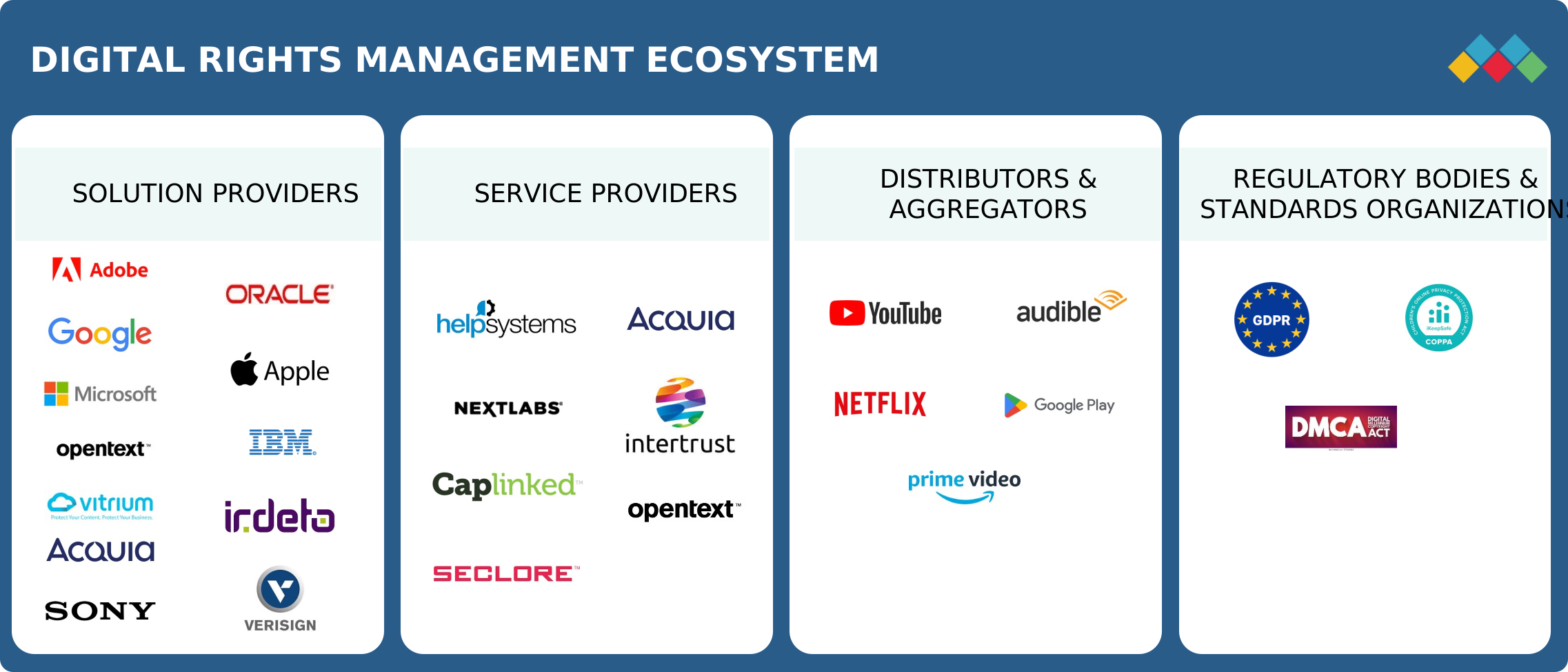
Digital Rights Management market: COMMERCIAL USE CASES ACROSS INDUSTRIES
| COMPANY | USE CASE DESCRIPTION | BENEFITS |
|---|---|---|
 |
DRM through FairPlay technology in iTunes, Apple Music, and Apple TV to protect music, movies, and app content across Apple devices. | Ensures secure content distribution, prevents piracy, and strengthens Apple’s closed ecosystem for monetization and user retention. |
 |
Widevine DRM integrated into Chrome, Android, and YouTube, securing premium video streaming and content licensing. | Enables major OTT platforms (Netflix, Amazon Prime, Disney+) to deliver secure video, boosting Google’s position in media delivery and digital advertising. |
 |
PlayReady DRM for Windows, Xbox, and Azure Media Services to safeguard video-on-demand and live streaming content. | Supports global broadcasters and OTT providers with scalable security, enhancing Microsoft’s cloud and entertainment ecosystem. |
 |
Adobe Primetime DRM for protecting premium video content and eLearning material across multiple devices and browsers. | Strengthens Adobe’s position in media and publishing by enabling secure streaming, compliance with licensing agreements, and user experience consistency. |
 |
DRM embedded in Oracle Digital Media Solutions to secure enterprise digital assets, eLearning modules, and proprietary software. | Provides enterprises with strong IP protection, regulatory compliance, and secure distribution of training and proprietary content. |
Logos and trademarks shown above are the property of their respective owners. Their use here is for informational and illustrative purposes only.
Related Ecosystem
Application Security
- Cloud Security
- Security Analytics
- Network Testing
- Biometric Security and Authentication System
- Cloud Encryption
- International Business Machines Corporation
- MICROSOFT CORPORATION
- Cisco Systems, Inc.
- PALO ALTO NETWORKS, INC
- Fortinet, Inc.
Cyber Security
- Cloud Security
- Biometric Systems
- Data Loss Prevention (DLP)
- Multi-Factor Authentication
- Security Analytics
- International Business Machines Corporation
- MITSUI BUSSAN SECURE DIRECTIONS INC
- Cisco Systems, Inc.
- MICROSOFT CORPORATION
- Allot Ltd.
Network Security
- Cloud Security
- Critical Communication Network
- Surveillance System
- Video Surveillance Systems
- Biometric Security and Authentication System
- Cisco Systems, Inc.
- International Business Machines Corporation
- Fortinet, Inc.
- MICROSOFT CORPORATION
- PALO ALTO NETWORKS, INC
Key Takeaways
- China's DRM market is valued at USD 570.4 million in 2025 and will reach USD 924.7 million by 2030, growing at a 10.1% CAGR.
- China's stringent IP protection policies and regulatory environment are primary drivers of DRM technology adoption across multiple sectors.
- Streaming platforms, e-commerce, and software vendors in China are major adopters of DRM solutions to combat piracy and protect digital assets.
- China's market represents a significant growth opportunity within Asia Pacific, driven by digital transformation and content monetization strategies.
Digital Rights Management Market Report Scope
| Report Metric | Details |
|---|---|
| Base Year | 2025 |
| Fastest Growing Segment | SALES & DISTRIBUTION (Business Function) |
| Forecast Period | 2025-2030 |
| Growth Rate | CAGR of 10.5% from 2025 to 2030 |
| Largest Segment | SOLUTIONS (Offering) |
| Market Size Base Year (Billions) | ~USD 6.71 (2025) |
| Revenue Forecast (Billions) | ~USD 11.05 (2030) |
| Segments Covered | Component, Type, Application, Vertical, Service, Offering, Business Function, Organization Size |
China Digital Rights Management Market Report Segmentation
8 segment dimensions are covered across the global market.
By Component
- Services
- Solutions
By Type
- Consulting
- Integration
- Operation And Maintenance
By Application
- Analytics & Reporting
- Audio Content
- Confidential Documents, Spreadsheets, & Presentations
- Confidential Documents, Spreadsheets, And Presentations
- Content Management System
- Document Collaboration
- Ebooks
- File Storage & Backup
- Images
- Mobile Access & Productivity
- Other Applications
- Software & Games
- Software And Games
- Video Content
By Vertical
- Banking, Financial Services, & Insurance (Bfsi)
- Banking, Financial Services, And Insurance (Bfsi)
- Bfsi
- Construction & Real Estate
- Education
- Education & Training
- Education And Training
- Government & Public Sector
- Healthcare
- It & Ites
- It & Telecom
- It And Ites
- Legal
- Legal Services
- Manufacturing
- Media & Entertainment
- Media And Entertainment
- Other Verticals
- Research & Publications
- Research And Publications
- Retail
- Retail & E-Commerce
- Travel & Hospitality
By Service
- Consulting
- Integration
- Operation & Maintenance
By Offering
- Services
- Solutions
By Business Function
- Finance & Accounting
- Hr
- Human Resources
- It
- It & Operations
- Legal
- Marketing & Advertising
- Other Business Functions
- Sales & Distribution
- Sales & Marketing
By Organization Size
- Large Enterprises
- Smes
CHINA: DIGITAL RIGHTS MANAGEMENT MARKET, BY APPLICATION, 2025–2030
| Segment | 2025 | 2026 | 2027 | 2028 | 2029 | 2030 | CAGR (%) |
|---|---|---|---|---|---|---|---|
| AUDIO CONTENT | 63.2 | 69.2 | 75.4 | 81.7 | 88.1 | 94.6 | 8.4 |
| CONFIDENTIAL DOCUMENTS, SPREADSHEETS, & PRESENTATIONS | 71 | 78.5 | 86.2 | 94.2 | 102.5 | 111 | 9.3 |
| EBOOKS | 37.5 | 41.3 | 45.2 | 49.3 | 53.4 | 57.6 | 8.9 |
| IMAGES | 49.3 | 55.1 | 61.4 | 68 | 74.9 | 82.2 | 10.8 |
| OTHER APPLICATIONS | 90.4 | 102.8 | 116.3 | 130.9 | 146.5 | 163.2 | 12.6 |
| SOFTWARE & GAMES | 76.1 | 86.7 | 98.3 | 110.8 | 124.3 | 138.7 | 12.8 |
| VIDEO CONTENT | 183 | 200.9 | 219.4 | 238.4 | 257.8 | 277.4 | 8.7 |
| TOTAL | 570.4 | 634.5 | 702.2 | 773.3 | 847.5 | 924.7 | 10.1 |
Target Audience
- DRM Software Vendors : Evaluate China's market potential, understand local demand drivers, and develop localized product strategies to capture share in this rapidly expanding USD 570.4M market with 10.1% annual growth.
- Content & Media Companies : Assess DRM investment requirements for protecting digital content in China's streaming and publishing sectors, understand regulatory compliance needs, and benchmark against market adoption trends.
- Enterprise IT Decision-Makers : Identify DRM solutions aligned with China's IP protection regulations, evaluate market-leading technologies, and plan digital rights infrastructure investments for software and content distribution.
- Investment & Private Equity Firms : Analyze growth opportunities in China's DRM market, identify acquisition targets, and evaluate portfolio companies' positioning within this high-growth sector expanding to USD 924.7M by 2030.
- Government & Policy Advisors : Monitor DRM market trends in China, assess IP protection policy effectiveness, and understand technology adoption patterns to inform regulatory frameworks and innovation incentive programs.
Reasons to Buy this Report
- Market Size & Growth Validation : Obtain precise market valuation data for China's DRM sector with verified CAGR figures (10.1%) and forecasts through 2030, enabling accurate business planning and investment decisions specific to this high-growth market.
- Regulatory Landscape Intelligence : Understand China's stringent IP protection frameworks and compliance requirements that are driving DRM adoption, helping you align product offerings and go-to-market strategies with local regulatory mandates.
- Sector-Specific Opportunity Mapping : Identify growth opportunities across China's entertainment, software, and publishing sectors with detailed insights into which verticals are driving DRM demand and where competitive advantages exist.
- Competitive Positioning Strategy : Benchmark your DRM solutions against market trends in China, understand local competitor dynamics, and identify white space opportunities to capture market share in this USD 924.7M market by 2030.
- Investment & Expansion Planning : Make data-driven decisions on market entry, partnership development, or expansion in China with comprehensive market analysis, growth projections, and strategic insights tailored to the DRM sector.
Frequently asked questions
What is the current size of China's Digital Rights Management market?
China's DRM market is valued at USD 570.4 million in 2025 and is projected to grow to USD 924.7 million by 2030.
What is the expected growth rate for China's DRM market through 2030?
China's DRM market is expected to grow at a compound annual growth rate (CAGR) of 10.1% from 2025 to 2030.
Which industries in China are driving DRM adoption?
Streaming platforms, e-commerce operators, software vendors, and publishing companies in China are primary drivers of DRM technology adoption.
What regulatory factors support DRM growth in China?
China's government policies emphasizing intellectual property protection, cybersecurity standards, and digital innovation compliance are key regulatory drivers of DRM adoption.
How does China's DRM market compare to the broader Asia Pacific region?
China represents a significant portion of the Asia Pacific DRM market, with strong growth momentum driven by digital transformation and content protection investments.
RESEARCH METHODOLOGY
This research study involved the extensive use of secondary sources, directories, and databases, such as Dun & Bradstreet (D&B), Hoovers, and Bloomberg BusinessWeek, to identify and collect information useful for a technical, market-oriented, and commercial study of the digital rights management market. The primary sources have been mainly industry experts from the core and related industries, and preferred suppliers, manufacturers, distributors, service providers, technology developers, alliances, and organizations related to all segments of the value chain of this market. In-depth interviews have been conducted with various primary respondents, including key industry participants, subject matter experts, C-level executives of key market players, and industry consultants, to obtain and verify critical qualitative and quantitative information.
Secondary Research
The market size of companies offering digital rights management worldwide was arrived at based on secondary data available through paid and unpaid sources. It was also arrived at by analyzing the product portfolio of major companies and rating them based on their performance and quality. In the secondary research process, various secondary sources were referred to identify and collect information for the study. The secondary sources include annual reports, press releases & investor presentations of companies, white papers, journals, and certified publications & articles from recognized authors, directories, and databases. Research reports from a few consortia and councils, such as the RSA Security, the States’ Digital Millennium Copyright Act, and the European Union’s Information Society Directive, have also been referred to for structuring qualitative content.
Secondary research was mainly used to obtain key information about the industry’s value chain and supply chain and to identify key players through various solutions and services, market classification and segmentation according to offerings of major players, industry trends related to technologies, applications, and regions, and key developments from both market-oriented and technology-oriented perspectives.
Primary Research
In the primary research process, various primary sources from the supply and demand sides were interviewed to obtain qualitative and quantitative information on the market. The primary sources from the supply side included various industry experts, including Chief Experience Officers (CXOs), Vice Presidents (VPs), directors from business development, marketing, and product development/innovation teams; related key executives from digital rights management solution vendors, professional service providers, and industry associations; and key opinion leaders.
Primary interviews were conducted to gather insights, such as market statistics, revenue data collected from solutions and services, market breakups, market size estimations, market forecasts, and data triangulation. Primary research also helped in understanding various trends related to technologies, applications, deployments, and regions. Stakeholders from the demand side, such as Chief Information Officers (CIOs), Chief Technology Officers (CTOs), Chief Strategy Officers (CSOs), and end users using digital rights management solutions, were interviewed to understand the buyer’s perspective on suppliers, products, service providers, and their current usage of digital rights management solutions, which would impact the overall digital rights management market.
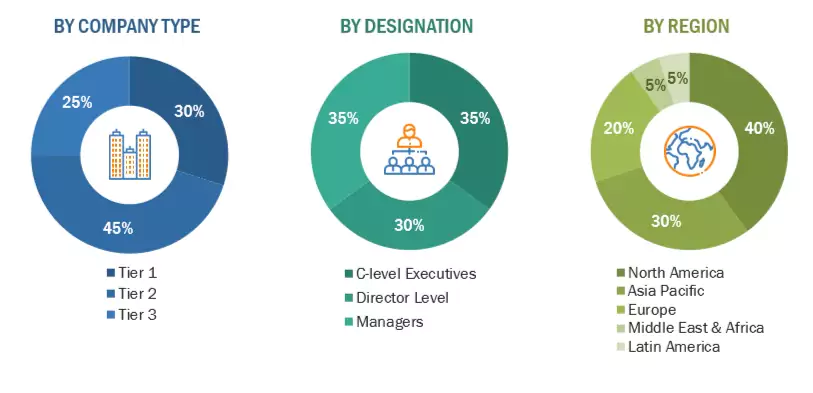
Note: Tier 1 companies’ revenue is more than USD 1 billion; Tier 2 companies’ revenue ranges between USD 500 million to
1 billion; and Tier 3 companies’ revenue ranges between USD 100 million and USD 500 million
To know about the assumptions considered for the study, download the pdf brochure
Market Size Estimation
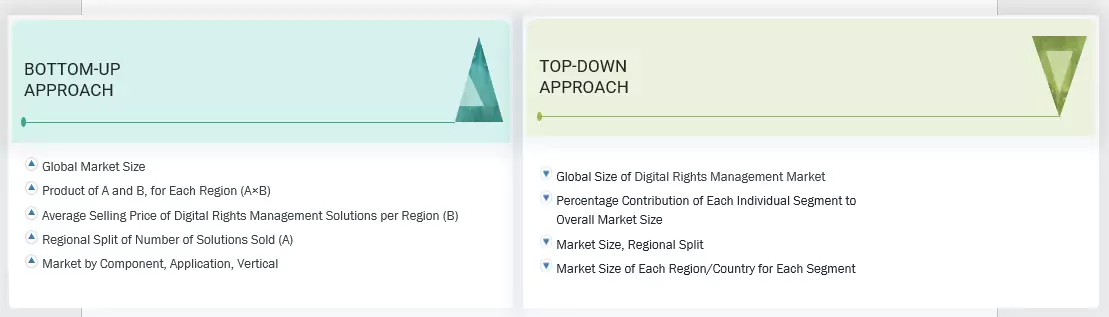
Multiple approaches were adopted to estimate and forecast the size of the digital rights management market. The first approach involves estimating market size by summing up the revenue generated by companies through the sale of digital rights management solutions.
Top-down and bottom-up approaches were used to estimate and validate the total size of the digital rights management market. These methods were also extensively used to estimate the size of various market segments. The research methodology used to evaluate the market size is listed below.
- Key players in the market have been identified through extensive secondary research.
- In terms of value, the industry’s supply chain and market size have been determined through primary and secondary research processes.
- All percentage shares, splits, and breakups have been determined using secondary sources and verified through primary sources.
Digital Rights Management Market : Top-Down and Bottom-Up Approach
Data Triangulation
After determining the overall market size, the digital rights management market was divided into several segments and subsegments. A data triangulation procedure was used to complete the overall market engineering process and arrive at the exact statistics for all segments and subsegments, wherever applicable. The data was triangulated by studying various factors and trends from the demand and supply sides. Along with data triangulation and market breakdown, the market size was validated by the top-down and bottom-up approaches.
Market Definition
Digital Rights Management (DRM) refers to the algorithms and processes that were created to enforce copyright compliance when accessing audio, documents, images, video content, and eBooks, among others. This mechanism prevents users from copying, converting, or redistributing content in a way that is not explicitly authorized by the content provider. It is a widely used and trusted method for protecting the copyright of digital media assets and files. It helps individuals and businesses control the access and usage of their digital assets, which is vital in the age of social media and widespread file sharing.
Stakeholders
- DRM vendors
- Research organizations
- Software vendors
- System integrators
- Cloud providers
- Suppliers, distributors, and contractors
- Value-added resellers (VARs)
- Service providers and distributors
- Investors and venture capitalists
- Government security agencies
- IT security agencies
- IT solution providers
- Wireless service providers
- Consulting firms
Report Objectives
- To determine and forecast the global digital rights management market by component (solutions and services), application, vertical, and region
- To forecast the size of the market segments for North America, Europe, Asia Pacific, Latin America, and the Middle East & Africa
- To provide detailed information about the major factors (drivers, restraints, opportunities, and challenges) influencing the growth of the digital rights management market
- To analyze each submarket concerning individual growth trends, prospects, and contributions to the overall digital rights management market
- To analyze the opportunities in the market for stakeholders by identifying the high-growth segments of the digital rights management market
- To profile the key market players, provide a comparative analysis based on business overviews, regional presence, product offerings, business strategies, and key financials, and illustrate the market’s competitive landscape
- Track and analyze competitive developments in the market, such as mergers and acquisitions, product developments, partnerships and collaborations, and research and development (R&D) activities
Available Customizations
With the given market data, MarketsandMarkets offers customizations to meet the company’s specific needs. The following customization options are available for the report:
Geographic Analysis as per Feasibility
- Analysis for additional countries (up to five)
Company Information
- Detailed analysis and profiling of additional market players (up to 5)
Get the Full Digital Rights Management Market Report
Full forecast, segment splits, and company analysis for all Digital Rights Management Market.
- Canada Digital Rights Management Market
- US Digital Rights Management Market
- UK Digital Rights Management Market
- Germany Digital Rights Management Market
- India Digital Rights Management Market
- Brazil Digital Rights Management Market
- Mexico Digital Rights Management Market
- Rest Of Europe Digital Rights Management Market
- Rest Of Asia Pacific Digital Rights Management Market
- Rest Of Latin America Digital Rights Management Market
Need a Tailored Report?
Customize this report to your needs
Get 10% FREE Customization
Customize This Report
