
US Digital Signage Market (2026-2031)

The US Digital Signage Market was valued at $5272.9 Million in 2026 and projected to reach to $7194.8 Million by 2031, representing a compound annual growth rate of 5.3%. The US digital signage market is poised for steady growth through 2031, driven by technological advancements in display technology and decreasing implementation costs.


| Market Size in | USD 26.32 MN |
| Market Forecast in | |
| CAGR | |
| Forecast Period | |
| Units Considered | Value (USD MN) |
US Digital Signage Market Trends and Insights
- The US market benefits from strong adoption across retail, hospitality, transportation, and corporate sectors, driven by technological advancements in LED and LCD displays, declining hardware costs, and increasing demand for dynamic content delivery.
- The US continues to lead in digital transformation initiatives, with enterprises investing heavily in interactive and networked signage solutions to enhance customer engagement and operational efficiency. Growth in the US digital signage market is supported by the proliferation of smart cities, expansion of retail and quick-service restaurant chains, and rising integration of artificial intelligence and cloud-based management platforms.
- The US market's maturity and high digital infrastructure penetration position it as a key driver for innovation in the sector.
- Between 2026 and 2031, the US is expected to see accelerated adoption of outdoor digital signage, venue-based displays, and integrated omnichannel marketing solutions that leverage real-time data analytics..
Key Market Statistics
- CAGR (2026-2031) 5.3% CAGR
- Market Size, 2026 ~USD 5272.9 Million
- Forecast, 2031 ~USD 7194.8 Million
- Country US
US Digital Signage Market Overview
Market Size & Growth :
The US digital signage market is valued at $5,272.9 million in 2026 and is projected to reach $7,194.8 million by 2031, growing at a CAGR of 5.3% during the forecast period.
Retail & Hospitality Dominance :
US retail and hospitality sectors are driving significant adoption of digital signage solutions, leveraging advanced displays for enhanced customer engagement and real-time promotional messaging.
Technology Cost Reduction :
Declining hardware costs for LED and LCD displays are making digital signage more accessible to mid-market and small businesses across the US, accelerating market penetration.
Transportation & Corporate Expansion :
Transportation hubs and corporate environments in the US are increasingly deploying digital signage for wayfinding, information dissemination, and brand communication, expanding market opportunities.
US Digital Signage Market Dynamics
- Retail chains, hospitality venues, and transportation networks continue to invest in digital signage to enhance customer experiences and streamline operations.
- The market benefits from strong digital transformation initiatives across multiple sectors and increasing consumer expectations for interactive, real-time content delivery. Looking ahead, the US market will see accelerated adoption in emerging verticals including healthcare, education, and smart cities.
- Integration of AI-powered analytics, cloud-based content management systems, and IoT connectivity will create new revenue streams.
- As businesses prioritize omnichannel strategies and personalized customer experiences, digital signage will become increasingly central to US commercial infrastructure..
Market Ecosystem
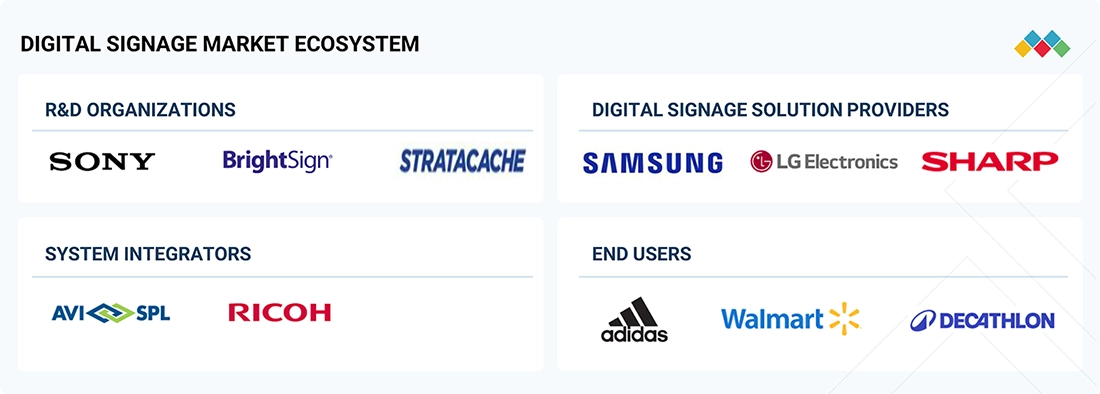
DIGITAL SIGNAGE MARKET SIZE, SHARE & GROWTH: COMMERCIAL USE CASES ACROSS INDUSTRIES
| COMPANY | USE CASE DESCRIPTION | BENEFITS |
|---|---|---|
 |
Provides large-format digital signage displays, video walls, and LED signage platforms used in retail stores, corporate offices, airports, and stadiums for dynamic advertising and real-time information display | High-resolution visuals, reliable performance, and scalable display networks for engaging customer communication |
 |
Offers OLED, LCD, and LED digital signage solutions with integrated content management platforms for retail, hospitality, healthcare, and transportation environments | Superior image quality, energy-efficient displays, and seamless remote content management |
 |
Develops professional digital signage displays and interactive touchscreens used in corporate, retail, and educational environments for presentations, promotions, and information sharing | Enhanced collaboration, clear visual communication, and durable commercial-grade displays |
 |
Provides professional digital signage displays, interactive screens, and AV solutions used in retail, transportation hubs, corporate environments, and entertainment venues for advertising, wayfinding, and real-time information delivery | High reliability, superior image quality, durable commercial displays, and seamless integration with professional AV and content management systems |
 |
Supplies fine-pitch LED video walls and large-scale digital signage displays for advertising, control rooms, entertainment venues, and smart city projects | Ultra-high brightness displays, seamless large-screen experiences, and strong visibility in indoor and outdoor environments |
Logos and trademarks shown above are the property of their respective owners. Their use here is for informational and illustrative purposes only.
Related Ecosystem
Display Technology
- Liquid Crystal Display (LCD)
- Sensors
- Virtual Reality Devices
- Augmented Reality
- Digital Light Processing (DLP)
- VIVITEK CORPORATION
- Samsung
- Lenovo
- Panasonic Holdings Corporation
- Lg corp
Key Takeaways
- The US digital signage market will grow from $5,272.9M in 2026 to $7,194.8M in 2031 at a 5.3% CAGR.
- The US market is driven by retail modernization, smart city initiatives, and AI-powered content management systems.
- The US leads in adoption of interactive and networked signage solutions across multiple verticals.
- The US digital signage sector is characterized by declining hardware costs and increasing cloud-based deployment models.
Digital Signage Market Report Scope
| Report Metric | Details |
|---|---|
| Base Year | 2026 |
| Fastest Growing Segment | TRANSACTION ENABLEMENT (Application) |
| Forecast Period | 2026–2031 |
| Growth Rate | CAGR of 6.6% from 2026 to 2031 |
| Largest Segment | HARDWARE (Offering) |
| Market Size Base Year (Billions) | ~USD 21.06 (2026) |
| Revenue Forecast (Billions) | ~USD 29 (2031) |
| Segments Covered | Offering, Type, End Use, Product Type, Application |
US Digital Signage Market Report Segmentation
5 segment dimensions are covered across the global market.
By Offering
- Hardware
- Services
- Software
By Type
- Bfsi Institutions
- Consulting & Other Services
- Content Management Systems
- Corporate Offices
- Displays
- Edge Server Software
- Educational Institution
- Educational Institutions
- Government & Public Sector Institutions
- Healthcare Facilities
- Hospitality Facilities & Restaurants
- Installation
- Maintenance & Other Services
- Media Players
- Other Hardware
- Other Software Offerings
- Projectors
- Retail
- Sports & Entertainment Venues
- Transportation Hubs & Public Places
By End Use
- Commercial
- Industrial
- Infrastructural
- Institutional
By Product Type
- Standalone Displays
- Video Walls
By Application
- Advertising & Promotion
- Corporate Communication & Process Management
- Entertainment
- Information & Messaging
- Transaction Enablement
- Wayfinding
Target Audience
- Retail & Hospitality Executives : Decision-makers in US retail chains and hospitality groups need market data to justify digital signage investments, benchmark against competitors, and optimize customer engagement strategies.
- Digital Signage Solution Providers : US-based hardware manufacturers, software vendors, and integrators require detailed market intelligence to identify growth segments, assess competitive positioning, and develop targeted sales strategies.
- Transportation & Infrastructure Planners : Public and private transportation operators in the US need market insights to evaluate digital signage ROI, understand adoption trends, and plan infrastructure modernization initiatives.
- Corporate Real Estate & Facilities Managers : US corporate organizations require market data to assess digital signage solutions for internal communications, wayfinding, and workplace engagement while managing capital expenditures.
- Investment & Strategy Consultants : Private equity firms, management consultants, and strategic investors need comprehensive US market analysis to evaluate acquisition targets, assess growth potential, and guide portfolio companies.
Key Companies in the US Digital Signage Market
| Company | HQ | Ownership | Strongest segments |
|---|---|---|---|
| QISDA CORPORATION | Taiwan | Public Company | Displays (Direct-view LED, LCD, OLED, E-paper),Projectors,Media Players, |
| VERIFONE | United States | Private Company | Kiosks,Menu Boards,Billboards & Video Walls, |
| BHARTI AIRTEL LIMITED | India | Public Company | Video Walls,Kiosks,Menu Boards, |
| ESTERLINE TECHNOLOGIES CORP | United States | Private Company | Video Walls,Kiosks,Menu Boards, |
| MICROSOFT CORPORATION | United States | Public Company | Content Management Software,Media Players,Kiosks, |
| WIPRO LIMITED | India | Public Company | Content Management Software & Integration,Media Players & IT Infrastructure,Displays (Direct-view LED, LCD, OLED, E-paper), |
| SYNNEX CORPORATION | United States | Public Company | Video Walls,Kiosks,Menu Boards, |
| KORE WIRELESS GROUP | United States | Public Company | Video Walls,Kiosks,Menu Boards, |
| VALENS | Israel | Public Company | Video Walls,Kiosks,Menu Boards, |
| TRUE CORPORATION PUBLIC COMPANY LIMITED | United States | Public Company | Video Walls,Kiosks,Menu Boards, |
| CORETRONIC CORPORATION | Taiwan | Public Company | Projectors (signage use cases),Displays (LCD, backlight-based, medical and intelligent displays),Media players and content / intelligent cloud platforms, |
| LENOVO | China | Public Company | Video Walls,Kiosks,Menu Boards, |
| L&T TECHNOLOGY SERVICES LIMITED | India | Public Company | Video Walls,Kiosks,Menu Boards, |
| SAMSUNG | South Korea | Public Company | Video Walls,Kiosks,Menu Boards, |
| LG ELECTRONICS | South Korea | Public Company | Video Walls,Kiosks,Menu Boards, |
| SHARP CORPORATION | Japan | Public Company | Video Walls,Kiosks,Menu Boards, |
| LEYARD | China | Public Company | Video Walls (dvLED and LCD),Billboards & Outdoor LED (including naked-eye 3D, smart poles),Kiosks & Menu Boards, |
| SONY GROUP CORPORATION | Japan | Public Company | Professional Displays (Direct-view LED, LCD, OLED, E-paper),Projectors,Media Players & Integrated SoC, |
| BARCO | Belgium | Public Company | Video Walls,Projectors,Displays (Direct-view LED, LCD, OLED, E-paper), |
| PANASONIC HOLDINGS CORPORATION | Japan | Public Company | Video Walls,Kiosks,Menu Boards, |
| AUO CORPORATION | Taiwan | Public Company | Video Walls,Kiosks,Menu Boards, |
| DAKTRONICS | United States | Public Company | Video Walls,Billboards,Kiosks, |
| DELTA ELECTRONICS, INC. | Taiwan | Public Company | Video Walls,Projectors,Kiosks & Menu Boards, |
QISDA CORPORATION
QISDA Corporation is a Taiwanese public company established in 1984 with 14,375 employees. It operates in the electronics and technology manufacturing sector.
VERIFONE
VeriFone is a United States-based private company founded in 1981 with 5,600 employees. The company specializes in payment and point-of-sale solutions.
BHARTI AIRTEL LIMITED
Bharti Airtel Limited is an Indian public company founded in 1995 with 28,730 employees. It is a major telecommunications and mobile services provider.
ESTERLINE TECHNOLOGIES CORP
Esterline Technologies Corp is a United States private company established in 1967 with 12,609 employees. The company operates in aerospace and defense technology.
MICROSOFT CORPORATION
Microsoft Corporation is a United States public company founded in 1975 with 228,000 employees. It is a global leader in software, cloud computing, and technology services.
WIPRO LIMITED
Wipro Limited is an Indian public company founded in 1945 with 240,000 employees. It is a major provider of information technology, consulting, and business process services.
SYNNEX CORPORATION
SYNNEX Corporation is a United States public company founded in 1980 with 24,000 employees. It is a leading distributor of information technology products and services.
KORE WIRELESS GROUP
KORE Wireless Group is a United States public company founded in 2002 with 403 employees. The company provides wireless connectivity and IoT solutions.
VALENS
Valens is an Israeli public company founded in 2006 with 233 employees. The company develops semiconductor and connectivity solutions.
TRUE CORPORATION PUBLIC COMPANY LIMITED
True Corporation Public Company Limited is a United States-based public company founded in 1990. The company operates in the telecommunications and media sectors.
CORETRONIC CORPORATION
Coretronic Corporation is a Taiwanese public company founded in 1992. The company specializes in display and projection technology.
LENOVO
Lenovo is a Chinese public company founded in 1984. It is a global leader in personal computers, servers, and technology solutions.
L&T TECHNOLOGY SERVICES LIMITED
L&T Technology Services Limited is an Indian public company founded in 2012 with 21,039 employees. The company provides engineering and technology services.
SAMSUNG
Samsung is a South Korean public company founded in 1969 with 128,735 employees. It is a global conglomerate operating in electronics, semiconductors, and consumer goods.
LG ELECTRONICS
LG Electronics is a South Korean public company founded in 1958 with 34,884 employees. The company manufactures consumer electronics, displays, and home appliances.
SHARP CORPORATION
Sharp Corporation is a Japanese public company founded in 1912 with 34,549 employees. The company operates in electronics, displays, and solar energy solutions.
LEYARD
Leyard is a Chinese public company founded in 1995 with 4,405 employees. The company specializes in LED display and digital signage technology.
SONY GROUP CORPORATION
Sony Group Corporation is a Japanese public company founded in 1946 with 94,900 employees. It is a global leader in electronics, entertainment, and gaming.
BARCO
Barco is a Belgian public company founded in 1934 with 2,927 employees. The company specializes in visualization and display technology solutions.
PANASONIC HOLDINGS CORPORATION
Panasonic Holdings Corporation is a Japanese public company founded in 1918 with 183,685 employees. It is a global manufacturer of electronics, appliances, and industrial solutions.
AUO CORPORATION
AU Optronics Corporation is a Taiwanese public company founded in 1996 with 43,000 employees. The company is a leading manufacturer of display panels and LCD technology.
DAKTRONICS
Daktronics is a United States public company founded in 1968 with 2,558 employees. The company designs and manufactures electronic displays and control systems.
DELTA ELECTRONICS, INC.
Delta Electronics, Inc. is a Taiwanese public company founded in 1971 with 85,684 employees. The company manufactures power supplies, thermal management, and industrial automation solutions.
Reasons to Buy this Report
- Accurate US Market Sizing : Obtain precise market valuation data specific to the United States, with detailed 2026-2031 forecasts to support strategic planning and investment decisions in the US digital signage sector.
- Sector-Specific Insights : Understand growth drivers across US retail, hospitality, transportation, and corporate segments with tailored analysis of adoption patterns and spending trends unique to American markets.
- Competitive Landscape Analysis : Identify key players, market consolidation trends, and competitive positioning within the US digital signage ecosystem to inform go-to-market strategies and partnership opportunities.
- Technology & Cost Trends : Access detailed insights on declining hardware costs, emerging display technologies, and ROI metrics specific to US implementations to optimize capital allocation and vendor selection.
- Growth Opportunity Mapping : Discover high-growth verticals and emerging use cases in the US market, including AI integration, cloud management, and IoT connectivity, to identify new revenue streams and expansion opportunities.
Frequently asked questions
What is the current size of the US digital signage market in 2026?
The US digital signage market is valued at $5,272.9 million in 2026.
What is the projected size of the US digital signage market by 2031?
The US digital signage market is projected to reach $7,194.8 million by 2031.
What is the growth rate of the US digital signage market?
The US digital signage market is expected to grow at a compound annual growth rate (CAGR) of 5.3% from 2026 to 2031.
Which sectors are driving growth in the US digital signage market?
The US digital signage market is driven by retail, hospitality, transportation, corporate, and smart city sectors, with increasing adoption of interactive and AI-powered solutions.
What are the key technology trends in the US digital signage market?
Key trends in the US market include LED and LCD display advancements, cloud-based content management, artificial intelligence integration, and real-time data analytics capabilities.
RESEARCH METHODOLOGY
The research study involved four major activities in estimating the digital signage market size. Exhaustive secondary research has been done to collect important information about the market and peer markets. The next step has been to validate these findings and assumptions and size them with the help of primary research with industry experts across the value chain. Both top-down and bottom-up approaches have been used to estimate the market size. The market breakdown and data triangulation have been adopted to estimate the market sizes of segments and sub-segments.
Secondary Research
In the secondary research process, various secondary sources were referred to identify and collect information required for this study. The secondary sources include annual reports, press releases, investor presentations of companies, white papers, and articles from recognized authors. Secondary research has been mainly done to obtain key information about the market’s value chain, the pool of key market players, market segmentation according to industry trends, regional outlook, and developments from both market and technology perspectives.
Primary Research
In primary research, various sources from both the supply and demand sides have been interviewed to obtain the qualitative and quantitative insights required for this report. Primary sources from the supply side include experts such as CEOs, vice presidents, marketing directors, manufacturers, technology and innovation directors, end users, and related executives from multiple key companies and organizations operating in the digital signage market ecosystem. After interacting with industry experts, brief sessions were conducted with highly experienced independent consultants to reinforce the findings from our primary research. This, along with the in-house subject matter experts’ opinions, has led us to the findings as described in the report. The breakdown of primary respondents is as follows:
Breakdown of Primaries
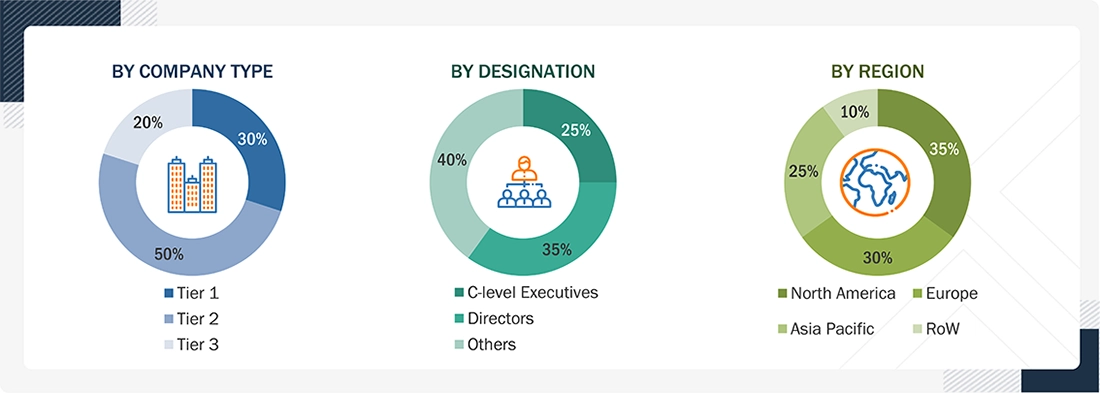
Note: “Others” includes sales, marketing, and product managers.
To know about the assumptions considered for the study, download the pdf brochure
Market Size Estimation
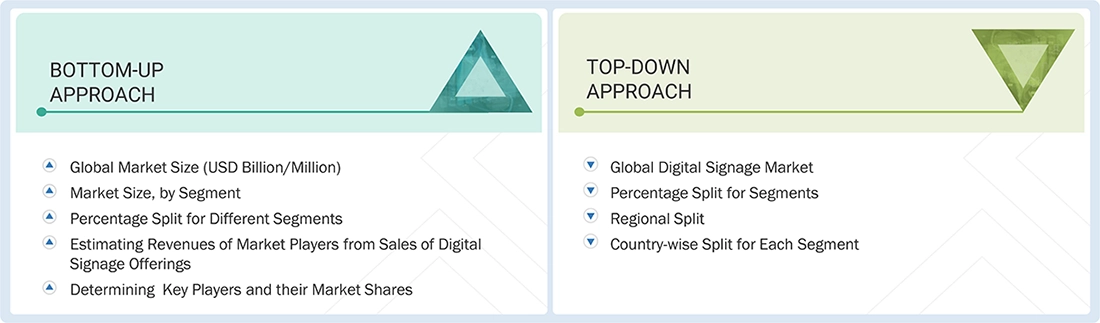
In the market engineering process, both top-down and bottom-up approaches and data triangulation methods have been used to estimate and validate the size of the digital signage market and other dependent submarkets. The research methodology used to estimate the market sizes includes the following:
- The bottom-up procedure has been employed to arrive at the overall size of the digital signage market.
- Major companies that provide digital signage were identified. This included analyzing company portfolios, product offerings, and presence across various regions.
- The segment-specific revenues of the companies, particularly those related to digital signage, were determined.
- The product-specific revenues of the companies, particularly those related to digital signage, were determined.
- These individual revenue figures were compiled to determine the total revenue generated across the identified companies within the sector.
- The global market size for digital signage was obtained using this consolidated data.
The top-down approach has been used to estimate and validate the total size of the digital signage market.
- Identified top-line investments and spending in the ecosystem and major market developments to consider segment-level splits
- Estimated the overall digital signage market size, then segmented the global market by allocating shares based on the segments considered
- Distributed the segment-level markets into regions and countries by aligning regional digital signage activity with economic indicators, digital signage manufacturing presence, and national development initiatives
Data Triangulation
After arriving at the overall market size using the market size estimation processes as explained above, the market has been split into several segments and subsegments. Data triangulation and market breakdown procedures have been employed to complete the entire market engineering process and arrive at the exact statistics of each market segment and subsegment. The data has been triangulated by studying various factors and trends from the demand and supply sides of the digital signage market.
Market Definition
The digital signage market encompasses the design, development, and deployment of digital display solutions used to deliver dynamic visual content, information, and advertising across commercial and public environments. These systems utilize advanced display technologies such as LCD, LED, OLED, and microLED screens integrated with media players, connectivity modules, and content management software to enable real-time content updates, remote management, and targeted messaging. Digital signage solutions support applications such as advertising, promotions, wayfinding, corporate communication, and public information displays across retail stores, transportation hubs, hospitality venues, healthcare facilities, educational institutions, and smart city infrastructure. Market growth is driven by increasing demand for data-driven advertising, interactive customer engagement, and centralized content control across large display networks. Advancements in high-resolution displays, cloud-based content management systems, AI-driven analytics, IoT connectivity, and energy-efficient display technologies are enhancing operational flexibility, audience targeting, and scalability, positioning digital signage as a critical communication and marketing tool in modern digital ecosystems.
Stakeholders
- Display Panel Manufacturers
- Display Material and Component Suppliers
- Manufacturing Equipment Suppliers
- System Integrators/OSAT Vendors
- Digital Signage Providers
- Digital Signage Hardware Providers
- Digital Signage Software Providers
- Technology/IP Developers
- Consulting and Market Research Service Providers
- Display and Material-related Associations, Organizations, Forums, and Alliances
- Venture Capitalists and Startups
- Research and Educational Institutes
- Distributors and Resellers
- End Users
Report Objectives
- To define, describe, segment, and forecast the digital signage market size by offering, product type, display size, installation location, application, enterprise size, end use, and region, in terms of value
- To evaluate the digital signage market size in four key regions: North America, Europe, Asia Pacific, and RoW, in terms of value
- To provide detailed information regarding the key factors such as drivers, restraints, opportunities, and challenges influencing the growth of the market
- To analyze the digital signage value chain and ecosystem, along with the average selling price for the product type and region segment
- To strategically study the regulatory landscape, tariffs, standards, patents, Porter’s Five Forces, import and export scenarios, trade values, and case studies pertaining to the market under study
- To understand micromarkets1 with regard to individual growth trends, prospects, and contributions to the overall market
- To offer the impact of AI/Gen AI on the digital signage market
- To outline the macroeconomic outlook for the regions under study
- To analyze strategies such as product launches, collaborations, acquisitions, and partnerships adopted by players in the digital signage market
- To profile key market players and comprehensively analyze their ranking based on their revenue, market share, and core competencies2
Get the Full Digital Signage Market Report
Full forecast, segment splits, and company analysis for all Digital Signage Market.
- Canada Digital Signage Market
- Mexico Digital Signage Market
- Germany Digital Signage Market
- UK Digital Signage Market
- France Digital Signage Market
- Italy Digital Signage Market
- Spain Digital Signage Market
- Netherlands Digital Signage Market
- Belgium Digital Signage Market
- Nordic Countries Digital Signage Market
- Rest Of Europe Digital Signage Market
- China Digital Signage Market
- Japan Digital Signage Market
- India Digital Signage Market
- South Korea Digital Signage Market
- Australia Digital Signage Market
- Southeast Asia Digital Signage Market
- Rest Of Asia Pacific Digital Signage Market
- Saudi Arabia Digital Signage Market
- UAE Digital Signage Market
- Qatar Digital Signage Market
- Kuwait Digital Signage Market
- Bahrain Digital Signage Market
- Oman Digital Signage Market
- Rest Of Middle East Digital Signage Market
- Brazil Digital Signage Market
- Argentina Digital Signage Market
- Rest Of South America Digital Signage Market
- South Africa Digital Signage Market
- Rest Of Africa Digital Signage Market
Need a Tailored Report?
Customize this report to your needs
Get 10% FREE Customization
Customize This Report
