
France Digital Signal Processor Market (2024-2029)

The France Digital Signal Processor Market was valued at $392.1 Million in 2024 and projected to reach to $539.8 Million by 2029, representing a compound annual growth rate of 6.6%. France's Digital Signal Processor market is positioned for sustained growth through 2029, supported by digital transformation across telecommunications, automotive, and industrial sectors.


| Market Size in | USD 26.32 MN |
| Market Forecast in | |
| CAGR | |
| Forecast Period | |
| Units Considered | Value (USD MN) |
France Digital Signal Processor Market Trends and Insights
- France is experiencing steady demand for DSP solutions driven by expanding applications in telecommunications, automotive, and industrial automation sectors.
- The French semiconductor ecosystem benefits from strong R&D investments and a growing focus on advanced signal processing technologies across consumer electronics and IoT devices. The growth trajectory in France reflects broader European trends toward digitalization and smart manufacturing.
- France's position as a technology hub in Europe supports the adoption of DSP-enabled solutions in aerospace, defense, and renewable energy applications.
- Between 2024 and 2029, France is expected to maintain moderate but consistent market expansion, supported by government initiatives promoting semiconductor self-sufficiency and digital innovation across the continent..
Key Market Statistics
- CAGR (2024-2029) 6.6% CAGR
- Market Size, 2024 ~USD 392.1 Million
- Forecast, 2029 ~USD 539.8 Million
- Country France
France Digital Signal Processor Market Overview
Market Size & Growth :
France's DSP market is valued at USD 392.1 million in 2024, with a projected CAGR of 6.6% through 2029, reaching USD 539.8 million. This steady growth outpaces many European peers, driven by robust industrial modernization initiatives.
Telecommunications Dominance :
France's advanced telecom infrastructure and 5G rollout are primary growth catalysts for DSP adoption. Major telecom operators are investing heavily in signal processing capabilities for network optimization and next-generation services.
Automotive & Industrial Sectors :
The French automotive industry, including luxury and EV manufacturers, is increasingly integrating DSP solutions for autonomous driving and in-vehicle signal processing. Industrial automation in manufacturing is also accelerating DSP demand.
Strong Semiconductor Ecosystem :
France hosts a mature semiconductor ecosystem with established R&D centers, design capabilities, and manufacturing partnerships. This infrastructure supports localized DSP innovation and attracts international semiconductor investments.
France Digital Signal Processor Market Dynamics
- The country's commitment to semiconductor sovereignty and investment in advanced manufacturing capabilities will strengthen its DSP market position within Europe.
- Increasing demand for 5G infrastructure, autonomous vehicle technologies, and Industry 4.0 solutions will drive consistent adoption of DSP solutions among French enterprises and technology providers. The French government's strategic focus on digital infrastructure and semiconductor self-sufficiency creates favorable conditions for DSP market expansion.
- Collaborations between French tech companies, automotive manufacturers, and telecom operators will accelerate innovation and market penetration.
- By 2029, France is expected to maintain its role as a key DSP market in Western Europe, with growing opportunities in edge computing and AI-enabled signal processing applications..
Market Ecosystem
Related Ecosystem
Semiconductor Materials And Components
- Sensors
- Gallium Nitride (GaN)
- Digital Signal Processor (DSP)
- Natural Language Processing (NLP)
- Silicon Carbide
- Texas Instruments Incorporated
- Samsung
- APPLIED MATERIALS, INC.
- Stmicroelectronics
- Lenovo
Defence Platforms And Systems
- Sensors
- Unmanned Ground Vehicles (UGV)
- Fighter Aircraft
- Special Mission Aircraft
- Antennas
- BAE Systems plc
- Thales group
- LOCKHEED MARTIN CORPORATION
- Northrop Grumman Corporation
- L3Harris Technologies, Inc.
Mobility And Telecom
- Smart Utilities
- Smart Healthcare
- Sensors
- Parking Management System
- Passenger Information System (PIS)
- AT&T Inc.
- Cisco Systems, Inc.
- HUAWEI TECHNOLOGIES CO LTD
- Telefonaktiebolaget LM Ericsson (publ)
- International Business Machines Corporation
Key Takeaways
- France's DSP market is valued at USD 392.1 million in 2024 and will reach USD 539.8 million by 2029 at a 6.6% CAGR.
- France benefits from strong R&D infrastructure and government support for semiconductor innovation and digital transformation initiatives.
- Key growth drivers in France include telecommunications, automotive electrification, industrial IoT, and aerospace applications.
- France's DSP market growth is supported by European digitalization trends and the region's focus on technological sovereignty.
Digital Signal Processor Market Report Scope
| Report Metric | Details |
|---|---|
| Base Year | 2024 |
| Fastest Growing Segment | HEALTHCARE (End-User Industry) |
| Forecast Period | 2024-2029 |
| Growth Rate | CAGR of 7.8% from 2024 to 2029 |
| Largest Segment | MULTI-CORE (Core) |
| Market Size Base Year (Billions) | ~USD 10.1 (2024) |
| Revenue Forecast (Billions) | ~USD 14.7 (2029) |
| Segments Covered | Core, Application, Type, Configuration, End-User Industry, Category, Ic Design, Application 2020-2023 |
France Digital Signal Processor Market Report Segmentation
8 segment dimensions are covered across the global market.
By Core
- Multi-Core
- Single-Core
By Application
- Audio Processing
- Communication Systems
- Image Processing
- Other Applications
- Radar Systems
- Speech Processing & Recognition
- Video Processing
By Type
- Application-Specific Dsps
- Consumer Electronics
- General-Purpose Dsps
- Other Audio Processing Applications
- Professional Audio Equipment
- Programmable Dsps
- Television & Radio Broadcasting
By Configuration
- High-End
- Low-End
- Mid-Range
By End-User Industry
- Aerospace & Defense
- Automotive
- Communication & Networking
- Consumer Electronics
- Healthcare
- Industrial Automation
- Other End-User Industries
- Other End-User Industry
By Category
- Fixed-Point
- Floating-Point
By Ic Design
- Embedded
- Standard
By Application 2020-2023
- Audio Processing
- Image Processing
- Other Applications
- Radar Systems
- Speech Processing & Recognition
- Video Processing
Target Audience
- DSP Semiconductor Manufacturers : Understand France's specific demand patterns, customer requirements, and competitive positioning to optimize product development and sales strategies for the French and broader European markets.
- Telecom & Network Equipment Providers : Identify growth opportunities in France's 5G infrastructure expansion and telecommunications modernization. Understand how DSP solutions integrate into next-generation network deployments.
- Automotive Technology Companies : Assess the French automotive sector's DSP needs for autonomous driving, in-vehicle signal processing, and EV technologies. Understand OEM requirements and integration opportunities with major French manufacturers.
- Industrial Automation & IoT Vendors : Evaluate France's Industry 4.0 adoption and industrial automation investments. Identify how DSP solutions enable smart manufacturing, predictive maintenance, and edge computing applications in French industrial facilities.
- Investment & Strategy Consultants : Support client advisory with credible France-specific market data for investment decisions, M&A strategies, and market entry planning in the European semiconductor and DSP sectors.
Reasons to Buy this Report
- Localized Market Intelligence : Gain France-specific insights into DSP adoption patterns, regional demand drivers, and competitive dynamics that differ from broader European trends. Understand how French regulatory frameworks and industrial policies shape market opportunities.
- Sector-Specific Growth Opportunities : Identify high-potential segments within France's telecommunications, automotive, and industrial automation sectors. Understand which applications are driving DSP adoption and where investment opportunities exist for vendors and service providers.
- Competitive Landscape Analysis : Benchmark your position against competitors in the French market. Understand key players, their market share, and strategic initiatives specific to France's DSP ecosystem and customer base.
- Strategic Market Entry Planning : Develop informed go-to-market strategies for France with accurate sizing, growth projections, and regional demand forecasts. Identify partnership opportunities and distribution channels tailored to the French market structure.
- Investment & Expansion Decisions : Support capital allocation and expansion planning with reliable France-specific market data. Make confident decisions about R&D investments, facility locations, and resource allocation based on validated market projections through 2029.
Frequently asked questions
What is the current size of France's Digital Signal Processor market?
France's DSP market is estimated at USD 392.1 million in 2024 and is expected to grow to USD 539.8 million by 2029.
What is the projected growth rate for France's DSP market?
France's DSP market is projected to grow at a compound annual growth rate (CAGR) of 6.6% from 2024 to 2029.
Which industries are driving DSP demand in France?
Key industries driving DSP adoption in France include telecommunications, automotive, industrial automation, aerospace, defense, and renewable energy sectors.
How does France's DSP market compare to the global market?
While the global DSP market grows at 7.8% CAGR, France's market grows at 6.6% CAGR, reflecting regional market maturity and specific sectoral dynamics within the country.
What factors support DSP market growth in France?
France's DSP growth is supported by strong R&D investments, government semiconductor initiatives, digital transformation across industries, and increasing IoT and smart device adoption.
RESEARCH METHODOLOGY
The research study involved the extensive use of secondary sources, directories, and databases (annual reports or presentations of companies, industry association publications, directories, technical handbooks, World Economic Outlook (WEO), trade websites, Hoovers, Bloomberg Businessweek, Factiva, and OneSource) to identify and collect information useful for this technical, market-oriented, and commercial study of the Digital Signal Processor market size . Primary sources mainly comprise several experts from the core and related industries, along with preferred suppliers, manufacturers, distributors, service providers, system providers, technology developers, alliances, and standards and certification organizations related to various phases of this industry’s value chain.
Secondary Research
Various secondary sources have been referred to in the secondary research process for identifying and collecting information important for this study. The secondary sources include annual reports, press releases, and investor presentations of companies; white papers; journals and certified publications; and articles from recognized authors, websites, directories, and databases. Secondary research has been conducted to obtain key information about the industry’s supply chain, market’s value chain, the total pool of key players, market segmentation according to the industry trends (to the bottom-most level), geographic markets, and key developments from both market- and technology-oriented perspectives. The secondary data has been collected and analyzed to determine the overall market size, further validated by primary research.
Primary Research
In the primary research process, various primary sources from the supply and demand sides have been interviewed to obtain qualitative and quantitative information for this report. The primary sources from the supply side include industry experts, such as CEOs, vice presidents, marketing directors, technology & innovation directors, and related key executives from key companies and organizations operating in the Digital Signal Processor market across four major regions: North America, Europe, Asia Pacific, and RoW (South America, Africa, Middle East). Primary data has been collected through questionnaires, e-mails, and telephonic interviews. Approximately 40% and 60% of primary interviews have been conducted from the demand and supply sides, respectively.
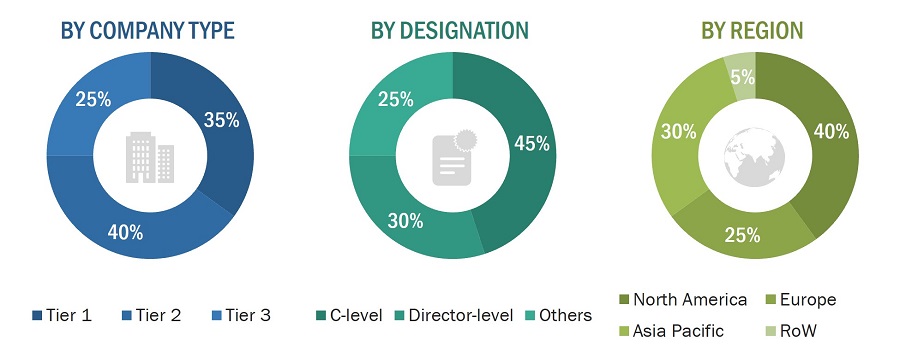
To know about the assumptions considered for the study, download the pdf brochure
Market Size Estimation
In the complete market engineering process, both top-down and bottom-up approaches have been used along with several data triangulation methods to perform market estimation and forecasting for the overall market segments and subsegments listed in this report. Key players in the market have been identified through secondary research, and their market shares in the respective regions have been determined through primary and secondary research. This entire procedure includes the study of annual and financial reports of the top market players and extensive interviews for key insights (quantitative and qualitative) with industry experts (CEOs, VPs, directors, and marketing executives).
In this approach, important players, such Analog Devices, Inc. (US), Microchip Technology Inc. (US), Texas Instruments Incorporated (US), NXP Semiconductors (Netherlands), and Marvell (US), have been identified. After confirming these companies through primary interviews with industry experts, their total revenue has been estimated by referring to annual reports, SEC filings, and paid databases. Revenues of these companies pertaining to the business units (Bus) that offer Digital Signal Processor have been identified through similar sources. Industry experts have reconfirmed these revenues through primary interviews.
Digital Signal Processor Market: Bottom-Up Approach
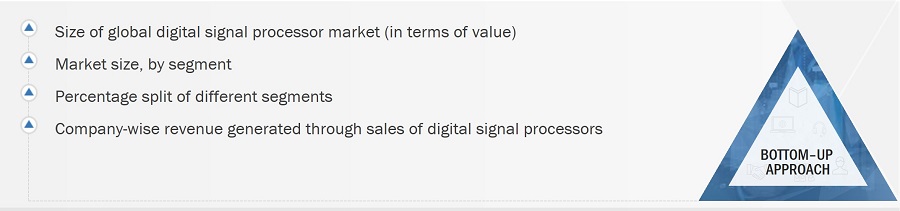
The bottom-up approach has been employed to arrive at the overall size of the Digital Signal Processor market from the revenues of key players and their share in the market.
Digital Signal Processor Market: Top-Down Approach
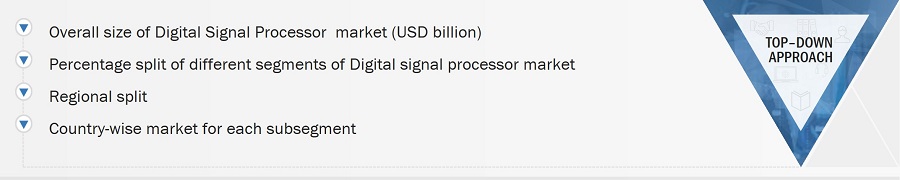
In the top-down approach, the overall market size has been used to estimate the size of the individual markets (mentioned in the market segmentation) through percentage splits from secondary and primary research. The most appropriate immediate parent market size has been used to implement the top-down approach to calculate the market size of specific segments. The top-down approach has been implemented for the data extracted from the secondary research to validate the market size obtained.
Each company’s market share has been estimated to verify the revenue shares used earlier in the supply-side approach. The overall parent market size and individual market size were determined and confirmed in this study by the data triangulation method and the validation of data through primaries. The data triangulation method used in this study is explained in the next section.
Data Triangulation
After arriving at the overall Industry size from the market size estimation process explained earlier, the total market was split into several segments and subsegments. Data triangulation and market breakdown procedures have been employed to complete the overall market engineering process and arrive at the exact statistics for all segments and subsegments, wherever applicable. The data has been triangulated by studying various factors and trends from both the demand and supply sides. Along with this, the Digital Signal Processor market share has been validated using both top-down and bottom-up approaches.
Market Definition
A digital signal processor (DSP) is an integrated circuit (IC), or IP core designed for efficient digital signal processing. It converts analog signals to digital, processes them using algorithms for tasks like filtering and compression, and outputs digital or converted analog signals. DSPs excel in real-time signal handling, performing complex math operations swiftly and power-efficiently. They find applications in audio processing, video processing, image processing, speech processing & recognition, radar systems, communication systems, and others. DSPs are programmable and often used to offload advanced tasks from CPUs, sometimes paired with specialized hardware for enhanced power efficiency and performance.
Key Stakeholders
- Digital Signal Processor products and solutions providers
- Electronic design automation (EDA) and design tool vendors
- Wafer manufacturers
- Government bodies, venture capitalists, and private equity firms
- Integrated device manufacturers (IDMs)
- Owners of intellectual property related to DSP
- DSP technology platform developers
- Digital Signal Processor consulting companies
- Digital Signal Processor related associations, organizations, forums, and alliances
- Government and corporate offices
- Venture capitalists, private equity firms, and start-up companies
- Distributors and traders
- Research organizations
- Semiconductor Foundry Service Provider
Report Objectives
- To define, describe, and forecast the global Digital Signal Processor market share , in terms of value, based on Type, Category, Core, Configuration, IC Design, Application, End-User Industry, and geography
- To describe and forecast the global Digital Signal Processor market size, by Type, in terms of volume
- To forecast the market size, in terms of value, for various segments, with respect to four main regions—North America, Europe, Asia Pacific, and Rest of the World (RoW)
- To provide detailed information regarding the major factors influencing the growth of the Digital Signal Processor market share (drivers, restraints, opportunities, and industry-specific challenges)
- To provide an ecosystem analysis, case study analysis, patent analysis, technology analysis, ASP analysis, Porter’s Five Forces analysis, and regulations pertaining to the market.
- To offer a comprehensive overview of the value chain of Digital Signal Processor market ecosystem
- To strategically analyze micromarkets1 with respect to individual growth trends, prospects, and contributions to the total Industry
- To analyze opportunities for the market stakeholders by identifying high-growth segments of the Digital Signal Processor market share
- To benchmark players within the market using the proprietary Competitive Leadership Mapping framework, which analyzes market players on various parameters within the broad categories of market rank and product offering
- To strategically profile the key players and comprehensively analyze their market shares and core competencies2 and provide a detailed competitive landscape for market leaders
- To analyze competitive developments such as partnerships, collaborations, agreements, and joint ventures; mergers and acquisitions; expansions; and product launches and developments in the Digital Signal Processor market
- To evaluate the impact of the recession on the Digital Signal Processor Industry
Available Customizations
With the given market data, MarketsandMarkets offers customizations according to the company’s specific needs. The following customization options are available for the report:
Company Information
- Detailed analysis and profiling of additional market players (up to 7)
Get the Full Digital Signal Processor Market Report
Full forecast, segment splits, and company analysis for all Digital Signal Processor Market.
- US Digital Signal Processor Market
- Canada Digital Signal Processor Market
- Mexico Digital Signal Processor Market
- Germany Digital Signal Processor Market
- UK Digital Signal Processor Market
- Italy Digital Signal Processor Market
- Rest Of Europe Digital Signal Processor Market
- China Digital Signal Processor Market
- Japan Digital Signal Processor Market
- India Digital Signal Processor Market
- South Korea Digital Signal Processor Market
- Rest Of Asia Pacific Digital Signal Processor Market
- GCC Countries Digital Signal Processor Market
- Rest Of Middle East Digital Signal Processor Market
Need a Tailored Report?
Customize this report to your needs
Get 10% FREE Customization
Customize This Report
