
Brazil Digital Therapeutics/DTx Market (2026-2031)

The Brazil Digital Therapeutics/DTx Market was valued at $221.1 Million in 2026 and projected to reach to $675.8 Million by 2031, representing a compound annual growth rate of 25.0%. Brazil's digital therapeutics market is positioned for sustained high-growth expansion through 2031, driven by increasing smartphone accessibility, government healthcare digitalization initiatives, and rising demand for cost-effective treatment solutions.


| Market Size in | USD 26.32 MN |
| Market Forecast in | |
| CAGR | |
| Forecast Period | |
| Units Considered | Value (USD MN) |
Brazil Digital Therapeutics/DTx Market Trends and Insights
- This 25.0% compound annual growth rate reflects Brazil's increasing adoption of digital health solutions and growing healthcare digitalization across the nation.
- Brazil's market growth is driven by rising smartphone penetration, expanding telehealth infrastructure, and growing demand for cost-effective treatment alternatives in a large, geographically dispersed population. The Brazilian DTx landscape is characterized by increasing investment in mental health, chronic disease management, and behavioral health applications.
- Brazil's healthcare system is progressively integrating digital therapeutics into clinical workflows, supported by regulatory frameworks and reimbursement pathways that are becoming more favorable.
- By 2031, Brazil is expected to consolidate its position as a leading DTx market in Latin America, with significant opportunities for both domestic and international DTx developers targeting Brazil's diverse patient populations..
Key Market Statistics
- CAGR (2026-2031) 25.0% CAGR
- Market Size, 2026 ~USD 221.1 Million
- Forecast, 2031 ~USD 675.8 Million
- Country Brazil
Brazil Digital Therapeutics/DTx Market Overview
Market Valuation Growth :
Brazil's digital therapeutics market is valued at USD 221.1 million in 2026 and is projected to expand to USD 675.8 million by 2031, representing a robust 25.0% CAGR over the forecast period.
Smartphone Penetration Driver :
Rising smartphone penetration across Brazil is a primary catalyst for DTx adoption, enabling broader access to digital health solutions among urban and emerging populations across the country.
Telehealth Expansion :
Expanding telemedicine infrastructure and regulatory support for remote healthcare delivery are accelerating the integration of digital therapeutics into Brazil's healthcare ecosystem.
Healthcare Digitalization Momentum :
Brazil's healthcare sector is undergoing significant digital transformation, with increasing investment in health tech infrastructure and growing acceptance of digital-first treatment modalities among patients and providers.
Brazil Digital Therapeutics/DTx Market Dynamics
- The market's 25% CAGR reflects strong momentum in chronic disease management, mental health applications, and remote patient monitoring solutions tailored to Brazil's diverse population.
- Healthcare providers are increasingly adopting DTx platforms to improve patient outcomes while reducing operational costs, particularly in underserved regions where traditional healthcare infrastructure remains limited.
- Regulatory frameworks supporting digital health innovation continue to evolve, creating favorable conditions for market entrants and established players alike..
Market Ecosystem
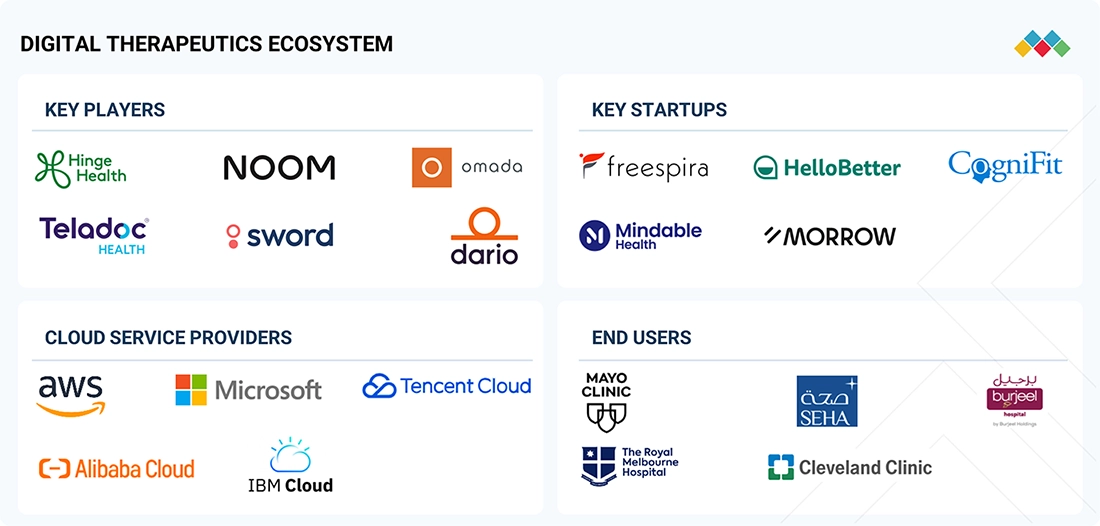
DIGITAL THERAPEUTICS MARKET: COMMERCIAL USE CASES ACROSS INDUSTRIES
| COMPANY | USE CASE DESCRIPTION | BENEFITS |
|---|---|---|
 |
AI-enabled virtual care, chronic disease management, remote patient monitoring (RPM), and integrated digital therapeutics platform | Improved patient engagement, reduced hospitalizations, enhanced chronic disease outcomes, and expanded access to virtual care |
 |
AI-powered behavior change platform, digital weight management, nutrition coaching, and personalized lifestyle interventions | Sustainable weight loss, improved metabolic health, higher patient adherence, and reduced risk of chronic diseases |
 |
AI-driven musculoskeletal (MSK) digital therapy, wearable-enabled motion tracking, computer vision, and virtual physical therapy | Faster recovery, reduced pain, lower musculoskeletal treatment costs, and decreased need for surgery or opioid use |
 |
Digital chronic disease prevention and management platform for diabetes, hypertension, obesity, and cardiovascular health using connected devices and personalized coaching | Improved clinical outcomes, better disease control, increased medication adherence, and reduced healthcare expenditures |
 |
AI-powered digital therapeutics platform integrating glucose monitoring, blood pressure monitoring, behavioral health, and personalized coaching | Better disease self-management, improved patient outcomes, enhanced engagement, and lower total cost of care |
Logos and trademarks shown above are the property of their respective owners. Their use here is for informational and illustrative purposes only.
Related Ecosystem
Healthcare Analytics
- Machine Learning
- Natural Language Processing (NLP)
- Blood Pressure Monitors
- Computed Tomography (CT)
- Magnetic Resonance Imaging (MRI)
- Oracle Corporation
- PHILIPS HEALTHCARE
- Siemens healthineers
- Zensar Technologies Limited
- EPIC SYSTEMS CORPORATION
Healthcare It
- Computed Tomography (CT)
- Machine Learning
- Magnetic Resonance Imaging (MRI)
- Natural Language Processing (NLP)
- Predictive Analytics
- CERNER CORPORATION
- PHILIPS HEALTHCARE
- Oracle Corporation
- GE HealthCare Technologies Inc.
- Siemens healthineers
Key Takeaways
- Brazil's DTx market will grow from USD 221.1M (2026) to USD 675.8M (2031), representing a 25.0% CAGR.
- Brazil's large population and geographic dispersion create strong demand for remote digital therapeutic solutions.
- Mental health and chronic disease management are primary growth drivers in Brazil's DTx adoption.
- Brazil's improving regulatory environment and reimbursement policies are accelerating DTx market penetration.
Digital Therapeutics/DTx Market Report Scope
| Report Metric | Details |
|---|---|
| Base Year | 2026 |
| Fastest Growing Segment | IMMERSIVE & INTERFACE-BASED THERAPEUTICS (Offering) |
| Forecast Period | 2026-2031 |
| Growth Rate | CAGR of 26.4% from 2026 to 2031 |
| Largest Segment | B2B SALES CHANNELS (Sales Channel) |
| Market Size Base Year (Billions) | ~USD 10.96 (2026) |
| Revenue Forecast (Billions) | ~USD 35.37 (2031) |
| Segments Covered | Offering, Product Type, Application, Type, Revenue Model, Sales Channel, End User |
Brazil Digital Therapeutics/DTx Market Report Segmentation
7 segment dimensions are covered across the global market.
By Offering
- Immersive & Interface-Based Therapeutics
- Software/Platforms
- Therapeutic Programs
By Product Type
- Non-Prescription Digital Therapeutics
- Prescription Digital Therapeutics
By Application
- Preventive Applications
- Treatment & Care-Related Applications
By Type
- Cardiovascular Diseases
- Central Nervous System (Cns) Disorders
- Chronic Respiratory Diseases
- Diabetes
- Diagnostic & Rehabilitation Centers
- Hospitals
- Medication Adherence
- Musculoskeletal Disorders
- Nutrition & Lifestyle Management
- Obesity & Weight Management
- Other Healthcare Providers
- Other Preventive Applications
- Other Treatment & Care-Related Applications
- Prediabetes
- Private Payers
- Public Payers
- Rehabilitation & Patient Care
- Sleep Disorders
- Smoking Cessation
- Specialty Clinics
- Substance Use Disorders & Addiction Management
By Revenue Model
- Licensing (Enterprise/SaaS) Models
- Outcome-/Value-Based Models
- Subscription-Based Models
By Sales Channel
- B2B Sales Channels
- B2C Sales Channels
By End User
- Employers
- Healthcare Payers
- Healthcare Providers
- Other End Users
- Patients/Individuals
Target Audience
- Digital Therapeutics Companies : DTx developers and vendors need Brazil-specific market data to assess market opportunity, identify customer segments, and develop localized product strategies for this high-growth Latin American market.
- Healthcare Investors & PE Firms : Investment professionals require detailed Brazil market analysis to evaluate portfolio opportunities, assess company valuations, and identify promising DTx startups and expansion-stage companies in the region.
- Healthcare Providers & Hospital Networks : Brazilian hospitals, clinics, and healthcare systems need market intelligence to benchmark digital therapeutics adoption, evaluate vendor solutions, and plan digital health infrastructure investments.
- Pharmaceutical & Medtech Companies : Pharma and medical device manufacturers require Brazil DTx market insights to identify partnership opportunities, understand competitive threats, and develop integrated digital health solutions for the market.
- Government & Healthcare Policy Makers : Brazilian health ministry officials and policy makers need market data to inform healthcare digitalization strategies, regulatory frameworks, and public health initiatives supporting DTx adoption.
Reasons to Buy this Report
- Market Size & Growth Validation : Obtain precise market valuation data for Brazil's DTx sector with verified CAGR projections through 2031, enabling accurate financial forecasting and investment decision-making for market entry or expansion strategies.
- Competitive Landscape Intelligence : Understand Brazil-specific market dynamics, key players, and competitive positioning to identify white-space opportunities and develop targeted go-to-market strategies for digital therapeutic solutions.
- Regulatory & Infrastructure Insights : Access detailed analysis of Brazil's healthcare digitalization policies, regulatory environment, and telehealth infrastructure to navigate compliance requirements and leverage government support initiatives.
- Customer Segmentation Data : Gain actionable insights into Brazil's patient demographics, healthcare provider adoption patterns, and regional variations to tailor product offerings and marketing approaches for maximum market penetration.
- Risk Mitigation & Forecasting : Leverage comprehensive market analysis to identify growth drivers, potential headwinds, and emerging trends specific to Brazil, reducing investment risk and improving strategic planning accuracy.
Frequently asked questions
What is the current size of Brazil's digital therapeutics market?
Brazil's digital therapeutics market is valued at USD 221.1 million in 2026 and is projected to grow to USD 675.8 million by 2031.
What is the expected growth rate for Brazil's DTx market?
Brazil's DTx market is expected to grow at a compound annual growth rate (CAGR) of 25.0% from 2026 to 2031.
Which therapeutic areas are driving growth in Brazil's DTx market?
Mental health, chronic disease management, and behavioral health applications are the primary therapeutic areas driving DTx adoption in Brazil.
What factors are supporting Brazil's DTx market expansion?
Brazil's DTx growth is supported by high smartphone penetration, expanding telehealth infrastructure, geographic healthcare access challenges, and improving regulatory frameworks.
How does Brazil's DTx market compare to other Latin American countries?
Brazil represents the largest DTx market in Latin America, with its 25.0% CAGR and substantial market size positioning it as a regional leader in digital therapeutics adoption.
RESEARCH METHODOLOGY
This research study involved the extensive use of both primary and secondary sources. It involved the analysis of various factors affecting the industry to identify the segmentation types, industry trends, key players, the competitive landscape of market players, and key market dynamics such as drivers, opportunities, challenges, restraints, and key player strategies.
Secondary Research
This research study extensively utilized secondary sources, including directories, databases such as Dun & Bradstreet, Bloomberg Businessweek, and Factiva, as well as white papers, annual reports, and companies' house documents. The secondary research aimed to gather and analyze information for a comprehensive and commercially focused study of the digital therapeutics market, encompassing technical aspects and market dynamics. It also facilitated the identification of key players, market classification, industry trends, geographical markets, and significant market-related developments. Additionally, a database of prominent industry leaders was compiled through secondary research.
Primary Research
In the primary research process, various supply-side and demand-side sources were interviewed to obtain qualitative and quantitative information for this report. Primary sources from the supply side included industry experts such as CEOs, vice presidents, marketing and sales directors, technology & innovation directors, engineers, and related key executives from various companies and organizations operating in the digital therapeutics market. Primary sources from the demand side included personnel from healthcare providers, payers, employees, and patients/individuals.
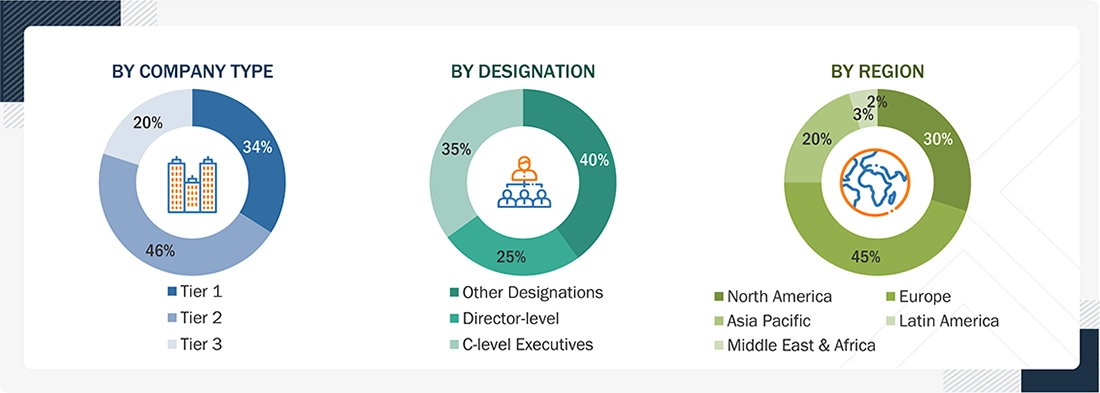
Others include sales managers, marketing managers, and product managers.
Note: Tiers are defined based on a company’s total revenue, as of 2025: Tier 1 = >USD 1 billion, Tier 2 = USD 500 million to USD 1 billion, and Tier 3 = <USD 500 million
To know about the assumptions considered for the study, download the pdf brochure
Market Size Estimation
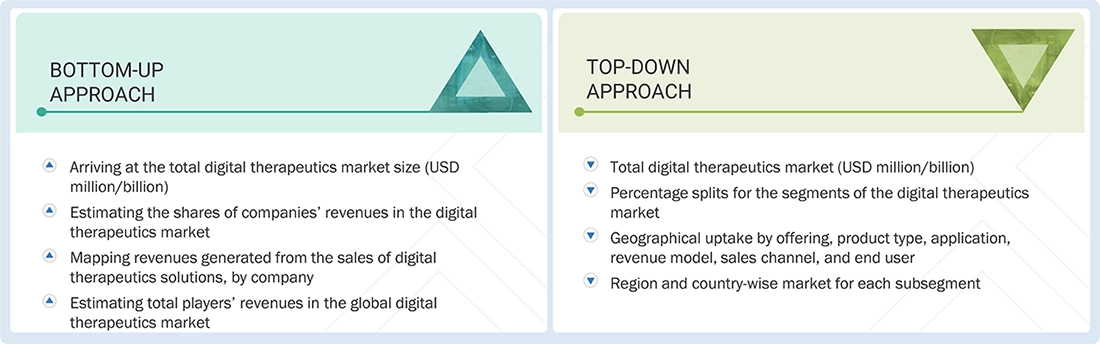
The total size of the digital therapeutics market was determined after data triangulation through the two approaches mentioned below. After the completion of each approach, the weighted average of these approaches was taken based on the level of assumptions used in each approach.
Global Digital Therapeutics Market Size: Top-down Approach and Bottom-up Approach
Data Triangulation
The size of the digital therapeutics market was estimated through segmental extrapolation using the bottom-up approach. The methodology used is as given below:
- Revenues for individual companies were gathered from public sources and databases.
- Shares of leading players in the digital therapeutics market were gathered from secondary sources to the extent available. In certain cases, shares of digital therapeutics businesses have been ascertained after a detailed analysis of various parameters, including product portfolios, market positioning, selling price, and geographic reach & strength.
- Individual shares or revenue estimates were validated through interviews with experts.
- The total revenue in the digital therapeutics market was determined by extrapolating the market share data of major companies.
Market Definition
The digital therapeutics market comprises evidence-based, clinically validated software solutions designed to prevent, manage, or treat medical conditions through therapeutic interventions delivered via digital technologies. These solutions are delivered through mobile applications, web-based platforms, connected devices, and immersive technologies, and may be prescribed by healthcare professionals or accessed directly by consumers. By leveraging data analytics, artificial intelligence (AI), and personalized behavioral interventions, digital therapeutics improve clinical outcomes, enhance patient engagement, and support the prevention and management of acute and chronic diseases.
Key Stakeholders
- Digital therapeutics developers and platform providers
- Pharmaceutical and biotechnology companies
- Healthcare providers (hospitals, specialty clinics, rehabilitation centers, and primary care centers)
- Health insurance companies (public and private payers)
- Employers and corporate wellness providers
- Medical device and wearable technology companies
- Academic medical centers, universities, and research institutions
- Regulatory agencies and health technology assessment (HTA) bodies
- Government and public health organizations
- Telehealth and digital health platform providers
- Electronic health record (EHR) and healthcare IT solution providers
- Investors, venture capital firms, and private equity firms
- Patients and patient advocacy organizations
- Business research and consulting service providers
Report Objectives
- To define, describe, and forecast the digital therapeutics market based on offering, product type, application, revenue model, sales channel, end user, and region
- To provide detailed information regarding the major factors influencing market growth (such as drivers, restraints, opportunities, and challenges)
- To analyze the micromarkets with respect to individual growth trends, prospects, and contributions to the overall digital therapeutics market
- To analyze the opportunities for stakeholders and provide details of the competitive landscape for market leaders
- To forecast the size of the market segments with respect to five main regions, namely, North America, Europe, the Asia Pacific, Latin America, and the Middle East & Africa
- To profile the key players and analyze their market shares and core competencies
- To track and analyze competitive developments such as product launches & approvals, partnerships, agreements, and collaborations in the overall digital therapeutics market
- To benchmark players within the market using the proprietary "Competitive Leadership Mapping" framework, which analyzes market players on various parameters within the broad categories of business and product strategy.
Available customizations:
With the given market data, MarketsandMarkets offers customizations as per your company’s specific needs. The following customization options are available for the report:
Company Information
- Detailed analysis and profiling of additional market players (up to 5)
Geographic Analysis
- Further breakdown of the Rest of Asia Pacific digital therapeutics market into Taiwan, New Zealand, Thailand, Singapore, Malaysia, and other countries
- Further breakdown of the Rest of Europe digital therapeutics market into Russia, Austria, Finland, Sweden, Turkey, Norway, Poland, Portugal, Romania, Denmark, and other countries
Get the Full Digital Therapeutics/DTx Market Report
Full forecast, segment splits, and company analysis for all Digital Therapeutics/DTx Market.
- US Digital Therapeutics/DTx Market
- Canada Digital Therapeutics/DTx Market
- Germany Digital Therapeutics/DTx Market
- France Digital Therapeutics/DTx Market
- UK Digital Therapeutics/DTx Market
- Italy Digital Therapeutics/DTx Market
- Spain Digital Therapeutics/DTx Market
- China Digital Therapeutics/DTx Market
- Japan Digital Therapeutics/DTx Market
- India Digital Therapeutics/DTx Market
- Australia Digital Therapeutics/DTx Market
- South Korea Digital Therapeutics/DTx Market
- Mexico Digital Therapeutics/DTx Market
- Saudi Arabia Digital Therapeutics/DTx Market
- UAE Digital Therapeutics/DTx Market
- South Africa Digital Therapeutics/DTx Market
- Rest Of Europe Digital Therapeutics/DTx Market
- Rest Of Asia Pacific Digital Therapeutics/DTx Market
- Rest Of Latin America Digital Therapeutics/DTx Market
- GCC Countries Digital Therapeutics/DTx Market
- Rest Of GCC Countries Digital Therapeutics/DTx Market
Need a Tailored Report?
Customize this report to your needs
Get 10% FREE Customization
Customize This Report
