
US Digital Transformation Market (2025-2030)

The US Digital Transformation Market was valued at $319660 Million in 2025 and projected to reach to $458980 Million by 2030, representing a compound annual growth rate of 6.2%. The US digital transformation market is positioned for sustained growth through 2030, driven by accelerating cloud adoption, enterprise automation investments, and modernization of legacy systems across key industries.


| Market Size in | USD 26.32 MN |
| Market Forecast in | |
| CAGR | |
| Forecast Period | |
| Units Considered | Value (USD MN) |
US Digital Transformation Market Trends and Insights
- The US market reflects strong enterprise investment in cloud migration, automation, and modernization initiatives across sectors including finance, healthcare, retail, and manufacturing.
- This growth trajectory underscores the US position as a leading adopter of digital technologies and transformation strategies. Driving the US market expansion are accelerating cloud adoption, increased cybersecurity investments, and enterprise demand for AI-powered solutions.
- The US continues to lead in digital infrastructure spending, with organizations prioritizing business process optimization and customer experience enhancement.
- Between 2025 and 2030, the US market will benefit from regulatory compliance requirements, competitive pressures, and the need for operational resilience in an increasingly digital economy. The US digital transformation landscape is characterized by mature technology ecosystems, significant venture capital investment, and a competitive vendor environment.
- Organizations across the US are allocating substantial budgets to legacy system modernization, data analytics capabilities, and workforce digital upskilling, positioning the country as a sustained growth engine within the global digital transformation market..
Key Market Statistics
- CAGR (2025-2030) 6.2% CAGR
- Market Size, 2025 ~USD 319660 Million
- Forecast, 2030 ~USD 458980 Million
- Country US
US Digital Transformation Market Overview
Market Size & Growth :
The US digital transformation market reached $319.66 billion in 2025 and is projected to expand to $458.98 billion by 2030, representing a steady 6.2% CAGR driven by enterprise modernization initiatives.
Cloud Migration Leadership :
US enterprises are prioritizing cloud migration as a cornerstone of digital transformation, with significant investments across AWS, Azure, and Google Cloud platforms to enhance scalability and operational efficiency.
Sector-Wide Adoption :
Financial services, healthcare, retail, and manufacturing sectors in the US are leading digital transformation spending, driven by regulatory compliance, customer experience demands, and competitive pressures.
Automation & AI Integration :
US organizations are increasingly deploying automation and AI-powered solutions to streamline operations, reduce costs, and improve decision-making across enterprise functions.
US Digital Transformation Market Dynamics
- Organizations are prioritizing digital-first strategies to enhance operational resilience and customer engagement in an increasingly competitive landscape.
- The 6.2% CAGR reflects a mature but expanding market where enterprises balance transformation investments with ROI expectations.
- Emerging technologies including AI, edge computing, and advanced analytics are expected to unlock new growth opportunities, while regulatory frameworks and cybersecurity requirements continue to shape investment priorities across the US market..
Market Ecosystem
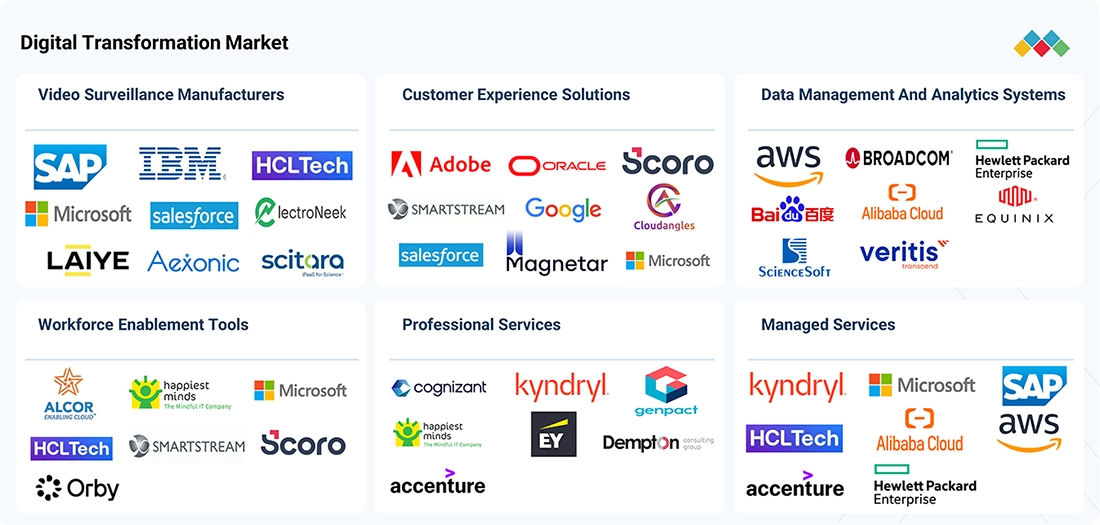
DIGITAL TRANSFORMATION MARKET: COMMERCIAL USE CASES ACROSS INDUSTRIES
| COMPANY | USE CASE DESCRIPTION | BENEFITS |
|---|---|---|
 |
Air India undertook a cloud-led digital transformation by migrating critical workloads, applications, databases, and networking systems from its legacy data centers to a cloud infrastructure. The initiative supported modernization of its IT environment, improved system performance, and enabled the use of advanced analytics and AI platforms across airline operations. | Achieved approximately 20% cost savings through cloud resource optimization and infrastructure right-sizing. The migration also improved system performance, scalability, security, and customer experience. |
 |
Apollo Hospitals implemented a unified data platform to address fragmented systems, data delays, and limited operational visibility across its healthcare network. The initiative enabled clinical teams to access integrated operational information, coordinate resources, and prioritize patient care using a more comprehensive view of hospital operations. | Reduced manual work by 25% and increased order conversions by 60%. The transformation also improved data visibility, operational coordination, and resource allocation across the healthcare network. |
 |
Voltas modernized its legacy IT environment by migrating more than 250 on-premises VMware applications to a cloud infrastructure and transitioning to SAP-based enterprise applications. The initiative was undertaken to improve infrastructure scalability, strengthen security, and support business continuity while modernizing enterprise applications. | Expanded cloud adoption from 0% in 2022 to 60% in 2024. The migration was completed without operational disruption, while improving infrastructure agility, security, and business continuity. |
 |
Cynergy Bank transformed its customer service ecosystem by addressing fragmented knowledge bases, manual processes, limited customer insights, and inadequate integration between front-office and back-office systems. The initiative involved digitizing workflows and improving contact center and back-office operations through AI, automation, and cloud-enabled technologies. | Reduced customer complaints by more than 50%, improved workforce optimization by 8%, and enhanced overall customer experience scores by 25%. |
Logos and trademarks shown above are the property of their respective owners. Their use here is for informational and illustrative purposes only.
Related Ecosystem
Key Takeaways
- The US digital transformation market will expand from $319.66B in 2025 to $458.98B in 2030, driven by enterprise cloud adoption and modernization investments.
- The US 6.2% CAGR reflects steady demand for AI, automation, and cybersecurity solutions across enterprise sectors.
- US organizations prioritize legacy system modernization and data analytics capabilities to enhance operational efficiency and competitive advantage.
- The US market benefits from mature technology ecosystems, regulatory compliance drivers, and significant venture capital supporting innovation.
Digital Transformation Market Report Scope
| Report Metric | Details |
|---|---|
| Base Year | 2025 |
| Fastest Growing Segment | INFRASTRUCTURE MODERNIZATION (Professional Service) |
| Forecast Period | 2025–2030 |
| Growth Rate | CAGR of 9.1% from 2025 to 2030 |
| Largest Segment | LARGE ENTERPRISES (Organization Size) |
| Market Size Base Year (Billions) | ~USD 1102.97 (2025) |
| Revenue Forecast (Billions) | ~USD 1704.86 (2030) |
| Segments Covered | Offering, Solution, Service, Professional Service, Transformation Focus Area, Technology, Organization Size, Vertical |
US Digital Transformation Market Report Segmentation
8 segment dimensions are covered across the global market.
By Offering
- Services
- Solution
- Solutions
By Solution
- Customer Experience Solutions
- Data Management & Analytics Systems
- Process Automation Platforms
- Workforce Enablement Tools
By Service
- Managed
- Professional
By Professional Service
- Application Modernization
- Infrastructure Modernization
- Support & Maintenance
- System Integration & Implementation
- Training, Strategy, And Consulting
By Transformation Focus Area
- Customer-Centric
- Financial
- Operational
- R&D
- R&D Transformation
- Workforce
By Technology
- AI & Analytics
- Blockchain
- Cloud Computing
- Cybersecurity
- Internet Of Things (IoT)
- Other Technologies
By Organization Size
- Large Enterprises
- Smes
By Vertical
- Bfsi
- Construction & Real Estate
- Education
- Energy & Utilities
- Government & Defense
- Healthcare, Life Sciences, And Pharmaceuticals
- It & Ites
- Manufacturing
- Media & Entertainment
- Other Verticals
- Other Verticals (Travel & Hospitality, Agriculture)
- Retail & Ecommerce
- Telecommunications
- Transportation & Logistics
Target Audience
- Enterprise IT Leaders : CIOs and IT directors need US market data to validate digital transformation budgets, benchmark spending against peers, and align technology investments with organizational growth objectives.
- Technology Solution Providers : Software vendors, cloud service providers, and consulting firms require US market insights to identify customer segments, forecast demand, and develop targeted sales strategies for transformation solutions.
- Management Consultants : Strategy and digital transformation consultants use US market data to advise clients on investment priorities, competitive positioning, and sector-specific transformation roadmaps.
- Investment & Financial Analysts : Equity analysts and investment professionals need accurate US market forecasts to evaluate technology companies, assess growth potential, and support investment recommendations in the digital transformation space.
- Corporate Strategy Teams : Business development and strategy executives require US market intelligence to evaluate acquisition targets, assess market opportunities, and inform long-term digital transformation initiatives.
Key Companies in the US Digital Transformation Market
| Company | HQ | Ownership | Strongest segments |
|---|---|---|---|
| BMC SOFTWARE INC. | United States | Private Company | Enterprise Service Management (ESM) / ITSM,Mainframe Service Management (MSM),Control-M Workload Automation and Orchestration, |
| OOREDOO | Qatar | Public Company | Mobile connectivity (voice and data),Fixed broadband and connectivity,Enterprise ICT and cloud (hosting, security, SD-WAN, IoT), |
| NUCLEUS SOFTWARE | India | Public Company | FinnOne Neo (Lending Suite),FinnAxia (Transaction Banking),Digital Payments & PaySe, |
| BITTIUM CORPORATION | Finland | Public Company | Defense & Security (Tough Mobile, SDR, Tactical Networks, VoIP, Secure Suite),Medical (Faros, OmegaSnap, Cardiac Navigator, MedicalSuite, Respiro, BrainStatus, NeurOne),Engineering Services (product design, development, testing, certification, ramp-up), |
| BOOZ ALLEN HAMILTON | United States | Public Company | AI and Advanced Analytics Solutions,Cybersecurity and Cyber Operations,Cloud, Data Platforms, and Software Modernization, |
| ZENSAR TECHNOLOGIES LTD | India | Public Company | Digital and Application Services,Data Engineering and Analytics,Cloud Infrastructure and Security, |
| ALTRAN | France | Private Company | Engineering & R&D Services,Organization & IT Systems Consulting,Embedded Systems & Next-Gen Connectivity Projects, |
| NETSCOUT SYSTEMS, INC | United States | Public Company | Service Assurance & nGeniusONE Platform (including ISNG, vSTREAM, Infinistream, test access points),DDoS & Arbor Cybersecurity (Sightline, TMS, Edge Defense, Omnis Cyber Intelligence),Omnis Insights & Observability / Analytics Integrations, |
| LARSEN & TOUBRO LTD. | India | Public Company | Infrastructure Projects,Energy Projects,Hi-Tech Manufacturing, |
| PCCW | Hong Kong | Public Company | Telecom Connectivity (fixed, mobile, broadband, international),Enterprise Solutions, Outsourcing, and Managed Services,Media and OTT (Viu, TV, advertising), |
| SWISSCOM AG | Switzerland | Public Company | Consumer mobile, broadband, and TV,Enterprise telecom & ICT services,Wholesale, infrastructure, and trust services, |
| PERSISTENT SYSTEMS | India | Public Company | Software Engineering & Product Development,Cloud & Infrastructure / CloudOps,CX & Salesforce-led Transformation, |
| APPLE INC | United States | Public Company | iPhone,Mac,iPad, |
BMC SOFTWARE INC.
BMC SOFTWARE INC. is a private software company established in 1980 in the United States with 6,700 employees.
OOREDOO
OOREDOO is a public telecommunications company based in Qatar, founded in 1987 and operating with 16,717 employees.
NUCLEUS SOFTWARE
NUCLEUS SOFTWARE is a public software company established in India in 1986, employing 1,917 professionals.
BITTIUM CORPORATION
BITTIUM CORPORATION is a public Finnish technology company founded in 1985 with 528 employees.
BOOZ ALLEN HAMILTON
BOOZ ALLEN HAMILTON is a public consulting and engineering services firm founded in 1914 in the United States, employing 31,500 people.
ZENSAR TECHNOLOGIES LTD
ZENSAR TECHNOLOGIES LTD is a public Indian information technology services company founded in 1963 with 10,066 employees.
ALTRAN
ALTRAN is a private engineering and technology consulting company founded in France in 1970, employing 50,124 professionals.
NETSCOUT SYSTEMS, INC
NETSCOUT SYSTEMS, INC is a public software and analytics company founded in 1984 in the United States with 2,063 employees.
LARSEN & TOUBRO LTD.
LARSEN & TOUBRO LTD. is a public Indian multinational conglomerate founded in 1938, employing 55,662 people across engineering and construction sectors.
PCCW
PCCW is a public telecommunications and technology services company based in Hong Kong, founded in 1925 with 14,600 employees.
SWISSCOM AG
SWISSCOM AG is a public Swiss telecommunications company founded in 1998, operating with 23,073 employees.
PERSISTENT SYSTEMS
PERSISTENT SYSTEMS is a public Indian information technology services company founded in 1990 with 22,205 employees.
APPLE INC
APPLE INC is a public technology company founded in 1976 in the United States, employing 166,000 people globally.
Reasons to Buy this Report
- Accurate US Market Sizing : Obtain precise valuation data for the US digital transformation market with verified 2025 baseline ($319.66B) and 2030 forecasts ($458.98B) to support strategic planning and investment decisions.
- Sector-Specific Insights : Understand digital transformation spending patterns across US financial services, healthcare, retail, and manufacturing sectors to identify high-opportunity verticals for your solutions and services.
- Competitive Benchmarking : Benchmark your organization's digital transformation initiatives against US market trends, adoption rates, and investment priorities to optimize resource allocation and competitive positioning.
- Growth Opportunity Identification : Leverage the 6.2% CAGR forecast and market expansion data to identify emerging opportunities in cloud migration, automation, and modernization services within the US enterprise market.
- Strategic Decision Support : Make informed decisions on market entry, product development, and go-to-market strategies with comprehensive US-specific data on digital transformation drivers and investment trends.
Frequently asked questions
What is the current size of the US digital transformation market in 2025?
The US digital transformation market is valued at $319.66 billion in 2025, representing significant enterprise investment in modernization and digital technologies.
What is the projected size of the US digital transformation market by 2030?
The US digital transformation market is forecast to reach $458.98 billion by 2030, reflecting a 6.2% compound annual growth rate over the five-year period.
What is driving growth in the US digital transformation market?
Growth in the US market is driven by cloud migration acceleration, increased cybersecurity investments, AI adoption, legacy system modernization, and regulatory compliance requirements across enterprises.
Which industries are leading digital transformation investments in the US?
The US financial services, healthcare, retail, and manufacturing sectors are leading digital transformation investments, prioritizing cloud adoption, automation, and data analytics capabilities.
How does the US digital transformation market compare to global growth?
The US market grows at 6.2% CAGR, slightly below the global average of 9.1%, reflecting the maturity of the US technology ecosystem and market saturation in certain segments.
RESEARCH METHODOLOGY
The research methodology for the global digital transformation market involved extensive secondary research, supported by primary interviews and market engineering to identify, collect, validate, and analyze information relevant to the market. The study covered digital transformation solutions and services, including process automation platforms, customer experience solutions, data management and analytics systems, workforce enablement tools, professional services, and managed services. In-depth interviews were conducted with industry participants, including technology vendors, cloud service providers, enterprise software providers, system integrators, IT consulting firms, managed service providers, and enterprise end users. Discussions with senior executives, product managers, technology specialists, and industry consultants helped validate qualitative and quantitative information, assess technology adoption patterns, and evaluate market prospects across different industries and regions.
Secondary Research
In the secondary research process, various authoritative sources were referred to for identifying and collecting information for the study. The secondary sources included annual reports, investor presentations, financial statements, SEC filings, company press releases, product announcements, corporate websites, product documentation, technical white papers, developer documentation, and official case studies published by companies operating in the digital transformation ecosystem. Information was collected from leading technology providers, including Microsoft, IBM, SAP, Oracle, Google, Salesforce, Adobe, Amazon Web Services (AWS), HPE, HCLTech, Broadcom, and Cisco, to understand their product portfolios, technology developments, strategic partnerships, acquisitions, and business expansion initiatives.
Secondary research also involved reviewing publications, reports, and technical documentation from recognized technology organizations and industry associations, including the International Organization for Standardization (ISO), International Electrotechnical Commission (IEC), National Institute of Standards and Technology (NIST), Organisation for Economic Co-operation and Development (OECD), European Commission, World Economic Forum (WEF), and International Telecommunication Union (ITU). Government publications and regulatory resources related to digital infrastructure, cloud adoption, cybersecurity, data protection, artificial intelligence, and enterprise technology modernization were also examined. These sources were supplemented with official publications and technical documentation covering cloud computing, artificial intelligence and analytics, cybersecurity, blockchain, Internet of Things (IoT), robotic process automation, digital twins, enterprise applications, and digital workplace technologies.
The secondary research was used to obtain key information about the digital transformation industry's value chain, market structure, monetary chain, ecosystem participants, market classification, and segmentation according to technology adoption and industry requirements. It also helped identify the overall pool of key solution and service providers, their competitive positioning, product offerings, revenue contributions, strategic developments, and regional market dynamics. The research further examined enterprise adoption patterns across BFSI, retail and e-commerce, IT/ITES, media and entertainment, manufacturing, healthcare and life sciences, energy and utilities, government and defense, telecommunications, education, transportation and logistics, and construction and real estate.
Primary Research
In the primary research process, a diverse range of stakeholders from both the supply and demand sides of the digital transformation ecosystem were interviewed to gather qualitative and quantitative insights specific to the market. On the supply side, key industry participants, including chief executive officers (CEOs), vice presidents (VPs), marketing directors, product managers, technology specialists, and business development executives from companies offering digital transformation solutions and services, were consulted. Additionally, system integrators, IT consulting firms, cloud service providers, enterprise software vendors, professional service providers, and managed service providers were included in the study. On the demand side, input from CIOs, CTOs, chief digital officers (CDOs), IT directors, digital transformation heads, procurement managers, and business unit leaders of enterprise end users was collected to understand technology adoption patterns, investment priorities, implementation requirements, and challenges across targeted industries.
The primary research process considered all major parameters affecting the digital transformation market, including technological advancements, evolving enterprise requirements, and emerging use cases across cloud computing, AI and analytics, cybersecurity, blockchain, IoT, robotic process automation, digital twins, and enterprise applications. Discussions also covered digital strategy development, legacy infrastructure modernization, cloud migration, systems integration, application modernization, workflow automation, customer experience management, workforce enablement, data governance, cybersecurity, and managed IT services. Each factor was analyzed and validated through primary interviews to obtain quantitative and qualitative data related to market demand, technology adoption, implementation priorities, and enterprise spending patterns.
Once the initial phase of market engineering was completed, including detailed calculations for market statistics, segment-specific growth forecasts, and data triangulation, an additional round of primary research was undertaken. This step was essential for refining and validating critical data points, including the adoption of digital transformation solutions and services, technology-wise demand, enterprise spending patterns, vertical-wise adoption, competitive developments, and regional growth trends. The discussions also helped validate market dynamics such as drivers (increasing enterprise investments in cloud computing, AI adoption, and business process automation), restraints (high implementation costs, integration complexity, and return-on-investment concerns), opportunities (generative AI, agentic AI, intelligent automation, and connected enterprise platforms), and challenges (legacy system integration, data silos, cybersecurity risks, and shortage of skilled professionals). The final findings were cross-verified with secondary research to improve the reliability and consistency of the market estimates.
Breakup of primary profiles
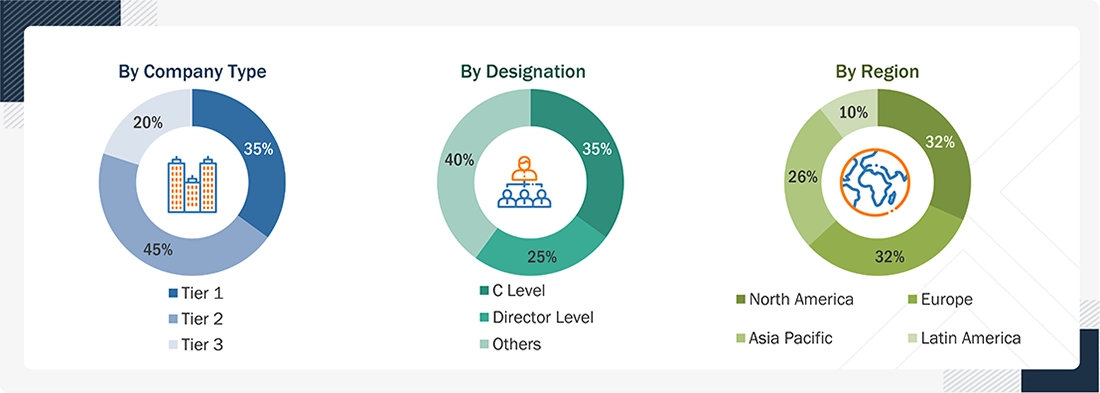
Note: Tier 1 companies’ revenues are more than USD 10 billion; tier 2 companies’ revenues range between USD 1 and 10 billion; and tier 3 companies’ revenues range between USD 500 million and USD 1 billion. Other designations include sales managers, marketing managers, and product managers.
Source: Industry Experts
To know about the assumptions considered for the study, download the pdf brochure
Market Size Estimation
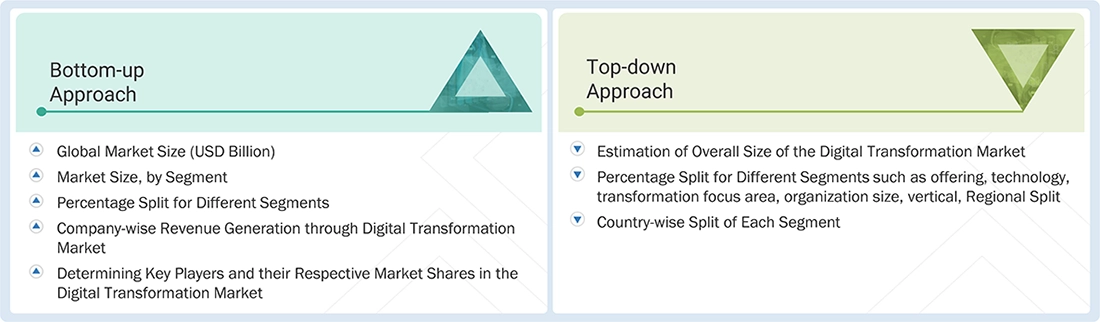
The top-down and bottom-up approaches were employed to estimate and forecast the digital transformation market, as well as its dependent submarkets. This multi-layered analysis was further reinforced through data triangulation, which incorporated primary and secondary research inputs. The market figures were also validated against the existing MarketsandMarkets repository for accuracy.
Digital Transformation Market: Top-Down and Bottom-Up Approach
Data Triangulation
After determining the overall market size using the market size estimation processes as explained above, the market was split into several segments and subsegments. Data triangulation and market breakup procedures were employed, wherever applicable, to complete the overall market engineering process and determine the exact statistics of each market segment and subsegment. The overall market size was used in the top-down procedure to estimate the size of other individual markets via percentage splits of the market segmentation.
Market Definition
The digital transformation market encompasses the adoption and implementation of digital technologies, solutions, and services by organizations to modernize business operations, improve operational efficiency, enhance customer experiences, and enable data-driven decision-making. It includes technologies such as artificial intelligence (AI) and analytics, cloud computing, blockchain, cybersecurity, and the Internet of Things (IoT), along with solutions for process automation, customer experience management, data management, and workforce enablement. The market also covers professional and managed services that support digital strategy, system integration, cloud migration, application modernization, and ongoing technology management. Digital transformation enables organizations to integrate digital capabilities across business functions, optimize workflows, improve business agility, and develop innovative business models.
Key Stakeholders
- Digital Transformation Software Providers
- Cybersecurity Firms
- Business Analysts
- Cloud Service Providers
- Consulting Service Providers
- Enterprise End Users
- Distributors and Value-added Resellers (VARs)
- Government Agencies
- Independent Software Vendors (ISV)
- Managed Service Providers
- Market Research and Consulting Firms
- Support & Maintenance Service Providers
- System Integrators (SIs)/Migration Service Providers
- Technology Providers
Report Objectives
- To define, describe, and forecast the digital transformation market by offering, technology, transformation focus area, organization size, vertical, and region
- To provide detailed information related to major factors (drivers, restraints, opportunities, and industry-specific challenges) influencing market growth
- To analyze micro markets with respect to individual growth trends, prospects, and their contribution to the total market
- To analyze the opportunities in the market for stakeholders by identifying the high-growth segments of the digital transformation market
- To analyze opportunities in the digital transformation market and provide details of the competitive landscape for stakeholders and market leaders
- To forecast the market size of segments for the five main regions: North America, Europe, Asia Pacific, the Middle East & Africa, and Latin America
- To profile the key players and comprehensively analyze their market ranking and core competencies
- To analyze competitive developments, such as partnerships, product launches, mergers, and acquisitions, in the digital transformation market
Available customizations:
With the given market data, MarketsandMarkets offers customizations to meet the company’s specific needs. The following customization options are available for the report:
Product/Brand Comparative Analysis
- Brand comparative analysis of additional vendors, including a detailed comparison of the product portfolio of each company
Geographic Analysis
- Inclusion of additional European countries, with breakup by offering, technology, transformation focus area, organization size, and vertical segments
- Inclusion of additional Asia Pacific countries, with breakup by offering, technology, transformation focus area, organization size, and vertical segments
- Breakup of Middle East & Africa by countries, with breakup by offering, technology, transformation focus area, organization size, and vertical segments
- Breakup of Latin America by countries, with breakup by offering, technology, transformation focus area, organization size, and vertical segments
Company Informarion
-
Detailed analysis and profiling of additional market players (up to five)
Get the Full Digital Transformation Market Report
Full forecast, segment splits, and company analysis for all Digital Transformation Market.
- Brazil Digital Transformation Market
- Canada Digital Transformation Market
- China Digital Transformation Market
- Finland Digital Transformation Market
- Germany Digital Transformation Market
- India Digital Transformation Market
- Mexico Digital Transformation Market
- Rest Of Europe Digital Transformation Market
- Saudi Arabia Digital Transformation Market
- Singapore Digital Transformation Market
- South Africa Digital Transformation Market
- South Korea Digital Transformation Market
- Sweden Digital Transformation Market
- UAE Digital Transformation Market
- UK Digital Transformation Market
Need a Tailored Report?
Customize this report to your needs
Get 10% FREE Customization
Customize This Report