
Brazil Digital Transformation Market (2025-2030)

The Brazil Digital Transformation Market was valued at $18.57 Million in 2025 and projected to reach to $33.6 Million by 2030, representing a compound annual growth rate of CAGR 10.4%. Brazil's digital transformation market is positioned for sustained expansion as enterprises prioritize cloud migration and AI integration to enhance competitiveness.


| Market Size in | USD 26.32 MN |
| Market Forecast in | |
| CAGR | |
| Forecast Period | |
| Units Considered | Value (USD MN) |
Brazil Digital Transformation Market Trends and Insights
- This represents a compound annual growth rate (CAGR) of 10.4%, outpacing global averages as Brazil accelerates its adoption of cloud computing, artificial intelligence, and enterprise automation solutions.
- Brazil's market expansion is driven by increasing investments from both public and private sectors seeking to modernize legacy systems and enhance operational efficiency. The Brazilian digital transformation landscape reflects the country's commitment to technological advancement across manufacturing, financial services, and government sectors.
- Brazil's market growth trajectory from 2025 to 2030 demonstrates strong demand for digital infrastructure upgrades and digital-first business models.
- Brazil's competitive environment is attracting both multinational technology providers and local innovators, positioning the nation as a key growth hub within Latin America's broader digital economy..
Key Market Statistics
- CAGR (2025-2030) CAGR 10.4%
- Market Size, 2025 ~USD 18.57 Million
- Forecast, 2030 ~USD 33.6 Million
- Country Brazil
Brazil Digital Transformation Market Overview
Market Valuation Growth :
Brazil's digital transformation market is valued at USD 18.57 million in 2025, with projections reaching USD 33.6 million by 2030, demonstrating strong investment momentum in the region.
Above-Average CAGR Performance :
Brazil's market grows at 10.4% CAGR, significantly outpacing the global average of 9.1%, indicating accelerated digital adoption and enterprise modernization initiatives across the country.
Key Technology Drivers :
Cloud computing, artificial intelligence, and enterprise automation solutions are primary growth catalysts, reflecting Brazil's strategic focus on modernizing legacy systems and improving operational efficiency.
Regional Market Leadership :
Brazil represents a critical growth hub in Latin America, with increasing government support for digital infrastructure and rising demand from mid-market enterprises seeking competitive advantages.
Brazil Digital Transformation Market Dynamics
- Government initiatives promoting digital economy development and increased foreign investment in tech infrastructure are accelerating adoption rates across sectors.
- The market's 10.4% CAGR reflects growing recognition among Brazilian organizations of digital transformation's strategic importance. Looking ahead, Brazil's market will benefit from rising digital literacy, expanding broadband connectivity, and increased venture capital funding for tech startups.
- Enterprise automation and AI-driven solutions will dominate spending as organizations seek cost optimization and improved customer experiences.
- Regional economic recovery and digital-first business models will further propel market growth through 2030..
Market Ecosystem
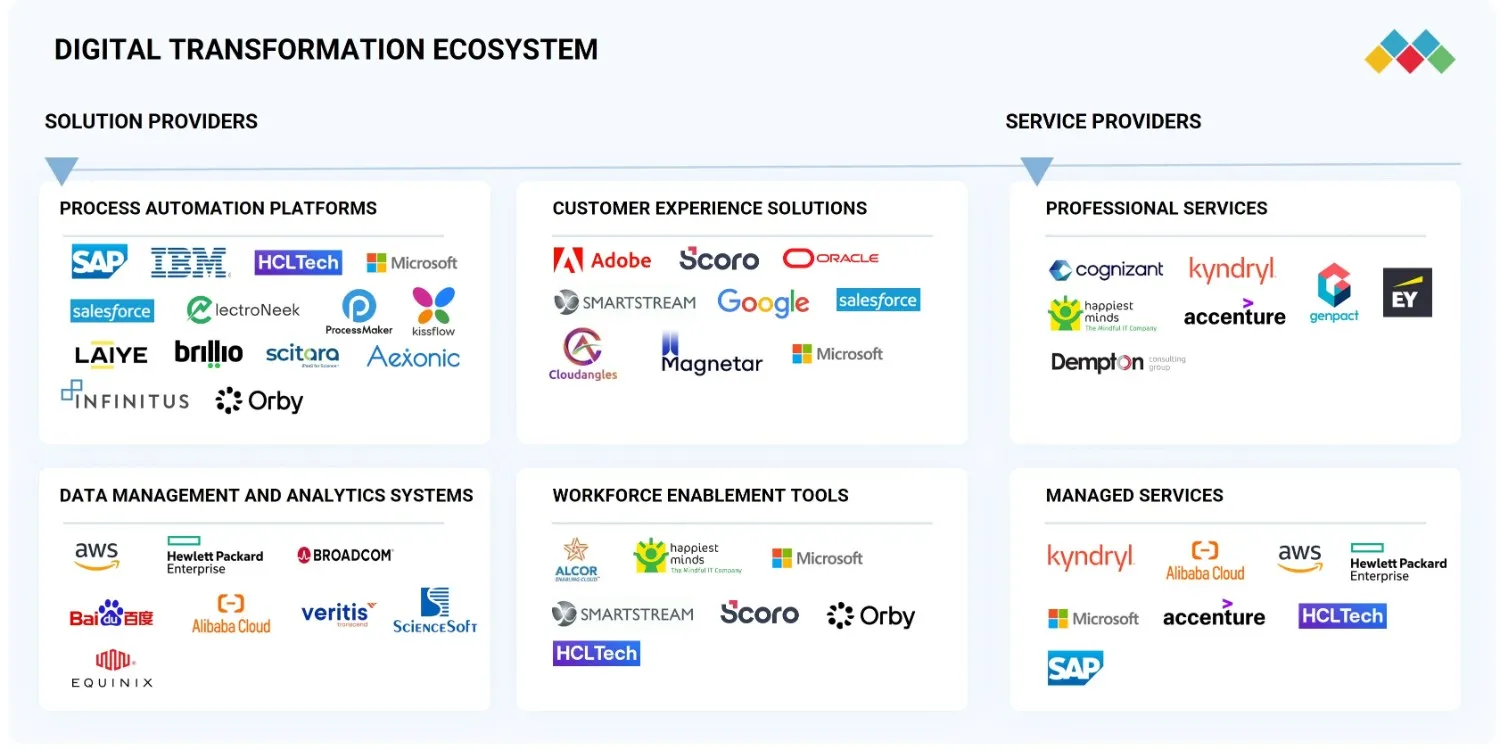
digital transformation market: COMMERCIAL USE CASES ACROSS INDUSTRIES
| COMPANY | USE CASE DESCRIPTION | BENEFITS |
|---|---|---|
 |
Cognizant’s AI and automation solution helps property and casualty insurance company improve claims process | Transcribed 25,000 saved calls using voice-to-text technology and analyzed these calls to identify the most repeated activities |
 |
ASOS uses Microsoft Azure ML to reduce time-to-market for recommendation model | Standardized Microsoft Azure ML shortened the time-to-market for a recommendations model, boosting marketing agility from six months to about six weeks |
 |
Searcher Seismic made easy access in oil & gas industry with Cloudera solutions | Allowed smooth and efficient data access throughout the organization, wherein employees can instantly view full data sets through a web portal by logging in with verified credentials |
 |
IBM helps Shenzhen CSOT boost production quality and output | Company can analyze product images in milliseconds and identify defects quickly and confidently, shortening inspection lead times |
 |
American TSP provider collaborates with HCL to enhance experience in a dynamic virtual ecosystem | Increased its customer base to 150+ million, and boosted its telecom service capabilities, 15% increase in speed-to-market, and a 20% reduction in the cost of implementation |
Logos and trademarks shown above are the property of their respective owners. Their use here is for informational and illustrative purposes only.
Related Ecosystem
Key Takeaways
- Brazil's digital transformation market will grow from $18.57B in 2025 to $33.6B by 2030, representing a 10.4% CAGR.
- Brazil's growth rate exceeds the global average of 9.1%, reflecting accelerated digital adoption across key industries.
- Brazil's market is driven by enterprise modernization, cloud migration, and AI implementation initiatives.
- Brazil's strategic position in Latin America makes it a critical market for technology vendors and digital service providers.
Digital Transformation Market Report Scope
| Report Metric | Details |
|---|---|
| Base Year | 2025 |
| Fastest Growing Segment | INFRASTRUCTURE MODERNIZATION (Professional Service) |
| Forecast Period | 2025–2030 |
| Growth Rate | CAGR of 9.1% from 2025 to 2030 |
| Largest Segment | LARGE ENTERPRISES (Organization Size) |
| Market Size Base Year (Billions) | ~USD 1102.97 (2025) |
| Revenue Forecast (Billions) | ~USD 1704.86 (2030) |
| Segments Covered | Offering, Solution, Service, Professional Service, Transformation Focus Area, Technology, Organization Size, Vertical |
Brazil Digital Transformation Market Report Segmentation
8 segment dimensions are covered across the global market.
By Offering
- Services
- Solution
- Solutions
By Solution
- Customer Experience Solutions
- Data Management & Analytics Systems
- Process Automation Platforms
- Workforce Enablement Tools
By Service
- Managed
- Professional
By Professional Service
- Application Modernization
- Infrastructure Modernization
- Support & Maintenance
- System Integration & Implementation
- Training, Strategy, And Consulting
By Transformation Focus Area
- Customer-Centric
- Financial
- Operational
- R&D
- R&D Transformation
- Workforce
By Technology
- AI & Analytics
- Blockchain
- Cloud Computing
- Cybersecurity
- Internet Of Things (IoT)
- Other Technologies
By Organization Size
- Large Enterprises
- Smes
By Vertical
- Bfsi
- Construction & Real Estate
- Education
- Energy & Utilities
- Government & Defense
- Healthcare, Life Sciences, And Pharmaceuticals
- It & Ites
- Manufacturing
- Media & Entertainment
- Other Verticals
- Other Verticals (Travel & Hospitality, Agriculture)
- Retail & Ecommerce
- Telecommunications
- Transportation & Logistics
Target Audience
- Enterprise Technology Leaders : CIOs and IT directors in Brazil need market data to justify digital transformation budgets, benchmark against peers, and align technology investments with regional growth opportunities.
- Solution Providers & Vendors : Software and cloud service providers require Brazil-specific market insights to develop localized offerings, identify customer segments, and optimize pricing strategies for competitive advantage.
- Management Consultants : Consulting firms advising Brazilian clients on digital strategy need regional market data to support recommendations, validate transformation roadmaps, and demonstrate market-driven business cases.
- Investment & Private Equity Firms : Investors evaluating opportunities in Brazil's tech sector require detailed market forecasts and growth analysis to assess portfolio companies, identify acquisition targets, and evaluate market potential.
- Government & Policy Makers : Brazilian government agencies and economic development organizations need market intelligence to inform digital economy policies, infrastructure investments, and regulatory frameworks.
Key Companies in the Brazil Digital Transformation Market
| Company | HQ | Ownership | Strongest segments |
|---|---|---|---|
| BMC SOFTWARE INC. | United States | Private Company | Enterprise Service Management (ESM) / ITSM,Mainframe Service Management (MSM),Control-M Workload Automation and Orchestration, |
| OOREDOO | Qatar | Public Company | Mobile connectivity (voice and data),Fixed broadband and connectivity,Enterprise ICT and cloud (hosting, security, SD-WAN, IoT), |
| NUCLEUS SOFTWARE | India | Public Company | FinnOne Neo (Lending Suite),FinnAxia (Transaction Banking),Digital Payments & PaySe, |
| BITTIUM CORPORATION | Finland | Public Company | Defense & Security (Tough Mobile, SDR, Tactical Networks, VoIP, Secure Suite),Medical (Faros, OmegaSnap, Cardiac Navigator, MedicalSuite, Respiro, BrainStatus, NeurOne),Engineering Services (product design, development, testing, certification, ramp-up), |
| BOOZ ALLEN HAMILTON | United States | Public Company | AI and Advanced Analytics Solutions,Cybersecurity and Cyber Operations,Cloud, Data Platforms, and Software Modernization, |
| ZENSAR TECHNOLOGIES LTD | India | Public Company | Digital and Application Services,Data Engineering and Analytics,Cloud Infrastructure and Security, |
| ALTRAN | France | Private Company | Engineering & R&D Services,Organization & IT Systems Consulting,Embedded Systems & Next-Gen Connectivity Projects, |
| NETSCOUT SYSTEMS, INC | United States | Public Company | Service Assurance & nGeniusONE Platform (including ISNG, vSTREAM, Infinistream, test access points),DDoS & Arbor Cybersecurity (Sightline, TMS, Edge Defense, Omnis Cyber Intelligence),Omnis Insights & Observability / Analytics Integrations, |
| LARSEN & TOUBRO LTD. | India | Public Company | Infrastructure Projects,Energy Projects,Hi-Tech Manufacturing, |
| PCCW | Hong Kong | Public Company | Telecom Connectivity (fixed, mobile, broadband, international),Enterprise Solutions, Outsourcing, and Managed Services,Media and OTT (Viu, TV, advertising), |
| SWISSCOM AG | Switzerland | Public Company | Consumer mobile, broadband, and TV,Enterprise telecom & ICT services,Wholesale, infrastructure, and trust services, |
| PERSISTENT SYSTEMS | India | Public Company | Software Engineering & Product Development,Cloud & Infrastructure / CloudOps,CX & Salesforce-led Transformation, |
| APPLE INC | United States | Public Company | iPhone,Mac,iPad, |
BMC SOFTWARE INC.
BMC SOFTWARE INC. is a private software company established in 1980 in the United States with 6,700 employees.
OOREDOO
OOREDOO is a public telecommunications company based in Qatar, founded in 1987 and operating with 16,717 employees.
NUCLEUS SOFTWARE
NUCLEUS SOFTWARE is a public software company established in India in 1986, employing 1,917 professionals.
BITTIUM CORPORATION
BITTIUM CORPORATION is a public Finnish technology company founded in 1985 with 528 employees.
BOOZ ALLEN HAMILTON
BOOZ ALLEN HAMILTON is a public consulting and engineering services firm founded in 1914 in the United States, employing 31,500 people.
ZENSAR TECHNOLOGIES LTD
ZENSAR TECHNOLOGIES LTD is a public Indian information technology services company founded in 1963 with 10,066 employees.
ALTRAN
ALTRAN is a private engineering and technology consulting company founded in France in 1970, employing 50,124 professionals.
NETSCOUT SYSTEMS, INC
NETSCOUT SYSTEMS, INC is a public software and analytics company founded in 1984 in the United States with 2,063 employees.
LARSEN & TOUBRO LTD.
LARSEN & TOUBRO LTD. is a public Indian multinational conglomerate founded in 1938, employing 55,662 people across engineering and construction sectors.
PCCW
PCCW is a public telecommunications and technology services company based in Hong Kong, founded in 1925 with 14,600 employees.
SWISSCOM AG
SWISSCOM AG is a public Swiss telecommunications company founded in 1998, operating with 23,073 employees.
PERSISTENT SYSTEMS
PERSISTENT SYSTEMS is a public Indian information technology services company founded in 1990 with 22,205 employees.
APPLE INC
APPLE INC is a public technology company founded in 1976 in the United States, employing 166,000 people globally.
Reasons to Buy this Report
- Localized Market Intelligence : Gain Brazil-specific insights on market size, growth trajectories, and regional dynamics that differ from global trends, enabling targeted investment and expansion strategies.
- Competitive Positioning Data : Understand Brazil's 10.4% CAGR advantage over global averages to identify market opportunities and benchmark your organization's digital transformation initiatives against regional performance.
- Technology Adoption Trends : Access detailed analysis of cloud, AI, and automation adoption patterns specific to Brazilian enterprises, helping you tailor solutions and go-to-market strategies for maximum relevance.
- Investment Decision Support : Make informed decisions on market entry, partnership development, and resource allocation in Brazil with comprehensive forecasts and growth driver analysis through 2030.
- Sector-Specific Opportunities : Identify high-growth segments and vertical markets within Brazil's digital transformation landscape to prioritize sales efforts and product development initiatives.
Frequently asked questions
What is the current size of Brazil's digital transformation market?
Brazil's digital transformation market is valued at USD 18.57 million in 2025, with verified data confirming this baseline for market analysis and forecasting.
What is Brazil's projected market size by 2030?
Brazil's digital transformation market is forecast to reach USD 33.6 million by 2030, representing significant expansion over the five-year forecast period.
How does Brazil's growth rate compare to global trends?
Brazil's CAGR of 10.4% exceeds the global digital transformation market CAGR of 9.1%, indicating stronger-than-average growth momentum in the Brazilian market.
What sectors are driving digital transformation in Brazil?
Brazil's digital transformation adoption is strongest in manufacturing, financial services, retail, and government sectors, where legacy system modernization and automation investments are concentrated.
Why is Brazil's market growing faster than the global average?
Brazil's accelerated growth reflects increased enterprise investment in cloud infrastructure, artificial intelligence, cybersecurity, and digital-first business model transformation across major industries.
RESEARCH METHODOLOGY
This research on the digital transformation market used extensive secondary sources, including directories, IEEE Communication-efficient Algorithms and Systems, the International Journal of Innovation and Technology Management, and paid databases. Primary sources consisted mainly of industry experts from the core and related industries, preferred digital transformation providers, third-party service providers, consulting firms, end users, and other commercial enterprises. In-depth interviews with primary respondents, such as key industry players and subject matter experts, were conducted to gather and verify important qualitative and quantitative information and to evaluate the market’s outlook.
Secondary Research
In the secondary research process, various sources were consulted to identify and gather information for this study. Secondary sources included annual reports, press releases, and investor presentations from companies; white papers, journals, and reputable publications; and articles by recognized authors, directories, and databases. Data was also obtained from other secondary sources such as journals, government websites, blogs, and vendors’ websites. Additionally, the digital transformation spending of different countries was collected from their respective sources.
Primary Research
In the primary research process, various sources from the supply and demand sides were interviewed to gather both qualitative and quantitative market information. Supply-side primary sources included industry experts such as Chief Experience Officers (CXOs), Vice Presidents (VPs), and directors specializing in business development, marketing, and digital transformation. It also encompassed key executives from digital transformation solution and service vendors, system integrators (SIs), professional service providers, industry associations, and other influential opinion leaders.
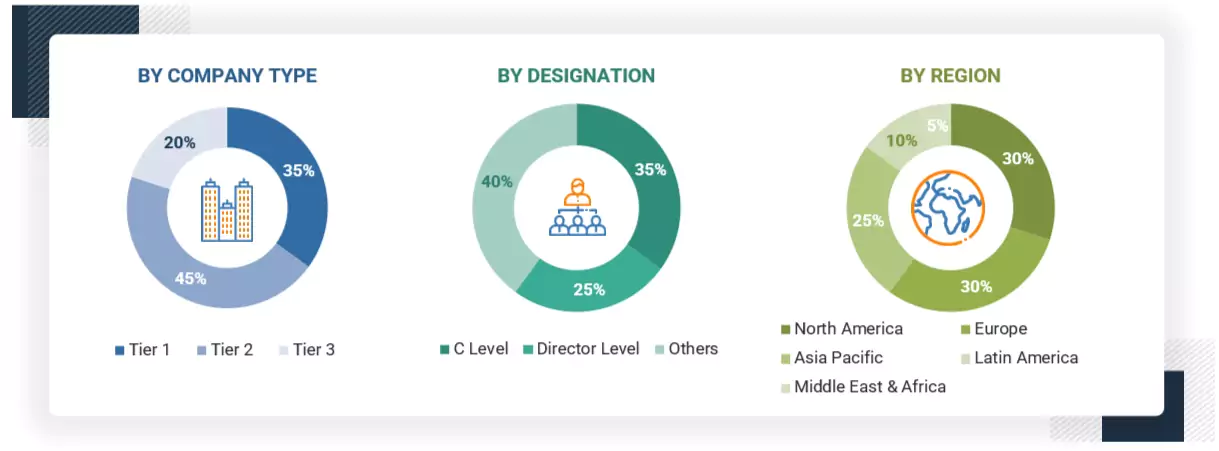
Note: Tier 1 companies generate more than USD 10 billion in revenue; tier 2 companies have revenues
between USD 1 billion and USD 10 billion; and tier 3 companies’ revenues range between million and USD
1 billion. Other designations include sales managers, marketing managers, and product managers.
Source: Industry Experts
To know about the assumptions considered for the study, download the pdf brochure
Market Size Estimation
Multiple methods were used to estimate and forecast the digital transformation market. The first method involved estimating the market size based on companies’ revenue from selling digital transformation products.
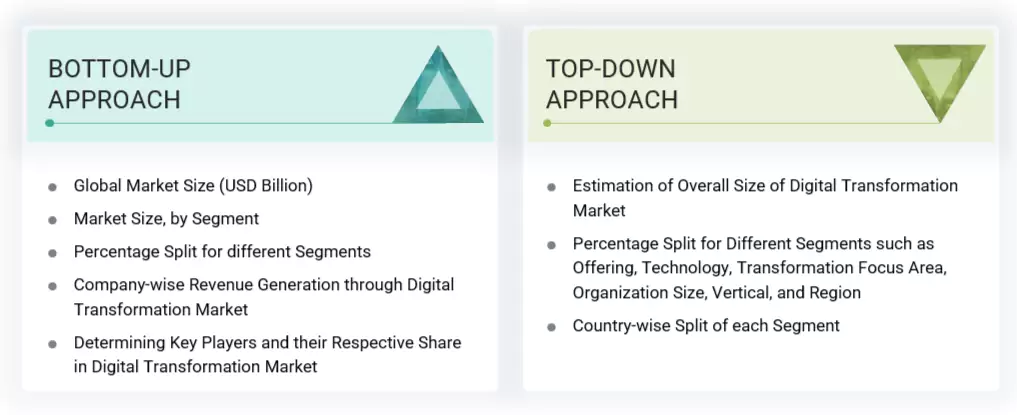
Market Size Estimation Methodology- Top-down approach
In the top-down approach, a comprehensive list of all vendors offering products in the digital transformation market was compiled. The revenue contribution of these vendors was estimated using annual reports, press releases, funding data, investor presentations, paid databases, and primary interviews. Each vendor’s offerings were assessed based on their products, technology, focus area of transformation, company size, vertical, and region. The market figures were validated through triangulation using both primary and secondary research. Primary research involved conducting in-depth interviews to gather key insights from industry leaders such as CIOs, CEOs, VPs, directors, and marketing executives. These market figures were further cross-checked with the existing MarketsandMarkets repository to ensure accuracy.
Market Size Estimation Methodology-Bottom-up approach
In the bottom-up approach, the adoption rate of digital transformation products across various industries in key countries within their respective regions was identified as the primary contributor to the market share. Cross-validation confirmed the adoption of digital transformation products among businesses, along with different use cases by region. Weighting was applied to use cases identified in various regions for the market size calculation.
Based on the market numbers, the regional split was determined by primary and secondary sources. The procedure included analyzing the digital transformation market’s regional penetration. Based on secondary research, the regional spending on Information and Communications Technology (ICT), socio-economic analysis of each country, strategic vendor analysis of major digital transformation providers, and organic and inorganic business development activities of regional and global players were estimated.
Digital Transformation Market : Top-Down and Bottom-Up Approach
Data Triangulation
After determining the overall market size using the estimation methods described above, the market was divided into several segments and subsegments. Data triangulation and market breakup procedures were used, where applicable, to complete the overall market analysis and obtain precise statistics for each segment and subsegment. The total market size was then applied in a top-down approach to estimate the sizes of other individual markets through percentage splits of the market segmentation.
Market Definition
SAP defines digital transformation as a key part of an overall business transformation strategy. While it’s not the only factor, it’s essential for the success or failure of any transformation effort. The right technologies, combined with people, processes, and operations, allow organizations to quickly adapt to disruptions or opportunities, meet new and changing customer needs, and drive future growth and innovation—often in unexpected ways.
Stakeholders
- Digital Transformation Software Providers
- Cybersecurity Firms
- Business Analysts
- Cloud Service Providers
- Consulting Service Providers
- Enterprise End Users
- Distributors and Value-added Resellers (VARs)
- Government Agencies
- Independent Software Vendors (ISV)
- Managed Service Providers
- Market Research and Consulting Firms
- Support & Maintenance Service Providers
- System Integrators (SIs)/Migration Service Providers
- Technology Providers
Report Objectives
- To define, describe, and forecast the digital transformation market by offering, technology, transformation focus area, organization size, vertical, and region
- To provide detailed information related to major factors (drivers, restraints, opportunities, and industry-specific challenges) influencing market growth
- To analyze micromarkets with respect to individual growth trends, prospects, and their contribution to the total market
- To analyze opportunities in the market for stakeholders by identifying the high-growth segments of the digital transformation market
- To analyze opportunities in the digital transformation market and provide details of the competitive landscape for stakeholders and market leaders
- To forecast the market size of segments for the five main regions: North America, Europe, Asia Pacific, the Middle East & Africa, and Latin America
- To profile the key players and comprehensively analyze their market ranking and core competencies
- To analyze competitive developments, such as partnerships, product launches, mergers, and acquisitions, in the digital transformation market
Available Customizations
With the given market data, MarketsandMarkets offers customizations to meet the company’s specific needs. The following customization options are available for the report:
Product/Brand Comparative Analysis
- Brand comparative analysis of additional vendors, including a detailed comparison of the product portfolio of each company
Geographic Analysis as per Feasibility
- Further breakup of additional European country-level splits by offering, technology, transformation focus area, organization size, and vertical in the digital transformation market.
- Further breakup of additional Asia Pacific country-level splits by offering, technology, transformation focus area, organization size, and vertical in the digital transformation market.
- Further breakup of additional Middle East & Africa country-level splits by offering, technology, transformation focus area, organization size, and vertical in the digital transformation market
- Further breakup of additional Latin America country-level splits by offering, technology, transformation focus area, organization size, and vertical in the digital transformation market.
Company Information
- Detailed analysis and profiling of additional market players (up to five)
Get the Full Digital Transformation Market Report
Full forecast, segment splits, and company analysis for all Digital Transformation Market.
- Canada Digital Transformation Market
- US Digital Transformation Market
- UK Digital Transformation Market
- Germany Digital Transformation Market
- Finland Digital Transformation Market
- Sweden Digital Transformation Market
- China Digital Transformation Market
- India Digital Transformation Market
- South Korea Digital Transformation Market
- Singapore Digital Transformation Market
- Saudi Arabia Digital Transformation Market
- UAE Digital Transformation Market
- South Africa Digital Transformation Market
- Mexico Digital Transformation Market
- Rest Of Europe Digital Transformation Market
Need a Tailored Report?
Customize this report to your needs
Get 10% FREE Customization
Customize This Report
