
US Digital Twin Market (2025-2030)

The US Digital Twin Market was valued at $1365.4 Million in 2025 and projected to reach to $11881.6 Million by 2030, representing a compound annual growth rate of 54.1%. The US digital twin market is positioned for exceptional expansion through 2030, driven by the semiconductor and electronics industry's urgent need for digital transformation and operational efficiency.


| Market Size in | USD 26.32 MN |
| Market Forecast in | |
| CAGR | |
| Forecast Period | |
| Units Considered | Value (USD MN) |
US Digital Twin Market Trends and Insights
- This remarkable 54.1% compound annual growth rate reflects the US semiconductor and electronics industry's accelerating adoption of digital twin technologies for product development, manufacturing optimization, and predictive maintenance.
- The US market's expansion is driven by substantial investments in Industry 4.0 initiatives, advanced manufacturing capabilities, and the region's leadership in semiconductor innovation. The US digital twin market benefits from strong demand across automotive, aerospace, industrial IoT, and consumer electronics sectors.
- By 2030, the US is expected to solidify its position as a global leader in digital twin deployment, with enterprises leveraging these technologies to enhance operational efficiency and reduce time-to-market.
- The market's rapid growth trajectory underscores the critical role digital twins play in the US semiconductor and electronics ecosystem's competitive advantage..
Key Market Statistics
- CAGR (2025-2030) 54.1% CAGR
- Market Size, 2025 ~USD 1365.4 Million
- Forecast, 2030 ~USD 11881.6 Million
- Country US
US Digital Twin Market Overview
Explosive US Market Growth :
The US digital twin market is projected to grow from $1,365.4 million in 2025 to $11,881.6 million by 2030, representing a 54.1% CAGR—significantly outpacing the global growth rate of 47.9%.
Manufacturing Optimization Leadership :
US semiconductor and electronics manufacturers are rapidly deploying digital twin solutions for production line optimization, quality control, and real-time monitoring, driving competitive advantages in global markets.
Predictive Maintenance Adoption :
American electronics companies are increasingly leveraging digital twins for predictive maintenance and asset lifecycle management, reducing downtime and operational costs across manufacturing facilities.
Product Development Acceleration :
US-based semiconductor firms are utilizing digital twin technology to accelerate product development cycles, simulate performance scenarios, and reduce time-to-market for innovative electronic components.
US Digital Twin Market Dynamics
- Major US technology hubs and manufacturing centers are investing heavily in digital twin infrastructure to maintain competitive positioning in global markets.
- The convergence of IoT adoption, cloud computing maturity, and AI integration is enabling more sophisticated digital twin applications across product design, manufacturing, and supply chain optimization.
- Government initiatives supporting advanced manufacturing and semiconductor reshoring further accelerate market growth, with enterprises prioritizing digital twin investments to enhance productivity and reduce costs..
Market Ecosystem
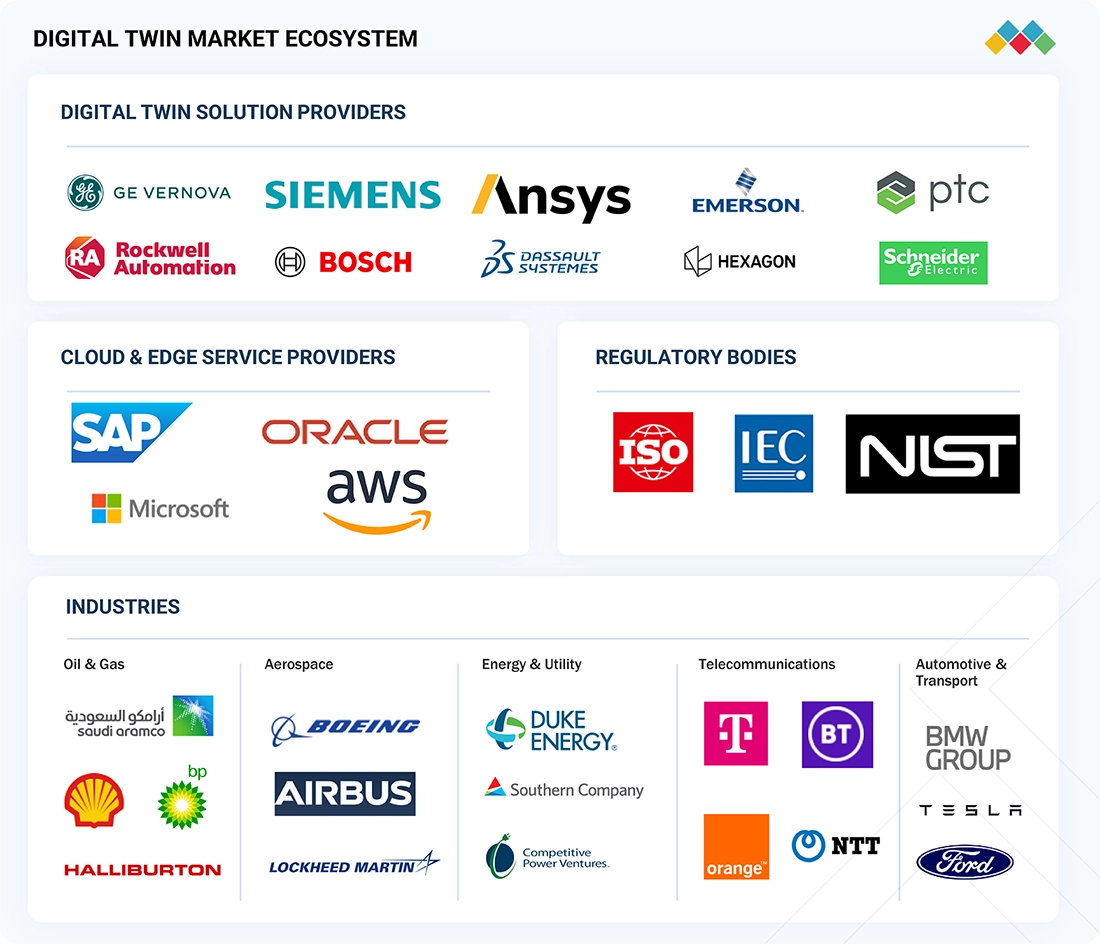
Digital Twin Market: COMMERCIAL USE CASES ACROSS INDUSTRIES
| COMPANY | USE CASE DESCRIPTION | BENEFITS |
|---|---|---|
 |
Design, simulate, and verify physical products and manufacturing processes using digital twins with historical and live data integration. | Accurate predictions, reduced development time, continuous lifecycle traceability. |
 |
Monitor production lines, evaluate equipment performance, and optimize energy assets like wind turbines through digital twin simulations. | Enhanced decision-making, reduced downtime via failure anticipation, improved energy generation. |
 |
Create virtual twin experiences for real-time manufacturing simulations to test products and processes before physical builds. | Faster product development, predictive maintenance, increased operational agility. |
 |
Develop virtual prototypes for real-time system analysis, predictive maintenance, and full product lifecycle management. | Prevent unanticipated failures, optimize asset management, enable hybrid physics-AI insights. |
 |
Implement digital twins for real-time product data collection across engineering, manufacturing, and service for predictive maintenance. | Improved customer satisfaction, enhanced product quality, reduced time to market, sustainability gains. |
Logos and trademarks shown above are the property of their respective owners. Their use here is for informational and illustrative purposes only.
Related Ecosystem
Aviation
- Narrow Body Aircraft
- Wide Body Aircraft
- Military Helicopters
- Special Mission Aircraft
- Fighter Aircraft
- HONEYWELL INTERNATIONAL INC.
- COLLINS AEROSPACE
- Thales group
- Safran group
- HEICO Corporation
Connected Car
- Light Commercial Vehicles (LCVs)
- Battery Electric Vehicle (BEV)
- Fuel Cell Electric Vehicle (FCEV)
- Cellular Network
- Sensors
- BOSCH LIMITED
- Visteon Corporation
- Jabil Inc.
- VALENS SEMICONDUCTOR LTD.
- DENSO Corporation
Digital Oilfield
- Remote Monitoring
- Dairy Products
- Digital Addressable Lighting Interface (DALI)
- Enocean
- Meter Data Management (MDM)
- International Business Machines Corporation
- HONEYWELL INTERNATIONAL INC.
- Oracle Corporation
- ABB India Limited
- SCHNEIDER ELECTRIC SE
Key Takeaways
- The US digital twin market will grow from $1,365.4M (2025) to $11,881.6M (2030), representing an exceptional 54.1% CAGR.
- The US semiconductor and electronics industry is driving adoption through Industry 4.0 investments and advanced manufacturing initiatives.
- By 2030, the US will lead global digital twin deployment across automotive, aerospace, and industrial IoT sectors.
- The US market's rapid expansion reflects enterprise demand for operational efficiency, predictive maintenance, and accelerated product development cycles.
Digital Twin Market Report Scope
| Report Metric | Details |
|---|---|
| Base Year | 2025 |
| Fastest Growing Segment | SMALL & MEDIUM-SIZED ENTERPRISES (Enterprise Size) |
| Forecast Period | 2025–2030 |
| Growth Rate | CAGR of 47.9% from 2025 to 2030 |
| Largest Segment | LARGE ENTERPRISES (Enterprise Size) |
| Market Size Base Year (Billions) | ~USD 21.17 (2025) |
| Revenue Forecast (Billions) | ~USD 149.81 (2030) |
| Segments Covered | Enterprise Size, Application, Industry |
US Digital Twin Market Report Segmentation
3 segment dimensions are covered across the global market.
By Enterprise Size
- Large Enterprises
- Small & Medium-Sized Enterprises
By Application
- Business Optimization
- Inventory Management
- Other Applications
- Performance Monitoring
- Predictive Maintenance
- Product Design & Development
By Industry
- Aerospace
- Agriculture
- Automotive & Transportation
- Energy & Utilities
- Healthcare
- Infrastructure
- Oil & Gas
- Other Industries
- Retail
- Telecommunications
US: DIGITAL TWIN MARKET, BY INDUSTRY, 2025–2030
| Segment | 2025 | 2026 | 2027 | 2028 | 2029 | 2030 | CAGR (%) |
|---|---|---|---|---|---|---|---|
| AEROSPACE | 870.6 | 1264.3 | 1842.2 | 2693.5 | 3951.4 | 5816.2 | 46.2 |
| AGRICULTURE | 17.2 | 24.5 | 34.8 | 49.6 | 70.8 | 101.3 | 42.5 |
| AUTOMOTIVE & TRANSPORTATION | 1365.4 | 2091.8 | 3214.5 | 4954.8 | 7660.9 | 11881.6 | 54.1 |
| ENERGY & UTILITIES | 1015.9 | 1512.9 | 2261.9 | 3394.6 | 5114.1 | 7734.1 | 50.1 |
| HEALTHCARE | 1106.9 | 1692.5 | 2595 | 3990.4 | 6153.8 | 9518.2 | 53.8 |
| INFRASTRUCTURE | 1080.4 | 1633.7 | 2478.8 | 3774.2 | 5766.8 | 8842 | 52.3 |
| OIL & GAS | 634.8 | 905.7 | 1296.4 | 1861.4 | 2681 | 3873.3 | 43.6 |
| OTHER INDUSTRIES | 514.1 | 665.4 | 846.9 | 1052.4 | 1260.8 | 1422.7 | 22.6 |
| RETAIL | 23.3 | 34.1 | 50.1 | 73.8 | 109.2 | 162.2 | 47.4 |
| TELECOMMUNICATIONS | 76.3 | 113.4 | 169.3 | 253.6 | 381.4 | 575.8 | 49.8 |
| TOTAL | 6705 | 9938.2 | 14789.8 | 22098.3 | 33150.2 | 49927.5 | 49.4 |
Target Audience
- US Semiconductor Manufacturers : Need market intelligence to understand digital twin adoption trends, competitive positioning, and ROI benchmarks for implementing solutions across US fabrication facilities and design centers.
- Electronics OEMs & Suppliers : Require detailed market analysis to evaluate digital twin investments for product development, supply chain optimization, and manufacturing efficiency improvements within their US operations.
- Technology Solution Providers : Seek comprehensive US market data to identify growth opportunities, target customer segments, and develop go-to-market strategies for digital twin platforms and services in the American market.
- Private Equity & Investors : Need validated market sizing and growth projections for the US digital twin sector to assess investment opportunities, portfolio company valuations, and exit potential in semiconductor and electronics.
- Enterprise IT & Operations Leaders : Require US-specific market insights to justify digital twin technology investments, benchmark against industry peers, and develop implementation roadmaps for manufacturing and predictive maintenance initiatives.
Key Companies in the US Digital Twin Market
| Company | HQ | Ownership | Strongest segments |
|---|---|---|---|
| PTC | United States | Public Company | PLM and related lifecycle (Windchill, Arena, FlexPLM, Codebeamer, Arbortext),CAD and product development (Creo, Onshape, Mathcad, PTC Products),Industrial IoT and connectivity (ThingWorx, Kepware, Kepware Edge, KEPServerEX), |
| ROCKWELL AUTOMATION | United States | Public Company | Intelligent Devices (drives, motion, safety, sensing, industrial components, configured-to-order hardware),Software & Control (control and visualization, digital twin, simulation, information software, network and security infrastructure),Lifecycle Services (digital consulting, professional services, engineered-to-order, recurring services, cybersecurity, support, training, spare parts), |
| HEXAGON AB | Sweden | Public Company | Manufacturing Intelligence (metrology, CAD/CAM, CAE, QA software),Geosystems (survey, mapping, laser scanning, AEC),Autonomous Solutions & Mining, |
| EMERSON ELECTRIC CO. | United States | Public Company | Final Control,Measurement & Analytical,Control Systems & Software, |
| ABB | Switzerland | Public Company | Electrification,Motion,Automation, |
| ROBERT BOSCH GMBH | Germany | Private Company | Mobility (powertrain, chassis, electronics, aftermarket, steering),Industrial Technology (drive, control, process and packaging),Consumer Goods (power tools, home appliances, garden tools), |
| SCHNEIDER ELECTRIC | France | Public Company | Low- and Medium-Voltage Equipment & Switchgear,Building Management, Power Metering & Smart Devices,Industrial Automation & Drives, |
| BENTLEY SYSTEMS, INCORPORATED | United States | Public Company | Open Modeling (MicroStation and Open* design applications),Open Simulation (structural, process, and subsurface simulation),Geoprofessional and subsurface applications, |
| AUTODESK INC. | United States | Public Company | AutoCAD & AutoCAD LT,AEC/BIM (Revit, Civil 3D, BIM Collaborate Pro, Autodesk Build, BuildingConnected, Tandem),Manufacturing & Product Design (Fusion, Inventor, PD&M Collection, Vault), |
PTC
PTC is a publicly traded software company founded in 1985 with 7,000 employees. The company provides digital transformation solutions and enterprise software.
ROCKWELL AUTOMATION
Rockwell Automation is a publicly traded industrial automation company founded in 1903 with 26,000 employees. The company specializes in industrial control and information technology.
HEXAGON AB
Hexagon AB is a Swedish publicly traded technology company founded in 1975 with 16,118 employees. The company provides digital solutions and enterprise software across multiple industries.
EMERSON ELECTRIC CO.
Emerson Electric Co. is a publicly traded diversified manufacturing company founded in 1890 with 71,000 employees. The company operates across climate technologies, automation solutions, and commercial and residential solutions.
ABB
ABB is a Swiss publicly traded multinational corporation founded in 1883 with 112,700 employees. The company specializes in robotics, power, and automation technologies.
ROBERT BOSCH GMBH
Robert Bosch GmbH is a privately held German multinational engineering and technology company founded in 1886 with 412,774 employees. The company operates across automotive, industrial, consumer goods, and energy sectors.
SCHNEIDER ELECTRIC
Schneider Electric is a French publicly traded multinational company founded in 1836 with 158,122 employees. The company specializes in energy management and industrial automation solutions.
BENTLEY SYSTEMS, INCORPORATED
Bentley Systems, Incorporated is a publicly traded software company founded in 1984 with 5,800 employees. The company provides infrastructure engineering software solutions.
AUTODESK INC.
Autodesk Inc. is a publicly traded software company founded in 1982 with 14,300 employees. The company provides design, engineering, and construction software solutions for professionals across multiple industries.
Reasons to Buy this Report
- Market Size & Growth Validation : Obtain precise US market valuation ($1,365.4M in 2025) and verified 54.1% CAGR projections through 2030 to support investment decisions and strategic planning in the American digital twin ecosystem.
- Competitive Benchmarking : Understand how the US market outpaces global growth (54.1% vs. 47.9% CAGR), enabling companies to identify competitive advantages and market positioning opportunities specific to North American operations.
- Sector-Specific Insights : Access detailed analysis of digital twin adoption patterns within US semiconductor and electronics manufacturing, including use cases for product development, optimization, and maintenance strategies.
- Investment & Expansion Planning : Leverage comprehensive US market data to justify capital allocation, identify high-growth segments, and plan facility investments or technology partnerships within the American semiconductor ecosystem.
- Strategic Decision Support : Make informed decisions on market entry, product development, and go-to-market strategies with US-specific insights on adoption rates, technology trends, and industry requirements through 2030.
Frequently asked questions
What is the current size of the US digital twin market in 2025?
The US digital twin market is valued at $1,365.4 million in 2025, with projections to reach $11,881.6 million by 2030.
What is the expected growth rate for the US digital twin market?
The US digital twin market is expected to grow at a 54.1% compound annual growth rate (CAGR) from 2025 to 2030.
Which industries in the US are driving digital twin adoption?
The US automotive, aerospace, industrial IoT, and consumer electronics sectors are primary drivers of digital twin market growth.
Why is the US digital twin market growing faster than the global average?
The US market benefits from advanced semiconductor capabilities, substantial Industry 4.0 investments, and strong enterprise demand for manufacturing optimization and predictive maintenance solutions.
What will be the market size of US digital twins by 2030?
The US digital twin market is projected to reach $11,881.6 million by 2030, representing nearly 9x growth from 2025 levels.
RESEARCH METHODOLOGY
The study involved major activities in estimating the current market size for the global Digital Twin market. Exhaustive secondary research was done to collect information on the industry. The next step was to validate these findings, assumptions, and sizing with industry experts across the value chain using primary research. Different approaches, such as top-down and bottom-up, were employed to estimate the total market size. After that, the market breakup and data triangulation procedures were used to estimate the market size of the segments and subsegments of the digital twin market.
Secondary Research
The market for companies offering digital twin is arrived at by secondary data available through paid and unpaid sources, analyzing the product portfolios of the major companies in the ecosystem, and rating the companies by their performance and quality. Various sources were referred to in the secondary research process to identify and collect information for this study. The secondary sources include annual reports, press releases, investor presentations of companies, white papers, journals, certified publications, and articles from recognized authors, directories, and databases. In the secondary research process, various secondary sources were referred to identify and collect information related to the study. Secondary sources included annual reports, press releases, and investor presentations of vendors, forums, certified publications, and whitepapers. The secondary research was used to obtain critical information on the industry's value chain, the total pool of key players, market classification, and segmentation from the market and technology-oriented perspectives.
Primary Research
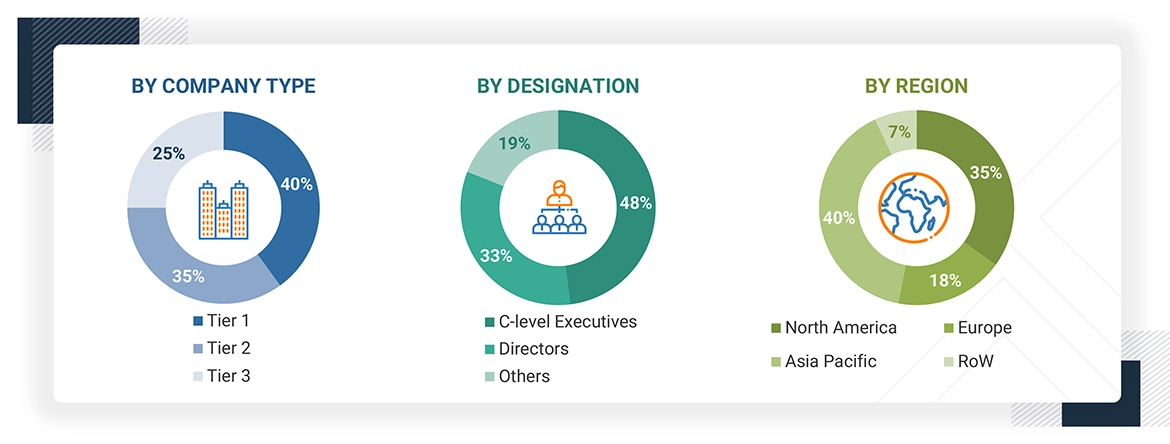
Extensive primary research has been conducted after understanding and analyzing the current scenario of the global Digital Twin market through secondary research. Several primary interviews have been conducted with the key opinion leaders from the demand and supply sides across four main regions—North America, Europe, Asia Pacific, and the Rest of the World. Approximately 30% of the primary interviews were conducted with the demand-side respondents, while approximately 70% were conducted with the supply-side respondents. The primary data has been collected through questionnaires, emails, and telephone interviews.
After interacting with industry experts, brief sessions were conducted with highly experienced independent consultants to reinforce the findings from our primary research. This, along with the in-house subject matter experts' opinions, has led us to the findings as described in the remainder of this report. The breakdown of primary respondents is as follows:
To know about the assumptions considered for the study, download the pdf brochure
Market Size Estimation
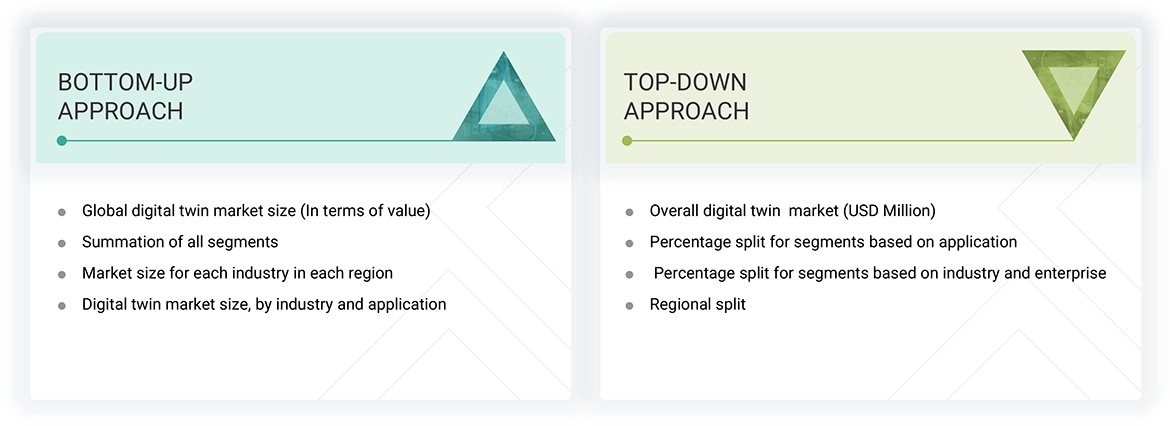
Both top-down and bottom-up approaches were used to estimate and validate the total size of the global Digital Twin market. These methods were also used extensively to estimate the size of various subsegments in the market. The research methodology used to estimate the market size includes the following:
Digital Twin Market : Top-Down and Bottom-Up Approach
Data Triangulation
The market was split into several segments and subsegments after arriving at the overall market size using the market size estimation processes as explained above. The data triangulation and market breakdown procedures were employed, wherever applicable, to complete the overall market engineering process and arrive at the exact statistics of each market segment and subsegment. The data was triangulated by studying various factors and trends from the demand and supply sides.
Market Definition
A digital twin is a virtual replica or digital copy of a physical object, process, or system. It serves as a digital counterpart that accurately captures the essential characteristics and behaviors of the real-world entity. Digital twins utilize advanced technologies such as sensors, data analysis, and simulations to collect real-time data from their physical counterparts. This data is then used to create and maintain an up-to-date digital representation that closely resembles the behavior of the actual object or system. The primary purpose of digital twins is to provide valuable insights and drive operational improvements in the business. By analyzing the digital twin, organizations can gain a deeper understanding of how the physical entity will perform, identify opportunities for enhancement, and test different strategies or scenarios before implementing them in the real world. Digital twins find applications in various industries, such as manufacturing, healthcare, transportation, energy, and construction.
Key Stakeholders
- Government bodies and policymakers
- Industry organizations, forums, alliances, and associations
- Market research and consulting firms
- Raw material suppliers and distributors
- Research institutes and organizations
- Analysts and strategic business planners
- End users of digital twins across various industries such as the aerospace, automotive & transportation, energy & utilities, oil & gas, infrastructure, healthcare, agriculture, retail, telecommunications, and other industries (semiconductors, chemicals, paper & pulp, and food & beverages)
Report Objectives
- To define, describe, and forecast the global Digital Twin market size, by industry, application, and enterprise, in terms of value
- To assess the size of the global Digital Twin market across four regions, namely, North America, Europe, Asia Pacific, and the RoW, along with their respective country-level market sizes, in terms of value
- To provide detailed information regarding the drivers, restraints, opportunities, and challenges influencing the global Digital Twin market growth
- To give ecosystem analysis, case study analysis, patent analysis, technology analysis, pricing analysis, Porter's five forces analysis, key stakeholders and buying criteria, key conferences and events, regulatory bodies, government agencies, and regulations pertaining to the global Digital Twin market
- To analyse the impact of AI and the US Tariff on the global Digital Twin market
- To offer a detailed overview of the process flow of the global Digital Twin market
- To strategically analyze micromarkets with respect to individual growth trends, prospects, and contributions to the overall global Digital Twin market size
- To study the complete value chain of the global Digital Twin market
- To understand opportunities for stakeholders by identifying high-growth segments of the global Digital Twin market
- To strategically profile the key players and comprehensively analyze their market positions in terms of their ranking and core competencies in the global Digital Twin market
- To analyze competitive developments, such as product launches, deals (mergers, acquisitions, partnerships, cooperation, alliances, collaborations, agreements, contracts, and investments), and others (expansions) in the global Digital Twin market
Available customizations:
With the given market data, MarketsandMarkets offers customizations according to the specific requirements of companies. The following customization options are available for the report:
- Detailed analysis and profiling of additional market players based on various blocks of the supply chain
Get the Full Digital Twin Market Report
Full forecast, segment splits, and company analysis for all Digital Twin Market.
- Canada Digital Twin Market
- Mexico Digital Twin Market
- Germany Digital Twin Market
- France Digital Twin Market
- UK Digital Twin Market
- Spain Digital Twin Market
- Italy Digital Twin Market
- Poland Digital Twin Market
- China Digital Twin Market
- Japan Digital Twin Market
- India Digital Twin Market
- South Korea Digital Twin Market
- Australia Digital Twin Market
- Indonesia Digital Twin Market
- Rest Of Europe Digital Twin Market
Need a Tailored Report?
Customize this report to your needs
Get 10% FREE Customization
Customize This Report
