
Australia Digital Twins in Healthcare Market (2026-2031)

The Australia Digital Twins in Healthcare Market was valued at $55.6 Million in 2026 and projected to reach to $756.2 Million by 2031, representing a compound annual growth rate of 68.6%. Australia's digital twins in healthcare market is poised for transformative growth through 2031, driven by increasing adoption among leading medical institutions and government support for healthcare innovation.


| Market Size in | USD 26.32 MN |
| Market Forecast in | |
| CAGR | |
| Forecast Period | |
| Units Considered | Value (USD MN) |
Australia Digital Twins in Healthcare Market Trends and Insights
- This exceptional growth trajectory reflects Australia's commitment to advanced healthcare technologies and digital transformation across medical institutions.
- Australia is positioning itself as a regional leader in adopting virtual patient modeling, surgical simulation, and personalized treatment planning through digital twin technologies. The Australian healthcare sector is increasingly leveraging digital twins to enhance clinical outcomes, reduce operational costs, and improve patient safety.
- Australia's strong healthcare infrastructure, coupled with significant investment in health technology innovation, is driving widespread adoption across hospitals, diagnostic centers, and research institutions.
- By 2031, Australia is expected to capture substantial market share within the Asia Pacific region, driven by regulatory support and growing demand for precision medicine solutions..
Key Market Statistics
- CAGR (2026-2031) 68.6% CAGR
- Market Size, 2026 ~USD 55.6 Million
- Forecast, 2031 ~USD 756.2 Million
- Country Australia
Australia Digital Twins in Healthcare Market Overview
Explosive Growth Trajectory :
Australia's digital twins healthcare market is projected to grow from $55.6 million in 2026 to $756.2 million by 2031, representing a remarkable 68.6% CAGR, outpacing global growth rates.
Regional Leadership Position :
Australia is establishing itself as a regional leader in digital twin adoption across Asia-Pacific, with major medical institutions investing heavily in virtual patient modeling and simulation technologies.
Digital Transformation Momentum :
Australian healthcare providers are accelerating digital transformation initiatives, leveraging digital twins for surgical planning, drug development, and personalized medicine applications.
Government & Private Sector Support :
Strong backing from Australian government health initiatives and private healthcare investments is driving infrastructure development and technology adoption across major hospital networks.
Australia Digital Twins in Healthcare Market Dynamics
- The market's 68.6% CAGR reflects strong demand for virtual patient simulations, surgical planning tools, and personalized treatment protocols across Australian healthcare systems. Key growth drivers include rising healthcare costs prompting efficiency improvements, growing investment in medical technology infrastructure, and Australia's commitment to becoming a digital health innovation hub.
- Major hospitals and research institutions are integrating digital twin technologies to enhance clinical outcomes, reduce operational costs, and advance medical research capabilities..
Market Ecosystem
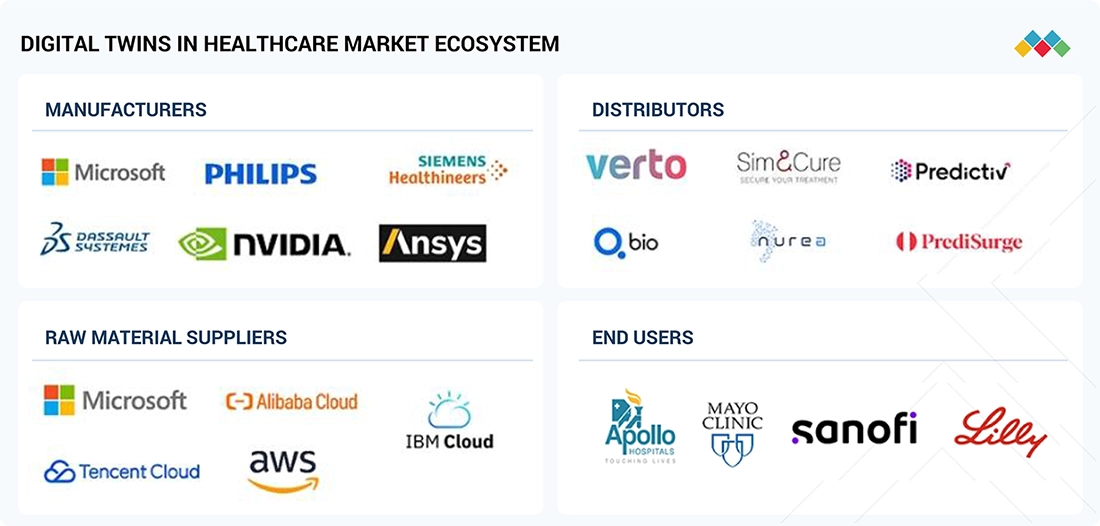
DIGITAL TWINS IN HEALTHCARE MARKET: COMMERCIAL USE CASES ACROSS INDUSTRIES
| COMPANY | USE CASE DESCRIPTION | BENEFITS |
|---|---|---|
 |
Development of patient-specific digital twins using Azure Digital Twins and AI to simulate disease progression and treatment outcomes. | Enables predictive care planning, accelerates clinical decision-making, and reduces trial-and-error in personalized therapy. |
 |
Creation of digital twins of medical imaging systems and patient organs to optimize imaging workflows and simulate diagnostic outcomes. | Improves imaging precision, enhances equipment uptime through predictive maintenance, and supports virtual clinical training. |
 |
Hospital digital twins built using Philips HealthSuite Platform to model and optimize hospital operations, patient flow, and resource allocation. | Increases operational efficiency, reduces patient wait times, and improves staff utilization through real-time simulation insights. |
 |
“Virtual Human Twin” initiative under the 3DEXPERIENCE platform to model human organs and biological systems for drug and device testing. | Reduces R&D timelines, minimizes reliance on animal testing, and accelerates regulatory submissions through validated in-silico models. |
 |
Cloud-based digital twin infrastructure integrating IoT, analytics, and AI via AWS IoT TwinMaker to monitor and optimize connected medical devices and facilities. | Enhances real-time monitoring, predictive maintenance, and compliance tracking, reducing downtime and operational costs. |
Logos and trademarks shown above are the property of their respective owners. Their use here is for informational and illustrative purposes only.
Related Ecosystem
Healthcare Analytics
- Machine Learning
- Natural Language Processing (NLP)
- Blood Pressure Monitors
- Computed Tomography (CT)
- Magnetic Resonance Imaging (MRI)
- Oracle Corporation
- PHILIPS HEALTHCARE
- Siemens healthineers
- Zensar Technologies Limited
- International Business Machines Corporation
Healthcare It
- Computed Tomography (CT)
- Machine Learning
- Magnetic Resonance Imaging (MRI)
- Natural Language Processing (NLP)
- Predictive Analytics
- CERNER CORPORATION
- PHILIPS HEALTHCARE
- Oracle Corporation
- GE HealthCare Technologies Inc.
- Siemens healthineers
Key Takeaways
- Australia's digital twins in healthcare market will grow from $55.6M (2026) to $756.2M (2031), representing a 68.6% CAGR.
- Australia is emerging as a regional innovation hub for digital twin adoption in surgical planning, patient monitoring, and drug development.
- Australia's advanced healthcare infrastructure and government support are accelerating digital twin implementation across major medical centers.
- Australia's market growth is driven by increasing demand for personalized medicine, operational efficiency, and improved patient outcomes through virtual modeling.
Digital Twins in Healthcare Market Report Scope
| Report Metric | Details |
|---|---|
| Base Year | 2026 |
| Fastest Growing Segment | HEALTHCARE WORKFLOW OPTIMIZATION & ASSET MANAGEMENT (Application) |
| Forecast Period | 2026–2031 |
| Growth Rate | CAGR of 68.4% from 2026 to 2031 |
| Largest Segment | SOFTWARE (Component) |
| Market Size Base Year (Billions) | ~USD 7.47 (2026) |
| Revenue Forecast (Billions) | ~USD 101.19 (2031) |
| Segments Covered | Component, Type, Application, End User |
Australia Digital Twins in Healthcare Market Report Segmentation
4 segment dimensions are covered across the global market.
By Component
- Services
- Software
By Type
- Body Part Twins
- Process Twins
- System Twins
- Whole Body Twins
By Application
- Drug Discovery & Development
- Healthcare Workflow Optimization & Asset Management
- Medical Device Design & Testing
- Other Applications
- Personalized Medicine
- Surgical Planning & Medical Education
By End User
- Healthcare Providers
- Medical Device Companies
- Other End Users
- Pharma & Biopharma Companies
- Research & Academia
AUSTRALIA: DIGITAL TWINS IN HEALTHCARE MARKET, BY END USER, 2024–2031
| Segment | 2024 | 2025 | 2026 | 2027 | 2028 | 2029 | 2030 | 2031 | CAGR (%) |
|---|---|---|---|---|---|---|---|---|---|
| HEALTHCARE PROVIDERS | 5.5 | 9.1 | 15.2 | 25.6 | 43.3 | 73.1 | 123.4 | 208.8 | 68.8 |
| MEDICAL DEVICE COMPANIES | 2.9 | 4.9 | 8.2 | 13.8 | 23.3 | 39.5 | 66.8 | 113.2 | 69.1 |
| OTHER END USERS | 1.7 | 2.8 | 4.6 | 7.7 | 12.7 | 21 | 34.8 | 57.6 | 65.5 |
| PHARMA & BIOPHARMA COMPANIES | 4.6 | 7.7 | 12.9 | 21.8 | 36.9 | 62.5 | 106 | 180 | 69.4 |
| RESEARCH & ACADEMIA | 5.3 | 8.7 | 14.6 | 24.4 | 41.1 | 69.3 | 116.6 | 196.6 | 68.3 |
| TOTAL | 20 | 33.2 | 55.6 | 93.3 | 157.3 | 265.3 | 447.5 | 756.2 | 68.6 |
Target Audience
- Healthcare Technology Vendors : Digital twin software and platform providers need Australia-specific market data to identify growth opportunities, develop localized solutions, and establish partnerships with major Australian healthcare networks.
- Hospital & Medical Institution Leaders : Australian hospital executives and chief medical officers require market insights to justify digital twin investments, benchmark against peer institutions, and plan technology adoption roadmaps.
- Investment & Private Equity Firms : Investors targeting Australian healthcare technology need detailed market analysis to evaluate investment opportunities, assess growth potential, and identify acquisition targets in the digital health space.
- Government & Health Policy Makers : Australian health department officials and policy makers need market intelligence to inform healthcare innovation strategies, funding priorities, and digital transformation initiatives.
- Medical Research Institutions : Australian universities and research centers require market data to secure funding, collaborate with industry partners, and advance digital twin research and development initiatives.
Key Companies in the Australia Digital Twins in Healthcare Market
| Company | HQ | Ownership | Strongest segments |
|---|---|---|---|
| MICROSOFT | United States | Public Company | Intelligent Cloud (Azure, Server, GitHub, Nuance),Productivity & Business Processes (Microsoft 365, LinkedIn, Dynamics),Personal Computing (Windows, Devices, Gaming, Search & Ads), |
| SIEMENS HEALTHINEERS AG | Germany | Public Company | Imaging,Diagnostics,Varian (Oncology), |
| KONINKLIJKE PHILIPS N.V. | Netherlands | Public Company | Diagnostic Imaging (MR, CT, X-ray, Ultrasound),Image Guided Therapy Systems & Devices,Connected Care & Monitoring / Enterprise Informatics, |
| DASSAULT SYSTèMES | France | Public Company | 3D Modeling (CATIA, SOLIDWORKS, GEOVIA, BIOVIA),Social & Collaborative (ENOVIA, CENTRIC PLM, 3DEXCITE),Simulation & Manufacturing (SIMULIA, DELMIA, 3DVIA), |
| GE HEALTHCARE | United States | Public Company | Imaging,Advanced Visualization Solutions (including Ultrasound and IGT),Patient Care Solutions, |
| ORACLE | United States | Public Company | Cloud applications (Fusion ERP/EPM/SCM/HCM, NetSuite, Oracle Health, CX),Cloud and on-premise database and infrastructure technologies,Hardware products and related software/support, |
| IBM | United States | Public Company | Software (Hybrid Cloud & AI Platforms),Consulting (Strategy, Technology, Intelligent Operations),Infrastructure (Servers, Storage, Lifecycle Services), |
| PTC | United States | Public Company | PLM (Windchill, Arena, FlexPLM),CAD (Creo, Onshape),IoT & AR (ThingWorx, Kepware, Vuforia), |
| SAP | Germany | Public Company | SAP S/4HANA and core ERP,Human Experience Management (SAP SuccessFactors),Spend Management and Business Network, |
| ATOS SE | United States | Public Company | Infrastructure & Cloud Managed Services,Digital Workplace Solutions,Business & Platform Integration / Digital Transformation, |
| NVIDIA CORPORATION | United States | Public Company | Data Center Accelerated Computing & AI Platforms,Networking (High-speed interconnects and DPUs),Gaming GPUs (GeForce), |
| ANSYS INC. | United States | Private Company | Structural & Multiphysics (Ansys Mechanical, LS-DYNA, design exploration),Fluids (Ansys Fluent and related CFD tools),Electronics, Power & EDA (HFSS, RedHawk-SC, mission simulation, SCADE), |
MICROSOFT
Microsoft is a public technology company founded in 1975 with 228,000 employees, headquartered in the United States.
SIEMENS HEALTHINEERS AG
Siemens Healthineers AG is a German public company founded in 1896 with 72,369 employees specializing in healthcare technology and diagnostics.
KONINKLIJKE PHILIPS N.V.
Koninklijke Philips N.V. is a Dutch public company founded in 1891 with 64,317 employees operating across healthcare, consumer electronics, and lighting sectors.
DASSAULT SYSTèMES
Dassault Systèmes is a French public company founded in 1981 with 25,724 employees providing 3D design and digital transformation software solutions.
GE HEALTHCARE
GE Healthcare is a public healthcare technology company founded in 2022 with 54,000 employees providing medical imaging and diagnostic solutions.
ORACLE
Oracle is a public software and database company founded in 1977 with 141,000 employees headquartered in the United States.
IBM
IBM is a public technology and consulting company founded in 1911 with 264,300 employees providing enterprise software, hardware, and services.
PTC
PTC is a public software company founded in 1985 with 7,000 employees specializing in product lifecycle management and industrial IoT solutions.
SAP
SAP is a German public company founded in 1972 with 111,038 employees providing enterprise resource planning and business software solutions.
ATOS SE
Atos SE is a public company founded in 1997 and based in the United States providing IT services and digital transformation solutions.
NVIDIA CORPORATION
NVIDIA Corporation is a public technology company founded in 1993 with 42,000 employees specializing in graphics processing units and AI computing.
ANSYS INC.
Ansys Inc. is a private software company founded in 1970 with 6,600 employees providing simulation and engineering software solutions.
Reasons to Buy this Report
- Market-Specific Growth Intelligence : Gain detailed insights into Australia's unique 68.6% CAGR trajectory and understand the specific drivers accelerating digital twin adoption across Australian healthcare institutions.
- Competitive Positioning Strategy : Identify key Australian healthcare providers, research institutions, and technology partners to develop targeted market entry or expansion strategies in this high-growth regional market.
- Investment & Funding Opportunities : Discover investment hotspots and funding trends specific to Australia's digital health sector, enabling informed capital allocation decisions for healthcare technology ventures.
- Regulatory & Implementation Roadmap : Understand Australia-specific regulatory requirements, compliance frameworks, and implementation best practices for deploying digital twin solutions in Australian healthcare systems.
- Revenue Forecasting & Planning : Leverage precise market sizing and segment forecasts for Australia to develop accurate revenue projections and strategic business plans through 2031.
Frequently asked questions
What is the current market size of digital twins in healthcare in Australia?
Australia's digital twins in healthcare market was valued at $55.6 million in 2026 and is projected to reach $756.2 million by 2031.
What is the expected growth rate for Australia's digital twins healthcare market?
Australia's digital twins in healthcare market is expected to grow at a compound annual growth rate (CAGR) of 68.6% from 2026 to 2031.
Which healthcare applications are driving digital twin adoption in Australia?
Australia is seeing significant adoption of digital twins in surgical simulation, personalized treatment planning, patient monitoring, and pharmaceutical development.
What factors are accelerating digital twin adoption across Australia's healthcare sector?
Australia's growth is driven by advanced healthcare infrastructure, government support for health technology innovation, demand for precision medicine, and the need for operational efficiency.
How does Australia's digital twins market compare to the broader Asia Pacific region?
Australia is positioned as a regional leader within Asia Pacific, with strong market fundamentals and expected to capture significant market share by 2031.
RESEARCH METHODOLOGY
This research study involved the extensive use of both primary and secondary sources. It involved the study of various factors affecting the industry to identify the segmentation types, industry trends, key players, the competitive landscape of market players, and key market dynamics such as drivers, opportunities, challenges, restraints, and key player strategies.
Secondary Research
This research study involved the wide use of secondary sources, directories, databases such as Dun & Bradstreet, Bloomberg Businessweek, and Factiva, white papers, annual reports, and companies’ house documents. Secondary research was undertaken to identify and collect information for this extensive, technical, market-oriented, and commercial study of the digital twins in healthcare market. It was also used to obtain important information about the top players, market classification, and segmentation according to industry trends to the bottom-most level, geographic markets, and key developments related to the market. A database of the key industry leaders was also prepared using secondary research.
Primary Research
In the primary research process, various supply-side and demand-side sources were interviewed to obtain qualitative and quantitative information for this report. Primary sources from the supply side included industry experts such as CEOs, vice presidents, marketing and sales directors, technology & innovation directors, engineers, and related key executives from various companies and organizations operating in the digital twins in healthcare market. Primary sources from the demand side included personnel from hospitals (small, medium-sized, and large hospitals), diagnostic centers, and stakeholders in corporate & government bodies.
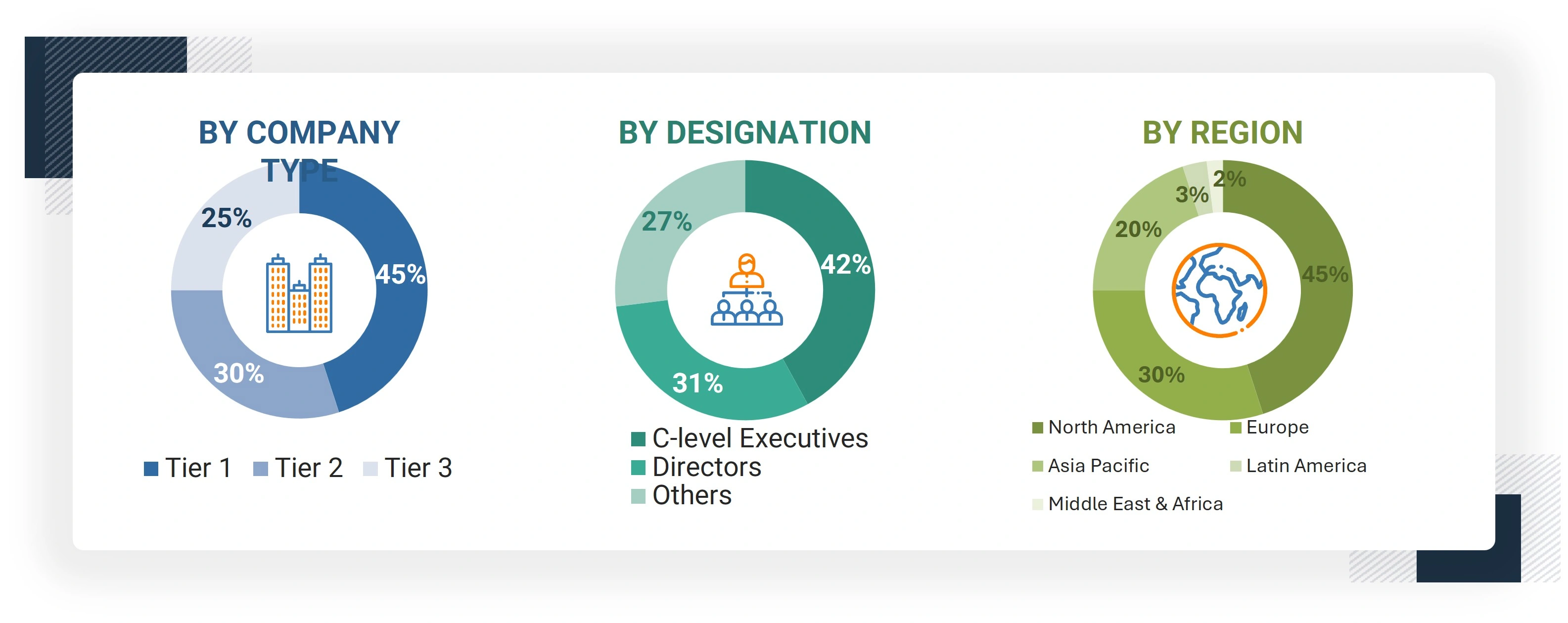
Note: Tiers are defined based on a company’s total revenue, as of 2025: Tier 1 = >USD 1 billion, Tier 2 = USD 500 million to USD 1 billion, and Tier 3 = <USD 500 million.
To know about the assumptions considered for the study, download the pdf brochure
Market Size Estimation
The total size of the digital twins in healthcare market was arrived at after data triangulation through the two approaches mentioned below. After the completion of each approach, the weighted average of these approaches was taken based on the level of assumptions used in each approach.
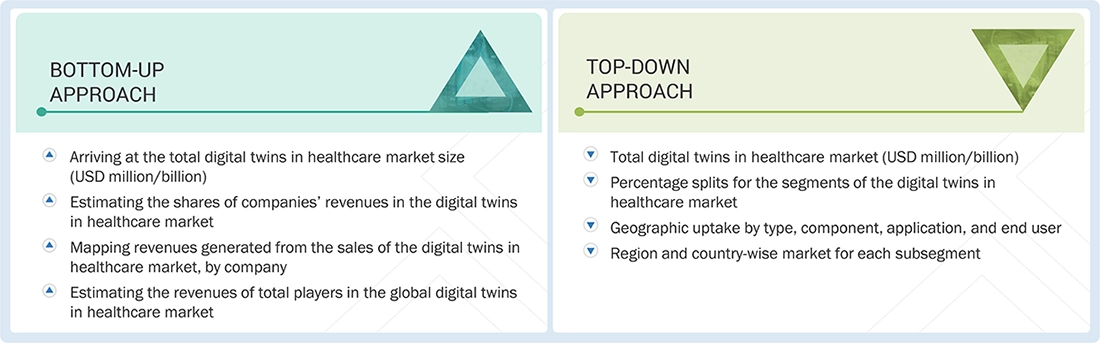
Data Triangulation
The size of the digital twins in healthcare market was estimated through segmental extrapolation using the bottom-up approach. The methodology used is as follows:
- Revenues for individual companies were gathered from public sources and databases.
- Shares of leading players in the digital twins in healthcare market were gathered from secondary sources to the extent available. In some instances, shares of digital twins in healthcare businesses have been ascertained after a detailed analysis of various parameters, including product portfolios, market positioning, selling price, and geographic reach & strength.
- Individual shares or revenue estimates were validated through interviews with experts.
The total revenue in the digital twins in healthcare market was determined by extrapolating the market share data of major companies.
Market Definition
According to the Digital Twin Consortium, a digital twin is a virtual representation of real-world entities and processes synchronized at a specified frequency and fidelity. This allows end users to monitor what is happening inside the physical asset in real-time. By providing a holistic view of real-time behavior in a real-world environment mapped to a constantly updated virtual model, digital twins make it possible to anticipate maintenance needs, optimize performance, and avoid costly failures.
Key Stakeholders
- Healthcare Providers
- Healthcare Vendors
- Technology Developers
- Patients
- Regulators and Policymakers
- Insurance companies and payers
- Academic Research Institutes
- Imagining and Diagnostic Labs
- Government Institutions
- Market Research and Consulting Firms
- Venture Capitalists and Investors
Report Objectives
- To define, describe, and forecast the digital twins in healthcare market based on component, application, end user, and region
- To provide detailed information regarding the major factors influencing the growth of the market (drivers, restraints, opportunities, and industry-specific challenges)
- To strategically analyze micromarkets with respect to individual growth trends, prospects, and contributions to the overall market
- To analyze opportunities in the market for stakeholders and provide details of the competitive landscape for market leaders
- To forecast the size of the market with respect to three geographic regions—North America, Europe, Asia Pacific (APAC), Latin America, and the Middle East & Africa
- To profile the key players and comprehensively analyze their core competencies and market shares
- To track and analyze competitive developments such as product/service launches & enhancements, agreements, expansions, partnerships, and collaborations
- To benchmark players within the market using the proprietary “Company Evaluation Matrix” framework, which analyzes market players on various parameters within the broad categories of business and product strategy.
Available customizations:
With the given market data, MarketsandMarkets offers customizations as per your company’s specific needs. The following customization options are available for the report:
Company Information
- Detailed analysis and profiling of additional market players (up to 5)
Geographic Analysis
- Further breakdown of the Rest of Europe digital twins in healthcare market into Denmark, Norway, and others
- Further breakdown of the Rest of Asia Pacific digital twins in healthcare market into Vietnam, New Zealand, Australia, South Korea, and others.
Get the Full Digital Twins in Healthcare Market Report
Full forecast, segment splits, and company analysis for all Digital Twins in Healthcare Market.
- US Digital Twins in Healthcare Market
- Canada Digital Twins in Healthcare Market
- Germany Digital Twins in Healthcare Market
- UK Digital Twins in Healthcare Market
- France Digital Twins in Healthcare Market
- Italy Digital Twins in Healthcare Market
- Spain Digital Twins in Healthcare Market
- Japan Digital Twins in Healthcare Market
- China Digital Twins in Healthcare Market
- India Digital Twins in Healthcare Market
- South Korea Digital Twins in Healthcare Market
- Brazil Digital Twins in Healthcare Market
- Mexico Digital Twins in Healthcare Market
- Saudi Arabia Digital Twins in Healthcare Market
- UAE Digital Twins in Healthcare Market
- South Africa Digital Twins in Healthcare Market
- Roe Digital Twins in Healthcare Market
- Rest Of Asia Pacific Digital Twins in Healthcare Market
- Rest Of Latin America Digital Twins in Healthcare Market
- GCC Countries Digital Twins in Healthcare Market
- Other GCC Countries Digital Twins in Healthcare Market
Need a Tailored Report?
Customize this report to your needs
Get 10% FREE Customization
Customize This Report
