
US Dimethyl Carbonate Market (2025-2030)

The US Dimethyl Carbonate Market was valued at $253.4 Million in 2025 and projected to reach to $360.4 Million by 2030, representing a compound annual growth rate of 7.3%. The US dimethyl carbonate market is positioned for steady growth through 2030, supported by robust demand from the automotive and electronics sectors, particularly in battery technology and polycarbonate applications.


| Market Size in | USD 26.32 MN |
| Market Forecast in | |
| CAGR | |
| Forecast Period | |
| Units Considered | Value (USD MN) |
US Dimethyl Carbonate Market Trends and Insights
- This steady expansion reflects increasing demand across the US chemical and material sectors, driven by applications in polycarbonate production, battery electrolytes, and specialty solvents.
- The US market benefits from robust industrial infrastructure and significant investment in advanced manufacturing technologies that leverage dimethyl carbonate's unique chemical properties. Growth in the US dimethyl carbonate market is supported by rising adoption in the US automotive and electronics industries, where the chemical serves as a critical intermediate in high-performance applications.
- The US regulatory environment continues to favor sustainable chemical alternatives, positioning dimethyl carbonate as a preferred choice over more hazardous compounds.
- Between 2025 and 2030, the US market is expected to experience consistent demand growth, driven by expanding end-use industries and ongoing innovation in the US chemical manufacturing sector..
Key Market Statistics
- CAGR (2025-2030) 7.3% CAGR
- Market Size, 2025 ~USD 253.4 Million
- Forecast, 2030 ~USD 360.4 Million
- Country US
US Dimethyl Carbonate Market Overview
Market Size & Growth :
The US dimethyl carbonate market is valued at $253.4 million in 2025 and is projected to reach $360.4 million by 2030, with a CAGR of 7.3%, outpacing many traditional chemical segments.
Key Application Drivers :
US demand is primarily driven by polycarbonate production, lithium-ion battery electrolytes, and specialty solvent applications across automotive, electronics, and consumer goods manufacturing sectors.
Industrial Infrastructure Advantage :
The US benefits from established chemical manufacturing infrastructure, advanced R&D capabilities, and proximity to major end-user industries, supporting consistent market expansion.
Regulatory & Sustainability Focus :
Increasing US environmental regulations and corporate sustainability initiatives are driving adoption of dimethyl carbonate as a safer, greener alternative to traditional solvents and chemical intermediates.
US Dimethyl Carbonate Market Dynamics
- Manufacturers are increasingly investing in sustainable production methods and expanding capacity to meet rising consumption.
- The market benefits from strong domestic chemical infrastructure and innovation capabilities, enabling competitive advantage in specialty applications.
- However, growth remains moderate compared to global rates, reflecting market maturity and established competition.
- Strategic partnerships and technological advancements in battery electrolytes will be critical drivers for accelerating adoption across US industrial segments..
Market Ecosystem
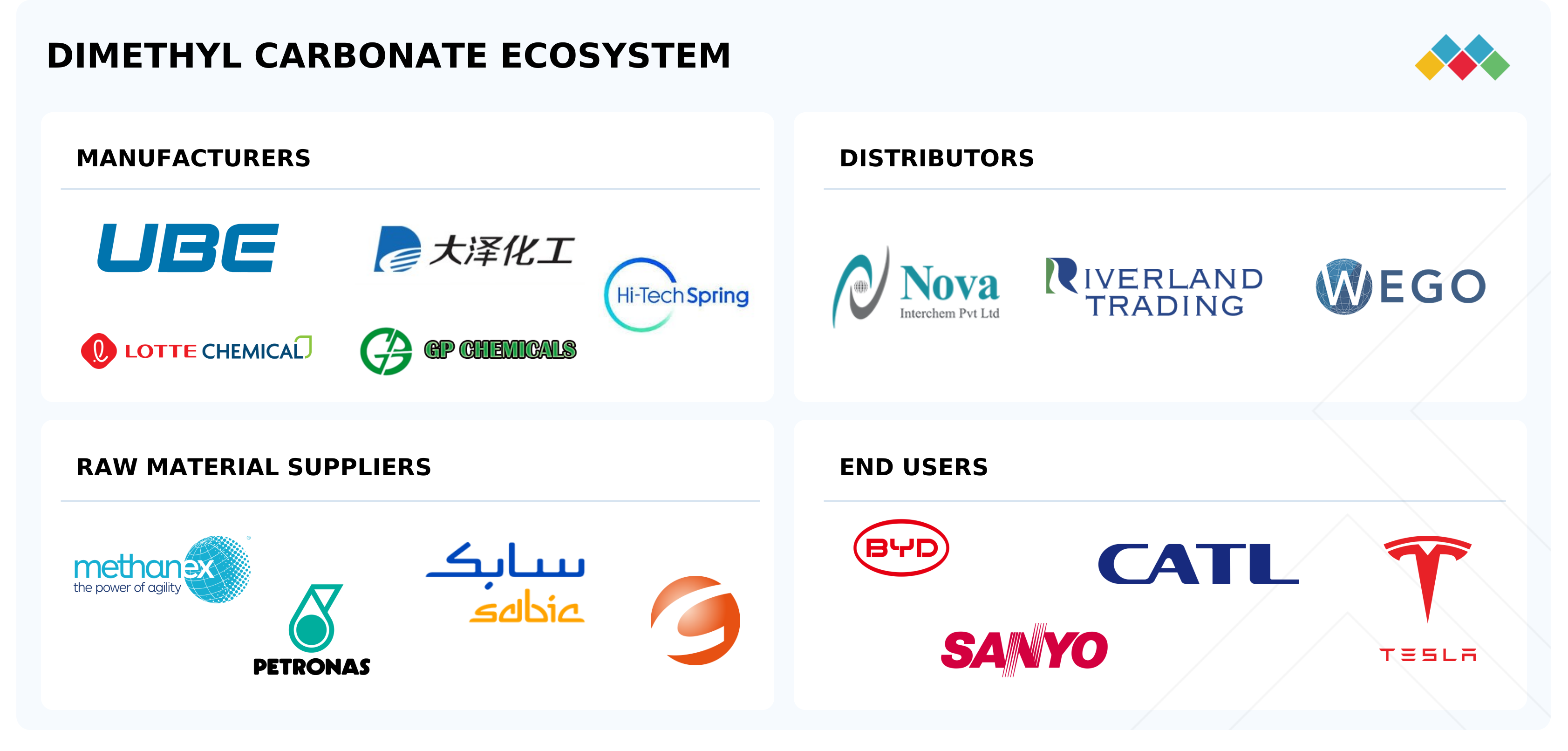
Dimethyl Carbonate Market: COMMERCIAL USE CASES ACROSS INDUSTRIES
| COMPANY | USE CASE DESCRIPTION | BENEFITS |
|---|---|---|
 |
Use of dimethyl carbonate-derived polycarbonates in smartphone casings, laptop housings, and optical media | Provides strength, heat resistance, and lightweight properties critical for durable yet slim electronic devices |
 |
Polycarbonate sheets and panels derived from dimethyl carbonate for roofing, skylights, and noise barriers | High transparency, UV resistance, and structural durability improve infrastructure performance and sustainability |
 |
Blending dimethyl carbonate into gasoline as an eco-friendly oxygenated additive | Reduces CO, NOx, and particulate emissions supports compliance with emission norms like Euro 6 and BS-VI |
 |
Dimethyl carbonate used as a solvent in lithium-ion battery electrolytes | Improves electrolyte stability and conductivity, essential for EV and consumer electronics battery performance |
 |
Serves as a solvent and processing aid in certain drug formulations and personal care products | Enhances solubility of active ingredients and supports formulation of high-purity compounds |
Logos and trademarks shown above are the property of their respective owners. Their use here is for informational and illustrative purposes only.
Related Ecosystem
Automotive Electronics And Electrical Equipment
- Battery Electric Vehicle (BEV)
- Light Commercial Vehicles (LCVs)
- Fuel Cell Electric Vehicle (FCEV)
- Sensors
- Hybrid Electric Vehicle (HEV)
- BOSCH LIMITED
- Continental ag
- DENSO Corporation
- Panasonic Holdings Corporation
- Texas Instruments Incorporated
Paints And Coatings
- Polyurethane Resin
- Alkyd Resins
- Epoxy Resin
- Polyester Resin
- Acrylics
- Basf se
- JOTUN
- PPG Industries, Inc.
- DOW CHEMICAL COMPANY
- Akzonobel n.v.
Speciality Chemicals
- Corrosion Inhibitors
- Polyetheretherketone (PEEK)
- Acrylonitrile Butadiene Styrene (ABS)
- Epoxy Resin
- Polycarbonate
- Basf se
- DOW CHEMICAL COMPANY
- Evonik industries ag
- Clariant ag.
- Solvay sa
Key Takeaways
- The US dimethyl carbonate market is valued at $253.4 million in 2025 and will reach $360.4 million by 2030, growing at a 7.3% CAGR.
- The US automotive and electronics sectors are primary growth drivers, leveraging dimethyl carbonate in battery electrolytes and polycarbonate production.
- The US regulatory landscape increasingly favors sustainable chemical alternatives, enhancing dimethyl carbonate's competitive positioning in the US market.
- Steady industrial demand and technological innovation in the US chemical manufacturing sector support consistent market expansion through 2030.
Dimethyl Carbonate Market Report Scope
| Report Metric | Details |
|---|---|
| Base Year | 2025 |
| Fastest Growing Segment | BATTERY ELECTROLYTES (Application) |
| Forecast Period | 2025–2030 |
| Growth Rate | CAGR of 11.1% from 2025 to 2030 |
| Largest Segment | LITHIUM-ION BATTERY (Battery Type) |
| Market Size Base Year (Billions) | ~USD 1.55 (2025) |
| Revenue Forecast (Billions) | ~USD 2.63 (2030) |
| Segments Covered | Grade, Application, End-Use Industry, Battery Type |
US Dimethyl Carbonate Market Report Segmentation
4 segment dimensions are covered across the global market.
By Grade
- Battery Grade (>99.9 Weight %)
- Industrial Grade (>99.0 Weight %)
- Pharmaceutical Grade (>99.5 Weight %)
- Pharmaceuticals Grade (>99.5 Weight %)
By Application
- Battery Electrolytes
- Other Applications
- Polycarbonate Synthesis
- Reagents
- Solvents
By End-Use Industry
- Agrochemical
- Agrochemicals
- Battery
- Other Applications
- Other End-Use Industries
- Paints & Coatings
- Pharmaceutical
- Pharmaceuticals
- Plastics
By Battery Type
- Lead-Acid Battery
- Lithium-Ion Battery
US: DIMETHYL CARBONATE MARKET, BY END-USE INDUSTRY, 2025–2030
| Segment | 2025 | 2026 | 2027 | 2028 | 2029 | 2030 | CAGR (%) |
|---|---|---|---|---|---|---|---|
| AGROCHEMICALS | 12.6 | 13.6 | 14.6 | 15.6 | 16.6 | 17.7 | 7 |
| BATTERY | 28.5 | 34.1 | 40.7 | 48.6 | 57.8 | 68.7 | 19.3 |
| OTHER END-USE INDUSTRIES | 15 | 16.3 | 17.7 | 19.1 | 20.7 | 22.3 | 8.3 |
| PAINTS & COATINGS | 26 | 27.6 | 29.2 | 30.8 | 32.5 | 34.2 | 5.6 |
| PHARMACEUTICALS | 18.3 | 19.8 | 21.3 | 22.9 | 24.6 | 26.3 | 7.5 |
| PLASTICS | 86.8 | 92.6 | 98.6 | 104.8 | 111.2 | 117.7 | 6.3 |
| TOTAL | 187.2 | 203.9 | 222.1 | 241.9 | 263.4 | 286.9 | 8.9 |
Target Audience
- Chemical Manufacturers : US-based and international chemical producers need market sizing and growth forecasts to plan capacity expansion, R&D investment, and competitive positioning in the American dimethyl carbonate market.
- Battery & Electronics Companies : Automotive and electronics manufacturers require US-specific demand data on dimethyl carbonate electrolytes to optimize supply chain strategy and secure reliable sourcing for battery production.
- Investment & Private Equity Firms : Investors evaluating US chemical sector opportunities need accurate market valuations, growth projections, and competitive analysis to assess investment viability and portfolio returns.
- Procurement & Supply Chain Managers : Corporate buyers across manufacturing sectors need US market intelligence to negotiate supplier contracts, forecast costs, and ensure supply security for dimethyl carbonate procurement.
- Market Research & Strategy Consultants : Consulting firms advising US industrial clients require detailed market data, trend analysis, and competitive insights to develop informed business strategies and client recommendations.
Key Companies in the US Dimethyl Carbonate Market
| Company | HQ | Ownership | Strongest segments |
|---|---|---|---|
| UBE INDUSTRIES LTD. | Japan | Public Company | Functional Products,High-Performance Urethanes,Pharmaceuticals, |
| UBE CORPORATION | United States | Public Company | Mobility,Delivery,Freight, |
| LOTTE CHEMICAL CORPORATION | South Korea | Public Company | Basic chemicals and petrochemicals (ethylene, PE, PP, EVA),PET and polyester-related materials,Advanced materials (ABS, MABS, ASA, engineering plastics, performance materials), |
| SHINGHWA ADVANCED MATERIAL GROUP CO., LTD. | China | Public Company | Lithium battery electrolyte (solvents, solutes, additives),Cathode and silicon anode materials (incl. pre-lithiation),Dimethyl carbonate and related carbonate series, |
| SHANDONG DEPU CHEMICAL INDUSTRY SCIENCE & TECHNOLOGY CO., LTD. | China | Specialty chemical intermediates,Performance chemicals and additives,Commodity and bulk chemicals, | |
| SHANDONG WANLING CHEMICAL CO., LTD | China | Core chemical intermediates,Specialty or formulated derivatives,Commodity/basic chemicals and by-products, |
UBE INDUSTRIES LTD.
UBE Industries Ltd. is a Japanese public company founded in 1897 with 7,968 employees, operating across multiple industrial sectors.
UBE CORPORATION
UBE Corporation is a publicly traded company established in 2009 with 35,000 employees based in the United States.
LOTTE CHEMICAL CORPORATION
Lotte Chemical Corporation is a South Korean public company founded in 1976 with 4,223 employees specializing in chemical manufacturing.
SHINGHWA ADVANCED MATERIAL GROUP CO., LTD.
Shinghwa Advanced Material Group Co., Ltd. is a publicly traded Chinese company established in 2002 with 1,992 employees.
SHANDONG DEPU CHEMICAL INDUSTRY SCIENCE & TECHNOLOGY CO., LTD.
Insufficient data provided for company description.
SHANDONG WANLING CHEMICAL CO., LTD
Insufficient data provided for company description.
Reasons to Buy this Report
- Accurate US Market Sizing : Obtain precise 2025-2030 market valuations and CAGR data specific to the United States, enabling accurate budgeting and investment planning for US operations.
- Competitive Landscape Intelligence : Understand US-specific competitive dynamics, market consolidation trends, and key player strategies to identify partnership and acquisition opportunities in the American market.
- Application-Specific Demand Analysis : Access detailed insights into US demand drivers across polycarbonates, battery electrolytes, and solvents, helping prioritize product development and market entry strategies.
- Regulatory & Compliance Guidance : Stay informed on US environmental regulations, sustainability requirements, and compliance standards shaping dimethyl carbonate adoption and manufacturing practices.
- Strategic Growth Roadmap : Leverage US-focused market forecasts and trend analysis to develop targeted expansion strategies, identify high-growth segments, and optimize resource allocation for maximum ROI.
Frequently asked questions
What is the current size of the US dimethyl carbonate market?
The US dimethyl carbonate market is estimated at $253.4 million in 2025 and is expected to grow to $360.4 million by 2030.
What is the growth rate of the US dimethyl carbonate market?
The US dimethyl carbonate market is projected to grow at a compound annual growth rate (CAGR) of 7.3% from 2025 to 2030.
Which industries drive demand for dimethyl carbonate in the US?
The US automotive, electronics, and chemical manufacturing sectors are primary drivers, utilizing dimethyl carbonate in battery electrolytes, polycarbonate production, and specialty solvents.
How does the US regulatory environment impact the dimethyl carbonate market?
The US regulatory environment increasingly favors sustainable and safer chemical alternatives, positioning dimethyl carbonate as a preferred substitute for more hazardous compounds in the US market.
What factors support growth in the US dimethyl carbonate market through 2030?
Growth is supported by rising industrial demand, technological innovation in US chemical manufacturing, expanding end-use applications, and the shift toward environmentally sustainable chemical solutions in the US.
RESEARCH METHODOLOGY
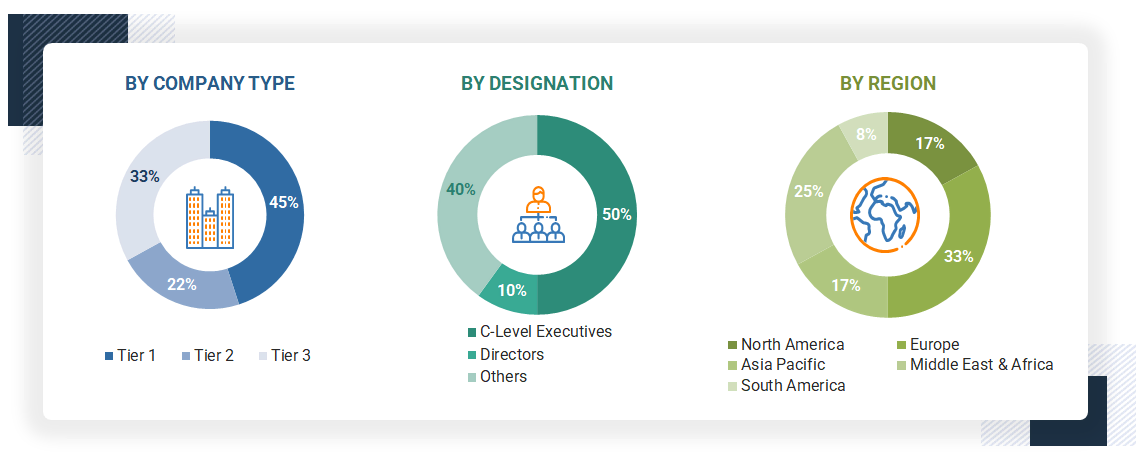
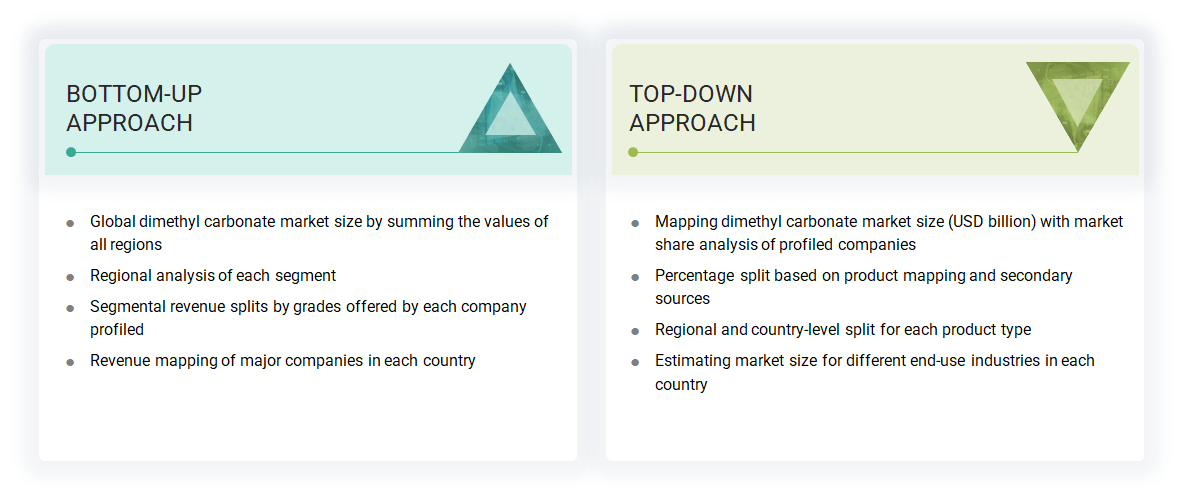
The study involved four main activities to estimate the current size of the dimethyl carbonate market—extensive secondary research collected information on the market and peer and parent markets. The next step was to validate these findings, assumptions, and measures with industry experts across the value chain of dimethyl carbonate through primary research. Both top-down and bottom-up approaches were used to estimate the total market size. Afterwards, market breakdown and data triangulation were applied to estimate the size of the segments and sub-segments of the market.
Secondary Research
The research methodology used to estimate and forecast the access control market starts with gathering data on the revenues of major vendors through secondary research. During this process, various secondary sources such as Hoovers, Bloomberg BusinessWeek, Factiva, World Bank, and Industry Journals were consulted to gather information for this study. These sources included annual reports, press releases, investor presentations, white papers, certified publications, articles by recognized authors, notifications from regulatory bodies, trade directories, and databases. Vendor offerings were also examined to establish market segmentation.
Primary Research
The dimethyl carbonate market includes various stakeholders in the supply chain, such as manufacturers, equipment producers, traders, associations, and regulatory agencies. The demand side is driven by the growth of different end-use industries. Interviews with key sources from both the supply and demand sides were conducted to gather qualitative and quantitative data.
To know about the assumptions considered for the study, download the pdf brochure
Market Size Estimation
The top-down and bottom-up approaches were used to estimate and verify the overall size of the dimethyl carbonate market. These methods were also widely applied to determine the market size of various segments. The research methodology for estimating the market size included the following:
- The key players were identified through extensive primary and secondary research.
- The value chain and market size of the dimethyl carbonate market, in terms of value and volume, were determined through primary and secondary research.
- All percentage shares, splits, and breakdowns were calculated using secondary sources and verified through primary sources.
- All relevant parameters impacting the market covered in this study were thoroughly examined, verified through primary research, and analyzed to produce final quantitative and qualitative data.
- The research included studying reports, reviews, and newsletters of leading market players, along with in-depth interviews to gather opinions from key leaders such as CEOs, directors, and marketing executives.
Data Triangulation
After estimating the overall market size using the methods described above, the market was divided into several segments and sub-segments. Data triangulation and market breakdown techniques were used to complete the overall market analysis and determine the precise statistics for each segment and subsegment. The global market size was obtained by summing data from individual countries and regions.
Market Definition
Dimethyl carbonate (DMC) is a versatile chemical used in various industries as a solvent, methylating agent, and intermediate in chemical processes. DMC is known for its low toxicity, biodegradability, and positive environmental profile, making it an appealing alternative to traditional solvents and methylating agents. Its uses span multiple sectors, including pharmaceuticals, agrochemicals, electronics, plastics, and automotive industries, where it helps improve process efficiency, product performance, and sustainability. As industries increasingly focus on eco-friendly and sustainable solutions, demand for DMC continues to rise, fueling market growth and diversification.
Stakeholders
- Manufacturers of dimethyl carbonate
- Traders, distributors, and suppliers of dimethyl carbonate
- Government and research organizations
- Associations and industrial bodies
- Research and consulting firms
- R&D institutions
- Environmental support agencies
- Investment banks and private equity firms
Report Objectives
- To define, describe, and forecast the size of the global dimethyl carbonate market in terms of value and volume
- To provide detailed information regarding the key factors, such as drivers, restraints, opportunities, and challenges influencing the growth of the dimethyl carbonate market.
- To analyze and forecast the size of various segments (grade, end-use industry, and application) of the dimethyl carbonate market based on five major regions—North America, Europe, Asia Pacific, South America, Middle East & Africa, along with key countries in each of these regions
- To analyze recent developments and competitive strategies, such as expansions, new product developments, partnerships, acquisitions, and product launches, to draw the competitive landscape of the market
- To strategically profile the key players in the market and comprehensively analyze their core competencies
Get the Full Dimethyl Carbonate Market Report
Full forecast, segment splits, and company analysis for all Dimethyl Carbonate Market.
- China Dimethyl Carbonate Market
- Japan Dimethyl Carbonate Market
- India Dimethyl Carbonate Market
- South Korea Dimethyl Carbonate Market
- Taiwan Dimethyl Carbonate Market
- Thailand Dimethyl Carbonate Market
- Germany Dimethyl Carbonate Market
- France Dimethyl Carbonate Market
- UK Dimethyl Carbonate Market
- Spain Dimethyl Carbonate Market
- Netherlands Dimethyl Carbonate Market
- Italy Dimethyl Carbonate Market
- Canada Dimethyl Carbonate Market
- Mexico Dimethyl Carbonate Market
- Saudi Arabia Dimethyl Carbonate Market
- UAE Dimethyl Carbonate Market
- Israel Dimethyl Carbonate Market
- Turkey Dimethyl Carbonate Market
- South Africa Dimethyl Carbonate Market
- Brazil Dimethyl Carbonate Market
- Argentina Dimethyl Carbonate Market
- Rest Of Europe Dimethyl Carbonate Market
- Rest Of Asia Pacific Dimethyl Carbonate Market
- Rest Of GCC Countries Dimethyl Carbonate Market
- Rest Of South America Dimethyl Carbonate Market
Need a Tailored Report?
Customize this report to your needs
Get 10% FREE Customization
Customize This Report
