
US DNA Diagnostics Market (2024-2029)

The US DNA Diagnostics Market was valued at $3160.7 Million in 2024 and projected to reach to $5021.5 Million by 2029, representing a compound annual growth rate of 9.7%. The US DNA Diagnostics Market is poised for sustained growth through 2029, driven by increasing healthcare provider adoption, expanding insurance reimbursement policies, and growing consumer demand for preventive genetic screening.


| Market Size in | USD 26.32 MN |
| Market Forecast in | |
| CAGR | |
| Forecast Period | |
| Units Considered | Value (USD MN) |
US DNA Diagnostics Market Trends and Insights
- This expansion reflects the US healthcare sector's increasing adoption of genetic testing for disease prevention, personalized medicine, and early diagnosis.
- The US market benefits from advanced healthcare infrastructure, high consumer awareness, and strong reimbursement policies that support DNA diagnostic adoption across clinical and consumer segments. Driving this growth, the US market is witnessing accelerated demand for non-invasive prenatal testing, cancer genomics, and pharmacogenomics applications.
- The US regulatory environment, led by the FDA, continues to streamline approval pathways for novel DNA diagnostic platforms, enabling rapid market entry.
- Between 2024 and 2029, the US is expected to maintain its position as a leading market, supported by increasing healthcare spending and growing integration of genomic data into electronic health records..
Key Market Statistics
- CAGR (2024-2029) 9.7% CAGR
- Market Size, 2024 ~USD 3160.7 Million
- Forecast, 2029 ~USD 5021.5 Million
- Country US
US DNA Diagnostics Market Overview
Market Valuation Growth :
The US DNA Diagnostics Market is valued at $3,160.7 million in 2024, with a projected CAGR of 9.7%, reaching $5,021.5 million by 2029, demonstrating strong double-digit expansion in genetic testing adoption.
Advanced Healthcare Infrastructure :
The US benefits from cutting-edge laboratory facilities, FDA-regulated testing centers, and integrated electronic health records systems that facilitate widespread DNA diagnostic implementation across healthcare providers.
Personalized Medicine Adoption :
US healthcare providers increasingly leverage DNA diagnostics for tailored treatment plans, pharmacogenomics, and precision oncology, driving demand among hospitals, clinics, and specialty care centers nationwide.
High Consumer Awareness :
American consumers demonstrate strong engagement with genetic testing for disease prevention, ancestry analysis, and health risk assessment, supported by direct-to-consumer marketing and insurance coverage expansion.
US DNA Diagnostics Market Dynamics
- Technological advancements in sequencing capabilities and declining test costs are making DNA diagnostics more accessible across diverse patient populations and healthcare settings. Key growth catalysts include rising prevalence of genetic disorders, aging population demographics, and integration of genomic data into clinical decision-making protocols.
- The US market will continue to benefit from robust regulatory frameworks, substantial R&D investments, and strategic partnerships between diagnostic companies and healthcare systems, positioning it as a global leader in personalized medicine innovation..
Market Ecosystem
Related Ecosystem
Medical Devices
- Polymerase Chain Reaction (PCR)
- Magnetic Resonance Imaging (MRI)
- Disposable Autoinjectors
- Pulse Oximeters
- Blood Pressure Monitors
- Medtronic plc
- Abbott Laboratories
- Stryker Corporation
- Becton, Dickinson and Company
- CONMED Corporation
Key Takeaways
- The US DNA Diagnostics Market is valued at $3,160.7 million in 2024 and will reach $5,021.5 million by 2029, growing at a 9.7% CAGR.
- The US market is driven by rising adoption of personalized medicine, non-invasive prenatal testing, and cancer genomics applications.
- Strong US regulatory support and favorable reimbursement policies accelerate market expansion and clinical integration.
- The US healthcare infrastructure and consumer awareness position the country as a global leader in DNA diagnostic adoption.
DNA Diagnostics Market Report Scope
| Report Metric | Details |
|---|---|
| Base Year | 2024 |
| Fastest Growing Segment | HPV (Type) |
| Forecast Period | 2024-2029 |
| Growth Rate | CAGR of 9.7% from 2024 to 2029 |
| Largest Segment | BLOOD, PLASMA, AND SERUM (Specimen) |
| Market Size Base Year (Billions) | ~USD 13.34 (2024) |
| Revenue Forecast (Billions) | ~USD 21.2 (2029) |
| Segments Covered | Offering, Technology, Specimen, Application, Type, End User |
US DNA Diagnostics Market Report Segmentation
6 segment dimensions are covered across the global market.
By Offering
- Instruments
- Reagents & Kits
- Services & Software
By Technology
- In Situ Hybridization
- Mass Spectrometry
- Microarray
- Other Technologies
- Pcr
- Sequencing
By Specimen
- Blood, Plasma, And Serum
- Other Specimens
- Urine
By Application
- Infectious Disease Diagnostics
- Myogenic Disorders
- Oncology Testing
- Other Applications
- Preimplantation
- Prenatal
By Type
- Ct/Ng
- Hepatitis
- Hiv
- Hpv
- Other Infectious Diseases
By End User
- Diagnostic Laboratories
- Hospitals & Clinics
- Other End Users
US: DNA DIAGNOSTICS MARKET, BY END USER, 2022–2029
| Segment | 2022 | 2023 | 2024 | 2025 | 2026 | 2027 | 2028 | 2029 | CAGR (%) |
|---|---|---|---|---|---|---|---|---|---|
| DIAGNOSTIC LABORATORIES | 2414 | 2621.2 | 2866.8 | 3143.5 | 3458.9 | 3819.3 | 4228 | 4692.3 | 10.4 |
| HOSPITALS & CLINICS | 1237.1 | 1322.2 | 1422.7 | 1533.9 | 1658.5 | 1798.5 | 1954 | 2127.2 | 8.4 |
| OTHER END USERS | 679.6 | 712.3 | 752.1 | 796.1 | 845.6 | 901.4 | 963.2 | 1032 | 6.5 |
| TOTAL | 4330.6 | 4655.7 | 5041.5 | 5473.4 | 5963.1 | 6519.1 | 7145.2 | 7851.4 | 9.3 |
Target Audience
- Diagnostic Laboratory Operators : Need US market sizing and growth forecasts to evaluate expansion opportunities, justify capital investments in sequencing infrastructure, and plan service line development for genetic testing.
- Healthcare System Executives : Require market intelligence on DNA diagnostic adoption trends, reimbursement models, and clinical integration strategies to inform procurement decisions and precision medicine program development.
- Biotech & Diagnostics Companies : Seek US market data to assess competitive landscape, identify unmet clinical needs, guide product development priorities, and support investor presentations and funding strategies.
- Healthcare Investors & Venture Capitalists : Need validated US market projections, growth drivers, and segment analysis to evaluate investment opportunities in genetic diagnostics companies and healthcare technology platforms.
- Healthcare Policy & Regulatory Consultants : Require comprehensive US market data to advise on reimbursement policies, regulatory frameworks, and healthcare system integration strategies for DNA diagnostic services.
Reasons to Buy this Report
- Market Size & Growth Validation : Obtain precise US market valuation ($3,160.7M in 2024) and verified CAGR projections (9.7%) through 2029 to support investment decisions, business planning, and competitive positioning strategies.
- Regional Opportunity Assessment : Identify high-growth segments within the US market, including personalized medicine, oncology diagnostics, and preventive screening, to prioritize market entry and resource allocation strategies.
- Competitive Intelligence : Benchmark against US market dynamics, healthcare infrastructure advantages, and consumer adoption patterns to develop differentiated go-to-market strategies and competitive advantages in genetic diagnostics.
- Regulatory & Reimbursement Insights : Understand US-specific FDA regulations, insurance coverage trends, and healthcare policy drivers that influence DNA diagnostic adoption and market expansion opportunities.
- Strategic Partnership Identification : Leverage US market data to identify potential healthcare system partnerships, laboratory networks, and distribution channels for scaling DNA diagnostic services and maximizing market penetration.
Frequently asked questions
What is the current size of the US DNA Diagnostics Market?
The US DNA Diagnostics Market is valued at $3,160.7 million in 2024.
What is the projected size of the US DNA Diagnostics Market by 2029?
The US DNA Diagnostics Market is projected to reach $5,021.5 million by 2029.
What is the CAGR of the US DNA Diagnostics Market?
The US DNA Diagnostics Market is expected to grow at a compound annual growth rate (CAGR) of 9.7% from 2024 to 2029.
What are the primary drivers of growth in the US DNA Diagnostics Market?
Key drivers include increasing adoption of personalized medicine, rising demand for non-invasive prenatal testing, cancer genomics applications, favorable US regulatory policies, and strong reimbursement coverage.
How does the US market compare to other regions in DNA diagnostics?
The US represents one of the largest and most mature DNA diagnostics markets globally, supported by advanced healthcare infrastructure, high consumer awareness, and robust regulatory frameworks that facilitate innovation and market growth.
RESEARCH METHODOLOGY
To determine the current size of the DNA diagnostics market, this study engaged in four main activities. A comprehensive study was conducted using secondary research methods to gather data about the market, its parent market, and its peer markets. The next stage involved conducting primary research to confirm these conclusions, assumptions, and sizing with industry experts throughout the value chain. A combination of top-down and bottom-up methods was used to assess the overall market size. The market sizes of segments and subsegments were then estimated using data triangulation techniques and market breakdown.
The four steps involved in estimating the market size are
Collecting Secondary Data
Within the secondary data collection process, a range of secondary sources were reviewed so as to identify and gather data for this study, including regulatory bodies, databases (like D&B Hoovers, Bloomberg Business, and Factiva), white papers, certified publications, articles by well-known authors, annual reports, press releases, and investor presentations of companies.
Collecting Primary Data
During the primary research phase, a comprehensive approach was adopted, involving interviews with a diverse array of sources from both the supply and demand sides. These interviews aimed to gather qualitative and quantitative data essential for compiling this report. Primary sources primarily comprised industry experts spanning core and related sectors, as well as favored suppliers, manufacturers, distributors, service providers, technology innovators, and entities associated with all facets of this industry's value chain. In-depth interviews were meticulously conducted with a range of primary respondents, including key industry stakeholders, subject-matter authorities, C-level executives representing pivotal market players, and industry advisors. The objective was to obtain and authenticate critical qualitative and quantitative insights and to evaluate future potentialities comprehensively.
A breakdown of the primary respondents is provided below:
Breakdown of Primary Participants:
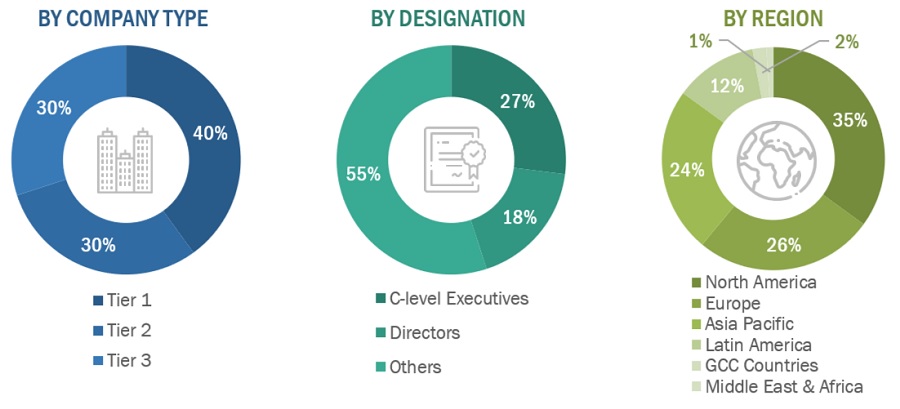
Note 1: Others include sales, marketing, and product managers.
Note 2: Tiers of companies are defined based on their total revenue. As of 2023, Tier 1 = >USD 5 billion, Tier 2 = USD 500 million to USD 5 billion, and Tier 3 = <USD 500 million.
To know about the assumptions considered for the study, download the pdf brochure
|
COMPANY NAME |
DESIGNATION |
|
Roche Diagnostics Ltd. |
Area Sales Manager |
|
Danaher Corporation |
General Manger |
|
Thermo Fisher Scientific Inc. |
Consultant |
Market Size Estimation
All major product providers offering various products and services were identified at the global/regional level. Revenue mapping was done for the major players and was extrapolated to arrive at the global market value of each type of segment. The market value of the DNA diagnostics market was also split into various segments and subsegments at the region and country level based on:
- Offering mapping of various manufacturers for each type in the DNA diagnostics market at the regional and country-level
- Relative adoption pattern of each DNA diagnostics market among key application segments at the regional and/or country-level
- Detailed primary research to gather qualitative and quantitative information related to segments and subsegments at the regional and/or country level.
- Detailed secondary research to gauge the prevailing market trends at the regional and/or country level
Global DNA Diagnostics Market Size: Bottom Up Approach
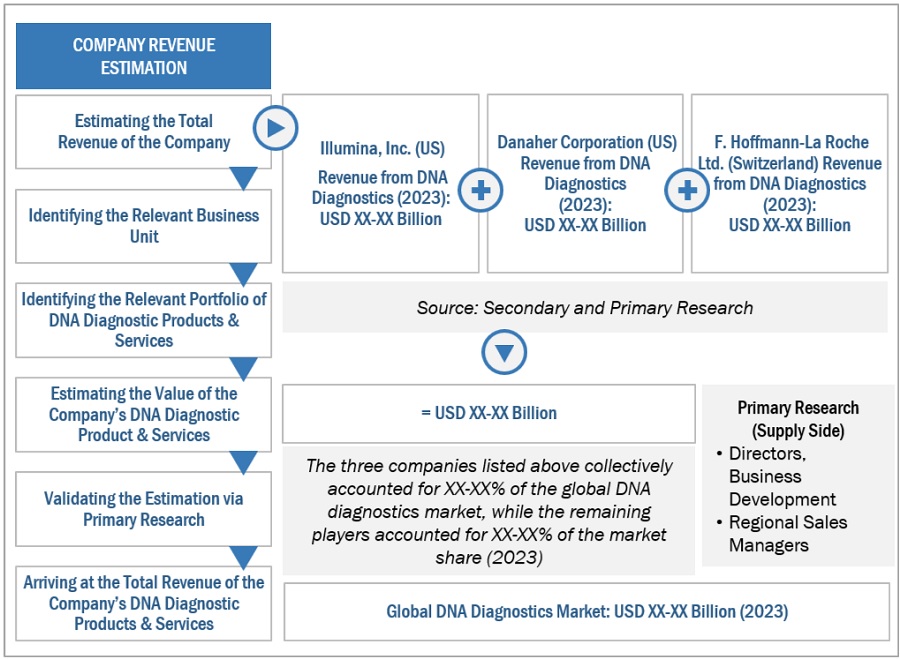
To know about the assumptions considered for the study, Request for Free Sample Report
Global DNA Diagnostics Market Size: Top-Down Approach
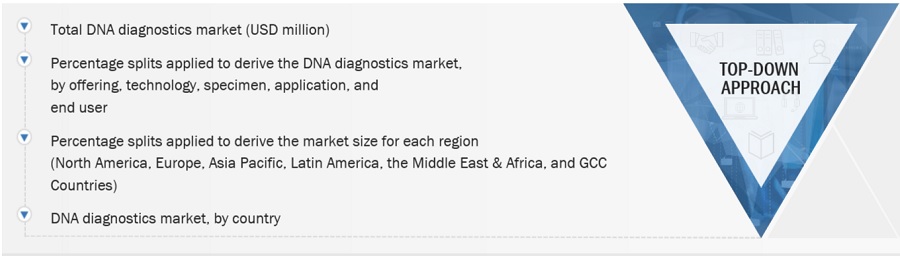
Data Triangulation
After arriving at the overall market size applying the process mentioned above, the total market was split into several segments and subsegments. To complete the overall market engineering process and arrive at the exact statistics for all segments and subsegments, data triangulation and market breakdown procedures were employed, wherever applicable. The data was triangulated by studying various factors and trends from both the demand and supply sides.
Market Definition
DNA diagnostic tests detect and analyze variations in the sequence, structure, or expression of deoxyribonucleic acid (DNA) to diagnose diseases or medical conditions. This includes identifying indications caused by specific pathogens or determining genetic carrier status.
DNA diagnostic techniques can detect numerous diseases, such as cancer, viral diseases, and myogenic disorders. They are also employed in prenatal diagnostics and clinical diagnostic confirmation.
Key Stakeholders
- Manufacturers and Distributors of DNA Diagnostic Instruments and Assays
- In Vitro Diagnostic (IVD) Companies
- Hospital Laboratories
- Diagnostic Laboratories
- Diagnostics Suppliers
- Blood Banks
- Home Health Agencies
- Market Research and Consulting Firms
- Government Associations
- Venture Capitalists and Investors
Report Objectives
- To define, describe, segment, and forecast the DNA diagnostics market by offering, technology, specimen, application, end user, and region
- To provide detailed information regarding the major factors influencing the market growth (such as drivers, restraints, opportunities, and challenges)
- To assess the DNA diagnostics market with respect to Porter’s five forces, regulatory landscape, the value chain, the supply chain, ecosystem analysis, patent protection, pricing assessment, key stakeholders, and buying criteria
- To analyze the micromarkets1 with respect to individual growth trends, prospects, and contributions to the overall DNA diagnostics market
- To analyze market opportunities for stakeholders and provide details of the competitive landscape for key players
- To forecast the size of the market segments with respect to six regions, namely, North America, Europe, Asia Pacific, Latin America, the Middle East & Africa, and GCC Countries
- To profile the key players and comprehensively analyze their product portfolios, market positions, and core competencies2
- To track and analyze company developments such as product launches & approvals, acquisitions, collaborations, expansions, and other developments
- To benchmark players within the market using the proprietary Company Evaluation Matrix framework, which analyzes market players on various parameters within the broad categories of business and product excellence
Available Customizations
With the given market data, MarketsandMarkets offers customizations to meet the company’s needs. The following customization options are available for the report:
Geographic Analysis:
Further breakdown of the DNA diagnostics market into specific countries/regions in Europe, Asia Pacific, Latin America, Middle East & Africa, and GCC Countries.
Company Information:
Detailed analysis and profiling of additional market players (up to Five), inclusive of:
- Business Overview
- Financial Information
- Product Portfolio
- Developments (last three years)
Note: Some companies are privately owned, and their revenues are unavailable in the public domain. Hence, revenues for privately owned companies will not be included in their profile. In addition, company developments that are not reported in the public domain will not be included.
Get the Full DNA Diagnostics Market Report
Full forecast, segment splits, and company analysis for all DNA Diagnostics Market.
- Canada DNA Diagnostics Market
- Germany DNA Diagnostics Market
- UK DNA Diagnostics Market
- France DNA Diagnostics Market
- Italy DNA Diagnostics Market
- Spain DNA Diagnostics Market
- China DNA Diagnostics Market
- Japan DNA Diagnostics Market
- India DNA Diagnostics Market
- Brazil DNA Diagnostics Market
- Mexico DNA Diagnostics Market
- Rest Of Europe DNA Diagnostics Market
- Rest Of Asia Pacific DNA Diagnostics Market
- Rest Of Latin America DNA Diagnostics Market
Need a Tailored Report?
Customize this report to your needs
Get 10% FREE Customization
Customize This Report
