
Brazil Drive By Wire Market (2025-2030)

The Brazil Drive By Wire Market was valued at $2788 Million in 2025 and projected to reach to $3408 Million by 2030, representing a compound annual growth rate of CAGR 2.9%. Brazil's Drive By Wire market is positioned for moderate but steady growth as the country's automotive industry modernizes and embraces electrification trends.


| Market Size in | USD 26.32 MN |
| Market Forecast in | |
| CAGR | |
| Forecast Period | |
| Units Considered | Value (USD MN) |
Brazil Drive By Wire Market Trends and Insights
- Brazil's automotive sector is gradually adopting drive-by-wire technologies as vehicle electrification and autonomous driving capabilities gain traction in the region.
- The market growth in Brazil is driven by increasing demand for advanced vehicle control systems, regulatory pressures for emissions reduction, and rising consumer interest in premium and electric vehicles equipped with modern safety features. During the 2025–2030 forecast period, Brazil is expected to experience steady expansion in drive-by-wire adoption across both passenger and commercial vehicle segments.
- Brazil's automotive manufacturers and suppliers are investing in localized production capabilities and partnerships to support the transition toward electrified and autonomous platforms.
- The relatively moderate growth rate reflects Brazil's developing infrastructure for autonomous technologies and the gradual pace of vehicle fleet modernization compared to more mature markets..
Key Market Statistics
- CAGR (2025-2030) CAGR 2.9%
- Market Size, 2025 ~USD 2788 Million
- Forecast, 2030 ~USD 3408 Million
- Country Brazil
Brazil Drive By Wire Market Overview
Market Size & Growth :
Brazil's Drive By Wire market is valued at USD 2,788 million in 2025, with projected growth to USD 3,408 million by 2030, reflecting a steady CAGR of 2.9% over the forecast period.
Electrification Adoption :
Brazil's automotive sector is increasingly embracing vehicle electrification, creating demand for advanced drive-by-wire technologies that enhance efficiency and enable autonomous driving capabilities.
Regional Market Dynamics :
While Brazil's CAGR of 2.9% trails the global average of 5.1%, the market demonstrates consistent growth potential driven by regulatory pressures and consumer demand for modern vehicle technologies.
Technology Integration :
Local automotive manufacturers and suppliers are gradually integrating drive-by-wire systems into new vehicle platforms, supporting Brazil's transition toward next-generation mobility solutions.
Brazil Drive By Wire Market Dynamics
- The adoption of drive-by-wire technologies is accelerating due to increasing consumer awareness of autonomous driving features and regulatory incentives for cleaner vehicle technologies.
- Local OEMs and tier-1 suppliers are investing in R&D to develop cost-effective solutions tailored to Brazil's market conditions. The forecast period through 2030 will see expanded integration of drive-by-wire systems across vehicle segments, particularly in premium and mid-range electric vehicles.
- Government initiatives supporting EV adoption and infrastructure development will further catalyze market growth.
- However, economic constraints and price sensitivity among Brazilian consumers may moderate growth rates compared to developed markets, requiring localized strategies from technology providers..
Market Ecosystem
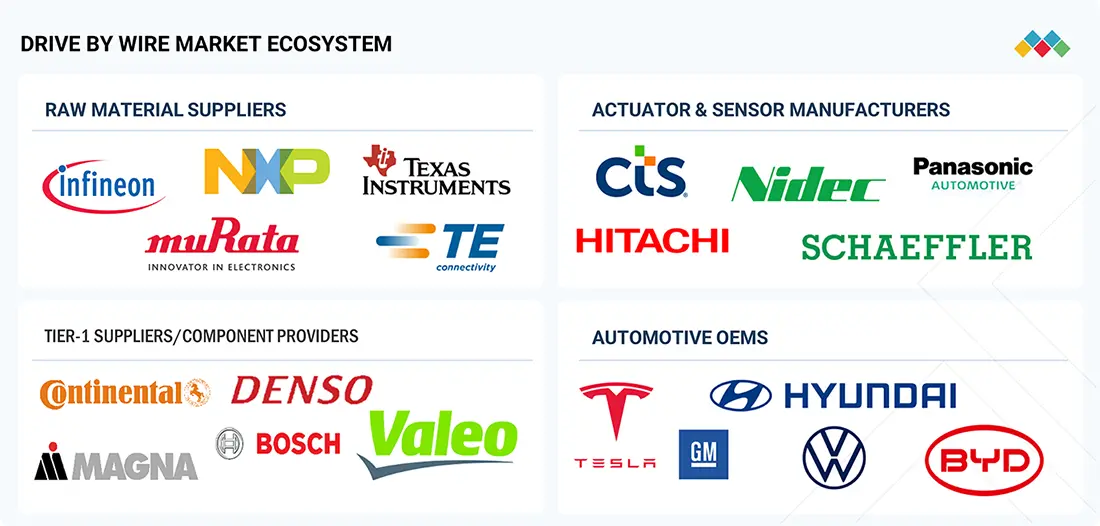
DRIVE BY WIRE MARKET: COMMERCIAL USE CASES ACROSS INDUSTRIES
| COMPANY | USE CASE DESCRIPTION | BENEFITS |
|---|---|---|
 |
Designs and supplies integrated brake by wire and steer by wire systems for passenger cars and electric vehicles, combining sensors, actuators, ECUs, and control software to replace hydraulic and mechanical linkages. | Enables precise vehicle control, improved braking consistency, enhanced ADAS integration, and compliance with global safety and functional-safety standards. |
 |
Provides complete chassis by wire solutions, including brake by wire, steer by wire, and integrated motion control platforms optimized for software-defined vehicles and electrified architectures. | Supports modular vehicle platforms, faster OEM integration, redundancy-ready architectures, and scalable deployment across ICE, hybrid, and electric vehicles. |
 |
Develops electronic braking and vehicle motion control systems that integrate brake by wire, ESC, and ADAS inputs to manage longitudinal and lateral vehicle dynamics without mechanical dependency. | Improves safety, reduces system complexity, enables energy-efficient braking for EVs, and supports automated driving functions with high reliability. |
 |
Specializes in steer by wire and electric power steering systems, including hand-wheel and pinion angle sensing, designed for passenger cars, EVs, and autonomous-ready vehicle platforms. | Delivers precise steering control, design flexibility for interiors, reduced mechanical complexity, and readiness for higher levels of vehicle automation. |
Logos and trademarks shown above are the property of their respective owners. Their use here is for informational and illustrative purposes only.
Related Ecosystem
Key Takeaways
- Brazil's Drive By Wire market is valued at USD 2,788 million in 2025 and will reach USD 3,408 million by 2030 at a 2.9% CAGR.
- Brazil's automotive sector is gradually transitioning toward electrified and autonomous vehicle platforms, driving steady demand for drive-by-wire technologies.
- Regulatory pressures for emissions reduction and consumer demand for advanced safety features are key growth catalysts in Brazil.
- Brazil's moderate growth rate reflects the developing state of autonomous driving infrastructure and the gradual modernization of the vehicle fleet.
Drive By Wire Market Report Scope
| Report Metric | Details |
|---|---|
| Base Year | 2025 |
| Fastest Growing Segment | BRAKE PEDAL SENSOR (Sensor Type) |
| Forecast Period | 2025–2030 |
| Growth Rate | CAGR of 5.1% from 2025 to 2030 |
| Largest Segment | BEV (Ev Type) |
| Market Size Base Year (Billions) | ~USD 29.07 (2025) |
| Revenue Forecast (Billions) | ~USD 37.28 (2030) |
| Segments Covered | Ice Vehicle Type, Ev Type, Sensor Type |
Brazil Drive By Wire Market Report Segmentation
3 segment dimensions are covered across the global market.
By Ice Vehicle Type
- Bus
- Light Commercial Vehicle
- Passenger Car
- Truck
By Ev Type
- Bev
- Fcev
- Phev
By Sensor Type
- Brake Pedal Sensor
BRAZIL: DRIVE BY WIRE MARKET, BY APPLICATION, 2025–2032
| Segment | 2025 | 2026 | 2027 | 2028 | 2029 | 2030 | 2031 | 2032 | CAGR (%) |
|---|---|---|---|---|---|---|---|---|---|
| BRAKE BY WIRE | 0 | 0 | 0 | 2 | 4 | 6 | 9 | 14 | 0 |
| PARK BY WIRE | 0 | 0 | 0 | 3 | 5 | 7 | 12 | 18 | 0 |
| SHIFT BY WIRE | 412 | 435 | 457 | 478 | 499 | 520 | 541 | 562 | 4.5 |
| STEER BY WIRE | 0 | 0 | 0 | 0 | 0 | 0 | 4 | 7 | 0 |
| THROTTLE BY WIRE | 2376 | 2451 | 2518 | 2579 | 2638 | 2693 | 2749 | 2807 | 4.7 |
| TOTAL | 2788 | 2886 | 2976 | 3063 | 3146 | 3226 | 3314 | 3408 | 5 |
Target Audience
- Automotive OEMs : Brazilian and international vehicle manufacturers need market intelligence to plan drive-by-wire technology integration, assess supplier capabilities, and align production strategies with regional demand.
- Tier-1 & Tier-2 Suppliers : Component and system suppliers require Brazil-specific market data to identify partnership opportunities, evaluate capacity investments, and develop competitive offerings for local OEM customers.
- Technology & Software Companies : Autonomous driving and vehicle control system developers need insights into Brazil's adoption rates, regulatory environment, and customer requirements to guide product development and commercialization.
- Investment & Private Equity Firms : Investors evaluating opportunities in Brazil's automotive technology sector require detailed market forecasts, growth drivers, and risk assessments to make informed funding and acquisition decisions.
- Consulting & Strategy Firms : Management consultants advising automotive clients on Brazil operations need country-specific market data, competitive analysis, and trend insights to develop credible strategic recommendations.
Key Companies in the Brazil Drive By Wire Market
| Company | HQ | Ownership | Strongest segments |
|---|---|---|---|
| BOREALIS AG | Austria | Private Company | Polyethylene solutions,Polypropylene solutions,Recyclates and circular solutions, |
| SPECTRA PREMIUM INDUSTRIES | Canada | Private Company | Automotive cooling (radiators, condensers, charge air coolers, intercoolers),Fuel delivery and fuel tanks,Engine management and undercar components, |
| ROBERT BOSCH GMBH | Germany | Private Company | Mobility (powertrain, chassis, automotive electronics, aftermarket),Industrial Technology (drive, control, and packaging solutions),Consumer Goods (power tools and home appliances), |
| CONTINENTAL AG | Germany | Public Company | Passenger car and light truck tires,Truck, bus, and specialty vehicle tires,Industrial rubber and conveyor solutions, |
| ZF FRIEDRICHSHAFEN AG | Germany | Private Company | Passenger car driveline, chassis, and safety systems,Commercial vehicle and fleet systems,Industrial applications (construction, agriculture, marine, wind, rail, material handling), |
| NEXTEER AUTOMOTIVE | United States | Public Company | Electric Power Steering (EPS) and Steer-by-Wire,Steering Columns and Intermediate Shafts,Driveline (Half Shafts and Related Solutions), |
| HITACHI, LTD. | Japan | Public Company | Digital Systems & Services,Green Energy & Mobility,Connective Industries, |
| HL MANDO CORP. | South Korea | Public Company | Braking systems (electronic and foundation),Steering systems (EPS and mechanical),Suspension and chassis electronics, |
| JTEKT CORPORATION | Japan | Public Company | Automotive (steering systems and drivelines),Industrial and Bearings,Machine Tools and Control Equipment, |
| THYSSENKRUPP AG | Germany | Public Company | Materials Services,Steel Europe,Automotive Technology, |
| KONGSBERG AUTOMOTIVE | Norway | Public Company | Drive Control Systems (DCS),Flow Control Systems (FCS) – brake and suspension couplings,Flow Control Systems (FCS) – clean powertrain and coolant assemblies, |
| CURTISS-WRIGHT CORPORATION | United States | Public Company | Naval & Power (pumps, valves, turbines, arresting systems, nuclear hardware),Defense Electronics (embedded computing, avionics, tactical comms, stabilization, weapons handling),Aerospace & Industrial (actuation, sensors, industrial vehicle controls, surface technologies), |
| CTS CORPORATION | United States | Public Company | Transportation sensing, controls, pedals, and switches,Industrial and factory automation sensing and motion-control,Medical, aerospace, and defense specialized components, |
| HYUNDAI MOBIS | South Korea | Public Company | Chassis, cockpit, and front-end modules,Electrification (power conversion, drive, battery, 48V mild hybrid),Autonomous driving and ADAS (driving, parking, in-cabin sensing, ECUs), |
BOREALIS AG
Borealis AG is an Austrian private company founded in 1994 that employs 5,887 people. The company operates in the chemical and materials sector.
SPECTRA PREMIUM INDUSTRIES
Spectra Premium Industries is a Canadian private company established in 1989 with 1,500 employees. The company specializes in automotive aftermarket products and components.
ROBERT BOSCH GMBH
Robert Bosch GmbH is a German private company founded in 1886 with 412,774 employees, making it one of the world's largest industrial manufacturers. The company operates across multiple sectors including automotive, industrial technology, and consumer goods.
CONTINENTAL AG
Continental AG is a German public company founded in 1871 with 22,076 employees. The company is a leading automotive supplier specializing in tires, brake systems, and vehicle electronics.
ZF FRIEDRICHSHAFEN AG
ZF Friedrichshafen AG is a German private company founded in 1915 with 145,909 employees. The company is a major global supplier of driveline and chassis technology for automotive and industrial applications.
NEXTEER AUTOMOTIVE
Nexteer Automotive is a United States public company founded in 1906 with 12,500 employees. The company specializes in steering and driveline systems for the automotive industry.
HITACHI, LTD.
Hitachi, Ltd. is a Japanese public company founded in 1910 with 287,901 employees. The company operates as a diversified conglomerate across industrial, power, and information technology sectors.
HL MANDO CORP.
HL Mando Corp. is a South Korean public company founded in 1962 with 3,585 employees. The company is an automotive supplier specializing in braking and suspension systems.
JTEKT CORPORATION
JTEKT Corporation is a Japanese public company founded in 1921 with 43,233 employees. The company manufactures bearings, steering systems, and other automotive components.
THYSSENKRUPP AG
ThyssenKrupp AG is a German public company founded in 1811 with 90,916 employees. The company operates in steel production, industrial engineering, and automotive supply.
KONGSBERG AUTOMOTIVE
Kongsberg Automotive is a Norwegian public company founded in 1957 with 4,214 employees. The company supplies automotive systems and components to the global vehicle industry.
CURTISS-WRIGHT CORPORATION
Curtiss-Wright Corporation is a United States public company founded in 1929 with 9,100 employees. The company provides engineered products and services for the aerospace, defense, and industrial markets.
CTS CORPORATION
CTS Corporation is a United States public company founded in 1896 with 3,492 employees. The company designs and manufactures sensors, actuators, and connectivity solutions for automotive and industrial applications.
HYUNDAI MOBIS
Hyundai Mobis is a South Korean public company founded in 1977. The company is a major automotive supplier providing components and systems to Hyundai and Kia vehicles.
Reasons to Buy this Report
- Market Entry Strategy : Gain detailed insights into Brazil's specific market dynamics, competitive landscape, and growth drivers to develop targeted market entry strategies and localization approaches for drive-by-wire solutions.
- Investment Decision Support : Access comprehensive forecasts and market sizing data for Brazil to evaluate investment opportunities, assess ROI potential, and identify high-growth segments within the country's automotive sector.
- Competitive Intelligence : Understand Brazil-specific competitive positioning, local supplier ecosystems, and OEM partnerships to benchmark your offerings and identify differentiation opportunities in this emerging market.
- Regulatory & Policy Insights : Stay informed on Brazil's automotive regulations, EV incentives, and technology adoption policies that directly impact drive-by-wire market growth and implementation timelines.
- Customer & Demand Analysis : Leverage Brazil-focused consumer behavior data and demand forecasts to tailor product development, pricing strategies, and go-to-market campaigns for maximum market penetration.
Frequently asked questions
What is the current size of Brazil's Drive By Wire market?
Brazil's Drive By Wire market is estimated at USD 2,788 million in 2025.
What is the projected market size for Brazil's Drive By Wire market by 2030?
Brazil's Drive By Wire market is projected to reach USD 3,408 million by 2030.
What is the CAGR for Brazil's Drive By Wire market from 2025 to 2030?
Brazil's Drive By Wire market is expected to grow at a compound annual growth rate (CAGR) of 2.9% during the 2025–2030 forecast period.
What are the primary drivers of growth in Brazil's Drive By Wire market?
Key growth drivers in Brazil include increasing vehicle electrification, regulatory pressures for emissions reduction, rising consumer demand for advanced safety features, and growing interest in autonomous driving technologies.
How does Brazil's Drive By Wire market growth compare to global trends?
Brazil's 2.9% CAGR is lower than the global 5.1% CAGR, reflecting Brazil's developing autonomous driving infrastructure and the gradual pace of vehicle fleet modernization relative to more mature markets.
RESEARCH METHODOLOGY
Exhaustive secondary research was conducted to gather information on the market based on application type, component type, sensor type, and region. The next step was to validate these findings, assumptions, and market analysis with industry experts across value chains through primary research. Bottom-up and top-down approaches were employed to estimate the complete market size for different segments considered in this study. Thereafter, market breakdown and data triangulation processes were used to estimate the market size of segments and subsegments.
Secondary Research
Secondary sources referred to for estimating the drive by wire market included automotive industry organizations, such as Organisation Internationale des Constructeurs d’Automobiles (OICA), ACEA, CAAM, IEA, and publications from government sources [country-level automotive associations and organizations, Organisation for Economic Co-operation and Development (OECD), World Bank, CDC, and Eurostat]; corporate filings (such as annual reports, investor presentations, and financial statements); and trade repositories. Additionally, historical production data was collected and analyzed, and this data was further validated by primary research
Primary Research
During the primary research process, various primary sources from the supply and demand sides were interviewed to gather qualitative and quantitative information on the market. The primary sources from the supply side included various industry experts, such as CXOs, vice presidents, directors from business development, marketing, product development/innovation teams, and related key executives from various key companies. Various system integrators, industry associations, independent consultants/industry veterans, as well as key opinion leaders, were also interviewed.
Primary interviews were conducted to gather insights, including vehicle production forecasts, drive by wire market forecasts, future technology trends, and upcoming technologies in the drive by wire market. Data triangulation was conducted across all these points, utilizing information gathered from secondary research and model mapping. Stakeholders from the demand and supply sides were interviewed to understand their views on the aforementioned points.
Primary interviews were also conducted with market experts from the demand (OEMs) and supply-side (drive by wire component manufacturers) players across four major regions, namely North America, Europe, Asia Pacific, and the Rest of the World. Approximately 30% and 70% of primary interviews were conducted from the demand and supply sides, respectively. Primary data was collected through questionnaires, emails, and telephonic interviews. In the canvassing of primaries, various departments within organizations, such as sales and operations, were covered to provide a holistic viewpoint in our report.
After interacting with industry experts, brief sessions with highly experienced independent consultants were conducted to reinforce the findings from our primaries. This, along with the opinions of our in-house subject matter experts, led us to the conclusions described in the remainder of this report
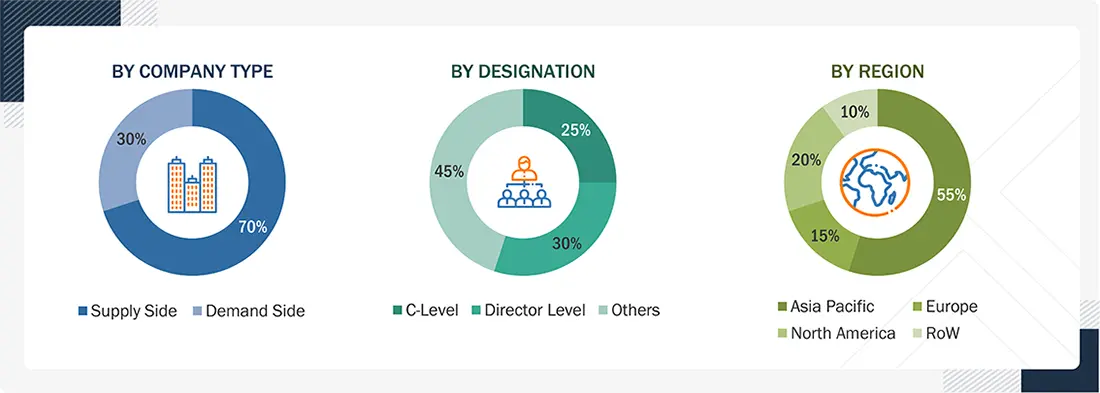
Note: Others included sales, marketing, and product managers.
To know about the assumptions considered for the study, download the pdf brochure
Market Size Estimation
A detailed market estimation approach was employed to estimate and validate the value of the drive by wire market, as well as its dependent submarkets.
Bottom-up Approach
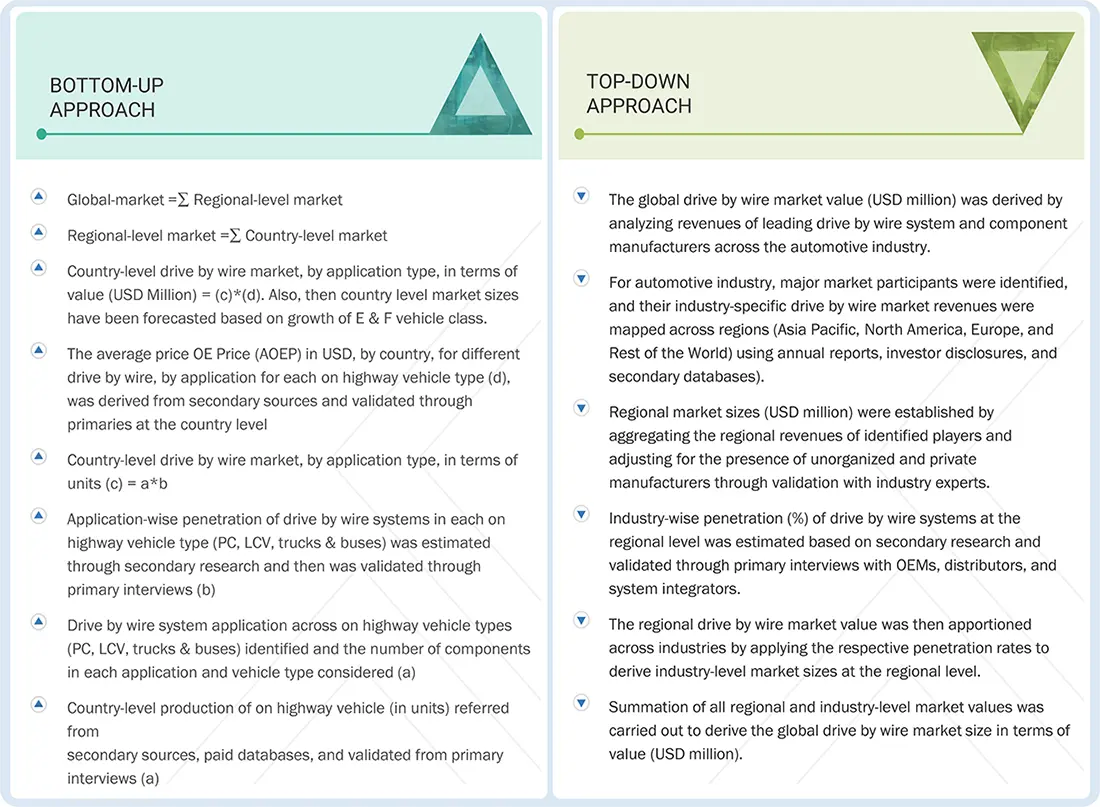
In the bottom-up approach, vehicle production of each vehicle type at the country level was considered. Penetration of each drive by wire application was derived through model mapping for each vehicle type. The country-level production by vehicle type was then multiplied by the penetration for each application to determine the market size of the market in terms of volume. The country-level market size, in terms of volume, by application, was then multiplied by the country-level average OE price of each drive by wire application to determine the market size in terms of value for each vehicle type. Summation of the country-level market size for each vehicle type by application, in terms of volume and value, would give the regional-level market size. The summation of the regional markets provided the market size. The market size for the vehicle type was derived from the global market.
Top-down Approach
The top-down approach starts with estimating the global drive by wire market value by assessing the revenue of leading manufacturers supplying drive by wire systems. Key market participants are identified, and their industry-specific drive by wire revenues are mapped across Asia Pacific, North America, Europe, and the Rest of the World using annual reports, investor disclosures, and established secondary databases.
Regional market values are derived by aggregating the mapped revenues of identified companies, with validation carried out through discussions with industry experts. Industry-wise penetration of drive by wire at the regional level is estimated through secondary research and cross-verified via primary interviews with OEMs, distributors, and system integrators. The regional market value is then distributed across end-use industries by applying the validated penetration levels, resulting in industry-level market sizes at the regional level. The global market value is finalized by consolidating all region-wise and industry-wise market estimates to arrive at the overall market size in value terms. All assumptions were cross-verified through data triangulation and primary validation to maintain consistency and reliability across the regional forecast.
Drive by Wire Market : Top-Down and Bottom-Up Approach
Data Triangulation
After arriving at the overall market size using the market size estimation processes as explained above, the market was split into several segments and subsegments. To complete the overall market engineering process and arrive at the exact statistics of each market segment and subsegment, data triangulation and market breakdown procedures were employed, wherever applicable. The data was triangulated by studying various factors and trends from both the demand and supply sides.
Market Definition
The drive by wire market covers electronic vehicle control systems that replace mechanical or hydraulic linkages with electronic signals and electrically actuated components. These systems translate driver inputs for steering, braking, acceleration, and gear selection into digital commands processed by control units and executed by actuators. Drive by wire includes steer by wire, brake by wire, throttle by wire, shift by wire, and park by wire systems. They enable precise control, flexible vehicle packaging, and software-based functionality, and are designed with redundancy and functional safety to support electric vehicles, software-defined vehicles, and advanced driver assistance systems.
Key Stakeholders
- Automotive OEMs
- EV and software-defined vehicle platform developers
- ECU and domain controller manufacturers
- Actuator and motor suppliers
- Power electronics and semiconductor suppliers
- Off-highway, agricultural, and construction equipment OEMs
- Testing, certification, and standards organizations
Report Objectives
-
To define, describe, and forecast the size of the drive by wire market in terms of value (USD million) and volume (thousand units) based on
- Steer by wire
- Brake by wire
- Shift by wire
- Park by wire
- Throttle by wire
- Autonomous vehicle drive by wire market by applications
- Region
- To identify and analyze key drivers, restraints, opportunities, and challenges influencing market growth
-
To study the following concerning the market
- Supply Chain Analysis
- Ecosystem Analysis
- Technology Analysis
- Case Study Analysis
- Patent Analysis
- Regulatory Landscape
- Pricing Analysis
- Impact of AI/Gen AI
- Trend and Disruption Impact
- Key Conferences and Events
- To understand competition in the drive by wire market and position players as stars, emerging leaders, pervasive players, and participants based on their product portfolios and business strategies
- To strategically analyze key player strategies/right to win, as well as evaluate the competitive leadership mapping
- To analyze the opportunities in the market for stakeholders and provide details of the competitive landscape for market leaders
- To provide an analysis of recent developments, such as joint ventures, mergers & acquisitions, product launches/developments, and other activities carried out by key market players.
Available customizations:
Along with the given market data, MarketsandMarkets offers customizations in accordance with a company’s specific needs. The following customizations are available:
- Drive By Wire Market, By Application, at Country Level (For Countries Covered In Report)
- By Off-Highway Vehicle Type
Get the Full Drive By Wire Market Report
Full forecast, segment splits, and company analysis for all Drive By Wire Market.
- China Drive By Wire Market
- India Drive By Wire Market
- Japan Drive By Wire Market
- South Korea Drive By Wire Market
- Thailand Drive By Wire Market
- Germany Drive By Wire Market
- France Drive By Wire Market
- Russia Drive By Wire Market
- Spain Drive By Wire Market
- UK Drive By Wire Market
- Turkey Drive By Wire Market
- Italy Drive By Wire Market
- Canada Drive By Wire Market
- Mexico Drive By Wire Market
- Iran Drive By Wire Market
- Argentina Drive By Wire Market
- South Africa Drive By Wire Market
- US Drive By Wire Market
Need a Tailored Report?
Customize this report to your needs
Get 10% FREE Customization
Customize This Report
