
China Drone Package Delivery Market (2024-2029)

The China Drone Package Delivery Market was valued at $74.9 Million in 2024 and projected to reach to $733.2 Million by 2029, representing a compound annual growth rate of 46.3%. China's drone package delivery market stands at an inflection point, driven by the convergence of e-commerce growth, urbanization, and government backing.


| Market Size in | USD 26.32 MN |
| Market Forecast in | |
| CAGR | |
| Forecast Period | |
| Units Considered | Value (USD MN) |
China Drone Package Delivery Market Trends and Insights
- This represents a compound annual growth rate of 46.3%, significantly outpacing global market expansion.
- China's dominance in the sector is driven by rapid urbanization, e-commerce penetration, and substantial government support for autonomous delivery infrastructure. The Chinese market benefits from favorable regulatory frameworks and investments by major logistics and technology companies establishing drone delivery networks across urban and rural regions.
- China's advanced manufacturing capabilities and tech ecosystem position the country as a global leader in drone package delivery innovation.
- Between 2024 and 2029, China is expected to capture an increasingly larger share of the Asia Pacific drone delivery market, with deployment accelerating in last-mile logistics and same-day delivery services. China's competitive advantages include established supply chain networks, lower operational costs, and pilot programs in major cities.
- The market's trajectory reflects China's strategic focus on modernizing logistics infrastructure and reducing delivery times through autonomous technologies..
Key Market Statistics
- CAGR (2024-2029) 46.3% CAGR
- Market Size, 2024 ~USD 74.9 Million
- Forecast, 2029 ~USD 733.2 Million
- Country China
China Drone Package Delivery Market Overview
Explosive Growth Trajectory :
China's drone package delivery market is projected to grow from $74.9 million in 2024 to $733.2 million by 2029, representing a 46.3% CAGR—significantly exceeding the global growth rate of 37.4%.
E-commerce and Urbanization Drivers :
Rapid urbanization combined with China's massive e-commerce sector creates unprecedented demand for last-mile delivery solutions, positioning drone delivery as a critical logistics innovation.
Government Support and Regulation :
Chinese government initiatives promoting autonomous delivery systems and favorable regulatory frameworks are accelerating market adoption and infrastructure development across major cities.
Technology Leadership :
China's dominance in drone manufacturing and AI capabilities positions local companies to capture significant market share in autonomous package delivery solutions.
China Drone Package Delivery Market Dynamics
- The 46.3% CAGR reflects strong momentum as logistics companies and tech firms invest heavily in autonomous delivery infrastructure.
- Major cities are establishing drone corridors and testing zones, enabling rapid commercialization.
- By 2029, the market is expected to reach $733.2 million as adoption scales across urban and suburban regions.
- Regulatory clarity and technological maturity will be critical success factors.
- Competition among domestic players will intensify, spurring innovation in battery technology, AI navigation, and regulatory compliance.
- China's market leadership will likely influence global drone delivery standards and best practices..
Market Ecosystem
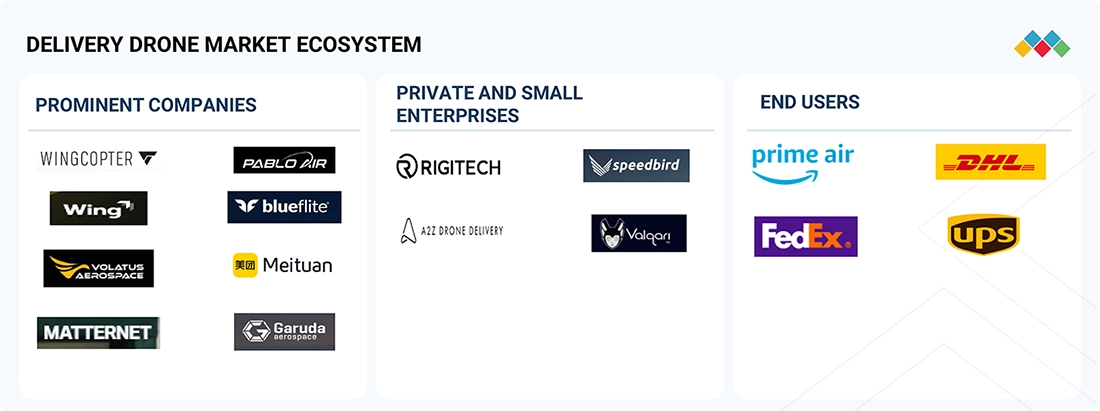
DELIVERY DRONES MARKET: COMMERCIAL USE CASES ACROSS INDUSTRIES
| COMPANY | USE CASE DESCRIPTION | BENEFITS |
|---|---|---|
 |
Wingcopter has deployed its Wingcopter 198 delivery drone for transporting medical supplies, laboratory samples, and parcels through partnerships with healthcare providers, logistics companies, and government agencies. The platform supports Beyond Visual Line of Sight (BVLOS) operations and serves both urban and remote locations. | Demonstrates the commercial viability of long-range drone delivery for healthcare and parcel logistics; supports faster deliveries, improved access to remote communities, and reduced dependence on conventional ground transportation |
 |
PABLO AIR has conducted autonomous drone delivery demonstrations and pilot projects for parcel transportation using its drone platforms and fleet management software. The company integrates drone operations with unmanned traffic management (UTM) systems to support commercial logistics. | Highlights the integration of autonomous delivery drones with digital airspace management; supports safer drone operations, scalable logistics services, and the expansion of urban drone delivery networks. |
 |
Blueflite develops autonomous cargo drones designed for transporting parcels, medical supplies, and industrial goods. Its logistics platform combines autonomous flight with fleet management software to support scheduled and on-demand delivery operations. | Demonstrates the use of autonomous drone systems for commercial logistics across healthcare and industrial applications; improves delivery efficiency while reducing transportation time for high-priority shipments |
Logos and trademarks shown above are the property of their respective owners. Their use here is for informational and illustrative purposes only.
Related Ecosystem
Key Takeaways
- China's drone package delivery market will grow from $74.9M (2024) to $733.2M (2029) at a 46.3% CAGR, nearly 25x expansion in five years.
- China leads Asia Pacific adoption due to e-commerce scale, urbanization, and government regulatory support for autonomous logistics.
- Major Chinese tech and logistics companies are investing heavily in drone delivery networks for last-mile and same-day delivery services.
- China's manufacturing expertise and cost advantages position it as the global innovation hub for drone package delivery technology.
Drone Package Delivery Market Report Scope
| Report Metric | Details |
|---|---|
| Base Year | 2024 |
| Fastest Growing Segment | >5 KILOGRAMS (Package Size) |
| Forecast Period | 2024–2029 |
| Growth Rate | CAGR of 37.4% from 2024 to 2029 |
| Largest Segment | SHORT DURATION (<30 MINUTES) (Duration) |
| Market Size Base Year (Billions) | ~USD 0.69 (2024) |
| Revenue Forecast (Billions) | ~USD 3.39 (2029) |
| Segments Covered | Solution, Platform, Software, Infrastructure, Range, Type, Package Size, Duration, Operation Mode, End Use |
China Drone Package Delivery Market Report Segmentation
10 segment dimensions are covered across the global market.
By Solution
- Infrastructure
- Platform
- Service
- Software
By Platform
- Airframe
- Avionics & Sensory Payload
- Propulsion
- Software
By Software
- Computer Vision
- Fleet Management
- Inventory Management
- Live Tracking
- Route Planning & Optimizing
By Infrastructure
- Charging Stations
- Ground Control Stations
- Landing Pads
- Micro-Fulfilment Centers
By Range
- Long Range (>50 Kilometers)
- Medium Range (25-50 Kilometers)
- Short Range (<25 Kilometers)
By Type
- Fixed Wing
- Hybrid
- Multirotor
By Package Size
- 2–5 Kilograms
- <2 Kilograms
- >5 Kilograms
By Duration
- Long Duration (>30 Minutes)
- Short Duration (<30 Minutes)
By Operation Mode
- Fully Autonomous
- Partially Autonomous
By End Use
- Blood Supply
- Equipment Transport
- Food Delivery
- Industrial Delivery
- Maritime Delivery
- Medical Aid Delivery
- Medicine Supply
- Organ Transport
- Postal Delivery
- Precision Agriculture
- Retail Goods Delivery
- Weapons & Ammunition Delivery
Target Audience
- Logistics & Delivery Companies : Chinese and international logistics providers need market data to evaluate drone integration feasibility, assess competitive positioning, and plan last-mile delivery transformation investments.
- Drone & Aerospace Manufacturers : Manufacturers require detailed market forecasts and demand drivers to guide R&D investments, production capacity planning, and product development for China's high-growth delivery segment.
- E-commerce & Retail Enterprises : Major e-commerce platforms and retailers need market insights to evaluate drone delivery partnerships, understand cost-benefit economics, and enhance customer delivery experiences.
- Investment & Private Equity Firms : Investors seeking exposure to China's autonomous delivery sector require comprehensive market analysis, growth validation, and competitive intelligence to identify high-potential investment targets.
- Government & Policy Makers : Chinese regulatory bodies and urban planners need market data to inform drone corridor policies, safety standards, and infrastructure investments supporting autonomous delivery ecosystems.
Key Companies in the China Drone Package Delivery Market
| Company | HQ | Ownership | Strongest segments |
|---|---|---|---|
| ALPHABET INC. | United States | Public Company | Platform (aircraft, UTM, routing stack),Infrastructure (ground stations, charging, depots),Software (SaaS, APIs, analytics), |
| MATTERNET, INC. | United States | Private Company | Platform (UAS hardware + integrated network platform),Infrastructure (stations, depots, ground systems),Software (network management, routing, control), |
| FEDEX | United States | Public Company | Platform (Drone Hardware and Integrated Systems),Infrastructure (Hubs, Vertiports, Charging, Ground Systems),Software (Routing, Fleet Management, Dataworks Integration), |
| AIRBUS | United States | Public Company | Platform,Service,Software, |
| EHANG | China | Public Company | Platform (UAVs and eVTOL aircraft used for logistics),Infrastructure (vertiports, charging piles, ground systems),Software (airborne systems, command-and-control, UAM platform), |
| AMAZON.COM, INC. | United States | Public Company | Platform (Drone Hardware and Integrated Systems),Infrastructure (Fulfillment, Vertiports, Charging),Software (Routing, Fleet, Airspace Integration), |
| DRONE DELIVERY CANADA CORP. | Canada | Public Company | Platform (industrial-grade drones and FLYTE software licenses),Infrastructure (DroneSpot depots, battery systems, detect-and-avoid radar),Software (standalone FLYTE platform and integrations), |
| JD.COM | China | Public Company | Platform (drone hardware and integrated delivery platform),Infrastructure (fulfillment nodes, vertiports, charging),Software (autonomy, fleet management, optimization), |
| WALMART | United States | Public Company | Platform (drones, onboard systems),Infrastructure (vertiports, charging, ground systems),Software (routing, fleet, integration), |
ALPHABET INC.
Alphabet Inc. is a publicly traded American technology company founded in 1998 with 194,668 employees, serving as the parent company of Google and other subsidiaries.
MATTERNET, INC.
Matternet, Inc. is a privately held American company founded in 2011 with 50 employees, specializing in autonomous drone delivery technology.
FEDEX
FedEx is a publicly traded American logistics company founded in 1971 with 405,000 employees, providing courier and freight delivery services worldwide.
AIRBUS
Airbus is a publicly traded American aerospace company founded in 1998 with 166,876 employees, engaged in aircraft manufacturing and related services.
EHANG
EHang is a publicly traded Chinese company founded in 2014 with 829 employees, specializing in autonomous aerial vehicle technology and urban air mobility.
AMAZON.COM, INC.
Amazon.com, Inc. is a publicly traded American technology and e-commerce company founded in 1994 with 1,576,000 employees, operating in retail, cloud services, and logistics.
DRONE DELIVERY CANADA CORP.
Drone Delivery Canada Corp. is a publicly traded Canadian company founded in 2011 with 30 employees, developing autonomous drone delivery solutions.
JD.COM
JD.com is a publicly traded Chinese e-commerce and logistics company founded in 2006 with 900,000 employees, providing online retail and supply chain services.
WALMART
Walmart is a publicly traded American retail company founded in 1945 with 2,100,000 employees, operating as one of the world's largest discount retailers.
Reasons to Buy this Report
- Market Size & Growth Validation : Obtain precise market valuation ($74.9M in 2024) and verified growth projections through 2029, enabling accurate financial planning and investment decisions specific to China's market dynamics.
- Competitive Landscape Intelligence : Understand China's unique competitive environment, including dominant local players, technology capabilities, and market consolidation trends to identify partnership and acquisition opportunities.
- Regulatory & Policy Insights : Access detailed analysis of Chinese government support mechanisms, regulatory frameworks, and autonomous delivery approvals that directly impact market entry and operational strategies.
- Regional Expansion Strategy : Leverage city-level market segmentation and urbanization data to prioritize geographic expansion, identify high-potential zones, and optimize resource allocation across China.
- Technology & Supply Chain Trends : Gain insights into China's drone manufacturing ecosystem, battery technology advancements, and logistics integration strategies to benchmark capabilities and identify innovation gaps.
Frequently asked questions
What is the current size of China's drone package delivery market?
China's drone package delivery market was valued at $74.9 million in 2024 and is projected to reach $733.2 million by 2029.
What is the growth rate of China's drone delivery market?
China's drone package delivery market is growing at a compound annual growth rate (CAGR) of 46.3% from 2024 to 2029.
Why is China's drone delivery market growing faster than the global average?
China benefits from massive e-commerce demand, rapid urbanization, favorable government policies, advanced manufacturing capabilities, and significant investments by major logistics and technology companies.
Which companies are leading China's drone delivery market?
Major Chinese tech companies, e-commerce platforms, and logistics providers are establishing drone delivery networks, though specific market leaders vary by region and service type.
What are the main applications of drone delivery in China?
Primary applications include last-mile logistics, same-day delivery services, rural area delivery, and urban package distribution across China's major metropolitan regions.
RESEARCH METHODOLOGY
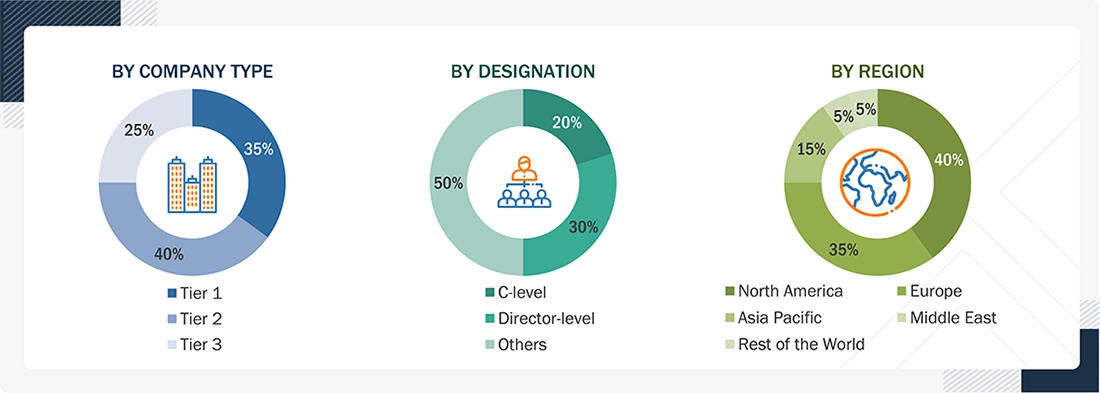
The study involved four major activities in estimating the current size of the delivery drone market. Exhaustive secondary research was done to collect information on the market, its adjacent markets, and its parent market. The next step was to validate these findings, assumptions, and sizing with industry experts across the value chain through primary research. Demand-side analysis was conducted to estimate the overall market size. After that, market breakdown and data triangulation procedures were employed to estimate the sizes of various segments and subsegments within the market.
Secondary Research
During the secondary research process, various sources were consulted to identify and collect information for this study. The secondary sources included government sources, such as SIPRI; corporate filings, including annual reports, press releases, and investor presentations from companies; white papers, journals, and certified publications; and articles from recognized authors, directories, and databases.
Primary Research
Extensive primary research was conducted after acquiring information regarding the delivery drone market scenario through secondary research. Several primary interviews were conducted with market experts from the demand and supply sides across major countries of North America, Europe, Asia Pacific, and the Rest of the World (RoW). Primary data was collected through questionnaires, emails, and telephonic interviews.
To know about the assumptions considered for the study, download the pdf brochure
Market Size Estimation
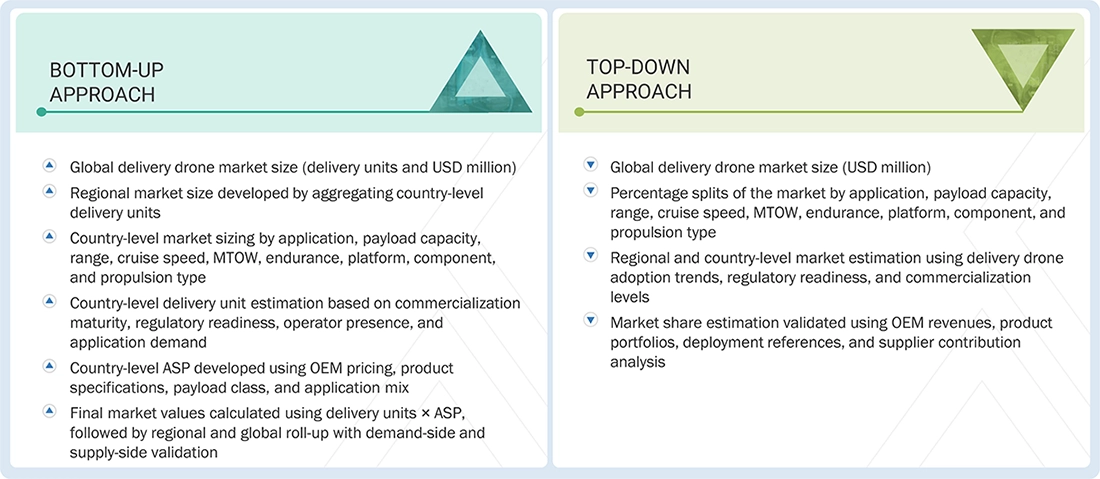
The top-down and bottom-up approaches were used to estimate and validate the size of the delivery drone market. The research methodology used to estimate the size of the market included the following details:
- Key players in the delivery drone market were identified through secondary research, and their market shares were determined through a combination of primary and secondary research. This included a study of the annual and financial reports of the top market players, as well as extensive interviews with leaders, including directors, engineers, marketing executives, and other key stakeholders of leading companies operating in the market.
- All percentage shares, splits, and breakdowns were determined using secondary sources and verified through primary sources.
- All possible parameters that affect the markets covered in this research study were accounted for, viewed in extensive detail, verified through primary research, and analyzed to obtain the final quantitative and qualitative data on the delivery drone market. This data was consolidated, enhanced with detailed inputs, analyzed by MarketsandMarkets, and presented in this report.
Delivery Drone Market Size: Bottom-up & Top-Down Approach
Data Triangulation
After determining the overall market size, the total market was divided into several segments and subsegments. The data triangulation and market breakdown procedures explained below were implemented, wherever applicable, to complete the overall market engineering process and arrive at the estimated market numbers for the market segments and subsegments. The data was triangulated by studying various factors and trends from the demand and supply sides. Additionally, the market size was validated using top-down and bottom-up approaches.
Market Definition
The delivery drone market encompasses unmanned aerial vehicles and associated delivery-specific systems used to transport lightweight goods, parcels, medical supplies, food, retail products, industrial samples, agricultural inputs, and other small commercial payloads from one point to another. The market is limited to delivery drones with cargo/payload capacity of up to 10 kg and includes drone platforms, onboard cargo-carrying systems, navigation and communication systems, ground control infrastructure, fleet management software, docking/charging systems, and integration services required for safe and reliable autonomous or remotely supervised delivery operations.
These systems are installed and operated across healthcare logistics, retail and e-commerce delivery, food and grocery delivery, postal and courier services, industrial site logistics, agriculture support logistics, campus delivery, remote-area supply, and emergency logistics. The market includes both new drone deployment and replacement, upgrade, modernization, and fleet expansion of delivery drone systems.
Key Stakeholders
- Delivery Drone Manufacturers & OEMs
- Logistics, Courier, Retail & E-commerce Companies
- Healthcare Organizations & Medical Logistics Providers
- Government Agencies, Emergency Services & Public Safety Organizations
- Defense Organizations & Military Logistics Units
- Drone Delivery Service Providers & Fleet Operators
- Software, Autonomy, Fleet Management & UTM Solution Providers
- Component Suppliers (Battery, Propulsion, Navigation, Communication & Payload Systems)
- Infrastructure Providers (Drone Ports, Charging Stations & Ground Support Systems)
- System Integrators, Maintenance, Training & Lifecycle Support Providers
- Civil Aviation Authorities, Air Navigation Service Providers & Regulatory Bodies
- Research Institutions, Universities & Industry Associations
Report Objectives
- To define, describe, segment, and forecast the size of the delivery drone market based on component, payload capacity, cruise speed, range, MTOW, endurance, platform, propulsion type, and application
- To forecast the size of market segments across five regions: North America, Europe, Asia Pacific, Middle East, and the Rest of the World
- To identify and analyze key drivers, restraints, opportunities, and challenges influencing the growth of the market
- To identify industry trends, market trends, and technology trends in the market
- To analyze micro markets with respect to individual technology trends, growth prospects, and their contribution to the overall market
- To strategically profile key market players and analyze their market position and core capabilities
- To provide a detailed competitive landscape of the market and analyze competitive strategies such as product launches, partnerships, agreements, and collaborations adopted by key players
- To assess the financial position of key players along with their key products, unique offerings, and recent developments
Available customizations:
MarketsandMarkets offers the following customizations for this market report:
- Additional country-level analysis of the delivery drone market
- Profiling of other market players (up to 5)
Product Analysis
- Product matrix, which provides a detailed comparison of the product portfolio of each company in the delivery drone market
Get the Full Drone Package Delivery Market Report
Full forecast, segment splits, and company analysis for all Drone Package Delivery Market.
- Canada Drone Package Delivery Market
- US Drone Package Delivery Market
- UK Drone Package Delivery Market
- Germany Drone Package Delivery Market
- France Drone Package Delivery Market
- Switzerland Drone Package Delivery Market
- India Drone Package Delivery Market
- Japan Drone Package Delivery Market
- Australia Drone Package Delivery Market
- Malaysia Drone Package Delivery Market
- UAE Drone Package Delivery Market
- Saudi Arabia Drone Package Delivery Market
- Brazil Drone Package Delivery Market
- Mexico Drone Package Delivery Market
- Peru Drone Package Delivery Market
- Rest Of Europe Drone Package Delivery Market
- Rest Of Asia Pacific Drone Package Delivery Market
- Middle East Drone Package Delivery Market
- Rest Of Latin America Drone Package Delivery Market
- Rest Of Middle East Drone Package Delivery Market
- Israel Drone Package Delivery Market
Need a Tailored Report?
Customize this report to your needs
Get 10% FREE Customization
Customize This Report
