
Asia Pacific E-fuels Market (2025-2030)

The Asia Pacific E-fuels Market was valued at $1973 Million in 2025 and projected to reach to $22851.9 Million by 2030, representing a compound annual growth rate of 63.2%. Asia Pacific is poised to become the world's fastest-growing e-fuels market, driven by China and India's massive investments in green hydrogen infrastructure and synthetic fuel production.


| Market Size in | USD 26.32 MN |
| Market Forecast in | |
| CAGR | |
| Forecast Period | |
| Units Considered | Value (USD MN) |
Asia Pacific E-fuels Market Trends and Insights
- This exceptional 63.2% compound annual growth rate significantly outpaces the global average of 22%, reflecting Asia Pacific's accelerating transition toward sustainable energy solutions and decarbonization initiatives.
- Asia Pacific's rapid industrialization, coupled with stringent environmental regulations and substantial government investments in green hydrogen and synthetic fuel infrastructure, positions the region as a frontrunner in e-fuels adoption. The Asia Pacific e-fuels market is driven by rising energy demand, supportive policy frameworks, and technological advancements across major economies including China, Japan, South Korea, and India.
- Asia Pacific's strategic focus on achieving net-zero emissions targets and reducing transportation sector carbon footprints is catalyzing investment in e-fuel production facilities and distribution networks.
- By 2030, Asia Pacific is expected to capture a substantially larger share of global e-fuels capacity, establishing itself as both a major producer and consumer of advanced synthetic fuels..
Key Market Statistics
- CAGR (2025-2030) 63.2% CAGR
- Market Size, 2025 ~USD 1973 Million
- Forecast, 2030 ~USD 22851.9 Million
- Geography Asia Pacific
Asia Pacific E-fuels Market Overview
Exceptional Growth Trajectory :
Asia Pacific's e-fuels market is experiencing unprecedented expansion at 63.2% CAGR, nearly three times the global average of 22%, driven by aggressive decarbonization policies and renewable energy investments across the region.
Market Size Expansion :
The region's market is projected to grow from $1,973.0 million in 2025 to $22,851.9 million by 2030, representing an 11.6x increase and establishing Asia Pacific as a dominant force in global e-fuels adoption.
China and India Leadership :
China ($9,540.1 million) and India ($4,809.3 million) are the primary growth catalysts, accounting for a substantial portion of Asia Pacific's market value and driving technological innovation and infrastructure development.
Strategic Regional Positioning :
Asia Pacific's abundant renewable energy resources, manufacturing capabilities, and government support for green hydrogen and synthetic fuels position the region as a critical hub for e-fuels production and commercialization.
Asia Pacific E-fuels Market Dynamics
- Government mandates for carbon neutrality, coupled with declining renewable energy costs, are accelerating the transition from fossil fuels to e-fuels across transportation, industrial, and power generation sectors.
- The region's manufacturing expertise and supply chain capabilities further enhance its competitive advantage. By 2030, Asia Pacific's e-fuels market will represent a transformative shift in the region's energy landscape.
- Emerging economies are leveraging e-fuels to achieve climate targets while maintaining energy security and industrial competitiveness.
- Strategic partnerships between governments, energy companies, and technology providers are establishing Asia Pacific as the global epicenter for e-fuels innovation, production, and deployment..
Market Ecosystem
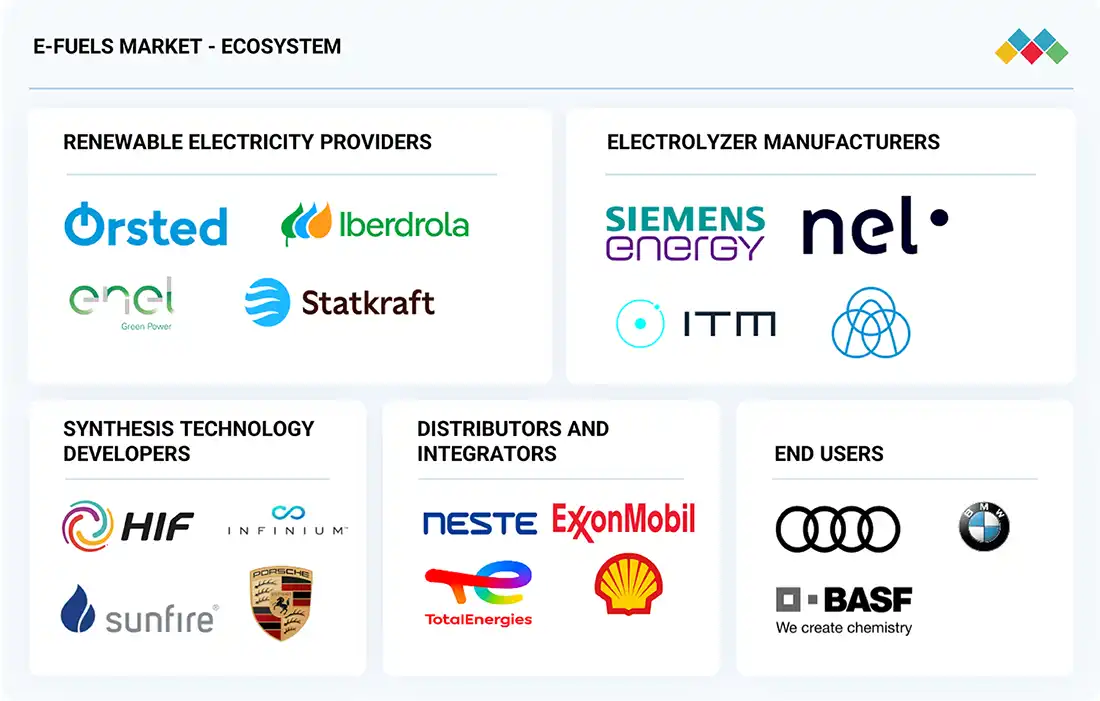
E-fuels Market: COMMERCIAL USE CASES ACROSS INDUSTRIES
| COMPANY | USE CASE DESCRIPTION | BENEFITS |
|---|---|---|
 |
Bioagra, Poland’s leading bioethanol producer, aimed to expand into e-fuels to support the energy shift and meet rising demand for sustainable fuels like e-methanol and Sustainable Aviation Fuel (SAF). However, uncertainty lingered over the best technology route, plant design, power strategy, and cost structure to ensure commercial success and the lowest levelized cost of production (LCOx) from biogenic CO2 and green hydrogen. | When demand is high, stored e-fuels such as e-methanol and SAF are released to meet the energy needs of the aviation and transportation sectors. This system is designed to supply Bioagra's fuel requirements for an entire year by storing and releasing e-fuels as needed. Engineers studied integrating biogenic CO2 and green hydrogen with optimized technology pathways and plant designs to capture excess renewable energy during peak production periods. The stored e-fuels were then used to achieve the lowest LCOx, improve round-trip efficiencies of 50-60%, and enhance the commercial viability of sustainable fuel production. |
 |
The transport sector’s dependence on fossil fuels still significantly contributes to global carbon emissions. Decarbonizing fuel-heavy applications like passenger vehicles requires sustainable options that work with existing infrastructure. However, large-scale production of carbon-neutral liquid fuels remains limited due to difficulties in combining renewable electricity, hydrogen production, and CO2 utilization technologies. | When demand is high, the stored carbon-neutral liquid fuels are released to meet the energy needs of passenger vehicles. This system is designed to supply EcoFuel Innovations' fuel requirements for a full year by storing and releasing e-fuels as necessary. Engineers examined the integration of renewable electricity, hydrogen production, and CO2 utilization to capture excess energy during periods of high renewable output. The stored e-fuels are then used to support existing fuel infrastructure, achieving round-trip efficiencies of 45-55%, which helps promote the adoption of sustainable transportation solutions. |
Logos and trademarks shown above are the property of their respective owners. Their use here is for informational and illustrative purposes only.
Related Ecosystem
Decarbonization
- Battery Electric Vehicle (BEV)
- Energy Management Systems
- Fuel Cell
- Fuel Cell Electric Vehicle (FCEV)
- Geographical Information System (GIS)
- TotalEnergies SE
- Siemens ag
- Mitsui & Co., Ltd.
- General Electric Company
- Thyssenkrupp ag
Key Takeaways
- Asia Pacific e-fuels market is projected to grow from $1,973.0M (2025) to $22,851.9M (2030) at a 63.2% CAGR, far exceeding global growth rates.
- Asia Pacific's rapid industrialization and net-zero commitments are driving substantial investments in green hydrogen and synthetic fuel infrastructure across the region.
- Major Asia Pacific economies including China, Japan, South Korea, and India are leading e-fuels adoption through supportive policies and technological innovation.
- Asia Pacific is positioned to become a dominant global hub for e-fuels production and consumption by 2030, reshaping the region's energy landscape.
E-fuels Market Report Scope
| Report Metric | Details |
|---|---|
| Base Year | 2025 |
| Fastest Growing Segment | E-AMMONIA (Type) |
| Forecast Period | 2025-2030 |
| Growth Rate | CAGR of 22% from 2025 to 2030 |
| Largest Segment | FUEL (Application) |
| Market Size Base Year (Billions) | ~USD 24.51 (2025) |
| Revenue Forecast (Billions) | ~USD 66.25 (2030) |
| Segments Covered | Type, State, Application, End Use, End-Use |
Asia Pacific E-fuels Market Report Segmentation
5 segment dimensions are covered across the global market.
By Type
- E-Ammonia
- E-Diesel
- E-Gasoline
- E-Kerosene
- E-Methane
- E-Methanol
By State
- Gaseous (Power-To-Gas)
- Liquid (Power-To-Liquid)
By Application
- Fuel
- Non-Fuel
By End Use
- Chemicals
- Grid Injection
- Other End Uses
- Power Generation
- Transportation
By End-Use
- Chemicals
- Grid Injection
- Other End Uses
- Power Generation
- Transportation
Target Audience
- Energy & Utility Companies : Strategic planning for renewable energy integration and e-fuels production capacity expansion across Asia Pacific's high-growth markets.
- Automotive & Transportation OEMs : Market assessment for e-fuel vehicle compatibility and infrastructure readiness in Asia Pacific's emerging sustainable transportation landscape.
- Chemical & Industrial Manufacturers : Evaluation of synthetic fuel adoption for decarbonizing industrial processes and meeting ESG commitments in Asia Pacific operations.
- Investment & Private Equity Firms : Due diligence and portfolio optimization for e-fuels ventures, startups, and infrastructure projects across high-growth Asia Pacific markets.
- Government & Policy Makers : Evidence-based policy development and regulatory framework design to accelerate e-fuels adoption and achieve regional decarbonization targets.
Countries within Asia Pacific - compare and drill down
| Country | 2025 size (native) |
|---|---|
| China | USD 9540.1 Million |
| India | USD 4809.3 Million |
| Australia | USD 2261.9 Million |
| Rest Of Asia Pacific | USD 6240.6 Million |
Country market size visualization
Reasons to Buy this Report
- Regional Growth Intelligence : Gain comprehensive insights into Asia Pacific's 63.2% CAGR trajectory, understanding market drivers, investment patterns, and growth opportunities that significantly outpace global averages.
- Country-Level Market Analysis : Access detailed market sizing and forecasts for key Asia Pacific economies including China, India, and Australia, enabling targeted strategic planning and market entry decisions.
- Competitive Landscape Mapping : Identify leading players, emerging competitors, and technology innovators within Asia Pacific's rapidly evolving e-fuels ecosystem to inform partnership and investment strategies.
- Policy and Regulatory Framework : Understand region-specific government mandates, carbon neutrality targets, and incentive structures driving e-fuels adoption across Asia Pacific markets.
- Investment and Expansion Roadmap : Develop data-driven expansion strategies with market projections through 2030, identifying high-potential segments, geographies, and value chain opportunities in Asia Pacific.
Frequently asked questions
What is the projected market size of e-fuels in Asia Pacific by 2030?
Asia Pacific's e-fuels market is projected to reach $22,851.9 million by 2030, growing from $1,973.0 million in 2025.
What is the CAGR for Asia Pacific's e-fuels market?
Asia Pacific's e-fuels market is expected to grow at a compound annual growth rate of 63.2% between 2025 and 2030.
Which countries are driving e-fuels growth in Asia Pacific?
Major drivers in Asia Pacific include China, Japan, South Korea, and India, which are investing heavily in green hydrogen and synthetic fuel infrastructure.
Why is Asia Pacific's e-fuels growth rate higher than the global average?
Asia Pacific's rapid industrialization, stringent environmental regulations, net-zero commitments, and substantial government investments in sustainable energy are accelerating e-fuels adoption beyond global averages.
What are the primary applications for e-fuels in Asia Pacific?
Asia Pacific e-fuels are primarily used in transportation, aviation, and industrial sectors to reduce carbon emissions and meet decarbonization targets.
RESEARCH METHODOLOGY
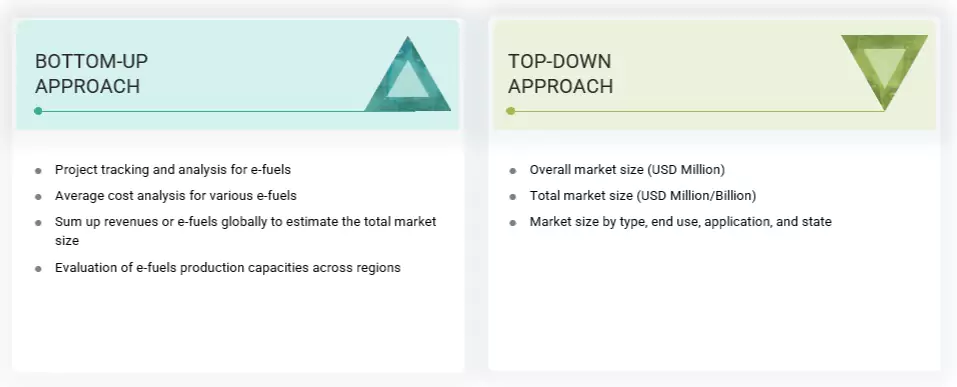
The study involved major activities in estimating the current size of the e-fuels market. Exhaustive secondary research was done to collect information on the peer and parent markets. The next step was to validate these findings, assumptions, and sizing with industry experts across the value chain through primary research. Both top-down and bottom-up approaches were employed to estimate the complete market size. Thereafter, market breakdown and data triangulation were used to estimate the market size of the segments and subsegments.
Secondary Research
The secondary sources referred to for this research study included annual reports, press releases, investor presentations of companies, white papers, certified publications, articles from recognized authors, and databases of various companies and associations. Secondary research has been mainly used to obtain key information about the industry's supply chain, market's monetary chain, total pool of key players, market classification and segmentation according to industry trends to the bottom-most level, regional markets, and key developments from both market- and technology-oriented perspectives.
Primary Research
In the primary research process, various primary sources from both the supply and demand sides have been interviewed to obtain qualitative and quantitative information for this report. Primary sources from the supply side include industry experts, such as CEOs, vice presidents, marketing directors, technology & innovation directors, and related key executives from various companies and organizations operating in the e-fuels market.
In the complete market engineering process, the top-down and bottom-up approaches and several data triangulation methods have been used to perform market estimation and market forecasts for the market segments and subsegments listed in this report. Extensive qualitative and quantitative analyses have been performed in the market engineering process to list key information/insights in the report.
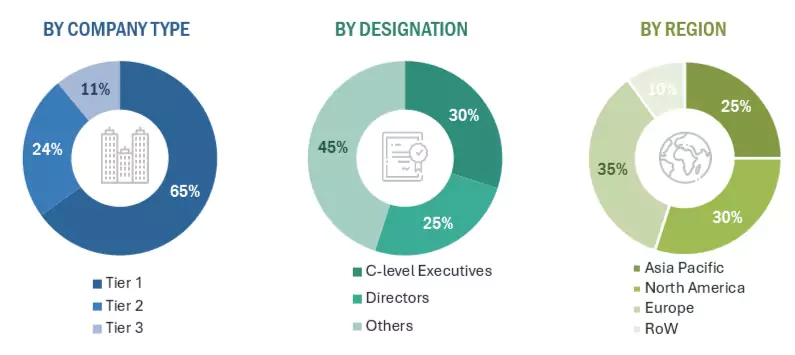
To know about the assumptions considered for the study, download the pdf brochure
Market Size Estimation
Both top-down and bottom-up approaches have been used to estimate and validate the size of the global e-fuels market and its dependent submarkets. The key application areas in the market have been identified through secondary research, while their market shares in respective regions have been identified through both primary and secondary research. The data included in the study is from the annual and financial reports of the top market players and interviews with industry experts, such as CEOs, VPs, directors, sales managers, and marketing executives, for key quantitative and qualitative insights into the market. The following segments provide details about this study's overall market size estimation process.
E-fuels Market : Top-Down and Bottom-Up Approach
Data Triangulation
After arriving at the overall market size from the estimation process explained below, the total market has been split into several segments and subsegments. Where applicable, data triangulation and market breakdown procedures have been employed to complete the overall market engineering process and arrive at the exact statistics for all the segments and subsegments. The data has been triangulated by studying various factors and trends from the demand and supply sides. The market has also been validated using both top-down and bottom-up approaches.
Market Definition
E-fuels or electrofuels are renewable or low-carbon liquid or gaseous fuels. They are produced by combining renewable electricity, often sourced from wind or solar power, with carbon dioxide (CO2). This process creates synthetic hydrocarbon-based fuels such as e-diesel or e-kerosene that can replace conventional fossil fuels. E-fuels are particularly useful for aviation and heavy industries because direct electrification is difficult. However, producing e-fuels requires significant renewable energy input and faces challenges regarding costs and scalability. Despite these challenges, e-fuels can play a crucial role in achieving a sustainable and carbon-neutral energy landscape, helping to combat climate change and reduce greenhouse gas emissions.
The market size for e-fuels is the sum of revenue generated by suppliers of various types of e-fuels, such as e-diesel, e-ammonia, e-kerosene, e-gasoline, e-methane, and e-methanol. The e-fuels market for North America, Europe, Asia Pacific, and RoW has been analyzed.
Stakeholders
- E-fuel vendors
- Consulting companies in the energy & power sector
- Consulting companies related to the energy & power sector
- Energy regulators
- Government and research organizations
- Power and energy associations
- Repairs and maintenance service providers
- State and national regulatory authorities
- Research and consulting companies in the clean energy generation sector
- Organizations, forums, alliances, and associations
- Industrial authorities and associations
- State and national regulatory authorities
- Research institutes
Report Objectives
- To define, describe, segment, and forecast the size of the e-fuels market based on fuel type, state, end-use application, and region, in terms of value
- To provide information about the renewable sources used in manufacturing e-fuels
- To segment and forecast the size of the e-fuels market based on fuel type and region, in terms of volume
- To assess the market sizes for North America, Europe, Asia Pacific, and the Rest of the World region
- To offer detailed information regarding key drivers, restraints, opportunities, and challenges influencing the growth of the e-fuels market
- To provide the supply chain analysis, trends/disruptions impacting customer business, ecosystem analysis, regulatory landscape, patent analysis, case study analysis, technology analysis, key conferences & events, the impact of AI/Gen AI, macroeconomic outlook, pricing analysis, porter's five forces analysis, and regulatory analysis, the impact of 2025 US tariff on the market
- To analyze opportunities for stakeholders in the e-fuels market and draw a competitive landscape of the market
- To benchmark market players using the company evaluation matrix, which analyzes market players on broad categories of business and product strategies adopted by them
- To compare key market players for the market share, product specifications, and end-use
- To strategically profile key players and comprehensively analyze their market ranking and core competencies
- To analyze competitive developments, such as contracts, agreements, partnerships, and joint ventures, in the e-fuels market
Available Customizations
MarketsandMarkets offers customizations according to the specific needs of the companies using the given market data.
The following customization options are available for the report:
Product Analysis
- Product matrix, which gives a detailed comparison of the product portfolio of each company
Geographic Analysis as per Feasibility
- Further breakdown of the e-fuels market, by Europe, Asia Pacific, North America, and Rest of the World.
Company Information
- Detailed analysis and profiling of additional market players (up to five)
Get the Full E-fuels Market Report
Full forecast, segment splits, and company analysis for all E-fuels Market.
Need a Tailored Report?
Customize this report to your needs
Get 10% FREE Customization
Customize This Report
