
GCC Countries Edge Computing Market (2026-2031)

The GCC Countries Edge Computing Market was valued at $2451.4 Million in 2026 and projected to reach to $7079.2 Million by 2031, representing a compound annual growth rate of 23.6%. The GCC Countries edge computing market is poised for exceptional growth through 2031, driven by aggressive digital transformation policies and substantial government investments in smart infrastructure.


| Market Size in | USD 26.32 MN |
| Market Forecast in | |
| CAGR | |
| Forecast Period | |
| Units Considered | Value (USD MN) |
GCC Countries Edge Computing Market Trends and Insights
- This represents a compound annual growth rate (CAGR) of 23.6%, significantly driven by the region's digital transformation initiatives and heavy investment in smart city infrastructure.
- GCC Countries are leveraging edge computing to enhance real-time data processing capabilities across telecommunications, healthcare, and financial services sectors. GCC Countries' strategic positioning as a technology hub in the Middle East is accelerating edge computing adoption.
- The region's focus on reducing latency, improving bandwidth efficiency, and supporting IoT deployments is propelling market growth through 2031.
- GCC Countries are increasingly deploying edge solutions to support autonomous systems, industrial automation, and enhanced cybersecurity frameworks, positioning the market for sustained expansion over the forecast period..
Key Market Statistics
- CAGR (2026-2031) 23.6% CAGR
- Market Size, 2026 ~USD 2451.4 Million
- Forecast, 2031 ~USD 7079.2 Million
- Country GCC Countries
GCC Countries Edge Computing Market Overview
Rapid Market Expansion :
GCC Countries' edge computing market is projected to grow from USD 2,451.4 million in 2026 to USD 7,079.2 million by 2031, representing a robust 23.6% CAGR, outpacing the global average of 23.3%.
Smart City Infrastructure Investment :
GCC nations are heavily investing in smart city projects across UAE, Saudi Arabia, and Qatar, driving substantial demand for edge computing solutions to support real-time data processing and IoT deployments.
Digital Transformation Catalyst :
Regional digital transformation initiatives, including Vision 2030 in Saudi Arabia and UAE's digital agenda, are accelerating edge computing adoption across government, healthcare, and industrial sectors.
Strategic Geographic Position :
GCC Countries' position as a technology hub in the Middle East, combined with high digital spending and advanced telecommunications infrastructure, creates a favorable ecosystem for edge computing growth.
GCC Countries Edge Computing Market Dynamics
- The region's focus on reducing latency-sensitive applications, supporting autonomous systems, and enabling real-time analytics across smart cities creates significant opportunities for edge computing providers.
- Saudi Arabia, UAE, and Qatar are leading adoption, with enterprises increasingly deploying edge solutions for manufacturing, healthcare, and telecommunications applications. Key growth drivers include the proliferation of IoT devices, 5G network expansion, and the region's commitment to becoming a global technology leader.
- GCC governments are actively supporting edge computing through regulatory frameworks and public-private partnerships.
- The market will benefit from localized data processing requirements, enhanced cybersecurity needs, and the region's substantial capital availability for technology infrastructure investments..
Market Ecosystem
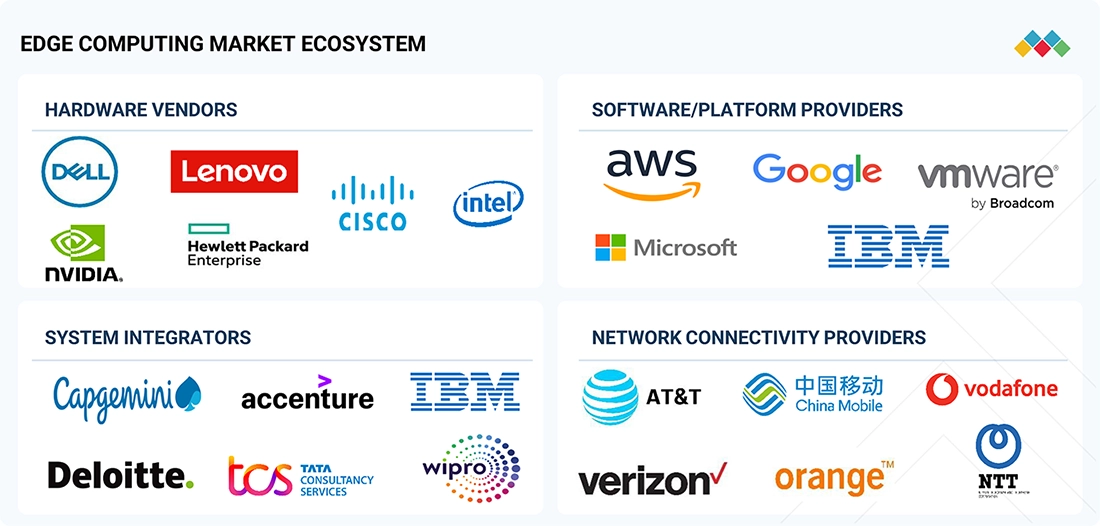
EDGE COMPUTING MARKET : COMMERCIAL USE CASES ACROSS INDUSTRIES
| COMPANY | USE CASE DESCRIPTION | BENEFITS |
|---|---|---|
 |
Akamai helped Matrimony.com achieve website optimization and increased user retention | User retention rate increased | Website revisit rate increased | New user attraction and addition witnessed a 10% half-yearly growth | Surge in the number of matches made successfully vis-à-vis paid/premium members |
 |
ESPN adopted Microsoft’s innovative technologies to reshape the future of sports production | 50% reduction in closed-captioning costs | Significant cost savings across multiple other areas | Cloud technology enabled fans even greater access to ESPN’s vast sports insights, statistics, and media files |
 |
VMware helped Northern Beaches Council be a pacesetter to drive and digitalize regional municipal services | Unleashing IoT capabilities and improving reliability | Identify and eliminate outages | Remotely monitor incidents and connection issues in any region | Helped the Northern Beaches Council set the pace for digitizing municipal services across Australia |
 |
Maserati MSG racing automated workflow enablement with Hewlett Packard Enterprise to optimize team performance | Gaining speed and efficiency in the competition | Optimized team performance and energy management | Leveraging AI and edge technologies to accelerate data-driven insights | Speeding up image processing time by 8x (30 min vs. 4 hrs.) | Delivering AI-driven video and audio analytics for real-time insight into competitors’ strategies |
 |
99Bridges helped human habits restore and protect the environment with Cisco’s IoT Operations Dashboard | Enhanced features such as Secure Equipment Access for monitoring and maintenance activities | IoT Operations Dashboard is used to provision and monitor the Cisco routers in parallel while providing visibility of connectivity right through to the connected IoT controllers |
Logos and trademarks shown above are the property of their respective owners. Their use here is for informational and illustrative purposes only.
Related Ecosystem
Cloud Computing
- Software as A Service (SaaS)
- Natural Language Processing (NLP)
- Platform as A Service (PaaS)
- Machine Learning
- Supply Chain Management
- International Business Machines Corporation
- MICROSOFT CORPORATION
- Oracle Corporation
- Amazon.com, Inc.
Data Centre And Networking
- Software-Defined Networking (SDN)
- Mid-Sized Data Centers
- Small Data Centers
- Remote Monitoring
- Smart Healthcare
- Cisco Systems, Inc.
- HUAWEI TECHNOLOGIES CO LTD
- Hewlett Packard Enterprise Company
- MITSUBISHI ELECTRIC INFORMATION SYSTEMS CORPORATION
- MITSUBISHI ELECTRIC INFORMATION NETWORK CORPORATION
Digitalization And Iot
- Sensors
- Remote Monitoring
- Supply Chain Management
- Passenger Information System (PIS)
- Platform as A Service (PaaS)
- International Business Machines Corporation
- Cisco Systems, Inc.
- MICROSOFT CORPORATION
- Oracle Corporation
- HUAWEI TECHNOLOGIES CO LTD
Key Takeaways
- GCC Countries' edge computing market is valued at USD 2,451.4 million in 2026, with a projected CAGR of 23.6% through 2031.
- GCC Countries are investing heavily in smart city and IoT infrastructure, driving demand for low-latency edge computing solutions.
- The forecast size for GCC Countries' edge computing market reaches USD 7,079.2 million by 2031, nearly tripling from the base year.
- GCC Countries' focus on digital transformation and autonomous systems is accelerating edge computing adoption across multiple sectors.
Edge Computing Market Report Scope
| Report Metric | Details |
|---|---|
| Base Year | 2026 |
| Fastest Growing Segment | EDGE AI & ANALYTICS PLATFORMS (Software) |
| Forecast Period | 2026–2031 |
| Growth Rate | CAGR of 23.3% from 2026 to 2031 |
| Largest Segment | LARGE ENTERPRISES (Organization Size) |
| Market Size Base Year (Billions) | ~USD 111.37 (2026) |
| Revenue Forecast (Billions) | ~USD 317.39 (2031) |
| Segments Covered | Offering, Hardware, Software, Service, Application, Deployment Mode, Organization Size, Vertical |
GCC Countries Edge Computing Market Report Segmentation
8 segment dimensions are covered across the global market.
By Offering
- Edge Infrastructure Hardware
- Services
- Software
By Hardware
- AI Accelerators & Processors
- Edge Gateways
- Edge Servers & Appliances
- Edge Storage
- Networking Equipment
By Software
- Edge AI & Analytics Platforms
- Edge Data Management & Integration Software
- Edge Orchestration & Management Platforms
- Edge Security Software
By Service
- Managed Edge Services
- Professional Services
By Application
- Asset Monitoring & Predictive Maintenance
- Autonomous Systems & Immersive Applications
- Connected Asset & IoT Monitoring
- Content Delivery & Network Optimization
- Industrial Automation & Operational Control
- Other Applications
- Real-Time Analytics & Decision Support
- Video Analytics & Computer Vision
By Deployment Mode
- On-Premise Edge
- Regional/Cloud Edge
- Telco/Network Edge
By Organization Size
- Large Enterprises
- Smes
By Vertical
- Automotive
- Bfsi
- Energy & Utilities
- Government & Defense
- Healthcare & Life Sciences
- It & Data Centers
- Manufacturing & Industrial
- Media & Entertainment
- Other Verticals
- Retail & E-Commerce
- Telecommunications
- Transportation & Logistics
Target Audience
- Technology Solution Providers : Edge computing vendors and software providers need GCC-specific market data to develop localized solutions, identify customer segments, and establish distribution partnerships in this high-growth region.
- Enterprise IT Decision Makers : CIOs and IT directors in GCC organizations require market insights to evaluate edge computing investments, benchmark against regional peers, and align technology strategies with market trends.
- Investment & Private Equity Firms : Investors targeting the GCC technology sector need detailed market forecasts and growth drivers to identify acquisition targets, fund allocation decisions, and portfolio company strategies.
- Government & Policy Makers : GCC government agencies and regulatory bodies use market intelligence to inform digital transformation policies, infrastructure investments, and technology adoption roadmaps aligned with national visions.
- System Integrators & Consultants : Regional system integrators and management consultants need GCC-specific market data to advise clients on edge computing adoption, develop implementation strategies, and identify emerging opportunities.
Key Companies in the GCC Countries Edge Computing Market
| Company | HQ | Ownership | Strongest segments |
|---|---|---|---|
| SIFY TECHNOLOGIES LIMITED | India | Public Company | Network-centric services (VPN, connectivity, managed SD-WAN/Wi-Fi),Data Center services (colocation, cross-connects, managed DC),Digital infrastructure services (hosting, infra management, NOC, EUC), |
| CASA SYSTEMS | United States | Private Company | Converged cable access and fixed-line broadband platforms,Virtualized broadband network gateway and multiservice routers,Wireless core (vEPC/5G core) and small cells, |
| ATOS SE | France | Public Company | Infrastructure & Cloud Managed Services,Digital Workplace & Business Process Services,Application & Platform Integration, |
| F5 NETWORKS | United States | Public Company | BIG-IP Systems and Packaged Software,NGINX (Plus, One Console, Ingress, WAF for NGINX),Distributed Cloud Services (WAAP, Multi-Cloud Networking, CDN, DNS), |
| TELECOM EGYPT | Egypt | Public Company | Fixed voice & access (retail and wholesale),Fixed broadband & data connectivity,Mobile services (voice, data, roaming, entertainment), |
| AXIATA GROUP | Malaysia | Public Company | Digital telco / Mobile services,Infrastructure (towers, transmission, backbone),Digital & Financial services (e-wallet, microfinance, digital credit), |
| COMMSCOPE HOLDING COMPANY, INC | United States | Public Company | RUCKUS Wi-Fi, switching, and IoT,Aurora cable access and video infrastructure,Services, support, and integration, |
| DELL TECHNOLOGIES | United States | Public Company | Client Solutions Group (notebooks, desktops, workstations, peripherals, services),Servers and AI-optimized compute (ISG),Storage (all-flash, HCI, software-defined, traditional), |
| NVIDIA | United States | Public Company | Data Center AI Compute & Networking,Gaming GPUs (GeForce),Professional Visualization (RTX/Workstations), |
| MICROSOFT | United States | Public Company | Productivity and Business Processes (Microsoft 365, LinkedIn, Dynamics),Intelligent Cloud (Azure, Server, Enterprise Services),Personal Computing (Windows, Devices, Gaming, Search/Ads), |
| United States | Public Company | Search and Other Google Services Advertising,YouTube Ads and Consumer Subscriptions,Google Play and Devices, | |
| CISCO | United States | Public Company | Campus and data center switching and routing,Security (network security, SASE, identity, threat detection and response),Collaboration (Webex suite, devices, contact center, CPaaS), |
| IBM | United States | Public Company | Software (Hybrid Cloud and AI Platforms),Consulting,Infrastructure, |
| INTEL | United States | Public Company | Client Computing (PC and edge CPUs, GPUs, connectivity),Data Center and AI (server CPUs, accelerators, networking),Intel Foundry (wafer fabrication, substrates, services), |
SIFY TECHNOLOGIES LIMITED
SIFY TECHNOLOGIES LIMITED is a publicly traded Indian IT services and telecommunications company founded in 1995 with 1,047 employees.
CASA SYSTEMS
CASA SYSTEMS is a private software and infrastructure company based in the United States, founded in 2003 and employing 1,043 people.
ATOS SE
ATOS SE is a French multinational public company founded in 1997 that provides IT services and digital transformation solutions.
F5 NETWORKS
F5 NETWORKS is a publicly traded American software company founded in 1996 with 6,545 employees specializing in application delivery and security.
TELECOM EGYPT
TELECOM EGYPT is a public telecommunications company founded in 1854 and based in Egypt, providing telecom services to the Egyptian market.
AXIATA GROUP
AXIATA GROUP is a Malaysian public company founded in 1992 with 12,976 employees operating as a leading telecommunications and digital services provider.
COMMSCOPE HOLDING COMPANY, INC
COMMSCOPE HOLDING COMPANY, INC is a publicly traded American infrastructure solutions company founded in 1976 with 4,500 employees.
DELL TECHNOLOGIES
DELL TECHNOLOGIES is a publicly traded American technology company founded in 1984 with 97,000 employees providing computing hardware and IT solutions.
NVIDIA
NVIDIA is a publicly traded American semiconductor and AI computing company founded in 1993 with 42,000 employees.
MICROSOFT
MICROSOFT is a publicly traded American technology giant founded in 1975 with 228,000 employees specializing in software, cloud services, and enterprise solutions.
GOOGLE is a publicly traded American technology company founded in 1998 with 194,668 employees operating as a leader in search, advertising, and cloud services.
CISCO
CISCO is a publicly traded American networking and IT infrastructure company founded in 1984 with 86,200 employees.
IBM
IBM is a publicly traded American technology and consulting company founded in 1911 with 264,300 employees offering enterprise IT services and solutions.
INTEL
INTEL is a publicly traded American semiconductor company founded in 1968 with 85,100 employees specializing in microprocessor design and manufacturing.
Reasons to Buy this Report
- Market-Specific Growth Projections : Access precise forecasts for GCC Countries' edge computing market with detailed CAGR analysis (23.6%), enabling accurate business planning and investment decisions specific to this high-growth region.
- Regional Opportunity Identification : Identify country-specific opportunities across UAE, Saudi Arabia, Qatar, and other GCC nations with insights into smart city projects, government initiatives, and sector-specific adoption patterns.
- Competitive Landscape Intelligence : Understand regional competitive dynamics, local player strategies, and market entry barriers specific to GCC Countries, helping you position offerings effectively in this lucrative market.
- Investment & Partnership Strategy : Leverage detailed market sizing and growth trajectories to identify optimal investment opportunities, joint venture partners, and expansion strategies tailored to GCC market characteristics.
- Sector-Specific Demand Analysis : Gain insights into edge computing demand across GCC sectors including smart cities, healthcare, manufacturing, and telecommunications, enabling targeted product development and go-to-market strategies.
Frequently asked questions
What is the current market size of edge computing in GCC Countries?
The edge computing market in GCC Countries is valued at USD 2,451.4 million in 2026 and is expected to grow at a CAGR of 23.6% through 2031.
What is the projected market size for edge computing in GCC Countries by 2031?
GCC Countries' edge computing market is forecast to reach USD 7,079.2 million by 2031, representing nearly a threefold increase from 2026.
What are the primary drivers of edge computing growth in GCC Countries?
GCC Countries' growth is driven by smart city initiatives, IoT deployment, digital transformation efforts, and the need for reduced latency in telecommunications and financial services.
Which sectors in GCC Countries are adopting edge computing most rapidly?
GCC Countries are seeing rapid adoption in telecommunications, healthcare, financial services, industrial automation, and autonomous systems sectors.
How does the GCC Countries edge computing market compare to global growth rates?
GCC Countries' edge computing market CAGR of 23.6% slightly exceeds the global CAGR of 23.3%, indicating stronger regional growth momentum.
RESEARCH METHODOLOGY
This research study on the edge computing market involved extensive secondary sources, directories, IEEE Communication-Efficient: Algorithms and Systems, International Journal of Innovation and Technology Management, and paid databases. Primary sources were mainly industry experts from the core and related industries, preferred edge computing providers, third-party service providers, consulting service providers, end users, and other commercial enterprises. In-depth interviews with primary respondents, including key industry participants and subject matter experts, were conducted to obtain and verify critical qualitative and quantitative information and assess the market’s prospects.
Secondary Research
In the secondary research process, various sources were referred to identify and collect information for this study. Secondary sources included annual reports, press releases, and investor presentations of companies; white papers, journals, and certified publications; and articles from recognized authors, directories, and databases. The data was also collected from other secondary sources, such as journals, government websites, blogs, and vendors’ websites. Additionally, the edge computing spending of various countries was extracted from the respective sources.
Primary Research
In the primary research process, various sources from the supply and demand sides were interviewed to obtain qualitative and quantitative information on the market. The primary sources from the supply side included various industry experts, such as Chief Experience Officers (CXOs), Vice Presidents (VPs), and directors specializing in business development, marketing, and edge computing providers. It also included key executives from edge computing vendors, system integrators (SIs), professional service providers, industry associations, and other key opinion leaders.
Breakup of primary profiles:
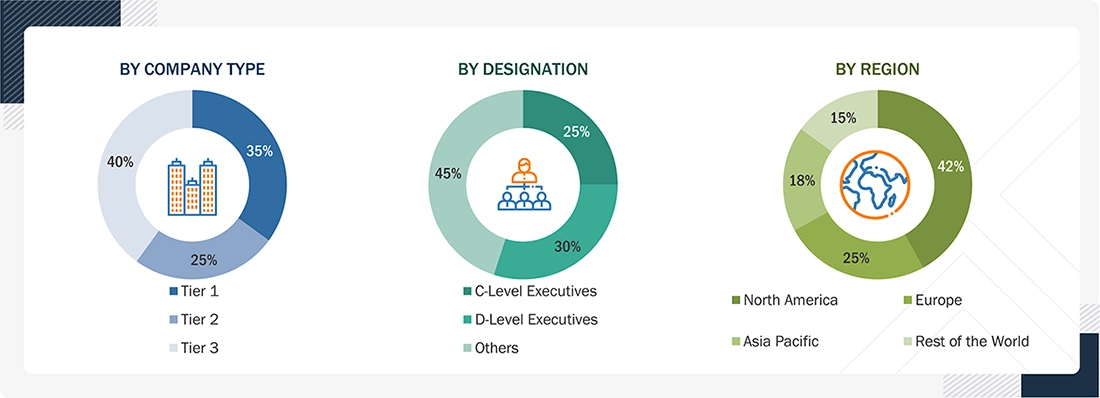
Note: Tier 1 companies’ revenues are more than USD 10 billion; tier 2 companies’ revenues range between USD 1 and 10 billion; and tier 3 companies’ revenues range between USD 500 million and USD 1 billion. Other designations include sales managers, marketing managers, and product managers.
Source: Industry Experts
To know about the assumptions considered for the study, download the pdf brochure
Market Size Estimation
Multiple approaches were adopted to estimate and forecast the edge computing market. The first approach involved estimating the market size by companies’ revenue generated through the sale of edge computing services.
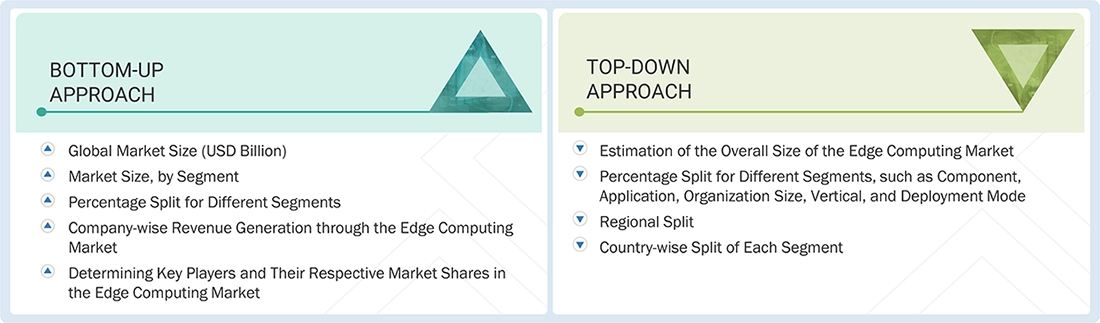
Market Size Estimation Methodology: Top-down Approach
The top-down approach prepared an exhaustive list of all the vendors offering products in the edge computing market. The revenue contribution of the market vendors was estimated through annual reports, press releases, funding, investor presentations, paid databases, and primary interviews. Each vendor’s offerings were evaluated based on platform, degree of customization, type, application, end user, and region. The markets were triangulated through primary and secondary research. The primary procedure included extensive interviews for key insights from industry leaders, such as CIOs, CEOs, VPs, directors, and marketing executives. The market numbers were further triangulated with the existing MarketsandMarkets’ repository for validation.
Market Size Estimation Methodology: Bottom-up Approach
The bottom-up approach identified the adoption rate of edge computing services among different verticals in key countries, considering their regions contributing the most to the market share. For cross-validation, the adoption of edge computing services among enterprises and other use cases for their regions was identified and extrapolated. Use cases identified in different areas were weighed for the market size calculation.
Based on the market numbers, the regional split was determined by primary and secondary sources. The procedure included an analysis of the edge computing market’s regional penetration. Based on secondary research, the regional spending on Information and Communications Technology (ICT), socioeconomic analysis of each country, strategic vendor analysis of major edge computing service providers, and organic and inorganic business development activities of regional and global players were estimated.
Edge Computing Market : Top-Down and Bottom-Up Approach
Data Triangulation
After determining the overall market size using the market size estimation processes as explained above, the market was split into several segments and subsegments. Data triangulation and market breakup procedures were employed, wherever applicable, to complete the overall market engineering process and arrive at the exact statistics of each market segment and subsegment. The overall market size was then used in the top-down procedure to estimate the size of other individual markets via percentage splits of the market segmentation.
Market Definition
Edge computing refers to a distributed computing model in which data processing, storage, analytics, application execution, and decision-making are performed closer to devices, users, machines, and enterprise locations instead of relying only on centralized cloud or data center infrastructure. In this report, the edge computing market includes edge infrastructure hardware such as servers, appliances, gateways, accelerators, storage, and networking equipment; software platforms for orchestration, AI analytics, data management, integration, and security; and professional and managed services required to deploy and operate edge environments. Edge computing enables low-latency processing, real-time monitoring, localized intelligence, reduced bandwidth dependency, improved data control, and reliable operations across manufacturing, telecom, retail, healthcare, transportation, energy, government, BFSI, and media & entertainment applications.
Key Stakeholders
- Training and consulting service providers
- Information Technology (IT) infrastructure providers
- Component providers
- System Integrators (SI)
- Support service providers
- Cloud Service Providers (CSPs)
- Government organizations and standardization bodies
- Datacenter providers
- Regional associations
- Independent hardware and software vendors
- Value-added resellers and distributors
Report Objectives
- To define, describe, and forecast the edge computing market based on offering, including edge infrastructure hardware, software, and services. Edge infrastructure hardware includes edge servers & appliances, edge gateways, AI accelerators & processors, edge storage, and networking equipment. Software includes edge orchestration & management platforms, edge AI & analytics platforms, edge data management & integration software, and edge security software. Services include professional services and managed edge services. The market is also segmented by application, including video analytics & computer vision, asset monitoring & predictive maintenance, industrial automation & operational control, connected asset & IoT monitoring, real-time analytics & decision support, content delivery & network optimization, autonomous systems & immersive applications, and other applications. The market is further analyzed by organization size, including large enterprises and SMEs; by deployment mode, including on-premises edge, telco/network edge, and regional/cloud edge; by vertical, including manufacturing, telecommunications, retail & e-commerce, healthcare & life sciences, transportation & logistics, energy & utilities, government & defense, BFSI, and media & entertainment; and by region.
- To forecast the market size of five major regional segments: North America, Europe, Asia Pacific, the Middle East & Africa, and Latin America
- To strategically analyze the market subsegments with respect to individual growth trends, prospects, and contributions to the total market
- To provide detailed information related to the major factors influencing the growth of the market (drivers, restraints, opportunities, and challenges)
- To analyze industry trends, patents, innovations, and pricing data related to the market
- To analyze the opportunities in the market for stakeholders and provide details of the competitive landscape for major players
- To analyze the impact of AI/generative AI on the market
- To profile key players in the market and comprehensively analyze their market share/ranking and core competencies
- To track and analyze competitive developments such as mergers & acquisitions, product launches, and partnerships & collaborations in the market
Available customizations:
With the given market data, MarketsandMarkets offers customizations as per the company’s specific needs. The following customization options are available for the report:
Product Analysis
- The product matrix provides a detailed comparison of the product portfolio of each company.
Geographic Analysis based on feasibility
- Further breakup of the North American edge computing market
- Further breakup of the European edge computing market
- Further breakup of the Asia Pacific edge computing market
- Further breakup of the Middle East & Africa edge computing market
- Further breakup of the Latin American edge computing market
Company Information
- Detailed analysis and profiling of additional market players (up to five)
Get the Full Edge Computing Market Report
Full forecast, segment splits, and company analysis for all Edge Computing Market.
- Rest Of GCC Countries Edge Computing Market
- UAE Edge Computing Market
- Canada Edge Computing Market
- US Edge Computing Market
- UK Edge Computing Market
- Germany Edge Computing Market
- France Edge Computing Market
- Italy Edge Computing Market
- China Edge Computing Market
- Japan Edge Computing Market
- India Edge Computing Market
- Saudi Arabia Edge Computing Market
- South Africa Edge Computing Market
- Brazil Edge Computing Market
- Mexico Edge Computing Market
- Rest Of Europe Edge Computing Market
- Rest Of Asia Pacific Edge Computing Market
Need a Tailored Report?
Customize this report to your needs
Get 10% FREE Customization
Customize This Report
