
Canada ebike Market (2026-2031)

The Canada ebike Market was valued at $133 Million in 2026 and projected to reach to $150 Million by 2031, representing a compound annual growth rate of 5.6%. Canada's ebike market is poised for sustained growth through 2031, driven by rising environmental consciousness and government policies promoting clean mobility alternatives.


| Market Size in | USD 26.32 MN |
| Market Forecast in | |
| CAGR | |
| Forecast Period | |
| Units Considered | Value (USD MN) |
Canada ebike Market Trends and Insights
- This steady growth reflects Canada's increasing adoption of electric bicycles as a sustainable transportation solution, driven by urbanization, environmental awareness, and government incentives supporting clean mobility.
- Canada's diverse geography and climate conditions present both opportunities and challenges for ebike penetration across provinces. The Canadian ebike market benefits from strong infrastructure development and supportive policies aimed at reducing carbon emissions.
- Canada's commitment to sustainable transportation aligns with rising consumer demand for eco-friendly commuting alternatives.
- Between 2026 and 2031, Canada is expected to see expanded product offerings, improved battery technology, and growing consumer familiarity with ebike benefits.
- Urban centers in Canada are leading adoption, while rural markets present emerging growth opportunities as charging infrastructure expands across the country..
Key Market Statistics
- CAGR (2026-2031) 5.6% CAGR
- Market Size, 2026 ~USD 133 Million
- Forecast, 2031 ~USD 150 Million
- Country Canada
Canada ebike Market Overview
Market Valuation :
Canada's ebike market is valued at $133.0 million in 2026 and is projected to reach $150.0 million by 2031, representing a steady expansion in the sustainable transportation sector.
Growth Trajectory :
The Canadian ebike market is expanding at a CAGR of 5.6% from 2026 to 2031, outpacing the global average of 5.5%, indicating stronger regional adoption momentum.
Government Support :
Federal and provincial incentive programs, including rebates and tax credits for electric bicycle purchases, are accelerating market penetration across urban and suburban regions in Canada.
Urban Mobility Shift :
Increasing urbanization in major Canadian cities like Toronto, Vancouver, and Montreal is driving demand for last-mile connectivity solutions, positioning ebikes as a preferred eco-friendly commuting option.
Canada ebike Market Dynamics
- Urban centers are experiencing accelerated adoption as consumers seek cost-effective and sustainable commuting solutions.
- The market benefits from Canada's strong cycling infrastructure, favorable climate policies, and increasing investment in active transportation networks across provinces. Looking ahead, the Canadian ebike sector will likely see expanded product offerings, improved battery technology, and enhanced charging infrastructure.
- Growing consumer awareness of health benefits and reduced transportation costs will further stimulate demand.
- Strategic partnerships between municipalities and manufacturers, combined with continued government incentives, are expected to solidify Canada's position as a key North American ebike market through the forecast period..
Market Ecosystem
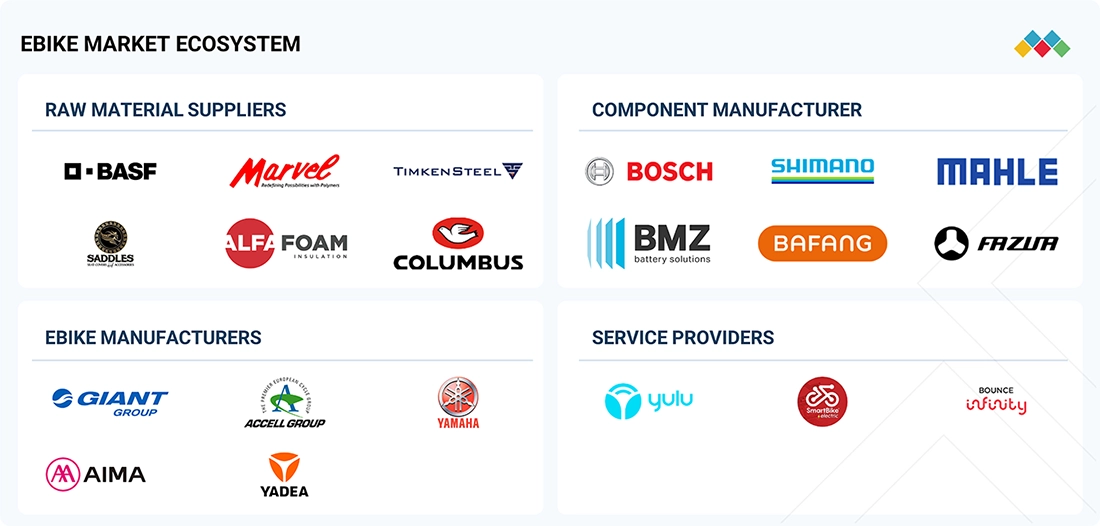
E-BIKE MARKET SIZE, SHARE & ANALYSIS: COMMERCIAL USE CASES ACROSS INDUSTRIES
| COMPANY | USE CASE DESCRIPTION | BENEFITS |
|---|---|---|
 |
Focuses on a wide range of premium ebikes including urban commuting, mountain (e-MTB), and performance cycling, supported by a strong global retail and manufacturing network | Offers high-quality engineering, global availability, and advanced motor integration (often with Yamaha systems), making it suitable for everyday commuters as well as professional riders |
 |
Specializes in urban mobility, cargo ebikes, and niche applications (like logistics and adventure cycling), with strong presence across Europe and partnerships with public/private sectors | Provides diverse product portfolio and strong European distribution, enabling efficient last-mile delivery solutions and sustainable urban transport adoption |
 |
Targets mass-market urban commuting and affordable e-mobility, with strong focus on high-volume production and expansion into global markets | Delivers cost-effective ebikes with smart features (GPS, digital display, battery tech) and large-scale production, making them accessible for emerging markets |
 |
Primarily provides ebike drive systems (motors, batteries, displays) and collaborates with OEMs to power high-performance and premium ebikes | Enables high-performance, reliable powertrain solutions (e.g., 85 Nm motors), supporting innovation and performance across multiple ebike brands globally |
Logos and trademarks shown above are the property of their respective owners. Their use here is for informational and illustrative purposes only.
Related Ecosystem
Automotive Advance Technologies
- Battery Electric Vehicle (BEV)
- Light Commercial Vehicles (LCVs)
- Fuel Cell Electric Vehicle (FCEV)
- Hybrid Electric Vehicle (HEV)
- Internal Combustion Engine (ICE)
- BOSCH LIMITED
- Continental ag
- Visteon Corporation
- DENSO Corporation
- ZF FRIEDRICHSHAFEN AG
Electric Hybrid Vehicles
- Battery Electric Vehicle (BEV)
- Fuel Cell Electric Vehicle (FCEV)
- Light Commercial Vehicles (LCVs)
- Hybrid Electric Vehicle (HEV)
- Agricultural Tractors
- Visteon Corporation
- Byd company ltd.
- BOSCH LIMITED
- Tesla, Inc.
- FORD MOTOR COMPANY
Key Takeaways
- Canada's ebike market reaches $133.0 million in 2026 with projected growth to $150.0 million by 2031.
- Canada experiences a 5.6% CAGR, reflecting steady demand for sustainable urban mobility solutions.
- Government incentives and environmental policies in Canada are accelerating ebike adoption across provinces.
- Urban centers in Canada lead market growth, while rural expansion presents untapped opportunities through infrastructure development.
ebike Market Report Scope
| Report Metric | Details |
|---|---|
| Base Year | 2026 |
| Fastest Growing Segment | CLASS III (Class) |
| Forecast Period | 2026–2031 |
| Growth Rate | CAGR of 5.5% from 2026 to 2031 |
| Largest Segment | CLASS I (Class) |
| Market Size Base Year (Billions) | ~USD 46.31 (2026) |
| Revenue Forecast (Billions) | ~USD 60.53 (2031) |
| Segments Covered | Class |
Canada ebike Market Report Segmentation
1 segment dimensions are covered across the global market.
By Class
- Class I
- Class Ii
- Class Iii
Target Audience
- Ebike Manufacturers & OEMs : Manufacturers need Canada-specific market data to assess market size, growth rates, and regional demand patterns to guide product development, pricing strategies, and market entry decisions.
- Retail & Distribution Partners : Retailers and distributors require detailed Canadian market insights to optimize inventory management, identify high-growth regions, and align supply chain strategies with local consumer demand.
- Investment & Private Equity Firms : Investors need precise market valuations and growth forecasts for Canada to evaluate investment opportunities, assess portfolio companies, and identify emerging players in the ebike sector.
- Government & Policy Makers : Municipal and provincial officials use market data to design effective incentive programs, infrastructure investments, and sustainability initiatives that support clean mobility adoption.
- Market Consultants & Analysts : Consulting firms and research professionals require Canada-specific ebike market data to support client advisory services, competitive analysis, and strategic planning recommendations.
Key Companies in the Canada ebike Market
| Company | HQ | Ownership | Strongest segments |
|---|---|---|---|
| VISTEON CORPORATION | United States | Public Company | Instrument clusters and information displays,Infotainment and connected car solutions,SmartCore domain controllers and middleware (SmartCore Runtime, SmartCore Studio), |
| CUBE | United States | Public Investment Firm | Owned self-storage facilities,Managed/third-party properties,Ancillary services and fees, |
VISTEON CORPORATION
VISTEON CORPORATION is a United States-based public company founded in 2000 with 10500 employees. The company operates as a publicly traded enterprise in the automotive industry.
CUBE
CUBE is a United States-based public investment firm founded in 2004 with 3121 employees. The company operates as a publicly traded investment entity.
Reasons to Buy this Report
- Precise Market Sizing : Access validated market valuations for Canada's ebike sector with detailed 2026-2031 projections, enabling accurate business planning and investment decisions specific to the Canadian market.
- Regional Growth Intelligence : Understand Canada's 5.6% CAGR performance relative to global trends, identifying unique growth drivers and market dynamics that differentiate the Canadian ebike landscape from other regions.
- Policy & Incentive Insights : Gain comprehensive analysis of federal and provincial government incentives, rebate programs, and regulatory frameworks shaping consumer purchasing behavior and market expansion in Canada.
- Competitive Positioning : Benchmark your business strategy against market trends specific to Canadian urban centers, consumer preferences, and infrastructure development to optimize market entry or expansion plans.
- Investment & Opportunity Assessment : Evaluate growth potential and market maturity indicators for Canada's ebike sector to identify high-value investment opportunities, partnerships, and distribution channels in key provinces.
Frequently asked questions
What is the current size of Canada's ebike market?
Canada's ebike market is valued at $133.0 million in 2026 and is expected to reach $150.0 million by 2031.
What is the growth rate of Canada's ebike market?
Canada's ebike market is growing at a compound annual growth rate of 5.6% from 2026 to 2031.
What factors are driving ebike adoption in Canada?
Key drivers include government incentives, environmental policies, urbanization, improved battery technology, and growing consumer awareness of sustainable transportation benefits in Canada.
Which regions in Canada are leading ebike market growth?
Urban centers across Canada are currently leading adoption, with emerging opportunities in rural areas as charging infrastructure expands throughout the country.
How does Canada's ebike market compare to North America?
Canada represents a significant segment of the North American ebike market, with its 5.6% CAGR reflecting strong regional demand for sustainable mobility solutions.
RESEARCH METHODOLOGY
Various secondary sources, directories, and databases were used to identify and collect information for an extensive ebike market study. The study involved four main activities in estimating the current size of the market: secondary research, validation through primary research, assumptions, and market analysis. The research study drew on secondary sources such as company annual reports and presentations, industry association publications, ebike magazine articles, directories, technical handbooks, the World Economic Outlook, trade websites, technical articles, and databases to identify and collect information for an extensive study of the market. Primary sources, including experts from related industries, automobile OEMs, and suppliers, were interviewed to obtain and verify critical information and to assess prospects and market estimates.
Secondary Research
Secondary sources for this research study included the ebike industry associations, internal databases, corporate filings (such as annual reports, investor presentations, and financial statements), and data from trade and business publications. Secondary data was collected and analyzed to determine the overall market size, and the findings were further validated by primary research.
Primary Research
In the primary research process, several interviews were conducted with market experts from the demand and supply sides across three major regions: North America, Europe, and Asia-Oceania. 30% of primary interviews were conducted with OEMs, and 70% with Tier-1.
Primary data was collected through questionnaires, emails, and telephone interviews. In the canvassing of primary sources, various departments within organizations, such as sales, operations, and administration, were included to provide a holistic viewpoint in the report. After interacting with industry experts, brief sessions were held with highly experienced independent consultants to validate the findings from the primary sources. These sessions, along with insights from in-house subject-matter experts, led to the conclusions described in the remainder of this report.
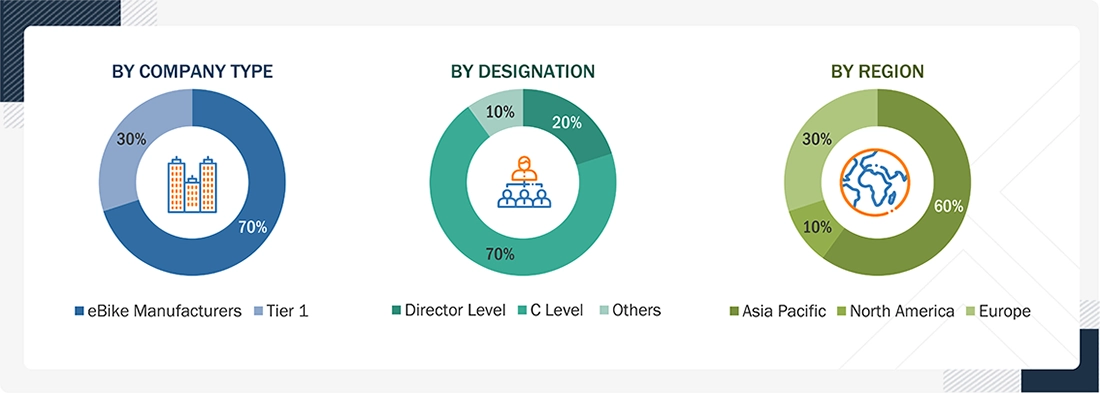
Note: Company tiers are based on the supply chain (Tier 1: component manufacturers; Tier 2: OEMs; Tier 3: ebike manufacturers). Other designations include sales, marketing, and product managers.
To know about the assumptions considered for the study, download the pdf brochure
Market Size Estimation
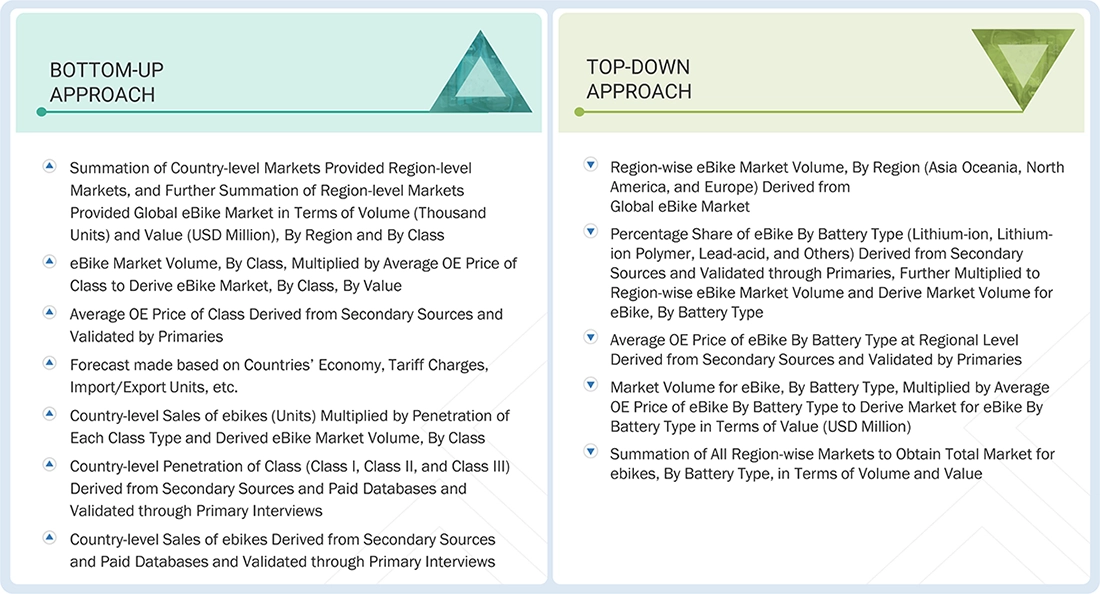
The bottom-up approach derived the market size based on volume and value. This was followed by primary interviews and feature mapping on a regional basis, using the MarketsandMarkets repository.
The market size was validated through in-depth interviews with industry experts, excerpts from the discussion guide in the appendix, and secondary research. The report-writing phase begins after the final market size numbers are determined.
Bottom-Up Approach: By Usage
The bottom-up approach was used to estimate and validate the size of the ebike market by usage. Country-level ebike sales (in units) were derived from secondary sources such as country-wise manufacturing associations, paid databases, research publications and journals, and secondary articles, and were validated through primary interviews to determine the size of the market by class and usage in terms of volume. Country-level penetration and usage types (mountain/trekking bikes, city/urban, cargo, and others) were derived from secondary sources and paid databases and validated through primary interviews.
The market is then forecast based on various parameters, including analysis of historical data, market trends, and growth drivers such as increasing bike sales, increased infrastructure development activities, economic conditions, and government incentives and subsidies. Technological advancements in e-bike motors, emerging market opportunities, and competitive landscape assessments are also considered to arrive at the country-wise forecast of e-bikes by usage.
Country-level ebike sales (in units) were multiplied by the penetration of each usage type to derive the ebike market volume by usage type. The average OE price by usage type was derived from secondary sources and validated by primary sources. The market volume by usage type was then multiplied by the average OE usage price to derive the market value by usage type (USD million). The summation of country-level markets provided the regional-level market. Further summation of the regional-level markets provided the global market in terms of volume (thousand units) and value (USD million) by usage.
Top-Down Approach – By Battery Type
Regional market size estimates for ebikes by battery type were derived from the global ebike market by volume. The percentage share of ebikes by battery type (lithium-ion, lithium-ion polymer, lead-acid, and others) was derived from secondary sources and validated through primary research. This share was multiplied by the region-wise market volume to derive the market volume for ebikes by battery type. The average OE price of an ebike by battery type at the regional level was derived from secondary sources and validated through primary research. The market volume for ebikes by battery type was then multiplied by the average OE price of ebikes to derive the market for ebikes by battery type in value (USD million). All region-wise markets were summed to obtain the total market for ebikes by battery type in volume (thousand units) and value (USD million).
A similar approach was followed to obtain the ebike market by motor type, mode, battery type, component, and speed.
ebike Market : Top-Down and Bottom-Up Approach
Data Triangulation
All percentage shares, splits, and breakdowns were determined using secondary sources and verified through primary sources. All parameters expected to affect the markets covered in this research study were accounted for, viewed in extensive detail, verified through primary research, and analyzed to obtain the final quantitative and qualitative data. This data was consolidated, supplemented with detailed inputs and analysis from MarketsandMarkets, and presented in the report.
Market Definition
An ebike is a bicycle equipped with a small electric motor and a rechargeable battery that assists the rider's pedaling power. The battery can be recharged by plugging it into a power source. Typically, an ebike takes about 6 to 8 hours to fully charge and can travel a distance of 35 to 50 kilometers at a speed of approximately 20 km/h.
Key Stakeholders
- ebike manufacturers
- ebike battery & motor manufacturers
- Component suppliers for ebikes
- Raw material suppliers for ebikes
- Country-level associations
- Traders, distributors, and suppliers of ebikes
Report Objectives
-
To define, describe, and forecast the size of the global ebike market in terms of value (USD million) and volume (thousand units)
- By Class (Class-I, Class-II, Class-III) at the regional level
- By Speed (up to 25 km/h, 25-45 km/h) at the regional level
- By Battery Type (Lithium-ion, Lithium-ion Polymer, Lead Acid, and Others) at the regional level
- By Motor Type (Hub and Mid) at the regional level
- By Mode (Pedal Assist and Throttle) at the regional level
- By Component (Batteries, Electric Motors, Frames with Forks, Wheels, Crank Gears, Brake Systems, and Motor Controller) at the regional level
- By Usage (Mountain/Trekking, City/Urban, Cargo, and Others) at the regional level
- By Ownership (Shared and Personal)
- By Battery Capacity (<250W, >250 & <450W, >450 & <650W, and >650W)
- By Motor Weight (<2 kg, >2 kg & <2.4 kg, >2.4 kg)
- By Motor Power (<40 Nm, >40 Nm-<70 Nm, >70 Nm)
- Country-level Analysis of Class-wise and Usage-wise segments (Asia Pacific, Europe, and North America)
- To understand the dynamics (drivers, restraints, opportunities, and challenges) of the market
- To strategically analyze market with trade analysis, pricing analysis, recession impact, case study analysis, patent analysis, technology analysis, regulatory analysis, key conferences and events, bill of material, the total cost of ownership, pricing analysis trends/disruptions impacting buyers, financial matrix, investment, and funding case scenario.
- To analyze the competitive landscape of the global players in the market, along with their market share/ranking
- To analyze the Competitive Evaluation Matrix of the global and regional ebike manufacturers and ebike component suppliers in the market
- To analyze a detailed listing of OEMs and their brands, OEM-wise technical specifications, mergers & acquisitions, partnerships, collaborations, expansions, and new product launches/developments undertaken by critical participants in the market.
Available customizations:
Along with the market data, MarketsandMarkets offers customizations per company-specific needs.
The following customization options are available for the report:
Get the Full ebike Market Report
Full forecast, segment splits, and company analysis for all ebike Market.
- China ebike Market
- Japan ebike Market
- India ebike Market
- South Korea ebike Market
- Taiwan ebike Market
- Australia ebike Market
- US ebike Market
- Germany ebike Market
- Netherlands ebike Market
- France ebike Market
- UK ebike Market
- Austria ebike Market
- Italy ebike Market
- Belgium ebike Market
- Spain ebike Market
- Switzerland ebike Market
Need a Tailored Report?
Customize this report to your needs
Get 10% FREE Customization
Customize This Report
