
Asia Pacific Electric Commercial Vehicle Market (2026-2031)

The Asia Pacific Electric Commercial Vehicle Market was valued at $54287.6 Million in 2026 and projected to reach to $116072.4 Million by 2031, representing a compound annual growth rate of 11.5%. Asia Pacific stands as a pivotal growth region for the global electric commercial vehicle market, fueled by rapid urbanization, stringent environmental regulations, and substantial government incentives across major economies.


| Market Size in | USD 26.32 MN |
| Market Forecast in | |
| CAGR | |
| Forecast Period | |
| Units Considered | Value (USD MN) |
Asia Pacific Electric Commercial Vehicle Market Trends and Insights
- In 2026, Asia Pacific's electric commercial vehicle market is estimated at $54,287.6 million, driven by rapid urbanization, stringent emissions regulations, and government incentives across major economies.
- The region is expected to nearly double in value, reaching $116,072.4 million by 2031, reflecting a compound annual growth rate of 11.5%. The expansion of Asia Pacific's electric commercial vehicle sector is underpinned by increasing fleet electrification initiatives, rising fuel costs, and technological advancements in battery systems.
- Asia Pacific's logistics and e-commerce boom, particularly in China, India, and Southeast Asia, is accelerating adoption of electric trucks and delivery vehicles.
- Government policies promoting zero-emission transportation and infrastructure investments in charging networks are further catalyzing market growth throughout Asia Pacific. Asia Pacific's competitive landscape features both established automotive manufacturers and emerging EV-focused companies establishing regional production capabilities.
- The region's cost-competitive manufacturing base and growing supply chain maturity position Asia Pacific as both a major market and production hub for electric commercial vehicles through 2031..
Key Market Statistics
- CAGR (2026-2031) 11.5% CAGR
- Market Size, 2026 ~USD 54287.6 Million
- Forecast, 2031 ~USD 116072.4 Million
- Geography Asia Pacific
Asia Pacific Electric Commercial Vehicle Market Overview
Rapid Market Expansion :
Asia Pacific's electric commercial vehicle market is projected to nearly double from $54,287.6 million in 2026 to $116,072.4 million by 2031, demonstrating exceptional growth momentum driven by regional industrialization and logistics expansion.
Strong Regulatory Support :
Stringent emissions regulations across major Asia Pacific economies, including China, India, and South Korea, are accelerating the adoption of electric commercial vehicles and creating favorable market conditions for fleet operators.
Government Incentive Programs :
Comprehensive government subsidies, tax benefits, and infrastructure investments in Asia Pacific countries are significantly reducing total cost of ownership for electric commercial vehicles and stimulating market penetration.
Urbanization & Logistics Growth :
Rapid urbanization and e-commerce expansion across Asia Pacific are driving demand for last-mile delivery solutions, positioning electric commercial vehicles as essential for sustainable urban logistics networks.
Asia Pacific Electric Commercial Vehicle Market Dynamics
- The region's market is expected to nearly double between 2026 and 2031, with a robust 11.5% CAGR, reflecting strong demand from logistics, delivery, and public transportation sectors. Key drivers include China's dominance in EV manufacturing, India's emerging commercial vehicle market, and South Korea's advanced battery technology ecosystem.
- Rising fuel costs, improving charging infrastructure, and corporate sustainability commitments are accelerating fleet electrification.
- The region's competitive manufacturing base and supply chain advantages position Asia Pacific as both a major consumption hub and production center for electric commercial vehicles globally..
Market Ecosystem
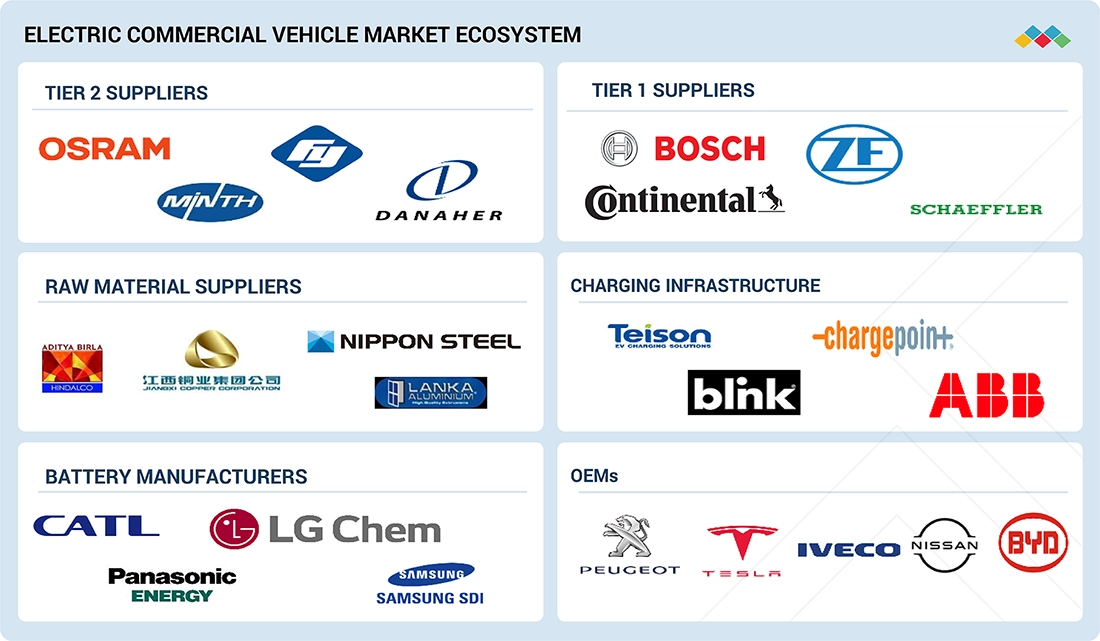
ELECTRIC COMMERCIAL VEHICLE MARKET SIZE & SHARE: COMMERCIAL USE CASES ACROSS INDUSTRIES
| COMPANY | USE CASE DESCRIPTION | BENEFITS |
|---|---|---|
 |
Launched electric commercial truck portfolio and partnered with fleet operators to accelerate adoption in logistics applications. | Expanded ECV penetration, reduced operating cost, strengthened zero emission transport adoption. |
 |
Introduced battery electric commercial trucks and collaborated with charging ecosystem providers for fleet deployment. | Improved fleet efficiency, lower emissions, enhanced commercialization of ECVs. |
 |
Expanded electric commercial vehicle offerings and partnered with logistics companies for large-scale fleet electrification. | Increased vehicle utilization, reduced TCO, supported fleet decarbonization. |
 |
Launched electric heavy truck models and established partnerships for charging and commercial operations. | Reduced diesel reliance, improved operating economics, accelerated fleet transition. |
 |
Expanded electric bus portfolio and collaborated with transit operators to support public transport electrification. | Lower operating expenses, reduced urban emissions, improved sustainable mobility adoption. |
Logos and trademarks shown above are the property of their respective owners. Their use here is for informational and illustrative purposes only.
Related Ecosystem
Automotive Advance Technologies
- Battery Electric Vehicle (BEV)
- Light Commercial Vehicles (LCVs)
- Fuel Cell Electric Vehicle (FCEV)
- Hybrid Electric Vehicle (HEV)
- Internal Combustion Engine (ICE)
- BOSCH LIMITED
- Continental ag
- Visteon Corporation
- DENSO Corporation
- ZF FRIEDRICHSHAFEN AG
Electric Hybrid Vehicles
- Battery Electric Vehicle (BEV)
- Fuel Cell Electric Vehicle (FCEV)
- Light Commercial Vehicles (LCVs)
- Hybrid Electric Vehicle (HEV)
- Agricultural Tractors
- Visteon Corporation
- Byd company ltd.
- BOSCH LIMITED
- Tesla, Inc.
- FORD MOTOR COMPANY
Decarbonization
- Battery Electric Vehicle (BEV)
- Energy Management Systems
- Fuel Cell
- Fuel Cell Electric Vehicle (FCEV)
- Geographical Information System (GIS)
- TotalEnergies SE
- Siemens ag
- Mitsui & Co., Ltd.
- General Electric Company
- Thyssenkrupp ag
Key Takeaways
- Asia Pacific's electric commercial vehicle market will grow from $54.3B in 2026 to $116.1B by 2031, representing 11.5% CAGR.
- Government incentives, emissions regulations, and e-commerce logistics demand are primary growth drivers across Asia Pacific.
- Asia Pacific's manufacturing capabilities and battery supply chain maturity position the region as a global production and innovation hub.
- Infrastructure development and fleet electrification initiatives in Asia Pacific are accelerating commercial EV adoption rates.
Electric Commercial Vehicle Market Report Scope
| Report Metric | Details |
|---|---|
| Base Year | 2026 |
| Fastest Growing Segment | ABOVE 300 MILES (Range) |
| Forecast Period | 2026-2031 |
| Growth Rate | CAGR of 12.9% from 2026 to 2031 |
| Largest Segment | BEV (Propulsion) |
| Market Size Base Year (Billions) | ~USD 84.49 (2026) |
| Revenue Forecast (Billions) | ~USD 154.98 (2031) |
| Segments Covered | Vehicle Type, Propulsion, Battery Type, Power Output, Range, End Use, Battery Capacity |
Asia Pacific Electric Commercial Vehicle Market Report Segmentation
7 segment dimensions are covered across the global market.
By Vehicle Type
- Bus
- Electric Bus
- Electric Heavy-Duty Truck
- Electric Medium-Duty Truck
- Lcv
- Truck
By Propulsion
- Bev
- Phev
By Battery Type
- Lfp Batteries
- Nmc Batteries
By Power Output
- 100-250 Kw
- Above 250 Kw
- Less Than 100 Kw
By Range
- 151-300 Miles
- Above 300 Miles
- Less Than 150 Miles
By End Use
- Distribution Services
- Field Services
- Last-Mile Delivery
- Long-Haul Transportation
- Refuse Trucks
By Battery Capacity
- 121-200 Kwh
- 201-300 Kwh
- 301-500 Kwh
- 60-120 Kwh
- Above 500 Kwh
- Less Than 60 Kwh
Target Audience
- Fleet Operators & Logistics Companies : Need Asia Pacific market data to evaluate electrification ROI, identify regional incentive programs, and plan fleet transition strategies across multiple countries with varying regulatory requirements.
- Vehicle Manufacturers & OEMs : Require detailed Asia Pacific market insights to guide product localization, capacity planning, and go-to-market strategies for electric commercial vehicles in the region's fastest-growing segments.
- Investment & Private Equity Firms : Seek comprehensive Asia Pacific market analysis to identify investment opportunities in EV manufacturers, charging infrastructure, and logistics technology companies operating in high-growth regional markets.
- Government & Policy Makers : Need market intelligence on Asia Pacific electric commercial vehicle adoption trends to inform infrastructure planning, incentive program design, and emissions reduction policy development.
- Charging Infrastructure & Energy Providers : Require Asia Pacific market forecasts and regional demand projections to plan charging network expansion, grid capacity investments, and energy supply strategies aligned with commercial EV growth.
Countries within Asia Pacific - compare and drill down
| Country | 2025 size (native) |
|---|---|
| China | USD 2159589 Million |
| Japan | USD 1050 Million |
| India | USD 68810 Million |
| South Korea | USD 75136 Million |
| Thailand | USD 3829 Million |
| Indonesia | USD 5316 Million |
| Philippines | USD 4972 Million |
| Malaysia | USD 626 Million |
| Vietnam | USD 531 Million |
| Singapore | USD 2305 Million |
| Australia | USD 42696 Million |
Country market size visualization
Reasons to Buy this Report
- Regional Market Sizing & Forecasts : Obtain precise market valuations for Asia Pacific's electric commercial vehicle sector with detailed projections through 2031, enabling accurate business planning and investment decisions specific to this high-growth region.
- Country-Level Intelligence : Access granular market data across 11 Asia Pacific countries including China, India, South Korea, and Australia, identifying the most attractive markets and regional variations in adoption rates and regulatory environments.
- Competitive Landscape Analysis : Understand regional competitive dynamics, key players, and market consolidation trends specific to Asia Pacific, helping stakeholders identify partnership and expansion opportunities in this strategically important region.
- Regulatory & Incentive Mapping : Gain comprehensive insights into country-specific emissions regulations, government subsidies, and infrastructure policies driving electric commercial vehicle adoption across Asia Pacific markets.
- Strategic Growth Opportunities : Identify emerging segments, underserved markets, and high-potential use cases within Asia Pacific's electric commercial vehicle ecosystem to guide product development and market entry strategies.
Frequently asked questions
What is the projected market size for electric commercial vehicles in Asia Pacific by 2031?
Asia Pacific's electric commercial vehicle market is projected to reach $116,072.4 million by 2031, growing from $54,287.6 million in 2026.
What is the CAGR for Asia Pacific's electric commercial vehicle market?
Asia Pacific's electric commercial vehicle market is expected to grow at a compound annual growth rate of 11.5% between 2026 and 2031.
Which countries are driving growth in Asia Pacific's electric commercial vehicle market?
China, India, and Southeast Asian nations are primary growth drivers in Asia Pacific, supported by government policies, e-commerce expansion, and urbanization.
What factors are accelerating electric commercial vehicle adoption in Asia Pacific?
Key factors include government incentives and subsidies, stringent emissions regulations, rising fuel costs, logistics sector growth, and expanding charging infrastructure.
How does Asia Pacific's market compare to the global electric commercial vehicle market?
Asia Pacific represents a significant portion of global demand, with its 11.5% CAGR slightly below the global 12.9% CAGR, reflecting mature market dynamics in certain segments.
RESEARCH METHODOLOGY
Various secondary sources, directories, and databases have been used to identify and collect information for an extensive study of the electric commercial vehicle market. The study involved four main activities in estimating the current size of the electric commercial vehicle market: secondary research, validation through primary research, assumptions, and market analysis. The research study involved various secondary sources, such as company annual reports/presentations, industry association publications, automotive wiring harness magazine articles, directories, technical handbooks, World Economic Outlook, trade websites, technical articles, and databases, which were used to identify and collect information for an extensive study of the electric commercial vehicle market. Primary sources experts from related industries, automobile OEMs, and suppliers were interviewed to obtain and verify critical information and assess prospects and market estimations.
Secondary Research
Secondary sources used in this research study included electric commercial vehicle industry organizations; corporate filings such as annual reports, investor presentations, and financial statements; trade and business whitepapers and databases; and articles from recognized associations and government publications. The secondary data were collected and analyzed to determine the overall market size, which was further validated through primary research.
Primary Research
Extensive primary research has been conducted following an understanding of the market scenario gained through secondary research. Several primary interviews have been conducted with market experts from the demand- and supply-side OEMs (in terms of component supply, country-level government associations, and trade associations) and component manufacturers across four major regions, namely, Asia Pacific - 35%, Southeast Asia - 25%, Europe - 20%, North America - 15%, and Rest of the World - 5%. Approximately 60% and 40% of primary interviews have been conducted from the demand and supply side, respectively. Primary data has been collected through questionnaires, emails, LinkedIn, and telephone interviews. In canvassing primaries, we have striven to cover various departments within organizations, such as sales, operations, and administration, to provide a holistic viewpoint in our report.
Brief sessions with highly experienced independent consultants were conducted to reinforce findings from primaries after interacting with industry experts. This, along with the opinions of in-house subject matter experts, led to the findings described in the remainder of this report.
In the primary research process, various primary sources from the supply and demand sides were interviewed to obtain qualitative and quantitative information for the report. The primary sources from the supply side included industry experts, such as Vice Presidents (VPs), marketing directors, technology and innovation directors, and related key executives from various key companies and organizations. The primary sources from the demand side included end users, such as Chief Information Officers (CIOs), consultants, service professionals, technicians and technologists, and managers at public and investor-owned utilities.
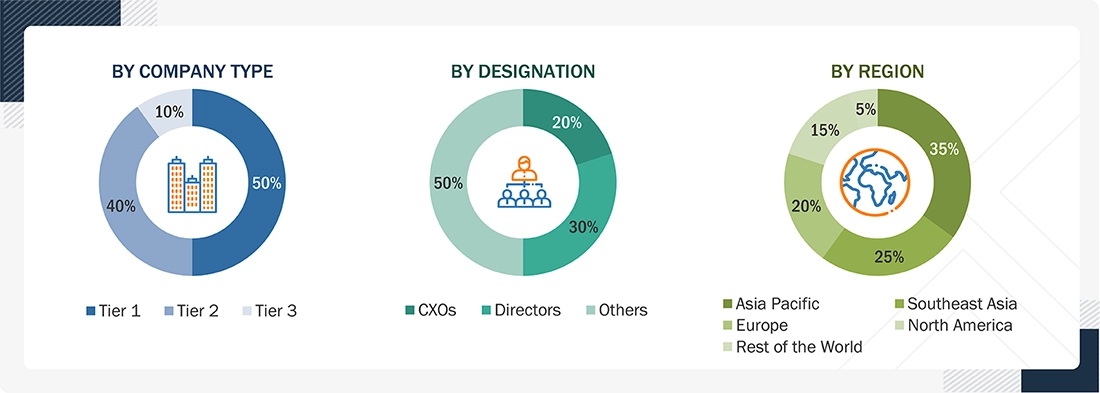
Note: Others include purchase and sales managers, marketing managers, and product managers.
To know about the assumptions considered for the study, download the pdf brochure
Market Size Estimation
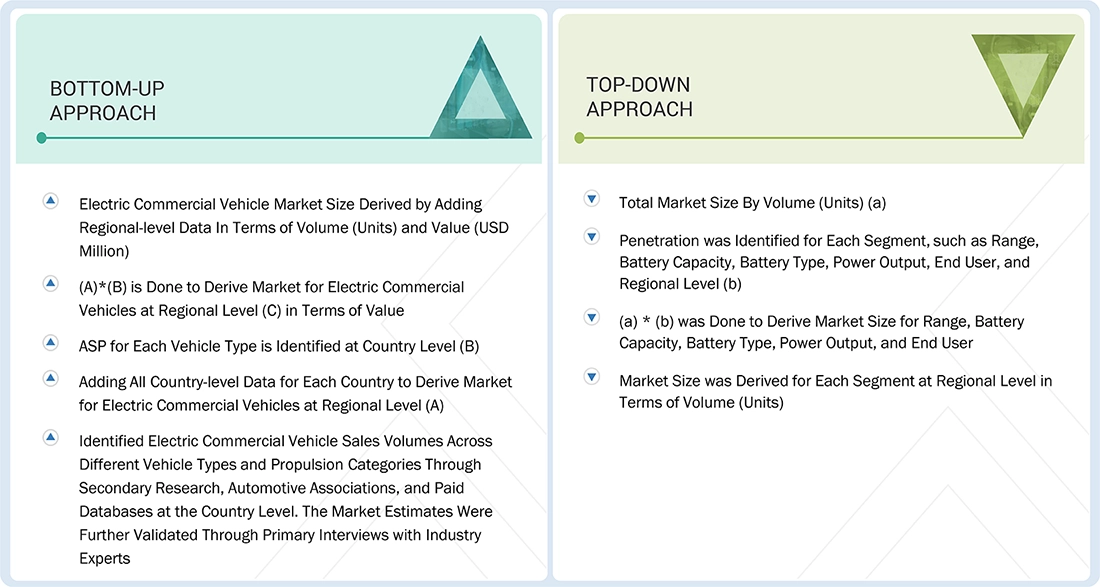
The electric commercial vehicle market is estimated using a bottom-up methodology, in which market size is calculated and validated against country-level sales data and industry verification. Under this approach, sales statistics for each vehicle category, including electric trucks, LCVs, and buses, are mapped at the country level using public databases and validated through industry associations and expert inputs. The country-level sales volumes are then aggregated to derive regional market volumes. To estimate market value, average selling prices are mapped for each vehicle type at the country level and multiplied by corresponding sales volumes. The resulting country-level market values are consolidated at the regional level and further aggregated to determine the global electric commercial vehicle market size in terms of both volume and value.
The end use segment of the electric commercial vehicle market is estimated using a top-down methodology, where the total market size is calculated and validated in terms of volume (units). The top-down assessment evaluates commercial vehicle electrification trends at the regional and country levels, followed by an adoption analysis across trucks, vans, and LCVs used in last-mile delivery, distribution, long-haul transportation, field services, and refuse operations.
Penetration rates are then applied to derive segment-level demand. The calculated volumes are aggregated and validated to determine the overall market size and further distributed across regional and country-level segments. A similar approach is followed across battery types, capacities, power outputs, and segments to ensure consistency and alignment of volume estimates across the market.
Data Triangulation
After arriving at the overall market size using the market size estimation processes as explained above, the market was split into several segments and subsegments. To complete the overall market engineering process and obtain the exact statistics for each market segment and subsegment, data triangulation and market breakdown procedures were employed wherever applicable. The data was triangulated by studying various factors and trends from both the demand and supply sides.
Market Definition
According to the European Alternative Fuels Observatory (EAFO), an electric vehicle is any motor vehicle that can be recharged from an external source of electricity. The electricity stored in the rechargeable battery packs drives the wheels. Electric commercial vehicles include LCVs, trucks and buses that use electric motors for propulsion. These vehicles are electric and used for commercial purposes, such as transporting goods or passengers.
Report Objectives
- To segment and forecast the electric commercial vehicle market in terms of volume (thousand units) and value (USD million) from 2021 to 2033
- To define, describe, and forecast the electric commercial vehicle market based on vehicle type, propulsion, battery type, battery capacity, power output, range, end use, component, and region
- To segment and forecast the market size by volume and value at the regional level based on vehicle type [LCVs, trucks (medium-duty trucks and heavy-duty trucks), and buses]
- To segment and forecast the market size by volume based on propulsion (BEVs and PHEVs)
- To segment and forecast the market size by volume based on battery type (NMC and LFP)
- To segment and forecast the market size by volume based on battery capacity (less than 60 kWh, 60–120 kWh, 121–200 kWh, 201–300 kWh, 301–500 kWh, and 501–1,000 kWh)
- To segment and forecast the market size by volume based on power output (less than 100 kW, 100–250 kW, and above 250 kW)
- To segment and forecast the market size by volume based on range (less than 150 miles, 151–300 miles, and above 300 miles)
- To segment and forecast the market size by volume based on end use (last-mile delivery, field services, distribution services, long-haul transportation, and refuse trucks)
- To segment the market based on component (battery packs, onboard chargers, electric motors, inverters, DC-DC converters, e-axles (including gearboxes), and fuel-cell stacks)
- To forecast the market size with respect to key regions, namely, Asia Pacific, Southeast Asia, Europe, North America, and the Rest of the World.
- To analyze regional markets for growth trends, prospects, and their contribution to the overall market
- To define, describe, and forecast the size of the electric commercial vehicle market with respect to growth trends and prospects, and determine the contribution of the segments to the total market
- To provide detailed information regarding the major factors (drivers, challenges, restraints, and opportunities) influencing market growth
- To strategically analyze markets with respect to individual growth trends, prospects, and contribution to the total market
- To analyze opportunities for stakeholders and the competitive landscape for market leaders
- To study the following with respect to the market -
- Supply chain analysis
- Ecosystem analysis
- Pricing analysis
- Technology analysis
- Trade analysis
- Case study analysis
- OEM and supplier analysis
- Patent analysis
- Regulatory landscape
- Key stakeholders and buying criteria
- Funding, by application
- Key conferences & events
- To strategically profile key players and comprehensively analyze their market share and core competencies
- To track and analyze competitive developments such as deals (mergers & acquisitions, partnerships, collaborations), product developments, and other activities carried out by key industry participants
Available customizations:
With the given market data, MarketsandMarkets offers customizations in line with company-specific needs.
- Electric Commercial Vehicle Market, by Bus Length, at the regional level (For regions covered in the report)
- ElectrSSic Commercial Vehicle Market, by Propulsion at the country level (For the countries not covered in the report)
Company Information
- Profiling of Additional Market Players (Up to 5)
Get the Full Electric Commercial Vehicle Market Report
Full forecast, segment splits, and company analysis for all Electric Commercial Vehicle Market.
- China Electric Commercial Vehicle Market
- Japan Electric Commercial Vehicle Market
- India Electric Commercial Vehicle Market
- South Korea Electric Commercial Vehicle Market
- Thailand Electric Commercial Vehicle Market
- Indonesia Electric Commercial Vehicle Market
- Philippines Electric Commercial Vehicle Market
- Malaysia Electric Commercial Vehicle Market
- Vietnam Electric Commercial Vehicle Market
- Singapore Electric Commercial Vehicle Market
- Australia Electric Commercial Vehicle Market
- Canada Electric Commercial Vehicle Market
- Mexico Electric Commercial Vehicle Market
- France Electric Commercial Vehicle Market
- Germany Electric Commercial Vehicle Market
- Spain Electric Commercial Vehicle Market
- Austria Electric Commercial Vehicle Market
- Norway Electric Commercial Vehicle Market
- Sweden Electric Commercial Vehicle Market
- Netherlands Electric Commercial Vehicle Market
- UK Electric Commercial Vehicle Market
- Italy Electric Commercial Vehicle Market
- Belgium Electric Commercial Vehicle Market
- Denmark Electric Commercial Vehicle Market
- Switzerland Electric Commercial Vehicle Market
- Russia Electric Commercial Vehicle Market
- Brazil Electric Commercial Vehicle Market
- Turkey Electric Commercial Vehicle Market
- US Electric Commercial Vehicle Market
Need a Tailored Report?
Customize this report to your needs
Get 10% FREE Customization
Customize This Report
