
Poland Electric Two-Wheeler Market (2026-2031)

The Poland Electric Two-Wheeler Market was valued at $3 Million in 2026 and projected to reach to $3 Million by 2031, representing a compound annual growth rate of CAGR 2.7%. Poland's electric two-wheeler market faces significant headwinds that constrain growth despite global momentum.


| Market Size in | USD 26.32 MN |
| Market Forecast in | |
| CAGR | |
| Forecast Period | |
| Units Considered | Value (USD MN) |
Poland Electric Two-Wheeler Market Trends and Insights
- This steady but limited expansion indicates that Poland faces structural headwinds in electric two-wheeler adoption compared to global markets, which are growing at 7.6% CAGR over the same period.
- Poland's slower growth trajectory suggests that consumer demand, regulatory frameworks, and infrastructure development for electric two-wheelers remain nascent relative to Western European peers. Despite the flat market size projection between 2026 and 2031, Poland's electric two-wheeler segment is gradually gaining traction as urbanization and sustainability awareness increase.
- Poland's market dynamics are shaped by price sensitivity, limited charging infrastructure, and competition from traditional combustion-powered alternatives.
- The forecast period through 2031 will be critical for Poland to develop supportive policies, expand distribution networks, and build consumer confidence in electric two-wheeler technology to accelerate market penetration beyond the current baseline..
Key Market Statistics
- CAGR (2026-2031) CAGR 2.7%
- Market Size, 2026 ~USD 3 Million
- Forecast, 2031 ~USD 3 Million
- Country Poland
Poland Electric Two-Wheeler Market Overview
Modest Market Size :
Poland's electric two-wheeler market is valued at $3.0 million in 2026, significantly smaller than global counterparts, indicating limited market penetration and early-stage adoption in the region.
Subdued Growth Trajectory :
With a CAGR of 2.7% through 2031, Poland's market growth lags substantially behind the global rate of 7.6%, suggesting structural barriers to electric two-wheeler adoption in the country.
Stagnant Forecast Period :
The market is projected to remain flat at $3.0 million by 2031, indicating minimal expansion over the five-year forecast window and limited near-term catalysts for acceleration.
Global Underperformance :
Poland's 2.7% CAGR represents less than one-third of global growth rates, reflecting unique domestic challenges such as infrastructure gaps, consumer preferences, and regulatory constraints.
Poland Electric Two-Wheeler Market Dynamics
- The stagnant valuation between 2026 and 2031 suggests that structural barriers—including limited charging infrastructure, consumer preference for larger vehicles, and competitive pricing pressures—continue to impede adoption.
- The 2.7% CAGR reflects a market struggling to gain traction compared to neighboring European nations and global peers. Future growth in Poland will depend on policy interventions, infrastructure investment, and shifting consumer attitudes toward micro-mobility solutions.
- Government incentives, urban congestion concerns, and environmental regulations may gradually unlock demand, but near-term prospects remain constrained.
- Stakeholders should anticipate a prolonged maturation period before the market achieves acceleration comparable to global benchmarks..
Market Ecosystem
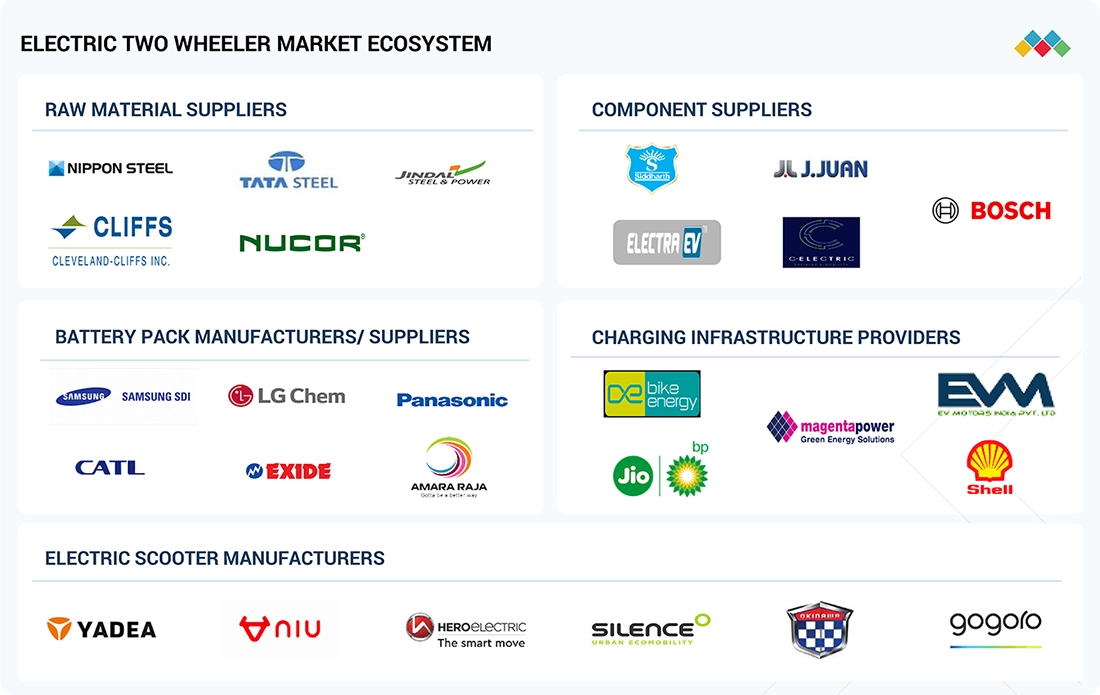
ELECTRIC TWO WHEELER MARKET: COMMERCIAL USE CASES ACROSS INDUSTRIES
| COMPANY | USE CASE DESCRIPTION | BENEFITS |
|---|---|---|
 |
Offers connected electric scooters with digital sales platforms and battery flexibility for urban users. | Expands EV access, improves ownership convenience, and supports lower urban emissions. |
 |
Provides connected electric scooters with advanced battery management and regenerative systems. | Enhances range efficiency, enables remote diagnostics, and supports fleet monitoring. |
 |
Develops urban focused electric scooters with integrated lithium ion battery and motor control systems. | Reduces operating cost, ensures consistent city performance, and supports ICE replacement. |
 |
Offers connected smart scooters for individual and commercial users, integrated with telematics, navigation, and performance analytics | Enhances user experience through data-driven insights, improves vehicle efficiency, and enables predictive maintenance |
 |
Provides electric scooters for personal mobility and fleet operations in urban areas through app-based rentals and ownership models | Reduces carbon emissions, lowers per km travel cost, and supports shared mobility infrastructure |
Logos and trademarks shown above are the property of their respective owners. Their use here is for informational and illustrative purposes only.
Related Ecosystem
Driving Support Security
Electric Hybrid Vehicles
On Highway Off Highway Vehicles
Key Takeaways
- Poland's electric two-wheeler market is valued at $3.0 million in 2026 with a projected size of $3.0 million in 2031, indicating minimal growth over the forecast period.
- Poland's 2.7% CAGR significantly lags the global market growth rate of 7.6%, suggesting structural barriers to adoption in the country.
- Poland's market is constrained by price sensitivity, underdeveloped charging infrastructure, and strong competition from traditional two-wheelers.
- Policy support, infrastructure investment, and consumer education will be essential for Poland to unlock growth potential in the electric two-wheeler segment by 2031.
Electric Two-Wheeler Market Report Scope
| Report Metric | Details |
|---|---|
| Base Year | 2026 |
| Fastest Growing Segment | BATTERY (Technology Type) |
| Forecast Period | 2026–2031 |
| Growth Rate | CAGR of 7.6% from 2026 to 2031 |
| Largest Segment | LITHIUM-ION (Battery Type) |
| Market Size Base Year (Billions) | ~USD 5.32 (2026) |
| Revenue Forecast (Billions) | ~USD 7.68 (2031) |
| Segments Covered | Vehicle Type, Vehicle Class, Voltage Type, Battery Type, Range, Usage, Technology Type, Motor Type |
Poland Electric Two-Wheeler Market Report Segmentation
8 segment dimensions are covered across the global market.
By Vehicle Type
- E-Motorcycle
- E-Scooter/Moped
By Vehicle Class
- Economy
- Luxury
By Voltage Type
- 36 V
- 48 V
- 60 V
- 72 V
- Above 72 V
By Battery Type
- Lithium-Ion
- Sealed Lead-Acid
By Range
- 75–100 Miles
- Above 100 Miles
- Below 75 Miles
By Usage
- Commercial
- Private
By Technology Type
- Battery
- Plug-In
By Motor Type
- Hub Motor
- Mid-Drive Motor
Target Audience
- OEM & Manufacturers : Electric two-wheeler manufacturers need Poland-specific market data to assess viability, localize offerings, and determine resource allocation for this emerging but constrained market.
- Investors & PE Firms : Investment professionals require detailed Poland market analysis to evaluate portfolio opportunities, understand growth constraints, and identify turnaround or acquisition targets.
- Government & Policy Makers : Polish policymakers and transport authorities need market intelligence to design effective incentive programs, infrastructure investments, and regulatory frameworks to stimulate adoption.
- Distributors & Retailers : Channel partners and retailers require Poland-specific demand forecasts and market dynamics to optimize inventory, pricing strategies, and distribution network planning.
- Consulting & Strategy Firms : Management consultants advising clients in automotive and mobility sectors need granular Poland data to support client strategy development and market entry recommendations.
Key Companies in the Poland Electric Two-Wheeler Market
| Company | HQ | Ownership | Strongest segments |
|---|---|---|---|
| VISTEON CORPORATION | United States | Public Company | Instrument clusters and information displays,Infotainment and connected car solutions,SmartCore domain controllers and middleware, |
| VINFAST | Vietnam | Public Company | Car (EV SUVs, mini EVs, pickup, MPV),E-scooters and electric bikes,E-bus and services (battery lease, charging), |
| TVS MOTOR COMPANY | India | Public Company | Motorcycles (Apache, Raider, Radeon, StaR City+, HLX, Sport),Scooters (Jupiter, Neo, Ntorq, Zest),Electric two-wheelers and e-bikes (TVS X, Orbiter, iQube, Cilo, Simpel, Zenith, Allegro), |
| BAJAJ AUTO LTD. | India | Public Company | Motorcycles and bikes (ICE),Three-wheelers and commercial vehicles,Electric two-wheelers, |
| ATHER ENERGY | India | Public Company | Premium electric scooters (flagship models),Mid-range/entry EV scooters,Charging infrastructure, software, accessories, and insurance, |
| OLA ELECTRIC | India | Public Company | Electric scooters (complete vehicles),EV components (battery packs, motors, frames),Cells and energy solutions, |
| GOGORO | Taiwan | Public Company | Electric scooters and bikes (hardware sales),Battery swapping services (Swap & Go, subscriptions),Platform technology, software, and licensing, |
| HERO MOTOCORP LTD. | India | Public Company | Motorcycles (ICE),Scooters (ICE),Electric scooters, |
| VMOTO LIMITED | Australia | Public Company | Electric mopeds / scooters,Electric motorcycles,Fleet solutions (VMOTO Fleet, services), |
| JIANGSU XINRI E-VEHICLE CO., LTD. | China | Public Company | High-speed and moped electric two-wheelers,Small-size vehicles and E-car related products,Electric bicycles, |
| ASKOLL EVA S.P.A. | Italy | Private Company | Electric scooters (consumer and B2B),Pedal-assisted e-bikes,Services, rentals, and accessories, |
VISTEON CORPORATION
Visteon Corporation is a publicly traded American company founded in 2000 with 10,500 employees. It is a global automotive supplier specializing in cockpit electronics and connected car solutions.
VINFAST
VinFast is a Vietnamese public company with 29,878 employees that manufactures electric vehicles and batteries. The company has rapidly expanded its operations to become a major player in the global EV market.
TVS MOTOR COMPANY
TVS Motor Company is an Indian public company founded in 1992 with 6,850 employees. It manufactures two-wheelers, three-wheelers, and commercial vehicles for domestic and international markets.
BAJAJ AUTO LTD.
Bajaj Auto Ltd. is an Indian public company founded in 1945 with 5,231 employees. It is a leading manufacturer of motorcycles, scooters, and three-wheelers with a significant global presence.
ATHER ENERGY
Ather Energy is an Indian private company founded in 2013 with 1,617 employees. It designs and manufactures electric scooters and develops charging infrastructure for the Indian market.
OLA ELECTRIC
Ola Electric is an Indian public company founded in 2017 that manufactures electric two-wheelers and related products. The company is focused on sustainable mobility solutions for the Indian market.
GOGORO
Gogoro is a Taiwanese public company founded in 2011 with 1,416 employees. It manufactures electric scooters and operates a battery-swapping network for convenient vehicle charging.
HERO MOTOCORP LTD.
Hero MotoCorp Ltd. is an Indian public company founded in 1984 with 9,177 employees. It is one of the world's largest manufacturers of two-wheelers and motorcycles.
VMOTO LIMITED
Vmoto Limited is an Australian public company founded in 2001. It designs and manufactures electric scooters and motorcycles for global markets.
JIANGSU XINRI E-VEHICLE CO., LTD.
Jiangsu Xinri E-Vehicle Co., Ltd. is a Chinese public company founded in 1999 with 2,204 employees. It manufactures electric vehicles and components for the Chinese market.
ASKOLL EVA S.P.A.
Askoll Eva S.p.A. is an Italian private company founded in 1978 with 64 employees. It manufactures electric motors and powertrains for two-wheelers and light vehicles.
Reasons to Buy this Report
- Identify Market Entry Barriers : Understand the specific structural and regulatory obstacles preventing faster adoption in Poland, enabling strategic market entry planning and localized product positioning.
- Competitive Benchmarking : Compare Poland's underperformance against global and regional peers to identify competitive advantages and differentiation opportunities in an underpenetrated market.
- Investment Decision Support : Make informed capital allocation decisions with detailed market sizing and growth forecasts specific to Poland, reducing investment risk in a nascent segment.
- Policy & Regulatory Insights : Gain clarity on Poland-specific regulatory environment and infrastructure gaps that influence market dynamics and future growth potential.
- Long-Term Strategic Planning : Develop multi-year strategies grounded in Poland's unique market trajectory, enabling proactive positioning before potential acceleration phases.
Frequently asked questions
What is the current size of Poland's electric two-wheeler market in 2026?
Poland's electric two-wheeler market is estimated at $3.0 million in 2026, representing a relatively small segment within the broader European automotive market.
What is the projected market size for Poland's electric two-wheeler market by 2031?
Poland's electric two-wheeler market is forecast to reach $3.0 million by 2031, indicating minimal growth over the five-year forecast period.
What is Poland's CAGR for the electric two-wheeler market?
Poland's electric two-wheeler market is expected to grow at a compound annual growth rate of 2.7% from 2026 to 2031, significantly below the global CAGR of 7.6%.
Why is Poland's electric two-wheeler market growing slower than the global average?
Poland's slower growth is driven by price sensitivity among consumers, limited charging infrastructure, regulatory gaps, and strong competition from traditional two-wheelers and alternative transportation modes.
What factors could accelerate Poland's electric two-wheeler market growth by 2031?
Government incentives, subsidies, expanded charging networks, improved product affordability, and increased consumer awareness of environmental benefits could significantly boost Poland's market growth trajectory through 2031.
RESEARCH METHODOLOGY
This research study involved the extensive use of secondary sources, such as company annual reports/presentations, industry association publications, automotive magazine articles, directories, technical handbooks, the World Economic Outlook, trade websites, technical articles, and databases, to identify and collect information on the electric two-wheeler market. In-depth interviews were conducted with various primary respondents, including key industry participants, subject-matter experts, C-level executives of key market players, and industry consultants, among other experts, to obtain and verify critical qualitative and quantitative information and assess market prospects.
Secondary Research
In the secondary research process, various secondary sources were referred to identify and collect information on the electric two-wheeler market for this study. Secondary sources included annual reports, press releases, and investor presentations of companies; whitepapers, certified publications, and articles from recognized authors; directories; databases; and articles from recognized associations and government publishing sources.
Primary Research
Extensive primary research was conducted after understanding the electric two-wheeler market scenario through secondary research. Several primary interviews were conducted with market experts from both demand (vehicle manufacturers, country-level government associations, and trade associations) and supply (OEMs and component manufacturers) sides across three regions: North America, Europe, and Asia Pacific. Approximately 30% and 70% of primary interviews were conducted from the demand and supply sides, respectively. Primary data was collected through questionnaires, emails, and telephonic interviews. In the canvassing of primaries, various departments within organizations, such as sales, operations, and administration, were covered to provide a holistic viewpoint in the report.
Breakdown of Primary Respondents:
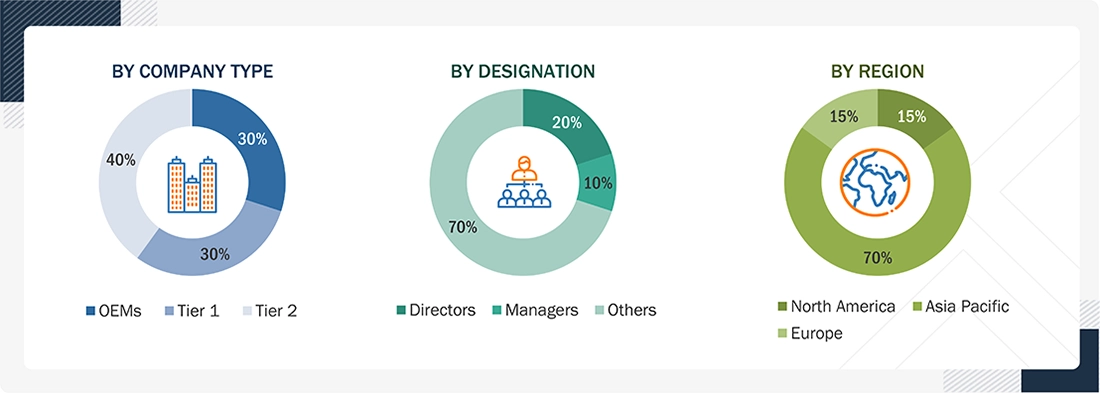
Note: The tiers of companies are based on the supply chain of the electric two-wheeler market.
Other designations include design engineers, manufacturing engineers, and sales executives.
To know about the assumptions considered for the study, download the pdf brochure
Market Size Estimation
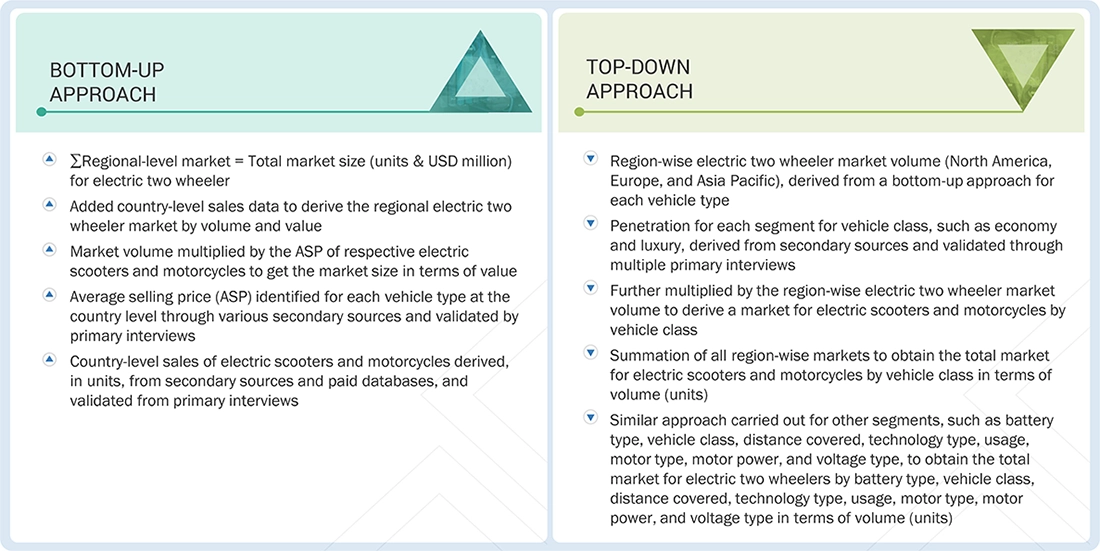
Bottom-up Approach
The bottom-up approach was used to estimate and validate the size of the electric two-wheeler market by vehicle type. In this approach, the vehicle sales statistics for each vehicle type (e-scooters/mopeds, e-motorcycles) have been considered at the country level. To determine the market size in terms of volume and value, a mapping of electric two-wheelers has been conducted for each country and vehicle type (e-scooters/mopeds, e-motorcycles). Following this, the market has been categorized for these vehicle types. The number of electric models varies from country to country. The country-level data has been summed up to arrive at the regional-level data in terms of volume. The summation of the country-level market size gives the regional market size, and further summation of the regional market size provides the global electric two-wheeler market size. Further, the volume numbers have been multiplied by the average selling price of electric scooters and motorcycles by vehicle type, which gives the global electric two-wheeler market in terms of value.
Top-Down Approach
The top-down approach has been used to estimate and validate the size of the electric two-wheeler market at the global level and by battery type, vehicle class, distance covered, technology type, usage, motor type, motor power, and voltage type in terms of volume and value. In this approach, battery type, vehicle class, distance covered, technology, usage, motor type, motor power, and voltage segments of the electric two-wheeler market have been identified at the regional level. The penetration identified for each battery type, vehicle class, distance covered, technology type, usage, and voltage type for each vehicle type has been multiplied by the volume of each scooter and motorcycle at the regional level to derive the segmental market size by volume. All regional-level data have been summed up to derive the global electric two-wheeler market by battery type, vehicle class, distance covered, technology, usage, and voltage.
Data Triangulation
After arriving at the overall market size using the market size estimation process explained above, the market was split into several segments and subsegments. To complete the overall market engineering process and arrive at the exact statistics of each market segment and subsegment, data triangulation and market breakdown procedures were employed, wherever applicable. The data was triangulated by studying various factors and trends from both the demand and supply sides.
Market Definition
Electric two-wheelers are plug-in vehicles powered by electric motors. They store electricity in rechargeable batteries, which drive the motors. These vehicles produce zero emissions and are considered electric motor-driven. The operating and top speeds of electric two-wheelers depend on battery technology. Scooters and mopeds are simple-to-operate two-wheelers with a step-through frame and a foot platform. They are budget-friendly, lightweight, and easy to commute with. Motorcycles are heavier, faster, and larger than scooters and mopeds. Depending on the needs, they feature different body designs and frames compared to scooters and mopeds. The electric versions of scooters and motorcycles are powered by electricity stored in their batteries.
Stakeholders
- Electric Two-wheeler Associations, Forums, and Alliances
- Automobile Manufacturers
- Automotive Component Manufacturers
- Automotive Investors
- Battery Distributors
- Battery Manufacturers
- Charging Infrastructure Providers
- Charging Service Providers
- Electric Two-wheeler Distributors and Retailers
- Electric Two-wheeler Charging Station Service Providers
- Electric Two-wheeler Cable Manufacturers
- Government Agencies and Policymakers
- Electric Two-wheeler Manufacturers
- Electric Two-wheeler Charging Pole Manufacturers
- Electric Two-wheeler Component Manufacturers
- Raw Material Providers
Report Objectives
- To segment and forecast the size of the electric two-wheeler market in terms of value and volume based on vehicle type, battery type, voltage, vehicle class, technology, distance covered, usage, motor type, motor power, and region
- To forecast the size of market segments with respect to the following regions: North America, Europe, and Asia Pacific
- To identify and analyze key drivers, restraints, opportunities, and challenges influencing market growth
- To analyze market opportunities for stakeholders
- To analyze micro markets with respect to individual growth trends, prospects, and contributions to the total market
- To strategically profile key players and comprehensively analyze their market share and core competencies
-
To study the following with respect to the market:
- Supply Chain Analysis
- Ecosystem Analysis
- Technology Analysis
- Trade Analysis
- Case Study Analysis
- Patent Analysis
- Regulatory Landscape
- Key Conferences and Events
- Pricing Analysis
- Buying Criteria
- To track and analyze competitive developments, such as product launches/developments and deals, undertaken by key market players
Get the Full Electric Two-Wheeler Market Report
Full forecast, segment splits, and company analysis for all Electric Two-Wheeler Market.
- China Electric Two-Wheeler Market
- Japan Electric Two-Wheeler Market
- India Electric Two-Wheeler Market
- South Korea Electric Two-Wheeler Market
- Taiwan Electric Two-Wheeler Market
- Thailand Electric Two-Wheeler Market
- Indonesia Electric Two-Wheeler Market
- Malaysia Electric Two-Wheeler Market
- Philippines Electric Two-Wheeler Market
- Vietnam Electric Two-Wheeler Market
- France Electric Two-Wheeler Market
- Germany Electric Two-Wheeler Market
- Spain Electric Two-Wheeler Market
- Austria Electric Two-Wheeler Market
- UK Electric Two-Wheeler Market
- Italy Electric Two-Wheeler Market
- Belgium Electric Two-Wheeler Market
- Netherlands Electric Two-Wheeler Market
- Denmark Electric Two-Wheeler Market
Need a Tailored Report?
Customize this report to your needs
Get 10% FREE Customization
Customize This Report
