
UK EV Battery Market (2026-2031)

The UK EV Battery Market was valued at $95944 Million in 2026 and projected to reach to $118572 Million by 2031, representing a compound annual growth rate of 11.1%. The UK EV battery market is positioned as a cornerstone of Europe's electrification agenda, with substantial growth momentum through 2031.


| Market Size in | USD 26.32 MN |
| Market Forecast in | |
| CAGR | |
| Forecast Period | |
| Units Considered | Value (USD MN) |
UK EV Battery Market Trends and Insights
- Valued at $95,944 million in 2026, the UK market is projected to expand to $118,572 million by 2031, representing a compound annual growth rate of 11.1%.
- This acceleration reflects the UK's commitment to electrification, supported by stringent emissions regulations and substantial government incentives for EV adoption.
- The UK's established manufacturing base and supply chain infrastructure further strengthen its position as a key hub for battery production and innovation in the region. Driving this expansion, the UK benefits from increasing consumer demand for electric vehicles, coupled with declining battery costs and technological advancements in energy density and charging speeds.
- The UK government's ban on petrol and diesel vehicle sales by 2030 (with hybrid phase-out by 2035) creates sustained demand for EV batteries across passenger and commercial segments.
- Investment in domestic battery gigafactories and recycling infrastructure positions the UK to capture significant value throughout the battery lifecycle, from manufacturing to end-of-life recovery..
Key Market Statistics
- CAGR (2026-2031) 11.1% CAGR
- Market Size, 2026 ~USD 95944 Million
- Forecast, 2031 ~USD 118572 Million
- Country UK
UK EV Battery Market Overview
Rapid Market Expansion :
The UK EV battery market is experiencing accelerated growth with an 11.1% CAGR from 2026 to 2031, significantly outpacing the global average of 5.6%, driven by aggressive electrification targets and regulatory mandates.
Government Support & Policy :
UK government incentives, including grants for EV purchases and investments in battery manufacturing infrastructure, are catalyzing market growth and attracting major battery producers to establish local production facilities.
Supply Chain Localization :
Post-Brexit, the UK is prioritizing domestic battery production and supply chain resilience, with new gigafactories under development to reduce dependency on imports and create competitive advantages.
Emissions Regulations Impact :
Stringent UK and EU emissions standards, including the phase-out of petrol and diesel vehicles by 2030, are forcing automotive manufacturers to accelerate EV adoption and battery procurement.
UK EV Battery Market Dynamics
- Market expansion is underpinned by regulatory pressures, government subsidies, and increasing consumer demand for electric vehicles.
- The UK's strategic focus on developing domestic battery manufacturing capabilities will enhance supply chain resilience and reduce reliance on Asian suppliers. By 2031, the market is expected to reach $118.6 billion, reflecting strong investment in battery technology, recycling infrastructure, and next-generation solid-state batteries.
- Key drivers include the 2030 petrol/diesel vehicle ban, corporate sustainability commitments, and declining battery costs.
- However, competition from established Asian manufacturers and supply chain vulnerabilities remain challenges that UK stakeholders must address..
Market Ecosystem
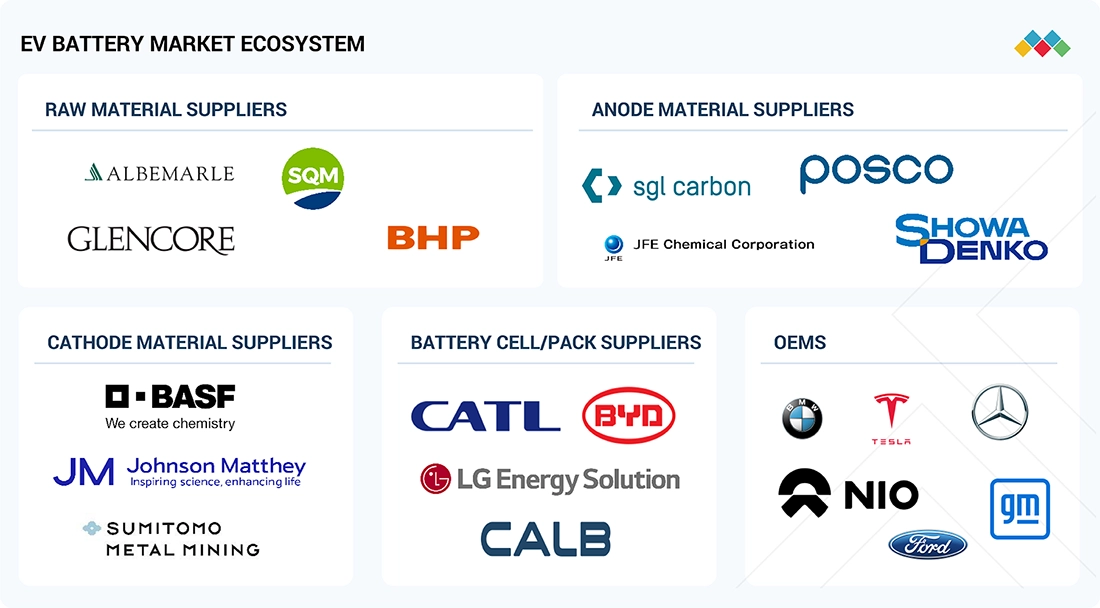
EV BATTERY MARKET SIZE, SHARE & ANALYSIS: COMMERCIAL USE CASES ACROSS INDUSTRIES
| COMPANY | USE CASE DESCRIPTION | BENEFITS |
|---|---|---|
 |
Supplies lithium-ion and LFP battery systems to passenger EVs, commercial vehicles, and battery energy storage projects globally. | Reduces battery cost per kWh, improves vehicle range, and supports large-scale electrification. |
 |
Uses Blade Battery technology across passenger cars, buses, and commercial fleets with a focus on safety and lifecycle performance. | Enhances thermal safety, extends battery life, and lowers operating costs. |
 |
Supplies high-energy battery cells for electric passenger vehicles and stationary energy storage applications. | Improves energy density, enables longer driving range, and supports platform scalability. |
 |
Develops cylindrical battery cells for premium EVs and integrated mobility platforms. | Enables fast charging capability, improves energy efficiency, and supports high-performance EV architectures. |
 |
Provides advanced battery packs for premium passenger EVs and electric commercial vehicles. | Delivers higher power output, enhances durability, and improves charging performance. |
Logos and trademarks shown above are the property of their respective owners. Their use here is for informational and illustrative purposes only.
Related Ecosystem
Automotive Advance Technologies
- Battery Electric Vehicle (BEV)
- Light Commercial Vehicles (LCVs)
- Fuel Cell Electric Vehicle (FCEV)
- Hybrid Electric Vehicle (HEV)
- Internal Combustion Engine (ICE)
- BOSCH LIMITED
- Continental ag
- Visteon Corporation
- DENSO Corporation
- ZF FRIEDRICHSHAFEN AG
Electric Hybrid Vehicles
- Battery Electric Vehicle (BEV)
- Fuel Cell Electric Vehicle (FCEV)
- Light Commercial Vehicles (LCVs)
- Hybrid Electric Vehicle (HEV)
- Agricultural Tractors
- Visteon Corporation
- Byd company ltd.
- BOSCH LIMITED
- Tesla, Inc.
- FORD MOTOR COMPANY
Battery And Wireless Charging
- Nickel-Cadmium Battery
- Battery Electric Vehicle (BEV)
- Energy Harvesting
- Hybrid Electric Vehicle (HEV)
- Smart Cards
- Panasonic Holdings Corporation
- MOMENTIVE PERFORMANCE MATERIALS INC.
- Lg corp
- FDK Corporation
- EnerSys
Key Takeaways
- The UK EV battery market will grow from $95.9B (2026) to $118.6B (2031) at an 11.1% CAGR, outpacing global growth.
- UK regulatory mandates—including the 2030 petrol/diesel ban—create sustained structural demand for EV batteries.
- The UK's emerging gigafactory capacity and battery recycling infrastructure position it as a European manufacturing and circular economy leader.
- Declining battery costs and advancing technology drive UK consumer adoption, supporting market expansion across all vehicle segments.
EV Battery Market Report Scope
| Report Metric | Details |
|---|---|
| Base Year | 2026 |
| Fastest Growing Segment | EUROPE (Battery Type) |
| Forecast Period | 2026–2031 |
| Growth Rate | CAGR of 5.6% from 2026 to 2031 |
| Largest Segment | BEV (Propulsion) |
| Market Size Base Year (Billions) | ~USD 103.46 (2026) |
| Revenue Forecast (Billions) | ~USD 135.86 (2031) |
| Segments Covered | Battery Type, Material Type, Vehicle Type, Battery Form, Battery Capacity, Propulsion |
UK EV Battery Market Report Segmentation
6 segment dimensions are covered across the global market.
By Battery Type
- Lithium-Ion
- Other Battery Types
- Solid-State
By Material Type
- Cobalt
- Iron
- Lithium
- Manganese
- Natural Graphite
- Nickel
- Other Material Types
- Phosphate
By Vehicle Type
- Bus
- Light Commercial Vehicle
- Medium & Heavy Truck
- Off-Highway Vehicle
- Passenger Car
- Van/Light Truck
By Battery Form
- Cylindrical
- Pouch
- Prismatic
By Battery Capacity
- 111–200 Kwh
- 201–300 Kwh
- 50–110 Kwh
- < 50 Kwh
- > 300 Kwh
By Propulsion
- Bev
- Phev
Target Audience
- Automotive OEMs & Suppliers : UK and international vehicle manufacturers need detailed market intelligence to plan battery procurement strategies, establish local supply partnerships, and meet regulatory requirements for UK vehicle production.
- Battery Manufacturers & Producers : Existing and prospective battery producers require UK-specific market data to evaluate gigafactory investments, assess competitive positioning, and identify growth opportunities in the rapidly expanding domestic market.
- Investment & Private Equity Firms : Investors seeking exposure to UK EV battery sector need comprehensive market analysis, growth forecasts, and risk assessments to identify acquisition targets, fund allocation, and portfolio optimization opportunities.
- Government & Policy Makers : UK government agencies and regulatory bodies require market insights to inform industrial strategy, incentive programs, supply chain resilience initiatives, and long-term electrification policy development.
- Logistics & Infrastructure Providers : Supply chain, logistics, and energy infrastructure companies need UK market forecasts to plan distribution networks, charging infrastructure expansion, and battery recycling facilities aligned with market growth.
Key Companies in the UK EV Battery Market
| Company | HQ | Ownership | Strongest segments |
|---|---|---|---|
| FREUDENBERG GROUP | Germany | Private Company | Automotive components (battery, fuel cell systems, floor mats, elastomers, technical textiles),Industrial sealing, pumps, compressors, and specialty lubricants/chemicals,Technical textiles and filtration (air and liquid, filter media, building interiors), |
| VISTEON CORPORATION | United States | Public Company | Instrument clusters (analog and digital),Information displays and cockpit HMI,Infotainment and connected car (incl. Android, voice assistants), |
| BODYCOTE PLC | United Kingdom | Public Company | Precision Heat Treatment,Specialist Technologies – HIP & Powdermet,Specialist Technologies – Surface Technologies, |
| CONTEMPORARY AMPEREX TECHNOLOGY CO., LIMITED | China | Public Company | Power battery systems for passenger vehicles,Commercial and specialty vehicle battery systems,Energy storage battery systems, |
| BYD COMPANY LTD. | China | Public Company | Automobiles and Related Products (incl. NEVs, auto components, leasing, after-sales),Automobile Power Batteries and Lithium-ion Batteries,Mobile Handset Components, Assembly Service and Other Products, |
| LG ENERGY SOLUTION | South Korea | Public Company | Automotive batteries,Mobility and IT batteries,Energy storage systems, |
| CALB | Japan | Public Company | Potato-based snacks (chips, Jagabee, JagaRico, Sapporo Potato),Corn- and bean-based snacks (Harvest Snaps, Sayaendo, Kappa Ebisen),Flour-based and other savory snacks, |
| GOTION, INC. | China | Public Company | Power battery systems (EV and hybrid),Energy storage battery systems,Power transmission and distribution equipment, |
| SK INNOVATION CO. LTD. | South Korea | Public Company | Energy & Chemicals (refining, petrochemicals, lubricants, base oil, city gas, LNG),Battery & Materials (EV batteries, separators, industrial gas, waste battery services),E&S and Renewables (power, district energy, hydrogen, CCS, energy solutions), |
| PANASONIC HOLDINGS CORPORATION | Japan | Public Company | HVAC & CC (air-conditioners, heat pumps, ventilation, showcases),Energy (cylindrical in-vehicle batteries, storage systems, dry and secondary batteries),Electric Works (lighting, wiring devices, solar PV, fuel cells, building materials), |
| EVE ENERGY CO., LTD. | China | Public Company | Power batteries (EV and energy storage: prismatic LFP, prismatic NCM, pouch NCM, EV cylindrical, systems),Consumer small lithium-ion and cylindrical cells,Lithium primary batteries (lithium-thionyl chloride, lithium-carbon dioxide, battery capacitors, composite ES), |
| SAMSUNG SDI | South Korea | Public Company | Small-sized lithium-ion batteries,Automotive batteries,Energy storage systems, |
| SUNWODA ELECTRONIC CO., LTD. | China | Public Company | 3C Consumer Batteries & PCBA/Components,Electric Vehicle Batteries & Vehicle Systems (BMS, BDU, Domain Controllers),Energy Storage Systems & Zero-Carbon Energy Services, |
| TOSHIBA CORPORATION | Japan | Private Company | Energy Systems & Solutions (nuclear, thermal, renewables, T&D),Infrastructure Systems & Solutions (water, rail, airports, roads, security, telecom),Building Solutions (elevators, escalators, lighting, HVAC components), |
| MITSUBISHI CORPORATION | Japan | Public Company | Global Environmental Energy (natural gas, LNG, LPG, petroleum, energy businesses),Mineral Resources (copper, coking coal, iron ore, aluminum, lithium, nickel),Material Solutions (petrochemicals, basic chemicals, functional materials, carbon/ceramics, steel products), |
| EXIDE INDUSTRIES LIMITED | India | Public Company | Automotive lead-acid batteries (OEM + replacement),Inverter and home UPS batteries/systems,Industrial, UPS, telecom, and infrastructural batteries, |
| E-ONE MOLI ENERGY CORP. | Taiwan | Private Company | Cordless power tools and garden tools cells,Automotive, motorsports, and urban transportation cells,Energy storage systems cells, |
| ALTAIR NANOTECHNOLOGIES INC. | United States | Private Company | Turn-key energy storage systems (incl. PowerRack),Battery packs, modules, and cells,nLTO powders and materials, |
FREUDENBERG GROUP
Freudenberg Group is a German private company with roots dating back to 1849 and currently employs 50,968 people.
VISTEON CORPORATION
Visteon Corporation is a publicly traded United States company founded in 2000 with 10,500 employees.
BODYCOTE PLC
Bodycote PLC is a United Kingdom-based public company established in 1923 with 3,921 employees.
CONTEMPORARY AMPEREX TECHNOLOGY CO., LIMITED
Contemporary Amperex Technology Co., Limited is a Chinese public company founded in 2011 with 185,839 employees.
BYD COMPANY LTD.
BYD Company Ltd. is a Chinese public company established in 1994 with 869,600 employees.
LG ENERGY SOLUTION
LG Energy Solution is a South Korean public company founded in 2020 with 12,461 employees.
CALB
CALB is a Japanese public company established in 1949 with 6,974 employees.
GOTION, INC.
Gotion, Inc. is a Chinese public company founded in 1995 with 33,087 employees.
SK INNOVATION CO. LTD.
SK Innovation Co. Ltd. is a South Korean public company established in 1962 with 1,505 employees.
PANASONIC HOLDINGS CORPORATION
Panasonic Holdings Corporation is a Japanese public company founded in 1918 with 183,685 employees.
EVE ENERGY CO., LTD.
EVE Energy Co., Ltd. is a Chinese public company established in 2001 with 31,213 employees.
SAMSUNG SDI
Samsung SDI is a South Korean public company founded in 1970 with 13,073 employees.
SUNWODA ELECTRONIC CO., LTD.
Sunwoda Electronic Co., Ltd. is a Chinese public company established in 1997 with 63,696 employees.
TOSHIBA CORPORATION
Toshiba Corporation is a Japanese private company with origins dating back to 1875 and currently employs 106,648 people.
MITSUBISHI CORPORATION
Mitsubishi Corporation is a Japanese public company established in 1950 with 62,062 employees.
EXIDE INDUSTRIES LIMITED
Exide Industries Limited is an Indian public company founded in 1916 with 5,143 employees.
E-ONE MOLI ENERGY CORP.
E-ONE Moli Energy Corp. is a Taiwanese private company established in 1998 with 384 employees.
ALTAIR NANOTECHNOLOGIES INC.
Altair Nanotechnologies Inc. is a United States-based private company with 1,125 employees.
Reasons to Buy this Report
- Regulatory Compliance Intelligence : Understand UK-specific emissions regulations, vehicle phase-out timelines, and government incentive structures to align business strategies with evolving compliance requirements and capitalize on policy-driven opportunities.
- Market Sizing & Forecasting : Access precise UK market valuations ($95.9B in 2026, $118.6B in 2031) and segment-level forecasts to support investment decisions, capacity planning, and competitive positioning in the high-growth UK market.
- Supply Chain Localization Insights : Identify emerging UK battery manufacturing hubs, domestic production capacity, and supply chain reshoring opportunities to optimize sourcing strategies and reduce dependency on international suppliers.
- Competitive Landscape Analysis : Benchmark against UK-based and international battery manufacturers, assess market consolidation trends, and identify partnership or acquisition opportunities within the UK automotive ecosystem.
- Investment & Growth Opportunities : Discover high-potential segments including battery recycling, solid-state technology development, and EV infrastructure expansion to guide capital allocation and strategic expansion plans in the UK market.
Frequently asked questions
What is the projected size of the UK EV battery market in 2031?
The UK EV battery market is forecast to reach $118,572 million by 2031, up from $95,944 million in 2026.
What is the CAGR for the UK EV battery market between 2026 and 2031?
The UK EV battery market is expected to grow at a compound annual growth rate of 11.1% from 2026 to 2031.
How does the UK market growth compare to global EV battery market growth?
The UK's 11.1% CAGR significantly outpaces the global EV battery market CAGR of 5.6%, reflecting stronger regional demand and policy support.
What regulatory factors are driving UK EV battery market growth?
The UK government's ban on petrol and diesel vehicle sales by 2030 and hybrid phase-out by 2035 create sustained demand for EV batteries and accelerate market expansion.
What role does battery recycling play in the UK market?
Investment in UK battery recycling infrastructure supports circular economy objectives, reduces supply chain dependency, and creates additional value recovery opportunities throughout the battery lifecycle.
RESEARCH METHODOLOGY
The study encompassed four primary tasks to determine the present and future scope of the EV battery market. Initially, extensive secondary research was conducted to gather data on the market, its related sectors, and overarching industries. Subsequently, primary research involving industry experts across the value chain corroborated and validated these findings and assumptions. The complete market size was estimated by using both top-down and bottom-up methodologies. Following this, a market breakdown and data triangulation approach were utilized to determine the size of specific segments and subsegments within the market.
Secondary Research
In the secondary research process, various secondary sources such as company annual reports and presentations, press releases, industry association publications [e.g., International Energy Agency (IEA), International Organization of Motor Vehicle Manufacturers (OICA), National Highway Traffic Safety Administration (NHTSA)], articles, technical papers, trade publications, industry databases (e.g., MarkLines and Factiva), and company websites were used to identify and collect information for an extensive commercial study of the global EV battery market.
Primary Research
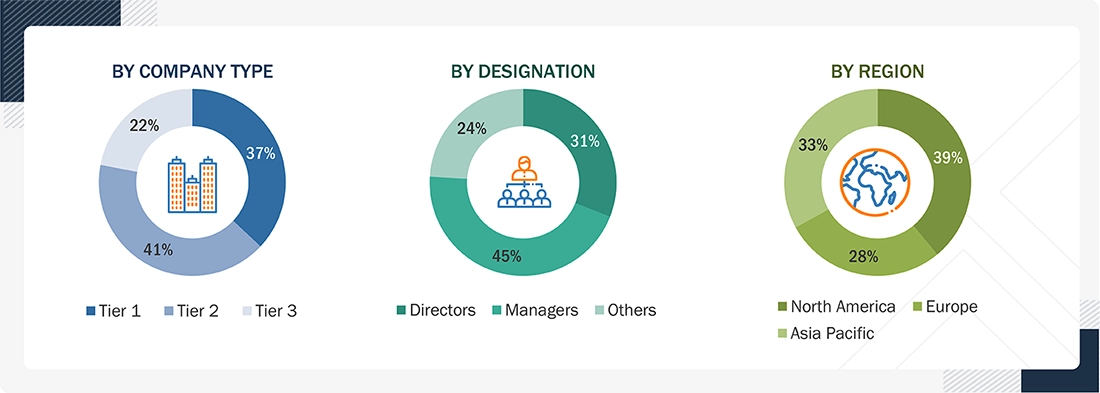
In the primary research process, various primary sources from both the supply and demand sides were interviewed to obtain qualitative and quantitative information on the market. The primary sources from the supply side included various industry experts, such as CXOs, vice presidents, directors from business development, marketing, product development/innovation teams, and related key executives from various key companies. Various system integrators, industry associations, independent consultants/industry veterans, and key opinion leaders were also interviewed.
Primary interviews have been conducted to gather insights such as sizing estimates on the EV battery market and forecast, future technology trends, and upcoming technologies in the market. Data triangulation of all these points was done using the information gathered from secondary research and model mapping. Stakeholders from the demand and supply sides have been interviewed to understand their views on the abovementioned points.
To know about the assumptions considered for the study, download the pdf brochure
Market Size Estimation
Both top-down and bottom-up approaches were used to estimate and validate the total size of the EV battery market. These methods were also used extensively to estimate the size of various subsegments in the market. The research methodology used to estimate the market size includes the following:
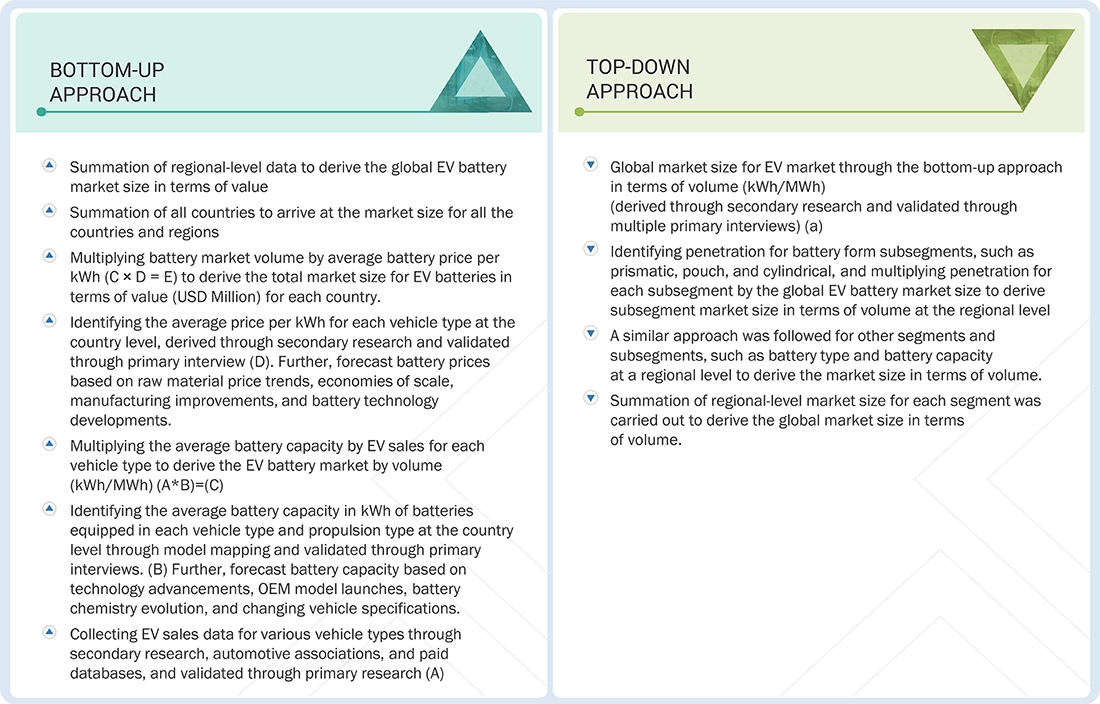
Data Triangulation
After arriving at the overall market size—using the market size estimation processes as explained above—the market was split into several segments and subsegments. To complete the overall market engineering process and arrive at the exact statistics of each market segment and subsegment, data triangulation and market breakdown procedures were employed, wherever applicable. The data was triangulated by studying various factors and trends from both the demand and supply sides.
Market Definition
According to the Batteries Directive 2006/66/EC, batteries are defined as any source of electrical energy generated by direct conversion of chemical energy and consisting of one or more primary battery cells (non-rechargeable) or one or more secondary battery cells (rechargeable). An EV battery is a rechargeable battery used to power BEVs. PHEVs, and HEVs. An EV battery usually comprises numerous small, individual cells arranged in series or parallel to achieve the desired voltage and capacity.
Key Stakeholders
- Automotive OEMs
- EV Battery Casing Manufacturers
- EV Battery Cell Manufacturers
- EV Battery Manufacturers
- EV Battery Pack Manufacturers
- EV Battery-related Service Providers
- EV Component Manufacturers
- EV Infrastructure Component Manufacturers
- EV Infrastructure Developers
- EV Manufacturers
- Government Bodies (who directly and indirectly provide incentives, aid, and orders to EV manufacturers)
- Raw Material Miners and Suppliers for EV batteries
- Raw Material Refineries for EV batteries
- Regulatory Bodies
- Traders and Distributors of Electric Vehicles
- Traders, Distributors, and Suppliers of EV Battery Components
Report Objectives
- To define, segment, and forecast the size of the EV battery market in terms of volume (thousand units/MWh) and value (USD million) based on the following categories:
- Battery Capacity (<50 kWh, 50–110 kWh, 111–200 kWh, 201–300 kWh, and >300 kWh)
- Battery Form (Prismatic, Pouch, and Cylindrical)
- Battery Type (Lithium-ion, Nickel-metal Hydride, Solid-state, and Other Battery Types)
- Material Type (Cobalt, Lithium, Natural Graphite, Manganese, Iron, Phosphate, Nickel, and Other Material Types)
- Propulsion (BEV, PHEV, FCEV, and HEV)
- Vehicle Type (Passenger Car, Light Commercial Vehicle, Medium & Heavy Truck, and Bus)
- Lithium-ion Battery Component (Negative Electrode, Positive Electrode, Electrolyte, and Separator)
- Method (Wire Bonding, Laser Bonding, and Ultrasonic Metal Welding)
- Region (Asia Pacific, Europe, and North America)
- To identify and analyze key drivers, restraints, opportunities, and challenges influencing the market growth
- To strategically analyze the market, considering individual growth trends, prospects, and their contribution to the market
- To study the following components of the EV battery market:
- Pricing Analysis
- Investment and Funding Scenario
- Supply Analysis
- Ecosystem Analysis
- Technology Analysis
- Trade Analysis
- Case Study Analysis
- Patent Analysis
- Regulatory Landscape
- Key Stakeholders and Buying Criteria
- Key Conferences and Events
- Analysis of the impact of the Iran war on the EV battery market
- OEM analysis
- Production sites and capacity expansion of major battery suppliers
- Impact of battery recycling ecosystem on EV battery supply chain
- Emerging trends in raw materials and resources used for lithium-ion batteries
- Insights into China’s expanding EV battery dominance
- To strategically profile key players and comprehensively analyze their market share and core competencies
- To track and analyze competitive developments, such as product launches/developments, deals, expansion strategies, and other developments undertaken by key players
Available customizations:
With the market data, MarketsandMarkets offers customizations in line with a company’s specific needs.
- EV Battery Market, by propulsion (country level)
- EV Battery Market, by battery capacity (vehicle type level)
- Profiling of additional market players (up to five)
Get the Full EV Battery Market Report
Full forecast, segment splits, and company analysis for all EV Battery Market.
- China EV Battery Market
- India EV Battery Market
- Japan EV Battery Market
- South Korea EV Battery Market
- Germany EV Battery Market
- France EV Battery Market
- Italy EV Battery Market
- Spain EV Battery Market
- Norway EV Battery Market
- Sweden EV Battery Market
- Denmark EV Battery Market
- Canada EV Battery Market
- US EV Battery Market
Need a Tailored Report?
Customize this report to your needs
Get 10% FREE Customization
Customize This Report
