
Norway Electrolyzers Market (2025-2030)

The Norway Electrolyzers Market was valued at $19.9 Million in 2025 and projected to reach to $164.5 Million by 2030, representing a compound annual growth rate of 42.2%. Norway's electrolyzer market is poised for transformative growth, driven by the country's renewable energy infrastructure and ambitious green hydrogen initiatives.


| Market Size in | USD 26.32 MN |
| Market Forecast in | |
| CAGR | |
| Forecast Period | |
| Units Considered | Value (USD MN) |
Norway Electrolyzers Market Trends and Insights
- This represents a compound annual growth rate of 42.2%, significantly outpacing global trends.
- Norway's strategic position as a renewable energy powerhouse, combined with its commitment to green hydrogen production, positions the country as a critical hub for electrolyzer deployment in Europe. The Norwegian electrolyzer market is driven by substantial government investments in hydrogen infrastructure and the nation's abundant hydroelectric resources.
- Norway's industrial sectors, particularly oil and gas transition initiatives and heavy manufacturing, are increasingly adopting electrolyzer technology to decarbonize operations.
- Between 2025 and 2030, Norway is expected to become a leading electrolyzer market in Northern Europe, supported by favorable regulatory frameworks and private sector innovation. Norway's electrolyzer expansion reflects broader European hydrogen ambitions and the country's role in supplying green hydrogen to neighboring markets.
- The market's robust growth trajectory underscores Norway's commitment to establishing itself as a global leader in clean hydrogen production and export capabilities..
Key Market Statistics
- CAGR (2025-2030) 42.2% CAGR
- Market Size, 2025 ~USD 19.9 Million
- Forecast, 2030 ~USD 164.5 Million
- Country Norway
Norway Electrolyzers Market Overview
Exceptional Growth Trajectory :
Norway's electrolyzer market is projected to grow from $19.9 million in 2025 to $164.5 million by 2030, representing a 42.2% CAGR that significantly exceeds the global average of 38.2%.
Renewable Energy Advantage :
Norway's abundant hydroelectric power and commitment to carbon neutrality provide an ideal foundation for scaling green hydrogen production and electrolyzer deployment across industrial sectors.
Strategic Green Hydrogen Hub :
As a Nordic leader in renewable energy, Norway is positioning itself as a critical hub for green hydrogen export and domestic industrial applications, driving electrolyzer technology adoption.
Industrial Decarbonization Focus :
Norwegian industries are increasingly investing in electrolyzer technology to meet stringent EU emissions regulations and achieve net-zero targets, creating sustained market demand.
Norway Electrolyzers Market Dynamics
- The 42.2% CAGR reflects strong government support, industrial investment, and favorable regulatory frameworks that position Norway as a leading electrolyzer market in Europe.
- Key growth drivers include decarbonization mandates, export opportunities for green hydrogen, and technological advancements in electrolyzer efficiency. Looking ahead to 2030, Norway's market expansion will be sustained by increasing demand from heavy industries, shipping, and chemical manufacturing sectors seeking sustainable hydrogen solutions.
- Strategic partnerships between technology providers and Norwegian industrial players, combined with EU hydrogen strategy alignment, will further accelerate market penetration and establish Norway as a critical player in the global green hydrogen economy..
Market Ecosystem
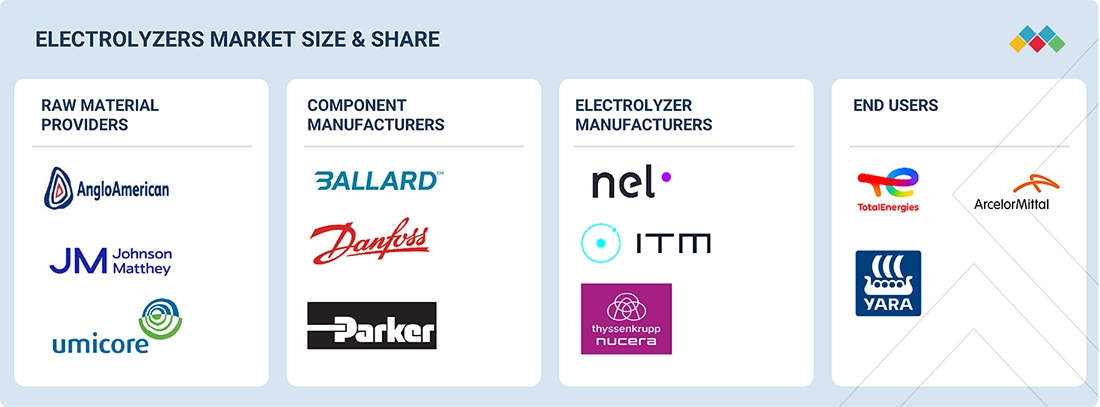
electrolyzers-market: COMMERCIAL USE CASES ACROSS INDUSTRIES
| COMPANY | USE CASE DESCRIPTION | BENEFITS |
|---|---|---|
 |
Shell’s Holland Hydrogen I project required the precise installation of 200 MW electrolyzer modules within a highly congested industrial zone. The project faced challenges related to oversized component handling, restricted workspace, and coordination with offshore wind infrastructure. These conditions created risks around safety, sequencing, and timely execution. | Mammoet used advanced simulations, modular lifting plans, and engineered transport routes to streamline installation | Their precision-controlled assembly minimized congestion, improved safety, and aligned delivery with the offshore wind schedule | This optimized approach reduced project risks, accelerated deployment, and enhanced the reliability of installing the 200 MW electrolyzer system |
 |
Air Liquide aimed to produce high-purity green hydrogen at a commercial scale in Québec to meet the rising industrial demand, requiring a PEM electrolyzer that could perform reliably in extreme weather conditions. The project needed consistent hydrogen purity, cost-efficient operations, and seamless integration with existing hydrogen infrastructure. Deploying a system larger than typical pilots added technical and operational complexity. | Cummins’ HyLYZER 20 MW PEM electrolyzer delivered stable, high-purity hydrogen output while maintaining strong year-round performance in Québec’s harsh climate | The system reduced regional carbon intensity, improved operational reliability, and demonstrated the scalability of PEM technology | This installation set a proven reference model for future 100 MW-class commercial green-hydrogen projects across North America |
Logos and trademarks shown above are the property of their respective owners. Their use here is for informational and illustrative purposes only.
Related Ecosystem
Decarbonization
- Battery Electric Vehicle (BEV)
- Energy Management Systems
- Fuel Cell
- Fuel Cell Electric Vehicle (FCEV)
- Geographical Information System (GIS)
- TotalEnergies SE
- Siemens ag
- Mitsui & Co., Ltd.
- General Electric Company
- Thyssenkrupp ag
Key Takeaways
- Norway's electrolyzer market will grow from $19.9M (2025) to $164.5M (2030) at a 42.2% CAGR, driven by renewable energy abundance and hydrogen transition policies.
- Norway's strategic renewable energy infrastructure and government hydrogen initiatives position the country as a leading European electrolyzer hub.
- Industrial decarbonization in Norway, particularly in oil and gas and manufacturing sectors, is accelerating electrolyzer adoption and deployment.
- Norway's electrolyzer market expansion supports both domestic green hydrogen production and export potential to neighboring European markets.
Electrolyzers Market Report Scope
| Report Metric | Details |
|---|---|
| Base Year | 2025 |
| Fastest Growing Segment | GRID INJECTION (Application) |
| Forecast Period | 2025–2030 |
| Growth Rate | CAGR of 38.2% from 2025 to 2030 |
| Largest Segment | BALANCE OF PLANT (Component) |
| Market Size Base Year (Billions) | ~USD 2.08 (2025) |
| Revenue Forecast (Billions) | ~USD 10.48 (2030) |
| Segments Covered | Technology, Component, Power Rating, Application, Type |
Norway Electrolyzers Market Report Segmentation
5 segment dimensions are covered across the global market.
By Technology
- Alkaline Electrolyzer
- Anion Exchange Membrane Electrolyzer
- Proton Exchange Membrane Electrolyzer
- Solid Oxide Electrolyzer
By Component
- Balance Of Plant
- Stack
By Power Rating
- 500–2,000 Kw
- <500 Kw
- >2,000 Kw
- Above 2,000 Kw
By Application
- Energy
- Grid Injection
- Industrial
- Mobility
By Type
- Chemicals
- Chp
- Other Industries
- Power Generation
NORWAY: ELECTROLYZERS MARKET, BY APPLICATION, 2025–2031
| Segment | 2025 | 2026 | 2027 | 2028 | 2029 | 2030 | 2031 | CAGR (%) |
|---|---|---|---|---|---|---|---|---|
| ENERGY | 1.3 | 2.25 | 3.55 | 5.75 | 9.27 | 15 | 22.94 | 61.3 |
| GRID INJECTION | 0 | 0 | 0 | 0 | 0 | 0 | 0 | 0 |
| INDUSTRIAL | 16.96 | 23.49 | 32.36 | 44.16 | 59.64 | 79.92 | 109.36 | 36.4 |
| MOBILITY | 1.61 | 2.78 | 4.61 | 7.64 | 12.63 | 20.96 | 32.21 | 64.7 |
| TOTAL | 19.88 | 28.52 | 40.52 | 57.54 | 81.55 | 115.87 | 164.5 | 42.2 |
Target Audience
- Energy & Utilities Companies : Norwegian and international energy providers need market data to evaluate electrolyzer investments, green hydrogen production capacity, and integration with existing renewable infrastructure.
- Industrial Manufacturers : Heavy industry players in Norway require insights on electrolyzer technology adoption, hydrogen supply chains, and decarbonization pathways to meet EU emissions targets and maintain competitiveness.
- Technology & Equipment Providers : Electrolyzer manufacturers and hydrogen technology vendors need Norway-specific market sizing, growth forecasts, and customer segmentation to optimize product development and sales strategies.
- Investment & Financial Institutions : Private equity, venture capital, and institutional investors require detailed market analysis to identify high-growth opportunities and assess the viability of green hydrogen projects in Norway.
- Government & Policy Makers : Norwegian government agencies and EU policymakers need market intelligence to design effective hydrogen strategies, allocate funding, and establish regulatory frameworks supporting electrolyzer deployment.
Key Companies in the Norway Electrolyzers Market
| Company | HQ | Ownership | Strongest segments |
|---|---|---|---|
| SHELL PLC | United Kingdom | Public Company | Integrated Gas (LNG & GTL),Upstream (Oil, Gas, NGLs),Marketing (Mobility, Lubricants, Commercial Fuels), |
| CUMMINS INC. | United States | Public Company | Engine,Distribution & Aftermarket,Components (aftertreatment, turbo, fuel, controls), |
| PLUG POWER INC. | United States | Public Company | GenDrive fuel cell systems for material handling EVs,GenFuel hydrogen generation, storage, and dispensing systems,GenCare and GenKey turnkey and service solutions, |
| ENAPTER | Germany | Public Company | AEM electrolyser hardware,AI software and energy management systems,Services, integration, and support, |
| ITM POWER PLC | United Kingdom | Public Company | TRIDENT PEM stack technology,NEPTUNE 2 MW plug-and-play systems,POSEIDON 20 MW process modules, |
| SUNGROW | China | Public Company | Photovoltaic inverters,Energy storage systems,Wind power converters and transmission products, |
| LONGI | China | Public Company | Monocrystalline wafers,High-efficiency modules (utility-scale),C&I and residential modules, |
| BLOOM ENERGY | United States | Public Company | Bloom Energy Server (SOFC on-site power),Bloom Electrolyzer (hydrogen production),Services, installation, and other solutions, |
| ASAHI KASEI CORPORATION | Japan | Public Company | Battery separators and energy-storage materials (Hipore, Celgard, related polymers),Semiconductor and electronic materials (Pimel, Sunfort, Novacure, glass fabric, sensors),Membranes and process systems (Microza, Aciplex, Aqualyzer), |
| NEXT HYDROGEN | Canada | Public Company | Large-scale electrolyzer systems,Modular/smaller electrolyzers,Balance-of-plant and plant equipment, |
SHELL PLC
Shell PLC is a British multinational energy company founded in 1897 that operates across oil, gas, and renewable energy sectors. With 84,000 employees worldwide, it is one of the largest publicly traded energy companies globally.
CUMMINS INC.
Cummins Inc. is an American industrial manufacturer founded in 1919 that designs, manufactures, and distributes engines, power generation systems, and related technologies. The publicly traded company employs 67,400 people and serves markets including transportation, power generation, and industrial applications.
PLUG POWER INC.
Plug Power Inc. is an American hydrogen fuel cell company founded in 1997 that develops hydrogen and fuel cell solutions for material handling and stationary power applications. As a publicly traded company, it employs 2,344 people and focuses on clean energy technology.
ENAPTER
Enapter is a German electrolyzer manufacturer founded in 1998 that produces modular alkaline electrolysis systems for green hydrogen production. The publicly traded company has 193 employees and specializes in decentralized hydrogen generation technology.
ITM POWER PLC
ITM Power PLC is a British hydrogen energy company founded in 2000 that designs and manufactures proton exchange membrane (PEM) electrolyzers for hydrogen production. The publicly traded company employs 306 people and focuses on renewable hydrogen solutions.
SUNGROW
Sungrow is a Chinese renewable energy company founded in 1997 that specializes in solar inverters and energy storage systems. With 19,006 employees, the publicly traded company is a global leader in photovoltaic and battery storage technology.
LONGI
Longi is a Chinese solar energy company founded in 2000 that manufactures solar panels and related photovoltaic products. As a publicly traded company, it is one of the world's largest solar panel manufacturers.
BLOOM ENERGY
Bloom Energy is an American energy technology company founded in 2001 that manufactures solid oxide fuel cells for distributed power generation. The publicly traded company employs 2,214 people and provides clean energy solutions for commercial and industrial customers.
ASAHI KASEI CORPORATION
Asahi Kasei Corporation is a Japanese diversified chemical and materials company founded in 1922 that operates across chemicals, fibers, electronics, and homes segments. With 47,895 employees, the publicly traded company is a major global manufacturer of specialty materials and chemical products.
NEXT HYDROGEN
Next Hydrogen is a Canadian hydrogen technology company founded in 2007 that develops hydrogen production and fuel cell solutions. The publicly traded company has 60 employees and focuses on clean hydrogen generation technologies.
Reasons to Buy this Report
- Market-Specific Growth Data : Access detailed projections showing Norway's electrolyzer market expanding 8.2% faster than global trends, enabling precise investment and expansion planning in this high-growth Nordic market.
- Competitive Landscape Intelligence : Understand Norway-specific market dynamics, key players, and competitive positioning to identify partnership opportunities and market entry strategies in Scandinavia's leading green hydrogen economy.
- Regulatory & Policy Insights : Gain comprehensive analysis of Norwegian government incentives, EU hydrogen directives, and carbon pricing mechanisms driving electrolyzer adoption and industrial decarbonization investments.
- Sector-Specific Demand Analysis : Identify high-opportunity industrial segments in Norway—including shipping, chemicals, and heavy manufacturing—with detailed demand forecasts and technology adoption timelines through 2030.
- Strategic Investment Roadmap : Develop data-driven strategies for market entry, technology deployment, and partnership development in Norway's rapidly expanding electrolyzer ecosystem with actionable market intelligence.
Frequently asked questions
What is the projected size of Norway's electrolyzer market by 2030?
Norway's electrolyzer market is projected to reach $164.5 million by 2030, growing from $19.9 million in 2025 at a 42.2% CAGR.
What factors are driving growth in Norway's electrolyzer market?
Norway's electrolyzer market growth is driven by abundant hydroelectric resources, government hydrogen infrastructure investments, industrial decarbonization initiatives, and favorable regulatory frameworks supporting green hydrogen production.
How does Norway's electrolyzer market compare to global trends?
Norway's electrolyzer market is growing at 42.2% CAGR, significantly exceeding the global average of 38.2%, reflecting Norway's strategic position and commitment to hydrogen leadership.
Which industries in Norway are adopting electrolyzer technology?
Norway's oil and gas sector, heavy manufacturing, and industrial decarbonization initiatives are primary adopters of electrolyzer technology for transitioning to clean hydrogen production.
What is Norway's role in the European electrolyzer market?
Norway is positioning itself as a leading Northern European electrolyzer hub with potential to supply green hydrogen to neighboring markets, leveraging its renewable energy advantages and strategic location.
RESEARCH METHODOLOGY
The study involved major activities in estimating the current size of the electrolyzers market. Exhaustive secondary research was done to collect information on the peer and parent markets. The next step was to validate these findings, assumptions, and sizing with industry experts across the value chain through primary research. The top-down and bottom-up approaches were employed to estimate the total market size. Thereafter, market breakdown and data triangulation techniques were used to estimate the market size of the segments and subsegments.
Secondary Research
This research study utilized extensive secondary sources, including Hoover’s, Bloomberg, Factiva, IRENA, the International Energy Agency, and Statista Industry Journal, as well as directories and databases, to collect and identify valuable information for a technical, market-oriented, and commercial study of the electrolyzers. Other secondary sources included annual reports, press releases, and investor presentations from companies; white papers; certified publications; articles by recognized authors; and manufacturer associations, trade directories, and databases.
Primary Research
During the primary research process, various primary sources from both the supply and demand sides were interviewed to gather qualitative and quantitative information for this report. Primary sources from the supply side include industry experts such as chief executive officers (CEOs), vice presidents (VPs), marketing directors, and related key executives from various companies and organizations operating in the electrolyzers market.
In the comprehensive market engineering process, the top-down and bottom-up approaches, along with various data triangulation methods, were extensively employed to estimate market sizes and forecast demand for all segments and subsegments listed in this report. Extensive qualitative and quantitative analyses were conducted to complete the market engineering process and list key information/insights throughout the report.
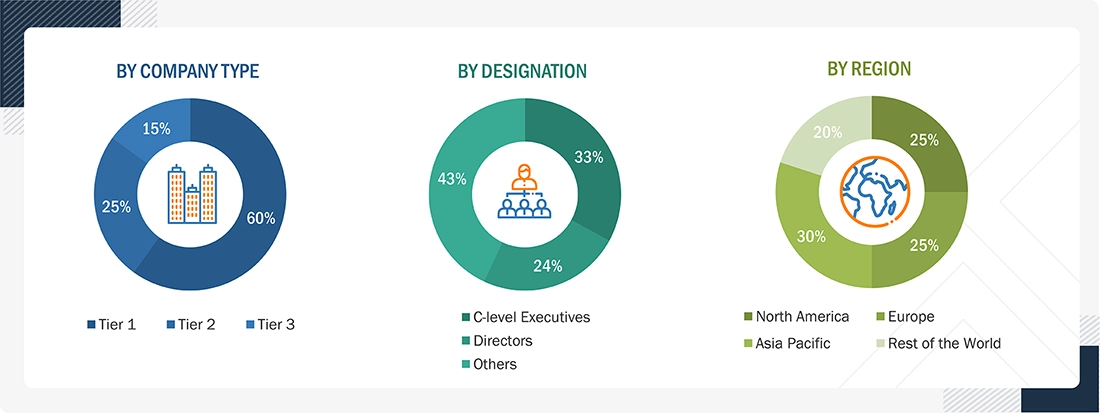
Note: The tiers of the companies are defined based on their total revenues as of 2024. Tier 1: >USD 1 billion, Tier 2: From USD 500 million to USD 1 billion, and Tier 3: USD 500 million. Others include sales managers, engineers, and regional managers.
To know about the assumptions considered for the study, download the pdf brochure
Market Size Estimation
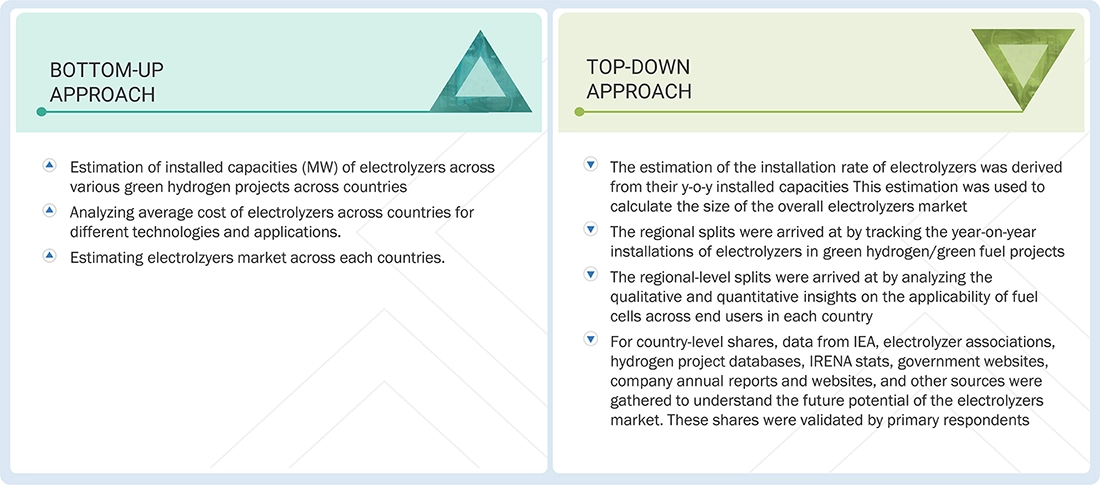
The top-down and bottom-up approaches were used to estimate and validate the total size of the electrolyzers market. These methods were also used extensively to estimate the size of various market segments. The research methodology used to estimate the market size comprises the following steps.
Electrolyzers Market : Top-Down and Bottom-Up Approach
Data Triangulation
The total market was divided into several segments and subsegments after determining the overall market size through the above estimation process. Data triangulation and market breakdown processes were employed to complete the overall market engineering process and determine the exact statistics for all segments and subsegments, as applicable. The data was triangulated by studying various factors and trends from the demand and supply sides. Additionally, the market size was validated using both top-down and bottom-up approaches.
Market Definition
An electrolyzer is a device that uses electrical energy to split water into hydrogen and oxygen. When powered by renewable or nuclear energy, it enables the production of low-emission hydrogen. The hydrogen generated can be utilized across various applications, while the oxygen produced can be released, stored, or used in industrial and medical sectors. Electrolyzers are available in multiple capacities: smaller units are used for on-site or localized hydrogen production, whereas larger systems can be paired with renewable or low-carbon power sources for large-scale hydrogen generation.
The electrolyzers market refers to the year-over-year installation of new electrolyzer capacities across different technologies. This market has been assessed across major regions, including North America, Europe, Asia Pacific, and Rest of the World (RoW).
Key Stakeholders
- Consulting companies in the energy & power sector
- Government and research organizations
- Investment banks
- Industrial gas companies
- Power and energy associations
- Hydrogen generation product and solutions providers
- Green hydrogen producers
- Engineering, procurement, and construction companies
- Renewable energy producers
- Manufacturers of electrolyzers
- Electrolyzer equipment manufacturers
Report Objectives
- To define, describe, segment, and forecast the size of the electrolyzers market, by power rating, technology, application, and region, in terms of value
- To segment and forecast the size of the electrolyzers market by region, application, and technology, in terms of volume
- To forecast the market sizes for four key regions: North America, Europe, Asia Pacific, and RoW
- To provide detailed information regarding key drivers, restraints, opportunities, and challenges influencing the growth of the electrolyzers market
- To offer the supply chain analysis, trends/disruptions impacting customer business, ecosystem analysis, regulatory landscape, patent analysis, case study analysis, technology analysis, key conferences and events, impact of AI/Gen AI, macroeconomic outlook, pricing analysis, Porter’s five forces analysis, regulatory analysis, and impact of the 2025 US tariff on the market
- To analyze opportunities for stakeholders in the electrolyzers market and draw a competitive landscape of the market
- To benchmark market players using the company evaluation matrix, which analyzes market players on broad categories of business and product strategies adopted by them
- To compare key market players for the market share, product specifications, and end uses
- To strategically profile key players and comprehensively analyze their market ranking and core competencies
- To analyze competitive developments, such as contracts, agreements, partnerships, and joint ventures, in the electrolyzers market
Available Customizations
MarketsandMarkets offers customizations tailored to the specific needs of companies using the provided market data.
The following customization options are available for the report:
Product Analysis
- Product matrix, which gives a detailed comparison of the product portfolio of each company
Regional Analysis
- Further breakdown of the electrolyzers market, by country
Company Information
- Detailed analysis and profiling of additional market players (up to five)
Get the Full Electrolyzers Market Report
Full forecast, segment splits, and company analysis for all Electrolyzers Market.
- China Electrolyzers Market
- Japan Electrolyzers Market
- Australia Electrolyzers Market
- India Electrolyzers Market
- Germany Electrolyzers Market
- UK Electrolyzers Market
- France Electrolyzers Market
- Denmark Electrolyzers Market
- Austria Electrolyzers Market
- Netherlands Electrolyzers Market
- Canada Electrolyzers Market
- US Electrolyzers Market
- Egypt Electrolyzers Market
- Saudi Arabia Electrolyzers Market
- Rest Of Europe Electrolyzers Market
- Rest Of Asia Pacific Electrolyzers Market
Need a Tailored Report?
Customize this report to your needs
Get 10% FREE Customization
Customize This Report
