
UK Emotion Detection and Recognition (EDR) Market (2026-2031)

The UK Emotion Detection and Recognition (EDR) Market was valued at $1702.6 Million in 2026 and projected to reach to $2345 Million by 2031, representing a compound annual growth rate of 6.6%. The UK Emotion Detection and Recognition market is positioned for steady growth through 2031, driven by increasing regulatory support for AI adoption and growing consumer acceptance of emotion-sensing technologies.


| Market Size in | USD 26.32 MN |
| Market Forecast in | |
| CAGR | |
| Forecast Period | |
| Units Considered | Value (USD MN) |
UK Emotion Detection and Recognition (EDR) Market Trends and Insights
- The UK market is driven by increasing adoption of AI-powered emotion recognition technologies across healthcare, retail, and customer service sectors.
- UK enterprises are investing in EDR solutions to enhance customer experience, improve mental health monitoring, and optimize human-computer interaction across digital platforms. The UK's strong technology infrastructure and regulatory framework position it as a key hub for EDR innovation within Europe.
- UK organizations are leveraging emotion recognition for applications ranging from employee wellness programs to interactive entertainment and security systems.
- Between 2026 and 2031, the UK market will benefit from growing demand for privacy-compliant emotion analytics and the integration of EDR with broader AI and machine learning ecosystems. The UK market reflects steady expansion as businesses recognize the commercial and operational value of understanding emotional responses in real-time.
- Investment in UK-based EDR startups and partnerships with established technology firms underscore the region's commitment to advancing emotion recognition capabilities..
Key Market Statistics
- CAGR (2026-2031) 6.6% CAGR
- Market Size, 2026 ~USD 1702.6 Million
- Forecast, 2031 ~USD 2345 Million
- Country UK
UK Emotion Detection and Recognition (EDR) Market Overview
Market Valuation Growth :
The UK EDR market is valued at £1,702.6 million in 2026 and is projected to reach £2,345 million by 2031, demonstrating strong market expansion with a 6.6% CAGR over the forecast period.
Healthcare Sector Leadership :
UK healthcare providers are increasingly deploying emotion detection technologies for patient mental health monitoring, therapeutic applications, and clinical decision support, driving significant market adoption.
Retail and Customer Experience :
UK retailers are leveraging EDR solutions to analyze customer emotions in-store and online, optimizing customer journeys and improving satisfaction metrics across omnichannel retail environments.
Enterprise AI Investment :
UK enterprises across financial services, telecommunications, and customer service sectors are investing heavily in AI-powered emotion recognition to enhance customer interactions and operational efficiency.
UK Emotion Detection and Recognition (EDR) Market Dynamics
- UK businesses are recognizing the competitive advantage of EDR solutions in understanding customer behavior and improving service delivery across multiple sectors.
- The market will benefit from advancements in facial recognition, voice analysis, and multimodal emotion detection technologies.
- However, data privacy regulations and ethical considerations around emotion surveillance will shape implementation strategies.
- Investment in UK-based AI research and development, combined with enterprise digital transformation initiatives, will sustain market momentum..
Market Ecosystem
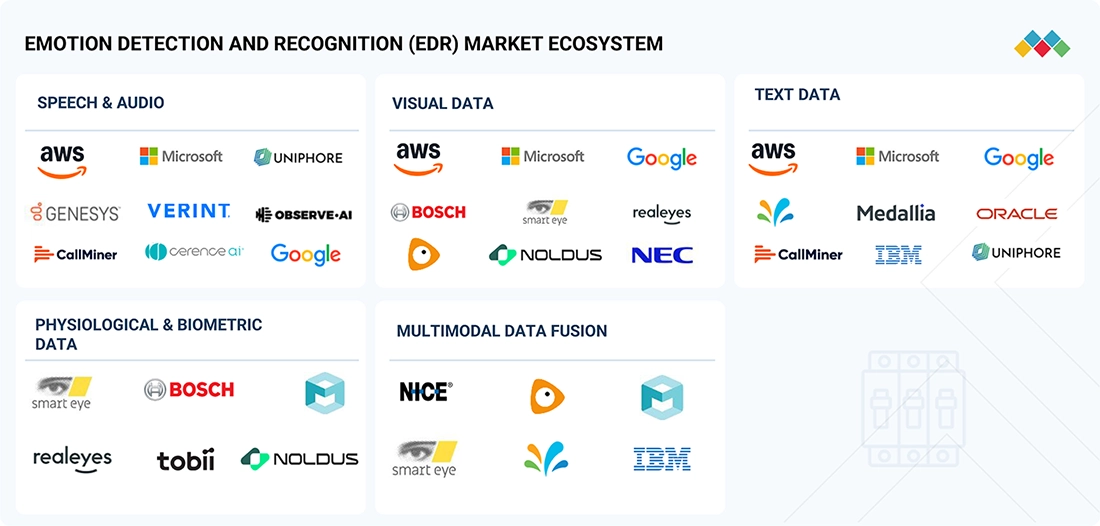
EMOTION DETECTION AND RECOGNITION (EDR) MARKET: COMMERCIAL USE CASES ACROSS INDUSTRIES
| COMPANY | USE CASE DESCRIPTION | BENEFITS |
|---|---|---|
 |
Smart Eye's driver monitoring system is deployed by 24 automotive OEMs across 372 vehicle models to monitor driver attention, fatigue, distraction, and in-cabin behavior using AI-powered computer vision and emotion recognition technologies. | Improved road safety, reduced accidents caused by distraction and drowsiness, enhanced driver experience, and compliance with emerging vehicle safety regulations. |
 |
Seeing Machines' Guardian platform is used by commercial fleet operators to monitor driver fatigue and distraction in real time through in-cabin cameras and AI-based driver monitoring technology. The company supports more than 800 transport companies globally. | Reduced fatigue-related driving events, improved fleet safety, lower accident risk, enhanced regulatory compliance, and improved driver wellbeing. |
 |
Tobii's eye-tracking technology is used across healthcare, automotive, user experience research, and training applications to analyze visual attention, cognitive behavior, and user interactions. It is also utilized in healthcare assessments and automotive research. | Improved user experience insights, enhanced healthcare assessments, better human-machine interaction, optimized product design, and improved attention and behavioral analysis. |
Logos and trademarks shown above are the property of their respective owners. Their use here is for informational and illustrative purposes only.
Related Ecosystem
Cyber Security
- Cloud Security
- Biometric Systems
- Data Loss Prevention (DLP)
- Multi-Factor Authentication
- Security Analytics
- International Business Machines Corporation
- Cisco Systems, Inc.
- MITSUI BUSSAN SECURE DIRECTIONS INC
- MICROSOFT CORPORATION
- Allot Ltd.
Software And Services
- Natural Language Processing (NLP)
- Machine Learning
- Supply Chain Management
- Predictive Analytics
- Image Sensors
- International Business Machines Corporation
- MICROSOFT CORPORATION
- Oracle Corporation
- SAP SE
- Amazon.com, Inc.
Key Takeaways
- The UK EDR market will grow from £1,702.6M (2026) to £2,345M (2031) at a 6.6% CAGR, reflecting strong enterprise adoption across multiple sectors.
- UK healthcare and retail organizations are primary drivers of EDR adoption, using emotion recognition for patient care optimization and customer engagement.
- Privacy and data protection regulations in the UK are shaping EDR solution design, creating opportunities for compliant, ethical emotion recognition platforms.
- The UK's technology ecosystem and venture capital investment are accelerating innovation in emotion detection, positioning the country as a European leader in EDR development.
Emotion Detection and Recognition (EDR) Market Report Scope
| Report Metric | Details |
|---|---|
| Base Year | 2026 |
| Fastest Growing Segment | SERVICES (Offering) |
| Forecast Period | 2026–2031 |
| Growth Rate | CAGR of 8.2% from 2026 to 2031 |
| Largest Segment | SOLUTIONS (Offering) |
| Market Size Base Year (Billions) | ~USD 29.19 (2026) |
| Revenue Forecast (Billions) | ~USD 43.29 (2031) |
| Segments Covered | Offering |
UK Emotion Detection and Recognition (EDR) Market Report Segmentation
1 segment dimensions are covered across the global market.
By Offering
- Services
- Solutions
UK: EMOTION DETECTION AND RECOGNITION MARKET, BY APPLICATION, 2026–2031
| Segment | 2026 | 2027 | 2028 | 2029 | 2030 | 2031 | CAGR (%) |
|---|---|---|---|---|---|---|---|
| CONSUMER EXPERIENCE ANALYTICS | 494 | 521.3 | 549.2 | 577.5 | 607 | 638.1 | 5.3 |
| DRIVER MONITORING & AUTOMOTIVE SAFETY | 234.7 | 267.4 | 304.2 | 345.4 | 392.1 | 445.1 | 13.7 |
| EDUCATION & LEARNING ANALYTICS | 75.6 | 82.2 | 89.2 | 96.7 | 104.7 | 113.4 | 8.5 |
| ENTERTAINMENT & INTERACTIVE EXPERIENCES | 72 | 74.5 | 77 | 79.4 | 81.8 | 84.4 | 3.2 |
| HEALTH & WELLNESS MONITORING | 324.3 | 357.7 | 393.8 | 432.8 | 475.4 | 522.3 | 10 |
| LIE DETECTION & BEHAVIORAL ANALYSIS | 116.3 | 127.7 | 137.2 | 144.2 | 148.3 | 148.8 | 5.1 |
| MARKETING & ADVERTISING ANALYTICS | 293.5 | 301 | 308.1 | 314.9 | 321.6 | 328.6 | 2.3 |
| SECURITY, SURVEILLANCE & THREAT DETECTION | 355.4 | 370.4 | 385.2 | 400 | 415.2 | 431.1 | 3.9 |
| WORKFORCE ENGAGEMENT & PRODUCTIVITY ANALYSIS | 259.1 | 283.5 | 309.6 | 337.6 | 367.9 | 401 | 9.1 |
| TOTAL | 2224.9 | 2385.6 | 2553.4 | 2728.4 | 2913.9 | 3112.76 | 6.9 |
Target Audience
- UK Enterprise Decision Makers : C-suite executives and digital transformation leaders in UK organizations need market intelligence to justify EDR investments, benchmark against competitors, and align technology adoption with business objectives.
- Technology Solution Providers : EDR software vendors and AI technology companies require UK market data to develop localized go-to-market strategies, identify customer segments, and forecast revenue potential in the British market.
- Healthcare and Retail Leaders : UK healthcare providers and retail organizations need sector-specific insights on emotion detection applications, implementation best practices, and ROI metrics to guide technology adoption decisions.
- Investment and Private Equity Firms : UK-focused investors and PE firms require comprehensive market analysis to evaluate investment opportunities in EDR startups and established vendors, assess market growth potential, and identify acquisition targets.
- Consultants and System Integrators : UK-based management consultants and systems integrators need detailed market intelligence to advise clients on EDR implementation strategies, vendor selection, and technology roadmaps aligned with UK market trends.
Key Companies in the UK Emotion Detection and Recognition (EDR) Market
| Company | HQ | Ownership | Strongest segments |
|---|---|---|---|
| HCL TECHNOLOGIES LIMITED | India | Public Company | Software Platforms,APIs & SDKs,Managed Emotion AI Services, |
| ZENSAR TECHNOLOGIES LTD | India | Public Company | Software Platforms,APIs & SDKs,Managed Emotion AI, |
| MICROSOFT | United States | Public Company | Software Platforms (Azure Cognitive Services, Microsoft 365 & Dynamics-integrated EDR),APIs & SDKs (Vision, Speech, Text Sentiment & Emotion APIs),Managed Emotion AI Services, |
| NICE | Israel | Public Company | Software Platforms (CXone, Actimize, Evidencentral with embedded EDR),APIs & SDKs for Emotion and Behavioral Analytics,Managed Emotion AI Services, |
| SALESFORCE | United States | Public Company | Software Platforms,APIs & SDKs,Managed Emotion AI Services, |
| United States | Public Company | Software Platforms (Vertex AI, Gemini, YouTube/Ads EDR tooling),APIs & SDKs (Vision, Speech, Natural Language, Affect APIs),Managed Emotion AI Services, | |
| ORACLE | United States | Public Company | Software Platforms,APIs & SDKs,Managed Emotion AI Services, |
| QUALTRICS | United States | Private Company | Software Platforms,APIs & SDKs,Managed Emotion AI Services, |
| BOSCH | India | Public Company | Software Platforms,APIs & SDKs,Managed Emotion AI Services, |
| NEC | Japan | Public Company | Software Platforms,APIs & SDKs,Managed Emotion AI Services, |
| GENESYS | United States | Private Company | Software Platforms (Genesys Cloud CX/EX with embedded EDR),APIs & SDKs (emotion-aware integrations via AppFoundry and open APIs),Managed Emotion AI Services, |
| IBM | United States | Public Company | Software Platforms,APIs & SDKs,Managed Emotion AI Services, |
| SMARTEYE | Sweden | Public Company | Automotive driver monitoring and interior sensing (OEM + AIS fleet/aftermarket),Behavioral research platforms (Smart Eye Pro, AI-X, XO, Aurora, smart recorders, services),Media analytics and emotion AI for video testing (cloud platform, SDKs), |
| TOBII | Sweden | Public Company | Software Platforms (Tobii Pro Lab, Sticky, UX Explore, Tobii Aware, Eye Tracker Manager),APIs & SDKs (Tobii Pro SDK, Glasses 3 API, Ocumen, IS5 Integration platform),Managed Emotion AI & Insight Services, |
| SEEING MACHINES | Australia | Public Company | Software Platforms,APIs & SDKs,Managed Emotion AI, |
HCL TECHNOLOGIES LIMITED
HCL Technologies Limited is a publicly traded Indian IT services company founded in 1976, providing technology and business solutions globally.
ZENSAR TECHNOLOGIES LTD
Zensar Technologies Ltd is a publicly traded Indian IT services company founded in 1963 with 10,066 employees, offering technology solutions and services.
MICROSOFT
Microsoft is a publicly traded American technology company founded in 1975 with 228,000 employees, developing software, cloud services, and hardware products.
NICE
NICE is a publicly traded Israeli software company founded in 1986 with 9,626 employees, specializing in customer engagement and business intelligence solutions.
SALESFORCE
Salesforce is a publicly traded American cloud computing company founded in 1999 with 83,334 employees, providing customer relationship management and enterprise solutions.
Google is a publicly traded American technology company founded in 1998 with 194,668 employees, operating search engines, advertising platforms, and cloud services.
ORACLE
Oracle is a publicly traded American software company founded in 1977 with 141,000 employees, providing database systems, cloud computing, and enterprise software solutions.
QUALTRICS
Qualtrics is a private American software company founded in 2002 with 5,300 employees, providing experience management and survey platforms.
BOSCH
Bosch is a publicly traded Indian manufacturing company founded in 1886 with 37,131 employees, producing automotive and industrial technology products.
NEC
NEC is a publicly traded Japanese electronics company founded in 1899 with 101,800 employees, providing IT solutions, telecommunications, and semiconductor products.
GENESYS
Genesys is a private American software company founded in 1990 with 730 employees, specializing in customer experience and contact center solutions.
IBM
IBM is a publicly traded American technology company founded in 1911 with 264,300 employees, providing IT services, cloud solutions, and enterprise software.
SMARTEYE
Smarteye is a publicly traded Swedish technology company founded in 1999 with 277 employees, developing eye-tracking and driver monitoring systems.
TOBII
Tobii is a publicly traded Swedish technology company founded in 2001 with 404 employees, specializing in eye-tracking and attention-based computing solutions.
SEEING MACHINES
Seeing Machines is a publicly traded Australian technology company founded in 2000 with 353 employees, developing driver monitoring and eye-tracking technologies.
Reasons to Buy this Report
- UK-Specific Market Sizing : Access precise valuation data for the UK EDR market with detailed 2026-2031 forecasts, enabling accurate budget allocation and investment planning for UK-focused business strategies.
- Sector-Specific Insights : Understand how UK healthcare, retail, and customer service sectors are adopting emotion detection technologies, with actionable intelligence on sector-specific growth drivers and implementation trends.
- Competitive Landscape Analysis : Identify leading UK and international EDR solution providers, their market positioning, and competitive strategies specific to the British market to inform partnership and procurement decisions.
- Regulatory and Compliance Guidance : Navigate UK data protection regulations, GDPR compliance requirements, and ethical frameworks governing emotion detection deployment, ensuring compliant technology implementation.
- Investment and Growth Opportunities : Discover high-growth segments within the UK market, emerging use cases, and expansion opportunities for vendors, investors, and enterprises planning UK market entry or expansion.
Frequently asked questions
What is the current size of the UK Emotion Detection and Recognition market?
The UK EDR market is valued at £1,702.6 million in 2026 and is expected to reach £2,345 million by 2031.
What is the projected growth rate for the UK EDR market?
The UK EDR market is projected to grow at a compound annual growth rate (CAGR) of 6.6% between 2026 and 2031.
Which industries are driving EDR adoption in the UK?
Healthcare, retail, customer service, entertainment, and security sectors are the primary drivers of EDR adoption in the UK, leveraging emotion recognition for improved outcomes and customer experience.
How do UK regulations impact EDR market development?
UK data protection and privacy regulations, including GDPR compliance requirements, shape EDR solution design and create demand for ethical, transparent emotion recognition technologies.
What opportunities exist for EDR vendors in the UK market?
UK vendors can capitalize on growing demand for privacy-compliant emotion analytics, integration with AI ecosystems, and sector-specific applications in healthcare, retail, and employee wellness programs.
RESEARCH METHODOLOGY
Secondary research was conducted to collect information useful for this technical, market-oriented, and commercial study of the emotion detection and recognition market. The next step involved validating these findings, assumptions, and sizing with industry experts across the value chain using primary research. Different approaches, including top-down and bottom-up methods, were employed to estimate the total market size. After that, the market breakup and data triangulation procedures were used to estimate the market size of the segments and subsegments of the emotion detection and recognition market.
Secondary Research
During the secondary research process, various secondary sources were consulted to identify and collect information relevant to the study. The secondary sources included annual reports, press releases, investor presentations of emotion detection and recognition vendors, forums, certified publications, and whitepapers. The secondary research was mainly used to obtain key information about the industry’s supply chain, the total pool of key players, market classification and segmentation according to industry trends to the bottom-most level, regional markets, and key developments from both market- and technology-oriented perspectives, all of which were further validated by primary sources.
Primary Research
In the primary research process, various primary sources from both the supply and demand sides were interviewed to obtain qualitative and quantitative information for this report. The primary sources from the supply side included various industry experts, including chief executive officers (CEOs), vice presidents (VPs), marketing directors, technology and innovation directors, and related key executives from various key companies and organizations operating in the emotion detection and recognition market.
In the market engineering process, top-down and bottom-up approaches were extensively used, along with several data triangulation methods, to perform market estimation and forecasting for the overall market segments and subsegments listed in this report. Extensive qualitative and quantitative analysis was performed on the complete market engineering process to list key information/insights throughout the report.
After the complete market engineering process (including calculations for market statistics, market breakups, market size estimations, market forecasts, and data triangulation), extensive primary research was conducted to gather information and verify & validate the critical numbers arrived at. The primary research was also conducted to identify the segmentation types, industry trends, competitive landscape of emotion detection and recognition market players, and key market dynamics, such as drivers, restraints, opportunities, challenges, industry trends, and key strategies.
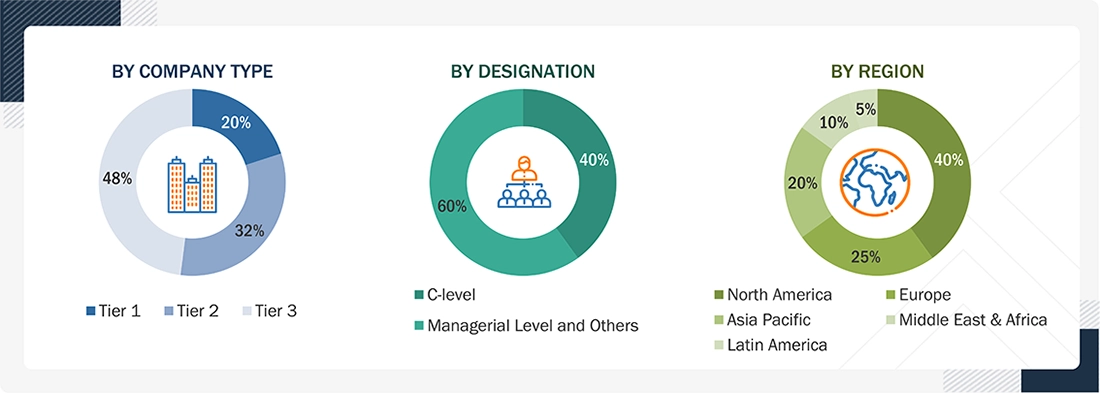
Note: Tier 1 companies receive revenues higher than USD 10 billion; Tier 2 companies' revenues range between USD 1 and 10 billion; and Tier 3 companies' revenues range between USD 500 million and USD 1 billion. Other designations include sales, marketing, and product managers.
To know about the assumptions considered for the study, download the pdf brochure
Market Size Estimation
Top-down and bottom-up approaches were employed to estimate and validate the size of the emotion detection and recognition market, as well as the size of various dependent sub-segments within the overall emotion detection and recognition market. The research methodology used to estimate the market size includes the following details: critical players in the market were identified through secondary research, and their market shares in the respective regions were determined through primary and secondary research. This entire procedure involved studying the annual and financial reports of the top market players, and extensive interviews were conducted with key industry leaders, including CEOs, VPs, directors, and marketing executives, to gather valuable insights.
All percentage splits and breakdowns were determined using secondary sources and verified through primary sources. All possible parameters that affect the market covered in this research study were accounted for, viewed in extensive detail, verified through primary research, and analyzed to get the final quantitative and qualitative data. This data was consolidated and added to detailed inputs and analysis from MarketsandMarkets.
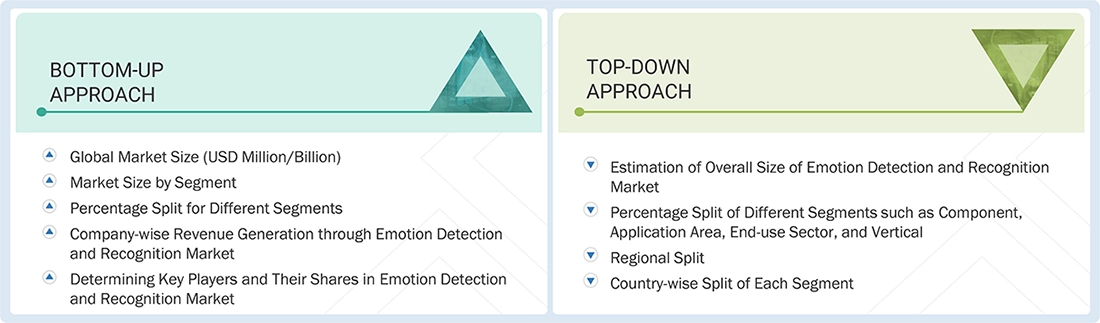
Data Triangulation
The market was split into several segments and subsegments after arriving at the overall market size using the market size estimation processes explained above. The data triangulation and market breakup procedures were employed, wherever applicable, to complete the overall market engineering process and arrive at the exact statistics of each market segment and subsegment. The data was triangulated by studying various factors and trends from both the demand and supply sides.
Market Definition
Emotion detection and recognition (EDR) refers to a set of artificial intelligence (AI)-enabled technologies that identify, analyze, interpret, and classify human emotions from various data sources, including facial expressions, speech and voice patterns, text sentiment, physiological signals, and behavioral indicators. EDR solutions leverage technologies such as computer vision, natural language processing (NLP), speech analytics, machine learning, deep learning, and multimodal AI to generate insights into emotional states, engagement levels, and behavioral responses in real time or through post-interaction analysis. These solutions are increasingly deployed across customer experience management, healthcare, automotive, workforce analytics, retail, media, and public sector applications to improve personalization, decision-making, safety, operational efficiency, and human-machine interactions.
Key Stakeholders
- Emotion Detection and Recognition (EDR) Platform Vendors
- AI Infrastructure and Cloud Service Providers
- System Integrators and Consulting Firms
- Customer Experience (CX) Solution Providers
- Healthcare Technology Providers
- Automotive Technology Providers
- Government Authorities and Regulatory Bodies
- Value-added Resellers (VARs) and Distributors
- Enterprise End Users
Report Objectives
- To describe and forecast the emotion detection and recognition market by offering, deployment mode, data modality, application, and vertical from 2026 to 2031, and analyze the various macroeconomic and microeconomic factors that affect market growth
- To forecast the market size of five major regions: North America, Europe, Asia Pacific, the Middle East & Africa, and Latin America
- To analyze the subsegments of the market with respect to individual growth trends, prospects, and contributions to the overall market
- To provide detailed information regarding major factors (drivers, restraints, opportunities, and challenges) influencing the growth of the market
- To analyze opportunities in the market for stakeholders and provide details of the competitive landscape of major players
- To profile key market players; provide a comparative analysis based on the business overviews, regional presence, product offerings, business strategies, and key financials; and illustrate the competitive landscape of the market
- To analyze competitive developments, such as mergers & acquisitions, product developments, partnerships and collaborations, and research & development (R&D) activities, in the market.
Available customizations:
With the given market data, MarketsandMarkets offers customizations based on company-specific needs. The following customization options are available for the report:
GEOGRAPHIC ANALYSIS
- Further breakup of the Asia Pacific market into countries contributes to the rest of the regional market size.
- Further breakup of the North American market into countries contributes to the rest of the regional market size.
- Further breakup of the Latin American market into countries contributing to the rest of the regional market size
- Further breakup of the Middle East & African market into countries contributing to the rest of the regional market size
- Further breakup of the European market into countries contributes to the rest of the regional market size
Company information
- Detailed analysis and profiling of additional market players (up to 5)
Get the Full Emotion Detection and Recognition (EDR) Market Report
Full forecast, segment splits, and company analysis for all Emotion Detection and Recognition (EDR) Market.
- US Emotion Detection and Recognition (EDR) Market
- Canada Emotion Detection and Recognition (EDR) Market
- Germany Emotion Detection and Recognition (EDR) Market
- France Emotion Detection and Recognition (EDR) Market
- Italy Emotion Detection and Recognition (EDR) Market
- China Emotion Detection and Recognition (EDR) Market
- Japan Emotion Detection and Recognition (EDR) Market
- India Emotion Detection and Recognition (EDR) Market
- South Africa Emotion Detection and Recognition (EDR) Market
- Brazil Emotion Detection and Recognition (EDR) Market
- Mexico Emotion Detection and Recognition (EDR) Market
Need a Tailored Report?
Customize this report to your needs
Get 10% FREE Customization
Customize This Report
