
Germany Employee Performance Management Market (2025-2030)

The Germany Employee Performance Management Market was valued at $497.5 Million in 2025 and projected to reach to $620.2 Million by 2030, representing a compound annual growth rate of 13.5%. Germany's Employee Performance Management Market is positioned for sustained expansion, driven by the country's commitment to Industry 4.0 and digital workplace transformation.


| Market Size in | USD 26.32 MN |
| Market Forecast in | |
| CAGR | |
| Forecast Period | |
| Units Considered | Value (USD MN) |
Germany Employee Performance Management Market Trends and Insights
- This 13.5% compound annual growth rate reflects Germany's strong demand for advanced workforce analytics and digital HR transformation across its manufacturing, technology, and service sectors.
- Germany's emphasis on data-driven decision-making and regulatory compliance is driving adoption of sophisticated performance management solutions among mid-market and enterprise organizations. The German market benefits from the country's mature ICT infrastructure and high digital literacy among HR professionals.
- Germany's focus on employee development, works councils, and structured performance frameworks creates a favorable environment for integrated performance management platforms.
- Between 2025 and 2030, Germany is expected to see increased investment in AI-powered performance analytics, real-time feedback systems, and mobile-first solutions tailored to the German business culture and labor regulations..
Key Market Statistics
- CAGR (2025-2030) 13.5% CAGR
- Market Size, 2025 ~USD 497.5 Million
- Forecast, 2030 ~USD 620.2 Million
- Country Germany
Germany Employee Performance Management Market Overview
Market Valuation & Growth :
Germany's Employee Performance Management Market is valued at $497.5 million in 2025, with a robust 13.5% CAGR projected through 2030, reaching $620.2 million. This growth rate exceeds the global average of 12.4%, reflecting Germany's accelerated digital HR adoption.
Digital HR Transformation :
German enterprises across manufacturing, technology, and service sectors are prioritizing workforce analytics and digital performance management solutions. The country's strong industrial base and tech-forward culture drive demand for sophisticated HR technology platforms.
Data-Driven Decision Making :
Germany's emphasis on data-driven HR strategies is reshaping talent management practices. Organizations are increasingly leveraging advanced analytics to optimize employee engagement, productivity, and retention across their operations.
Sector-Specific Adoption :
Manufacturing, automotive, and technology sectors in Germany are leading the adoption of performance management systems. These industries require scalable solutions to manage large, distributed workforces and comply with stringent labor regulations.
Germany Employee Performance Management Market Dynamics
- Organizations are increasingly investing in cloud-based performance management platforms that integrate with existing HR ecosystems, enabling real-time employee analytics and continuous feedback mechanisms.
- The market benefits from Germany's strong regulatory framework around data protection and employee rights, which encourages adoption of compliant, transparent performance management solutions. Looking ahead to 2030, the German market will be shaped by growing demand for AI-powered performance insights, mobile-first HR platforms, and integrated talent management suites.
- Mid-market and SME segments represent significant growth opportunities as these organizations seek affordable, scalable alternatives to legacy systems.
- The convergence of workforce analytics, employee experience platforms, and compliance automation will define competitive differentiation in Germany's evolving performance management landscape..
Market Ecosystem
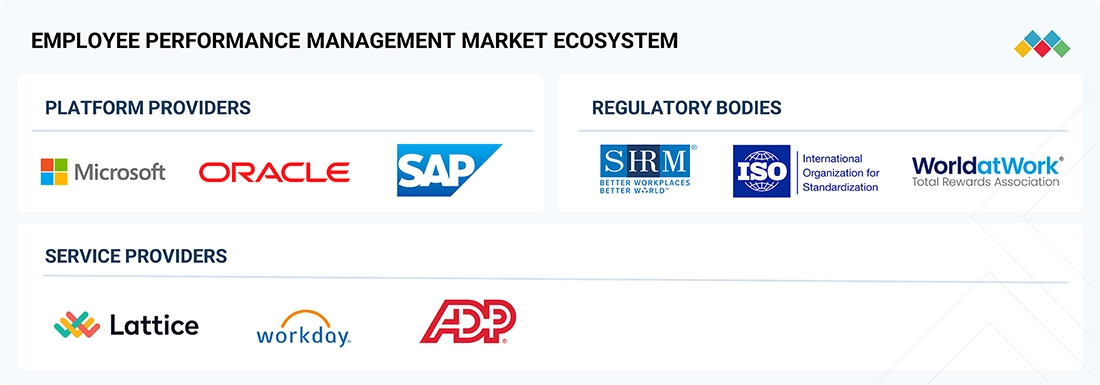
Employee Performance Management Market: COMMERCIAL USE CASES ACROSS INDUSTRIES
| COMPANY | USE CASE DESCRIPTION | BENEFITS |
|---|---|---|
 |
SAP SuccessFactors uses real-time analytics, continuous feedback loops, and competency mapping to help enterprises track employee productivity, identify high-potential talent, and streamline performance review cycles. Its AI-backed workflows enable automated goal setting, skill assessments, and personalized learning recommendations. | Organizations gain a unified view of performance, reduced manual appraisal workloads, improved employee engagement, and data-driven talent decisions. Managers can proactively address skill gaps and drive better alignment of their workforce with business priorities. |
 |
Oracle Fusion HCM leverages AI-powered insights, sentiment analysis, and automated performance evaluations to modernize employee performance management. It centralizes goal tracking, behavioral assessments, and career development planning across large distributed teams. | Companies benefit from more accurate performance measurements, reduced bias in evaluations, enhanced transparency, and quicker performance interventions. This leads to stronger productivity, better retention outcomes, and a more responsive workforce planning approach. |
 |
Microsoft Viva integrates with Teams to deliver continuous performance insights, OKR alignment, employee well-being analytics, and personalized productivity recommendations. It captures real-time collaboration patterns to help managers assess engagement and coach employees more effectively. | Enterprises experience improved team collaboration, proactive burnout detection, and stronger alignment between employee goals and organizational outcomes. The platform boosts overall performance by fostering a culture of ongoing feedback and data-backed development. |
Logos and trademarks shown above are the property of their respective owners. Their use here is for informational and illustrative purposes only.
Related Ecosystem
Software And Services
- Natural Language Processing (NLP)
- Machine Learning
- Supply Chain Management
- Predictive Analytics
- Image Sensors
- International Business Machines Corporation
- MICROSOFT CORPORATION
- Oracle Corporation
- SAP SE
- Amazon.com, Inc.
Key Takeaways
- Germany's Employee Performance Management Market will grow from $497.5M (2025) to $620.2M (2030) at a 13.5% CAGR, outpacing global growth.
- Germany's regulatory environment and emphasis on structured HR processes drive strong adoption of compliance-focused performance management solutions.
- German enterprises increasingly prioritize AI-driven analytics and real-time feedback capabilities to enhance workforce productivity and engagement.
- Germany's mature ICT infrastructure and high digital adoption among HR professionals accelerate the deployment of cloud-based performance platforms.
Employee Performance Management Market Report Scope
| Report Metric | Details |
|---|---|
| Base Year | 2025 |
| Fastest Growing Segment | CONTINUOUS FEEDBACK & LEARNING PLATFORMS (Platform) |
| Forecast Period | 2025–2030 |
| Growth Rate | CAGR of 12.4% from 2025 to 2030 |
| Largest Segment | LARGE ENTERPRISES (Organization Size) |
| Market Size Base Year (Billions) | ~USD 3.53 (2025) |
| Revenue Forecast (Billions) | ~USD 6.33 (2030) |
| Segments Covered | Offering, Platform, Service, Organization Size, Vertical |
Germany Employee Performance Management Market Report Segmentation
5 segment dimensions are covered across the global market.
By Offering
- Platforms
- Services
By Platform
- 360-Degree Feedback Tools
- Continuous Feedback & Learning Platforms
- Continuous Feedback And Learning Platforms
- Goal Setting & Tracking Platforms
- Goal-Setting And Tracking Platforms
- Other Platforms
- Performance Appraisal Systems
By Service
- Integration & Implementation
- Support & Maintenance
- Training & Development
By Organization Size
- Large Enterprises
- Smes
By Vertical
- Bfsi
- Government
- Healthcare
- It & Ites
- Manufacturing
- Other Verticals
- Telecom
GERMANY: EMPLOYEE PERFORMANCE MANAGEMENT MARKET, BY VERTICAL, 2026–2031
| Segment | 2026 | 2027 | 2028 | 2029 | 2030 | 2031 | CAGR (%) |
|---|---|---|---|---|---|---|---|
| BFSI | 64 | 73 | 82.7 | 92.8 | 102.7 | 112.6 | 12 |
| GOVERNMENT | 26.4 | 29.9 | 33.7 | 37.6 | 41.3 | 45 | 11.3 |
| HEALTHCARE | 48.5 | 56.8 | 66.1 | 76.1 | 86.5 | 97.4 | 15 |
| IT & ITES | 90 | 105 | 121.7 | 139.6 | 158 | 177.1 | 14.5 |
| MANUFACTURING | 43.6 | 50.3 | 57.6 | 65.3 | 73.1 | 81.1 | 13.2 |
| OTHER VERTICALS | 23.1 | 26.9 | 31.1 | 35.6 | 40.2 | 45 | 14.3 |
| TELECOM | 34.2 | 39.3 | 44.8 | 50.6 | 56.4 | 62.2 | 12.7 |
| TOTAL | 329.7 | 381.3 | 437.7 | 497.5 | 558.3 | 620.2 | 13.5 |
Target Audience
- HR Technology Vendors : Performance management software providers need Germany-specific market data to refine product positioning, identify customer segments, and develop localized go-to-market strategies that address German compliance requirements and buyer preferences.
- Enterprise HR Leaders : German C-suite HR executives and talent management directors require market insights to benchmark their performance management investments, evaluate vendor solutions, and align technology strategies with industry best practices and competitive positioning.
- Management Consulting Firms : Consultants advising German enterprises on digital transformation and HR modernization need credible market data to support client recommendations, validate business cases, and identify emerging trends in workforce analytics and performance management.
- Private Equity & Investment Firms : Investors evaluating acquisition targets or portfolio companies in the German HR tech space require detailed market sizing, growth projections, and competitive analysis to assess investment returns and strategic value creation opportunities.
- System Integrators & Implementation Partners : German IT service providers and HR consultants need market intelligence to identify client demand patterns, competitive threats, and service expansion opportunities in performance management implementation and managed services.
Key Companies in the Germany Employee Performance Management Market
| Company | HQ | Ownership | Strongest segments |
|---|---|---|---|
| WORKDAY | United States | Public Company | Human Capital Management (HCM) Suite,Financial Management & Spend/Expense,Planning Applications, |
| MICROSOFT | United States | Public Company | Intelligent Cloud (Azure, server products, GitHub, Nuance, enterprise services),Productivity & Business Processes (Microsoft 365, Teams, LinkedIn, Dynamics, Power BI),Personal Computing (Windows OEM, devices, gaming, search & news advertising), |
| CORNERSTONE ONDEMAND | United States | Private Company | Learning Management & Platform,Content & Learning Libraries,Performance, Careers & Talent Modules, |
| QUALTRICS | United States | Private Company | Customer Experience (CX) XM Platform,Employee Experience (EX) XM Platform,Product & Brand Experience (PX/BX) and DesignXM Research, |
| TRINET | United States | Public Company | PEO bundled HR (payroll, benefits, workers’ comp, compliance),Technology platform and HR analytics,Administrative services and standalone HR solutions, |
| LATTICE | United States | Public Company | Small FPGA platforms (Nexus, Nexus 2, MachXO, iCE),Mid-range and general purpose FPGA (Lattice Avant family, Certus),Specialized FPGAs (CrossLink, CrossLinkPlus, Avant-E/X, SCP), |
| CULTURE AMP | Australia | Private Company | Engagement & Pulse Surveys,Performance Management,Employee Lifecycle, Onboarding & Exit, |
WORKDAY
Workday is a public company founded in 2005 and headquartered in the United States with 20,834 employees. The company provides cloud-based enterprise resource planning and human capital management software solutions.
MICROSOFT
Microsoft is a public technology company founded in 1975 in the United States with 228,000 employees. The company develops, manufactures, and sells computer software, consumer electronics, and cloud computing services.
CORNERSTONE ONDEMAND
Cornerstone OnDemand is a private company founded in 1999 in the United States with 2,900 employees. The company provides cloud-based learning and talent management software solutions.
QUALTRICS
Qualtrics is a private company founded in 2002 in the United States with 5,300 employees. The company provides experience management software that helps organizations collect and act on customer, employee, and product feedback.
TRINET
TriNet is a public company founded in 1988 in the United States with 302,955 employees. The company provides human resources and payroll services to small and mid-sized businesses.
LATTICE
Lattice is a public company founded in 1983 in the United States with 1,174 employees. The company provides performance management and employee engagement software solutions.
CULTURE AMP
Culture Amp is a private company founded in 2011 in Australia. The company provides employee engagement and organizational culture software that helps companies gather and act on employee feedback.
Reasons to Buy this Report
- Market Size & Growth Validation : Obtain precise valuation data for Germany's $497.5M market with verified 13.5% CAGR projections through 2030. Validate investment decisions and budget allocations with authoritative market sizing specific to the German region.
- Competitive Landscape Intelligence : Understand Germany-specific competitive dynamics, vendor positioning, and market share distribution. Identify key players dominating the German market and emerging challengers disrupting traditional performance management approaches.
- Sector-Specific Opportunity Analysis : Access detailed insights into manufacturing, automotive, technology, and service sector adoption patterns in Germany. Tailor go-to-market strategies and product development roadmaps to sector-specific performance management requirements and pain points.
- Regulatory & Compliance Framework : Navigate Germany's stringent data protection regulations (GDPR, BDSG) and labor law requirements with market-specific compliance guidance. Understand how regulatory environment shapes product features and market opportunities for performance management solutions.
- Strategic Growth Planning : Leverage Germany-focused market forecasts and trend analysis to identify high-growth segments, emerging technologies (AI, analytics), and customer acquisition opportunities. Make informed expansion and partnership decisions backed by regional market intelligence.
Frequently asked questions
What is the current size of Germany's Employee Performance Management Market?
Germany's Employee Performance Management Market is valued at $497.5 million in 2025, with verified data confirming strong market fundamentals across the country's enterprise and mid-market segments.
What is the projected market size for Germany by 2030?
Germany's Employee Performance Management Market is forecast to reach $620.2 million by 2030, representing a 13.5% compound annual growth rate over the five-year period.
Why is Germany's growth rate higher than the global average?
Germany's 13.5% CAGR exceeds the global 12.4% rate due to strong digital transformation initiatives, strict regulatory compliance requirements, and high enterprise investment in workforce analytics and HR technology modernization.
What are the key drivers of growth in Germany's market?
Key drivers include Germany's emphasis on data-driven HR decision-making, regulatory compliance frameworks, digital workplace transformation, demand for AI-powered analytics, and the country's mature ICT infrastructure supporting cloud-based solutions.
Which industries in Germany are leading adoption of performance management solutions?
Germany's manufacturing, automotive, technology, financial services, and professional services sectors are leading adopters, driven by their need for structured performance frameworks, compliance management, and workforce optimization.
RESEARCH METHODOLOGY
This research study extensively utilized secondary sources, directories, and databases, including Dun & Bradstreet (D&B), Hoovers, and Bloomberg Businessweek, to identify and collect information relevant to a technical, market-oriented, and commercial study of the employee performance management market. The primary sources have primarily consisted of industry experts from core and related industries, as well as preferred suppliers, manufacturers, distributors, service providers, technology developers, alliances, and organizations related to all segments of the value chain of this market. In-depth interviews have been conducted with various primary respondents, including key industry participants, subject matter experts, C-level executives of key market players, and industry consultants, to obtain and verify critical qualitative and quantitative information.
Secondary Research
The market size of companies offering employee performance management worldwide was arrived at based on secondary data available through paid and unpaid sources. It was also arrived at by analyzing the product portfolio of major companies and rating them based on their performance and quality. In the secondary research process, various secondary sources were referred to identify and collect information for the study. The secondary sources included annual reports, press releases, investor presentations of companies, white papers, certified publications, and articles from recognized associations and government publishing sources. Several journals and associations, such as the International Journal of Human Resource Management, HR Magazine (SHRM), were also referenced. Secondary research was employed to gather key information on industry insights, the market’s monetary chain, the overall pool of key players, market classification, and segmentation according to industry trends, regional markets, and key developments from both market- and technology-oriented perspectives.
Secondary research was mainly used to obtain key information about the industry’s value chain and supply chain and to identify key players through various solutions and services, market classification and segmentation according to offerings of major players, industry trends related to technologies, applications, and regions, and key developments from both market-oriented and technology-oriented perspectives.
Primary Research
During the primary research process, various primary sources from both the supply and demand sides were interviewed to gather qualitative and quantitative information on the market. The primary sources from the supply side included various industry experts, including Chief Experience Officers (CXOs), Vice Presidents (VPs), directors from business development, marketing, and product development/innovation teams, related key executives from employee performance management solution vendors, professional service providers, and industry associations, and key opinion leaders.
Market Size Estimation
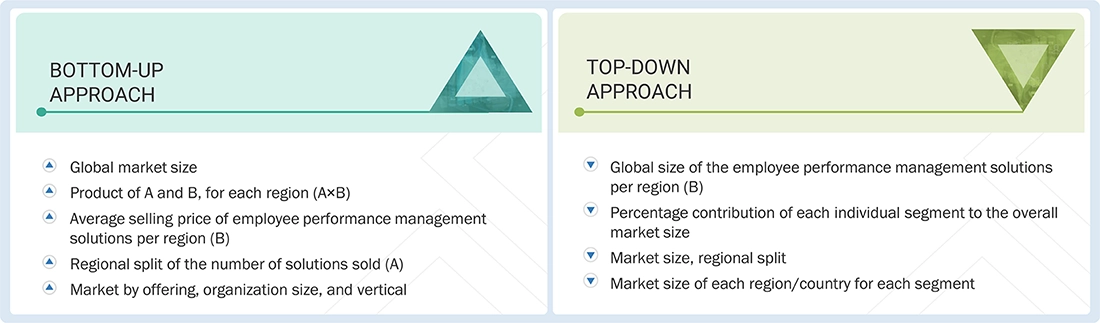
Multiple approaches were adopted to estimate and forecast the size of the employee performance management market. The first approach involves estimating market size by summing up the revenue generated by companies through the sale of employee performance management solutions.
Top-down and bottom-up approaches were employed to estimate and validate the total market size. These methods were also extensively used to estimate the size of various market segments. The research methodology used to evaluate the market size is listed below.
- Key players in the market have been identified through extensive secondary research.
- In terms of value, the industry’s supply chain and market size have been determined through a combination of primary and secondary research processes.
- All percentage shares, splits, and breakups have been determined using secondary sources and verified through primary sources.
Data Triangulation
After determining the overall market size, the employee performance management market was segmented into several categories and subcategories. A data triangulation procedure was employed to complete the overall market engineering process and derive the precise statistics for all segments and subsegments, as applicable. The data was triangulated by studying various factors and trends from the demand and supply sides. In addition to data triangulation and market breakdown, the market size was validated using both top-down and bottom-up approaches.
Market Definition
According to Qualtrics, employee performance management is a continuous process that balances the relationship between employees and the value they deliver to a business through clear communication and ongoing support from their managers. It encompasses setting business objectives, evaluating and reviewing performance, and creating a system of behaviors and processes that promote high performance, accountability, and organizational success.
The scope of employee performance management, as per the defined segmentation, delivers four core capabilities across platforms and services for both large enterprises and SMEs: Performance Appraisal Systems enabling standardized evaluation frameworks, competency mapping, and role-based assessment cycles; 360-Degree Feedback Tools capturing multi-source insights to drive transparency, self-awareness, and developmental alignment; Goal Setting & Tracking Systems integrating OKRs and KPIs with real-time progress visualization, alignment to business outcomes, and data-driven performance analytics; and Continuous Feedback and Learning Platforms fostering a culture of coaching and agility through automated feedback loops, pulse surveys, and recognition workflows, complemented by Services encompassing deployment, customization, training, and ongoing performance optimization.
Stakeholders
- Software Providers
- Service Providers
- System Integrators
- HR Technology Vendors
- Cloud Service Providers
- Consulting Firms
- Enterprises (Large and SMEs)
- HR Departments and Managers
- IT Departments
- End Users (Employees)
- Government and Regulatory Bodies
- Industry Associations
- Investors and Venture Capitalists
Report Objectives
- To determine, segment, and forecast the employee performance management market based on offering, organization size, vertical, and region in terms of value
- To forecast the size of the market segments with respect to five main regions: North America, Europe, Asia Pacific, the Middle East & Africa, and Latin America
- To provide detailed information about the major factors (drivers, restraints, opportunities, and challenges) influencing the growth of the market
- To study the complete value chain and related industry segments, and perform a value chain analysis of the market landscape
- To strategically analyze the macro and micromarkets with respect to individual growth trends, prospects, and contributions to the total market
- To analyze the industry trends, pricing data, patents, and innovations related to the market
- To analyze the opportunities for stakeholders by identifying the high-growth segments of the market
- To profile the key players in the market and comprehensively analyze their market share/ranking and core competencies
- To track and analyze competitive developments, such as mergers & acquisitions, product launches & developments, partnerships, agreements, collaborations, business expansions, and research & development (R&D) activities
Get the Full Employee Performance Management Market Report
Full forecast, segment splits, and company analysis for all Employee Performance Management Market.
- US Employee Performance Management Market
- Canada Employee Performance Management Market
- UK Employee Performance Management Market
- France Employee Performance Management Market
- China Employee Performance Management Market
- Japan Employee Performance Management Market
- India Employee Performance Management Market
- UAE Employee Performance Management Market
- South Africa Employee Performance Management Market
- Brazil Employee Performance Management Market
- Mexico Employee Performance Management Market
- Rest Of Europe Employee Performance Management Market
- Rest Of Asia Pacific Employee Performance Management Market
Need a Tailored Report?
Customize this report to your needs
Get 10% FREE Customization
Customize This Report
