
Japan Energy Efficient Motor Market (2025-2030)

The Japan Energy Efficient Motor Market was valued at $2715.1 Million in 2025 and projected to reach to $3775.9 Million by 2030, representing a compound annual growth rate of 6.8%. Japan's energy efficient motor market is positioned for sustained growth driven by the nation's commitment to energy conservation and industrial decarbonization.


| Market Size in | USD 26.32 MN |
| Market Forecast in | |
| CAGR | |
| Forecast Period | |
| Units Considered | Value (USD MN) |
Japan Energy Efficient Motor Market Trends and Insights
- Japan's commitment to energy conservation and industrial modernization is driving adoption of high-efficiency motors across manufacturing, HVAC, and pump applications.
- The market in Japan benefits from stringent energy regulations, government incentives, and a strong focus on reducing operational costs in industrial sectors. During the forecast period from 2025 to 2030, Japan's energy efficient motor market will be supported by increasing electrification of industrial processes and replacement cycles for aging equipment.
- Japan's aging infrastructure and need for sustainability improvements create significant opportunities for energy efficient motor deployment.
- The country's advanced manufacturing base and emphasis on carbon neutrality further accelerate market penetration in Japan across diverse end-use industries..
Key Market Statistics
- CAGR (2025-2030) 6.8% CAGR
- Market Size, 2025 ~USD 2715.1 Million
- Forecast, 2030 ~USD 3775.9 Million
- Country Japan
Japan Energy Efficient Motor Market Overview
Market Size & Growth :
Japan's energy efficient motor market is valued at USD 2,715.1 million in 2025 and is projected to reach USD 3,775.9 million by 2030, representing a steady CAGR of 6.8% over the forecast period.
Regulatory Support & Standards :
Japan's stringent energy efficiency regulations and Top Runner Program mandate high-efficiency motor adoption across industrial sectors, creating sustained demand for compliant solutions and driving market expansion.
Industrial Modernization :
Manufacturing facilities across Japan are upgrading legacy motor systems to energy-efficient alternatives to reduce operational costs and meet carbon neutrality targets by 2050, accelerating market penetration.
Key Application Sectors :
Primary demand drivers include manufacturing, HVAC systems, and pump applications, with significant adoption in automotive, electronics, and chemical industries seeking to optimize energy consumption.
Japan Energy Efficient Motor Market Dynamics
- Government incentives, including subsidies for motor replacement programs and tax benefits for energy-saving investments, are accelerating adoption rates across manufacturing and commercial sectors.
- The market benefits from Japan's advanced industrial base and technological expertise in motor design and efficiency optimization. Looking ahead to 2030, the market will be shaped by increasing electricity costs, stricter environmental regulations, and corporate sustainability commitments.
- The integration of IoT and smart motor technologies will create additional growth opportunities, enabling predictive maintenance and real-time energy monitoring.
- Japan's focus on achieving carbon neutrality by 2050 ensures long-term market resilience and continued investment in high-efficiency motor solutions..
Market Ecosystem
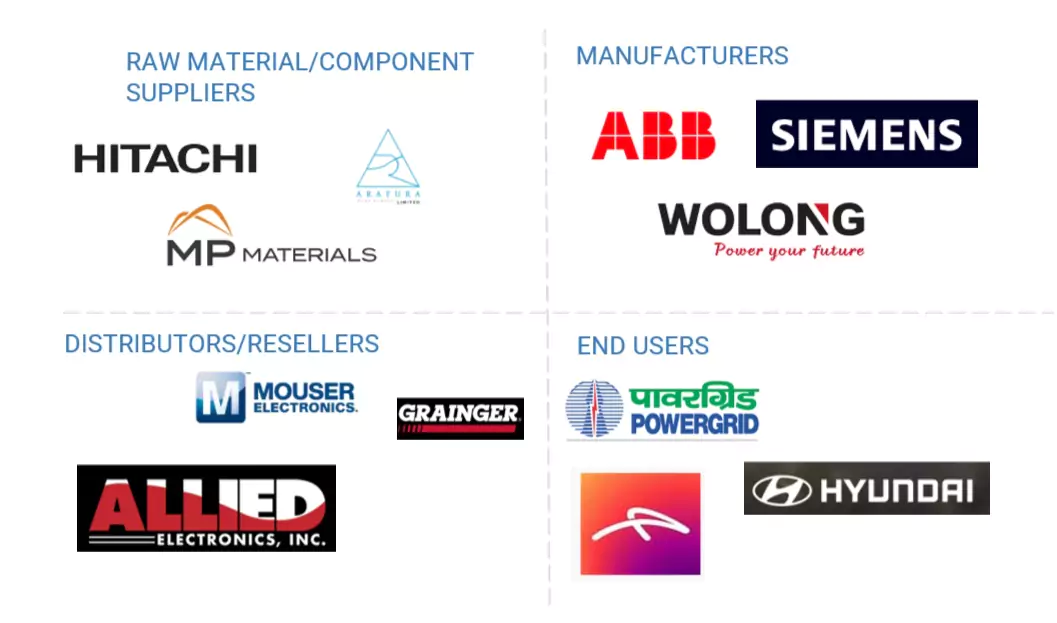
energy efficient motor market: COMMERCIAL USE CASES ACROSS INDUSTRIES
| COMPANY | USE CASE DESCRIPTION | BENEFITS |
|---|---|---|
 |
Upgrades rolling mill drives with energy-efficient motors to reduce electricity use | Lower energy bills, reduced emissions |
 |
Implements efficient motors in mineral extraction equipment for continuous operation | Improved reliability, operational cost savings |
 |
Deploys motors in smelting and processing plants to boost productivity | Enhanced uptime, decreased maintenance costs |
Logos and trademarks shown above are the property of their respective owners. Their use here is for informational and illustrative purposes only.
Related Ecosystem
Industrial Equipment
- HVAC System
- Fiberglass
- Actuators
- Cartridge Filters
- Electrostatic Precipitators
- Siemens ag
- GRUNDFOS GROUP
- ABB India Limited
- SCHNEIDER ELECTRIC SE
- Emerson Electric Co.
Key Takeaways
- Japan's energy efficient motor market reaches USD 2,715.1 million in 2025 with projected growth to USD 3,775.9 million by 2030.
- Japan experiences a steady 6.8% CAGR driven by regulatory compliance and industrial energy cost reduction initiatives.
- Japan's stringent energy efficiency standards and government incentives accelerate adoption across manufacturing and infrastructure sectors.
- Japan's focus on carbon neutrality and equipment modernization creates sustained demand for high-efficiency motor solutions through 2030.
Energy Efficient Motor Market Report Scope
| Report Metric | Details |
|---|---|
| Base Year | 2025 |
| Fastest Growing Segment | IE5 (Efficiency Level) |
| Forecast Period | 2025–2030 |
| Growth Rate | CAGR of 8.2% from 2025 to 2030 |
| Largest Segment | AC MOTORS (Type) |
| Market Size Base Year (Billions) | ~USD 48.96 (2025) |
| Revenue Forecast (Billions) | ~USD 72.6 (2030) |
| Segments Covered | Efficiency Level, Type, Power Output Rating, Application |
Japan Energy Efficient Motor Market Report Segmentation
4 segment dimensions are covered across the global market.
By Efficiency Level
- Ie1
- Ie2
- Ie3
- Ie4
- Ie5
By Type
- Ac Motors
- Dc Motors
By Power Output Rating
- 1–2.2 Kw
- 2.2–375 Kw
- < 1 Kw
- > 375 Kw
By Application
- Compressors
- Fans
- Hvac
- Material Handling
- Material Processing
- Pumps
- Refrigeration
JAPAN: ENERGY-EFFICIENT MOTOR MARKET, BY END USER, 2025–2030
| Segment | 2025 | 2026 | 2027 | 2028 | 2029 | 2030 | CAGR (%) |
|---|---|---|---|---|---|---|---|
| AEROSPACE & DEFENSE | 50.7 | 54 | 57.6 | 61.5 | 65.8 | 70.6 | 6.9 |
| AGRICULTURE | 319.9 | 339 | 359.8 | 382.4 | 407.1 | 434.7 | 6.3 |
| AUTOMOTIVE | 162.2 | 173.8 | 186.3 | 199.9 | 214.7 | 230.9 | 7.3 |
| COMMERCIAL | 491.1 | 522.3 | 556.2 | 593 | 633.2 | 677.8 | 6.7 |
| INDUSTRIAL | 1431.6 | 1526.8 | 1630.6 | 1744 | 1867.9 | 2006.3 | 7 |
| RESIDENTIAL | 259.6 | 275.6 | 293 | 312 | 332.6 | 355.6 | 6.5 |
| TOTAL | 2715.1 | 2891.4 | 3083.5 | 3292.9 | 3521.3 | 3775.9 | 6.8 |
Target Audience
- Motor Manufacturers & OEMs : Manufacturers need Japan-specific market data to optimize product portfolios, identify growth segments, and develop competitive strategies for the Japanese industrial motor market.
- Industrial Equipment Distributors : Distributors require detailed market insights to forecast demand, manage inventory, and identify emerging opportunities in Japan's energy efficient motor segment across key verticals.
- Energy & Facility Managers : Facility managers need market intelligence to justify motor replacement investments, understand cost-benefit analysis, and identify best-in-class efficient solutions available in the Japanese market.
- Government & Policy Bodies : Policymakers and regulatory agencies use market data to assess program effectiveness, design incentive structures, and evaluate progress toward Japan's energy conservation and carbon neutrality goals.
- Investment & Consulting Firms : Investors and consultants require Japan market analysis to identify investment opportunities, assess sector growth potential, and develop strategic recommendations for clients in the energy efficiency space.
Key Companies in the Japan Energy Efficient Motor Market
| Company | HQ | Ownership | Strongest segments |
|---|---|---|---|
| RICARDO | United Kingdom | Private Company | Energy and Environment (EE),Rail,Automotive and Industrial (A&I) Established, |
| GODREJ GROUP | India | Private Company | Home appliances,Commercial appliances & cooling solutions,Locks, architectural hardware, and security products, |
| ABB | India | Public Company | Electrification solutions and equipment,Motion (drives, motors, generators, traction converters),Automation, control, and industrial software, |
| SIEMENS | Germany | Public Company | Digital Industries (automation and industrial software),Smart Infrastructure (electrification and buildings),Mobility (rail and related digital services), |
| WEG | Brazil | Public Company | Electric motors, gearmotors, and drives,Transformers, generators, and substations,Automation, control, and protection (including converters, starters, switching devices), |
| WOLONG ELECTRIC GROUP CO., LTD | China | Public Company | Low voltage motors,High voltage motors and generators,Drive control and automation solutions, |
| NIDEC CORPORATION | Japan | Public Company | Small-size and precision motors,Medium- and large-size motors,Fans and blowers, |
| ROCKWELL AUTOMATION | United States | Public Company | Intelligent Devices,Software & Control,Lifecycle Services, |
| CG POWER & INDUSTRIAL SOLUTIONS LTD. | India | Public Company | Power Systems (transformers and switchgear),Industrial Systems (motors, drives, automation, rail products),Semiconductors (design, OSAT, turnkey), |
| REGAL REXNORD CORPORATION | United States | Public Company | Automation & Motion Control,Industrial Powertrain Solutions,Power Efficiency Solutions, |
| TOSHIBA CORPORATION | Japan | Private Company | Energy Systems & Solutions,Infrastructure Systems & Solutions,Building Solutions, |
| BHARAT BIJLEE | India | Public Company | Power transformers & substation EPC (Power Systems),Standard LV/MV motors,High-efficiency SynchroVERT IE4 and specialized motors, |
| KIRLOSKAR ELECTRIC COMPANY | India | Public Company | AC LV/HV Motors and Rotating Machines,Transformers (distribution, power, cast resin, special),Generators and DG Sets, |
RICARDO
Ricardo is a private company founded in 1915 in the United Kingdom with 2,600 employees.
GODREJ GROUP
Godrej Group is a private company founded in 1897 in India with 13,316 employees.
ABB
ABB is a public company founded in 1883 in India with 112,700 employees.
SIEMENS
Siemens is a public company founded in 1847 in Germany with 310,312 employees.
WEG
WEG is a public company founded in 1961 in Brazil with 49,258 employees.
WOLONG ELECTRIC GROUP CO., LTD
Wolong Electric Group Co., Ltd. is a public company founded in 1984 in China with 14,094 employees.
NIDEC CORPORATION
Nidec Corporation is a public company founded in 1973 in Japan with 104,285 employees.
ROCKWELL AUTOMATION
Rockwell Automation is a public company founded in 1903 in the United States with 26,000 employees.
CG POWER & INDUSTRIAL SOLUTIONS LTD.
CG Power & Industrial Solutions Ltd. is a public company founded in 1878 in India with 3,113 employees.
REGAL REXNORD CORPORATION
Regal Rexnord Corporation is a public company founded in 1955 in the United States with 28,950 employees.
TOSHIBA CORPORATION
Toshiba Corporation is a private company founded in 1875 in Japan with 106,648 employees.
BHARAT BIJLEE
Bharat Bijlee is a public company founded in 1946 in India with 1,197 employees.
KIRLOSKAR ELECTRIC COMPANY
Kirloskar Electric Company is a public company founded in 1946 in India with 858 employees.
Reasons to Buy this Report
- Market-Specific Sizing & Forecasts : Access precise valuation data for Japan's market (USD 2,715.1M in 2025) with detailed 5-year forecasts, enabling accurate budgeting and investment planning tailored to the Japanese market landscape.
- Regulatory & Policy Insights : Understand Japan's unique regulatory framework, including the Top Runner Program and carbon neutrality targets, to align product strategies with compliance requirements and government incentive programs.
- Sector-Specific Demand Analysis : Identify high-growth application segments within Japan's manufacturing, HVAC, and pump sectors with detailed insights into adoption rates and growth drivers specific to Japanese industries.
- Competitive Landscape for Japan : Gain intelligence on key market players, local competitors, and distribution channels operating in Japan, enabling informed go-to-market strategies and partnership opportunities.
- Investment & Expansion Strategy : Leverage Japan-specific market data to evaluate expansion opportunities, identify underserved segments, and develop localized product offerings aligned with Japanese customer preferences and industrial standards.
Frequently asked questions
What is the current market size of energy efficient motors in Japan?
Japan's energy efficient motor market is valued at USD 2,715.1 million in 2025.
What is the projected market size for energy efficient motors in Japan by 2030?
Japan's energy efficient motor market is forecast to reach USD 3,775.9 million by 2030.
What is the growth rate of Japan's energy efficient motor market?
Japan's energy efficient motor market is expected to grow at a CAGR of 6.8% from 2025 to 2030.
What factors are driving growth in Japan's energy efficient motor market?
Growth in Japan is driven by stringent energy regulations, government incentives, industrial modernization, and the country's commitment to carbon neutrality.
Which industries in Japan are the primary consumers of energy efficient motors?
Primary consumers in Japan include manufacturing, HVAC systems, pump applications, and industrial processing sectors seeking to reduce operational costs.
RESEARCH METHODOLOGY
The study involved major activities in estimating the current size of the energy efficient motor market. Exhaustive secondary research was done to collect information on the peer and parent markets. The next step was to validate these findings, assumptions, and sizing with industry experts across the value chain through primary research. Both top-down and bottom-up approaches were employed to estimate the complete market size. Thereafter, market breakdowns and data triangulation were used to estimate the market size of the segments and subsegments.
Secondary Research
This research study on the energy efficient motor market involved the use of extensive secondary sources, directories, and databases, such as Hoovers, Bloomberg, Businessweek, Factiva, International Energy Agency, and BP Statistical Review of World Energy, to identify and collect information useful for a technical, market-oriented, and commercial study of the global energy efficient motor market. The other secondary sources included annual reports, press releases, investor presentations of companies, white papers, certified publications, articles by recognized authors, manufacturer associations, trade directories, and databases.
Primary Research
The energy efficient motor market comprises several stakeholders, such as energy efficient motor manufacturers, manufacturers of energy efficient motor infrastructure components, technology providers, and technology support providers in the supply chain. The demand side of this market is characterized by the rising demand for energy efficient motors in nations to reduce energy consumption and move toward decarbonization. The supply side is characterized by rising demand for contracts from the industries, and mergers & acquisitions among big players. Various primary sources from the supply and demand sides of the market were interviewed to obtain qualitative and quantitative information. The following is the breakdown of primary respondents:
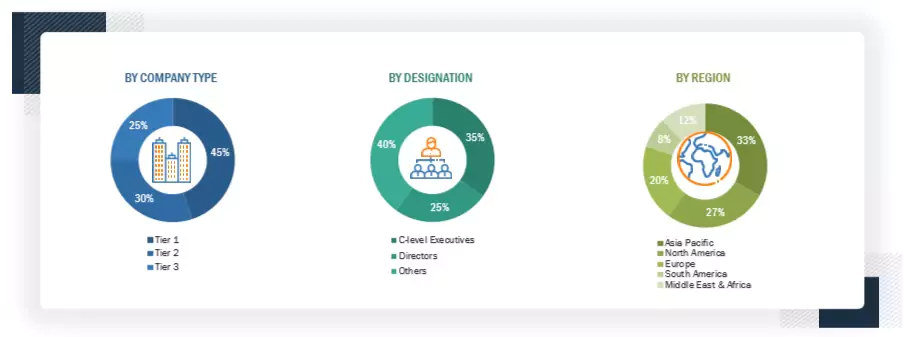
Note: Other designations include sales managers, engineers, and regional managers.
The tiers of the companies are defined based on their total revenue as of 2024: Tier 1: >USD 1 billion, Tier 2:
USD 500 million–1 billion, and Tier 3:
To know about the assumptions considered for the study, download the pdf brochure
Market Size Estimation
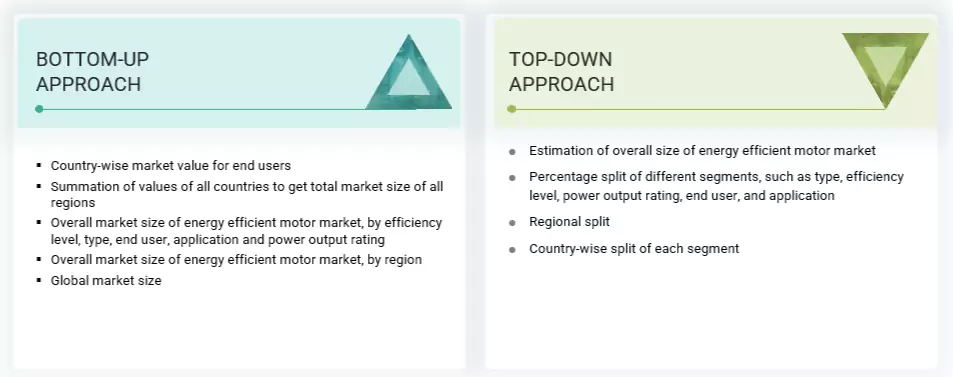
Top-down and bottom-up approaches were used to estimate and validate the size of the energy efficient motor market and its dependent submarkets. Key players in the market were identified through secondary research, and their market share in the respective regions was obtained through primary and secondary research. The research methodology includes studying top market players’ annual and financial reports and interviews with industry experts, such as chief executive officers, vice presidents, directors, sales managers, and marketing executives, for key quantitative and qualitative insights related to the energy efficient motor market.
Energy Efficient Motor Market : Top-Down and Bottom-Up Approach
Data Triangulation
After arriving at the overall market size from the estimation process explained above, the total market has been split into several segments and subsegments. To complete the overall market engineering process and arrive at the exact statistics for all the segments and subsegments, the data triangulation and market breakdown processes have been employed, wherever applicable. The data has been triangulated by studying various factors and trends from the demand and supply sides. Along with this, the market has been validated using both the top-down and bottom-up approaches.
Market Definition
The energy efficient motor market consists of all business enterprises dealing with electric motors to reduce energy use and preserve or enhance performance. These motors meet global efficiency requirements, such as IE2, IE3, IE4, and IE5, and are designed to minimize energy wastage by improving their development, material, and controls. However, compared with conventional motors, energy-efficient motors have greater operational efficiency, less heat production, and lower carbon emissions. This market caters to the needs of manufacturing, distribution, and use of such motors in major sectors, such as industrial manufacturing, HVAC, water & wastewater treatment, transportation, and building automation. The strong energy efficiency regulation, electricity price increment, and the growing prominence of sustainability and decarbonization within the global industrial processes contribute to the market growth.
Stakeholders
- Motor Manufacturing Companies
- Energy Efficient Motor Manufacturers Associations
- Government & Research Organizations
- Institutional Investors
- Investors/Shareholders
- Electric Motors Manufacturers, Dealers, and Suppliers
- Consulting Companies
- Automotive Manufacturers
- Electronic Equipment Manufacturers
- Food & Beverage, Textile, and Pulp & Paper Companies
- Motor Part and Component Suppliers
Report Objectives
- To define, describe, segment, and forecast the energy efficient motor market size, by installation type, type, power output rating, efficiency level, end user, and application
- To provide detailed information on the major drivers, restraints, opportunities, and challenges influencing the growth of the energy efficient motor market
- To strategically analyze the energy efficient motor market with respect to individual growth trends, prospects, and contributions of each segment to the market
- To analyze market opportunities for stakeholders and provide a detailed competitive landscape for market leaders
- To forecast the revenue of the market segments with respect to five main regions (along with countries), namely North America, Europe, Asia Pacific, South America, and the Middle East & Africa
- To strategically profile key players and comprehensively analyze their market ranking and core competencies
- To track and analyze competitive developments, such as new product developments, agreements, investments & expansions, and acquisitions, in the energy efficient motor market
Available Customizations
MarketsandMarkets offers customizations according to the specific needs of the companies using the given market data.
The following customization options are available for the report:
Product Analysis
- Product matrix, which gives a detailed comparison of the product portfolio of each company
Geographic Analysis as per Feasibility
- Further breakdown of the energy efficient motor market, by country
Company Information
- Detailed analysis and profiling of additional market players (up to five)
Get the Full Energy Efficient Motor Market Report
Full forecast, segment splits, and company analysis for all Energy Efficient Motor Market.
- France Energy Efficient Motor Market
- Italy Energy Efficient Motor Market
- Spain Energy Efficient Motor Market
- Poland Energy Efficient Motor Market
- South America Energy Efficient Motor Market
- Rest Of Europe Energy Efficient Motor Market
- Rest Of Asia Pacific Energy Efficient Motor Market
- China Energy Efficient Motor Market
- Australia Energy Efficient Motor Market
- India Energy Efficient Motor Market
- South Korea Energy Efficient Motor Market
- Canada Energy Efficient Motor Market
- Mexico Energy Efficient Motor Market
- US Energy Efficient Motor Market
- Brazil Energy Efficient Motor Market
- Argentina Energy Efficient Motor Market
- Chile Energy Efficient Motor Market
- Saudi Arabia Energy Efficient Motor Market
- UAE Energy Efficient Motor Market
- Turkey Energy Efficient Motor Market
- South Africa Energy Efficient Motor Market
- Egypt Energy Efficient Motor Market
- Qatar Energy Efficient Motor Market
- Israel Energy Efficient Motor Market
- UK Energy Efficient Motor Market
- Germany Energy Efficient Motor Market
Need a Tailored Report?
Customize this report to your needs
Get 10% FREE Customization
Customize This Report
