
South Korea Engines Market (2024-2029)

The South Korea Engines Market was valued at $9495.7 Million in 2024 and projected to reach to $11737.8 Million by 2029, representing a compound annual growth rate of 4.3%. South Korea's engines market is poised for sustained growth through 2029, supported by the country's position as a global manufacturing powerhouse and increasing investments in industrial automation.


| Market Size in | USD 26.32 MN |
| Market Forecast in | |
| CAGR | |
| Forecast Period | |
| Units Considered | Value (USD MN) |
South Korea Engines Market Trends and Insights
- South Korea's strategic position as a manufacturing and technology hub in Asia Pacific drives sustained demand for advanced engine solutions across industrial, automotive, and power generation sectors.
- The market in South Korea reflects strong industrial output and export-oriented manufacturing, with engines serving critical roles in both domestic consumption and export-dependent industries. Growth in South Korea's engines market is underpinned by modernization of aging infrastructure, increased adoption of energy-efficient technologies, and regulatory pressures to reduce emissions.
- South Korea continues to invest in renewable energy integration and hybrid propulsion systems, creating new opportunities for engine manufacturers.
- Between 2024 and 2029, South Korea is expected to see accelerated demand from the marine, aerospace, and heavy equipment sectors, supported by government initiatives promoting industrial competitiveness and green energy transitions..
Key Market Statistics
- CAGR (2024-2029) 4.3% CAGR
- Market Size, 2024 ~USD 9495.7 Million
- Forecast, 2029 ~USD 11737.8 Million
- Country South Korea
South Korea Engines Market Overview
Market Size & Growth :
South Korea's engines market is valued at USD 9,495.7 million in 2024, with projected growth to USD 11,737.8 million by 2029, reflecting a steady CAGR of 4.3% driven by industrial modernization and automotive sector expansion.
Manufacturing Hub Advantage :
As Asia Pacific's leading manufacturing and technology hub, South Korea benefits from strong demand for advanced engine solutions across automotive, industrial machinery, and power generation sectors, supported by robust supply chain infrastructure.
Automotive & Industrial Demand :
South Korea's automotive industry and heavy machinery manufacturers drive significant engine demand, with increasing adoption of fuel-efficient and emission-compliant engine technologies to meet stringent environmental regulations.
Technology Innovation Focus :
South Korean engine manufacturers are investing heavily in R&D for hybrid, electric, and advanced combustion technologies, positioning the country as a regional innovation leader in next-generation engine solutions.
South Korea Engines Market Dynamics
- The automotive sector's transition toward advanced powertrains and the expansion of manufacturing capabilities across multiple industries will continue to drive engine demand.
- Government initiatives promoting energy efficiency and emissions reduction further accelerate market expansion.
- South Korea's technological expertise and established supply chains position it favorably for capturing regional demand from neighboring Asian markets, while domestic industrial growth ensures consistent domestic consumption of advanced engine solutions..
Market Ecosystem
Related Ecosystem
Engine Engine System Exhaust
- Light Commercial Vehicles (LCVs)
- Agricultural Tractors
- Battery Electric Vehicle (BEV)
- Hybrid Electric Vehicle (HEV)
- Sensors
- TENNECO
- GORKOVSKY AVTOMOBILNY ZAVOD
- Titan Company Limited
- AISIN CORPORATION
- TI AUTOMOTIVE
Engines And Gensets
- Fuel Cell
- Agricultural Tractors
- Analytics Software
- Biometric Systems
- Cogeneration
- General Electric Company
- Wartsila
- Siemens ag
- Cummins Inc.
- UNIPER GLOBAL COMMODITIES SE
Industrial Equipment
- HVAC System
- Fiberglass
- Actuators
- Cartridge Filters
- Electrostatic Precipitators
- Siemens ag
- GRUNDFOS GROUP
- ABB India Limited
- SCHNEIDER ELECTRIC SE
- Eaton Corporation plc
Key Takeaways
- South Korea's engines market is valued at USD 9,495.7 million in 2024 and will reach USD 11,737.8 million by 2029 at a 4.3% CAGR.
- South Korea's manufacturing-led economy and export orientation create sustained demand for high-performance engines across multiple industrial verticals.
- Regulatory focus on emissions reduction and energy efficiency is driving South Korea's adoption of advanced and hybrid engine technologies.
- South Korea's investment in renewable energy and green industrial initiatives will support long-term market expansion through 2029.
Engines Market Report Scope
| Report Metric | Details |
|---|---|
| Base Year | 2024 |
| Fastest Growing Segment | OTHER FUELS (Fuel Type) |
| Forecast Period | 2024-2029 |
| Growth Rate | CAGR of 4.8% from 2024 to 2029 |
| Largest Segment | BELOW 0.5 MW (Power Rating) |
| Market Size Base Year (Billions) | ~USD 378.03 (2024) |
| Revenue Forecast (Billions) | ~USD 477.89 (2029) |
| Segments Covered | Fuel Type, Speed, Power Rating, End Use |
South Korea Engines Market Report Segmentation
4 segment dimensions are covered across the global market.
By Fuel Type
- Diesel
- Gasoline
- Natural Gas
- Other Fuels
By Speed
- High
- Low
- Medium
- Very High
By Power Rating
- 0.5-1.0 Mw
- 0.5-1 Mw
- 1.1-2.0 Mw
- 1.1-2 Mw
- 2.1-5.0 Mw
- 2.1-5 Mw
- 5.1-15.0 Mw
- 5.1-15 Mw
- Above 15 Mw
- Below 0.5 Mw
By End Use
- Automotive
- Aviation
- Construction
- Industrial Manufacturing
- Marine
- Mining
- Oil & Gas
- Other End Uses
- Power Generation
Target Audience
- Engine Manufacturers & OEMs : South Korean and international engine manufacturers need market-specific data to optimize production capacity, identify growth segments, and develop products aligned with local automotive and industrial demand.
- Automotive Industry Players : Vehicle manufacturers and suppliers require detailed engine market insights to forecast component demand, evaluate supplier capabilities, and plan powertrain strategies for South Korea's competitive automotive sector.
- Industrial & Machinery Companies : Heavy machinery and industrial equipment manufacturers need South Korea-specific engine demand forecasts to plan procurement strategies and identify opportunities in the country's expanding manufacturing sector.
- Investment & Strategy Consultants : Private equity firms, management consultants, and strategic advisors require granular South Korea market data to evaluate investment opportunities, assess market attractiveness, and guide client expansion strategies.
- Government & Policy Organizations : South Korean government agencies and trade organizations need market intelligence to develop industrial policies, support domestic manufacturers, and align regulations with market growth trajectories and technology trends.
Reasons to Buy this Report
- Market-Specific Sizing & Forecasts : Access precise market valuation for South Korea (USD 9,495.7M in 2024) with detailed 5-year forecasts, enabling accurate budget allocation and investment planning specific to this high-growth regional market.
- Competitive Landscape Intelligence : Understand South Korea's unique competitive dynamics, local manufacturer strategies, and technology adoption patterns to identify partnership opportunities and market entry strategies in this advanced manufacturing economy.
- Sector-Specific Demand Analysis : Gain insights into automotive, industrial machinery, and power generation engine demand drivers specific to South Korea, allowing targeted product development and marketing strategies for each vertical.
- Regulatory & Technology Trends : Stay informed on South Korea's emissions standards, energy efficiency mandates, and technology innovation priorities that shape engine specifications and create opportunities for advanced solution providers.
- Regional Supply Chain Positioning : Leverage South Korea's role as Asia Pacific's manufacturing hub to understand supply chain dynamics, sourcing opportunities, and distribution advantages for expanding engine business across the region.
Frequently asked questions
What is the current size of South Korea's engines market?
South Korea's engines market is estimated at USD 9,495.7 million in 2024.
What is the projected market size for South Korea's engines market by 2029?
South Korea's engines market is projected to reach USD 11,737.8 million by 2029.
What is the CAGR for South Korea's engines market from 2024 to 2029?
South Korea's engines market is expected to grow at a compound annual growth rate (CAGR) of 4.3% between 2024 and 2029.
Which sectors drive demand for engines in South Korea?
South Korea's engines market is driven by demand from automotive, marine, aerospace, heavy equipment, industrial manufacturing, and power generation sectors.
What regulatory factors influence South Korea's engines market?
South Korea's regulatory environment emphasizes emissions reduction, energy efficiency standards, and green energy transitions, which are shaping engine technology adoption and market growth.
RESEARCH METHODOLOGY
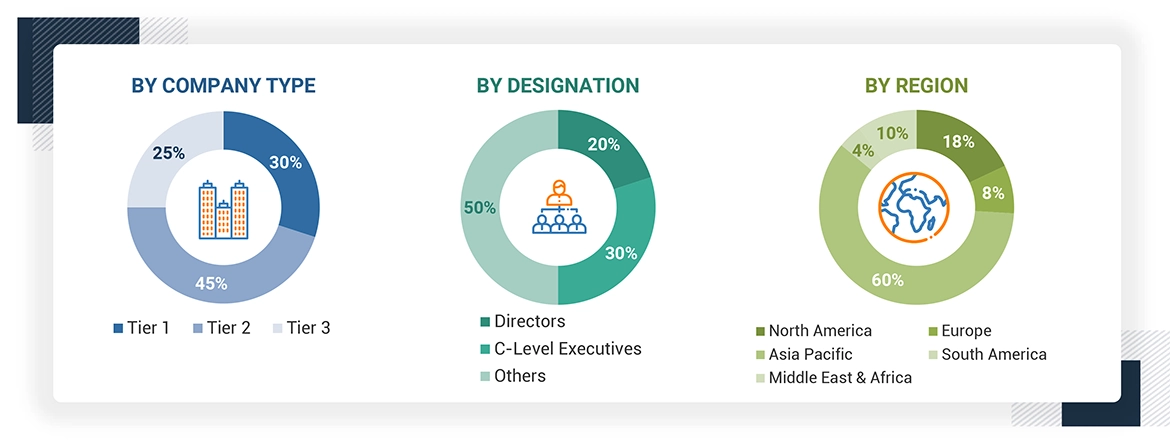
This research study involves the use of extensive secondary sources, directories, and databases, such as Hoovers, Bloomberg L.P., Factiva, ICIS, and OneSource, to identify and collect information useful for this technical, market-oriented, and commercial study of the global engines market. Primary sources are mainly industry experts from core and related industries, preferred suppliers, manufacturers, distributors, service providers, and organizations related to all segments of the value chain of this industry. In-depth interviews were conducted with various primary respondents, including key industry participants, subject matter experts, C-level executives of key market players, and industry consultants, among other experts, to obtain and verify critical qualitative and quantitative information as well as assess growth prospects of the market.
Secondary Research
Secondary sources include annual reports, press releases, and investor presentations of companies; directories and databases, which include D&B, Bloomberg, and Factiva; white papers and articles from recognized authors, and publications and databases from associations, such as International Energy Agency (IEA), US Energy Information Administration (EIA), European Association of Internal Combustion Engine Manufacturers, Truck and Engine Manufacturers Association (EMA), Indian Diesel Engine Manufacturers' Association. Secondary research has been used to obtain important information about the key players and market classification & segmentation according to industry trends to the bottom-most level and key developments related to market and technology perspectives. A database of the key industry leaders has also been prepared using secondary research.
Primary Research
In the primary research process, various sources from both the supply and demand sides have been interviewed to obtain and verify qualitative and quantitative information for this report and analyze prospects. Primary sources from the supply side include industry experts such as CEOs, vice presidents, marketing directors, technology and innovation directors, and related executives from various leading companies and organizations operating in the engines market. Primary sources from the demand side include experts and key persons.
After the complete market engineering process (which includes calculations of market statistics, market breakdown, market size estimations, market forecasts, and data triangulation), extensive primary research has been conducted to gather information and verify and validate the critical numbers arrived at. Primary research has also been conducted to identify the segmentation, applications, Porter’s Five Forces, key players, competitive landscape, and key market dynamics such as drivers, opportunities, challenges, industry trends, and strategies adopted by key players.
To know about the assumptions considered for the study, download the pdf brochure
Market Size Estimation
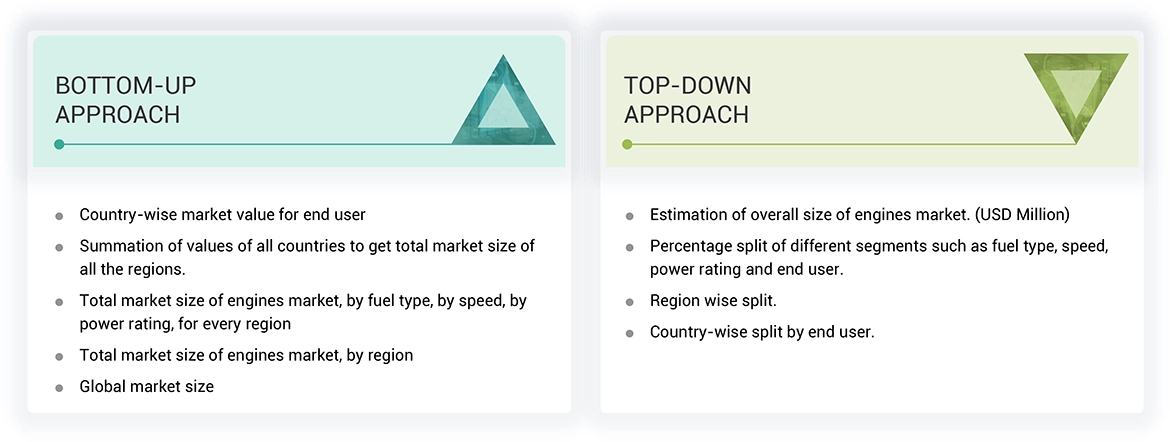
In the complete market engineering process, both top-down and bottom-up approaches have been extensively used along with several data triangulation methods to estimate and forecast the overall market segments listed in this report.
Top-down and bottom-up approaches have been used to estimate and validate the market size of engines for various end user in each region. The key players in the market have been identified through secondary research, and their market share in respective regions has been determined through primary and secondary research. This entire procedure includes the study of annual and financial reports of the key market players and extensive interviews for insights from industry leaders such as CEOs, vice presidents, directors, and marketing executives. All percentage shares, splits, and breakdowns have been determined using secondary sources and verified through primary sources.
Engines Market : Top-Down and Bottom-Up Approach
Data Triangulation
After arriving at the overall market size from the estimation process explained above, the total market has been split into several segments and sub-segments. Data triangulation and market breakdown procedures have been used wherever applicable to complete the overall market engineering process and to arrive at the exact statistics for all segments and sub-segments. The data has been triangulated by studying various factors and trends from both the demand and supply sides. The market has been validated using both the top-down and bottom-up approaches. Then, it was verified through primary interviews. Hence, for every data segment, there are three sources—the top-down approach, the bottom-up approach, and expert interviews. When the values arrived at from the three points matched, the data was assumed to be correct.
Market Definition
Engines are mechanical devices designed to convert energy from fuel combustion or other sources into mechanical power. They are widely used across various industries including automotive, aerospace, marine, construction, and power. Internal combustion engines (ICE) remain the most common type, powered by gasoline, diesel, or natural gas.
Engines are categorized based on their energy source, operation mode, and application. Types of engines include reciprocating engines, rotary engines, and jet engines. Key components of an engine include the cylinder, crankshaft, piston, and spark plug in ICEs, or the stator, rotor, and magnetic field in electric motors. Engine displacement, torque, and horsepower are crucial performance metrics in evaluating engine efficiency and capacity.
Modern engines offer significant benefits such as improved fuel efficiency, lower emissions, and enhanced durability. Advanced designs like turbocharged engines and hybrid engines integrate features to meet stringent environmental regulations while maximizing performance. The engines market is witnessing a shift towards sustainable solutions, driven by regulatory frameworks and consumer demand for eco-friendly products.
Stakeholders
- Government organizations and regulatory agencies
- Engine manufacturing companies
- Automotive, aerospace, marine, and industrial equipment manufacturers
- Research and development institutes
- Environmental and sustainability organizations
- Fuel and energy supply companies
- Trade associations and industry forums related to engine technologies
- Original Equipment Manufacturers (OEMs)
- Component and parts suppliers for engines
- Consulting companies in energy, automotive, and manufacturing sectors
- Transportation and logistics companies
- Maintenance and repair service providers
Report Objectives
- To describe and forecast the engines market in terms of value based on fuel type, speed, power rating, end user and region
- To describe and forecast the engines market in terms of volume based on region and power rating segment
- To provide detailed information about the key factors such as drivers, restraints, opportunities, and challenges influencing the growth of the engine market
- To strategically analyze the subsegments with respect to individual growth trends, prospects, and contributions of each segment to the overall market size
- To forecast the market size for five key regions: North America, Europe, Asia Pacific, Middle East & Africa, and South America, along with their key countries
- To strategically analyze micromarkets1 with respect to individual growth trends, prospects, and contributions to the total market
- To study the complete supply chain and allied industry segments and perform a supply chain analysis of the engines market’ landscape
- To study market trends, patent analysis, trade analysis, tariff and regulatory landscape, Porter’s five forces analysis, ecosystem mapping, technologies, investment and funding scenario, key stakeholders & buying criteria, case studies pertaining to off engines market
- To analyze the opportunities for various stakeholders by identifying the high-growth segments of the engines market
- To profile the key players and comprehensively analyze their market positions in terms of ranking and core competencies, along with detailing the competitive landscape for the market leaders
- To analyze competitive developments, such as contracts, collaborations, expansions, product launches, investments, and acquisitions, in the engines market
Note: 1. Micro markets are defined as the further segments and subsegments of the engines market included in the report.
2. Core competencies of companies are captured in terms of their key developments and product portfolios, as well as key strategies adopted to sustain their position in the engines market.
Available Customizations
MarketsandMarkets offers customizations according to the specific needs of the companies with the given market data.
The following customization options are available for the report:
Product Analysis
- Product matrix, which gives a detailed comparison of the product portfolio of each company
Regional Analysis
- Further breakdown of the engine market, by country
Company Information
- Detailed analysis and profiling of additional market players (up to five)
Get the Full Engines Market Report
Full forecast, segment splits, and company analysis for all Engines Market.
- China Engines Market
- Japan Engines Market
- India Engines Market
- Australia Engines Market
- Canada Engines Market
- Mexico Engines Market
- US Engines Market
- Germany Engines Market
- UK Engines Market
- Italy Engines Market
- France Engines Market
- Spain Engines Market
- Saudi Arabia Engines Market
- UAE Engines Market
- South Africa Engines Market
- Egypt Engines Market
- Brazil Engines Market
- Argentina Engines Market
- Chile Engines Market
- Rest Of Europe Engines Market
- Rest Of Asia Pacific Engines Market
- GCC Engines Market
- Rest Of GCC Countries Engines Market
- Rest Of South America Engines Market
Need a Tailored Report?
Customize this report to your needs
Get 10% FREE Customization
Customize This Report
