
US EV Charging Cable Market (2026-2031)

The US EV Charging Cable Market was valued at $1181 Million in 2026 and projected to reach to $1454 Million by 2031, representing a compound annual growth rate of 3.0%. The US EV charging cable market is positioned for steady but measured growth, expanding from $1,181 million in 2026 to $1,454 million by 2031.


| Market Size in | USD 26.32 MN |
| Market Forecast in | |
| CAGR | |
| Forecast Period | |
| Units Considered | Value (USD MN) |
US EV Charging Cable Market Trends and Insights
- This moderate growth trajectory reflects the US market's mature EV infrastructure development and standardized charging protocols.
- The US charging cable segment benefits from established OEM partnerships, widespread adoption of Level 2 and DC fast-charging networks, and regulatory support for electrification across the transportation sector. Driving the US market expansion through 2031 are increasing EV fleet deployments, replacement demand for aging charging infrastructure, and investments in public charging networks.
- The US market faces unique dynamics compared to global trends, with slower growth reflecting market saturation in certain regions and the dominance of established charging standards.
- Key factors shaping the US landscape include supply chain resilience, domestic manufacturing initiatives, and the transition toward universal connector standards that simplify cable compatibility across vehicle platforms..
Key Market Statistics
- CAGR (2026-2031) 3.0% CAGR
- Market Size, 2026 ~USD 1181 Million
- Forecast, 2031 ~USD 1454 Million
- Country US
US EV Charging Cable Market Overview
Mature Infrastructure Development :
The US EV charging cable market demonstrates steady growth with established standardization across Tesla Supercharger networks, SAE J1772, and CCS protocols, creating a stable foundation for cable manufacturers and suppliers.
OEM Partnership Dominance :
Major US automotive manufacturers including Tesla, Ford, GM, and Volkswagen have secured long-term charging cable supply agreements, driving predictable demand and reducing market volatility in the domestic segment.
Moderate Growth Trajectory :
With a 3% CAGR through 2031, the US market reflects slower expansion compared to global rates (15.8%), indicating market saturation in urban areas and slower rural EV adoption rates across the country.
Standardization Benefits :
Widespread adoption of unified charging standards in the US has reduced product complexity and manufacturing costs, enabling competitive pricing while maintaining quality standards across domestic cable suppliers.
US EV Charging Cable Market Dynamics
- This 3% CAGR reflects a maturing market where infrastructure investments have already established robust charging networks across major metropolitan areas.
- Growth drivers include increasing EV fleet penetration, replacement demand for aging cables, and technological upgrades to support faster charging capabilities. Future expansion will be constrained by market saturation in developed regions and slower adoption in rural areas.
- However, opportunities exist in premium cable segments, smart charging solutions, and durability improvements.
- The US market will increasingly focus on innovation in cable materials, safety features, and compatibility with emerging fast-charging technologies rather than volume expansion..
Market Ecosystem
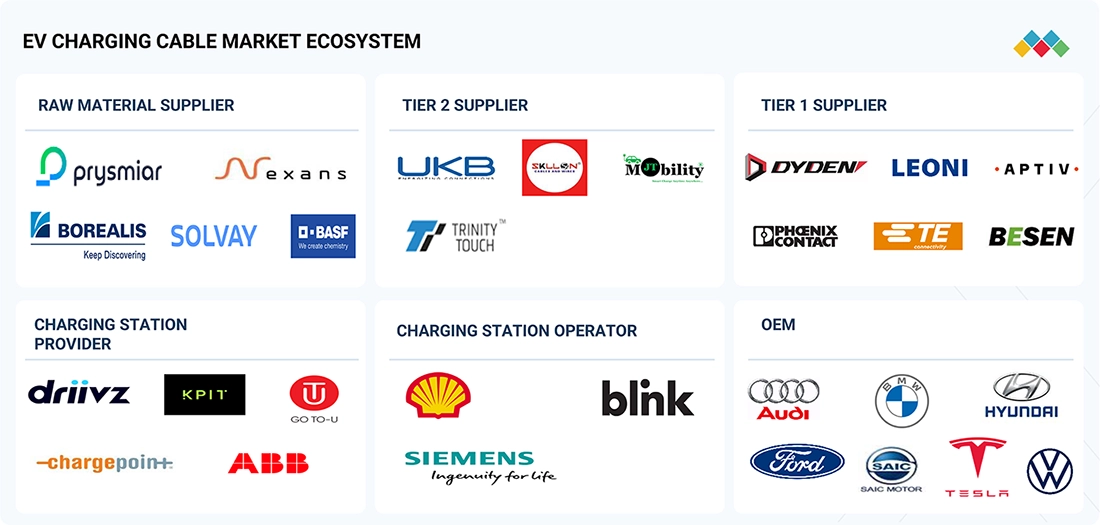
EV CHARGING CABLES MARKET SIZE, SHARE & ANALYSIS: COMMERCIAL USE CASES ACROSS INDUSTRIES
| COMPANY | USE CASE DESCRIPTION | BENEFITS |
|---|---|---|
 |
Provides high-power EV charging cables and connectors for ultra-fast DC charging applications. | Improves charging reliability, thermal performance, and power delivery efficiency. |
 |
Develops lightweight and flexible EV charging cables for public, residential, and fleet charging. | Enhances cable handling, durability, and user convenience. |
 |
Designs EV charging cables integrated with advanced vehicle electrical and connectivity systems. | Supports safer charging and improved compatibility with modern EV platforms. |
 |
Manufactures EV charging cables compliant with global standards for diverse charging environments. | Enables broad interoperability and dependable long-term performance. |
 |
Supplies high-conductivity EV charging cables for fast charging infrastructure deployment. | Increases charging efficiency and extends cable service life under intensive use. |
Logos and trademarks shown above are the property of their respective owners. Their use here is for informational and illustrative purposes only.
Related Ecosystem
Automotive Electronics And Electrical Equipment
- Battery Electric Vehicle (BEV)
- Light Commercial Vehicles (LCVs)
- Fuel Cell Electric Vehicle (FCEV)
- Sensors
- Hybrid Electric Vehicle (HEV)
- BOSCH LIMITED
- DENSO Corporation
- Panasonic Holdings Corporation
- Continental ag
- Texas Instruments Incorporated
Automotive Materials
- Light Commercial Vehicles (LCVs)
- Battery Electric Vehicle (BEV)
- Hybrid Electric Vehicle (HEV)
- Fuel Cell Electric Vehicle (FCEV)
- Agricultural Tractors
- AISIN CORPORATION
- GORKOVSKY AVTOMOBILNY ZAVOD
- Basf se
- BOSCH LIMITED
- Continental ag
Electric Hybrid Vehicles
- Battery Electric Vehicle (BEV)
- Fuel Cell Electric Vehicle (FCEV)
- Light Commercial Vehicles (LCVs)
- Hybrid Electric Vehicle (HEV)
- Agricultural Tractors
- Visteon Corporation
- BOSCH LIMITED
- Byd company ltd.
- Tesla, Inc.
- FORD MOTOR COMPANY
Key Takeaways
- The US EV charging cable market is valued at $1,181 million in 2026 and will reach $1,454 million by 2031 at a 3.0% CAGR.
- The US market demonstrates slower growth than global averages due to mature infrastructure and standardized charging protocols already in place.
- Replacement demand and public charging network expansion are primary growth drivers for the US market through 2031.
- The US transition to universal connector standards will streamline cable compatibility and support long-term market stability.
EV Charging Cable Market Report Scope
| Report Metric | Details |
|---|---|
| Base Year | 2026 |
| Fastest Growing Segment | LIQUID-COOLED HIGH-POWER CHARGING CABLE (Cable Type) |
| Forecast Period | 2026-2031 |
| Growth Rate | CAGR of 15.8% from 2026 to 2031 |
| Largest Segment | NORMAL CHARGING CABLE (Cable Type) |
| Market Size Base Year (Billions) | ~USD 2.02 (2026) |
| Revenue Forecast (Billions) | ~USD 4.2 (2031) |
| Segments Covered | Application, Cable Type, Charging Level, Diameter, Length, Mode, Power Supply, Shape, Vehicle Type |
US EV Charging Cable Market Report Segmentation
9 segment dimensions are covered across the global market.
By Application
- Private Charging
- Public Charging
By Cable Type
- High-Power Charging Cable
- Liquid-Cooled High-Power Charging Cable
- Normal Charging Cable
By Charging Level
- Level 1
- Level 2
- Level 3
By Diameter
- 10-20 Mm
- <10 Mm
- >20 Mm
By Length
- 2-5 Meters
- 6-10 Meters
- >10 Meters
By Mode
- Mode 1 & 2
- Mode 3
- Mode 4
By Power Supply
- Ac
- Ac Charging
- Dc
- Dc Charging
By Shape
- Coiled
- Straight
By Vehicle Type
- Ac Charging
- Dc Charging
Target Audience
- EV Charging Cable Manufacturers : Manufacturers need US-specific market data to optimize production capacity, negotiate OEM contracts, and develop products meeting SAE/CCS standards while competing in a moderately growing market.
- Automotive OEMs & Suppliers : Ford, GM, Tesla, and Volkswagen require detailed market intelligence to forecast cable demand, manage supply chain costs, and plan long-term sourcing strategies for their US EV portfolios.
- Charging Infrastructure Operators : Companies operating public charging networks need market insights to estimate cable replacement cycles, upgrade requirements, and compatibility planning across diverse charging standards in the US.
- Investment & Private Equity Firms : Investors evaluating opportunities in the US EV supply chain require market sizing, growth projections, and competitive analysis to assess acquisition targets and portfolio company valuations.
- Technology & Innovation Companies : Firms developing smart charging, fast-charging, or safety technologies need US market data to identify adoption barriers, customer requirements, and commercialization timelines for new solutions.
Reasons to Buy this Report
- Strategic OEM Insights : Understand partnership dynamics with Tesla, Ford, GM, and Volkswagen to identify supply chain opportunities and competitive positioning within the US automotive charging ecosystem.
- Market Sizing & Forecasting : Access precise valuation data ($1,181M in 2026 growing to $1,454M by 2031) to support investment decisions, capacity planning, and revenue projections for US operations.
- Standardization & Compliance : Gain detailed analysis of SAE J1772 and CCS protocol adoption across US regions, enabling product development aligned with dominant standards and regulatory requirements.
- Regional Growth Differentiation : Identify high-growth urban markets versus slower rural adoption patterns to optimize distribution strategies, manufacturing locations, and targeted marketing investments across the US.
- Competitive Landscape Analysis : Benchmark against established cable suppliers and emerging competitors to understand market consolidation trends, pricing strategies, and differentiation opportunities in the mature US segment.
Frequently asked questions
What is the current size of the US EV charging cable market?
The US EV charging cable market is valued at $1,181 million in 2026 and is expected to grow to $1,454 million by 2031.
What is the growth rate of the US EV charging cable market?
The US market is projected to grow at a compound annual growth rate (CAGR) of 3.0% from 2026 to 2031.
Why is the US market growing slower than the global average?
The US market exhibits slower growth due to mature EV infrastructure, established charging standards, and market saturation in certain regions compared to emerging markets globally.
What are the main drivers of growth in the US EV charging cable market?
Key drivers include increasing EV fleet deployments, replacement demand for aging infrastructure, public charging network investments, and the adoption of universal connector standards.
How will connector standardization impact the US market?
Universal connector standards will simplify cable compatibility across vehicle platforms, reduce consumer confusion, and support sustainable long-term market growth in the US.
RESEARCH METHODOLOGY
The study involved four major activities in estimating the current size of the EV charging cable market. Exhaustive secondary research was done to collect information on the market, the peer market, and the parent market. The next step was to validate these findings, assumptions, and sizing with the industry experts across value chains through primary research. The top-down approach was employed to estimate the complete market size. Thereafter, market breakdown and data triangulation processes were used to estimate the market size of segments and subsegments.
Secondary Research
Secondary sources referred to for this research study included EV charging cable industry organizations; corporate filings such as annual reports, investor presentations, and financial statements; trade and business whitepapers and databases; and articles from recognized associations and government publishing sources. The secondary data was collected and analyzed to arrive at the overall market size, which was further validated by primary research.
Primary Research
Extensive primary research has been conducted after acquiring an understanding of this market scenario through secondary research. Several primary interviews have been conducted with market experts from the demand- and supply-side OEMs (in terms of component supply, country-level government associations and trade associations), and component manufacturers across four major regions, namely, Asia Pacific, Europe, and North America. Approximately 60% and 40% of primary interviews have been conducted from the demand and supply sides, respectively. Primary data has been collected through questionnaires, emails, LinkedIn, and telephone interviews. In the canvassing of primaries, we have strived to cover various departments within organizations, such as sales, operations, and administration, to provide a holistic viewpoint in our report.
Brief sessions with highly experienced independent consultants were conducted to reinforce findings from primaries after interacting with industry experts. This, along with the in-house subject matter experts’ opinions, led to the findings, as described in the remainder of this report.
In the primary research process, various primary sources from the supply and demand sides were interviewed to obtain qualitative and quantitative information for the report. The primary sources from the supply side included industry experts, such as Vice Presidents (VPs), marketing directors, technology and innovation directors, and related key executives from various key companies and organizations. The primary sources from the demand side included end users, such as Chief Information Officers (CIOs), consultants, service professionals, technicians and technologists, and managers at public and investor-owned utilities.
Breakdown of Primaries
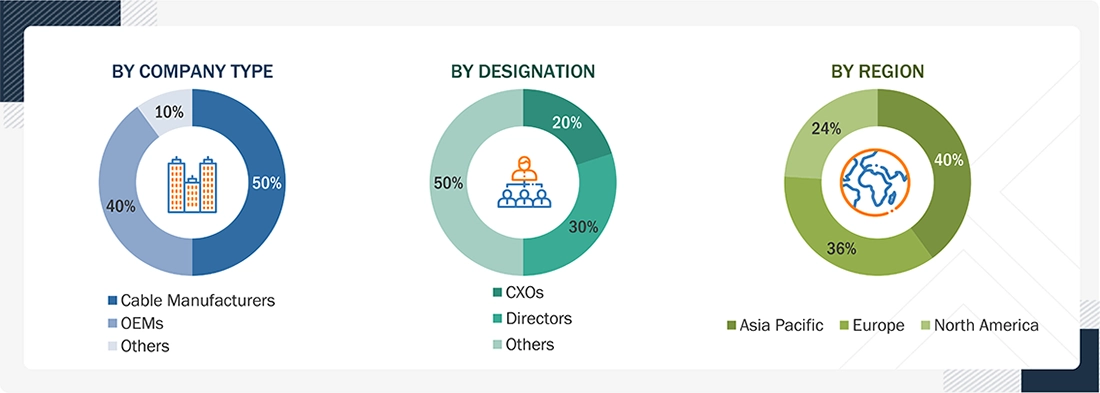
Note: Other company types include charging station manufacturers and operators
Note: Other designations include purchase and sales managers, marketing managers, and product managers
To know about the assumptions considered for the study, download the pdf brochure
Market Size Estimation
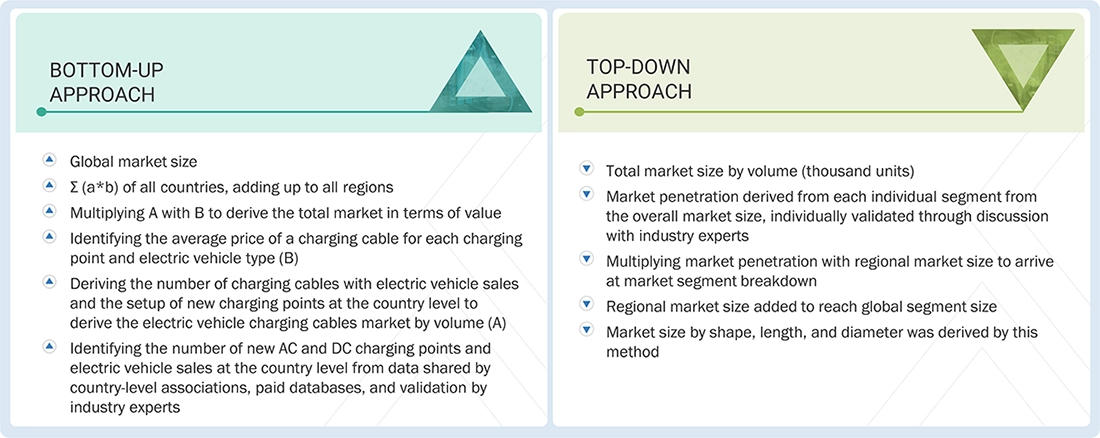
In the bottom-up approach, the number of EV sales and charging point sales at the country level has been considered. The number of charging cables per vehicle and per charging point has been identified through model mapping and secondary research. The sale of EVs and charging points installed at the country level has then been multiplied by the number of charging cables to determine the market size of the EV charging cable market in terms of volume. The average price of a charging cable has been identified for each charging point and EV through secondary and primary research. The country-level market size, in terms of volume, has then been multiplied by the country-level average charging cable price to determine the market size in terms of value for each EV and charging point type. The summation of the country-level market size by value would give the regional-level market size. The summation of the regional markets provides the global market size.
The top-down approach has been used to estimate and validate the size of the EV charging cable market by shape, length, and diameter. The global market size in terms of value has been divided into AC and DC using the penetration and percentage split, respectively, to derive the market size by power supply type. The global market has been further segmented at the regional level. A similar approach has been used to derive the market size breakdown of shape, length, diameter, and mode segments.
EV Charging Cables Market : Top-Down and Bottom-Up Approach
Data Triangulation
After arriving at the overall market size using the market size estimation processes as explained above, the market was split into several segments and subsegments. To complete the overall market engineering process and arrive at the exact statistics of each market segment and subsegment, data triangulation and market breakdown procedures were employed, wherever applicable. The data was triangulated by studying various factors and trends from both the demand and supply sides.
Market Definition
EV charging cables include cables used in home charging as well as private, commercial, and public charging stations. They are cable assemblies designed for charging stations or portable cord sets. These charging cable assemblies provide a current capacity ranging from 16 amperes to 40 amperes. They are assembled inside a rubber or plastic covering. Charging cables supply electric power to charge the EV battery. The length, shape, and material of charging cables play a vital role in the charging process.
Report Objectives
-
To segment and forecast the EV charging cable market in terms of volume (Thousand Units) and value (USD million)
-
- Application (Public and Private)
- Power Supply (AC and DC)
- Region (Asia Pacific, Europe, and North America)
-
To segment and forecast the Market in terms of volume (Thousand Units)
- Cable Type (Normal Charging Cable, High Power Charging Cable, Liquid Cooled High Power Charging Cable)
- Diameter (<10 MM, 10-20 MM, >20 MM)
- Length (2-5 meters, 6-10 meters, >10 meters)
- Mode (Mode 1 & 2, Mode 3, and Mode 4)
- Charging Level (Level 1, Level 2, and Level 3)
- Shape (Straight and Coiled)
-
To segment and forecast the market (qualitative)
- Jacket Material (All Rubber Jacket, Thermoplastic Elastomer (TPE) Jacket, Polyvinyl Chloride (PVC) Jacket
- Connector Type (Type 1, Type 2, CCS 1, CCS2, CHADEMO, GB/T, NACS/TESLA CONNECTORS)
- To analyze regional markets for growth trends, prospects, and their contribution to the overall market
- To define, describe, and forecast the size of the market with respect to growth trends and prospects, and determine the contribution of the segments to the total market
- To provide detailed information regarding the major factors (drivers, challenges, restraints, and opportunities) influencing market growth
- To strategically analyze markets with respect to individual growth trends, prospects, and contribution to the total market
- To analyze opportunities for stakeholders and the competitive landscape for market leaders
-
To study the following with respect to the market -
- Supply Chain Analysis
- Ecosystem Analysis
- Pricing Analysis
- Technology Analysis
- HS Code
- Case Study Analysis
- Patent Analysis
- Impact of the 2025 India-EU Trade Deal
- Regulatory Landscape
- Key Stakeholders and Buying Criteria
- Funding, by Cable Type
- Key Conferences & Events
- To strategically profile key players and comprehensively analyze their market share and core competencies
- To analyze the impact of AI on the market
- To track and analyze competitive developments such as deals (mergers & acquisitions, partnerships, collaborations), product developments, and other activities carried out by key industry participants.
Available customizations:
With the given market data, MarketsandMarkets offers customizations tailored to company-specific needs.
- EV Charging Cable Market, by charging level, at the country level (for countries covered in the report)
- EV Charging Cable Market, by mode, at the country level (for countries covered in the report)
Company Information
- Profiling of Additional Market Players (Up to 5)
-
Get the Full EV Charging Cable Market Report
Full forecast, segment splits, and company analysis for all EV Charging Cable Market.
- China EV Charging Cable Market
- Japan EV Charging Cable Market
- India EV Charging Cable Market
- South Korea EV Charging Cable Market
- Germany EV Charging Cable Market
- France EV Charging Cable Market
- UK EV Charging Cable Market
- Spain EV Charging Cable Market
- Italy EV Charging Cable Market
- Netherlands EV Charging Cable Market
- Sweden EV Charging Cable Market
- Norway EV Charging Cable Market
- Austria EV Charging Cable Market
- Denmark EV Charging Cable Market
- Switzerland EV Charging Cable Market
- Canada EV Charging Cable Market
Need a Tailored Report?
Customize this report to your needs
Get 10% FREE Customization
Customize This Report
