
Kuwait Exoskeleton Market (2025-2030)

The Kuwait Exoskeleton Market was valued at $0.21 Million in 2025 and projected to reach to $0.4 Million by 2030, representing a compound annual growth rate of 13.3%. Kuwait's exoskeleton market is positioned for steady growth as the nation continues to modernize its industrial infrastructure and diversify its economy beyond oil dependency.


| Market Size in | USD 26.32 MN |
| Market Forecast in | |
| CAGR | |
| Forecast Period | |
| Units Considered | Value (USD MN) |
Kuwait Exoskeleton Market Trends and Insights
- The market in Kuwait is projected to expand to $0.40 million by 2030, representing a compound annual growth rate of 13.3%.
- This growth trajectory reflects Kuwait's increasing investment in advanced robotics and automation technologies across industrial and healthcare sectors.
- Kuwait's strategic focus on diversifying its economy beyond oil and gas is driving adoption of exoskeleton technologies in manufacturing and rehabilitation applications.
- The market expansion in Kuwait is supported by rising labor costs and growing demand for worker safety solutions in the region's industrial facilities..
Key Market Statistics
- CAGR (2025-2030) 13.3% CAGR
- Market Size, 2025 ~USD 0.21 Million
- Forecast, 2030 ~USD 0.4 Million
- Country Kuwait
Kuwait Exoskeleton Market Overview
Market Size Growth :
Kuwait's exoskeleton market is valued at $0.21 million in 2025 and is projected to reach $0.40 million by 2030, demonstrating consistent expansion in the regional robotics sector.
Strong CAGR Performance :
With a compound annual growth rate of 13.3% through 2030, Kuwait's exoskeleton market outpaces many regional peers, driven by industrial automation adoption and technological advancement initiatives.
Industrial Automation Focus :
Kuwait's market growth is primarily fueled by increasing investments in advanced robotics and automation technologies across industrial and manufacturing sectors, supporting economic diversification efforts.
Regional Market Position :
As part of the broader Middle East exoskeleton market, Kuwait represents a strategic growth opportunity with emerging demand for wearable robotics in healthcare, defense, and industrial applications.
Kuwait Exoskeleton Market Dynamics
- Government initiatives promoting technological innovation and private sector investments in automation are creating favorable conditions for exoskeleton adoption across manufacturing, logistics, and healthcare sectors.
- The market's 13.3% CAGR reflects growing awareness of productivity benefits and worker safety improvements that exoskeletons provide.
- By 2030, increased penetration in industrial facilities and potential healthcare applications will drive market expansion, supported by rising disposable incomes and technological accessibility improvements in the region..
Market Ecosystem
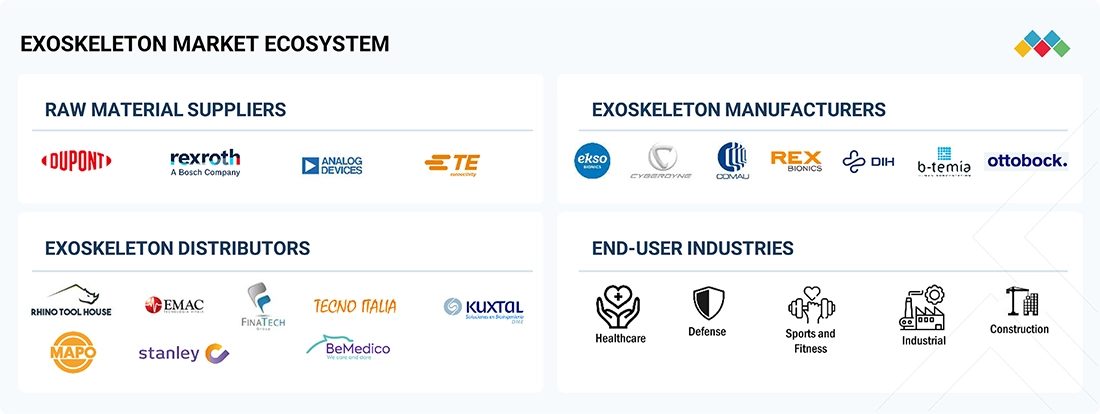
Exoskeleton Market: COMMERCIAL USE CASES ACROSS INDUSTRIES
| COMPANY | USE CASE DESCRIPTION | BENEFITS |
|---|---|---|
 |
Ekso Bionics launched GaitCoach in the US to enhance rehabilitation by providing real-time feedback and personalized guidance for patients using EksoNR. | Improved rehabilitation outcomes, simplified therapy processes, and enhanced patient and clinician experience |
 |
Comau introduced MATE-XB in Italy to reduce lower back fatigue and improve efficiency during lifting and repetitive industrial tasks. | Reduced worker fatigue, improved task efficiency, and enhanced comfort during repetitive motions |
 |
Hyundai Motor Group Robotics LAB developed X-ble MEX in South Korea to assist patients with lower limb rehabilitation and joint mobility. | Enhanced patient mobility, improved rehabilitation efficiency, and better support for clinical programs |
 |
Ottobock launched the Ottobock Shoulder in Germany to reduce strain and enhance comfort during overhead industrial work. | Reduced physical strain, improved worker comfort, and increased efficiency in industrial operations |
 |
Myomo Inc. announced MyoPro 2+ in the US to provide enhanced powered orthosis with better grasp functionality and improved comfort. | Improved user comfort, enhanced hand functionality, and better customization for patient needs |
Logos and trademarks shown above are the property of their respective owners. Their use here is for informational and illustrative purposes only.
Related Ecosystem
Electronics System And Components
- Sensors
- Temperature Sensors
- Pressure Sensors
- Actuators
- Image Sensors
- Lenovo
- Samsung
- Texas Instruments Incorporated
- HONEYWELL INTERNATIONAL INC.
- Teledyne Technologies Incorporated
Industrial Iot
- Sensors
- Pressure Sensors
- Flow Sensors
- Gas Sensors
- Image Sensors
- Siemens ag
- ABB India Limited
- HONEYWELL INTERNATIONAL INC.
- Emerson Electric Co.
- SCHNEIDER ELECTRIC SE
Key Takeaways
- Kuwait's exoskeleton market is valued at $0.21 million in 2025 and is expected to reach $0.40 million by 2030.
- Kuwait demonstrates a 13.3% CAGR, reflecting moderate but consistent market expansion in the Middle East.
- Kuwait's economic diversification strategy is accelerating adoption of exoskeleton technology in industrial and healthcare sectors.
- Kuwait's growing focus on worker safety and automation is positioning the country as an emerging market for exoskeleton solutions.
Exoskeleton Market Report Scope
| Report Metric | Details |
|---|---|
| Base Year | 2025 |
| Fastest Growing Segment | SENSORS (Component) |
| Forecast Period | 2025-2030 |
| Growth Rate | CAGR of 29.4% from 2025 to 2030 |
| Largest Segment | MOBILE (Mobility) |
| Market Size Base Year (Billions) | ~USD 0.56 (2025) |
| Revenue Forecast (Billions) | ~USD 2.03 (2030) |
| Segments Covered | Mobility, Type, Body Part, Component, Vertical, Technology, Segment |
Kuwait Exoskeleton Market Report Segmentation
7 segment dimensions are covered across the global market.
By Mobility
- Mobile
- Stationary
By Type
- Passive
- Powered
By Body Part
- Full Body
- Lower Extremities
- Upper Extremities
By Component
- Actuators
- Control Systems
- Other Components
- Power Sources
- Sensors
By Vertical
- Construction
- Defense
- Healthcare
- Industrial
- Other Verticals
By Technology
- Electric
- Hydraulic
- Pneumatic
By Segment
- Asia Pacific
- Europe
- North America
- Row
Target Audience
- Industrial Equipment Manufacturers : Manufacturers need Kuwait-specific market data to assess demand for exoskeleton integration in industrial automation solutions and identify partnership opportunities with local industrial operators.
- Robotics & Technology Companies : Technology firms require detailed Kuwait market insights to evaluate market entry feasibility, competitive landscape, and localized product development strategies for exoskeleton solutions.
- Healthcare & Rehabilitation Providers : Healthcare organizations need market analysis to understand exoskeleton adoption potential in Kuwait's medical sector, supporting procurement decisions and patient care innovation initiatives.
- Investment & Private Equity Firms : Investors require Kuwait market forecasts and growth metrics to evaluate investment opportunities in exoskeleton companies targeting Middle Eastern expansion and regional market penetration.
- Government & Economic Development Agencies : Kuwaiti policymakers and development agencies need market intelligence to support technology adoption initiatives, economic diversification strategies, and industrial modernization planning.
Reasons to Buy this Report
- Market-Specific Sizing Data : Access precise market valuation for Kuwait ($0.21M in 2025) with detailed 5-year forecasts, enabling accurate investment planning and resource allocation decisions specific to the Kuwaiti market.
- Growth Trajectory Insights : Understand Kuwait's 13.3% CAGR performance relative to global trends (29.4%), identifying unique market dynamics and localized growth drivers affecting exoskeleton adoption in the region.
- Industrial Sector Opportunities : Identify specific industrial and manufacturing applications driving demand in Kuwait, including automation, logistics, and worker safety initiatives that present targeted business expansion opportunities.
- Regional Competitive Analysis : Benchmark Kuwait's market performance against other Middle Eastern countries, understanding competitive positioning and market gaps for strategic market entry or expansion planning.
- Investment Decision Support : Make informed investment decisions with comprehensive Kuwait-focused market intelligence, supporting business case development, partnership strategies, and market entry planning for exoskeleton solutions.
Frequently asked questions
What is the current size of Kuwait's exoskeleton market?
Kuwait's exoskeleton market is estimated at $0.21 million in 2025, with projections to grow to $0.40 million by 2030.
What is the expected growth rate for exoskeletons in Kuwait?
Kuwait's exoskeleton market is expected to grow at a compound annual growth rate of 13.3% from 2025 to 2030.
Which industries are driving exoskeleton adoption in Kuwait?
Kuwait's primary drivers include industrial manufacturing, healthcare rehabilitation, and worker safety applications across the country's diversifying economy.
How does Kuwait's exoskeleton market compare to the global market?
Kuwait's 13.3% CAGR is lower than the global 29.4% CAGR, reflecting Kuwait's emerging status in the exoskeleton market relative to more mature global markets.
What factors are supporting exoskeleton market growth in Kuwait?
Kuwait's economic diversification initiatives, rising labor costs, and increased emphasis on worker safety and automation are key growth factors for the exoskeleton market.
RESEARCH METHODOLOGY
The study used four major activities to estimate the size of the exoskeleton market. Exhaustive secondary research was conducted to gather information on the market and its peer and parent markets. The next step was to validate these findings, assumptions, and sizing with industry experts across the value chain through primary research. Both top-down and bottom-up approaches were employed to estimate the total market size. Finally, market breakdown and data triangulation methods were utilized to estimate the market size for different segments and subsegments.
Secondary Research
The research methodology used to estimate and forecast the size of the exoskeleton market began with the acquisition of data related to the revenues of key vendors in the market through secondary research. Various secondary sources were referred to in the secondary research process to identify and collect information for this study. Secondary sources included annual reports, press releases, and investor presentations of companies; white papers, journals, certified publications, and articles by recognized authors; websites; directories; and databases. Secondary research was mainly used to obtain key information about the value chain of the exoskeleton market, key players, market classification, and segmentation according to the industry trends to the bottom-most level, geographic markets, and key developments from both market and technology-oriented perspectives. Secondary data was collected and analyzed to determine the overall market size, further validated through primary research. The secondary research referred to for this research study involved the Exoskeleton Report LLC, MDPI, Journal of NeuroEngineering and Rehabilitation, National Library of Medicine, IEEE Spectrum, and various other sources. Moreover, the study involved extensive use of secondary sources, directories, and databases, such as Hoovers, Bloomberg Businessweek, Factiva, and OneSource, to identify and collect valuable information for a technical, market-oriented, and commercial study of the exoskeleton market. Vendor offerings were taken into consideration to determine market segmentation.
Primary Research
In the primary research, various primary sources from both the supply and demand sides were interviewed to obtain the qualitative and quantitative information relevant to this report. Primary sources from the supply side included the key industry participants, subject-matter experts (SMEs), and C-level executives and consultants from various key companies and organizations in the exoskeleton ecosystem. After the complete market engineering (including calculations for the market statistics, the market breakdown, the market size estimations, the market forecasting, and the data triangulation), extensive primary research was conducted to verify and validate the critical market numbers obtained. Extensive qualitative and quantitative analyses were performed during the market engineering process to list key information/insights throughout the report. Extensive primary research was conducted after understanding the exoskeleton market scenario through secondary research. Several primary interviews were conducted with market experts from the demand and supply-side players across key regions: North America, Europe, Asia Pacific, and the Rest of the World (Middle East, Africa, and South America). Various primary sources from the supply and demand sides of the market were interviewed to obtain qualitative and quantitative information. The following is the breakdown of the primary respondents.
Primary data was collected through questionnaires, emails, and telephonic interviews. In the canvassing of primaries, various departments within organizations, such as sales, operations, and administration, were covered to provide a holistic viewpoint in the report. After interacting with industry experts, brief sessions were conducted with highly experienced independent consultants to reinforce the findings from the primaries. This and the in-house subject matter experts’ opinions led to the findings described in the remainder of this report.
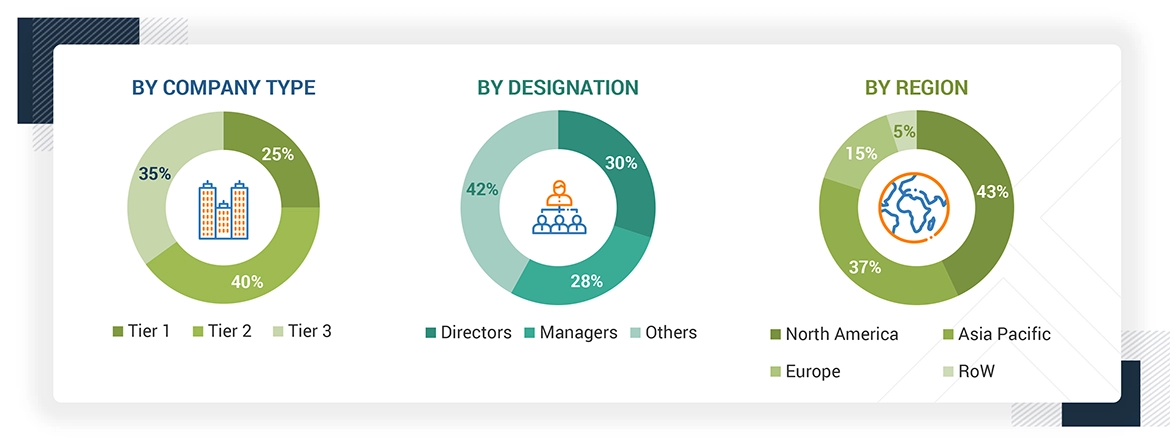
Note: The three tiers of the companies are defined based on their total revenue in 2024: Tier 1 - revenue greater than or equal to USD 1 billion; Tier 2 - revenue between USD 100 million and USD 1 billion; and Tier 3 revenue less than or equal to USD 100 million. Other designations include sales managers, marketing managers, and product managers.
To know about the assumptions considered for the study, download the pdf brochure
Market Size Estimation
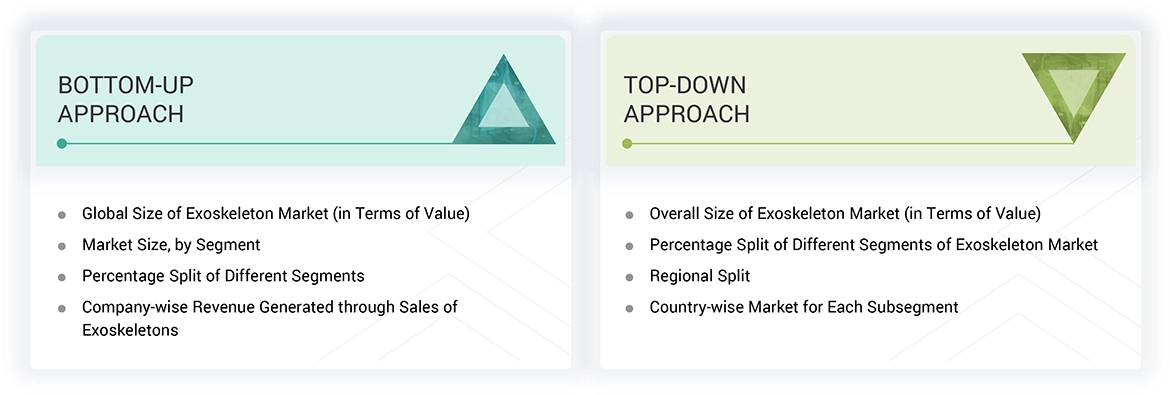
Both top-down and bottom-up approaches were utilized to estimate and validate the size of the exoskeleton market and its submarkets. Secondary research was conducted to identify the key players in the market, and primary and secondary research was used to determine their market share in specific regions. The entire process involved studying top players' annual and financial reports and conducting extensive interviews with industry leaders such as CEOs, VPs, directors, and marketing executives. Secondary sources were used to determine all percentage shares and breakdowns, which were verified through primary sources. All parameters that could impact the markets covered in this research study were accounted for, analyzed in detail, verified through primary research, and consolidated to obtain the final quantitative and qualitative data.
Exoskeleton Market : Top-Down and Bottom-Up Approach
Data Triangulation
Once the overall size of the exoskeleton market was determined using the methods described above, it was divided into multiple segments and subsegments. Market engineering was performed for each segment and subsegment using market breakdown and data triangulation methods, as applicable, to obtain accurate statistics. To triangulate the data, various factors and trends from the demand and supply sides were studied. The market was validated using both top-down and bottom-up approaches.
Market Definition
The exoskeleton market encompasses wearable, externally mounted devices designed to augment, support, or restore human physical performance. These systems are typically categorized into powered and passive types and are used to assist with movement, reduce strain, or enhance strength and endurance. They incorporate advanced technologies such as sensors, actuators, and artificial intelligence to deliver real-time motion assistance and are applied across healthcare, industrial, military, and rehabilitation sectors. In medical applications, exoskeletons aid in mobility restoration for individuals with physical disabilities or spinal cord injuries.
Key Stakeholders
- Raw Material Providers
- Component Manufacturers
- OEMs (Original Equipment Manufacturers)
- System Integrators
- Distributors and Retailers
- End-user Industries
Report Objectives
- To estimate and forecast the size of the exoskeleton market, in terms of value, based on type, component, body part, mobility, vertical, and region
- To provide qualitative information about the structure of exoskeletons
- To describe and forecast the market size, in terms of value, for four major regions-North America, Europe, Asia Pacific, and Rest of the World (RoW)
- To provide detailed information regarding major factors such as drivers, restraints, opportunities, and challenges influencing market growth
- To provide a detailed overview of the exoskeleton value chain
- To strategically analyze micromarkets regarding individual market trends, growth prospects, and contributions to the total market
- To strategically profile key players and comprehensively analyze their market position in terms of ranking and core competencies, along with a detailed competitive landscape for the market leaders
- To analyze major growth strategies such as product launches/developments and acquisitions adopted by the key market players to enhance their market position
- To analyze the impact of the macroeconomic factors on the exoskeleton market
Customization Options:
With the given market data, MarketsandMarkets offers customizations according to the specific requirements of companies. The following customization options are available for the report:
- Detailed analysis and profiling of additional market players (up to 5)
- Additional country-level analysis of the exoskeleton market
Product Analysis
- Product matrix, which provides a detailed comparison of the product portfolio of each company in the exoskeleton market.
Get the Full Exoskeleton Market Report
Full forecast, segment splits, and company analysis for all Exoskeleton Market.
- US Exoskeleton Market
- Canada Exoskeleton Market
- Mexico Exoskeleton Market
- UK Exoskeleton Market
- Germany Exoskeleton Market
- France Exoskeleton Market
- Italy Exoskeleton Market
- Poland Exoskeleton Market
- China Exoskeleton Market
- Japan Exoskeleton Market
- South Korea Exoskeleton Market
- India Exoskeleton Market
- Australia Exoskeleton Market
- Indonesia Exoskeleton Market
- Malaysia Exoskeleton Market
- Thailand Exoskeleton Market
- Vietnam Exoskeleton Market
- Nordics Exoskeleton Market
- Rest Of Europe Exoskeleton Market
- Rest Of Asia Pacific Exoskeleton Market
- Bahrain Exoskeleton Market
- Oman Exoskeleton Market
- Qatar Exoskeleton Market
- Rest Of Middle East Exoskeleton Market
- Saudi Arabia Exoskeleton Market
- UAE Exoskeleton Market
- Other African Countries Exoskeleton Market
- South Africa Exoskeleton Market
Need a Tailored Report?
Customize this report to your needs
Get 10% FREE Customization
Customize This Report
