
South Africa EPP Foam Market (2025-2030)

The South Africa EPP Foam Market was valued at $7.58 Million in 2025 and projected to reach to $9.1 Million by 2030, representing a compound annual growth rate of 3.7%. South Africa's EPP foam market is positioned for steady growth driven by expanding automotive manufacturing, rising e-commerce packaging demands, and growing consumer goods production.


| Market Size in | USD 26.32 MN |
| Market Forecast in | |
| CAGR | |
| Forecast Period | |
| Units Considered | Value (USD MN) |
South Africa EPP Foam Market Trends and Insights
- South Africa's EPP foam sector is driven by increasing demand from packaging, automotive, and consumer goods industries seeking lightweight, durable, and cost-effective material solutions.
- In 2025, South Africa's market reflects steady adoption of expanded polypropylene across protective packaging and thermal insulation applications, with regional manufacturers and importers strengthening supply chains to meet domestic and export demand. By 2030, South Africa is expected to experience moderate but consistent growth as industries prioritize sustainable packaging alternatives and improved product protection standards.
- South Africa's EPP foam market will benefit from rising e-commerce activity, growing automotive production, and heightened awareness of material recyclability.
- The forecast period through 2030 positions South Africa as a developing hub for EPP foam applications within the Middle East Africa region, supported by infrastructure improvements and industrial expansion..
Key Market Statistics
- CAGR (2025-2030) 3.7% CAGR
- Market Size, 2025 ~USD 7.58 Million
- Forecast, 2030 ~USD 9.1 Million
- Country South Africa
South Africa EPP Foam Market Overview
Market Size & Growth :
South Africa's EPP foam market is valued at USD 7.58 million in 2025, with projected growth to USD 9.10 million by 2030, representing a steady CAGR of 3.7% over the forecast period.
Key Driving Industries :
Packaging, automotive, and consumer goods sectors are primary demand drivers in South Africa, leveraging EPP foam's lightweight properties, durability, and cost-effectiveness for protective and structural applications.
Regional Performance :
South Africa's EPP foam market grows at 3.7% CAGR, moderately below the global average of 5.2%, indicating emerging but developing market maturity compared to international benchmarks.
Material Advantages :
South African manufacturers and end-users increasingly adopt EPP foam for its superior shock absorption, thermal insulation, and recyclability, meeting both performance and sustainability requirements.
South Africa EPP Foam Market Dynamics
- The 3.7% CAGR reflects moderate but consistent market expansion as local industries recognize EPP foam's cost-efficiency and performance benefits over traditional materials.
- Increasing focus on lightweight solutions in automotive applications and protective packaging for logistics presents significant growth opportunities. The market outlook remains positive as South African manufacturers invest in advanced production capabilities and sustainable material solutions.
- Growing awareness of EPP foam's recyclability aligns with regional environmental regulations and corporate sustainability initiatives.
- However, competition from alternative materials and import dynamics may moderate growth rates, requiring local producers to innovate and differentiate through quality and customization..
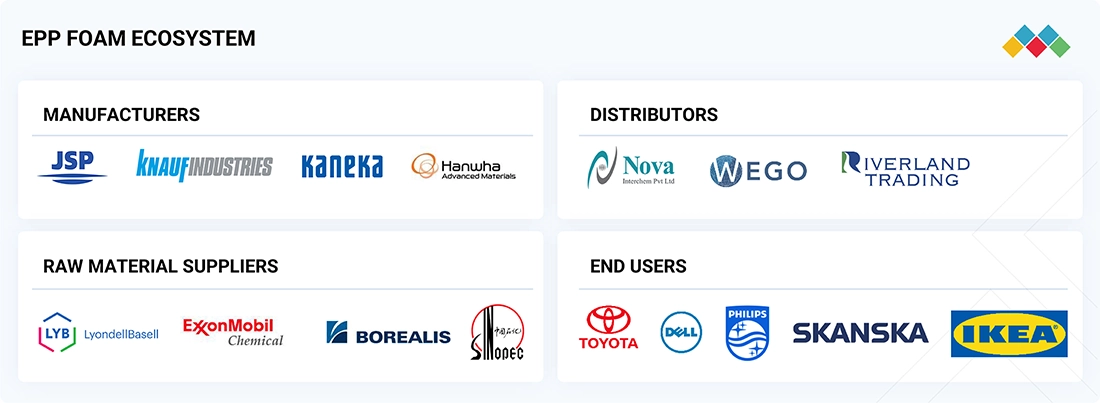
Market Ecosystem
EPP Foam Market: COMMERCIAL USE CASES ACROSS INDUSTRIES
| COMPANY | USE CASE DESCRIPTION | BENEFITS |
|---|---|---|
 |
Molded EPP parts for bumper cores, headrests, seat cores, energy-absorbing blocks, under-floor insulators, and interior fillers: EPP beads are molded into complex geometries that absorb impact while remaining lightweight. | Improved passenger safety through energy absorption; vehicle mass reduction of fuel/EV range benefits; parts durability and recyclability (EPP can be reprocessed) |
 |
Tailored internal packaging inserts for high-value electronics, lighting fixtures, medical kits, and fragile instruments: EPP is molded to part geometry for repeatable protection and can be used in reusable returnable systems. | Lower product damage rates; reduced packing labor (precision fits); potential for reusable/returnable packaging programs that cut material waste and long-term cost |
 |
Reusable instrument trays, protective shipping inserts for temperature-sensitive products, and returnable kits for surgical instruments: EPP’s closed-cell structure and inertness suit sterile logistics and repeated handling. | Protects expensive devices, supports sterilization workflows or returnable kit logistics, reduces single-use packaging waste and total lifecycle cost |
 |
Helmet impact liners (cycling, motorbike, equestrian), protective pads, lightweight cores in molded consumer furniture: EPP combines resilience with repeated impact recovery. | Better shock absorption and repeated-use durability (helmets that recover shape after multiple impacts), low weight for comfort, long service life |
 |
Thermal insulation panels, acoustic pads, lightweight formwork inserts, and vibration damping elements: EPP can be shaped for modular construction components. | Improved thermal and acoustic performance with low density, reduced structure dead-load, and parts that are durable and reusable in modular systems |
Logos and trademarks shown above are the property of their respective owners. Their use here is for informational and illustrative purposes only.
Related Ecosystem
Automotive Advance Technologies
- Battery Electric Vehicle (BEV)
- Light Commercial Vehicles (LCVs)
- Fuel Cell Electric Vehicle (FCEV)
- Hybrid Electric Vehicle (HEV)
- Internal Combustion Engine (ICE)
- BOSCH LIMITED
- Continental ag
- Visteon Corporation
- DENSO Corporation
- ZF FRIEDRICHSHAFEN AG
Foam And Insulation
- Fiberglass
- Acoustic Insulation
- Elastomeric Foam
- HVAC System
- Flexible Foam
- Basf se
- Saint-gobain
- ARMACELL INTERNATIONAL
- THE WOODBRIDGE GROUP
- Sekisui Chemical Co., Ltd.
Speciality Chemicals
- Corrosion Inhibitors
- Polyetheretherketone (PEEK)
- Acrylonitrile Butadiene Styrene (ABS)
- Epoxy Resin
- Polycarbonate
- Basf se
- DOW CHEMICAL COMPANY
- Evonik industries ag
- Clariant ag.
- Solvay sa
Key Takeaways
- South Africa's EPP foam market is valued at USD 7.58 million in 2025 with projected growth to USD 9.10 million by 2030.
- South Africa's market is expanding at a 3.7% CAGR, driven by packaging, automotive, and consumer goods demand.
- South Africa's e-commerce growth and automotive sector expansion are key growth catalysts through 2030.
- South Africa's focus on sustainable and recyclable materials is reshaping EPP foam applications and market dynamics.
EPP Foam Market Report Scope
| Report Metric | Details |
|---|---|
| Base Year | 2025 |
| Fastest Growing Segment | PACKAGING (Application) |
| Forecast Period | 2025–2030 |
| Growth Rate | CAGR of 5.2% from 2025 to 2030 |
| Largest Segment | AUTOMOTIVE (Application) |
| Market Size Base Year (Billions) | ~USD 1.93 (2025) |
| Revenue Forecast (Billions) | ~USD 2.49 (2030) |
| Segments Covered | Application, Type |
South Africa EPP Foam Market Report Segmentation
2 segment dimensions are covered across the global market.
By Application
- Automotive
- Consumer Products
- Packaging
By Type
- High-Density
- Low-Density
- Porous Pp
Target Audience
- EPP Foam Manufacturers & Producers : South African and regional manufacturers need market sizing and growth forecasts to plan capacity expansion, production investments, and market positioning strategies in a moderately growing market.
- Packaging & Logistics Companies : South African packaging firms require insights into EPP foam demand trends, material cost dynamics, and competitive offerings to optimize protective packaging solutions and supplier relationships.
- Automotive OEMs & Suppliers : Local automotive manufacturers and component suppliers need data on EPP foam adoption rates, performance specifications, and cost competitiveness to inform material selection and sourcing decisions.
- Investment & Private Equity Firms : Investors evaluating South African materials and chemicals sector opportunities require market valuation, growth trajectories, and competitive dynamics to assess investment returns and portfolio fit.
- Government & Trade Organizations : South African trade bodies and policy makers need market intelligence to support industrial development initiatives, sustainability regulations, and competitive positioning of local manufacturing sectors.
Key Companies in the South Africa EPP Foam Market
| Company | HQ | Ownership | Strongest segments |
|---|---|---|---|
| LCY CHEMICAL CORPORATION | Taiwan | Private Company | Performance plastics (PP for houseware, healthcare, automotive, construction, baby care),Performance composites and PP staple fibers,Methanol and solvent products, |
| PETRONAS | Malaysia | Private Company | Crude oil & refined products,LNG & pipeline gas,Petrochemicals (olefins, polymers, methanol, fertilizers), |
| TRINSEO | United States | Public Company | Engineered Materials,Latex Binders,Polymer Solutions, |
| CEPSA | Spain | Private Company | Refining, supply, and trading of petroleum products,Distribution and marketing of oil and gas products,Petrochemical and oleo-chemical products, |
| TOKUYAMA CORPORATION | Japan | Public Company | Chemicals Products (chlor-alkali, solvents, PVC, basic chemicals),Cement and Building Materials,Electronics Advanced Materials, |
| TASNEE | Saudi Arabia | Public Company | Petrochemicals (polyolefins, acrylics, solvents, SAP),Downstream plastics and packaging (BOPP, films, pipes, pallets, sheets),Metallurgy and titanium value chain (titanium sponge, slag, pig iron, lead), |
| LG CHEM LTD. | South Korea | Public Company | Ethylene- and propylene-based synthetic resins (PE, PP, EVA, POE, PVC, metallocene PE, UNIQABLE),Styrene-based resins and engineering plastics (ABS, ASA, PS, EPS, SAN, polycarbonate, high-performance plastics brands),Synthetic rubber, latex, and related elastomers, |
| JSP | Thailand | Public Company | Pharmaceuticals (Rx and OTC),Dietary supplements, traditional medicine, and herbal products,Hemodialysis products, purified water systems, and related medical supplies, |
| KANEKA CORPORATION | Japan | Public Company | PVC and Vinyls (PVC, crosslinked PVC, PVC-PVAc, paste PVC, chlorinated PVC),Specialty Additives and Engineering Resins,Advanced Films, Foams, and Functional Materials, |
| LOTTE CHEMICAL CORPORATION | South Korea | Public Company | Basic chemicals and petrochemicals (ethylene, PE, PP, EVA),Advanced materials (ABS, MABS, ASA, engineering plastics, performance materials),PET and packaging resins (cool/bio/clear PET), |
| POLYROCKS CHEMICAL | China | Public Company | Modified plastics, wires, cables, and automotive/home-appliance components,Halogen-free flame retardants, plastic additives, and phosphorus chemicals,Eco-friendly hygiene and packaging materials, biodegradable materials, breathable films, |
| ZHEJIANG ZHONGCHUANG MATERIAL TECHNOLOGY CO., LTD. | China | Public Company | Core specialty material line,Value-added engineered variants,Ancillary products and tolling services, |
LCY CHEMICAL CORPORATION
LCY Chemical Corporation is a private chemical company based in Taiwan, established in 1965.
PETRONAS
Petronas is a Malaysian private company founded in 1974 with 49,000 employees, operating as a major energy and petrochemical corporation.
TRINSEO
Trinseo is a United States-based public company founded in 2015 with 2,758 employees, engaged in specialty chemicals and materials manufacturing.
CEPSA
Cepsa is a Spanish private company founded in 1929 with 10,890 employees, operating in the energy and chemical sectors.
TOKUYAMA CORPORATION
Tokuyama Corporation is a Japanese public company founded in 1918 with 6,390 employees, specializing in chemicals and materials.
TASNEE
Tasnee is a Saudi Arabian public company established in 1984 with 7,000 employees, operating in the petrochemical and industrial sectors.
LG CHEM LTD.
LG Chem Ltd. is a South Korean public company founded in 1947 with 14,019 employees, a major global chemical and materials manufacturer.
JSP
JSP is a Thai public company established in 1954, engaged in manufacturing and industrial operations.
KANEKA CORPORATION
Kaneka Corporation is a Japanese public company founded in 1949 with 11,762 employees, specializing in chemicals and advanced materials.
LOTTE CHEMICAL CORPORATION
Lotte Chemical Corporation is a South Korean public company established in 1976 with 4,223 employees, operating in the chemical and petrochemical industries.
POLYROCKS CHEMICAL
Polyrocks Chemical is a Chinese public company founded in 1999 with 2,132 employees, engaged in chemical manufacturing.
ZHEJIANG ZHONGCHUANG MATERIAL TECHNOLOGY CO., LTD.
Zhejiang Zhongchuang Material Technology Co., Ltd. is a Chinese public company established in 2011.
Reasons to Buy this Report
- Market-Specific Sizing & Forecasts : Access precise valuation data for South Africa's EPP foam market (USD 7.58M in 2025, USD 9.10M in 2030) with country-specific CAGR analysis to support investment and expansion decisions.
- Industry Application Insights : Understand demand patterns across South Africa's packaging, automotive, and consumer goods sectors to identify high-potential customer segments and tailor product offerings accordingly.
- Competitive Landscape Analysis : Gain intelligence on local and regional competitors, market consolidation trends, and differentiation strategies specific to South Africa's EPP foam ecosystem.
- Growth Opportunity Identification : Identify emerging applications, sustainability trends, and regulatory drivers unique to South Africa that present untapped market segments and revenue expansion pathways.
- Strategic Planning & Risk Assessment : Benchmark South Africa's 3.7% CAGR against global 5.2% growth to assess market maturity, competitive intensity, and long-term viability for market entry or portfolio optimization.
Frequently asked questions
What is the current size of South Africa's EPP foam market?
South Africa's EPP foam market is estimated at USD 7.58 million in 2025.
What is the projected market size for South Africa's EPP foam by 2030?
South Africa's EPP foam market is forecast to reach USD 9.10 million by 2030.
What is the growth rate of South Africa's EPP foam market?
South Africa's EPP foam market is growing at a compound annual growth rate of 3.7% from 2025 to 2030.
Which industries drive demand for EPP foam in South Africa?
South Africa's EPP foam demand is primarily driven by packaging, automotive, consumer goods, and thermal insulation industries.
What factors are supporting growth in South Africa's EPP foam market?
South Africa's market growth is supported by rising e-commerce activity, automotive production expansion, and increased adoption of sustainable packaging materials.
RESEARCH METHODOLOGY
The study involved four main activities in estimating the current size of the EPP foam market: comprehensive secondary research gathered information on the market, related markets, and parent markets. The next step was to validate these findings, assumptions, and sizing with industry experts across the EPP foam value chain through primary research. Both top-down and bottom-up approaches were used to estimate the entire market size. Then, market segmentation and data triangulation helped to estimate the size of segments and subsegments.
Secondary Research
Secondary sources for this research study include annual reports, press releases, and investor presentations of companies; white papers; certified publications; articles by recognized authors; gold- and silver-standard websites; EPP foam manufacturing companies, regulatory bodies, trade directories, and databases. The secondary research was mainly used to obtain key information about the industry’s supply chain, the pool of key players, market classification, and segmentation according to industry trends, to the bottom-most level, and regional markets. It has also been used to obtain information about key developments from a market-oriented perspective.
Primary Research
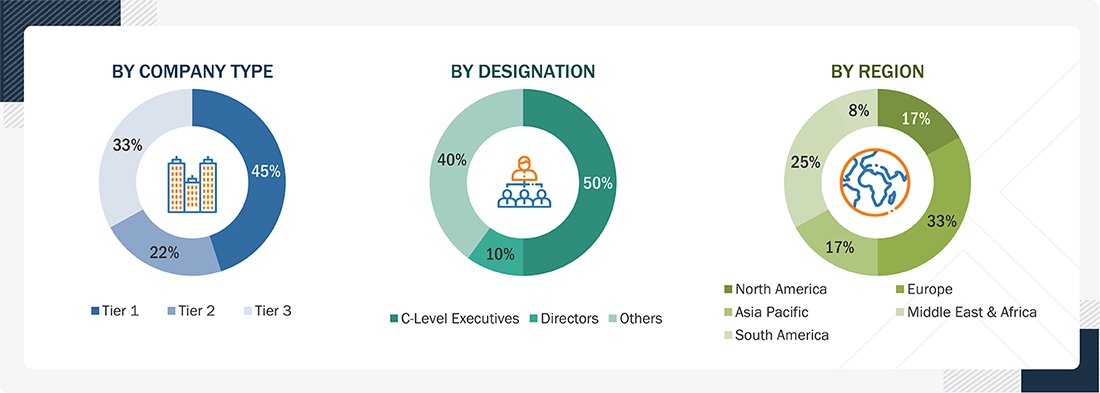
The EPP foam market includes various stakeholders, such as raw material suppliers, technology support providers, EPP foam manufacturers, and regulatory organizations in the supply chain. Different primary sources from both the supply and demand sides were interviewed to gather qualitative and quantitative information. Supply-side primary sources included industry experts like Chief Executive Officers (CEOs), vice presidents, marketing directors, technology and innovation directors, and other key executives from companies and organizations active in the EPP foam market. On the demand side, primary sources comprised directors, marketing heads, and purchasing managers from various sourcing industries.
The following is the breakdown of the primary respondents:
To know about the assumptions considered for the study, download the pdf brochure
Market Size Estimation
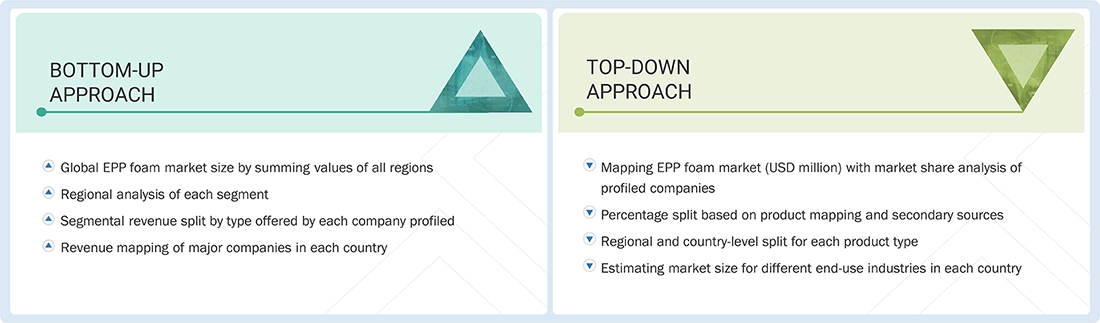
The top-down and bottom-up approaches have been used to estimate and validate the total size of the EPP foam market. These approaches have also been widely employed to estimate the size of various dependent market subsegments. The research methodology used to determine the market size included the following:
The following segments outline the market size estimation process used in this study:
- The key players in the market were identified through secondary research.
- The market share in the respective regions was identified through primary and secondary research.
- Primary and secondary research determined the EPP foam market's value chain and market size in terms of value and volume.
- All percentage shares, splits, and breakdowns were determined using secondary sources and verified through primary sources.
- All possible parameters that affect the market covered in this research study were accounted for, viewed in extensive detail, verified through primary research, and analyzed to obtain the final quantitative and qualitative data.
- The research included studying the annual and financial reports of the top market players and interviewing industry experts, such as CEOs, VPs, directors, sales managers, and marketing executives, for key quantitative and qualitative insights.
Global EPP Foam Market Size: Bottom-up Approach and Top-down Approach
Data Triangulation
After estimating the overall market size using the methods described above, the market was divided into several segments and sub-segments. To finalize the market engineering process and determine accurate statistics for each segment and sub-segment, data triangulation and market breakdown procedures were utilized, where applicable. The data was triangulated by analyzing various factors and trends from both the demand and supply sides in the oil & gas sector.
Market Definition
Expanded polypropylene foam, commonly referred to as EPP foam, is a type of thermoplastic foam material that belongs to the expanded polymer family. It is produced through polymer expansion, wherein unprocessed polypropylene resin beads are enlarged by the addition of steam prior to molding into the desired shape. The resultant product is a lightweight, closed-cell foam material characterized by interconnected spherical beads resembling a beehive. EPP foam is distinguished as an excellent choice for applications requiring adaptable and lightweight materials. Due to its exceptional combination of properties, EPP foam is a distinctive material favored by numerous industries.
Stakeholders
- Manufacturers of EPP foam
- Traders, distributors, and suppliers of EPP foam
- Government and research organizations
- Associations and industrial bodies
- Research and consulting firms
- R&D institutions
- Environmental support agencies
- Investment banks and private equity firms
Report Objectives
- To analyze and forecast the market size of the EPP foam market in terms of value and volume
- To provide detailed information regarding major factors (drivers, restraints, challenges, and opportunities) influencing the market
- To analyze and forecast the global EPP foam market based on type, application, and region
- To analyze opportunities in the market for stakeholders and provide details of a competitive landscape for market leaders
- To forecast the size of various market segments based on five major regions: Asia Pacific, Europe, North America, South America, and the Middle East & Africa, along with their respective key countries
- To analyze competitive developments, such as partnerships and expansions, in the market
- To strategically profile the key players and comprehensively analyze their market share and core competencies
Get the Full EPP Foam Market Report
Full forecast, segment splits, and company analysis for all EPP Foam Market.
- China EPP Foam Market
- India EPP Foam Market
- Japan EPP Foam Market
- South Korea EPP Foam Market
- Thailand EPP Foam Market
- Germany EPP Foam Market
- France EPP Foam Market
- Spain EPP Foam Market
- UK EPP Foam Market
- Netherlands EPP Foam Market
- Turkey EPP Foam Market
- Canada EPP Foam Market
- Mexico EPP Foam Market
- US EPP Foam Market
- Brazil EPP Foam Market
- Argentina EPP Foam Market
- Saudi Arabia EPP Foam Market
- UAE EPP Foam Market
- South America EPP Foam Market
- Rest Of Europe EPP Foam Market
- Rest Of Asia Pacific EPP Foam Market
- Other GCC Countries EPP Foam Market
Need a Tailored Report?
Customize this report to your needs
Get 10% FREE Customization
Customize This Report
