
Dcs Industrial Control & Factory Automation Market (2025-2030)

The Dcs Industrial Control & Factory Automation Market was valued at $15973 Million in 2025 and projected to reach to $20469.6 Million by 2030, representing a compound annual growth rate of 8.3%. The DCS market in the UK is experiencing sustained growth as manufacturers increasingly recognize the value of centralized, integrated control systems for managing complex industrial processes.


| Market Size in | USD 26.32 MN |
| Market Forecast in | |
| CAGR | |
| Forecast Period | |
| Units Considered | Value (USD MN) |
Dcs Industrial Control & Factory Automation Market Trends and Insights
- The UK market is driven by increasing adoption of Industry 4.0 technologies, digital transformation initiatives across manufacturing sectors, and rising demand for operational efficiency.
- UK manufacturers are investing heavily in automation solutions to enhance productivity, reduce labor costs, and improve product quality in an increasingly competitive global landscape. The UK's strong engineering heritage and advanced manufacturing base position the country as a key hub for industrial automation adoption.
- Between 2025 and 2030, the UK market will benefit from government support for smart manufacturing, growing integration of IoT and AI technologies, and modernization of legacy industrial systems.
- The UK's focus on sustainable manufacturing practices and energy-efficient automation solutions further accelerates market expansion.
- Key sectors driving growth in the UK include automotive, pharmaceuticals, food and beverage, and chemical manufacturing, all of which are prioritizing control systems and factory automation investments..
Key Market Statistics
- CAGR (2025-2030) 8.3% CAGR
- Market Size, 2025 ~USD 15973 Million
- Forecast, 2030 ~USD 20469.6 Million
- Geography Dcs
Dcs Industrial Control & Factory Automation Market Overview
DCS Market Valuation :
The Distributed Control Systems (DCS) segment within the UK Industrial Control & Factory Automation Market is valued at USD 15,973 million in 2025, demonstrating strong market penetration across manufacturing and process industries.
Robust Growth Trajectory :
DCS solutions are projected to reach USD 20,469.6 million by 2030, growing at a CAGR of 8.3%, driven by increasing complexity in industrial processes and the need for centralized control systems.
Industry 4.0 Integration :
DCS adoption is accelerating due to Industry 4.0 digital transformation initiatives, with manufacturers integrating advanced monitoring, predictive maintenance, and real-time data analytics capabilities into their control infrastructure.
Operational Efficiency Focus :
Rising demand for operational efficiency and cost reduction in manufacturing sectors is propelling DCS investments, as these systems enable better process optimization, reduced downtime, and improved product quality.
Dcs Industrial Control & Factory Automation Market Dynamics
- The shift toward Industry 4.0 and digital transformation is creating significant opportunities for DCS vendors to offer enhanced connectivity, cloud integration, and advanced analytics capabilities.
- With a CAGR of 8.3% through 2030, the market reflects strong demand from process industries, discrete manufacturing, and hybrid operations seeking to modernize their control infrastructure. Key drivers include the need for real-time visibility across production facilities, regulatory compliance requirements, and the competitive pressure to improve operational efficiency.
- As legacy systems reach end-of-life, replacement cycles are accelerating DCS adoption.
- Additionally, the integration of IoT sensors, edge computing, and AI-driven analytics into DCS platforms is creating new value propositions, positioning DCS as a critical enabler of smart manufacturing and sustainable production practices..
Market Ecosystem
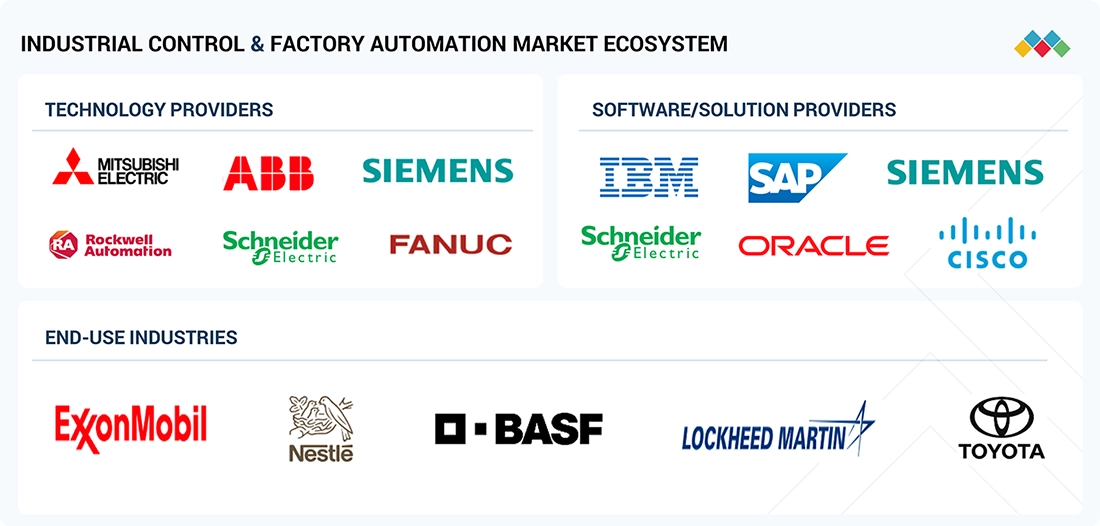
INDUSTRIAL CONTROL & FACTORY AUTOMATION MARKET SIZE, SHARE AND TRENDS: COMMERCIAL USE CASES ACROSS INDUSTRIES
| COMPANY | USE CASE DESCRIPTION | BENEFITS |
|---|---|---|
 |
Implemented an industrial robotics and HMI-based automation solution to improve material handling and production efficiency at a domestic manufacturing facility impacted by supply chain disruptions | Increased capacity utilization from 70% to 95%, improved productivity, supported domestic manufacturing expansion, and enabled cost-effective automation |
 |
Deployed a MicroSCADA system to monitor and control the power network for Bangkok’s Pink and Yellow monorail lines under the Mass Rapid Transit (MRT) project | Enabled real-time power monitoring, faster fault detection and recovery, improved reliability, and ensured uninterrupted operation of critical urban rail infrastructure |
 |
Implemented a Manufacturing Execution System (MES) to connect shop-floor operations with enterprise systems in tire manufacturing facilities | Reduced information silos, improved process standardization, enhanced decision-making, and increased overall production efficiency |
 |
Implemented ABB Ability Asset Performance Management (APM) to enable predictive, condition-based maintenance across hydropower plants | Reduced unplanned downtime, optimized maintenance costs, extended asset life, and improved operational reliability and energy efficiency |
 |
Deployed the EcoStruxure platform to optimize energy management and process control in large-scale cement manufacturing operations | Reduced labor intensity by 60%, improved energy efficiency by ~10%, lowered energy use per unit by 3–5%, achieved rapid ROI, and enhanced sustainability compliance |
Logos and trademarks shown above are the property of their respective owners. Their use here is for informational and illustrative purposes only.
Related Ecosystem
Locomotives And Rolling Stock
- Sensors
- Passenger Information System (PIS)
- Cartesian Robots
- Flow Sensors
- Gas Sensors
- Siemens ag
- Alstom s.a.
- Hitachi, Ltd.
- Knorr-bremse ag
- RAILPROS
Industrial Automation
- Sensors
- Image Sensors
- Manufacturing Execution System (MES)
- Actuators
- Flow Sensors
- Siemens ag
- ABB India Limited
- Emerson Electric Co.
- HONEYWELL INTERNATIONAL INC.
- SCHNEIDER ELECTRIC SE
Industrial Iot
- Sensors
- Pressure Sensors
- Flow Sensors
- Gas Sensors
- Image Sensors
- Siemens ag
- ABB India Limited
- HONEYWELL INTERNATIONAL INC.
- Emerson Electric Co.
- SCHNEIDER ELECTRIC SE
Key Takeaways
- The UK Industrial Control & Factory Automation Market will grow from USD 15,973M (2025) to USD 20,469.6M (2030) at an 8.3% CAGR.
- UK manufacturers are accelerating Industry 4.0 adoption to enhance productivity and reduce operational costs through advanced automation.
- Government initiatives and sustainability mandates are driving UK investment in smart manufacturing and energy-efficient control systems.
- Key UK sectors including automotive, pharmaceuticals, and food & beverage are major growth drivers for factory automation solutions.
Industrial Control & Factory Automation Market Report Scope
| Report Metric | Details |
|---|---|
| Base Year | 2025 |
| Fastest Growing Segment | INDUSTRIAL 3D PRINTING (Component) |
| Forecast Period | 2025–2030 |
| Growth Rate | CAGR of 9.6% from 2025 to 2030 |
| Largest Segment | INDUSTRIAL SOFTWARE (Component) |
| Market Size Base Year (Billions) | ~USD 275.22 (2025) |
| Revenue Forecast (Billions) | ~USD 435.24 (2030) |
| Segments Covered | Component, End-Use Industry, Type, Industry, Offering, Software, Service, Industrial Software, Industrial Robotics, Product Type, Hardware Type, Software Deployment Mode, Industrial Monitoring & Safety, Deployment, Tier Type, Software Deployment |
Dcs Industrial Control & Factory Automation Market Report Segmentation
16 segment dimensions are covered across the global market.
By Component
- Cnc Controller
- Cnc Controllers
- Field Instrumentation
- Flow Meter
- Flow Meters
- Industrial 3D Printing
- Industrial Communication
- Industrial Control Systems
- Industrial Monitoring & Safety
- Industrial Robotics
- Industrial Software
- Process Analyzer
- Process Analyzers
By End-Use Industry
- Aerospace
- Automotive
- Chemicals
- Energy & Power
- Food & Beverages
- Heavy Machinery
- Medical Devices
- Metal & Mining
- Metals & Mining
- Oil & Gas
- Other End-Use Industries
- Pharmaceutical
- Pulp & Paper
- Semiconductor & Electronics
By Type
- Cloud Enterprise Resource Planning
- Din Rail Ipcs
- Distributed Control Systems
- Embedded Ipcs
- Human Machine Interface
- Industrial Pcs
- Manufacturing Execution System
- Manufacturing Operation Management
- Panel Ipcs
- Plant Asset Management
- Programmable Logic Controllers
- Quality Management System
- Rack Mount Ipcs
- Supervisory Control And Data Acquisition Systems
- Warehouse Management System
By Industry
- Aerospace
- Automotive
- Chemicals
- Energy & Power
- Energy And Power
- Food & Beverages
- Food And Beverages
- Heavy Machinery
- Medical Devices
- Metal & Mining
- Metals & Mining
- Oil & Gas
- Other Industries
- Pharmaceuticals
- Pulp & Paper
- Semiconductors & Electronics
By Offering
- Hardware
- Professional Services
- Services
- Software
- Software & Services
By Software
- Cloud-Based
- On-Premises
By Service
- Managed Services
- Professional Services
By Industrial Software
- Cloud Enterprise Resource Planning (Erp)
- Manufacturing Execution System (Mes)
- Manufacturing Operation Management (Mom)
- Plant Asset Management (Pam)
- Quality Management Systems (Qms)
- Warehouse Management System (Wms)
By Industrial Robotics
- Industrial Robots
- Robot End Effector
By Product Type
- Collaborative Robot
- Traditional Robot
By Hardware Type
- Advanced Panel-Based Hmi
- Advanced Pc-Based Hmi
- Basic Hmi
- Others Hardware Types
By Software Deployment Mode
- Cloud-Based
- On-Premises
By Industrial Monitoring & Safety
- Industrial Sensor
- Machine Condition Monitoring
- Machine Safety
- Machine Vision
- Predictive Maintenance
- Solid State Relay
By Deployment
- Cloud
- Cloud-Based
- Hybrid
- On-Premises
By Tier Type
- Advanced (Tier 1)
- Basic (Tier 3)
- Intermediate (Tier 2)
By Software Deployment
- Hybrid
- Private
- Public
DCS: INDUSTRIAL CONTROL & FACTORY AUTOMATION MARKET, BY INDUSTRY, 2026–2032
| Segment | 2026 | 2027 | 2028 | 2029 | 2030 | 2031 | 2032 | CAGR (%) |
|---|---|---|---|---|---|---|---|---|
| CHEMICALS | 3247.5 | 3446.2 | 3666.6 | 3914.5 | 4246.9 | 4582.1 | 4956.1 | 7.3 |
| ENERGY & POWER | 4798.5 | 5093 | 5420.1 | 5787.6 | 6206 | 6673.6 | 7194.5 | 7 |
| FOOD & BEVERAGES | 2441.8 | 2586.1 | 2749.3 | 2931 | 3146 | 3368.8 | 3616.5 | 6.8 |
| METALS & MINING | 1238.9 | 1307.5 | 1383.5 | 1469.2 | 1576.4 | 1648.3 | 1727.8 | 5.7 |
| OIL & GAS | 5892.4 | 6233.2 | 6611.3 | 7036.1 | 7512.1 | 8028.7 | 8669.7 | 6.6 |
| OTHER INDUSTRIES | 2363.5 | 2517.8 | 2689 | 2881.3 | 3010.5 | 3260.4 | 3499.3 | 6.8 |
| PHARMACEUTICALS | 1876.8 | 1987.2 | 2116.2 | 2257.5 | 2419.5 | 2593.2 | 2786.3 | 6.8 |
| PULP & PAPER | 943.9 | 996.5 | 1054.8 | 1120.3 | 1197.7 | 1256.8 | 1293 | 5.4 |
| TOTAL | 22803.4 | 24167.4 | 25690.8 | 27397.4 | 29315.2 | 31411.9 | 33743 | 6.7 |
Target Audience
- DCS Solution Vendors : Manufacturers and providers of distributed control systems need this data to understand market size, growth rates, and competitive landscape to refine product strategies and pricing models.
- Industrial Automation Integrators : System integrators and implementation partners require DCS market insights to identify growth opportunities, assess demand across customer segments, and plan service delivery capabilities.
- Manufacturing Enterprises : Large manufacturers and process industry operators use this intelligence to evaluate DCS investment ROI, benchmark against peers, and justify modernization budgets to stakeholders.
- Investment & Private Equity Firms : Investors evaluating acquisition targets or portfolio companies in industrial automation need DCS market data to assess growth potential, market attractiveness, and valuation benchmarks.
- Technology Consultants & Analysts : Management consultants and industry analysts require detailed DCS market metrics to support client advisory work, competitive analysis, and strategic planning engagements.
Key Companies in the Dcs Industrial Control & Factory Automation Market
| Company | HQ | Ownership | Strongest segments |
|---|---|---|---|
| EMERSON ELECTRIC CO. | United States | Public Company | Final Control,Measurement & Analytical,Discrete Automation, |
| YOKOGAWA ELECTRIC CORPORATION | Japan | Public Company | Control Business (DCS, PLC, SCADA, software, lifecycle services),Field Instruments (flow, pressure, analyzers, recorders),Measuring Instruments (waveform, optical communications, signal generators), |
| FANUC CORPORATION | Japan | Public Company | Industrial robots,CNC systems and servo motors,Robomachines (machining centers, injection molding, wire EDM), |
| MITSUBISHI ELECTRIC CORPORATION | Japan | Public Company | Factory Automation (FA) systems and industrial solutions,Building systems, air conditioning, and refrigeration,Infrastructure, energy, and public utility systems, |
| OMRON CORPORATION | Japan | Public Company | Industrial Automation (sensors, safety, motion, robotics, control),Device & Module Solutions (relays, switches, connectors, components),Healthcare (cardiovascular, respiratory, pain, remote monitoring), |
| GE VERNOVA | United States | Public Company | Power (gas, nuclear, hydro, steam),Wind (onshore and offshore),Electrification (grid, power conversion, software, solar & storage), |
| FUJI ELECTRIC CO., LTD. | Japan | Public Company | Power Semiconductors,Drives, Motors, and Controls,Power Supply and UPS/Data Center Solutions, |
| HITACHI, LTD. | Japan | Public Company | Digital Systems & Services (IT, cloud, integration, ATMs),Green Energy & Mobility (power grids, energy, rail),Connective Industries (automation, industrial equipment, e-mobility), |
EMERSON ELECTRIC CO.
Emerson Electric Co. is a United States-based public company founded in 1890 with 71,000 employees. The company operates in industrial automation, climate technologies, and process management solutions.
YOKOGAWA ELECTRIC CORPORATION
Yokogawa Electric Corporation is a Japanese public company founded in 1915 with 18,313 employees. It specializes in industrial automation, control systems, and measurement technologies.
FANUC CORPORATION
FANUC Corporation is a Japanese public company founded in 1950 with 10,040 employees. The company is a leading manufacturer of industrial robots and factory automation systems.
MITSUBISHI ELECTRIC CORPORATION
Mitsubishi Electric Corporation is a Japanese public company founded in 1921 with 150,386 employees. It operates across multiple sectors including industrial automation, power systems, and electronic equipment manufacturing.
OMRON CORPORATION
Omron Corporation is a Japanese public company founded in 1933 with 26,050 employees. The company specializes in automation technology, sensing, and control systems for industrial applications.
GE VERNOVA
GE Vernova is a United States-based public company founded in 2023 with 78,000 employees. It focuses on energy infrastructure and industrial solutions.
FUJI ELECTRIC CO., LTD.
Fuji Electric Co., Ltd. is a Japanese public company founded in 1923 with 26,955 employees. The company manufactures power electronics, industrial systems, and automation equipment.
HITACHI, LTD.
Hitachi, Ltd. is a Japanese public company founded in 1910 with 287,901 employees. It is a diversified conglomerate operating in industrial systems, power generation, and digital solutions.
Countries within Dcs - compare and drill down
| Country | 2025 size (native) |
|---|---|
| UK | USD 15973 Million |
Country market size visualization
Reasons to Buy this Report
- Market Size & Growth Validation : Obtain precise market valuation data for DCS in the UK (USD 15,973M in 2025) with verified forecasts through 2030, enabling accurate business planning and investment decisions.
- Competitive Positioning Intelligence : Understand DCS market dynamics, growth drivers, and emerging trends to benchmark your offerings against competitors and identify white-space opportunities in the UK market.
- Industry 4.0 Adoption Insights : Gain actionable intelligence on how Industry 4.0 digital transformation is reshaping DCS demand, helping you align product development and go-to-market strategies with evolving customer needs.
- Investment & Expansion Planning : Use comprehensive market data to support capital allocation decisions, facility expansion plans, and resource allocation for DCS-focused business units in the UK region.
- Customer Segmentation & Targeting : Identify high-growth manufacturing sectors and process industries driving DCS adoption, enabling more precise customer targeting and customized solution development.
Frequently asked questions
What is the current size of the UK Industrial Control & Factory Automation Market?
The UK Industrial Control & Factory Automation Market is valued at USD 15,973 million in 2025.
What is the projected market size for the UK by 2030?
The UK market is projected to reach USD 20,469.6 million by 2030, growing at a CAGR of 8.3%.
Which sectors are driving growth in the UK Industrial Control & Factory Automation Market?
Key growth sectors in the UK include automotive, pharmaceuticals, food and beverage, and chemical manufacturing, all investing in advanced control systems and automation.
What are the main drivers of growth in the UK market?
The UK market is driven by Industry 4.0 adoption, digital transformation initiatives, government support for smart manufacturing, IoT and AI integration, and sustainability mandates.
How does the UK market compare to global trends?
The UK's 8.3% CAGR is slightly below the global average of 9.6%, reflecting the UK's mature manufacturing base and focus on quality over rapid expansion.
RESEARCH METHODOLOGY
The study involved major activities in estimating the current market size for the industrial control & factory automation market. Exhaustive secondary research was done to collect information on the industrial control & factory automation industry. The next step was to validate these findings, assumptions, and sizing with industry experts across the value chain using primary research. Different approaches, such as top-down and bottom-up, were employed to estimate the total market size. After that, the market breakup and data triangulation procedures were used to estimate the market size of the segments and subsegments of the industrial control & factory automation market.
Secondary Research
The market for the companies offering industrial control & factory automation solutions is arrived at by secondary data available through paid and unpaid sources, analyzing the product portfolios of the major companies in the ecosystem, and rating the companies by their performance and quality. Various sources were referred to in the secondary research process to identify and collect information for this study. The secondary sources include annual reports, press releases, investor presentations of companies, white papers, journals, certified publications, and articles from recognized authors, directories, and databases. In the secondary research process, various secondary sources were referred to for identifying and collecting information related to the study. Secondary sources included annual reports, press releases, and investor presentations of blockchain vendors, forums, certified publications, and whitepapers. The secondary research was used to obtain critical information on the industry's value chain, the total pool of key players, market classification, and segmentation from the market and technology-oriented perspectives.
Primary Research
Extensive primary research has been conducted after understanding and analyzing the current scenario of the industrial control & factory automation market through secondary research. Several primary interviews have been conducted with the key opinion leaders from the demand and supply sides across four main regions—North America, Europe, Asia Pacific, and the Rest of Europe. Approximately 25% of the primary interviews were conducted with the demand-side respondents, while approximately 75% were conducted with the supply-side respondents. The primary data has been collected through questionnaires, emails, and telephone interviews.
After interacting with industry experts, brief sessions were conducted with highly experienced independent consultants to reinforce the findings from our primary. This, along with the in-house subject matter experts’ opinions, has led us to the findings as described in the remainder of this report. The breakdown of primary respondents is as follows:
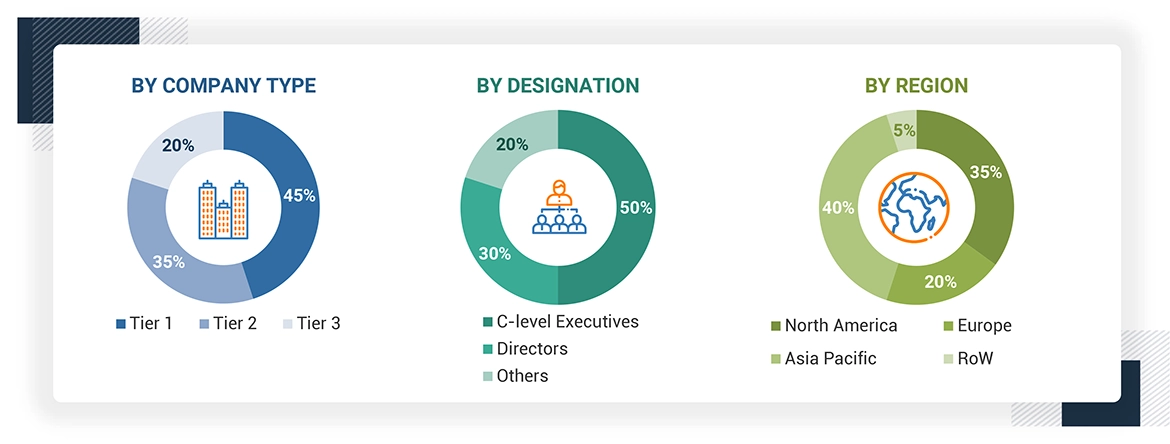
About the assumptions considered for the study, To know download the pdf brochure
Market Size Estimation
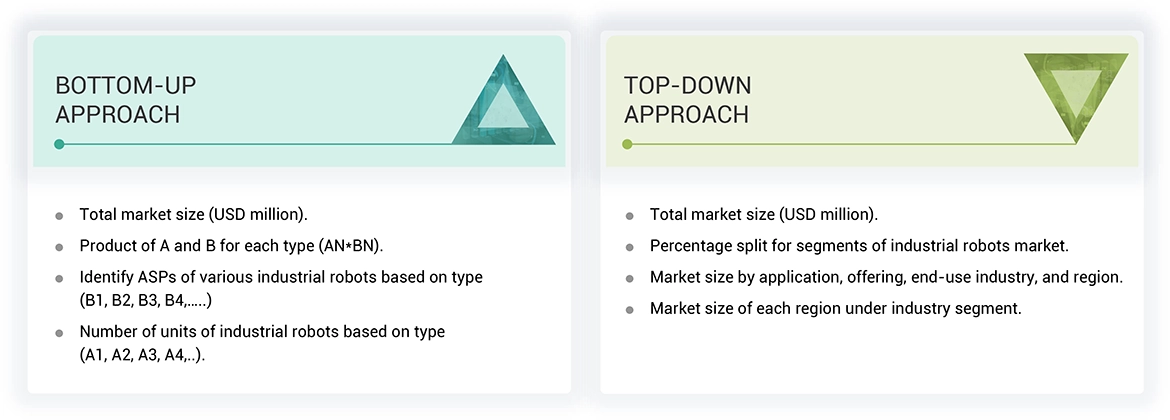
Both top-down and bottom-up approaches wete used to estimate and validate the total size of the industrial control & factory automation market. These methods were also used extensively to estimate the size of various subsegments in the market. The research methodology used to estimate the market size includes the following:
Industrial Control & Factory Automation Market : Top-Down and Bottom-Up Approach
Data Triangulation
After arriving at the overall market size using the market size estimation processes as explained above, the market was split into several segments and subsegments. The data triangulation and market breakdown procedures were employed, wherever applicable, to complete the overall market engineering process and arrive at the exact statistics of each market segment and subsegment. The data was triangulated by studying various factors and trends from the demand and supply sides.
Market Definition
Industrial control & factory automation is a highly digitalized and connected production system that can self-optimize performance across a broad network, self-adapt in various conditions in real time, and autonomously run an entire production process. The major advantage of industrial control & factory automation is its ability to evolve with the changing needs of organizations. Industrial control & factory automation uses a network to connect the virtual and physical elements of production processes to actual manufacturing operations. It helps to create an autonomous manufacturing environment that can handle any technical issues during real-time production, using fragmented information and communication structures to optimize production processes.
Key Stakeholders
- End users
- Government bodies, venture capitalists, and private equity firms
- Manufacturers of industrial control & factory automation components
- Distributors of industrial control & factory automation components and solutions
- Industrial control & factory automation industry associations
- Professional service/solution providers
- Research institutions and organizations
- Standards organizations and regulatory authorities related to the industrial control & factory automation market
- System integrators
- Technology consultants
Report Objectives
- To describe and forecast the industrial control and factory automation market, in terms of value, based on component , and industry
- To forecast the industrial control and factory automation market, in terms of volume, by component
- To forecast the market size, in terms of value, for four main regions—North America, Europe, Asia Pacific, and the RoW.
- To provide detailed information regarding drivers, restraints, opportunities, and challenges influencing the market growth
- To provide a detailed overview of the value chain of the industrial control and factory automation ecosystem
- To strategically analyze micromarkets1 with respect to individual growth trends, prospects, and contributions to the total market
- To provide a detailed overview of the industrial control and factory automation market value chain
- To provide an ecosystem analysis, case study analysis, key conferences, patent analysis, trade analysis, technology analysis, average selling price (ASP) analysis, Porter’s five forces analysis, buying criteria, and regulations pertaining to the market
- To track and analyze competitive developments undertaken by key players in the industrial control and factory automation market
- To profile key players and analyze their market share, core competencies2, and detailed competitive landscape for market leaders
- To benchmark market players using the company evaluation matrix, analyzing players based on various parameters within broad business categories and product strategies.
- To analyze strategies, such as product launches, acquisitions, partnerships, and expansions, adopted by the players in the industrial control and factory automation market
- To study the impact of AI on the market under study, along with the macroeconomic outlook for each region
Available Customizations
With the given market data, MarketsandMarkets offers customizations according to the specific requirements of companies. The following customization options are available for the report:
- Detailed analysis and profiling of additional market players based on various blocks of the supply chain
Get the Full Industrial Control & Factory Automation Market Report
Full forecast, segment splits, and company analysis for all Industrial Control & Factory Automation Market.
- Brazil Industrial Control & Factory Automation Market
- Rest Of South America Industrial Control & Factory Automation Market
- Canada Industrial Control & Factory Automation Market
- Mexico Industrial Control & Factory Automation Market
- US Industrial Control & Factory Automation Market
- Germany Industrial Control & Factory Automation Market
- France Industrial Control & Factory Automation Market
- Rest Of Europe Industrial Control & Factory Automation Market
- UK Industrial Control & Factory Automation Market
- China Industrial Control & Factory Automation Market
- India Industrial Control & Factory Automation Market
- Japan Industrial Control & Factory Automation Market
- Rest Of Asia Pacific Industrial Control & Factory Automation Market
- Italy Industrial Control & Factory Automation Market
- South America Industrial Control & Factory Automation Market
- GCC Industrial Control & Factory Automation Market
- Wms Industrial Control & Factory Automation Market
- South America Industrial Control & Factory Automation Market
- Mom Industrial Control & Factory Automation Market
- Cloud Erp Industrial Control & Factory Automation Market
- Qms Industrial Control & Factory Automation Market
- North America Industrial Control & Factory Automation Market
- Europe Industrial Control & Factory Automation Market
- Asia Pacific Industrial Control & Factory Automation Market
- Rest of World Industrial Control & Factory Automation Market
- Scada Industrial Control & Factory Automation Market
- Plc Industrial Control & Factory Automation Market
- Industrial Pc Industrial Control & Factory Automation Market
- Hmi Industrial Control & Factory Automation Market
- Mes Industrial Control & Factory Automation Market
- Pam Industrial Control & Factory Automation Market
Need a Tailored Report?
Customize this report to your needs
Get 10% FREE Customization
Customize This Report
