
South Korea Fiber Optics Market (2024-2029)

The South Korea Fiber Optics Market was valued at $121.7 Million in 2024 and projected to reach to $290 Million by 2029, representing a compound annual growth rate of 19.0%. South Korea's fiber optics market is poised for accelerated growth through 2029, driven by continuous digital transformation initiatives and the nation's commitment to maintaining technological superiority in telecommunications.


| Market Size in | USD 26.32 MN |
| Market Forecast in | |
| CAGR | |
| Forecast Period | |
| Units Considered | Value (USD MN) |
South Korea Fiber Optics Market Trends and Insights
- This 19.0% compound annual growth rate significantly outpaces global trends, reflecting South Korea's strategic position as a technology leader in Asia Pacific.
- South Korea's advanced telecommunications infrastructure, coupled with heavy investment in 5G deployment and data center expansion, is driving accelerated adoption of fiber optic solutions across the region. The market growth in South Korea is underpinned by the country's commitment to digital transformation and next-generation connectivity.
- South Korea's semiconductor and electronics sector continues to leverage fiber optics for high-speed data transmission, supporting both domestic demand and export-oriented manufacturing.
- Between 2024 and 2029, South Korea is expected to consolidate its position as a critical hub for fiber optics innovation, with increasing applications in telecommunications, enterprise networks, and emerging technologies such as AI infrastructure and autonomous systems..
Key Market Statistics
- CAGR (2024-2029) 19.0% CAGR
- Market Size, 2024 ~USD 121.7 Million
- Forecast, 2029 ~USD 290 Million
- Country South Korea
South Korea Fiber Optics Market Overview
Market Valuation & Growth :
South Korea's fiber optics market reached $121.7 million in 2024 with a projected value of $290.0 million by 2029, representing a 19.0% CAGR that significantly exceeds the global growth rate of 16.4%.
Technology Leadership Position :
South Korea maintains a strategic advantage as a leading technology hub in Asia Pacific, leveraging its advanced semiconductor expertise and digital infrastructure to drive fiber optics innovation and deployment.
Telecommunications Infrastructure Investment :
Heavy government and private sector investment in next-generation telecommunications networks, including 5G and broadband expansion, is accelerating fiber optics adoption across South Korea's urban and rural regions.
Regional Market Dominance :
South Korea's fiber optics market growth outpaces regional competitors, positioning the country as a critical market for manufacturers, service providers, and technology investors targeting Asia Pacific expansion.
South Korea Fiber Optics Market Dynamics
- The 19.0% CAGR reflects strong demand from both enterprise and consumer segments seeking high-speed connectivity solutions.
- Government policies supporting broadband infrastructure modernization and 5G network expansion will sustain this momentum.
- Additionally, South Korea's role as a manufacturing and export hub for fiber optics components positions it as a critical supply chain node for regional and global markets.
- The convergence of smart city initiatives, data center expansion, and industrial IoT adoption will further propel market growth through the forecast period..
Market Ecosystem
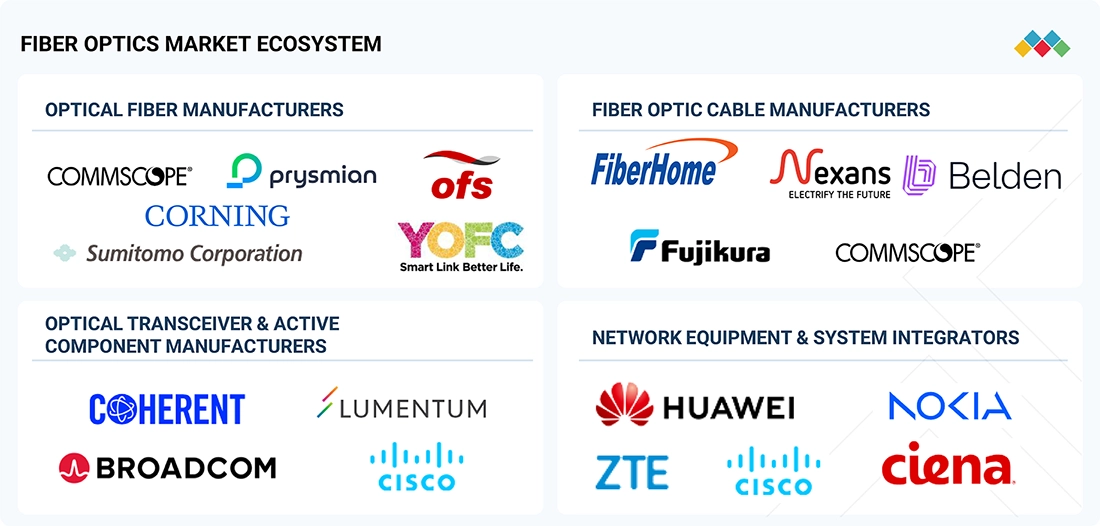
FIBER OPTICS MARKET SIZE SHARE & TRENDS, 2025: COMMERCIAL USE CASES ACROSS INDUSTRIES
| COMPANY | USE CASE DESCRIPTION | BENEFITS |
|---|---|---|
 |
Provided an FTTP cabling infrastructure with factory-connectorized solutions to help Alma Telecom upgrade its broadband network while enabling fast installation and high reliability. | Enabled fiber-to-every-home deployment using existing ducts, lowered installation costs, improved customer satisfaction, and ensured scalable GPON-based growth with minimal disruption. |
 |
Supplied high-quality cable solutions and comprehensive local service support to build a national FTTH network and launch GPON services amidst major project management challenges. | Secured 90% of the project scope, strengthened deployment efficiency, became a key regional supplier, and delivered Ecuador’s largest overseas optical cable project. |
|
|
Supported the rollout of a community broadband network using the FlexNAP system, enabling easy fiber tapping and fast connection to homes and businesses. | Achieved broadband availability for ~80% of residents, improved take rates (40–70%), reduced labor costs, and enabled future-ready gigabit services for economic and community development. |
 |
Delivered an end-to-end FTTX infrastructure including POP, backbone, access network, and customer-premise fiber solutions to support large-scale rural and semi-urban rollouts. | Accelerated commercialization of FTTX networks, supported the goal of connecting 500,000 homes by 2025, and enabled efficient rollout across 40,000+ addresses with optimized CAPEX/OPEX. |
 |
Use Case Description | Benefits |
.svg) |
Provided an FTTP cabling infrastructure with factory-connectorized solutions to help Alma Telecom upgrade its broadband network while enabling fast installation and high reliability. | Enabled fiber-to-every-home deployment using existing ducts, lowered installation costs, improved customer satisfaction, and ensured scalable GPON-based growth with minimal disruption. |
.svg) |
Supplied high-quality cable solutions and comprehensive local service support to build a national FTTH network and launch GPON services amidst major project management challenges. | Secured 90% of the project scope, strengthened deployment efficiency, became a key regional supplier, and delivered Ecuador’s largest overseas optical cable project. |
.svg) |
Supported the rollout of a community broadband network using the FlexNAP system, enabling easy fiber tapping and fast connection to homes and businesses. | Achieved broadband availability for ~80% of residents, improved take rates (40–70%), reduced labor costs, and enabled future-ready gigabit services for economic and community development. |
.svg) |
Delivered an end-to-end FTTX infrastructure including POP, backbone, access network, and customer-premise fiber solutions to support large-scale rural and semi-urban rollouts. | Accelerated commercialization of FTTX networks, supported the goal of connecting 500,000 homes by 2025, and enabled efficient rollout across 40,000+ addresses with optimized CAPEX/OPEX. |
Logos and trademarks shown above are the property of their respective owners. Their use here is for informational and illustrative purposes only.
Related Ecosystem
Communication And Connectivity Technology
- Sensors
- Smart Card & Readers
- Cellular Network
- Femtocell
- Image Sensors
- Cisco Systems, Inc.
- HUAWEI TECHNOLOGIES CO LTD
- Lenovo
- CommScope Holding Company, Inc.
- Nokia corporation
Automotive Advance Technologies
- Battery Electric Vehicle (BEV)
- Light Commercial Vehicles (LCVs)
- Fuel Cell Electric Vehicle (FCEV)
- Hybrid Electric Vehicle (HEV)
- Internal Combustion Engine (ICE)
- BOSCH LIMITED
- Continental ag
- Visteon Corporation
- DENSO Corporation
- ZF FRIEDRICHSHAFEN AG
Data Centre And Networking
- Software-Defined Networking (SDN)
- Mid-Sized Data Centers
- Small Data Centers
- Remote Monitoring
- Smart Healthcare
- Cisco Systems, Inc.
- HUAWEI TECHNOLOGIES CO LTD
- Hewlett Packard Enterprise Company
- MITSUBISHI ELECTRIC INFORMATION SYSTEMS CORPORATION
- MITSUBISHI ELECTRIC INFORMATION NETWORK CORPORATION
Key Takeaways
- South Korea's fiber optics market is projected to grow from $121.7M (2024) to $290.0M (2029) at a 19.0% CAGR, outpacing global growth rates.
- South Korea's 5G infrastructure rollout and data center investments are primary catalysts accelerating fiber optics adoption across the country.
- South Korea's semiconductor and electronics sector drives demand for high-speed fiber optic connectivity in manufacturing and enterprise applications.
- South Korea is positioned as a key innovation hub for fiber optics technology in Asia Pacific, supporting both regional and global supply chains.
Fiber Optics Market Report Scope
| Report Metric | Details |
|---|---|
| Base Year | 2024 |
| Fastest Growing Segment | AERIAL (Deployment) |
| Forecast Period | 2024–2029 |
| Growth Rate | CAGR of 16.4% from 2024 to 2029 |
| Largest Segment | COMMUNICATION (Application) |
| Market Size Base Year (Billions) | ~USD 3.18 (2024) |
| Revenue Forecast (Billions) | ~USD 6.8 (2029) |
| Segments Covered | Fiber Type, Cable Type, Application, Deployment |
South Korea Fiber Optics Market Report Segmentation
4 segment dimensions are covered across the global market.
By Fiber Type
- Glass
- Plastic
By Cable Type
- Multi-Mode
- Single-Mode
By Application
- Communication
- Non-Communication
- – Other Communication Applications
- –Catv
- –Fiber Optic Lighting
- –Industrial
- –Military
- –Other Communication Applications
- –Premises
- –Sensors
- –Telecom
- –Utility
By Deployment
- Aerial
- Underground
- Underwater
Target Audience
- Telecommunications Operators : South Korean telecom providers need market data to optimize fiber network expansion strategies, assess competitive positioning, and plan infrastructure investments aligned with 19% growth projections.
- Fiber Optics Manufacturers : Equipment and component manufacturers require South Korea-specific demand forecasts, production capacity benchmarks, and customer segmentation data to capture market share in this high-growth economy.
- Technology Investors & PE Firms : Investment professionals targeting Asia Pacific need detailed South Korea market analysis to evaluate acquisition targets, joint ventures, and portfolio companies in the fiber optics sector.
- Government & Policy Makers : South Korean government agencies and regulatory bodies use market intelligence to inform broadband policy, infrastructure funding decisions, and technology development initiatives through 2029.
- System Integrators & Service Providers : IT and telecommunications service providers need South Korea market insights to develop service offerings, identify customer segments, and align delivery capabilities with regional growth opportunities.
Key Companies in the South Korea Fiber Optics Market
| Company | HQ | Ownership | Strongest segments |
|---|---|---|---|
| NKT CABLES | Denmark | Private Company | Glass fiber-based OPGW and optical phase conductors,Submarine voltage cables with integrated fiber,Railway catenary and communication cables, |
| TT ELECTRONICS | United Kingdom | Public Company | Glass-fiber–aligned products (harsh-environment interconnects, optoelectronic sensors),Plastic-fiber–aligned products (short-reach industrial and automotive links),Single-mode–oriented solutions, |
| SUPERLOOP | Australia | Public Company | Glass fiber – single-mode (communication, underground/underwater),Glass fiber – multi-mode (campus and data center connectivity),Access over NBN and fixed wireless (fiber-fed, communication), |
| CORNING INCORPORATED | United States | Public Company | Glass fiber and cable,Connectivity, hardware, and equipment,Underwater and specialty fiber solutions, |
| PRYSMIAN GROUP | Italy | Public Company | Glass fiber & optical cable,Plastic optical fiber,Single-mode cable, |
| SUMITOMO ELECTRIC INDUSTRIES, LTD. | Japan | Public Company | Glass fiber & cable – single-mode, communication,Glass fiber & cable – multi-mode, data center and enterprise,Plastic optical fiber and non-communication fiber, |
| YANGTZE OPTICAL FIBRE AND CABLE JOINT STOCK LIMITED COMPANY | China | Public Company | Glass fiber and preforms,Optical fiber cable (single-mode dominated),Multi-mode and specialty fibers, |
| FUJIKURA LTD. | Japan | Public Company | Glass fiber and cables – single-mode (communication, all deployments),Glass fiber and cables – multi-mode (communication and data center),Plastic optical fiber and cables, |
| HENGTONG GROUP CO., LTD. | China | Private Company | Glass fiber and cables (single-mode, multi-mode),Submarine optical fiber and marine power communication systems,Communication cables (non-fiber, copper and hybrid), |
| FURUKAWA ELECTRIC CO., LTD. | Japan | Public Company | Glass fiber & single-mode cable (communication),Multi-mode cable & components (communication),Underwater & submarine fiber solutions, |
| LS CABLE & SYSTEM LTD. | South Korea | Private Company | Glass fiber – single-mode cables (communication, mainly underground/submarine),Glass fiber – multi-mode cables (LAN, data center, in-building),Plastic optical fiber and specialty non-communication applications, |
| COHERENT CORPORATION | United States | Public Company | Glass fiber for communication (single-mode dominated),Glass fiber for non-communication (industrial, sensing, laser delivery),Plastic optical fiber and short-reach links, |
| OPTICAL CABLE CORPORATION | United States | Public Company | Glass fiber optic cables (single-mode and multi-mode),Fiber connectivity and assemblies (enclosures, jumpers, cassettes, connectors),Copper datacom cables and connectivity, |
| FINOLEX CABLES LTD. | India | Public Company | Glass fiber – single-mode – communication – underground,Glass fiber – multi-mode – communication – indoor/aerial,Glass fiber – communication – underwater/harsh deployment, |
| COMMSCOPE HOLDING COMPANY | United States | Public Company | Glass fiber – single-mode centric communication solutions,Glass fiber – multi-mode and campus/data center,Plastic fiber and non-communication applications, |
| STERLITE TECHNOLOGIES LTD | India | Public Company | Glass fiber (single-mode, mainly communication),Glass fiber (multi-mode and specialty),Plastic optical fiber and related non-communication uses, |
NKT CABLES
NKT CABLES is a Danish private company founded in 2001 that operates in the cables and electrical equipment sector.
TT ELECTRONICS
TT ELECTRONICS is a United Kingdom public company established in 1906, employing 3,516 people in the electronics and components industry.
SUPERLOOP
SUPERLOOP is an Australian public company founded in 2014 with 800 employees operating in the telecommunications and infrastructure sector.
CORNING INCORPORATED
CORNING INCORPORATED is a United States public company founded in 1851 with 67,200 employees, specializing in materials science and specialty glass products.
PRYSMIAN GROUP
PRYSMIAN GROUP is an Italian public company established in 1879 with 33,824 employees, a leading manufacturer of cables and cable systems.
SUMITOMO ELECTRIC INDUSTRIES, LTD.
SUMITOMO ELECTRIC INDUSTRIES, LTD. is a Japanese public company founded in 1897 with 302,972 employees, operating across diverse sectors including electrical and optical fiber products.
YANGTZE OPTICAL FIBRE AND CABLE JOINT STOCK LIMITED COMPANY
YANGTZE OPTICAL FIBRE AND CABLE JOINT STOCK LIMITED COMPANY is a Chinese public company founded in 1988 with 10,596 employees specializing in optical fiber and cable manufacturing.
FUJIKURA LTD.
FUJIKURA LTD. is a Japanese public company established in 1885 with 50,586 employees, a major manufacturer of electrical wires, cables, and optical fiber products.
HENGTONG GROUP CO., LTD.
HENGTONG GROUP CO., LTD. is a Chinese private company founded in 1991 with 80 employees.
FURUKAWA ELECTRIC CO., LTD.
FURUKAWA ELECTRIC CO., LTD. is a Japanese public company founded in 1884 with 49,112 employees, manufacturing electrical cables, optical fibers, and related products.
LS CABLE & SYSTEM LTD.
LS CABLE & SYSTEM LTD. is a South Korean private company established in 1962 with 2,002 employees in the cable and electrical systems industry.
COHERENT CORPORATION
COHERENT CORPORATION is a United States public company founded in 1971 with 30,216 employees specializing in photonics and laser-based technologies.
OPTICAL CABLE CORPORATION
OPTICAL CABLE CORPORATION is a United States public company founded in 1983 with 348 employees manufacturing optical fiber and specialty cables.
FINOLEX CABLES LTD.
FINOLEX CABLES LTD. is an Indian public company established in 1958 with 1,594 employees producing electrical cables and wires.
COMMSCOPE HOLDING COMPANY
COMMSCOPE HOLDING COMPANY is a United States public company founded in 1976 with 4,500 employees providing infrastructure solutions for communications networks.
STERLITE TECHNOLOGIES LTD
STERLITE TECHNOLOGIES LTD is an Indian public company founded in 1988 with 1,050 employees manufacturing optical fiber and related telecommunications products.
Reasons to Buy this Report
- Market-Specific Growth Intelligence : Gain detailed insights into South Korea's 19.0% CAGR trajectory, understanding the unique drivers and dynamics that differentiate this market from global and regional competitors.
- Strategic Investment Opportunities : Identify high-potential segments within South Korea's $290M projected 2029 market, enabling informed capital allocation and partnership decisions in this technology-forward economy.
- Competitive Landscape Analysis : Understand South Korea's position as an Asia Pacific technology leader, including local competitors, market consolidation trends, and barriers to entry specific to the Korean market.
- Infrastructure & Policy Insights : Access detailed analysis of South Korea's government initiatives, telecommunications regulations, and broadband expansion programs driving fiber optics demand through 2029.
- Supply Chain & Manufacturing Data : Leverage South Korea's critical role as a fiber optics component manufacturer and exporter, with insights into production capacity, export markets, and supply chain opportunities.
Frequently asked questions
What is the current size of South Korea's fiber optics market?
South Korea's fiber optics market was valued at $121.7 million in 2024 and is expected to grow to $290.0 million by 2029.
What is the projected growth rate for South Korea's fiber optics market?
South Korea's fiber optics market is projected to grow at a compound annual growth rate (CAGR) of 19.0% from 2024 to 2029.
What are the main drivers of growth in South Korea's fiber optics market?
Key growth drivers in South Korea include 5G infrastructure deployment, data center expansion, digital transformation initiatives, and increasing demand from the semiconductor and electronics sector.
How does South Korea's fiber optics market compare to global trends?
South Korea's 19.0% CAGR significantly exceeds the global fiber optics market CAGR of 16.4%, reflecting the country's advanced technological infrastructure and strategic investments.
What applications are driving fiber optics demand in South Korea?
Primary applications include telecommunications networks, enterprise connectivity, 5G infrastructure, data centers, AI infrastructure, and high-speed manufacturing systems in South Korea's electronics sector.
RESEARCH METHODOLOGY
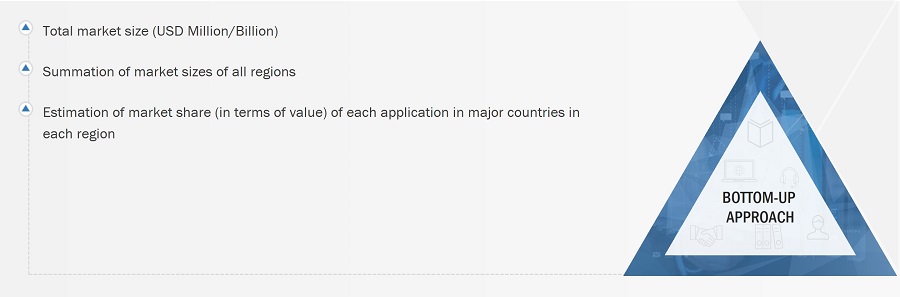
The study involved four major activities in estimating the size for fiber optics market. Exhaustive secondary research was done to collect information on the market, peer market, and parent market. The next step was to validate these findings, assumptions, and sizing with industry experts across value chains through primary research. The bottom-up approach was employed to estimate the overall market size. After that, market breakdown and data triangulation were used to estimate the market size of segments and subsegments.
Secondary Research
In the secondary research process, sources such as annual reports, press releases, investor presentations of companies, white papers, and articles by recognized authors were referred to. Secondary research was done to obtain key information about the market’s supply chain, the value chain of the market, the pool of key market players, market segmentation according to industry trends, region, and developments from both market and technology perspectives. The secondary data has been collected and analyzed to arrive at the overall market size, which has been further validated through primary research.
Primary Research
Extensive primary research has been conducted after understanding and analyzing the fiber optics market scenario through secondary research. Several primary interviews have been conducted with key opinion leaders from both demand- and supply-side vendors across four major regions—North America, Europe, Asia Pacific, and RoW. Approximately 25% of primary interviews have been conducted with the demand side and 75% with the supply side. These primary data have been collected through telephonic interviews, questionnaires, and emails.
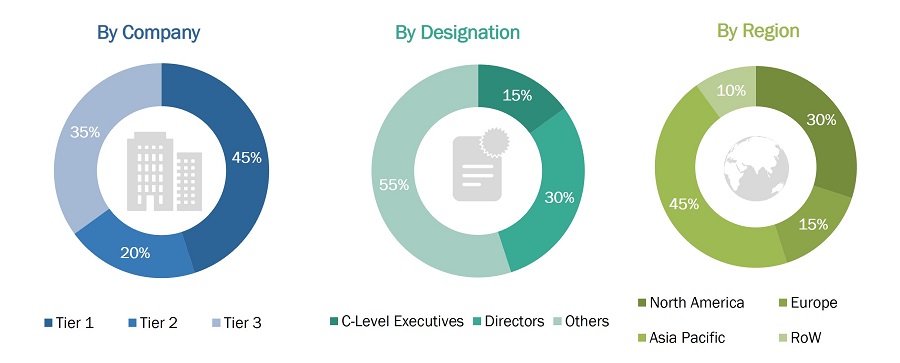
To know about the assumptions considered for the study, download the pdf brochure
Market Size Estimation
In this report, we have implemented both the top-down and bottom-up approaches to estimate and validate the size of the fiber optics market and various other dependent submarkets. The key players in the fiber optics market have been identified through secondary research, and their market shares in the respective regions have been determined through primary and secondary research. This entire research methodology includes the study of annual and financial reports of top players and interviews with experts (such as CEOs, COOs, VPs, directors, and marketing executives) for key insights (both quantitative and qualitative).
All percentage shares, splits, and breakdowns have been determined using secondary sources and verified through primary sources. All the parameters that affect the markets covered in this research study have been accounted for, viewed in detail, verified through primary research, and analyzed to obtain the final quantitative and qualitative data. This data has been consolidated and supplemented with detailed inputs and analysis from MarketsandMarkets and presented in this report. The figures given below show the market size estimation process from supply side employed for this study.
Fiber Optics Market: Bottom-Up Approach
Data Triangulation
After arriving at the overall market size through the process explained above, the overall market has been split into several segments. To complete the overall market engineering process and arrive at the exact statistics for all the segments, market breakdown and data triangulation procedures have been employed, wherever applicable. The data has been triangulated by studying various factors and trends from both the demand and supply sides. The market has also been validated using both top-down and bottom-up approaches.
Market Definition
A fiber optic is a flexible, transparent fiber made of extruded glass (silica) or plastic, which can function as a “light pipe” to transmit light by the process of total internal reflection. Fiber optics includes a transparent core surrounded by a transparent cladding material with a lower index of refraction, through which the light travels by total internal reflection. This phenomenon causes the fiber to act as a waveguide.
Key Stakeholders
- Raw material suppliers
- Fiber optics manufacturers
- Suppliers and distributors
- Manufacturers of cables and other fiber optic components
- Technology standards organizations, forums, alliances, and associations
- Government agencies, financial institutions, and investment communities
- Research organizations
- Analysts and strategic business planners
- Venture capitalists, private equity firms, and startups
- End users from the telecom, datacenter, utility, premises, military, industrial, and other end-users
Report Objectives
- To define, describe, segment, and forecast the size of the fiber optics market, by fiber type, cable type, deployment, application, and region, in terms of value
- To define, describe, segment, and forecast the size of the fiber optics market, by fiber type, cable type, and region, in terms of volume
- To forecast the market size for various segments with respect to four main regions, namely, North America, Europe, Asia Pacific, and Rest of the World (RoW)
- To provide detailed information regarding the drivers, restraints, opportunities, and challenges influencing the growth of the fiber optics market
- To provide an ecosystem analysis, case study analysis, patent analysis, technology analysis, pricing analysis, Porter’s Five Forces analysis, and regulations pertaining to the market
- To provide a detailed overview of the value chain of the fiber optics ecosystem
- To strategically analyze micromarkets1 with regard to individual growth trends, prospects, and contributions to the total market
- To analyze opportunities for stakeholders by identifying the high-growth segments of the market
- To strategically profile key players, comprehensively analyze their market position in terms of ranking and core competencies2, and provide information about the competitive landscape of the market
- To analyze strategic approaches such as product launches, acquisitions, agreements, and partnerships in the fiber optics market
Available Customizations
With the given market data, MarketsandMarkets offers customizations according to the company’s specific needs. The following customization options are available for the report:
Company Information
- Detailed analysis and profiling of additional market players (up to 7)
Get the Full Fiber Optics Market Report
Full forecast, segment splits, and company analysis for all Fiber Optics Market.
- Canada Fiber Optics Market
- Mexico Fiber Optics Market
- US Fiber Optics Market
- France Fiber Optics Market
- Germany Fiber Optics Market
- Italy Fiber Optics Market
- Spain Fiber Optics Market
- UK Fiber Optics Market
- Rest Of Europe Fiber Optics Market
- China Fiber Optics Market
- India Fiber Optics Market
- Japan Fiber Optics Market
- Rest Of Asia Pacific Fiber Optics Market
- GCC Fiber Optics Market
Need a Tailored Report?
Customize this report to your needs
Get 10% FREE Customization
Customize This Report
