
Italy Fire Resistant Glass Market (2024-2029)

The Italy Fire Resistant Glass Market was valued at $235.1 Million in 2024 and projected to reach to $353.5 Million by 2029, representing a compound annual growth rate of 8.5%. Italy's fire resistant glass market is positioned for sustained expansion through 2029, driven by increasingly stringent EU fire safety regulations and Italy's commitment to modernizing building infrastructure.


| Market Size in | USD 26.32 MN |
| Market Forecast in | |
| CAGR | |
| Forecast Period | |
| Units Considered | Value (USD MN) |
Italy Fire Resistant Glass Market Trends and Insights
- This growth trajectory reflects Italy's increasing regulatory focus on building safety standards and fire protection requirements across residential, commercial, and industrial sectors.
- Italy's construction industry and stringent EU fire safety directives are driving demand for advanced fire-resistant glazing solutions. The Italian market benefits from the country's robust architectural heritage and modernization initiatives that prioritize safety compliance.
- Italy's adoption of fire-resistant glass in high-rise buildings, public facilities, and renovation projects continues to accelerate.
- Between 2024 and 2029, Italy is expected to see heightened investment in fire safety infrastructure, supported by both public sector mandates and private sector awareness of liability and insurance benefits associated with fire-resistant materials..
Key Market Statistics
- CAGR (2024-2029) 8.5% CAGR
- Market Size, 2024 ~USD 235.1 Million
- Forecast, 2029 ~USD 353.5 Million
- Country Italy
Italy Fire Resistant Glass Market Overview
Market Valuation :
Italy's fire resistant glass market is valued at USD 235.1 million in 2024, with strong growth momentum driven by construction sector expansion and regulatory compliance demands.
Robust CAGR Growth :
The Italian market is projected to grow at 8.5% CAGR through 2029, reaching USD 353.5 million, outpacing broader economic trends and reflecting increased safety investments.
EU Regulatory Compliance :
Italy's stringent EU fire safety standards and building codes are accelerating adoption of fire resistant glass across residential, commercial, and industrial construction projects.
Construction Sector Momentum :
Rising investments in Italy's construction industry, particularly in urban renovation and new commercial developments, are creating sustained demand for advanced fire protection materials.
Italy Fire Resistant Glass Market Dynamics
- The construction sector's recovery and growth in commercial real estate development are creating significant opportunities for fire resistant glass adoption across multiple applications.
- Additionally, heightened awareness of fire safety in both public and private sectors is encouraging specification of premium fire protection solutions in new projects and retrofitting initiatives. The Italian market benefits from a mature construction industry with established safety standards and a growing emphasis on sustainable building practices.
- As building codes continue to evolve and insurance requirements become more stringent, demand for certified fire resistant glass solutions will intensify.
- Market players focusing on compliance certifications, innovative product offerings, and localized distribution networks are well-positioned to capture growth opportunities in this expanding market..
Market Ecosystem
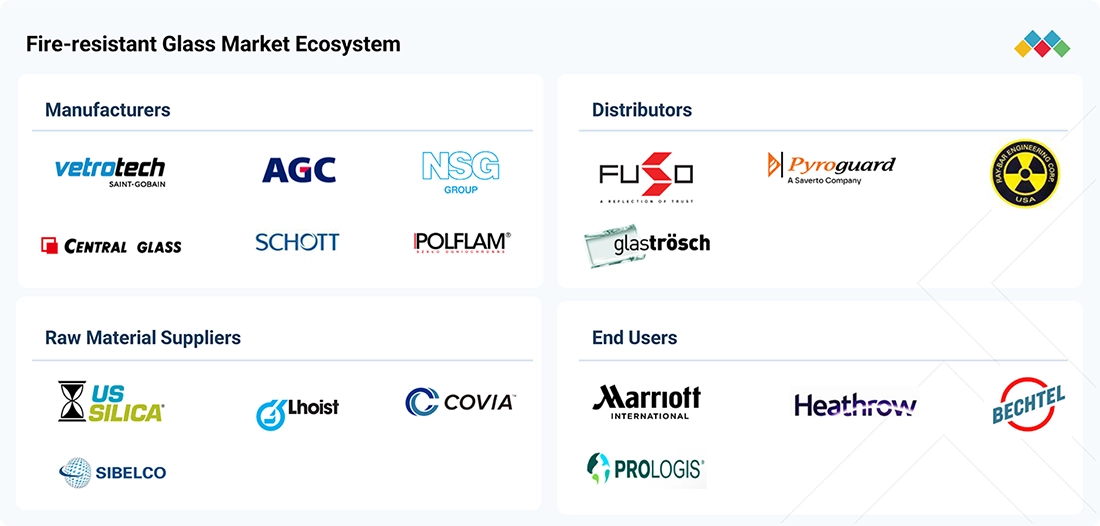
FIRE RESISTANT GLASS MARKET: COMMERCIAL USE CASES ACROSS INDUSTRIES
| COMPANY | USE CASE DESCRIPTION | BENEFITS |
|---|---|---|
 |
Fire-resistant glass in hotel fire-rated doors, partitions, corridors, stairwells, and façade glazing | Fire protection, code compliance, occupant safety, design flexibility |
 |
Fire-resistant glass in commercial, industrial, and infrastructure projects, including fire-rated doors, windows, and internal partitions | Enhanced fire safety, regulatory compliance, thermal protection |
 |
Fire-resistant glass in airport terminals, passenger areas, fire-rated partitions, doors, and façade systems | Improved passenger safety, fire containment, visibility, and code compliance |
 |
Fire-resistant glass in logistics warehouses, distribution centers, offices, and industrial facilities | Fire protection, compartmentation, durability, and improved building safety |
Logos and trademarks shown above are the property of their respective owners. Their use here is for informational and illustrative purposes only.
Related Ecosystem
Ceramics And Glass
- Zirconia
- Alumina Ceramics
- Silicon Carbide
- Silicon Nitride
- Titanate Ceramics
- Saint-gobain
- 3M COMPANY
- Kyocera Corporation
- CERAMTEC GMBH
- COORSTEK INCORPORATED
Building And Construction
- HVAC System
- Acoustic Insulation
- Alkyd Resins
- Fiberglass
- Thermal Insulation
- Snc-lavalin group inc.
- Saint-gobain
- LHOIST S.A
- USG CORPORATION
- Basf se
Infrastructure Material
- Alumina Ceramics
- Ceramic Coatings
- Monolithic Ceramics
- Polyphenylene Sulfide (PPS)
- Titanate Ceramics
- Saint-gobain
- Simpson Manufacturing Co., Inc.
- Basf se
- Sika ag
- DOW CHEMICAL COMPANY
Key Takeaways
- Italy's fire resistant glass market is valued at USD 235.1 million in 2024 and will grow to USD 353.5 million by 2029, representing an 8.5% CAGR.
- Italy's stringent EU fire safety regulations and building codes are primary drivers of market expansion across commercial and residential segments.
- Italy's modernization of aging infrastructure and high-rise construction projects are creating sustained demand for fire-resistant glazing solutions.
- Italy's market growth is supported by increasing insurance requirements and liability awareness among property developers and facility managers.
Fire Resistant Glass Market Report Scope
| Report Metric | Details |
|---|---|
| Base Year | 2024 |
| Fastest Growing Segment | CERAMIC (Type) |
| Forecast Period | 2024–2029 |
| Growth Rate | CAGR of 9% from 2024 to 2029 |
| Largest Segment | BUILDING & CONSTRUCTION (Application) |
| Market Size Base Year (Billions) | ~USD 10.46 (2024) |
| Revenue Forecast (Billions) | ~USD 16.1 (2029) |
| Segments Covered | Type, Sub-Type, Interlayer, Application, Subsegment |
Italy Fire Resistant Glass Market Report Segmentation
5 segment dimensions are covered across the global market.
By Type
- Ceramic
- Laminated
- Tempered
- Wired
By Sub-Type
- Cuttable
- Non-Cuttable
By Interlayer
- Eva
- Gel
- Pvb
By Application
- Building & Construction
- Building And Construction
- Marine
- Other Applications
By Subsegment
- Commercial
- Residential
ITALY: FIRE-RESISTANT GLASS MARKET, BY APPLICATION, 2024–2029
| Segment | 2024 | 2025 | 2026 | 2027 | 2028 | 2029 | CAGR (%) |
|---|---|---|---|---|---|---|---|
| BUILDING & CONSTRUCTION | 194 | 211.2 | 229.9 | 250.3 | 272.5 | 296.7 | 8.9 |
| MARINE | 9.2 | 9.9 | 10.7 | 11.5 | 12.4 | 13.4 | 7.9 |
| OTHER APPLICATIONS | 31.9 | 33.9 | 36.1 | 38.4 | 40.8 | 43.4 | 6.3 |
| TOTAL | 235.1 | 255 | 276.7 | 300.2 | 325.8 | 353.5 | 8.5 |
Target Audience
- Construction & Building Companies : Italian construction firms need market insights to understand fire safety glass demand trends, specification requirements, and growth opportunities in residential and commercial projects.
- Glass Manufacturers & Suppliers : Producers and distributors require Italy-specific market data to assess demand, identify growth segments, and develop localized product strategies for the Italian market.
- Architects & Design Professionals : Italian architects and building designers need market intelligence on fire resistant glass solutions, compliance standards, and material innovations to inform project specifications.
- Real Estate Developers : Property developers in Italy require market forecasts and regulatory insights to budget for fire safety materials and understand cost implications of compliance requirements.
- Investment & Strategy Consultants : Business consultants and investors need Italy-focused market analysis to evaluate opportunities, assess competitive landscapes, and support strategic recommendations for clients in the sector.
Key Companies in the Italy Fire Resistant Glass Market
| Company | HQ | Ownership | Strongest segments |
|---|---|---|---|
| CORNING, INC. | United States | Public Company | Optical Communications (fiber, cable, connectivity hardware),Display Technologies (LCD and OLED glass substrates),Specialty Materials (mobile, semiconductor, optics, radiation shielding, sunglasses), |
| SCHOTT AG | Germany | Public Company | Glass syringes (syriQ portfolio),Polymer syringes and containers (SCHOTT TOPPAC),Glass vials (adaptiQ, EVERIC family), |
| AGC INC. | United States | Public Company | High-horsepower and utility tractors,Compact tractors and implements,Combines and harvesting equipment, |
| NIPPON SHEET GLASS CO., LTD. | Japan | Public Company | Architectural (commercial and residential flat glass, solar),Automotive (OEM and replacement glazing),Technical Glass and MICROGLAS functional products, |
| ETEX GROUP | Belgium | Public Company | Building Performance (gypsum boards, ceilings, metal profiles, passive fire protection),Exteriors (fibre cement façades, roofing, water tanks, agricultural sheeting),Insulation (glass mineral wool, XPS, high-performance panels), |
| CENTRAL GLASS CO., LTD. | Japan | Public Company | Glassware and automotive glass,Electronic materials and semiconductor-related products,Fluorine products and specialty chemicals, |
CORNING, INC.
Corning, Inc. is a publicly traded American glass and materials science company founded in 1851. With 67,200 employees, Corning is a global leader in specialty glass, ceramics, and related materials for various industries including telecommunications, display technologies, and environmental applications.
SCHOTT AG
Schott AG is a German public company founded in 1884 that specializes in glass and glass-ceramic products. With 4,839 employees, the company serves diverse industries including pharmaceuticals, electronics, and laboratory equipment.
AGC INC.
AGC Inc. is a publicly traded American glass manufacturer founded in 1990. The company employs 22,000 people and produces a wide range of glass products for automotive, construction, and industrial applications.
NIPPON SHEET GLASS CO., LTD.
Nippon Sheet Glass Co., Ltd. is a Japanese public company established in 1918 with 25,406 employees. The company is a major global manufacturer of flat glass, specialty glass, and glass-related products for construction and automotive markets.
ETEX GROUP
Etex Group is a Belgian public company founded in 1905 that manufactures building materials and glass products. With 12,475 employees, the company serves construction and industrial markets across multiple regions.
CENTRAL GLASS CO., LTD.
Central Glass Co., Ltd. is a Japanese public company founded in 1936 with 3,194 employees. The company manufactures flat glass, automotive glass, and specialty glass products for global markets.
Reasons to Buy this Report
- Market Size & Growth Data : Access precise valuation metrics for Italy's fire resistant glass market with detailed CAGR analysis, enabling accurate financial forecasting and investment decision-making for the Italian region.
- Regulatory Landscape Insights : Understand Italy-specific EU fire safety compliance requirements and building codes driving market demand, helping businesses align product offerings with local regulatory standards.
- Sector-Specific Opportunities : Identify growth drivers across Italy's residential, commercial, and industrial segments with tailored insights into construction trends and safety investment priorities in each sector.
- Competitive Positioning : Benchmark your business against Italy's market dynamics and growth trajectory to develop targeted strategies for market entry, expansion, or product development in this high-growth region.
- Investment & Expansion Planning : Leverage Italy-focused market intelligence to support capital allocation decisions, partnership development, and go-to-market strategies for the Italian fire resistant glass sector.
Frequently asked questions
What is the current size of Italy's fire resistant glass market?
Italy's fire resistant glass market was valued at USD 235.1 million in 2024 and is projected to reach USD 353.5 million by 2029.
What is the expected growth rate for Italy's fire resistant glass market?
Italy's fire resistant glass market is expected to grow at a compound annual growth rate (CAGR) of 8.5% from 2024 to 2029.
What are the main drivers of growth in Italy's fire resistant glass market?
Italy's market growth is driven by stringent EU fire safety regulations, increased building modernization, high-rise construction projects, and heightened awareness of fire protection liability among property owners and developers.
Which sectors are driving demand for fire resistant glass in Italy?
Italy's demand for fire-resistant glass is driven by commercial buildings, residential high-rises, public facilities, hospitality venues, and industrial applications requiring enhanced fire safety compliance.
How do Italy's fire safety regulations impact the market?
Italy's adherence to EU fire safety directives and national building codes mandates the use of fire-resistant materials in specific applications, directly increasing market demand and creating compliance-driven purchasing requirements.
RESEARCH METHODOLOGY
This study consisted of two main tasks to determine the current size of the fire-resistant glass market. The first task entailed conducting exhaustive secondary research aimed at obtaining information about the market for fire-resistant glass, other markets, and the parent markets. The results, assumptions, and market sizing were further verified through primary research with industry players. Market size was estimated using both top-down and bottom-up approaches. Further market segmentation and data triangulation techniques were used to obtain the market size of segments and subsegments.
Secondary Research
Sources used for secondary research for this study include annual reports, financial documents, product portfolios, technical sheets, certificates, company websites, industry magazines, and glass, construction, and fire safety industry associations. Secondary research was conducted to gain insights into the value chain of fire-resistant glass, major market players, market segmentation, and classification by glass type, application, and geography. The data gathered through this process was further analyzed to estimate the size of the global fire-resistant glass market and its segments and sub-segments.
Primary Research
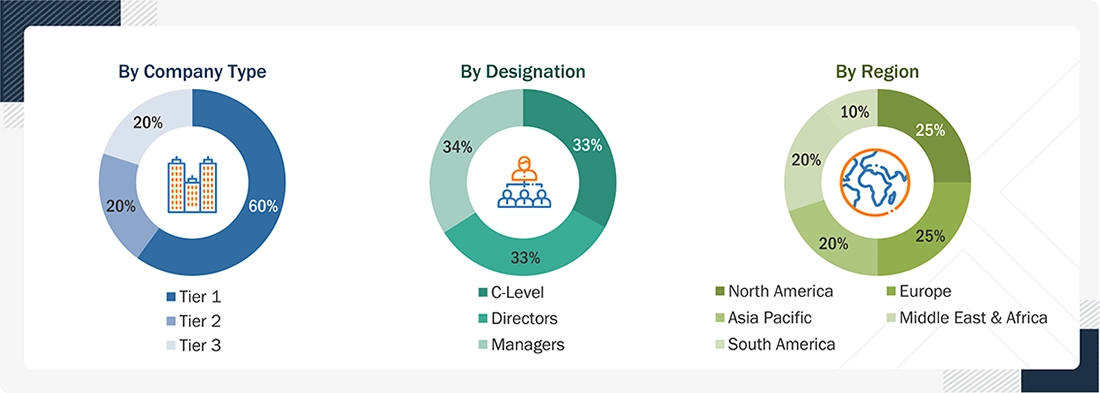
Extensive primary research was conducted after obtaining information regarding the market scenario of the fire-resistant market through secondary research. We conducted several primary interviews with market experts on both the demand and supply sides across major countries. We collected primary data through questionnaires, emails, and telephonic interviews. The primary sources from the supply side included various industry experts, such as chief experience officers (CXOs), vice presidents (VPs), business development/marketing directors, product development/innovation teams, related key executives from the fire-resistant glass industry, system integrators, component providers, distributors, and key opinion leaders. Primary interviews were conducted to gather insights such as market statistics, revenue data from products and services, market breakdowns, market size estimates, market forecasts, and data triangulation. Primary research helped in understanding the various trends related to type, application, and region. Stakeholders from the demand side, such as CIOs, CTOs, CSOs, and installation teams of the customers/end users who are seeking fire-resistant glass services, were interviewed to understand the buyer’s perspective on the suppliers, products, component providers, and their current usage of fire-resistant glass and future outlook of their business, which will affect the overall market.
To know about the assumptions considered for the study, download the pdf brochure
Market Size Estimation
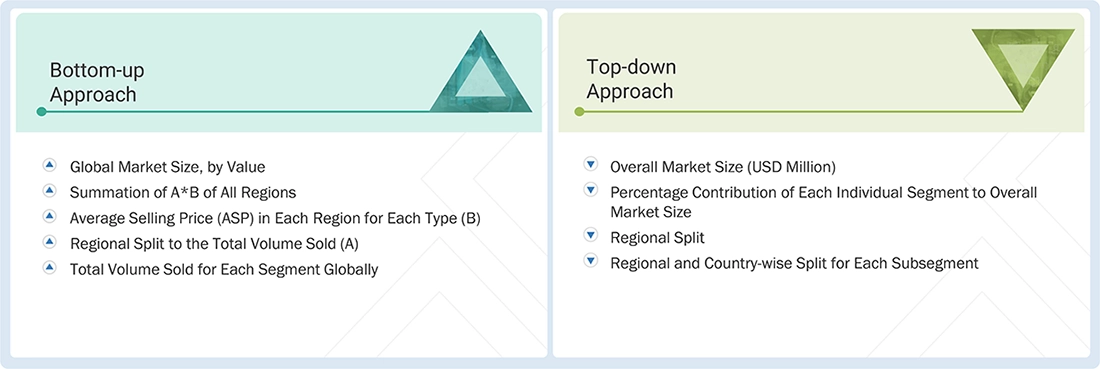
The research methodology used to estimate the size of the fire-resistant glass market includes the following details. The market size was estimated from the demand side. The market was expanded based on global demand for fire-resistant glass across different applications. These procurements provide demand-side information for each application in the fire-resistant glass industry. For each application, all possible segments of the fire-resistant glass market were integrated and mapped.
Data Triangulation
After determining the overall size through the market size estimation process explained above, the total market was split into several segments and subsegments. The data triangulation and market breakdown procedures explained below were implemented, wherever applicable, to complete the overall market engineering process and arrive at the exact statistics for various market segments and subsegments. The data were triangulated by studying factors and trends from both the demand and supply sides. In addition, the market size was validated using both the top-down and bottom-up approaches.
Market Definition
Fire-resistant glass controls the spread of fire, smoke, hot gases, and heat transfer. Fire resistivity is determined by prevention levels classified as integrity (E), insulation (I), and radiant heat control (EW). This glass is used in buildings, marine vessels, and oil refineries and comes with various fire ratings, ranging between 20 and 180 minutes. The use of fire-resistant glass depends on the area and size limitations under the applicable building code and/or the authority having jurisdiction. Fire-resistant glass is manufactured by sheet glass processing. Raw materials include silica sand, soda ash, limestone, dolomite, alumina, fire-retardant intumescent interlayers, ceramics, and wires.
Key Stakeholders
- Fire-resistant glass Manufacturers
- Fire-resistant glass Distributors and Suppliers
- Glass Processors, Fabricators, and Glazing Contractors
- Building Developers, Architects, and Construction Companies
- Building Code Organizations and Standards Development Bodies
- Fire Safety Testing and Certification Organizations
- R&D Institutes and Research Organizations
- Raw Material and Interlayer Suppliers
- Government and Regulatory Authorities
- Investment Banks and Private Equity Firms
Report Objectives
- To define, describe, and forecast the fire-resistant glass market size in terms of volume and value.
- To provide detailed information regarding the key factors, such as drivers, restraints, opportunities, and challenges influencing market growth.
- To analyze and project the market by type, application, and region.
- To forecast the global fire-resistant glass market size, along with regional and country-level data, and analyze key country-specific trends.
- To strategically analyze micromarkets, including individual growth trends, prospects, and submarket contributions to the overall market.
- To analyze the market opportunities and the competitive landscape for stakeholders and market leaders.
- To assess recent market developments and competitive strategies, such as agreements, contracts, acquisitions, and product developments/product launches, to map the competitive landscape.
- To strategically profile the key market players and comprehensively analyze their core competencies.
Available customizations:
MarketsandMarkets offers the following customizations for this market report:
- Additional country-level analysis of the fire-resistant glass market
Product Analysis
- Product matrix, which provides a detailed comparison of the product portfolio of each company in the market
Get the Full Fire Resistant Glass Market Report
Full forecast, segment splits, and company analysis for all Fire Resistant Glass Market.
- US Fire Resistant Glass Market
- Canada Fire Resistant Glass Market
- Mexico Fire Resistant Glass Market
- Germany Fire Resistant Glass Market
- France Fire Resistant Glass Market
- UK Fire Resistant Glass Market
- Spain Fire Resistant Glass Market
- Russia Fire Resistant Glass Market
- China Fire Resistant Glass Market
- Japan Fire Resistant Glass Market
- India Fire Resistant Glass Market
- South Korea Fire Resistant Glass Market
- UAE Fire Resistant Glass Market
- Saudi Arabia Fire Resistant Glass Market
- South Africa Fire Resistant Glass Market
- Brazil Fire Resistant Glass Market
- Argentina Fire Resistant Glass Market
- South America Fire Resistant Glass Market
Need a Tailored Report?
Customize this report to your needs
Get 10% FREE Customization
Customize This Report
