
Australia Flexible Endoscopes Market (2025-2030)

The Australia Flexible Endoscopes Market was valued at $9 Million in 2025 and projected to reach to $11.5 Million by 2030, representing a compound annual growth rate of 5.0%. Australia's flexible endoscopes market is positioned for steady growth driven by increasing prevalence of gastrointestinal and respiratory conditions, coupled with rising healthcare expenditure and patient preference for minimally invasive diagnostic procedures.


| Market Size in | USD 26.32 MN |
| Market Forecast in | |
| CAGR | |
| Forecast Period | |
| Units Considered | Value (USD MN) |
Australia Flexible Endoscopes Market Trends and Insights
- Australia's healthcare infrastructure and rising demand for minimally invasive diagnostic and therapeutic procedures are driving adoption of flexible endoscopy technologies across gastroenterology, pulmonology, and urology specialties.
- The market in Australia benefits from an aging population, increased prevalence of gastrointestinal disorders, and growing investment in advanced medical devices. In 2025, Australia's flexible endoscopes market reflects steady demand from both public and private healthcare sectors, supported by reimbursement policies and clinical guidelines favoring endoscopic procedures.
- By 2030, Australia is expected to see accelerated growth driven by technological innovations, including high-definition imaging and AI-assisted diagnostic tools.
- Market expansion in Australia will be supported by increasing healthcare expenditure, rising patient awareness, and the adoption of next-generation endoscopic platforms in major hospitals and diagnostic centers..
Key Market Statistics
- CAGR (2025-2030) 5.0% CAGR
- Market Size, 2025 ~USD 9 Million
- Forecast, 2030 ~USD 11.5 Million
- Country Australia
Australia Flexible Endoscopes Market Overview
Market Size & Growth :
Australia's flexible endoscopes market is valued at USD 9.0 million in 2025, with projected growth to USD 11.5 million by 2030, representing a steady 5.0% CAGR aligned with global expansion trends.
Healthcare Infrastructure Strength :
Australia's advanced healthcare system and high adoption rates of minimally invasive procedures support robust demand for flexible endoscopy technologies across major medical centers and private practices.
Clinical Application Expansion :
Growing utilization in gastroenterology, pulmonology, and bronchoscopy procedures drives market growth as Australian healthcare providers prioritize patient outcomes and reduced recovery times through endoscopic interventions.
Regulatory & Reimbursement Environment :
Australia's TGA approval pathways and Medicare reimbursement coverage for endoscopic procedures create favorable conditions for market penetration and sustained adoption of advanced flexible endoscope technologies.
Australia Flexible Endoscopes Market Dynamics
- The country's mature healthcare infrastructure and strong adoption of advanced medical technologies support market expansion through 2030. Key growth catalysts include aging population demographics, expanding endoscopy centers, and technological innovations in visualization and therapeutic capabilities.
- Investment in healthcare facilities and training programs for endoscopy specialists will further accelerate market penetration, with private healthcare providers and public hospital systems both contributing to sustained demand for flexible endoscopy equipment and accessories..
Market Ecosystem
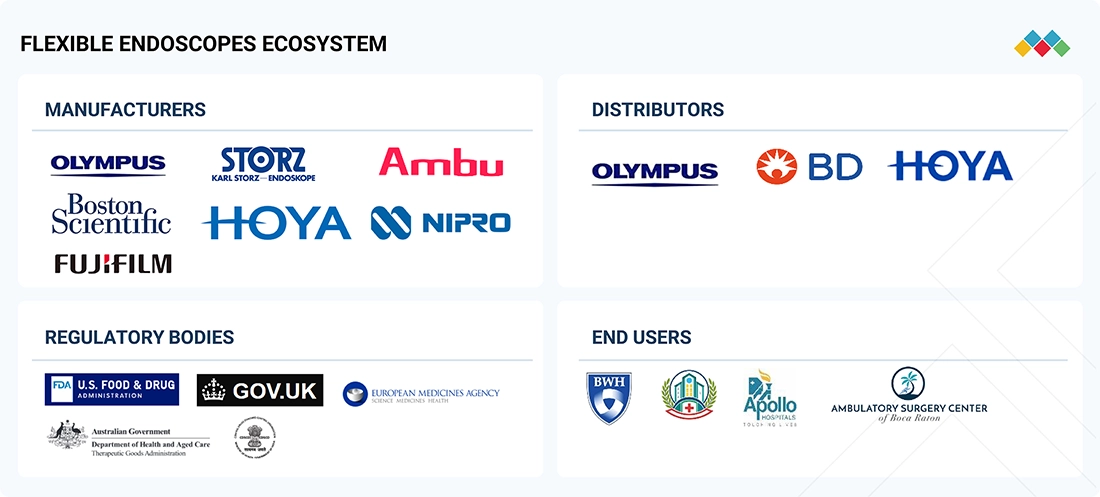
Flexible Endoscopes Market: COMMERCIAL USE CASES ACROSS INDUSTRIES
| COMPANY | USE CASE DESCRIPTION | BENEFITS |
|---|---|---|
 |
Offers a wide range of flexible endoscopes for gastrointestinal, urology, pulmonology, ENT, and gynecology applications | Integrated with advanced imaging, narrow-band imaging (NBI), and ergonomic designs to support minimally invasive procedures | Provides superior visualization and diagnostic accuracy, reduces patient discomfort during procedures, supports early disease detection, and enhances clinical workflow efficiency across diverse therapeutic areas |
 |
Supplies high-performance flexible endoscopes for ENT, gastroenterology, and bronchoscopy, with modular systems and reusable components | Offers advanced video endoscopes with compatibility across multiple platforms. | Delivers consistent image quality, lowers operating costs through reusable solutions, ensures adaptability across specialties, and supports long-term hospital and outpatient use |
 |
Focuses on flexible endoscopes for gastroenterology, pulmonology, and ENT, with advanced HD imaging, i-scan digital image enhancement, and therapeutic endoscopes for interventional procedures. | Improves diagnostic confidence with enhanced imaging, enables advanced therapeutic interventions, supports patient safety through infection prevention designs, and enhances physician comfort with ergonomic features |
 |
Develops flexible endoscopes with advanced CMOS imaging, multi-light spectrum technology (Linked Color Imaging, Blue Light Imaging), and wide-field visualization for GI and respiratory care | Enhances mucosal visualization, facilitates early cancer detection, improves procedural outcomes, reduces complications, and offers innovative lightweight designs that improve ease of handling |
 |
Provides flexible endoscopes and endoscopic solutions for gastroenterology and pulmonology, particularly for therapeutic procedures such as ERCP, EUS, and interventional bronchoscopy | Enables minimally invasive therapeutic procedures, reduces procedure time, expands clinical treatment options, and enhances patient outcomes through reliable device integration and innovation |
Logos and trademarks shown above are the property of their respective owners. Their use here is for informational and illustrative purposes only.
Related Ecosystem
Diagnostic Imaging
- Magnetic Resonance Imaging (MRI)
- Computed Tomography (CT)
- CT Scanners
- Nuclear Imaging
- Positron Emission Tomography
- Siemens healthineers
- PHILIPS HEALTHCARE
- CANON INC.
- FUJIFILM Holdings Corporation
- UNITED IMAGING HEALTHCARE CO., LTD.
Medical Devices
- Polymerase Chain Reaction (PCR)
- Magnetic Resonance Imaging (MRI)
- Disposable Autoinjectors
- Pulse Oximeters
- Blood Pressure Monitors
- Medtronic plc
- Abbott Laboratories
- Stryker Corporation
- Becton, Dickinson and Company
- JOHNSON & JOHNSON
Key Takeaways
- Australia's flexible endoscopes market is valued at USD 9.0 million in 2025 and will reach USD 11.5 million by 2030 at a 5.0% CAGR.
- Australia's aging population and rising gastrointestinal disease prevalence are key drivers of endoscopic procedure demand.
- Technological advancements in high-definition imaging and AI-assisted diagnostics are accelerating market growth in Australia.
- Australia's robust healthcare reimbursement framework and private sector investment support sustained market expansion through 2030.
Flexible Endoscopes Market Report Scope
| Report Metric | Details |
|---|---|
| Base Year | 2025 |
| Fastest Growing Segment | ENT ENDOSCOPY (Application) |
| Forecast Period | 2025–2030 |
| Growth Rate | CAGR of 5.1% from 2025 to 2030 |
| Largest Segment | HOSPITALS (End User) |
| Market Size Base Year (Billions) | ~USD 2.39 (2025) |
| Revenue Forecast (Billions) | ~USD 3.07 (2030) |
| Segments Covered | Type, Application, End User |
Australia Flexible Endoscopes Market Report Segmentation
3 segment dimensions are covered across the global market.
By Type
- Bronchoscopes
- Colonoscopes
- Duodenoscopes
- Fiber Bronchoscopes
- Fiber Colonoscopes
- Fiber Duodenoscopes
- Fiber Laryngoscopes
- Fiber Nasopharyngoscopes
- Fiber Pharyngoscopes
- Fiber Rhinoscopes
- Fiber Sigmoidoscope
- Fiber Sigmoidoscopes
- Laryngoscopes
- Nasopharyngoscopes
- Other Fiber Endoscopes
- Other Flexible Endoscopes
- Other Video Endoscopes
- Pharyngoscopes
- Rhinoscopes
- Sigmoidoscopes
- Upper Gi Endoscopes
- Upper Gi Fiberscopes
- Upper Gi Videoscopes
- Video Bronchoscopes
- Video Colonoscopes
- Video Duodenoscopes
- Video Laryngoscopes
- Video Nasopharyngoscopes
- Video Pharyngoscopes
- Video Rhinoscopes
- Video Sigmoidoscope
- Video Sigmoidoscopes
By Application
- Bronchoscopy
- Ent Endoscopy
- Gastrointestinal Endoscopy
- Obstetrics/ Gynecological Endoscopy
- Obstetrics/Gynecological Endoscopy
- Other Applications
- Urology Endoscopy
By End User
- Ascs
- Clinics
- Hospitals
- Other End Users
AUSTRALIA: FLEXIBLE ENDOSCOPES MARKET, BY END USER, 2023–2030
| Segment | 2023 | 2024 | 2025 | 2026 | 2027 | 2028 | 2029 | 2030 | CAGR (%) |
|---|---|---|---|---|---|---|---|---|---|
| ASCS | 9.9 | 10.3 | 10.8 | 11.2 | 11.7 | 12.2 | 12.8 | 13.4 | 4.5 |
| CLINICS | 6.4 | 6.6 | 6.9 | 7.1 | 7.4 | 7.7 | 8 | 8.4 | 4.1 |
| HOSPITALS | 23.3 | 24.1 | 25.2 | 26.2 | 27.3 | 28.4 | 29.7 | 31.1 | 4.3 |
| OTHER END USERS | 9.5 | 9.7 | 10 | 10.2 | 10.5 | 10.7 | 11 | 11.4 | 2.6 |
| TOTAL | 49.1 | 50.6 | 52.8 | 54.8 | 56.8 | 59.1 | 61.6 | 64.3 | 4 |
Target Audience
- Medical Device Manufacturers : Manufacturers of flexible endoscopes and accessories need Australia-specific market data to assess market potential, develop localized product strategies, and identify distribution partnerships within the Australian healthcare system.
- Healthcare Facility Operators : Hospital administrators and endoscopy center operators require market insights to justify capital investments in endoscopy equipment, benchmark utilization rates, and plan service expansion across Australian facilities.
- Investment & Private Equity Firms : Investors evaluating opportunities in Australian healthcare need comprehensive market analysis to assess growth potential, competitive dynamics, and return on investment in endoscopy-related healthcare businesses.
- Healthcare Consultants & Advisors : Consulting firms advising healthcare organizations and medical device companies require detailed Australia market data to develop strategic recommendations, market entry plans, and competitive positioning strategies.
- Government & Policy Makers : Healthcare policy officials and government agencies need market intelligence to inform healthcare infrastructure planning, reimbursement policy development, and technology adoption initiatives across Australian healthcare systems.
Key Companies in the Australia Flexible Endoscopes Market
| Company | HQ | Ownership | Strongest segments |
|---|---|---|---|
| OLYMPUS CORPORATION | Japan | Public Company | Gastrointestinal Solutions (endoscopes, devices, services),Surgical Endoscopy Systems,Advanced Energy Devices, |
| BOSTON SCIENTIFIC CORPORATION | United States | Public Company | Cardiovascular (Interventional Cardiology & Structural Heart),Cardiac Rhythm Management & Electrophysiology,MedSurg – Endoscopy (GI & Pulmonary), |
| FUJIFILM CORPORATION | Japan | Public Company | Healthcare (medical systems, CDMO, pharma, regenerative medicine, cosmetics/supplements),Business Innovation (office equipment, document services, graphic communications, inkjet),Electronics (display/touch panels, semiconductor materials, storage, industrial equipment, fine chemicals), |
| HOYA CORPORATION | Japan | Public Company | Ophthalmic lenses and eyeglasses,Contact lenses and Eyecity retail,Medical endoscopes, intraocular lenses, and surgical instruments, |
| NIPRO | Japan | Public Company | Dialysis products and artificial organ-related products,Injection, infusion, and hospital products,Pharmaceuticals (generic and kit products), |
| STERIS | Ireland | Public Company | Healthcare equipment (sterilizers, washers, OR infrastructure),Healthcare consumables and service contracts,Applied Sterilization Technologies (outsourced sterilization services), |
| HUGER MEDICAL INSTRUMENT CO., LTD | China | Private Company | Video endoscopy systems (towers, cameras, processors),Endoscopes and accessories,Light sources and visualization peripherals, |
| SONOSCAPE MEDICAL CORP. | China | Public Company | Human ultrasound (trolley and portable, B/W and color Doppler),Endoscopic diagnosis and treatment (GI, pulmonology, EUS, duodenoscopes, processors),Minimally invasive surgery camera systems and flexible endoscopes, |
OLYMPUS CORPORATION
Olympus Corporation is a Japanese public company founded in 1919 with 28,138 employees. The company operates as a diversified manufacturer in imaging and medical technology sectors.
BOSTON SCIENTIFIC CORPORATION
Boston Scientific Corporation is a United States public company founded in 1979 with 59,000 employees. The company develops and manufactures medical devices across multiple therapeutic areas.
FUJIFILM CORPORATION
Fujifilm Corporation is a Japanese public company founded in 1934 with 73,526 employees. The company operates in imaging, information technology, and healthcare sectors.
HOYA CORPORATION
Hoya Corporation is a Japanese public company established in 1941 with 37,752 employees. The company manufactures optical products and medical devices.
NIPRO
Nipro is a Japanese public company founded in 1947 with 38,593 employees. The company produces medical devices and pharmaceutical products.
STERIS
STERIS is a public company based in Ireland and founded in 1985. The company provides sterilization and contamination control solutions for healthcare and life sciences.
HUGER MEDICAL INSTRUMENT CO., LTD
Huger Medical Instrument Co., Ltd. is a Chinese private company founded in 1984. The company manufactures medical instruments.
SONOSCAPE MEDICAL CORP.
Sonoscape Medical Corp. is a Chinese public company founded in 2002 with 3,133 employees. The company develops and produces ultrasound imaging equipment.
Reasons to Buy this Report
- Market-Specific Sizing & Forecasts : Access precise market valuations for Australia (USD 9.0M in 2025, USD 11.5M in 2030) with granular CAGR analysis to support accurate business planning and investment decisions specific to the Australian market.
- Competitive Landscape Intelligence : Identify key market players, their market share, and strategic positioning within Australia's flexible endoscopes sector to benchmark performance and identify partnership or acquisition opportunities.
- Regulatory & Reimbursement Insights : Understand Australia's TGA approval processes, Medicare reimbursement policies, and healthcare funding mechanisms that directly impact product commercialization timelines and market accessibility strategies.
- Clinical Application Trends : Analyze adoption patterns across gastroenterology, pulmonology, and bronchoscopy specialties in Australia to identify high-growth segments and tailor product development and marketing strategies accordingly.
- Growth Driver Analysis : Leverage detailed insights on aging demographics, healthcare infrastructure expansion, and technological innovation trends specific to Australia to identify emerging opportunities and optimize market entry strategies.
Frequently asked questions
What is the current size of Australia's flexible endoscopes market?
Australia's flexible endoscopes market is estimated at USD 9.0 million in 2025.
What is the projected market size for flexible endoscopes in Australia by 2030?
Australia's flexible endoscopes market is projected to reach USD 11.5 million by 2030.
What is the CAGR for Australia's flexible endoscopes market?
Australia's flexible endoscopes market is expected to grow at a CAGR of 5.0% from 2025 to 2030.
What are the primary drivers of growth in Australia's flexible endoscopes market?
Key drivers include Australia's aging population, rising prevalence of gastrointestinal disorders, technological innovations in endoscopic imaging, and strong healthcare reimbursement policies.
Which medical specialties drive flexible endoscope demand in Australia?
Gastroenterology, pulmonology, and urology are the primary specialties driving flexible endoscope adoption in Australia.
RESEARCH METHODOLOGY
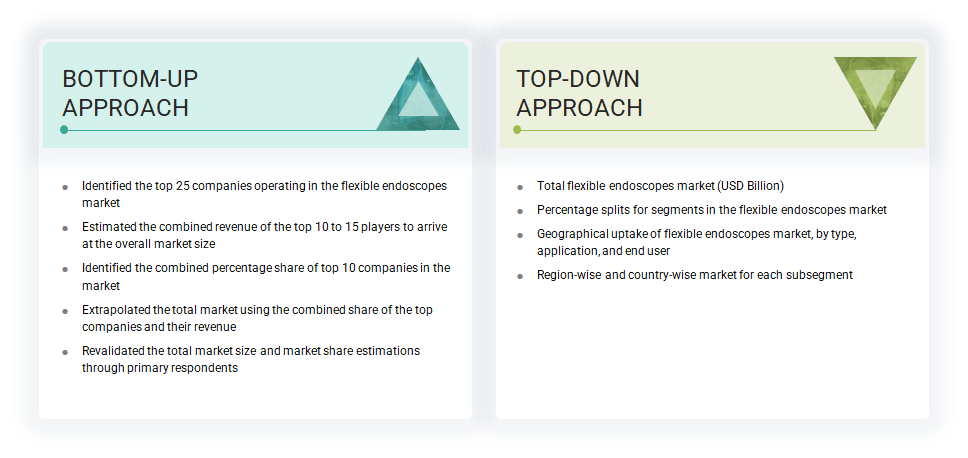
The research study involved major activities in estimating the current size of the flexible endoscopes market. Exhaustive secondary research was done to collect information on the flexible endoscope industry. The next step was to validate these findings, assumptions, and sizing with industry experts across the value chain using primary research. Different approaches, such as top-down and bottom-up, were employed to estimate the total market size. After that, the market breakup and data triangulation procedures were used to estimate the market size of the segments and subsegments of the flexible endoscopes market.
Secondary Research
The secondary research process involved the widespread use of secondary sources, directories, databases (Bloomberg Businessweek, Factiva, and D&B Hoovers), white papers, annual reports, investor presentations, SEC filings of companies and publications from government sources, such as National Institutes of Health (NIH), US FDA, US Census Bureau, World Health Organization (WHO), International Trade Administration (ITA), Global Burden of Disease Study, and Centers for Medicare and Medicaid Services (CMS). These sources were referred to, to identify and collect information on the global flexible endoscopes market study. They were also used to obtain important information about the key players and market classification & segmentation according to industry trends and key developments related to market and technology perspectives. A database of the key industry leaders was also prepared using secondary research.
Primary Research
In the primary research process, various sources from the supply and demand sides were interviewed to obtain qualitative and quantitative information for this report. Primary sources from the supply side included industry experts, such as CEOs, vice presidents; marketing and sales directors; technology & innovation directors; and related key executives from various key companies and organizations in the flexible endoscopes market. Primary sources from the demand side included ambulatory surgical centers (ASCs), hospitals, clinics, and other end users. The research was conducted to validate the market segmentation, identify key players, and gather insights on key industry trends & key market dynamics.
A breakdown of the primary respondents involved in the research process is provided below:
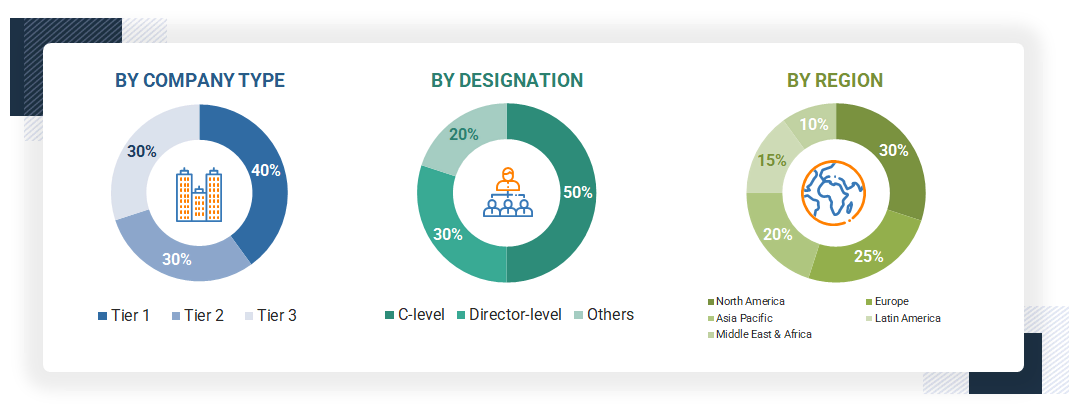
C-level Primaries include CEOs, CFOs, COOs, and VPs.
Others include Sales Managers, Marketing Managers, Business Development Managers, Product Managers, Distributors, and Suppliers.
Companies are classified into tiers based on their total revenue. These tiers are as follows:
Tier 1 = > USD 10.00 billion, tier 2 = USD 1.00 billion to USD 10.00 billion, and tier 3 = < USD 1.00 billion
Source: MarketsandMarkets Analysis
To know about the assumptions considered for the study, download the pdf brochure
Market Size Estimation
For global market value, annual revenue figures were calculated based on the revenue mapping of major product manufacturers and OEMs active in the global flexible endoscopes market. All major product manufacturers were identified at the international/country/regional levels. Revenue mapping for the respective business segments/sub-segments was done for the major players.
The global flexible endoscopes market was split into various segments and sub-segments by taking the following into consideration:
- List of major players operating in the product market at the regional and/or country level
- Product mapping of various flexible endoscope manufacturers at the regional and/or country level
- Mapping of annual revenue generated by listed major players in the flexible endoscopes market (or the nearest reported business unit/product category)
- Extrapolation of the revenue mapping of the listed major players to derive the global market value of the respective segments/subsegments
- Summation of the market value of all segments/subsegments to arrive at the global flexible endoscopes market
- The above data was consolidated and added with detailed inputs and analysis from MarketsandMarkets and presented in this report.
Market Size Estimation (Bottom-up & Top-down Approaches)
Data Triangulation
After arriving at the overall size of the global flexible endoscopes market through the methodology mentioned above, the market was split into several segments and subsegments. Where applicable, the data triangulation and market breakdown procedures were employed to complete the overall market engineering process and arrive at the exact market value data for the key segments and subsegments. The extrapolated market data was triangulated by studying various macroindicators and regional trends from both demand- and supply-side participants.
Market Definition
Flexible endoscopes are medical devices designed with a bendable, tube-like structure that enables visual examination and therapeutic intervention within internal organs and cavities, particularly in hard-to-reach areas. These devices, integrated with high-resolution imaging, illumination, and accessory channels, support minimally invasive procedures across gastrointestinal, respiratory, urology, and other applications. Their flexibility, precision, and patient-friendly design make diagnostic accuracy and procedural efficiency essential in modern healthcare.
Stakeholders
- Manufacturers of endoscopes and related devices
- Suppliers and distributors of endoscopy devices
- Hospitals, diagnostic centers, and medical colleges
- Independent surgeons and private physicians
- Ambulatory surgery centers (ASCs)
- Teaching hospitals and academic medical centers
- Government bodies/Municipal corporations
- Business research and consulting service providers
- Venture capitalists
Report Objectives
- To define, describe, segment, and forecast the flexible endoscopes market by type, application, end user, and region
- To provide detailed information about the factors (Drivers, restraints, opportunities, and challenges) influencing market growth
- To analyze micromarkets1 with respect to individual growth trends, prospects, and contributions to the overall flexible endoscopes market
- To analyze market opportunities for stakeholders and provide details of the competitive landscape for key players
- To forecast the size of the flexible endoscopes market across five main regions (along with their respective key countries), namely North America, Europe, the Asia Pacific, Latin America, and the Middle East & Africa
- To profile the key players in the flexible endoscopes market and comprehensively analyze their core competencies and market share
- To track and analyze competitive developments, such as acquisitions, product launches, expansions, collaborations, agreements, partnerships, and R&D activities of leading players in the flexible endoscopes market
- To benchmark players within the flexible endoscopes market using the Competitive Leadership Mapping framework, which analyzes market players on various parameters within the broad categories of business strategy, market share, and product offerings
Get the Full Flexible Endoscopes Market Report
Full forecast, segment splits, and company analysis for all Flexible Endoscopes Market.
- Canada Flexible Endoscopes Market
- US Flexible Endoscopes Market
- Germany Flexible Endoscopes Market
- UK Flexible Endoscopes Market
- France Flexible Endoscopes Market
- Italy Flexible Endoscopes Market
- Spain Flexible Endoscopes Market
- China Flexible Endoscopes Market
- India Flexible Endoscopes Market
- Japan Flexible Endoscopes Market
- South Korea Flexible Endoscopes Market
- Brazil Flexible Endoscopes Market
- Mexico Flexible Endoscopes Market
- Rest Of Europe Flexible Endoscopes Market
- Rest Of Asia Pacific Flexible Endoscopes Market
Need a Tailored Report?
Customize this report to your needs
Get 10% FREE Customization
Customize This Report
