
Asia Pacific Food and Beverage Metal Cans Market (2024-2029)

The Asia Pacific Food and Beverage Metal Cans Market was valued at $10600 Million in 2024 and projected to reach to $15580 Million by 2029, representing a compound annual growth rate of 8.0%. The Asia Pacific food and beverage metal cans market is poised for substantial growth, expanding from USD 10,600 million in 2024 to USD 15,580 million by 2029.


| Market Size in | USD 26.32 MN |
| Market Forecast in | |
| CAGR | |
| Forecast Period | |
| Units Considered | Value (USD MN) |
Asia Pacific Food and Beverage Metal Cans Market Trends and Insights
- Asia Pacific's 8.0% compound annual growth rate outpaces the global average, driven by rising consumer demand for convenient, sustainable packaging solutions across the region.
- Rapid urbanization, growing middle-class populations, and increasing beverage consumption in emerging economies are fueling market growth throughout Asia Pacific. Asia Pacific's metal cans sector benefits from strong demand in both carbonated soft drinks and alcoholic beverages, with particular momentum in countries like India, China, and Southeast Asia.
- The region's shift toward premium and ready-to-drink products is accelerating metal can adoption as manufacturers prioritize recyclability and brand differentiation.
- By 2029, Asia Pacific is expected to solidify its position as a critical growth engine for the global metal cans market, supported by improving manufacturing infrastructure and regulatory support for sustainable packaging across the region..
Key Market Statistics
- CAGR (2024-2029) 8.0% CAGR
- Market Size, 2024 ~USD 10600 Million
- Forecast, 2029 ~USD 15580 Million
- Geography Asia Pacific
Asia Pacific Food and Beverage Metal Cans Market Overview
Fastest Growing Regional Market :
Asia Pacific's 8% CAGR significantly outpaces the global average of 7%, positioning the region as the fastest-growing market for food and beverage metal cans through 2029.
Rapid Urbanization Driving Demand :
Accelerating urbanization across Asia Pacific is fueling consumer preference for convenient, ready-to-consume beverages and packaged foods in metal cans, particularly in emerging economies.
Sustainability Focus :
Growing environmental consciousness among Asia Pacific consumers is driving adoption of recyclable metal cans as a preferred sustainable packaging solution over plastic alternatives.
Rising Middle-Class Consumption :
Expanding middle-class populations in China, India, and Southeast Asia are increasing disposable incomes and demand for premium packaged beverages and food products in metal containers.
Asia Pacific Food and Beverage Metal Cans Market Dynamics
- This robust expansion is underpinned by rapid urbanization, rising disposable incomes, and a growing middle-class population across the region.
- Key markets including China, India, Japan, and Southeast Asian nations are experiencing increased consumption of canned beverages and packaged foods. Sustainability trends and regulatory pressures favoring recyclable packaging are accelerating metal can adoption across Asia Pacific.
- Beverage manufacturers are increasingly shifting from plastic to metal cans to meet consumer preferences and environmental standards.
- The region's young, urban demographic and expanding retail infrastructure further support market penetration, making Asia Pacific a critical growth engine for global metal can manufacturers..
Market Ecosystem

METALS CANS MARKET: COMMERCIAL USE CASES ACROSS INDUSTRIES
| COMPANY | USE CASE DESCRIPTION | BENEFITS |
|---|---|---|
 |
Ball Corporation manufactures lightweight, recyclable 2-piece aluminum beverage cans in multiple sizes, including formats used for carbonated soft drinks, beer, and energy drinks. Its metal packaging solutions focus on lightweighting, recyclability, and efficient beverage packaging. | Supports lightweight, recyclable beverage packaging, helps brand owners improve material efficiency and sustainability, and contributes to reducing packaging-related environmental impacts and meeting recycling objectives. |
 |
Crown Holdings manufactures 2-piece and 3-piece metal cans, coatings, and closures for food and beverage applications. Its portfolio includes aluminum and steel packaging solutions, with advanced coatings and decorative technologies designed to support product protection, food safety, and packaging performance. | Provides broad packaging options for food and beverage applications, supports food safety and product protection with advanced coatings, and enables customers to meet diverse packaging requirements across North America, Europe, and Asia Pacific. |
 |
Ardagh Group supplies metal beverage and food cans, with its metal packaging portfolio focused on lightweighting, sustainable packaging, and innovative can designs. Its solutions serve applications including alcoholic beverages, specialty beverages, and food products, alongside its broader glass packaging portfolio. | Enables brand differentiation through packaging design and decoration, supports lightweight, recyclable packaging solutions and helps brand owners strengthen product presentation and sustainability across beverage and food applications. |
Logos and trademarks shown above are the property of their respective owners. Their use here is for informational and illustrative purposes only.
Related Ecosystem
Fandb Logistics Cold Chain And Packaging
- Rigid Packaging
- Acrylics
- Active Packaging
- Dairy Products
- Gravure Process
- Amcor plc
- Basf se
- Essentra plc
- Sonoco Products Company
- AZELIS HOLDINGS SA
Fandb Processing And Technology
- Dairy Products
- Bakery Products
- Filtration Equipment
- Heat Exchanger
- Acetic Acid
- Gea group
- John Bean Technologies Corporation
- Alfa Laval Corporate AB
- AZELIS HOLDINGS SA
- SPX FLOW INC
Key Takeaways
- Asia Pacific's metal cans market is valued at USD 10,600 million in 2024 and will grow to USD 15,580 million by 2029, representing an 8.0% CAGR.
- Asia Pacific's growth rate exceeds the global average, positioning the region as the fastest-expanding market for food and beverage metal cans.
- Urbanization, rising disposable incomes, and premiumization trends in Asia Pacific are driving accelerated adoption of metal can packaging.
- Asia Pacific manufacturers are increasingly investing in sustainable and recyclable metal can solutions to meet regional regulatory requirements and consumer preferences.
Food and Beverage Metal Cans Market Report Scope
| Report Metric | Details |
|---|---|
| Base Year | 2024 |
| Fastest Growing Segment | 330 ML (Beverage Can Capacity) |
| Forecast Period | 2024-2029 |
| Growth Rate | CAGR of 7% from 2024 to 2029 |
| Largest Segment | BOTTLE (Packaging Type) |
| Market Size Base Year (Billions) | ~USD 50.42 (2024) |
| Revenue Forecast (Billions) | ~USD 70.72 (2029) |
| Segments Covered | Fabrication Type, Material Type, Material Subsegment, Coating Type, Application, Beverage Can Capacity, Food Subsegment, Beverage Subsegment, Beverages Subsegment, Packaging Type |
Asia Pacific Food and Beverage Metal Cans Market Report Segmentation
10 segment dimensions are covered across the global market.
By Fabrication Type
- 2-Piece Cans
- 3-Piece Cans
By Material Type
- Aluminum
- Aluminum Cans
- Steel
- Steel Cans
By Material Subsegment
- Tin Free Steel
- Tin Plated Steel
By Coating Type
- Bright Coating
- White Base Coating
By Application
- Beverages
- Food
- Fruits
- Meat Products
- Seafood
- Vegetables
By Beverage Can Capacity
- 100 ML
- 150 ML
- 200 ML
- 310 ML
- 330 ML
- Other Can Capacities
By Food Subsegment
- Convenience Foods
- Fruits & Vegetables
- Meat & Seafood
- Other Food Products
- Pet Food
By Beverage Subsegment
- Alcoholic Beverages
- Carbonated Soft Drinks
- Other Beverages
- Sports & Energy Drinks
By Beverages Subsegment
- Alcoholic Beverages
- Carbonated Soft Drinks
- Other Beverages
- Sports & Energy Drinks
By Packaging Type
- Bottle
- Can
- Carton
- Other Packaging Type*
- Pouch
Target Audience
- Beverage Manufacturers : Need regional market data to optimize product packaging strategies, expand canned beverage portfolios, and capitalize on Asia Pacific's growing consumer demand.
- Metal Can Producers : Require market sizing and growth forecasts to plan capacity expansion, identify high-growth countries, and secure supply contracts across Asia Pacific.
- Packaging Companies : Seek insights into regional sustainability trends and consumer preferences to develop innovative metal can solutions tailored to Asia Pacific markets.
- Investment & Private Equity Firms : Need comprehensive regional analysis to evaluate acquisition targets, assess growth potential, and make informed investment decisions in Asia Pacific packaging.
- Food & Beverage Retailers : Require market intelligence on canned product demand trends and regional preferences to optimize inventory, sourcing, and shelf placement strategies.
Countries within Asia Pacific - compare and drill down
| Country | 2025 size (native) |
|---|---|
| China | USD 3160 Million |
| India | USD 2330 Million |
| Japan | USD 2380 Million |
| Thailand | USD 2200 Million |
| Indonesia | USD 2020 Million |
| Australia & New Zealand | USD 1700 Million |
| Rest Of Asia Pacific | USD 1790 Million |
Country market size visualization
Reasons to Buy this Report
- Regional Growth Opportunity : Capture insights into Asia Pacific's 8% CAGR—the fastest-growing region globally—to identify high-potential markets and investment opportunities before competitors.
- Country-Level Market Intelligence : Access detailed market sizing for China, India, Japan, Thailand, Indonesia, and Australia & New Zealand to tailor strategies for specific Asia Pacific economies.
- Sustainability & Regulatory Trends : Understand how environmental regulations and consumer sustainability preferences are reshaping metal can adoption across Asia Pacific markets.
- Competitive Positioning : Benchmark your portfolio against regional demand patterns and identify gaps in the rapidly expanding Asia Pacific metal cans segment.
- Strategic Expansion Planning : Leverage forecasted growth data through 2029 to develop market entry strategies and resource allocation plans for Asia Pacific operations.
Frequently asked questions
What is the current size of the Asia Pacific food and beverage metal cans market?
The Asia Pacific food and beverage metal cans market was valued at USD 10,600 million in 2024 and is projected to reach USD 15,580 million by 2029.
What is the expected growth rate for Asia Pacific's metal cans market?
Asia Pacific's food and beverage metal cans market is expected to grow at a compound annual growth rate (CAGR) of 8.0% from 2024 to 2029.
Which countries are driving growth in Asia Pacific's metal cans market?
Key growth drivers in Asia Pacific include China, India, and Southeast Asian nations, where rising urbanization, increasing beverage consumption, and premiumization trends are accelerating metal can adoption.
What factors are contributing to Asia Pacific's metal cans market expansion?
Asia Pacific's market growth is fueled by rapid urbanization, expanding middle-class populations, growing demand for convenient packaging, sustainability preferences, and increased consumption of ready-to-drink beverages across the region.
How does Asia Pacific's growth compare to the global metal cans market?
Asia Pacific's 8.0% CAGR outpaces the global average of 7.0%, making the region the fastest-growing market for food and beverage metal cans worldwide.
RESEARCH METHODOLOGY
This study employed two primary approaches to estimate the current size of the food and beverage metal cans market. Exhaustive secondary research was carried out to collect information on the coating type, material type, application, degree of internal pressure, beverage can capacity, and fabrication type of the market. The next step involved validating these findings, assumptions, and sizing with industry experts across the value chain through primary research. The top-down and bottom-up approaches were employed to estimate the complete market size. Thereafter, data triangulation was used to estimate the market size of segments and subsegments.
Secondary Research
This research study used extensive secondary sources—directories and databases such as Bloomberg Businessweek and Factiva-to identify and collect information for a technical, market-oriented, and commercial market study. In the secondary research process, sources such as annual reports, press releases & investor presentations, white papers, metal cans and metal cans technology-related journals, certified publications, articles from recognized authors, directories, and databases were used to identify and collect information. Secondary research mainly provided key information on the industry’s supply chain, the pool of key players, and market classification and segmentation based on industry trends to the bottom-most level, regional markets, and key developments from market- and technology-oriented perspectives.
Primary Research
Extensive primary research was conducted after obtaining information regarding the food and beverage metal cans market scenario through secondary research. Several primary interviews were conducted with market experts from the demand and supply sides across all regions. Primary data was collected through questionnaires, emails, and telephone interviews. Primary sources on the supply side included industry experts such as chief experience officers (CXOs), vice presidents (VPs), directors from business development, marketing, research, and development teams, and key executives from distributors and key opinion leader
Primary interviews were conducted to gather insights, including market statistics, revenue data for products and services, market breakdowns, market size estimates, market forecasts, and data triangulation. Primary research also helped understand trends related to coating type, material type, application, degree of internal pressure, beverage can capacity, fabrication type, and region. Stakeholders on the demand side were interviewed to understand buyers’ perspectives on suppliers, products, and the outlook for their business, which will impact the overall market.
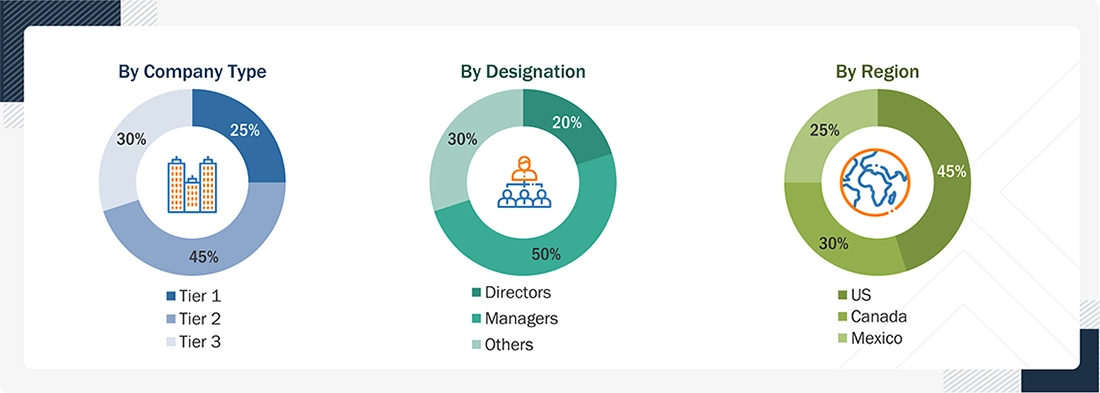
Note: The three tiers of the companies are defined based on their total revenues in 2024 or 2025, based on the availability of financial data: Tier 1: Revenue >USD 1 billion; Tier 2: USD 100 million ≤ revenue ≤ USD 1 billion; Tier 3: Revenue USD 100 million.
To know about the assumptions considered for the study, download the pdf brochure
|
COMPANY |
DESIGNATION |
|
Crown Holdings, Inc. (US) |
Regional Sales Manager |
|
Ball Corporation (US) |
Marketing Manager |
|
Ardagh Group (Luxembourg) |
General Manager |
|
Toyo Seikan Group Holdings, Ltd. (Japan) |
Sales Manager |
|
Silgan Holdings Inc. (US) |
Sales Manager |
|
CANPACK S.A. (Poland) |
Sales Executive |
Market Size Estimation
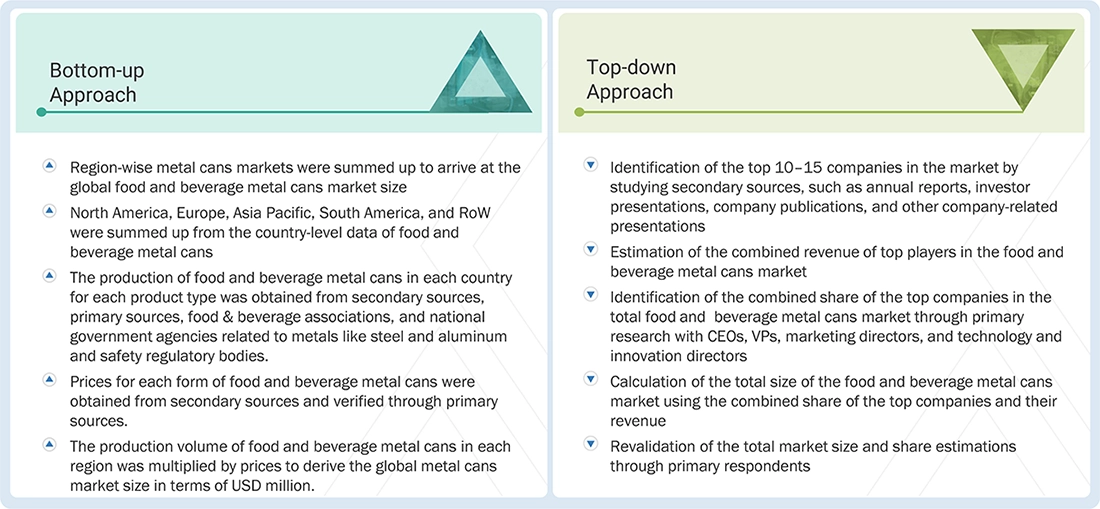
The top-down and bottom-up approaches were used to estimate and validate the total size of the food and beverage metal cans market. These approaches were also used extensively to determine the size of various subsegments in the market. The research methodology used to estimate the market size includes the following details::
- The key players in the industry and the overall market were identified through extensive secondary research.
- All shares, splits, and breakdowns were determined using secondary sources and verified through primary sources.
- All possible parameters that affect the market covered in this research study were accounted for, viewed in extensive detail, verified through primary research, and analyzed to obtain final quantitative and qualitative data.
- The research included the study of reports, reviews, and newsletters of top market players, along with extensive interviews for opinions from leaders, such as CEOs, directors, and marketing executives.
Data Triangulation
After determining the overall market size from the estimation process explained above, the total market was split into several segments and subsegments. The data triangulation procedure was employed, wherever applicable, to estimate the overall metal cans market and obtain precise statistics for all segments and subsegments. The data was triangulated by studying various factors and trends from the demand and supply sides. The market size was also validated using the top-down and bottom-up approaches.
Market Definition
The food and beverage metal cans industry refers to the global industry involved in producing, distributing, and using metal cans, primarily made from aluminum or steel, to package food and beverages. These cans are widely used for preserving a range of products, including soft drinks, beer, fruit juices, energy drinks, canned vegetables, soups, and ready-to-eat meals.
Key characteristics of metal cans in this market include their durability, ability to protect the contents from contamination, extend shelf life, and support recycling initiatives, which align with sustainability goals. Demand for metal cans is driven by factors such as their lightweight, corrosion-resistant properties, consumer preference for eco-friendly packaging solutions, and their ability to be fully recycled without loss of quality. The market includes metal can manufacturers, raw material suppliers (such as aluminum and steel), end-user industries (food and beverage companies), and consumers.
Key Stakeholders
- Food manufacturers
- Aluminum can manufacturers
- Steel can manufacturers
- Fruit and vegetable manufacturers
- Food importers and exporters
- Intermediary suppliers include traders and distributors of packed foods such as pet food and convenience foods
- Government and research organizations
- Venture capitalists and investors
-
Associations and industry bodies:
- Food and Agriculture Organization (FAO)
- United States Department of Agriculture (USDA)
- European Food Safety Authority (EFSA)
- European Association of Specialty Feed Ingredients and their Mixtures (FEFANA)
- Organisation for Economic Co-operation and Development (OECD)
Report Objectives
- To determine and project the size of the food and beverage metal cans market by fabrication type, application, degree of internal pressure, coating type, material type, beverage can capacity, and region over five years, ranging from 2026 to 2031
- To analyze opportunities for stakeholders by identifying the high-growth segments of the food and beverage metal cans market
- To forecast the size of the market segments with respect to five main regions: North America, Europe, Asia Pacific, the Middle East & Africa, and Latin America
- To analyze subsegments of the food and beverage metal cans market with respect to individual growth trends, prospects, and contributions to the overall market
- To profile the key players and comprehensively analyze their market sizes and core competencies
- To track and analyze competitive developments such as product enhancements and new product launches, acquisitions, and partnerships & collaborations in the food and beverage metal cans market globally
Customization Options:
With the given market data, MarketsandMarkets offers customizations according to company-specific scientific needs. The following customization options are available for the report:
Product analysis
- Product matrix, which gives a detailed comparison of the product portfolio of each company.t
Segmental Analysis
With the given market data, MarketsandMarkets offers customizations to meet company-specific needs.
- Further breakdown of other food products of the food and beverage metal cans market by food application.
- Further breakdown of other beverages of the food and beverage metal cans market by beverage application.
Company Information
- Detailed analyses and profiling of additional market players (up to five).
Get the Full Food and Beverage Metal Cans Market Report
Full forecast, segment splits, and company analysis for all Food and Beverage Metal Cans Market.
- Canada Food and Beverage Metal Cans Market
- Mexico Food and Beverage Metal Cans Market
- US Food and Beverage Metal Cans Market
- Germany Food and Beverage Metal Cans Market
- UK Food and Beverage Metal Cans Market
- France Food and Beverage Metal Cans Market
- Spain Food and Beverage Metal Cans Market
- Italy Food and Beverage Metal Cans Market
- China Food and Beverage Metal Cans Market
- India Food and Beverage Metal Cans Market
- Thailand Food and Beverage Metal Cans Market
- Indonesia Food and Beverage Metal Cans Market
- Japan Food and Beverage Metal Cans Market
- Brazil Food and Beverage Metal Cans Market
- Argentina Food and Beverage Metal Cans Market
- Rest Of Europe Food and Beverage Metal Cans Market
- Rest Of Asia Pacific Food and Beverage Metal Cans Market
- Rest Of South America Food and Beverage Metal Cans Market
Need a Tailored Report?
Customize this report to your needs
Get 10% FREE Customization
Customize This Report
