
Japan Food and Beverage Metal Cans Market (2024-2029)

The Japan Food and Beverage Metal Cans Market was valued at $1670 Million in 2024 and projected to reach to $2380 Million by 2029, representing a compound annual growth rate of 7.3%. Japan's food and beverage metal cans market is positioned for steady expansion through 2029, supported by the country's mature beverage industry and increasing consumer focus on sustainable packaging.


| Market Size in | USD 26.32 MN |
| Market Forecast in | |
| CAGR | |
| Forecast Period | |
| Units Considered | Value (USD MN) |
Japan Food and Beverage Metal Cans Market Trends and Insights
- Japan's market is driven by strong consumer demand for convenient, sustainable packaging solutions and the country's established beverage and canned food sectors.
- The growth trajectory reflects Japan's commitment to circular economy principles and increasing adoption of aluminum cans across premium beverage categories. In Japan, the metal cans market benefits from robust domestic consumption patterns, particularly in ready-to-drink beverages, craft beers, and specialty food products.
- Japan's aging population and urbanization trends continue to support demand for shelf-stable, portable canned goods.
- The forecast period through 2029 anticipates accelerated market expansion as Japan strengthens recycling infrastructure and manufacturers invest in lightweight, eco-friendly can designs to meet evolving consumer preferences..
Key Market Statistics
- CAGR (2024-2029) 7.3% CAGR
- Market Size, 2024 ~USD 1670 Million
- Forecast, 2029 ~USD 2380 Million
- Country Japan
Japan Food and Beverage Metal Cans Market Overview
Market Valuation :
Japan's food and beverage metal cans market reached USD 1,670 million in 2024, with projected growth to USD 2,380 million by 2029, driven by strong domestic consumption patterns and packaging innovation.
Growth Trajectory :
The Japanese market is expanding at a CAGR of 7.3%, outpacing the global average of 7%, reflecting the country's advanced beverage sector and increasing adoption of sustainable packaging solutions.
Consumer Preferences :
Japanese consumers demonstrate strong preference for convenient, eco-friendly metal can packaging, supported by established canned beverage and food industries with high quality standards and recycling infrastructure.
Market Drivers :
Growth is fueled by rising demand for ready-to-drink beverages, premium canned food products, and Japan's commitment to circular economy principles, making metal cans an attractive sustainable packaging option.
Japan Food and Beverage Metal Cans Market Dynamics
- The 7.3% CAGR reflects strong domestic demand for convenient, premium-quality canned products across both traditional and emerging beverage categories.
- Japan's advanced recycling infrastructure and environmental consciousness further strengthen market fundamentals. The outlook remains positive as manufacturers invest in innovative can designs and lightweight solutions to meet evolving consumer preferences.
- Rising consumption of functional beverages, craft beverages, and premium canned foods will continue driving market growth.
- Additionally, Japan's export-oriented food and beverage sector presents opportunities for metal can suppliers to expand beyond domestic markets, supporting sustained industry expansion through the forecast period..
Market Ecosystem
Food & Beverage Metal Cans Market: COMMERCIAL USE CASES ACROSS INDUSTRIES
| COMPANY | USE CASE DESCRIPTION | BENEFITS |
|---|---|---|
 |
Manufactures lightweight, recyclable 2-piece aluminum beverage cans across multiple sizes (100–330ml) with a focus on carbonated soft drinks, beer, and energy drinks | Industry leader in aluminum sustainability | Global scale | Helps brand owners reduce carbon footprint and meet recycling targets |
 |
Produces 2-piece and 3-piece cans, coatings, and closures for food and beverages | Innovation in high-strength steel and decorative coatings | Strong product diversity; supports food safety with advanced coatings | Broad regional presence across NA, EU, Asia Pacific |
 |
Supplies beverage and food cans with emphasis on design, lightweighting, and sustainability | Portfolio includes glass + metal | Differentiation through premium packaging design | Supports brand positioning in alcoholic beverages and specialty foods |
 |
Offers aluminum beverage cans with customization (printing, sizes, shapes); strong focus on emerging markets (Eastern Europe, Asia, South America) | Cost-competitive solutions; rapid response to regional demand; helps beverage companies penetrate high-growth developing markets |
 |
Largest US supplier of food cans (steel and aluminum) with 3-piece fabrication and vacuum/pressurised solutions | Trusted partner for food processors | Ensures long shelf life | Reliable domestic supply chain and strong service network |
Logos and trademarks shown above are the property of their respective owners. Their use here is for informational and illustrative purposes only.
Related Ecosystem
Fandb Logistics Cold Chain And Packaging
- Rigid Packaging
- Acrylics
- Active Packaging
- Dairy Products
- Gravure Process
- Amcor plc
- Basf se
- Essentra plc
- Sonoco Products Company
- AZELIS HOLDINGS SA
Fandb Processing And Technology
- Dairy Products
- Bakery Products
- Filtration Equipment
- Heat Exchanger
- Acetic Acid
- Gea group
- John Bean Technologies Corporation
- Alfa Laval Corporate AB
- AZELIS HOLDINGS SA
- SPX FLOW INC
Key Takeaways
- Japan's metal cans market is valued at USD 1,670 million in 2024 and will reach USD 2,380 million by 2029 at a 7.3% CAGR.
- Japan's beverage sector, particularly ready-to-drink and craft beer categories, drives significant demand for aluminum and steel cans.
- Japan's advanced recycling infrastructure and sustainability focus position the country as a leader in circular economy packaging adoption.
- Japan's demographic trends and urbanization support sustained growth in convenient, portable canned food and beverage consumption through 2029.
Food and Beverage Metal Cans Market Report Scope
| Report Metric | Details |
|---|---|
| Base Year | 2024 |
| Fastest Growing Segment | 330 ML (Beverage Can Capacity) |
| Forecast Period | 2024-2029 |
| Growth Rate | CAGR of 7% from 2024 to 2029 |
| Largest Segment | BOTTLE (Packaging Type) |
| Market Size Base Year (Billions) | ~USD 50.42 (2024) |
| Revenue Forecast (Billions) | ~USD 70.72 (2029) |
| Segments Covered | Fabrication Type, Material Type, Material Subsegment, Coating Type, Application, Beverage Can Capacity, Food Subsegment, Beverage Subsegment, Beverages Subsegment, Packaging Type |
Japan Food and Beverage Metal Cans Market Report Segmentation
10 segment dimensions are covered across the global market.
By Fabrication Type
- 2-Piece Cans
- 3-Piece Cans
By Material Type
- Aluminum
- Aluminum Cans
- Steel
- Steel Cans
By Material Subsegment
- Tin Free Steel
- Tin Plated Steel
By Coating Type
- Bright Coating
- White Base Coating
By Application
- Beverages
- Food
- Fruits
- Meat Products
- Seafood
- Vegetables
By Beverage Can Capacity
- 100 ML
- 150 ML
- 200 ML
- 310 ML
- 330 ML
- Other Can Capacities
By Food Subsegment
- Convenience Foods
- Fruits & Vegetables
- Meat & Seafood
- Other Food Products
- Pet Food
By Beverage Subsegment
- Alcoholic Beverages
- Carbonated Soft Drinks
- Other Beverages
- Sports & Energy Drinks
By Beverages Subsegment
- Alcoholic Beverages
- Carbonated Soft Drinks
- Other Beverages
- Sports & Energy Drinks
By Packaging Type
- Bottle
- Can
- Carton
- Other Packaging Type*
- Pouch
Target Audience
- Metal Can Manufacturers : Manufacturers need Japan-specific market data to assess production capacity requirements, identify growth opportunities in the 7.3% CAGR market, and develop competitive strategies for the Japanese beverage and food sectors.
- Beverage & Food Companies : Japanese and international food and beverage producers require market insights to optimize packaging strategies, understand consumer preferences for metal cans, and plan product launches in Japan's growing premium segment.
- Packaging Suppliers & Distributors : Suppliers and distributors need detailed Japan market analysis to forecast demand, identify customer segments, plan inventory, and develop distribution strategies aligned with the country's unique market dynamics.
- Investment & Private Equity Firms : Investors evaluating opportunities in Japan's food and beverage packaging sector require comprehensive market sizing, growth projections, and competitive analysis to support due diligence and investment decisions.
- Market Researchers & Consultants : Research professionals and consulting firms need Japan-specific market data to support client engagements, validate market assumptions, develop strategic recommendations, and provide competitive intelligence for stakeholders.
Reasons to Buy this Report
- Market Size & Growth Data : Access precise valuation figures for Japan's metal cans market (USD 1,670M in 2024) with detailed 5-year forecasts, enabling accurate investment planning and competitive benchmarking specific to the Japanese market.
- Japan-Specific Consumer Insights : Understand Japanese consumer preferences for sustainable, convenient packaging solutions and their purchasing behaviors in the beverage and canned food sectors to tailor products and marketing strategies effectively.
- Competitive Landscape Analysis : Identify key players, market share distribution, and competitive dynamics within Japan's metal cans industry to inform strategic positioning, partnership opportunities, and market entry strategies.
- Growth Driver Identification : Discover Japan-specific market drivers including recycling infrastructure, regulatory environment, and emerging beverage trends that will shape market expansion through 2029 and beyond.
- Strategic Decision Support : Leverage Japan market intelligence to support investment decisions, capacity planning, product development, and go-to-market strategies with confidence in localized, actionable market data.
Frequently asked questions
What is the current size of Japan's food and beverage metal cans market?
Japan's food and beverage metal cans market was valued at USD 1,670 million in 2024.
What is the projected market size for Japan's metal cans market by 2029?
Japan's metal cans market is projected to reach USD 2,380 million by 2029.
What is the CAGR for Japan's food and beverage metal cans market?
Japan's food and beverage metal cans market is expected to grow at a CAGR of 7.3% from 2024 to 2029.
Which beverage categories drive demand for metal cans in Japan?
Ready-to-drink beverages, craft beers, and specialty soft drinks are primary drivers of metal can demand in Japan.
How does Japan's sustainability focus impact the metal cans market?
Japan's advanced recycling infrastructure and circular economy commitment encourage manufacturers to adopt lightweight, recyclable aluminum cans, supporting market growth.
RESEARCH METHODOLOGY
The research study involved extensive secondary sources, directories, and databases such as Bloomberg Businessweek and Factiva to identify and collect information useful for a technical, market-oriented, and commercial study of the food and beverage metal cans market. In-depth interviews were conducted with various primary respondents—such as key industry participants, subject matter experts (SMEs), C-level executives of key market players, and industry consultants—to obtain and verify critical qualitative and quantitative information and assess prospects.
Secondary Research
The secondary sources referred for this research study include government sources, such as the Food and Agriculture Organization (FAO), the Can Manufacturers India (CMI), Eurostat (EU Database), and various national ministries of the agricultural department, corporate filings (such as annual reports, press releases, investor presentations, and financial statements), and trade, business, and professional associations such as In the secondary research process, various organizations such as The Aluminium Association, Metal Construction Association, and Metal Packaging Europe (MPE), were referred to identify and collect information for this study.
Secondary research was mainly used to obtain key information about the industry's supply chain—the total pool of key players, market classification, and segmentation according to the industry trends and key developments from market-oriented perspectives.
Primary Research
The food and beverage metal cans market comprises several stakeholders, including raw material suppliers, end-product manufacturers, and regulatory organizations in the supply chain. Various primary sources from both the supply and demand sides of the market were interviewed to obtain qualitative and quantitative information. Primary interviewees from the supply side include research institutions involved in R&D to introduce technology, distributors, wholesalers, importers & exporters of aluminium/steel manufacturers and technology providers. Primary sources from the demand-side include key opinion leaders, executives, vice presidents, and CEOs through questionnaires, emails, and telephonic interviews.
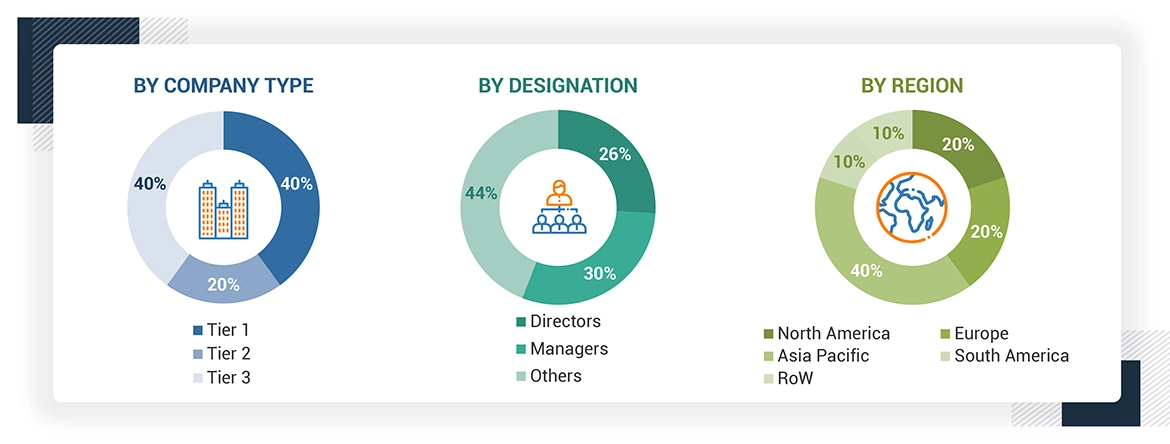
Note: Three tiers of the companies are defined based on their total revenues in 2022 or 2023, according to the availability of financial data.
Tier 1: Revenue > USD 1 billion
Tier 2: USD 100 million = Revenue = USD 1 billion
Tier 3: Revenue < USD 100 million
To know about the assumptions considered for the study, download the pdf brochure
Market Size Estimation
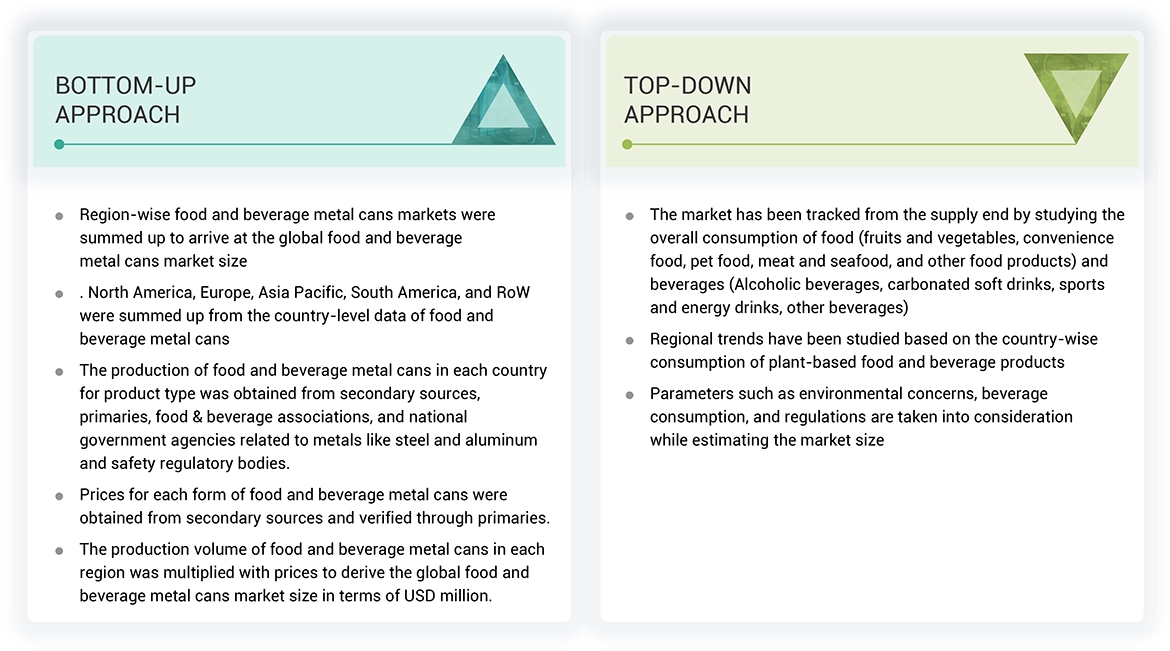
Both the top-down and bottom-up approaches have been used to estimate and validate the total size of the food and beverage metal cans market. These approaches were extensive to determine the size of the subsegments in the market. The research methodology used to estimate the market size includes the following details:
Food and Beverage Metal Cans Market : Top-Down and Bottom-Up Approach
Data Triangulation
After arriving at the overall market size from the estimation process explained above, the total market was split into several segments and subsegments. The data triangulation and market breakdown procedures were employed, wherever applicable, to estimate the overall food and beverage metal cans market and arrive at the exact statistics for all segments and subsegments. The data was triangulated by studying various factors and trends from the demand and supply sides. Along with this, the market size was validated using both the top-down and bottom-up approaches.
Market Definition
The food and beverage metal cans refers to the global industry involved in the production, distribution, and utilization of metal cans, primarily made from aluminum or steel, for packaging food and beverages. These cans are widely used for preserving a range of products, including soft drinks, beer, fruit juices, energy drinks, canned vegetables, soups, and ready-to-eat meals.
Key characteristics of metal cans in this market include their durability, ability to protect the contents from contamination, extend shelf life, and support recycling initiatives, which align with sustainability goals. The demand for metal cans is driven by factors such as their lightweight, corrosion-resistant properties, and consumer preference for eco-friendly packaging solutions, along with their ability to be fully recycled without loss of quality. The market encompasses manufacturers of metal cans, suppliers of raw materials (like aluminum and steel), end-user industries (food and beverage companies), and consumers.
Stakeholders
- Food manufacturers
- Aluminum can manufacturers
- Steel can manufacturers
- Fruit and Vegetable manufacturers
- Food importers and exporters
- Intermediary suppliers include traders and distributors of packed foods such as pet food and convenience foods.
- Government and research organizations
-
Associations and industry bodies:
- Food and Agriculture Organization (FAO)
- United States Department of Agriculture (USDA)
- European Food Safety Authority (EFSA)
- European Association of Specialty Feed Ingredients and their Mixtures (FEFANA)
- Organization for Economic Co-operation and Development (OECD)
- Venture capitalists and investors
Report Objectives
- To determine and project the size of the food and beverage metal cans market by fabrication type, application, degree of internal pressure, coating type, material type, beverage can capacity, and region over five years, ranging from 2024 to 2029.
- To analyze opportunities for stakeholders by identifying the high-growth segments of the food and beverage metal cans market
- To forecast the size of the market segments with respect to five main regions: North America, Europe, Asia Pacific, the Middle East & Africa, and Latin America
- To analyze subsegments of the food and beverage metal cans market with respect to individual growth trends, prospects, and contributions to the overall market
- To profile the key players and comprehensively analyze their market sizes and core competencies
- To track and analyze competitive developments such as product enhancements and new product launches, acquisitions, and partnerships & collaborations in the food and beverage metal cans market globally
Available Customizations
With the given market data, MarketsandMarkets offers customizations according to company-specific scientific needs.
The following customization options are available for the report:
PRODUCT ANALYSIS
- Product Matrix, which gives a detailed comparison of the product portfolio of each company.
GEOGRAPHIC ANALYSIS
With the given market data, MarketsandMarkets offers customizations according to company-specific scientific needs.
- Further breakdown of the Rest of the European food and beverage metal cans market, by key country
- Further breakdown of the Rest of the South American food and beverage metal cans market market, by key country
- Further breakdown of the Rest of Asia Pacific food and beverage metal cans market market, by key country
COMPANY INFORMATION
- Detailed analyses and profiling of additional market players
Get the Full Food and Beverage Metal Cans Market Report
Full forecast, segment splits, and company analysis for all Food and Beverage Metal Cans Market.
- Canada Food and Beverage Metal Cans Market
- Mexico Food and Beverage Metal Cans Market
- US Food and Beverage Metal Cans Market
- Germany Food and Beverage Metal Cans Market
- UK Food and Beverage Metal Cans Market
- France Food and Beverage Metal Cans Market
- Spain Food and Beverage Metal Cans Market
- Italy Food and Beverage Metal Cans Market
- China Food and Beverage Metal Cans Market
- India Food and Beverage Metal Cans Market
- Thailand Food and Beverage Metal Cans Market
- Indonesia Food and Beverage Metal Cans Market
- Brazil Food and Beverage Metal Cans Market
- Argentina Food and Beverage Metal Cans Market
- Rest Of Europe Food and Beverage Metal Cans Market
- Rest Of Asia Pacific Food and Beverage Metal Cans Market
- Rest Of South America Food and Beverage Metal Cans Market
Need a Tailored Report?
Customize this report to your needs
Get 10% FREE Customization
Customize This Report
