
Germany Forklift Market (2025-2032)

The Germany Forklift Market was valued at $120835 Million in 2025 and projected to reach to $172124 Million by 2032, representing a compound annual growth rate of 5.2%. Germany's forklift market is poised for sustained expansion through 2032, driven by the country's robust manufacturing sector, sophisticated supply chain networks, and increasing automation investments.


| Market Size in | USD 26.32 MN |
| Market Forecast in | |
| CAGR | |
| Forecast Period | |
| Units Considered | Value (USD MN) |
Germany Forklift Market Trends and Insights
- The German market is expected to expand to $172.1 billion USD by 2032, reflecting a compound annual growth rate (CAGR) of 5.2%.
- Germany's robust manufacturing base, advanced logistics infrastructure, and emphasis on automation drive sustained demand for forklift equipment across warehousing, automotive, and industrial sectors. The German forklift market benefits from the country's position as Europe's largest economy and a global manufacturing hub.
- Between 2025 and 2032, Germany will experience steady growth fueled by e-commerce expansion, supply chain modernization, and increased adoption of electric and autonomous material handling solutions.
- Germany's commitment to sustainability and Industry 4.0 initiatives further supports market expansion, as businesses invest in efficient, eco-friendly forklift technologies to meet regulatory standards and operational efficiency goals..
Key Market Statistics
- CAGR (2025-2032) 5.2% CAGR
- Market Size, 2025 ~USD 120835 Million
- Forecast, 2032 ~USD 172124 Million
- Country Germany
Germany Forklift Market Overview
Market Valuation :
Germany's forklift market is valued at $120.8 billion USD in 2025, establishing it as a critical hub within the European material handling sector and a key driver of regional logistics innovation.
Strong Growth Trajectory :
With a CAGR of 5.2% through 2032, Germany's forklift market is projected to reach $172.1 billion USD, outpacing many European counterparts due to sustained industrial demand and modernization initiatives.
Manufacturing Excellence :
Germany's world-class manufacturing base and precision engineering heritage create consistent demand for advanced forklift solutions, supporting both domestic production and export-driven logistics operations.
Automation & Infrastructure :
Advanced logistics infrastructure and Germany's commitment to Industry 4.0 automation standards drive adoption of technologically sophisticated forklift systems across warehousing, automotive, and e-commerce sectors.
Germany Forklift Market Dynamics
- The market benefits from Germany's position as Europe's largest economy and a global logistics hub, where demand for efficient material handling solutions remains consistently strong across automotive, chemical, pharmaceutical, and e-commerce industries. Key growth catalysts include the transition toward electric and autonomous forklift technologies, rising labor costs incentivizing mechanization, and regulatory pressures for sustainable logistics operations.
- German enterprises' focus on operational efficiency and Industry 4.0 integration will continue to fuel demand for smart, connected forklift systems, positioning Germany as a premium market for advanced material handling solutions..
Market Ecosystem
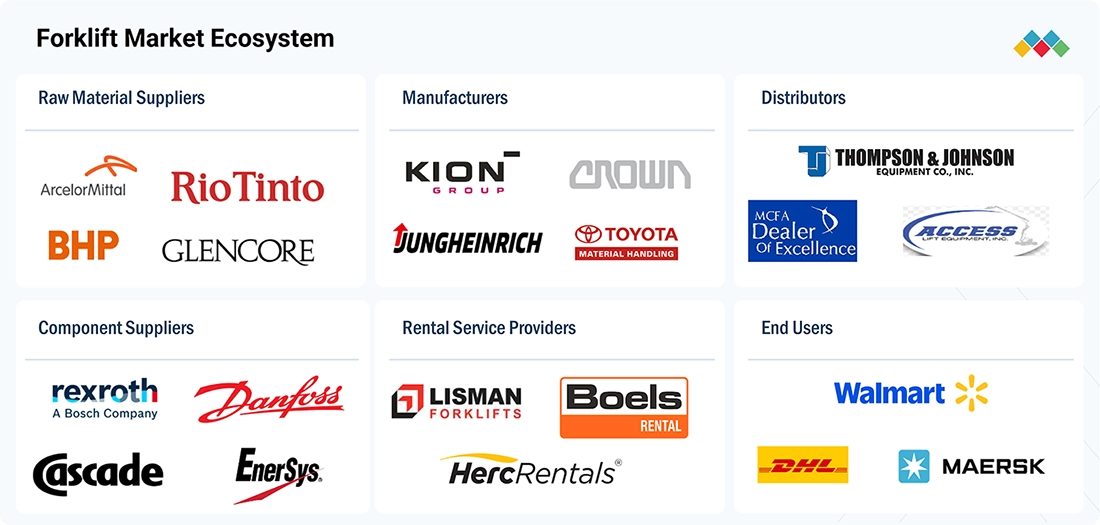
FORKLIFT MARKET: COMMERCIAL USE CASES ACROSS INDUSTRIES
| COMPANY | USE CASE DESCRIPTION | BENEFITS |
|---|---|---|
 |
Toyota Industries provides automated forklifts and warehouse trucks for repetitive pallet transport, storage, retrieval, and truck loading and unloading. Its automated warehouse portfolio includes low-lift trucks up to 2.5 tons, stacker trucks up to 1.6 tons, and reach trucks up to 2.5 tons, allowing automation across long-distance pallet movement, medium-level storage, and high-rack operations. | Enables warehouses to automate repetitive pallet handling while retaining the same basic truck architecture used in manual operations. Its automation approach can improve pallet handling accuracy, reduce manual travel, and support continuous operation in high-throughput facilities. |
 |
KION combines Linde forklift equipment with automation, AI, fleet control, and warehouse technologies. Its autonomous forklift solutions are designed for pallet transport and warehouse operations, with newer AI-based systems capable of independently executing complete transport orders and operating alongside employees and manually operated forklifts. | Enables operators to automate individual transport processes without requiring complete warehouse automation. AI-based perception and autonomous operation can improve task consistency, support mixed manual and automated fleets, and allow automation to be expanded as warehouse requirements increase. |
 |
Jungheinrich uses automated narrow-aisle forklifts, high-lift trucks, and automated guided equipment for high-density storage and repetitive pallet movement. Its automated solutions are particularly suitable for very narrow-aisle warehouses, where trucks can operate at storage heights of up to 10 meters and handle high-pallet throughput. | Increases storage density by allowing automated trucks to operate in narrow aisles and at high rack heights. Automation also reduces dependence on manual forklift operators for repetitive storage and retrieval tasks while supporting consistent throughput across multiple shifts. |
 |
Mitsubishi Logisnext provides automated guided forklifts for warehouses and factories, alongside reach stackers, automated warehouse systems, and forklift operation management systems. Its solutions are designed to connect automated equipment with broader logistics operations, including pallet movement and real-time monitoring of forklift activity. | Allows customers to combine automated forklifts with warehouse and fleet management technologies instead of deploying standalone equipment. This supports safer material movement, real-time visibility of equipment activity, and gradual automation of factories and warehouses. |
Logos and trademarks shown above are the property of their respective owners. Their use here is for informational and illustrative purposes only.
Related Ecosystem
Logistics And Transportation
- Internal Combustion Engine (ICE)
- Crawler Excavator
- Fuel Cell
- Light Commercial Vehicles (LCVs)
- Positive Train Control (PTC)
- Siemens ag
- Alstom s.a.
- Hitachi, Ltd.
- Godrej Industries Limited
- Toshiba Corporation
On Highway Off Highway Vehicles
- Internal Combustion Engine (ICE)
- Agricultural Tractors
- Battery Electric Vehicle (BEV)
- Crawler Excavator
- Excavators
- Visteon Corporation
- Deere & Company
- Honda Motor Co., Ltd.
- LIEBHERR-INTERNATIONAL AG
- AB VOLVO PENTA
Key Takeaways
- Germany's forklift market is valued at $120.8 billion USD in 2025 and is projected to reach $172.1 billion USD by 2032.
- Germany will experience a 5.2% CAGR from 2025 to 2032, driven by manufacturing strength and logistics modernization.
- Electric and autonomous forklift adoption in Germany is accelerating due to sustainability regulations and Industry 4.0 investments.
- Germany's position as Europe's largest economy ensures continued demand for advanced material handling solutions across multiple industrial sectors.
Forklift Market Report Scope
| Report Metric | Details |
|---|---|
| Base Year | 2025 |
| Fastest Growing Segment | LITHIUM-ION (Battery Type) |
| Forecast Period | 2025-2030 |
| Growth Rate | CAGR of 6.5% from 2025 to 2030 |
| Largest Segment | WAREHOUSE (Product Type) |
| Market Size Base Year (Billions) | ~USD 90.94 (2025) |
| Revenue Forecast (Billions) | ~USD 124.6 (2030) |
| Segments Covered | Propulsion, Tonnage Capacity, End-Use Industry, Class, Operation, Application, Battery Type, Lifting Capacity, Product Type, Tire Type |
Germany Forklift Market Report Segmentation
10 segment dimensions are covered across the global market.
By Propulsion
- Electric
- ICE
By Tonnage Capacity
- 11-36 Tons
- 5-10 Tons
- <5 Tons
- >36 Tons
By End-Use Industry
- Automotive
- Aviation
- Chemicals
- E-Commerce
- Food & Beverages
- Healthcare
- Metals & Heavy Machinery
- Pulp & Paper
- Semiconductors & Electronics
- Third-Party Logistics
By Class
- Class 1
- Class 2
- Class 3
- Class 4/5
By Operation
- Autonomous
- Manual
By Application
- Indoor
- Indoor & Outdoor
- Outdoor
By Battery Type
- Lead Acid
- Lithium-Ion
By Lifting Capacity
- 2-5 Tons
- <2 Tons
- >5 Tons
By Product Type
- Counterbalance
- Warehouse
By Tire Type
- Cushion
- Pneumatic
Target Audience
- Forklift Manufacturers & OEMs : Manufacturers need Germany-specific market data to assess production capacity requirements, identify distribution partnerships, and develop product lines aligned with German customer preferences for quality and automation.
- Logistics & Warehouse Operators : Operators require market insights to benchmark equipment investments, evaluate total cost of ownership, and make informed purchasing decisions for fleet modernization across German facilities.
- Private Equity & Investment Firms : Investors need validated market sizing and growth forecasts for Germany to evaluate acquisition targets, assess portfolio company performance, and identify consolidation opportunities in the material handling sector.
- Supply Chain Consultants : Consultants leverage Germany market data to advise clients on logistics optimization, equipment selection, and automation strategies that align with regional market trends and operational best practices.
- Government & Policy Makers : Policymakers use market intelligence to inform industrial policy, sustainability initiatives, and workforce development programs supporting Germany's logistics and manufacturing competitiveness.
Reasons to Buy this Report
- Precise Market Sizing : Access validated market valuations specific to Germany ($120.8B in 2025), enabling accurate financial forecasting and investment decisions tailored to the German market's unique dynamics and growth potential.
- Competitive Intelligence : Understand Germany's manufacturing-driven demand patterns, automation adoption rates, and technology preferences to benchmark against competitors and identify market positioning opportunities within Europe's largest economy.
- Sector-Specific Insights : Gain detailed analysis of forklift demand across Germany's key industries—automotive, logistics, pharmaceuticals, and e-commerce—to target high-growth segments and tailor product offerings effectively.
- Strategic Growth Planning : Leverage the 5.2% CAGR forecast through 2032 to develop long-term expansion strategies, capital allocation plans, and market entry timelines aligned with Germany's projected market trajectory.
- Regulatory & Technology Trends : Stay informed on Germany's Industry 4.0 standards, sustainability regulations, and electric/autonomous forklift adoption trends to ensure product development and compliance strategies meet local market requirements.
Frequently asked questions
What is the current size of Germany's forklift market in 2025?
Germany's forklift market is valued at approximately $120.8 billion USD in 2025, reflecting strong demand across manufacturing, logistics, and warehousing sectors.
What is the projected size of Germany's forklift market by 2032?
Germany's forklift market is forecast to reach $172.1 billion USD by 2032, representing significant growth over the seven-year period.
What is the CAGR for Germany's forklift market from 2025 to 2032?
Germany's forklift market is expected to grow at a compound annual growth rate (CAGR) of 5.2% between 2025 and 2032.
What factors are driving growth in Germany's forklift market?
Growth in Germany's forklift market is driven by e-commerce expansion, supply chain modernization, automation adoption, and increased demand for electric and sustainable material handling solutions.
How does Germany's forklift market compare to other European markets?
Germany's forklift market is the largest in Europe, supported by the country's position as Europe's leading manufacturing economy and advanced logistics infrastructure.
RESEARCH METHODOLOGY
The research study involved extensive use of secondary sources, such as company annual reports/presentations, industry association publications, automotive magazine articles, directories, technical handbooks, the World Economic Outlook, trade websites, technical articles, and databases, to identify and collect information on the Forklift market. Primary interviews have been conducted to obtain and verify critical qualitative and quantitative information, as well as assess the prospects of the industry. Primary sources, experts from related industries, including forklift OEMs, battery and other component suppliers, were interviewed to obtain and verify critical information and assess the growth prospects and market estimations. Detailed interviews have been conducted with various primary respondents, including key industry participants, Subject-matter experts (SMEs), C-level executives of key market players, and industry consultants.
Secondary Research
Secondary sources for this research study included corporate filings (such as annual reports, investor presentations, and financial statements), white papers, certified publications, articles by recognized authors, directories, databases, and industry organizations such as the Industrial Truck Association (ITA), Material Handling Industry (MHI), and the International Warehouse Logistics Association (IWLA). The secondary data was collected and analyzed to determine the overall market size, which was further validated through primary research.
Primary Research
Primary interviews have been conducted with market experts from demand (OEM) and supply-side players across four major regions: North America, Europe, Asia Pacific, and Rest of the World. Approximately 20% of interviews have been conducted from the demand side (end-use industries such as warehouses, distribution centers, logistics hubs), while 80% of primary interviews have been conducted from the supply side (OEMs). The primary data was collected through questionnaires, e-mails, and telephone interviews. In the canvassing of primary interviews, various departments within organizations, such as sales and operations, have been covered to provide a holistic viewpoint in this report.
After interacting with industry experts, brief sessions with highly experienced independent consultants have been conducted to reinforce the findings from primary interviews. This, along with the opinions of the in-house SMEs, led to the findings described in the remainder of this report. Primary interviews have been conducted to gather insights, including forklift market estimation and forecast, future trends, and upcoming technologies in the forklift market. Data triangulation of all these points has been done using the information gathered from secondary research and model mapping. Stakeholders from the demand and supply sides have been interviewed to understand their views on the aforementioned points.
Following is the breakup of the primary study:
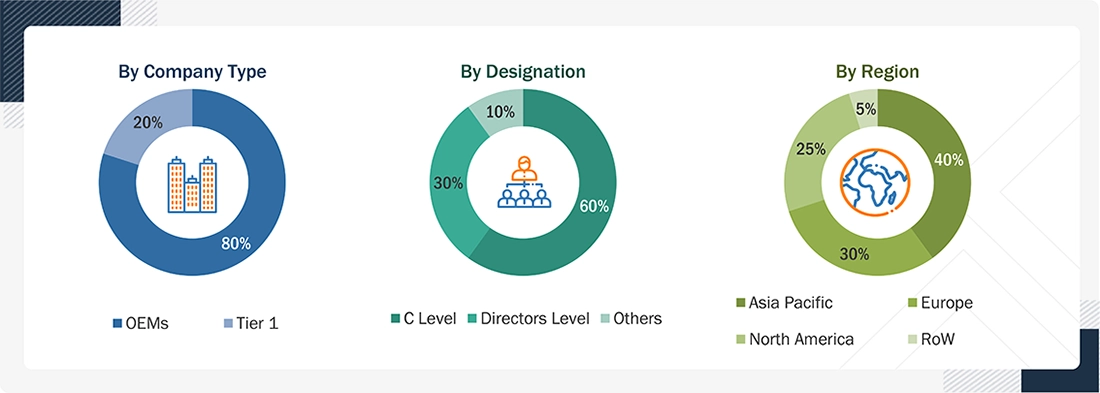
Note: Company types are based on the supply chain, and the value chain is not considered. Other company types include forklift suppliers (OEMs) and distributors. Other designations include sales, marketing, and product managers.
To know about the assumptions considered for the study, download the pdf brochure
Market Size Estimation
Bottom-Up Approach: Forklift MarketA detailed market estimation approach was followed to estimate and validate the value and volume of the Forklift market and other dependent submarkets, as mentioned below:
- Country-level forklift sales in units are derived from secondary sources, industry databases, OEM disclosures, trade associations, and validated through primary interviews.
- The forecast of forklift volumes is estimated leveraging several micro- and macroeconomic factors such as GDP and industrial production growth, warehouse and logistics activity, e-commerce growth, construction activity, fleet replacement cycles, electrification, automation, and technological advancements, among others.
- Country-level sales are segmented by forklift class, including Class 1, Class 2, Class 3 (Class 31 and Class 32), and Class 4/5, based on class-level penetration and available industry data. The derived market size and segment splits are cross-validated through OEM disclosures, industry associations, secondary databases, and primary interviews.
- Total country-level forklift sales are multiplied by the respective penetration of each forklift class to derive forklift market volume by class.
- Forklift volumes are further analyzed by powertrain, including electric and internal combustion engine (IC) forklifts, based on country-level adoption and sales data.
- Forklift demand is analyzed across major applications such as warehousing, manufacturing, logistics, construction, retail, and other material-handling operations, depending on data availability.
- These factors are used to estimate the forklift market volume in units by class, powertrain, and operation for each country.
- Country-level forklift volumes are summed to derive the regional forklift market (Units). Regional markets are further aggregated to derive the global forklift market in volume terms (units).
- Key players in the forklift market were identified through secondary research, and their global market rankings were determined through primary and secondary research.
- The research methodology included the study of annual and quarterly financial reports, regulatory filings of major market players, and interviews with industry experts to gain detailed market insights.
- All major penetration rates, percentage shares, splits, and breakdowns for the forklift market were determined through secondary sources and verified through primary sources.
- All key macro indicators affecting the revenue growth of the market segments and subsegments have been accounted for, viewed in extensive detail, verified through primary research, and analyzed to get the validated and verified quantitative & qualitative data.
- The market data gathered was consolidated and added with detailed inputs, analyzed, and presented in this report.
Top-Down Approach: Forklift Market
The top-down approach has been followed to determine the forklift market size by application, end-use industry, tire type, propulsion, and tonnage capacity in terms of volume and value. The region-wise forklift market volume and value (Asia Pacific, North America, Europe, and Rest of the World) have been derived from the global forklift market. The percentage share of forklifts by application, end-use industry, tire type, propulsion, and tonnage capacity has been derived from secondary sources and validated through primary interviews. It has been further multiplied by the region-wise forklift market volume and value. The forecast has been analyzed based on micro- and macro-economic factors such as countries' economic growth and GDP forecast trends, e-commerce industry growth, emission regulations, supply chain and logistics trends, and technological advancements. The market volume and value for forklifts by application, end-use industry, tire type, propulsion, and tonnage capacity have been derived through this. The summation of all region-wise markets has been done to obtain the total market for forklifts by application, end-use industry, tire type, operation, propulsion, and tonnage capacity in terms of volume (units) and value (USD million).
Forklift Market : Top-Down and Bottom-Up Approach
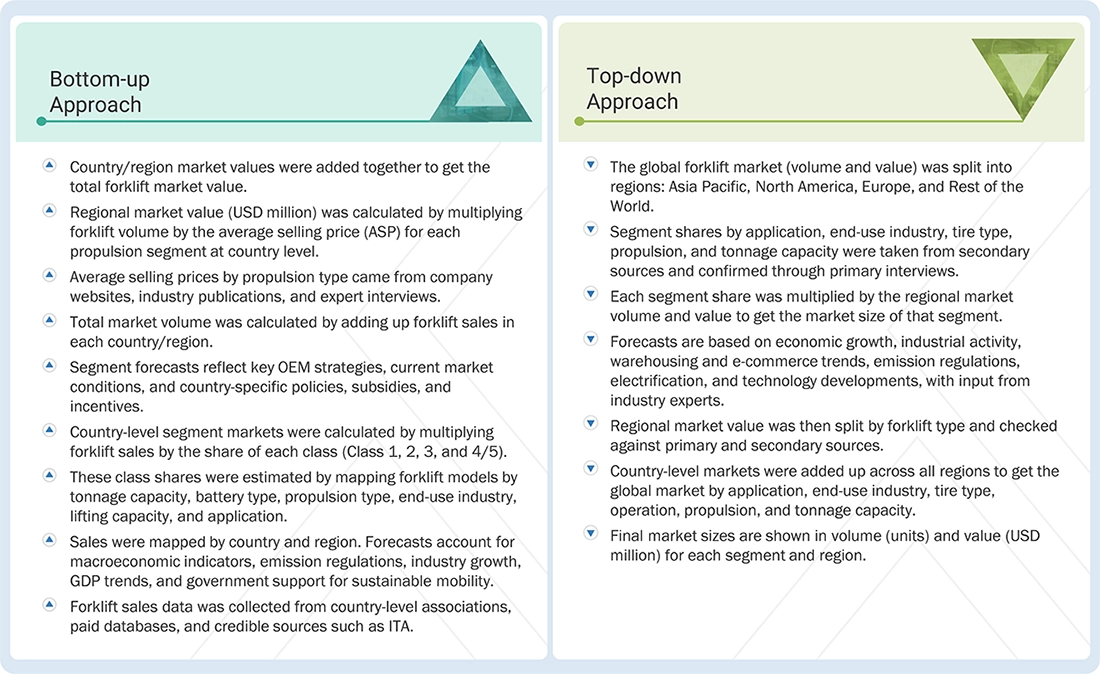
Source: MarketsandMarkets Analysis
Data Triangulation
All percentage shares, splits, and breakdowns have been determined using secondary sources and verified by primary sources. All parameters that affect the markets covered in this research study have been accounted for, viewed in extensive detail, and analyzed to obtain the final quantitative and qualitative data. This data has been consolidated and enhanced with detailed inputs and analysis from MarketsandMarkets and presented in the report. The following figure illustrates the overall market size estimation process employed for this study.
Market Definition
A forklift is an industrial vehicle with an attached, power-operated forked platform that can be raised and lowered to fit underneath cargo to lift or transfer it. Forklifts are used in many industries, including large storage facilities such as warehouses. Combustion engines and electric battery-powered forklifts are available in the market. This equipment is widely utilized throughout various sectors for transporting materials and goods.
Key Stakeholders
- Forklift system manufacturers
- Automation forklift solution & technology providers such as cameras, controllers, sensors, and other component suppliers
- Forklift rental fleet owners
- Forklift dealers and distributors
- Material handling associations, forums, and alliances
- Government agencies and policymakers
- Global industrial vehicle and container handler associations
Report Objectives
-
To define, describe, and forecast the forklift market in terms of value and volume based on the following segments:
- By tonnage capacity (<5 tons, 5–10 tons, 11–36 tons, and >36 tons)
- By application (indoor, outdoor, and indoor & outdoor)
- By class (class 1, class 2, class 3, and class 4/5)
- By end-use industry (third-party logistics (3PL), food & beverages, automotive, pulp & paper, metals and heavy machinery, e-commerce, aviation, semiconductors & electronics, chemicals, healthcare, and other end-use industries)
- By propulsion (electric, ICE, fuel cells)
- By operation (manual and autonomous)
- By type (warehouse and counterbalance)
- Electric forklift, by battery type (lithium-ion and lead-acid)
- Electric forklift market, by lifting capacity (<2 tons, 2–5 tons, and >5 tons)
- By tire type (cushion and pneumatic)
- Electric forklift by lifting capacity (<2 tons, 2–5 tons, and >5 tons)
- By region (Asia Pacific, Europe, North America, and Rest of the World)
- To provide detailed information about the major factors influencing market growth (drivers, challenges, restraints, and opportunities)
- To strategically analyze the market concerning individual growth trends, prospects, and contributions to the total market
- To strategically analyze the competitive landscape, prepare a company evaluation matrix for the players operating in the global market, evaluate the share/rankings based on product footprints of leading market players, and position them on the 2x2 quadrant. Also, analyze the competitive landscape of forklift manufacturers' startups/ SMEs, evaluate them based on product footprint, and position them on the 2x2 quadrant.
- To strategically analyze the market in terms of value chain, case study analysis, patent analysis, revenue analysis, OEM analysis, total cost of ownership, ecosystem analysis, trends/disruptions impacting buyers, pricing analysis, technology analysis, and regulatory analysis in the forklift market.
-
To study the following with respect to the market:
- Supply chain analysis
- Ecosystem analysis
- Technology analysis
- Case study analysis
- Patent analysis
- Regulatory landscape
- Pricing analysis
- Investment and funding scenario
- Key stakeholders and buying criteria
- OEM analysis
- To analyze competitive developments, such as product launches, deals, and other activities by key industry participants
- To examine the opportunities in the market for stakeholders and provide details of the competitive landscape for market leaders
Available Customizations:
With the given market data, MarketsandMarkets offers customizations according to the specific requirements of companies. The following customization options are available for the report:
Company Information
- Profiles of additional market players (up to 5)
Forklift Market by Tonnage Capacity at Country Level (For countries covered in the report)
- <5 Tons
- 5–10 Tons
- 11–36 Tons
- >36 Tons
Get the Full Forklift Market Report
Full forecast, segment splits, and company analysis for all Forklift Market.
- China Forklift Market
- India Forklift Market
- Japan Forklift Market
- South Korea Forklift Market
- UK Forklift Market
- France Forklift Market
- Italy Forklift Market
- Spain Forklift Market
- Russia Forklift Market
- Turkey Forklift Market
- US Forklift Market
- Canada Forklift Market
- Mexico Forklift Market
- Eastern Europe Forklift Market
- Rest Of Europe Forklift Market
Need a Tailored Report?
Customize this report to your needs
Get 10% FREE Customization
Customize This Report