
Canada Forklift Market (2025-2030)

The Canada Forklift Market was valued at $21464 Million in 2025 and projected to reach to $29201 Million by 2030, representing a compound annual growth rate of 4.5%. Canada's forklift market is poised for sustained growth through 2030, driven by expanding warehouse automation, e-commerce fulfillment demands, and manufacturing sector recovery.


| Market Size in | USD 26.32 MN |
| Market Forecast in | |
| CAGR | |
| Forecast Period | |
| Units Considered | Value (USD MN) |
Canada Forklift Market Trends and Insights
- This steady expansion reflects Canada's robust logistics, warehousing, and manufacturing sectors, which continue to drive demand for material handling equipment.
- Canada's strategic position as a North American trade hub and its investment in supply chain modernization support sustained market growth through the forecast period. The Canadian forklift market benefits from increasing e-commerce activity, warehouse automation initiatives, and infrastructure development across major metropolitan areas.
- Canada's adoption of advanced forklift technologies, including electric and autonomous models, is accelerating as businesses prioritize sustainability and operational efficiency.
- Between 2025 and 2030, Canada is expected to see heightened competition among equipment manufacturers and rental service providers, with particular emphasis on fleet electrification and integrated logistics solutions. Canada's market growth trajectory is supported by favorable economic conditions in key sectors such as retail, food and beverage, and automotive manufacturing.
- The country's regulatory environment and labor market dynamics continue to incentivize mechanization and material handling investments, positioning Canada as a significant contributor to North American forklift demand..
Key Market Statistics
- CAGR (2025-2030) 4.5% CAGR
- Market Size, 2025 ~USD 21464 Million
- Forecast, 2030 ~USD 29201 Million
- Country Canada
Canada Forklift Market Overview
Market Valuation :
Canada's forklift market is valued at $21.46 billion USD in 2025, with projections reaching $29.20 billion USD by 2030, demonstrating consistent growth in the material handling sector.
Steady Growth Trajectory :
The Canadian market exhibits a CAGR of 4.5% from 2025 to 2030, outpacing global growth rates and reflecting strong domestic demand driven by logistics and warehousing expansion.
Key Growth Drivers :
Canada's robust manufacturing, e-commerce, and logistics sectors are primary catalysts for forklift demand, supported by strategic North American trade positioning and supply chain investments.
Regional Competitiveness :
As a mature North American market, Canada benefits from advanced infrastructure, skilled workforce availability, and proximity to major U.S. markets, enhancing equipment adoption rates.
Canada Forklift Market Dynamics
- The 4.5% CAGR reflects steady investment in material handling infrastructure across major Canadian logistics hubs in Ontario, Quebec, and British Columbia.
- Increasing adoption of electric and automated forklifts aligns with Canada's sustainability initiatives and labor cost pressures. The market will benefit from cross-border trade dynamics with the United States and growing cold chain logistics requirements.
- Investment in supply chain modernization, particularly in last-mile delivery infrastructure, will sustain demand for diverse forklift categories.
- Regional economic stability and favorable business conditions position Canada as a resilient market for material handling equipment manufacturers and distributors..
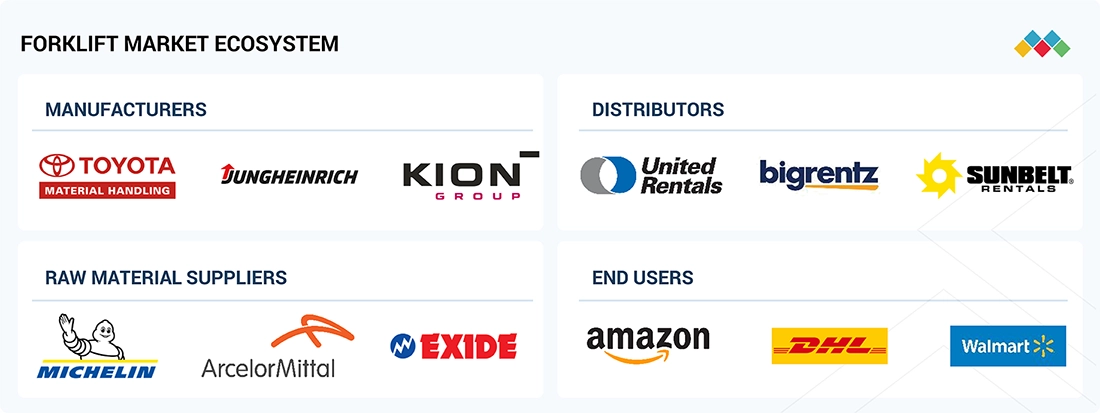
Market Ecosystem
FORKLIFT MARKET: COMMERCIAL USE CASES ACROSS INDUSTRIES
| COMPANY | USE CASE DESCRIPTION | BENEFITS |
|---|---|---|
 |
A wide range of forklifts including electric, internal combustion, and automated models for multiple industries like retail, manufacturing, and logistics. | Known for reliability, energy efficiency, seamless automation integration, and comprehensive customer support across all forklift types. |
 |
Manufactures intralogistics and warehouse automation equipment under brands like Linde, OM, and Baoli, covering diesel and electric forklifts across sectors such as manufacturing and e-commerce | Leads in digitalization and automation, offering solutions that reduce downtime and improve operational efficiency with green energy options. |
 |
Provides electric forklifts tailored for high-performance applications in wholesale, beverage, and manufacturing industries. | Wide product range with models offering high load capacities, energy efficiency, durability, and innovative safety features like regenerative braking. |
 |
Focuses on automated forklifts and lift trucks equipped with advanced automation technologies for warehouse optimization. | Combines advanced safety, operability, and energy efficiency with automation solutions to improve productivity and reduce labor shortages. |
Logos and trademarks shown above are the property of their respective owners. Their use here is for informational and illustrative purposes only.
Related Ecosystem
Logistics And Transportation
- Internal Combustion Engine (ICE)
- Crawler Excavator
- Fuel Cell
- Light Commercial Vehicles (LCVs)
- Sensors
- Siemens ag
- Alstom s.a.
- Hitachi, Ltd.
- Godrej Industries Limited
- ABB India Limited
On Highway Off Highway Vehicles
- Internal Combustion Engine (ICE)
- Agricultural Tractors
- Crawler Excavator
- Battery Electric Vehicle (BEV)
- Excavators
- Visteon Corporation
- Deere & Company
- Honda Motor Co., Ltd.
- AB VOLVO PENTA
- Komatsu Ltd.
Key Takeaways
- Canada's forklift market will expand from $21.46 billion in 2025 to $29.20 billion by 2030 at a 4.5% CAGR.
- E-commerce growth and warehouse automation are primary drivers of forklift demand across Canada.
- Canada is increasingly adopting electric and autonomous forklift technologies to meet sustainability goals.
- Canada's role as a North American logistics hub ensures continued investment in material handling infrastructure.
Forklift Market Report Scope
| Report Metric | Details |
|---|---|
| Base Year | 2025 |
| Fastest Growing Segment | LITHIUM-ION (Battery Type) |
| Forecast Period | 2025–2030 |
| Growth Rate | CAGR of 6.5% from 2025 to 2030 |
| Largest Segment | WAREHOUSE (Product Type) |
| Market Size Base Year (Billions) | ~USD 90.94 (2025) |
| Revenue Forecast (Billions) | ~USD 124.6 (2030) |
| Segments Covered | Propulsion, Tonnage Capacity, End-Use Industry, Class, Operation, Application, Battery Type, Lifting Capacity, Product Type, Tire Type |
Canada Forklift Market Report Segmentation
10 segment dimensions are covered across the global market.
By Propulsion
- Electric
- ICE
By Tonnage Capacity
- 11–36 Tons
- 5–10 Tons
- <5 Tons
- >36 Tons
By End-Use Industry
- Automotive
- Aviation
- Chemicals
- E-Commerce
- Food & Beverages
- Healthcare
- Metals & Heavy Machinery
- Pulp & Paper
- Semiconductors & Electronics
- Third-Party Logistics
By Class
- Class 1
- Class 2
- Class 3
- Class 4/5
By Operation
- Autonomous
- Manual
By Application
- Indoor
- Indoor & Outdoor
- Outdoor
By Battery Type
- Lead Acid
- Lithium-Ion
By Lifting Capacity
- 2–5 Tons
- <2 Tons
- >5 Tons
By Product Type
- Counterbalance
- Warehouse
By Tire Type
- Cushion
- Pneumatic
Target Audience
- Forklift Manufacturers : Manufacturers need Canada-specific market data to assess market size, growth potential, and competitive positioning for product launches, capacity planning, and regional expansion strategies.
- Logistics & Warehousing Companies : Logistics operators require market insights to benchmark equipment investments, understand industry trends, and make informed purchasing decisions for fleet modernization and expansion in Canada.
- Equipment Distributors & Dealers : Canadian distributors need detailed market analysis to identify growth segments, optimize inventory management, forecast demand by region, and develop targeted sales strategies for their territories.
- Private Equity & Investors : Investment firms evaluating Canadian logistics and material handling assets require market sizing, growth forecasts, and sector dynamics to assess investment opportunities and valuation multiples.
- Supply Chain Consultants : Consultants advising Canadian enterprises on supply chain optimization need market data to recommend equipment solutions, benchmark against industry standards, and support capital investment justifications.
Key Companies in the Canada Forklift Market
| Company | HQ | Ownership | Strongest segments |
|---|---|---|---|
| ENERSYS | United States | Public Company | Network & Infrastructure Solutions,Industrial Mobility Solutions,Precision Power Solutions, |
| TOYODA GOSEI CO., LTD | Japan | Public Company | Weatherstrips and body sealing,Interior and exterior plastic parts,Safety systems (airbags, steering wheels), |
| TENNECO | United States | Private Company | Emissions-control / clean air systems,Ride-performance systems (suspension, shocks, related components),Engine components / powertrain systems, |
| ZF FRIEDRICHSHAFEN AG | Germany | Private Company | Passenger car driveline, chassis, and safety systems,Commercial vehicle and bus systems,Industrial driveline and motion systems, |
| TOYOTA INDUSTRIES CORPORATION | Japan | Public Company | Materials handling equipment and warehouse solutions,Automobile-related components (engines, compressors, electronics, batteries),Automobiles and vehicles, |
| KION GROUP AG | Germany | Public Company | Industrial Trucks & Services – New Trucks (forklifts, warehouse trucks, narrow aisle, heavy trucks),Industrial Trucks & Services – Rental, Leasing, Maintenance, Repair, Fleet Management, Finance,Supply Chain Solutions – Automation Systems (AGVs, AS/RS, conveyors, sorters, palletizers), |
| JUNGHEINRICH AG | Germany | Public Company | Material handling equipment (new trucks: pallet, stackers, reach, VNA, forklifts, tow tractors),Automation systems and digital solutions (AGVs, shuttles, stacker cranes, software, mobile robots, PowerCube),Services, rental, and used equipment, |
| MITSUBISHI LOGISNEXT CO., LTD. | Japan | Private Company | Electric forklifts,Engine-powered forklifts,Container carriers and transfer cranes, |
| HYSTER-YALE MATERIALS HANDLING | United States | Public Company | Counterbalance lift trucks (IC and electric),Warehouse trucks and narrow-aisle equipment,Attachments, forks, masts, lift tables (Bolzoni, Auramo, Meyer), |
| CLARK MATERIAL HANDLING COMPANY | United States | Private Company | Forklifts, lift trucks, counterbalanced and reach machines,Parts, service supplies, planned maintenance products,Industrial and power batteries, load wheels, safety and accessories, |
| HYUNDAI CONSTRUCTION EQUIPMENT | South Korea | Public Company | Excavators,Wheel loaders,Backhoe, skid steer, and compact track loaders, |
| KOMATSU LTD. | Japan | Public Company | Construction Machinery and Vehicles,Mining Equipment,Industrial Machinery and Others, |
| BOBCAT COMPANY | South Korea | Public Company | Compact loaders and excavators,Attachments and utility products,Telehandlers, compact tractors, turf and grounds equipment, |
| KALMAR | Finland | Public Company | Container and cargo handling equipment (reach stackers, empty handlers, straddle carriers, spreaders),Forklift trucks and terminal tractors,Services and spare parts (on-call, contract maintenance, lifecycle, refurbishments, upgrades), |
| ANHUI HELI CO., LTD. | China | Public Company | Complete industrial vehicles (IC, electric, lithium, heavy forklifts, port and special vehicles),Spare parts and aftermarket (gearboxes, axles, brakes, hydraulics, attachments, batteries),Intelligent logistics and AGV solutions, |
| BYD COMPANY LTD. | China | Public Company | Automobiles and Related Products,Automobile Power Batteries and Lithium-ion Batteries,Mobile Handset Components, Assembly Service and Other Products, |
ENERSYS
EnerSys is a publicly traded United States company founded in 1991 that employs 9,682 people. The company specializes in energy storage and power conversion solutions.
TOYODA GOSEI CO., LTD
Toyoda Gosei Co., Ltd. is a Japanese public company established in 1949 with 41,304 employees. The company manufactures automotive components and industrial products.
TENNECO
Tenneco is a United States-based private company founded in 1930 with 71,000 employees. The company is a major manufacturer of automotive components and emission control systems.
ZF FRIEDRICHSHAFEN AG
ZF Friedrichshafen AG is a German private company established in 1915 with 145,909 employees. The company is a leading global supplier of driveline and chassis technology.
TOYOTA INDUSTRIES CORPORATION
Toyota Industries Corporation is a Japanese public company founded in 1926 with 81,808 employees. The company manufactures industrial equipment, vehicles, and textile machinery.
KION GROUP AG
KION Group AG is a German public company established in 2006 with 41,974 employees. The company is a leading supplier of industrial trucks and warehouse equipment.
JUNGHEINRICH AG
Jungheinrich AG is a German public company founded in 1953 with 21,438 employees. The company manufactures and distributes material handling equipment and warehouse solutions.
MITSUBISHI LOGISNEXT CO., LTD.
Mitsubishi Logisnext Co., Ltd. is a Japanese private company established in 1937 with 11,161 employees. The company manufactures forklifts and material handling equipment.
HYSTER-YALE MATERIALS HANDLING
Hyster-Yale Materials Handling is a publicly traded United States company founded in 1991 with 7,500 employees. The company manufactures forklifts and other material handling equipment.
CLARK MATERIAL HANDLING COMPANY
Clark Material Handling Company is a United States-based private company founded in 1903 with 249 employees. The company manufactures and distributes material handling equipment.
HYUNDAI CONSTRUCTION EQUIPMENT
Hyundai Construction Equipment is a South Korean public company founded in 1985 with 1,059 employees. The company manufactures construction and material handling equipment.
KOMATSU LTD.
Komatsu Ltd. is a Japanese public company established in 1884 with 67,279 employees. The company manufactures construction equipment, mining machinery, and industrial products.
BOBCAT COMPANY
Bobcat Company is a South Korean public company founded in 1947 with 142 employees. The company manufactures compact equipment and material handling solutions.
KALMAR
Kalmar is a Finnish public company founded in 2024 with 5,290 employees. The company provides cargo handling solutions and equipment.
ANHUI HELI CO., LTD.
Anhui Heli Co., Ltd. is a Chinese public company established in 1958 with 11,419 employees. The company manufactures forklifts and material handling equipment.
BYD COMPANY LTD.
BYD Company Ltd. is a Chinese public company founded in 1994 with 869,600 employees. The company is a major manufacturer of batteries, electric vehicles, and industrial equipment.
Reasons to Buy this Report
- Market-Specific Sizing Data : Access precise valuation figures for Canada's forklift market ($21.46B in 2025) with detailed forecasts through 2030, enabling accurate budget allocation and revenue projections for Canadian operations.
- Competitive Landscape Intelligence : Understand Canada-specific market dynamics, regional competitor positioning, and market share distribution across provinces to identify growth opportunities and competitive threats in your target segments.
- Sector-Specific Insights : Gain detailed analysis of demand drivers across Canadian logistics, warehousing, manufacturing, and e-commerce sectors, with insights into regional variations and emerging opportunities by industry vertical.
- Strategic Market Entry Planning : Leverage Canada-focused market intelligence to develop go-to-market strategies, distribution partnerships, and product positioning tailored to Canadian customer preferences and regulatory requirements.
- Investment Decision Support : Make informed capital allocation decisions with comprehensive Canadian market data, growth trajectory analysis, and risk assessments specific to the North American material handling sector.
Frequently asked questions
What is the current size of Canada's forklift market?
Canada's forklift market is valued at $21.46 billion USD in 2025 and is expected to reach $29.20 billion USD by 2030.
What is the projected growth rate for Canada's forklift market?
Canada's forklift market is projected to grow at a compound annual growth rate (CAGR) of 4.5% from 2025 to 2030.
What factors are driving growth in Canada's forklift market?
Key drivers include e-commerce expansion, warehouse automation, supply chain modernization, and increased adoption of electric and autonomous material handling equipment across Canada.
How is Canada's forklift market responding to sustainability trends?
Canada's forklift market is experiencing accelerated adoption of electric and autonomous forklifts as businesses prioritize environmental compliance and operational efficiency.
Which sectors are the largest consumers of forklifts in Canada?
Retail, food and beverage, automotive manufacturing, and logistics and warehousing sectors are the primary consumers of forklifts in Canada.
RESEARCH METHODOLOGY
The research study involved extensive use of secondary sources such as company annual reports/presentations, industry association publications, industrial vehicle magazine articles, directories, technical handbooks, World Economic Outlook, trade websites, technical articles, and databases to identify and collect information on the forklift market. Primary sources—experts from related industries, including forklift OEMs, battery, and other component suppliers —were interviewed to obtain and verify critical information and assess the growth prospects and market estimations.
Secondary Research
Secondary sources for this research study included corporate filings (such as annual reports, investor presentations, and financial statements), white papers, certified publications, articles by recognized authors, directories, databases, and industry organizations like the Industrial Truck Association (ITA), Material Handling Industry (MHI), and the International Warehouse Logistics Association (IWLA). The secondary data was collected and analyzed to determine the overall market size, which was further validated through primary research.
Primary Research
Primary interviews have been conducted with market experts from demand (OEM) and supply-side players across four major regions: North America, Europe, Asia Pacific, and the Rest of the World. Approximately 20% of interviews have been conducted from the demand side (end-users such as warehouses, distribution centers, logistics hubs, etc.), while 80% of primary interviews have been conducted from the supply side (OEMs). The primary data was collected through questionnaires, e-mails, and telephone interviews. In the canvassing of primaries, various departments within organizations, such as sales and operations, have been covered to provide a holistic viewpoint in this report.
After interacting with industry experts, brief sessions with highly experienced independent consultants were conducted to reinforce the findings from primary interviews. This, along with the opinions of the in-house subject matter experts, led to the findings described in the remainder of this report.

Note: Company types are based on the supply chain, and the value chain is not considered. Other company types include forklift suppliers (OEMs) and distributors. Other designations include sales, marketing, and product managers.
To know about the assumptions considered for the study, download the pdf brochure
Market Size Estimation
Market Size Estimation Methodology-Bottom-up approach
The bottom-up approach has been used to estimate and validate the size of the forklift market. In this approach, the country-level sales of forklifts (in units) have been derived from secondary sources and various databases and validated through primary interviews. Further, the country-level penetration of forklifts by class (Class 1, Class 2, Class 3 (Class 31 & Class 32), and Class 4/5) has been derived. The country-level sales of forklifts (in units) have been further multiplied by the penetration of each forklift class type. The forecast has been analyzed based on micro and macro-economic factors such as countries' economic growth and GDP forecast trends, e-commerce industry growth, emission regulations, supply chain and logistics trends, and technological advancements. Through this, the forklift market volume, by class, has been derived for each country. The summation of country-level markets provided the regional-level markets. The further summation of regional-level markets provided the global forklift market in terms of volume (units) by region and class. A similar approach has been followed to analyze the country-level forklift market, by operation.
Market Size Estimation Methodology- Top-down approach
The top-down approach has been followed to determine the market size by application, end-use industry, tire type, propulsion, and tonnage capacity in terms of volume and value for forklifts. The region-wise forklift market volume and value (Asia Pacific, North America, Europe, and the Rest of the World) have been derived from the global forklift market. The percentage share of forklifts by application, end-use industry, tire type, propulsion, and tonnage capacity has been derived from secondary sources and validated through primaries. It has been further multiplied by the region-wise forklift market volume and value. The forecast has been analyzed based on micro and macro-economic factors such as countries' economic growth and GDP forecast trends, e-commerce industry growth, emission regulations, supply chain and logistics trends, and technological advancements. The market volume and value for forklifts by application, end-use industry, tire type, propulsion, and tonnage capacity have been derived through this. The summation of all region-wise markets has been carried out to obtain the total market for forklifts by application, end-use industry, tire type, operation, propulsion, and tonnage capacity in terms of volume (units) and value (USD million).
Forklift Market : Top-Down and Bottom-Up Approach

Data Triangulation
All percentage shares, splits, and breakdowns have been determined using secondary sources and verified by primary sources. All parameters that affect the markets covered in this research study have been accounted for, viewed in extensive detail, and analyzed to obtain the final quantitative and qualitative data. This data has been consolidated and enhanced with detailed inputs and analysis from MarketsandMarkets and presented in the report. The following figure illustrates the overall market size estimation process employed for this study.
Market Definition
A forklift is an industrial vehicle with an attached, power-operated forked platform that can be raised and lowered to fit underneath cargo to lift or transfer it. Forklifts are used in many industries, including big storage facilities like warehouses. Combustion engines and electric battery-powered forklifts are available in the market. This equipment is widely utilized throughout various sectors for transporting materials and goods.
Stakeholders
- Forklift System Manufacturers and Suppliers
- Forklift Cameras, Controllers, Sensors, and Other Component Suppliers
- Forklift Technology Providers
- Forklift Rental Fleet Owners
- Forklift Dealers and Distributors
- Autonomous Forklift Solution Providers
- Material Handling Associations, Forums, and Alliances
- Government Agencies and Policymakers
- Global Industrial Vehicle and Container Handler Associations
Report Objectives
-
To define, describe, and forecast the forklift market in terms of value and volume based on the following segments:
- By tonnage capacity (below 5 tons, 5–10 tons, 11–36 tons, and above 36 tons)
- By application (indoor, outdoor, and indoor & outdoor)
- By class (Class 1, Class 2, Class 3, and Class 4/5)
- By end-use industry (Third-party logistics (3PL), food & beverage, automotive, pulp & paper, metals and heavy machinery, e-commerce, aviation, semiconductors & electronics, chemicals, healthcare, and others)
- By propulsion (electric, ICE, fuel cells)
- By operation (manual and autonomous)
- By type (warehouse and counterbalance)
- Electric forklift, by battery type (lithium-ion and lead-acid)
- Electric forklift market, by lifting capacity (below 2 tons, 2–5 tons, above 5 tons)
- By tire type (cushion and pneumatic)
- Electric Forklift by Lifting Capacity (Below 2 tons, 2–5 tons, and Above 5 tons)
- By region (Asia Pacific, Europe, North America, and the Rest of the World)
- To provide detailed information about the major factors influencing market growth (drivers, challenges, restraints, and opportunities)
- To strategically analyze the market concerning individual growth trends, prospects, and contributions to the total market
- To strategically analyze the competitive landscape, prepare a company evaluation matrix for the players operating in the global market, evaluate the share/rankings based on product footprints of leading market players, and position them on the 2x2 quadrant. Also, analyze the competitive landscape of forklift manufacturers' start-ups/ SMEs, evaluate them based on product footprint, and position them on the 2x2 quadrant
- To strategically analyze the market in terms of value chain, case study analysis, patent analysis, revenue analysis, OEM analysis, total cost of ownership, ecosystem analysis, trends/disruptions impacting buyers, pricing analysis, technology analysis, and regulatory analysis in the forklift market
- To track and analyze competitive developments, such as product launches, deals, and other activities by key industry participants
- To examine the opportunities in the market for stakeholders and provide details of the competitive landscape for market leaders
Available Customizations
With the given market data, MarketsandMarkets offers customizations according to the specific requirements of companies. The following customization options are available for the report:
Product Analysis
- Profiles of additional market players (up to 5)
FORKLIFT MARKET BY TONNAGE CAPACITY AT COUNTRY LEVEL (For countries covered in the report)
- Below 5 Tons
- 5–10 Tons
- 11–36 Tons
- Above 36 Tons
Get the Full Forklift Market Report
Full forecast, segment splits, and company analysis for all Forklift Market.
Need a Tailored Report?
Customize this report to your needs
Get 10% FREE Customization
Customize This Report
