
China Fraud Detection and Prevention (FDP) Market (2026-2031)

The China Fraud Detection and Prevention (FDP) Market was valued at $2303.7 Million in 2026 and projected to reach to $5770.2 Million by 2031, representing a compound annual growth rate of 20.2%. China's Fraud Detection and Prevention market is positioned for exceptional growth, expanding from USD 2,303.7 million in 2026 to USD 5,770.2 million by 2031.


| Market Size in | USD 26.32 MN |
| Market Forecast in | |
| CAGR | |
| Forecast Period | |
| Units Considered | Value (USD MN) |
China Fraud Detection and Prevention (FDP) Market Trends and Insights
- This accelerated growth in China reflects the nation's rapid digital transformation, increasing e-commerce penetration, and heightened regulatory scrutiny across financial services and fintech sectors.
- China's large population and expanding digital payment ecosystem create substantial demand for advanced fraud prevention solutions. Driving China's market momentum are regulatory mandates from authorities such as the China Banking and Insurance Regulatory Commission (CBIRC), coupled with rising cybercrime sophistication targeting China's financial institutions and consumers.
- China's investment in artificial intelligence and machine learning technologies has positioned domestic vendors competitively, while international players continue to expand operations to capture market share.
- The forecast period through 2031 indicates China will remain a critical growth engine within the Asia Pacific region, as enterprises across banking, e-commerce, and digital payments prioritize fraud mitigation strategies..
Key Market Statistics
- CAGR (2026-2031) 20.2% CAGR
- Market Size, 2026 ~USD 2303.7 Million
- Forecast, 2031 ~USD 5770.2 Million
- Country China
China Fraud Detection and Prevention (FDP) Market Overview
Rapid Market Expansion :
China's FDP market is growing at 20.2% CAGR, significantly outpacing the global rate of 17.5%, driven by massive digital transformation and e-commerce proliferation across the nation.
Regulatory Compliance Pressure :
Heightened regulatory scrutiny from Chinese authorities is compelling financial institutions, fintech companies, and payment processors to invest heavily in advanced fraud detection solutions.
E-Commerce Dominance :
China's world-leading e-commerce sector generates unprecedented transaction volumes, creating critical demand for real-time fraud prevention systems to protect merchants and consumers.
Financial Technology Innovation :
The rise of mobile payments, digital wallets, and fintech platforms in China necessitates sophisticated FDP technologies to combat evolving fraud schemes and maintain consumer trust.
China Fraud Detection and Prevention (FDP) Market Dynamics
- This trajectory reflects the country's digital-first economy, where e-commerce transactions, mobile banking, and fintech adoption create substantial fraud risks requiring advanced detection capabilities.
- Government mandates for financial security and data protection further accelerate market penetration across banking, insurance, and payment sectors. The competitive landscape in China will intensify as both domestic technology providers and international vendors vie for market share.
- Investment in artificial intelligence, machine learning, and behavioral analytics will become essential differentiators.
- Regional players leveraging localized compliance expertise and integration with China's unique payment ecosystems will capture significant opportunities, while the market's growth trajectory remains among the fastest globally..
Market Ecosystem
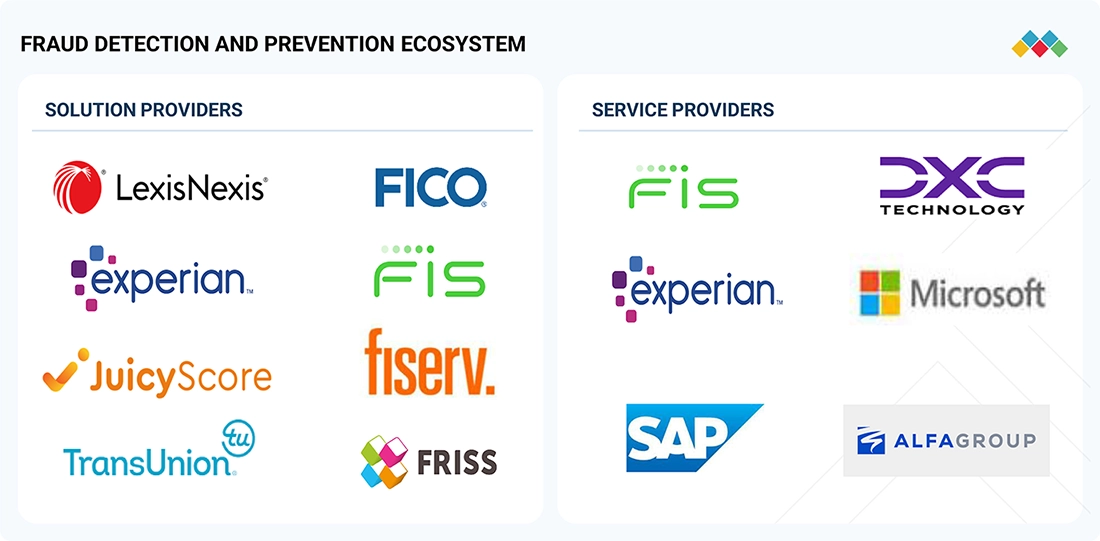
FRAUD DETECTION AND PREVENTION (FDP) MARKET: COMMERCIAL USE CASES ACROSS INDUSTRIES
| COMPANY | USE CASE DESCRIPTION | BENEFITS |
|---|---|---|
 |
Cross River Bank implemented Alloy's identity decisioning platform to automate customer onboarding, unify identity verification, fraud detection, and compliance checks, enabling faster account opening while managing fraud risk across digital banking channels. | Faster digital customer onboarding | Improved fraud detection and identity verification | Reduced manual reviews and operational costs | Enhanced AML/KYC compliance |
 |
UNA Financial deployed JuicyScore's JuicyID solution to strengthen digital identity verification and fraud detection by leveraging device intelligence and behavioral analytics to assess customer risk during loan origination. | Reduced operational risks from fraudulent applications | Improved identity verification accuracy | Faster lending decisions | Lower fraud losses while maintaining customer experience |
 |
Bank Mandiri implemented FICO Falcon Fraud Manager to strengthen payment card fraud detection using AI driven analytics, real time transaction monitoring, and adaptive fraud models across its card portfolio. | Improved fraud detection accuracy | Reduced card fraud losses | Faster real time fraud identification | Enhanced customer experience with fewer false positives |
 |
Dime Community Bank collaborated with Fiserv to enhance its Card Expert platform, improving card fraud management capabilities through advanced monitoring, analytics, and operational enhancements that support proactive fraud prevention. | Enhanced card fraud monitoring and prevention | Improved fraud investigation efficiency | Better operational visibility into fraud events | Strengthened customer protection and payment security |
Logos and trademarks shown above are the property of their respective owners. Their use here is for informational and illustrative purposes only.
Related Ecosystem
Bfsi Security
- Multi-Factor Authentication
- Single-Factor Authentication
- Biometric Systems
- Fraud Analytics
- Application Integration
- International Business Machines Corporation
- Fiserv, Inc.
- ROLAND BERGER
- FINASTRA
- MICROSOFT CORPORATION
Insurance
- Cloud Security
- Security Analytics
- Battery Electric Vehicle (BEV)
- Big Data Analytics
- Black Box
- International Business Machines Corporation
- ROLAND BERGER
- MICROSOFT CORPORATION
- SAP SE
- Oracle Corporation
Cyber Security
- Cloud Security
- Biometric Systems
- Data Loss Prevention (DLP)
- Multi-Factor Authentication
- Security Analytics
- REDINGTON
- International Business Machines Corporation
- Cisco Systems, Inc.
- MITSUI BUSSAN SECURE DIRECTIONS INC
- MICROSOFT CORPORATION
Key Takeaways
- China's FDP market will grow from USD 2,303.7M (2026) to USD 5,770.2M (2031) at a 20.2% CAGR, outpacing global growth.
- Regulatory pressure and digital payment expansion are primary catalysts driving fraud prevention adoption across China's financial ecosystem.
- China's AI and machine learning capabilities enable domestic vendors to compete globally while addressing localized fraud threats.
- By 2031, China will represent a dominant market within Asia Pacific, attracting both regional and international FDP solution providers.
Fraud Detection and Prevention (FDP) Market Report Scope
| Report Metric | Details |
|---|---|
| Base Year | 2026 |
| Fastest Growing Segment | INSIDER FRAUD (Fraud Type) |
| Forecast Period | 2026-2031 |
| Growth Rate | CAGR of 17.5% from 2026 to 2031 |
| Largest Segment | SOLUTIONS (Offering) |
| Market Size Base Year (Billions) | ~USD 35.72 (2026) |
| Revenue Forecast (Billions) | ~USD 80.01 (2031) |
| Segments Covered | Fraud Type, Offering, Solution, Service, Deployment Mode, Functionality, Organization Size, Vertical, Bfsi Type, Services |
China Fraud Detection and Prevention (FDP) Market Report Segmentation
10 segment dimensions are covered across the global market.
By Fraud Type
- Check Fraud
- Friendly Fraud
- Identity Fraud
- Insider Fraud
- Insurance Fraud
- Investment Fraud
- Other Fraud Types
- Payment Fraud
By Offering
- Services
- Solution
- Solutions
By Solution
- Authentication
- Fraud Analytics
- Governance, Risk & Compliance
- Governance, Risk & Compliance (Grc)
- Governance, Risk, & Compliance
By Service
- Managed Services
- Professional Services
By Deployment Mode
- Cloud
- Hybrid
- On-Premises
By Functionality
- Fraud Investigation & Case Management
- Real-Time Detection
By Organization Size
- Large Enterprises
- Smes
By Vertical
- Bfsi
- Government
- Healthcare
- Manufacturing
- Other Verticals
- Real Estate
- Retail & Ecommerce
- Telecommunications
- Travel & Transportation
By Bfsi Type
- Banking
- Financial Services
- Insurance
By Services
- Managed Services
- Professional Services
Target Audience
- Fintech & Payment Companies : Chinese and international fintech firms need market intelligence to understand fraud prevention investment requirements, competitive threats, and regulatory compliance obligations in China's rapidly evolving digital payment ecosystem.
- Financial Institutions : Banks and insurance companies operating in China require data-driven insights to justify FDP technology investments, benchmark against competitors, and align fraud prevention strategies with regulatory mandates.
- Technology Vendors & Solution Providers : FDP software and AI/ML solution providers need China-specific market analysis to identify customer segments, assess market penetration opportunities, and develop localized product strategies for this high-growth region.
- Private Equity & Investors : Investment firms evaluating opportunities in China's cybersecurity and fintech sectors require validated market sizing and growth forecasts to support due diligence, valuation models, and portfolio decisions.
- Government & Policy Makers : Chinese regulatory bodies and policy organizations benefit from comprehensive market data to assess industry health, inform cybersecurity initiatives, and develop evidence-based financial security regulations.
Reasons to Buy this Report
- Market Size & Growth Validation : Quantified market data for China showing USD 2,303.7M (2026) to USD 5,770.2M (2031) validates investment decisions and helps stakeholders understand the scale of opportunity in this high-growth region.
- Competitive Positioning Intelligence : Understand China-specific market dynamics, regulatory requirements, and competitive landscape to develop targeted go-to-market strategies and identify partnership opportunities with local players.
- Regulatory & Compliance Insights : Gain clarity on China's evolving regulatory framework driving FDP adoption, enabling compliance-focused organizations to align product development and sales strategies with local requirements.
- Sector-Specific Opportunity Mapping : Identify high-growth segments within China's banking, fintech, e-commerce, and payment sectors to prioritize resource allocation and maximize ROI in this critical Asian market.
- Strategic Planning & Forecasting : Leverage 5-year projections and CAGR analysis to inform long-term business planning, investment decisions, and market entry strategies specific to China's unique digital economy.
Frequently asked questions
What is the projected market size of China's FDP market in 2031?
China's Fraud Detection and Prevention market is forecast to reach USD 5,770.2 million by 2031, growing from USD 2,303.7 million in 2026.
What is the CAGR for China's FDP market between 2026 and 2031?
China's FDP market is expected to grow at a compound annual growth rate (CAGR) of 20.2% from 2026 to 2031.
What are the primary drivers of fraud detection growth in China?
Key drivers include regulatory mandates from CBIRC, rapid e-commerce and digital payment expansion, rising cybercrime sophistication, and China's advanced AI and machine learning capabilities.
How does China's FDP market growth compare to global trends?
China's 20.2% CAGR significantly exceeds the global FDP market CAGR of 17.5%, positioning China as a high-growth region within the Asia Pacific segment.
Which sectors are driving FDP adoption in China?
Banking, fintech, e-commerce, digital payments, and insurance sectors are primary adopters of fraud detection and prevention solutions in China.
RESEARCH METHODOLOGY
Secondary research was conducted to collect information useful for this technical, market-oriented, and commercial study of the fraud detection and prevention (FDP) market. The next step involved validating these findings, assumptions, and sizing with industry experts across the value chain using primary research. Different approaches, including top-down and bottom-up methods, were employed to estimate the total market size. After that, the market breakup and data triangulation procedures were used to estimate the market size of the segments and subsegments of the FDP market.
Secondary Research
During the secondary research process, various secondary sources were consulted to identify and collect information relevant to the study. The secondary sources included annual reports, press releases, investor presentations of FDP vendors, forums, certified publications, and whitepapers. The secondary research was mainly used to obtain key information about the industry’s supply chain, the total pool of key players, market classification and segmentation according to industry trends to the bottom-most level, regional markets, and key developments from both market- and technology-oriented perspectives, all of which were further validated by primary sources.
Primary Research
In the primary research process, various primary sources from both the supply and demand sides were interviewed to obtain qualitative and quantitative information for this report. The primary sources from the supply side included industry experts such as chief executive officers (CEOs), vice presidents (VPs), marketing directors, technology and innovation directors, and other key executives from major companies and organizations operating in the FDP market.
In the market engineering process, top-down and bottom-up approaches were extensively used, along with several data triangulation methods, to estimate and forecast the overall market segments and subsegments listed in this report. Extensive qualitative and quantitative analyses were conducted across the entire market engineering process to present key information/insights throughout the report.
After the complete market engineering process (including calculations for market statistics, market breakups, market size estimates, market forecasts, and data triangulation), extensive primary research was conducted to gather information and verify & validate the derived critical numbers. The primary research was also conducted to identify segmentation types, industry trends, the competitive landscape of FDP market players, and key market dynamics, including drivers, restraints, opportunities, challenges, and key strategies.
The following is the breakup of the primary study:
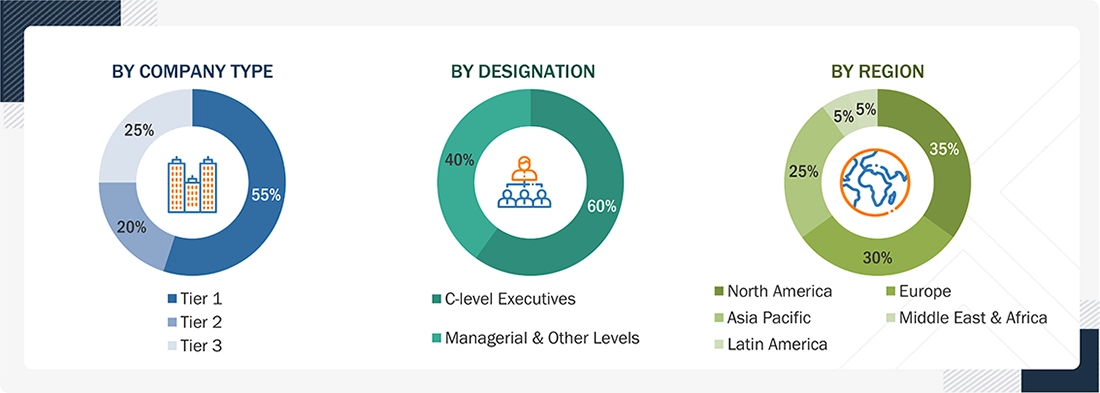
Note: Tier 1 companies receive revenues higher than USD 10 billion; Tier 2 companies' revenues range between USD 1 and 10 billion; and Tier 3 companies' revenues range between USD 500 million and USD 1 billion. Other designations include sales, marketing, and product managers.
To know about the assumptions considered for the study, download the pdf brochure
Market Size Estimation
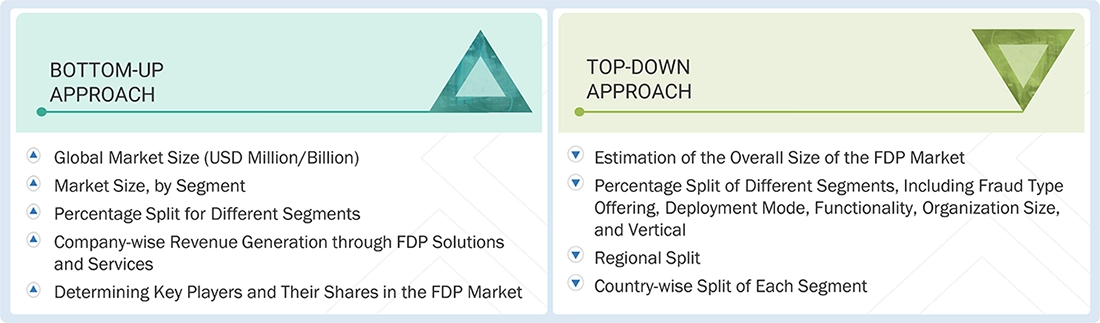
Top-down and bottom-up approaches were employed to estimate and validate the size of the FDP market and of various dependent subsegments within it. The research methodology used to estimate the market size includes the following: critical players in the market were identified through secondary research, and their market shares in the respective regions were determined through both primary and secondary research. This procedure involved analyzing the annual and financial reports of the top market players and conducting extensive interviews with key industry leaders, including CEOs, VPs, directors, and marketing executives, to gather valuable insights.
All percentage splits and breakdowns were determined using secondary sources and verified through primary sources. All parameters that affect the market covered in this study were accounted for, examined in detail, verified through primary research, and analyzed to obtain final quantitative and qualitative data. This data was consolidated with detailed inputs and analysis from MarketsandMarkets.
Fraud Detection and Prevention (FDP) Market : Top-Down and Bottom-Up Approach
Data Triangulation
The market was divided into several segments and subsegments after determining the overall market size using the market size estimation processes explained above. Data triangulation and market breakup procedures were employed, where applicable, to complete the overall market engineering process and arrive at the exact statistics for each market segment and subsegment. The data was triangulated by studying various factors and trends from both the demand and supply sides.
Market Definition
According to MarketsandMarkets, “FDP is the process of finding fraudulent activity in a system and utilizing the resources to mitigate those risks is termed fraud detection and utilizing automated tools and predictive analytics methods to discover the vulnerability is termed fraud prevention”.
Key Stakeholders
- Chief Technology and Data Officers
- Anti-Fraud Service Professionals
- Business Analysts
- Information Technology (IT) Professionals
- Government Agencies
- Investors And Venture Capitalists
- Small and Medium-Sized Enterprises (SMEs) and Large Enterprises
- Third-party Service Providers
- Consultants/Consultancies/Advisory Firms
- Managed And Professional Service Providers
Report Objectives
- To describe and forecast the FDP market by offering, fraud type, functionality, deployment mode, organization size, vertical, and region, as well as analyze the various macroeconomic and microeconomic factors that affect market growth
- To forecast the market size of five major regions: North America, Europe, Asia Pacific, the Middle East & Africa, and Latin America
- To analyze the subsegments of the market concerning individual growth trends, prospects, and contributions to the overall market
- To provide detailed information related to the primary factors (drivers, restraints, opportunities, and challenges) influencing the growth of the FDP market
- To analyze opportunities in the market for stakeholders by identifying high-growth segments of the FDP market
- To profile the key players of the FDP market and comprehensively analyze their market size and core competencies
- To analyze competitive developments, such as product launches, mergers and acquisitions, partnerships, agreements, and collaborations in the global FDP market
Available customizations:
With the given market data, MarketsandMarkets offers customizations based on company-specific needs. The following customization options are available for the report:
Product Analysis
- Product matrix, which gives a detailed comparison of the product portfolio of each company
Regional Analysis
- Further breakdown of the Asia Pacific market, by country
- Further breakdown of the North American market, by country
- Further breakdown of the Latin American market, by country
- Further breakdown of the Middle Eastern & African market, by country
- Further breakdown of the European market, by country
Company Information
- Detailed analysis and profiling of additional market players (up to 5)
Get the Full Fraud Detection and Prevention (FDP) Market Report
Full forecast, segment splits, and company analysis for all Fraud Detection and Prevention (FDP) Market.
- US Fraud Detection and Prevention (FDP) Market
- Canada Fraud Detection and Prevention (FDP) Market
- UK Fraud Detection and Prevention (FDP) Market
- Germany Fraud Detection and Prevention (FDP) Market
- France Fraud Detection and Prevention (FDP) Market
- Spain Fraud Detection and Prevention (FDP) Market
- Italy Fraud Detection and Prevention (FDP) Market
- Poland Fraud Detection and Prevention (FDP) Market
- Ireland Fraud Detection and Prevention (FDP) Market
- Czech Republic Fraud Detection and Prevention (FDP) Market
- Japan Fraud Detection and Prevention (FDP) Market
- India Fraud Detection and Prevention (FDP) Market
- Singapore Fraud Detection and Prevention (FDP) Market
- UAE Fraud Detection and Prevention (FDP) Market
- South Africa Fraud Detection and Prevention (FDP) Market
- Brazil Fraud Detection and Prevention (FDP) Market
- Mexico Fraud Detection and Prevention (FDP) Market
- Colombia Fraud Detection and Prevention (FDP) Market
- Rest Of Europe Fraud Detection and Prevention (FDP) Market
- Anz Fraud Detection and Prevention (FDP) Market
- Rest Of Asia Pacific Fraud Detection and Prevention (FDP) Market
- Rest Of Latam Fraud Detection and Prevention (FDP) Market
- GCC Fraud Detection and Prevention (FDP) Market
- Ksa Fraud Detection and Prevention (FDP) Market
- Rest Of GCC Fraud Detection and Prevention (FDP) Market
Need a Tailored Report?
Customize this report to your needs
Get 10% FREE Customization
Customize This Report
