
UK Fuel Cell Market (2025-2030)

The UK Fuel Cell Market was valued at $37 Million in 2025 and projected to reach to $122.7 Million by 2030, representing a compound annual growth rate of 27.1%. The UK fuel cell market is poised for accelerated growth through 2030, driven by the government's hydrogen strategy and net-zero commitments.


| Market Size in | USD 26.32 MN |
| Market Forecast in | |
| CAGR | |
| Forecast Period | |
| Units Considered | Value (USD MN) |
UK Fuel Cell Market Trends and Insights
- The UK's commitment to decarbonization and hydrogen economy development is driving significant investment in fuel cell technologies across transport, stationary power, and portable applications.
- Government incentives and regulatory frameworks supporting clean energy adoption are positioning the UK as a key European hub for fuel cell innovation and deployment. The UK fuel cell market's 27.1% compound annual growth rate reflects accelerating demand for zero-emission solutions in the UK's industrial and mobility sectors.
- By 2030, the UK is expected to see widespread commercialization of fuel cell systems, supported by expanding hydrogen infrastructure and manufacturing capabilities.
- The UK's strategic focus on achieving net-zero emissions by 2050 underpins sustained market momentum through the forecast period..
Key Market Statistics
- CAGR (2025-2030) 27.1% CAGR
- Market Size, 2025 ~USD 37 Million
- Forecast, 2030 ~USD 122.7 Million
- Country UK
UK Fuel Cell Market Overview
Strong Market Growth :
The UK fuel cell market is projected to grow from $37.0 million in 2025 to $122.7 million by 2030, representing a robust CAGR of 27.1%, significantly outpacing global growth rates.
Government Hydrogen Strategy :
The UK government's commitment to hydrogen economy development and decarbonization targets is driving substantial investment in fuel cell infrastructure and technology deployment across multiple sectors.
Multi-Sector Applications :
UK fuel cell adoption spans transport, stationary power generation, and portable applications, with particular momentum in heavy-duty vehicles, industrial backup power, and distributed energy systems.
Regulatory Support Framework :
Favorable regulatory frameworks and government incentives are accelerating fuel cell commercialization, positioning the UK as a leading European hub for clean energy technology innovation and deployment.
UK Fuel Cell Market Dynamics
- Investment in hydrogen production infrastructure, coupled with declining fuel cell costs, will expand market penetration across commercial transport, industrial applications, and grid-scale power generation.
- The UK's regulatory environment and clean energy incentives create a favorable ecosystem for technology adoption and supply chain development. Key growth catalysts include increased fleet electrification in heavy transport, expansion of hydrogen refueling networks, and rising demand for zero-emission industrial solutions.
- Strategic partnerships between government, industry, and technology providers will accelerate commercialization timelines.
- By 2030, the UK fuel cell market will establish itself as a critical component of the nation's energy transition strategy..
Market Ecosystem

Fuel Cell Market: COMMERCIAL USE CASES ACROSS INDUSTRIES
| COMPANY | USE CASE DESCRIPTION | BENEFITS |
|---|---|---|
 |
Walmart aimed for 100% renewable energy while keeping costs low, needing reliable, continuous, and scalable clean energy that withstands outages and meets sustainability standards. Traditional power was carbon-heavy and unreliable, risking operations and safety. The solution had to be scalable across many facilities without major upgrades. | Walmart installed Bloom Energy Servers—solid oxide fuel cells—at many stores and distribution centers, mostly powered by biogas. These systems now provide 60–75% of their electricity, offering year-round, low-carbon, cost-effective power during grid failures. With over 40 Bloom units in California, their modular design allowed quick deployment and scalability. The system's reliable performance and predictable costs help Walmart with energy planning and budgeting. |
 |
Southern Linc, a subsidiary of Southern Company, was deploying over 1,300 LTE Advanced cell sites to improve its network across the Southeast US. These sites needed reliable backup power for service during storms and outages. Diesel generators used at several sites also faced operational issues, including refueling, maintenance, noise, and emissions, which conflicted with Southern Linc's goal of a modern, efficient, and eco-friendly solution. | Southern Linc partnered with Plug Power to deploy 500 GenSure hydrogen fuel cell backup systems in outdoor-rated cabinets, combining fuel cell power, DC systems, and LTE in a compact, space-saving design needing up to 87% less site space than diesel or battery solutions. Plug Power also provided GenFuel hydrogen delivery, enabling automated, onsite fueling that eliminated manual refueling. The solution achieved 99.6% uptime, cut annual O&M costs by 64%, required less maintenance than traditional generators, and reduced environmental impact with silent, zero-emission operation. It also improved response times during weather crises, such as Hurricane Irma, showcasing resilience. |
Logos and trademarks shown above are the property of their respective owners. Their use here is for informational and illustrative purposes only.
Related Ecosystem
Decarbonization
- Battery Electric Vehicle (BEV)
- Energy Management Systems
- Fuel Cell
- Fuel Cell Electric Vehicle (FCEV)
- Geographical Information System (GIS)
- TotalEnergies SE
- Siemens ag
- Mitsui & Co., Ltd.
- General Electric Company
- Thyssenkrupp ag
Key Takeaways
- The UK fuel cell market will grow from $37.0M (2025) to $122.7M (2030) at a 27.1% CAGR.
- The UK's hydrogen strategy and net-zero commitments are primary catalysts for fuel cell adoption.
- The UK is emerging as a leading European center for fuel cell manufacturing and deployment.
- Transport and industrial applications represent the largest growth opportunities in the UK market.
Fuel Cell Market Report Scope
| Report Metric | Details |
|---|---|
| Base Year | 2025 |
| Fastest Growing Segment | UTILITIES & GOVERNMENT/MUNICIPAL INSTITUTES (End User) |
| Forecast Period | 2025–2030 |
| Growth Rate | CAGR of 26.3% from 2025 to 2030 |
| Largest Segment | HYDROGEN (Fuel Type) |
| Market Size Base Year (Billions) | ~USD 5.65 (2025) |
| Revenue Forecast (Billions) | ~USD 18.16 (2030) |
| Segments Covered | Type, Application, Component, Size, Fuel Type, Application Type, End User |
UK Fuel Cell Market Report Segmentation
7 segment dimensions are covered across the global market.
By Type
- Alkaline
- Direct Methanol
- Microbial
- Phosphoric Acid
- Proton Exchange Membrane
- Proton-Exchange Membrane
- Solid Oxide
By Application
- Fuel Cell Vehicles
- Portable
- Stationary
By Component
- Balance Of Plant (Bop)
- Stack
By Size
- Large-Scale (Above 200 Kw)
- Small-Scale (Up To 200 Kw)
By Fuel Type
- Ammonia
- Hydrogen
- Methanol
- Other Fuel Types
By Application Type
- Backup Power Systems
- Chp Systems
- Fuel Cell Buses
- Fuel Cell Trucks
- Other Fuel Cell Vehicles
- Passenger Light Duty Fuel Cell Vehicles
- Passenger Light-Duty Fuel Cell Vehicles
- Primary Power Generation Systems
By End User
- Commercial & Industrial
- Data Center
- Data Centers
- Military & Defense
- Residential
- Transportation
- Utilities & Government/Municipal Institutes
UK: FUEL CELL MARKET, BY END USER, 2025–2030
| Segment | 2025 | 2026 | 2027 | 2028 | 2029 | 2030 | CAGR (%) |
|---|---|---|---|---|---|---|---|
| COMMERCIAL & INDUSTRIAL | 11.62 | 14.75 | 19.05 | 23.6 | 30.22 | 38.16 | 26.8 |
| DATA CENTER | 6.63 | 8.36 | 10.72 | 13.19 | 16.78 | 21.03 | 26 |
| MILITARY & DEFENSE | 4.52 | 5.54 | 6.92 | 8.28 | 10.23 | 12.44 | 22.5 |
| RESIDENTIAL | 4.44 | 5.55 | 7.07 | 8.63 | 10.9 | 13.56 | 25 |
| TRANSPORTATION | 14.85 | 19.03 | 24.81 | 31.02 | 40.08 | 51.06 | 28 |
| UTILITIES & GOVERNMENT/MUNICIPAL INSTITUTES | 3.51 | 4.49 | 5.84 | 7.29 | 9.4 | 11.94 | 27.8 |
| TOTAL | 45.56 | 57.72 | 74.4 | 92.01 | 117.6 | 148.19 | 26.6 |
Target Audience
- Energy & Utilities Companies : UK energy providers need market intelligence to develop hydrogen and fuel cell strategies, identify investment opportunities, and plan infrastructure deployment aligned with decarbonization targets.
- Automotive & Transport OEMs : Vehicle manufacturers require UK-specific demand forecasts, regulatory requirements, and market adoption rates to guide fuel cell vehicle development and commercialization strategies.
- Industrial & Manufacturing Firms : UK industrial operators need insights into fuel cell applications for backup power, process heat, and zero-emission operations to evaluate technology viability and ROI.
- Government & Policy Bodies : UK policymakers and hydrogen strategy teams require market data to validate hydrogen economy investments, set realistic deployment targets, and design effective incentive programs.
- Technology & Equipment Suppliers : Fuel cell manufacturers and component suppliers need UK market forecasts to identify growth segments, plan production capacity, and develop localized go-to-market strategies.
Key Companies in the UK Fuel Cell Market
| Company | HQ | Ownership | Strongest segments |
|---|---|---|---|
| THYSSENKRUPP AG | Germany | Public Company | Materials Services (alloys, metals, plastics, logistics),Steel Europe (flat carbon, electrical, packaging, coated products),Automotive Technology (systems, components, mechatronics, carValoo), |
| INTERTEK GROUP PLC | United Kingdom | Public Company | Consumer Products,Corporate Assurance,Health and Safety, |
| ENERSYS | United States | Public Company | Network & Infrastructure Solutions,Industrial Mobility Solutions,Precision Power Solutions, |
| WARTSILA | Finland | Public Company | Engine and hybrid power plants,Battery energy storage (Quantum BESS),GEMS Digital Energy Platform and software, |
| MOL GROUP | Hungary | Public Company | Refined fuels (gasoline, diesel, heating oil, bunker, JET A-1, LPG),Petrochemicals and black products,Retail convenience and mobility services, |
| DAIMLER AG | Germany | Public Company | Heavy-duty trucks,Medium- and light-duty trucks,Buses and bus chassis, |
| JAPAN VILENE COMPANY, LTD. | Japan | Private Company | Automotive materials and cabin/engine air filters,Industrial materials and technical nonwovens,Apparel materials and interlinings, |
| SHELL PLC | United Kingdom | Public Company | Integrated Gas (LNG and GTL),Upstream (Oil, Gas, NGLs),Marketing (Mobility, Lubricants, Commercial Fuels), |
| BLOOM ENERGY | United States | Public Company | Bloom Energy Server (SOFC power systems),Bloom Electrolyzer and hydrogen solutions,Service, maintenance, and long-term contracts, |
| PLUG POWER INC. | United States | Public Company | GenDrive material-handling fuel cell systems,GenFuel hydrogen generation, storage, and dispensing,GenCare IoT-enabled service and maintenance, |
| AISIN CORPORATION | Japan | Public Company | Automatic, CVT, and manual transmissions,eAxle and electrified driveline components,Brakes, steering, doors, roofs, and body systems, |
| DOOSAN FUEL CELL CO., LTD. | South Korea | Public Company | 400 NG natural-gas stationary fuel cells,M400 hydrogen energy solutions,Services, maintenance, and ancillary solutions, |
| SFC ENERGY AG | Germany | Public Company | EFOY Hydrogen fuel cells (2.5 / 5.0 kW),EFOY Pro direct methanol fuel cells,Power management, SCADA, telemetry, and control solutions, |
| BALLARD POWER SYSTEMS | Canada | Public Company | Bus and Truck Fuel Cell Power Products,Rail and Marine Fuel Cell Solutions,Stationary Power and Backup Applications, |
| FUELCELL ENERGY, INC. | United States | Public Company | Carbonate fuel cell platforms (on-site power, grid support, microgrids),Turn-key project and service solutions,Hydrogen and Tri-gen systems (solid oxide electrolysis, zero-carbon hydrogen), |
| KYOCERA CORPORATION | Japan | Public Company | Core Components Business (fine ceramics, packages, medical devices),Electronic Components Business (sensors, capacitors, crystal devices, connectors, power semis),Solutions Business (MFPs, printers, cutting tools, communication terminals, ICT and smart energy solutions), |
| CUMMINS INC. | United States | Public Company | Engine segment (on-/off-highway diesel and natural gas engines),Distribution (aftermarket parts, service, and support),Components (aftertreatment, turbochargers, fuel systems, controls), |
| MITSUBISHI HEAVY INDUSTRIES, LTD. | Japan | Public Company | Thermal Power Generation Systems (gas turbine combined cycle, steam),Nuclear Power Systems and Post-Operational Services,Wind Power and CO2 Capture / Environmental Systems, |
| TOSHIBA CORPORATION | Japan | Private Company | Energy Systems & Solutions,Infrastructure Systems & Solutions,Building Solutions, |
| ELRINGKLINGER AG | Germany | Public Company | Original Equipment,Aftermarket,Engineered Plastics, |
| POWERCELL SWEDEN AB | Sweden | Public Company | Hydrogen fuel cell stacks,Integrated fuel cell systems (on-road, off-road, marine, stationary),Services, integration, and engineering, |
| AFC ENERGY | United Kingdom | Public Company | H-Power Tower and S series fuel cell generators (sales),Rental of fuel cell generators,Support solutions and services, |
THYSSENKRUPP AG
ThyssenKrupp AG is a German industrial conglomerate founded in 1811 with approximately 90,916 employees. Operating as a public company, it is one of Europe's largest steel and industrial engineering firms with a history spanning over two centuries.
INTERTEK GROUP PLC
Intertek Group PLC is a British multinational testing, inspection, and certification company established in 1885 with 45,425 employees. As a public company, it provides quality and safety solutions across multiple industries worldwide.
ENERSYS
EnerSys is an American manufacturer of energy storage and power conversion solutions founded in 1991 with 9,682 employees. The public company specializes in industrial batteries and chargers for various applications.
WARTSILA
Wärtsilä is a Finnish technology company founded in 1834 with 17,938 employees that provides solutions for the marine and energy sectors. Operating as a public company, it focuses on sustainable technologies and smart solutions.
MOL GROUP
MOL Group is a Hungarian oil and gas company founded in 1991 with 24,744 employees. Operating as a public company, it is one of Central Europe's leading integrated energy companies.
DAIMLER AG
Daimler AG is a German multinational automotive manufacturer founded in 1896 with 108,655 employees. As a public company, it is renowned for producing luxury vehicles and commercial trucks under brands including Mercedes-Benz.
JAPAN VILENE COMPANY, LTD.
Japan Vilene Company, Ltd. is a Japanese manufacturer of non-woven fabrics and materials founded in 1960 with 1,739 employees. Operating as a private company, it serves diverse industries including automotive, filtration, and apparel.
SHELL PLC
Shell PLC is a British-Dutch multinational energy company founded in 1897 with 84,000 employees. As a public company, it is one of the world's largest oil and gas producers and renewable energy providers.
BLOOM ENERGY
Bloom Energy is an American clean energy company founded in 2001 with 2,214 employees that manufactures solid oxide fuel cells. Operating as a public company, it provides distributed power generation solutions for commercial and industrial customers.
PLUG POWER INC.
Plug Power Inc. is an American hydrogen fuel cell company founded in 1997 with 2,344 employees. As a public company, it develops hydrogen fuel cell systems for material handling and stationary power applications.
AISIN CORPORATION
Aisin Corporation is a Japanese automotive parts manufacturer founded in 1943 with 113,292 employees. Operating as a public company, it is a leading global supplier of drivetrain and chassis components.
DOOSAN FUEL CELL CO., LTD.
Doosan Fuel Cell Co., Ltd. is a South Korean fuel cell manufacturer founded in 2019 with 541 employees. As a public company, it develops fuel cell power generation systems for various applications.
SFC ENERGY AG
SFC Energy AG is a German fuel cell company founded in 2000 with 499 employees that manufactures portable and stationary fuel cell systems. Operating as a public company, it serves defense, industrial, and telecommunications markets.
BALLARD POWER SYSTEMS
Ballard Power Systems is a Canadian fuel cell technology company founded in 1979 with 492 employees. As a public company, it designs and manufactures proton exchange membrane fuel cells for transportation and stationary power applications.
FUELCELL ENERGY, INC.
FuelCell Energy, Inc. is an American fuel cell manufacturer founded in 1969 with 629 employees. Operating as a public company, it develops stationary fuel cell systems for power generation and carbon capture.
KYOCERA CORPORATION
Kyocera Corporation is a Japanese multinational electronics and ceramics manufacturer founded in 1946 with 73,856 employees. As a public company, it produces components, equipment, and systems for telecommunications, automotive, and industrial markets.
CUMMINS INC.
Cummins Inc. is an American manufacturer of diesel and alternative fuel engines founded in 1919 with 67,400 employees. Operating as a public company, it is a global leader in power solutions for transportation and industrial applications.
MITSUBISHI HEAVY INDUSTRIES, LTD.
Mitsubishi Heavy Industries, Ltd. is a Japanese multinational engineering and manufacturing conglomerate founded in 1884 with 78,793 employees. As a public company, it operates across aerospace, defense, energy, and industrial machinery sectors.
TOSHIBA CORPORATION
Toshiba Corporation is a Japanese multinational conglomerate founded in 1875 with 106,648 employees. Operating as a private company, it manufactures electronics, semiconductors, and energy solutions across consumer and industrial markets.
ELRINGKLINGER AG
ElringKlinger AG is a German automotive supplier founded in 1879 with 8,542 employees that manufactures sealing and shielding components. As a public company, it serves the automotive and industrial sectors with innovative polymer and metal solutions.
POWERCELL SWEDEN AB
PowerCell Sweden AB is a Swedish fuel cell company founded in 2008 with 154 employees that develops hydrogen fuel cell stacks and systems. Operating as a public company, it focuses on clean energy solutions for transportation and stationary applications.
AFC ENERGY
AFC Energy is a British fuel cell technology company founded in 2006 with 121 employees developing alkaline fuel cell systems. Operating as a public company, it focuses on clean power generation for industrial and commercial applications.
Reasons to Buy this Report
- UK-Specific Market Sizing : Access precise market valuations and forecasts tailored to the UK market, enabling accurate investment planning and resource allocation for UK-focused fuel cell initiatives.
- Regulatory & Policy Insights : Understand UK-specific government incentives, hydrogen strategy frameworks, and regulatory requirements that directly impact market opportunities and competitive positioning.
- Sector-Specific Opportunity Analysis : Identify high-growth segments within UK transport, industrial, and stationary power applications with detailed market penetration data and adoption timelines.
- Competitive Landscape Intelligence : Gain insights into UK market players, supply chain dynamics, and emerging partnerships shaping the hydrogen economy and fuel cell deployment landscape.
- Strategic Investment Guidance : Make informed decisions on UK market entry, expansion, or technology investment with data-driven forecasts and growth trajectory analysis through 2030.
Frequently asked questions
What is the current size of the UK fuel cell market?
The UK fuel cell market was valued at $37.0 million in 2025 and is projected to grow to $122.7 million by 2030.
What is the growth rate of the UK fuel cell market?
The UK fuel cell market is expected to grow at a compound annual growth rate (CAGR) of 27.1% from 2025 to 2030.
What are the main drivers of the UK fuel cell market?
Key drivers include the UK's net-zero 2050 target, government hydrogen strategy, regulatory support for clean energy, and increasing demand for zero-emission transport and industrial solutions.
Which sectors are driving fuel cell adoption in the UK?
Transport (heavy-duty vehicles and buses), stationary power generation, and industrial heat applications are the primary sectors driving UK fuel cell market growth.
How does the UK fuel cell market compare to Europe?
The UK fuel cell market is one of Europe's fastest-growing segments, with its 27.1% CAGR reflecting strong government support and industrial momentum in hydrogen technology development.
RESEARCH METHODOLOGY
The study involved major activities in estimating the current size of the fuel cell market. Exhaustive secondary research was done to collect information on the peer and parent markets. The next step was to validate these findings, assumptions, and sizing with industry experts across the value chain through primary research. The top-down and bottom-up approaches were employed to estimate the total market size. Thereafter, market breakdown and data triangulation techniques were used to estimate the market size of the segments and subsegments.
Secondary Research
This research study on the fuel cell market used extensive secondary sources, directories, and databases, such as Hoover’s, Bloomberg, Factiva, IRENA, International Energy Agency, and Statista Industry Journal, to collect and identify valuable information for a technical, market-oriented, and commercial study of the fuel cell market. Other secondary sources included annual reports, press releases, and investor presentations of companies; white papers; certified publications; and articles by recognized authors, manufacturer associations, trade directories, and databases.
Primary Research
The fuel cell market comprises several stakeholders, such as raw material providers, component providers, and fuel cell integrators, in the supply chain. The rising demand for portable, stationary, and fuel cell vehicles characterizes the demand side of this market. The supply side is characterized by prominent players' increasing focus on securing contracts from industrial players. Various primary sources from the supply and demand sides of the market were interviewed to obtain qualitative and quantitative information. The following is the breakdown of primary respondents.
In the complete market engineering process, the top-down and bottom-up approaches and several data triangulation methods were extensively used to perform the market size estimations and forecasts for all segments and subsegments listed in this report. Extensive qualitative and quantitative analyses were conducted to complete the market engineering process and list key information/insights throughout the report.
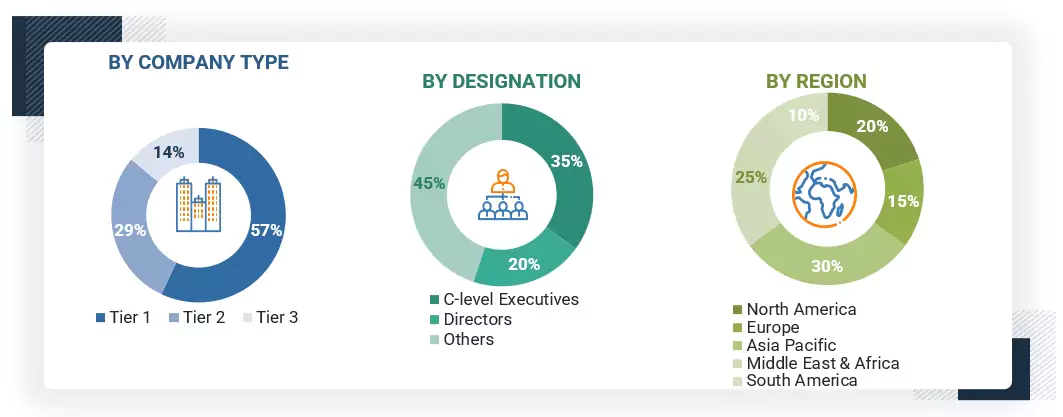
Note: The tiers of the companies are defined based on their total revenues as of 2024.
Tier 1: >USD 1 billion, Tier 2: USD 500 million to USD 1 billion, and Tier 3:
To know about the assumptions considered for the study, download the pdf brochure
Market Size Estimation
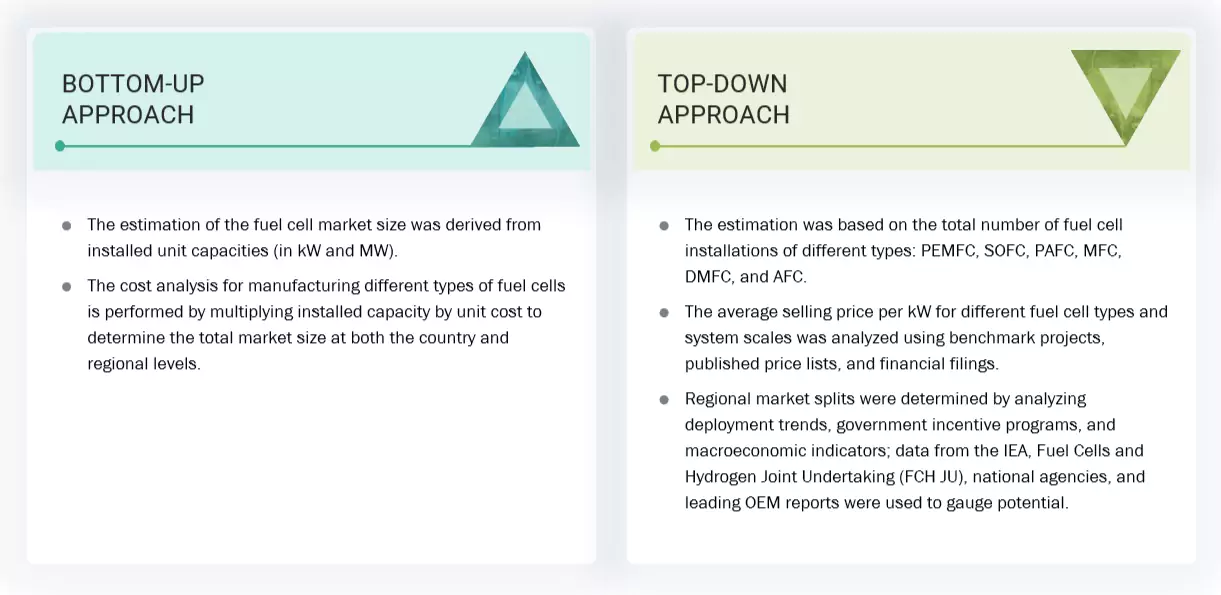
The top-down and bottom-up approaches were used to estimate and validate the total size of the fuel cell market. These methods were also used extensively to estimate the size of various subsegments in the market. The research methodology used to estimate the market size includes the following.
Fuel Cell Market : Top-Down and Bottom-Up Approach
Data Triangulation
After arriving at the overall market size from the above estimation process, the total market was split into several segments and subsegments. Data triangulation and market breakdown processes were employed to complete the overall market engineering process and arrive at the exact statistics for all the segments and subsegments, wherever applicable. The data was triangulated by studying various factors and trends from the demand and supply sides. In addition, the market size was validated using both the top-down and bottom-up approaches.
Market Definition
Fuel cells are electrochemical devices that convert different fuel types into electrical energy using chemical reactions rather than combustion. They operate in two terminals that consist of an anode and a cathode separated by an electrolyte and membrane. They are noted for their quiet operation, clean, reliable, and highly efficient power. As long as fuel is supplied, fuel cells will continuously generate electricity without occasionally recharging a battery. They are used in many applications, including propulsion or range extension in fuel cell-powdered vehicles and as primary or backup power sources for data centers and energy companies.
Stakeholders
- Ceramic and electrolyte manufacturers
- Energy & power consulting companies
- Environmental research institutes
- Fuel cell and stack manufacturers
- Government and research organizations
- Institutional investors/shareholders
- Power and energy associations
- Repair and maintenance service providers
- Fuel cell technology manufacturing companies
- Organizations, forums, alliances, and associations
- Clean energy generation research and consulting companies
- State and national regulatory authorities
Report Objectives
- To describe, segment, and forecast the fuel cell market, by type, component, fuel type, size, application, and end user, in terms of value
- To describe, segment, and forecast the fuel cell market, by type, in terms of volume
- To forecast the market across four key regions, namely, North America, Europe, Asia Pacific, and the Rest of the World (RoW), along with country-level analysis, in terms of value and volume
- To provide detailed information regarding key drivers, restraints, opportunities, and challenges influencing the growth of the fuel cell market
- To give the supply chain analysis, trends/disruptions impacting customer business, ecosystem analysis, regulatory landscape, patent analysis, case study analysis, technology analysis, key conferences & events, the impact of AI/Gen AI, macroeconomic outlook, pricing analysis, porter’s five forces analysis, regulatory analysis, and the impact of 2025 US tariff on the fuel cell market
- To analyze opportunities for stakeholders and draw a competitive landscape of the fuel cell market
- To benchmark market players using the company evaluation matrix, which analyzes market players on broad categories of business and product strategies adopted by them
- To compare key market players for the market share, product specifications, and applications
- To strategically profile key players and comprehensively analyze their market ranking and core competencies.
- To analyze competitive developments, such as contracts, agreements, partnerships, and joint ventures, in the fuel cell market
Available Customizations
MarketsandMarkets offers customizations according to the specific needs of the companies using the given market data.
The following customization options are available for the report:
Product Analysis
- Product matrix, which gives a detailed comparison of the product portfolio of each company
Geographic Analysis as per Feasibility
- Further breakdown of the fuel cell market, by country
Company Information
- Detailed analysis and profiling of additional market players (up to five)
Get the Full Fuel Cell Market Report
Full forecast, segment splits, and company analysis for all Fuel Cell Market.
Need a Tailored Report?
Customize this report to your needs
Get 10% FREE Customization
Customize This Report
